
Building a CBT for PTSD Treatment Plan for Recovery
Key Takeaways
- A working CBT plan for PTSD moves through four phases—assessment, stabilization, trauma processing, and consolidation—with each phase doing a specific job that prepares you for the next 3.
- You don’t need to be sober before trauma work begins; trauma-focused CBT is safe and effective alongside active substance use when safety rails are built in 5, 6.
- CPT, PE, and CT-PTSD are all first-line protocols with comparable outcomes, so the right choice is the one that fits how you think, what you can tolerate, and what you’ll actually finish 3, 1.
- Match level of care to current severity—residential, PHP, IOP, or outpatient—and decide in advance what would trigger stepping up or down, while avoiding benzodiazepines and cannabis that reinforce avoidance 7, 3.
What a real treatment plan looks like when PTSD and substance use travel together
If you’ve ever been told to “get sober first, then we’ll deal with the trauma,” you already know how that usually ends. The drinking or the pills or the kratom were doing a job — muting the flashbacks, shutting off the 3 a.m. replay, getting you through a grocery store run. Take the coping tool away without replacing what it was managing, and the nightmares come back louder. So does the urge to use.
A real cognitive behavioral therapy (CBT) plan for PTSD doesn’t ask you to white-knuckle one condition while the other runs the show. The current evidence is clear: trauma-focused CBT can be delivered safely and effectively alongside substance use treatment, and patients often do better on both fronts when the two are handled together rather than in sequence 5, 6. You don’t have to earn trauma therapy with a sobriety streak.
What you do need is structure. A plan worth building has four phases — assessment, stabilization, trauma processing, and consolidation — and inside those phases, specific decisions: which CBT protocol (CPT, PE, or CT-PTSD), at what level of care, with which safety rails for cravings and crises 3, 10. That’s what this guide walks you through. Not a sales pitch for therapy in general, but the actual sequencing logic, so when someone sketches a plan on a whiteboard in front of you, you can tell whether it’s built to hold.
The architecture: four phases, not one therapy
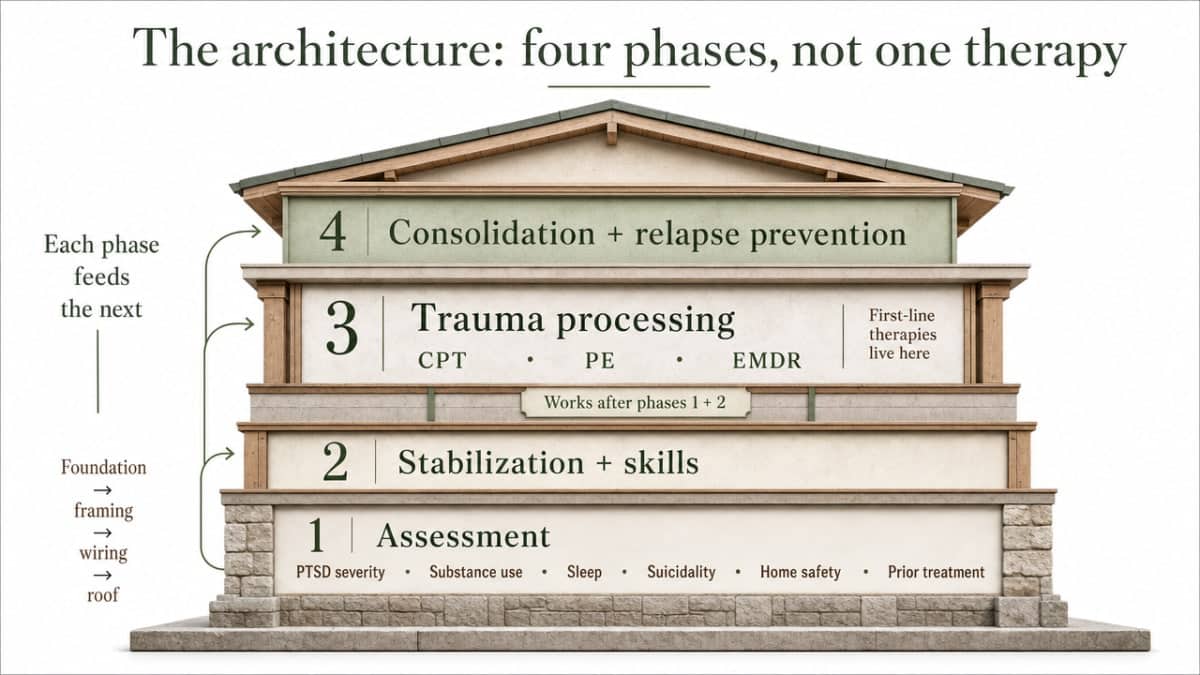
Think of a CBT plan for PTSD less like a single treatment and more like a building with four floors. You don’t skip floors. You don’t pour the roof before the foundation. And you don’t try to do the wiring while the framing is still going up.
The four phases are: assessment, stabilization and skills, trauma processing, and consolidation and relapse prevention. Each one has a job. Each one feeds the next. The trauma-focused therapies that the VA/DoD 2023 guideline names as first-line — Cognitive Processing Therapy (CPT), Prolonged Exposure (PE), and EMDR — live inside phase three, but they only work if phases one and two have actually been done 3.
Phase one is where a clinician figures out what you’re carrying: PTSD symptom severity, substance use pattern, sleep, suicidality, what’s safe at home, what’s been tried before. This is also where the dual-diagnosis picture gets named out loud instead of split into two charts.
Phase two is skills. Grounding, sleep hygiene, urge surfing, naming a craving without acting on it, basic emotion regulation. You’re not avoiding the trauma here — you’re building the handles you’ll need to hold on when phase three gets loud. For people with co-occurring substance use, this is where motivational work and CBT skills start to overlap, because the same coping muscles that interrupt a craving also interrupt a flashback spiral 9.
Phase three is the actual trauma processing — CPT, PE, or CT-PTSD — where you change your relationship to the memory rather than keep running from it 10. This is the floor most people fear. It’s also the floor where the symptoms finally start to break.
Phase four is consolidation. The gains get rehearsed, the relapse-prevention plan gets written, and the supports that will catch you on a bad week get scheduled before the bad week shows up.
What matters is that the phases aren’t strictly linear. You’ll loop back to skills mid-processing. You’ll re-assess if a new stressor lands. But the order — and the fact that there is an order — is what separates a plan from a hope.
Phase 1: Assessment that actually shapes the plan
A good assessment is not a clipboard ritual. It’s the part of the plan where someone finally looks at the whole picture of you — the trauma, the substances, the sleep, the relationships, the suicidal thoughts you may not have said out loud yet — and writes it down in one chart instead of two.
If your intake felt like a tax form, you didn’t get one. If you left feeling like the clinician actually understood why you started drinking the year your sister died, you probably did.
What a real phase one covers, at minimum:
- PTSD symptom severity and functional impact. Standardized measures like the PCL-5 give a baseline you can track against later. You want a number you can move, not just a vibe.
- Substance use pattern, not just substance use. What you use, how much, when it spikes, and what it’s doing for you. Cravings tied to trauma cues are different than cravings tied to boredom, and the plan should reflect that 9.
- Safety. Suicidality, self-harm, who you live with, whether home is a place you can actually rest. The evidence shows CBT for PTSD can be done safely even when suicidal thinking or psychosis is in the mix — but only when the clinician knows it’s there 2.
- Co-occurring conditions. Depression and anxiety are the rule, not the exception, in PTSD. So is sleep disruption. The VA/DoD guideline is built around treating these as connected, not as separate referrals 3.
- Treatment history. What you’ve tried, what helped a little, what made things worse. “I started PE and quit after session three” is critical information, not a confession.
From this, you and your clinician decide three things together: which CBT protocol fits, what level of care you start at, and what skills you’ll build first. If you leave assessment without clear answers to those three questions, the plan isn’t finished yet. Ask for the rest.
Phase 2: Stabilization without stalling — skills before the deep work
Here’s where a lot of plans go sideways. Stabilization gets stretched into months of “coping skills” group while the actual trauma — the thing you came in for — never gets touched. You start to wonder if you’re being protected or parked.
What you’re actually learning in this phase:
- Grounding that works under pressure. Not just “name five things you see.” Specific techniques you’ve practiced enough that they show up automatically when a flashback starts in the cereal aisle.
- Urge surfing and craving response. The same skill that lets you ride out a craving without using is the skill that lets you ride out a trauma memory without dissociating. Your clinician should be teaching them as one set, not two 9.
- Sleep scaffolding. If you’re sleeping three hours a night, trauma processing will not stick. Sleep work — schedule, environment, nightmare protocols — is clinical, not optional.
- Distress tolerance for the in-between. The gap between sessions is where most people use. You need a plan for Tuesday at 9 p.m. when the urge to drink and the urge to text your ex are both loud.
For dual diagnosis, phase two is also where motivational interviewing earns its keep. Ambivalence about treatment is not failure — it’s the actual terrain. A good clinician works with that ambivalence instead of around it, using MI to keep you engaged while CBT skills give you something to hold 9.
One marker you’re ready for phase three: you can name a craving or a trigger out loud without immediately needing to act on it. That’s not small. That’s the whole foundation. When you can do it consistently — not perfectly, just consistently — the deep work can begin.
Choosing your protocol: CPT, PE, and CT-PTSD compared
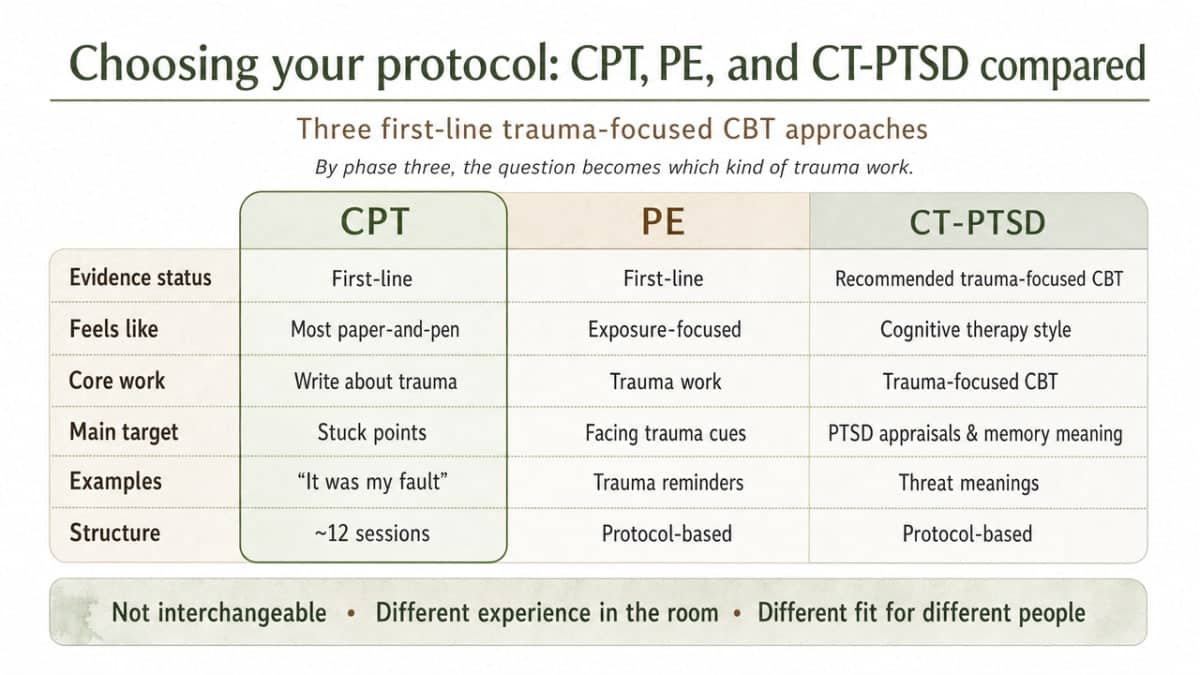
By the time you get to phase three, the question stops being whether to do trauma work and starts being which kind. Three CBT protocols carry the strongest evidence, and the VA/DoD 2023 guideline names Cognitive Processing Therapy (CPT) and Prolonged Exposure (PE) as first-line, with Ehlers-style Cognitive Therapy for PTSD (CT-PTSD) also recommended as trauma-focused CBT 3, 4. They are not interchangeable. They feel different in the room, ask different things of you, and tend to suit different people.
Cognitive Processing Therapy (CPT) is the most paper-and-pen of the three. Across roughly 12 sessions, you write about the trauma and then work, week by week, on the “stuck points” — the beliefs that keep the memory loaded. Things like it was my fault, or nowhere is safe, or I can’t trust my own judgment anymore. Your clinician hands you worksheets that pick those beliefs apart with evidence. CPT tends to suit people who live in their head, who can already articulate what they think and just need a structured way to challenge it. If the idea of reading the trauma narrative aloud over and over makes you want to walk out, CPT may feel more tolerable than PE.
Prolonged Exposure (PE) is the one most people fear by name. Across about 8 to 15 sessions, you do two things: you talk through the trauma memory in detail, repeatedly, with the recording played back between sessions, and you build a list of real-world situations you’ve been avoiding and start, gradually, going to them. The grocery store. The freeway exit. The smell of a certain cologne. PE works by teaching your nervous system, through repetition, that the memory is a memory and the parking lot is just a parking lot. It tends to suit people whose lives have shrunk around avoidance and who are ready, even reluctantly, to take territory back. The concurrent-treatment evidence is strongest for PE in dual diagnosis — it is safe and effective even when substance use is active 5.
Cognitive Therapy for PTSD (CT-PTSD), sometimes called the Ehlers and Clark approach, blends cognitive work with shorter, targeted exposure and a heavy focus on “updating” the trauma memory itself — finding what you know now that you didn’t know then, and weaving it into the recollection. A 2025 pragmatic randomized trial in routine UK mental health services found CT-PTSD produced large, durable reductions in PTSD symptoms and in comorbid depression and anxiety, with gains holding at follow-up 1. It tends to suit people who want trauma-focused work but find pure exposure too steep, and who benefit from a protocol designed to handle the messy comorbid picture most dual-diagnosis patients actually have.
Three honest things to know before you choose. First, the differences in outcome between these protocols are smaller than the differences in how they feel — pick the one you’ll actually finish. Second, dropout is the real enemy, not protocol selection; a clinician trained and supervised in the model you pick matters more than the model. Third, you get a vote. If your first session of PE feels wrong in a way you can name, say so. Switching protocols is a clinical decision, not a personal failure.
Phase 3: Trauma processing when cravings and triggers share a circuit
Here’s the part most people brace for. Phase three is where you finally turn toward the memory instead of away from it. And if you have a substance use disorder running alongside your PTSD, you’ve probably been told this is where things get dangerous — that processing trauma will spike cravings, that you’ll relapse, that you should wait. The research tells a different story. Exposure-based and other trauma-focused CBT approaches are safe and effective in people with active co-occurring substance use, and adding trauma-focused treatment to standard addiction care tends to help, not hurt, both sets of symptoms 5, 6.
The reason is mechanistic. The trigger that fires a craving and the trigger that fires a flashback often share the same circuit. A smell, a song, a tone of voice, the particular gray light of a hospital hallway — these don’t sort themselves neatly into “trauma cue” and “substance cue.” They land as one signal, and the old response was to use. CBT for PTSD works by changing your relationship to those cues and to the trauma-related beliefs that keep them loaded 10. When the cue stops carrying the same charge, the craving it used to fire loses some of its fuel too.
What phase three actually looks like, week to week:
- Sessions get longer and more focused. Whether you’re in CPT, PE, or CT-PTSD, the trauma material itself is the agenda. You’re not catching up on the week before you get to it.
- Cravings get tracked, not hidden. Your clinician should be asking about use and urges every session, without the conversation turning into a lecture. A craving spike after a hard session is data, not a failure — it tells you which cues are still hot.
- Between-session work is the real work. Listening to a recording of your imaginal exposure. Going to the avoided place. Filling out a stuck-point worksheet at the kitchen table at 10 p.m. The session opens the door; the homework walks through it.
- Safety rails stay in place. If suicidal thinking spikes, if use escalates, if you stop sleeping entirely — the plan adjusts. Trauma-focused CBT has been shown to work safely even in people with severe mental illness, psychosis, and suicidality, but only when clinicians are watching for those signals and responding 2.
Two things you should expect, because nobody warns people enough. Symptoms often get a little louder before they get quieter — that’s the memory becoming workable, not the treatment failing. And you will want to quit at least once. The session you most want to skip is usually the one right before things shift. If you can tell your clinician “I want to stop” instead of just not showing up, you’ve already done something different than every other time. That, more than any worksheet, is what carries you through.
Matching intensity to severity: residential, PHP, IOP, outpatient
Not every CBT plan for PTSD needs to happen in the same setting. The protocol — CPT, PE, or CT-PTSD — is the engine. The level of care is the chassis it rides in. And the right chassis depends on how loud your symptoms are right now, how much your substance use is interfering, and how safe your daily life feels between sessions.
Four levels are worth knowing by name.
- Residential treatment is 24/7 care in a facility. You live there. It’s the right starting point when use is heavy enough to need medical detox, when sleep is essentially gone, when home isn’t safe, or when you’ve tried outpatient and couldn’t get traction. Trauma work in residential settings tends to start gently — heavy on stabilization and skills — and shift toward processing once you’ve stopped white-knuckling each day.
- Partial hospitalization (PHP) usually runs five days a week, several hours a day, with you sleeping at home or in sober living. It fits when you need more structure than a weekly appointment but don’t need someone watching overnight. Most dual-diagnosis PHPs braid trauma-focused CBT into a fuller day that also addresses substance use, sleep, and emotion regulation.
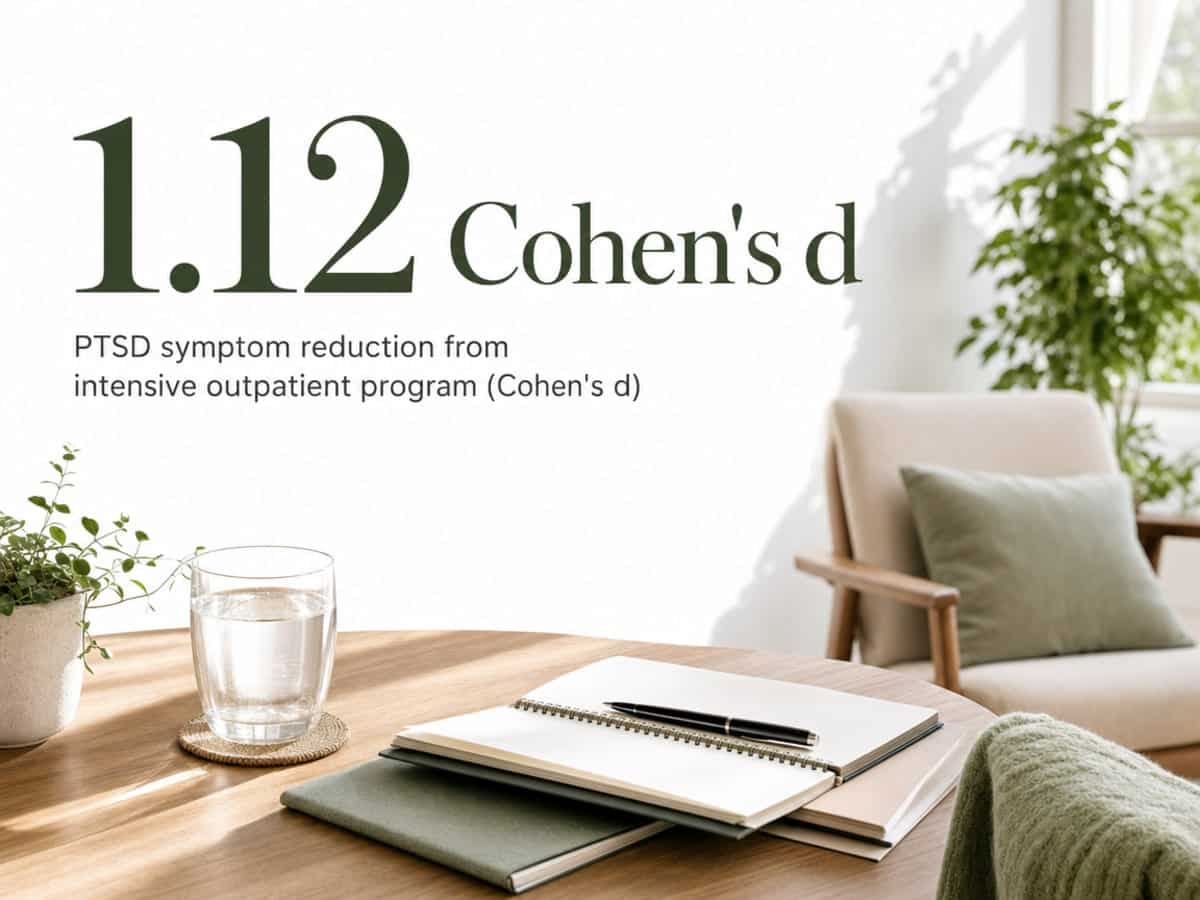
- Intensive outpatient (IOP) is typically three days a week, three hours per session. The intensity is real — and so is the evidence. A 2024 systematic evaluation of an intensive outpatient program that combined PE, EMDR, physical exercise, and psychoeducation across six treatment days over two weeks produced a Cohen’s d of 1.12 for PTSD symptom reduction, with gains maintained at six-month follow-up 7. For reference, a Cohen’s d of 0.8 is considered a large effect in clinical research. 1.12 is well past that mark — from a brief, intensive format, holding six months out.
- Standard outpatient is one session a week, sometimes two. It’s the right level when you’re functional in daily life, when use is contained or absent, and when you can do the between-session homework without it swallowing you.
A few honest things about matching. The right level is rarely where you start and stay. Most people step down — residential to PHP to IOP to weekly — as symptoms loosen their grip. Some people need to step back up for a stretch, and that is not relapse. It’s responsiveness. The plan should name, in writing, what would trigger a level-of-care change: a return to daily use, a week without sleep, a suicidal crisis, a missed safety check. Decisions made in advance are easier to keep than ones made in the middle of a hard week.
Phase 4: Consolidation, relapse prevention, and what ‘better’ looks like
Phase four is the part of the plan people underestimate. The flashbacks have quieted. The grocery store is just a grocery store. You’ve gone two weeks without that 3 a.m. spiral. The temptation is to declare yourself finished and step away from treatment entirely. That’s also the moment most plans quietly come apart.
Consolidation is where the gains get cemented and the next twelve months get planned for. Practically, that means a written relapse-prevention map that names your specific high-risk situations — anniversaries, the season your trauma happened, a particular relationship, a particular drink — and pairs each one with a concrete response you’ve already rehearsed. Not a vague “call my sponsor.” An actual sequence: which person, which skill, which appointment, in which order.
It also means deciding what your maintenance dose of treatment looks like. Maybe that’s monthly check-ins for six months, then quarterly. Maybe it’s staying in a weekly group while individual therapy tapers. The point is that the step-down is planned, not improvised in a moment when you’re already wobbling.
And it means redefining “better.” Better is rarely the absence of all symptoms. Better is sleeping through most nights. Naming a craving and letting it pass. Sitting through a fireworks show. Telling someone what happened without coming apart. Trauma-focused CBT changes your relationship to the memory and the beliefs that kept it loaded — it doesn’t erase the memory 10. The 2025 pragmatic trial of CT-PTSD in routine care found gains generally held at follow-up, which is the realistic frame: durable improvement, not perfection 1. You’re not aiming to be the person you were before. You’re building someone steadier than that.
Medications, cannabis, and what the guidelines tell you to avoid
Medication can sit alongside a CBT plan for PTSD, but it isn’t the main engine. The 2023 VA/DoD guideline puts trauma-focused psychotherapies — CPT, PE, and EMDR — ahead of pharmacotherapy when both are available, and reserves medications like sertraline, paroxetine, or venlafaxine as reasonable options when therapy isn’t accessible or you want a combined approach 3, 4.
Two things the guidelines tell you, plainly, to avoid.
Benzodiazepines. Xanax, Ativan, Klonopin, Valium. They feel like they help — the panic drops fast — but the evidence says they make PTSD outcomes worse over time, interfere with the extinction learning that trauma-focused CBT depends on, and carry serious dependence risk for anyone with a substance use history 3, 4. If you’re being prescribed one long-term for PTSD, that’s a conversation worth having.
Cannabis. The same guideline advises against cannabis for PTSD, including medical cannabis marketed for it 3, 4. It can blunt symptoms in the short term and reinforce avoidance in the long term — the exact pattern CBT is built to interrupt.
Speak With a Specialist About Your CBT Plan
Get immediate guidance on building your personalized CBT plan for PTSD recovery.
Start Building Your Personalized PTSD Recovery Plan
Connect with a team ready to support your dual diagnosis recovery and next steps.
Frequently Asked Questions
Do I have to be sober before starting CBT for PTSD?
No. The older “sobriety first” model isn’t supported by current evidence. Trauma-focused CBT, including exposure-based approaches, is safe and effective in people with active co-occurring substance use, and adding trauma work to standard addiction treatment tends to help both sets of symptoms rather than hurt either one 5, 6. What matters is having safety rails in place — not a sobriety streak before you’re allowed to start.
What is the difference between CPT, PE, and CT-PTSD?
Cognitive Processing Therapy (CPT) is structured writing and worksheet work that targets the trauma-related beliefs keeping the memory loaded. Prolonged Exposure (PE) has you retell the memory in detail and gradually return to avoided places. Cognitive Therapy for PTSD (CT-PTSD) blends cognitive work with shorter exposure and focuses on “updating” the memory with what you know now 3, 4. All three are first-line. The best one is the one you’ll actually finish.
How long does a CBT for PTSD treatment plan usually take?
The trauma-processing protocols themselves typically run 8 to 16 sessions, though the full plan — assessment, stabilization, processing, and consolidation — usually spans three to six months. Intensive formats can compress the processing phase into about two weeks 7. Dual diagnosis often extends the timeline because skills and stabilization work needs more room. Durable gains, not speed, are what the evidence supports as the real measure 1.
Can trauma processing make my PTSD or cravings worse?
Symptoms often get a little louder for a stretch before they get quieter — that’s the memory becoming workable, not the treatment failing. Cravings can spike around hard sessions because trauma cues and substance cues often share the same circuit. The research is clear that trauma-focused CBT is safe and effective even alongside active substance use and in people with severe symptoms, including suicidality, when clinicians are watching for those signals 2, 5.
How do I know if I need residential, PHP, IOP, or outpatient care?
Match intensity to what’s loud right now. Residential fits when use needs medical detox, when sleep is gone, or when home isn’t safe. PHP suits people needing daily structure without overnight care. IOP works when you’re stable enough to live at home but need more than weekly sessions — and the evidence for intensive formats combining PE and EMDR is strong 7. Standard outpatient fits when daily life is functional and homework is doable.
What medications should I avoid during CBT for PTSD?
The 2023 VA/DoD guideline advises against benzodiazepines (Xanax, Ativan, Klonopin, Valium) and against cannabis, including medical cannabis marketed for PTSD 3, 4. Both can blunt the cue in the short term and reinforce avoidance long-term, which is the exact pattern CBT is built to interrupt. Benzodiazepines also interfere with the extinction learning trauma-focused therapy depends on. Bring your full medication list to assessment so the plan accounts for what’s actually in your system.
References
- A pragmatic randomized controlled trial of cognitive therapy for post-traumatic stress disorder in routine clinical care. https://pmc.ncbi.nlm.nih.gov/articles/PMC12434375/
- A Randomized Controlled Trial of Cognitive-Behavioral Treatment of Posttraumatic Stress Disorder in Severe Mental Illness. https://pmc.ncbi.nlm.nih.gov/articles/PMC3916092/
- VA/DoD 2023 Clinical Practice Guideline for the Management of Posttraumatic Stress Disorder and Acute Stress Disorder. https://www.ptsd.va.gov/professional/treat/txessentials/cpg_ptsd_management.asp
- A Clinician’s Guide to the 2023 VA/DoD Clinical Practice Guideline for Management of PTSD and Acute Stress Disorder. https://www.ptsd.va.gov/professional/articles/article-pdf/id1629192.pdf
- Concurrent Treatment of Substance Use Disorders and Posttraumatic Stress Disorder. https://pmc.ncbi.nlm.nih.gov/articles/PMC4928573/
- Trauma-focused treatment for posttraumatic stress disorder in patients with co-occurring substance use disorders. https://pmc.ncbi.nlm.nih.gov/articles/PMC3698199/
- The effects of an intensive outpatient treatment for PTSD: A systematic evaluation. https://pmc.ncbi.nlm.nih.gov/articles/PMC11057464/
- A Pilot Study of Trauma-Focused Cognitive-Behavioral Therapy for Treatment of Post-Traumatic Stress Disorder. https://clinicaltrials.gov/study/NCT06516874
- Substance Use and Co-Occurring Disorders: MI + CBT for Counselors. https://www.indwes.edu/articles/2026/03/substance-use-co-occurring-disorders-mi-cbt-counselors
- Overview of Cognitive Behavioral Therapy for PTSD (Treatment Essentials). https://www.ptsd.va.gov/professional/treat/txessentials/cbt_treatment_research.asp