
Why It Happens: The Real Causes of Substance Abuse
Key Takeaways

- Substance use disorder rarely traces to one cause—genetics, trauma, mental health, developmental timing, and environment stack together until a substance becomes hard to stop.
- About half of addiction risk is heritable, and much of that vulnerability is shared across substances rather than tied to any single drug 1, 6.
- Trauma keeps the nervous system on alert and disrupts emotion regulation, which is why substances that quiet distress become so difficult to release 3, 8.
- Integrated, trauma-focused care that treats substance use and trauma together—without requiring sobriety first—shows better retention and symptom reduction than sequential approaches 9, 11.
Understanding the Complex Nature of Addiction
If you’ve ever asked yourself why you reach for a substance despite your intentions, you’re asking a crucial question. The answer is not simple. Science indicates that no single factor causes someone to develop a substance use problem. It’s not solely about genetics, childhood experiences, trauma, stress, loss, or a prescription that escalated. Instead, it’s about how these elements interact and combine.
Traditional views often frame addiction as a moral failing, a sign of weak will, or a clear-cut disease. These perspectives oversimplify a complex issue and can leave individuals feeling helpless. A more accurate understanding recognizes that biological vulnerabilities, experiences like trauma and chronic stress, mental health symptoms, and specific life timing can accumulate. When enough of these factors align, a substance that initially provides temporary relief can become something you can’t stop using.
This perspective is not an excuse but a framework for understanding. It shifts the focus from self-blame to recognizing the intricate challenges you’ve faced.
The Biological Foundation of Vulnerability
Genetic Predisposition: The Role of Heritability
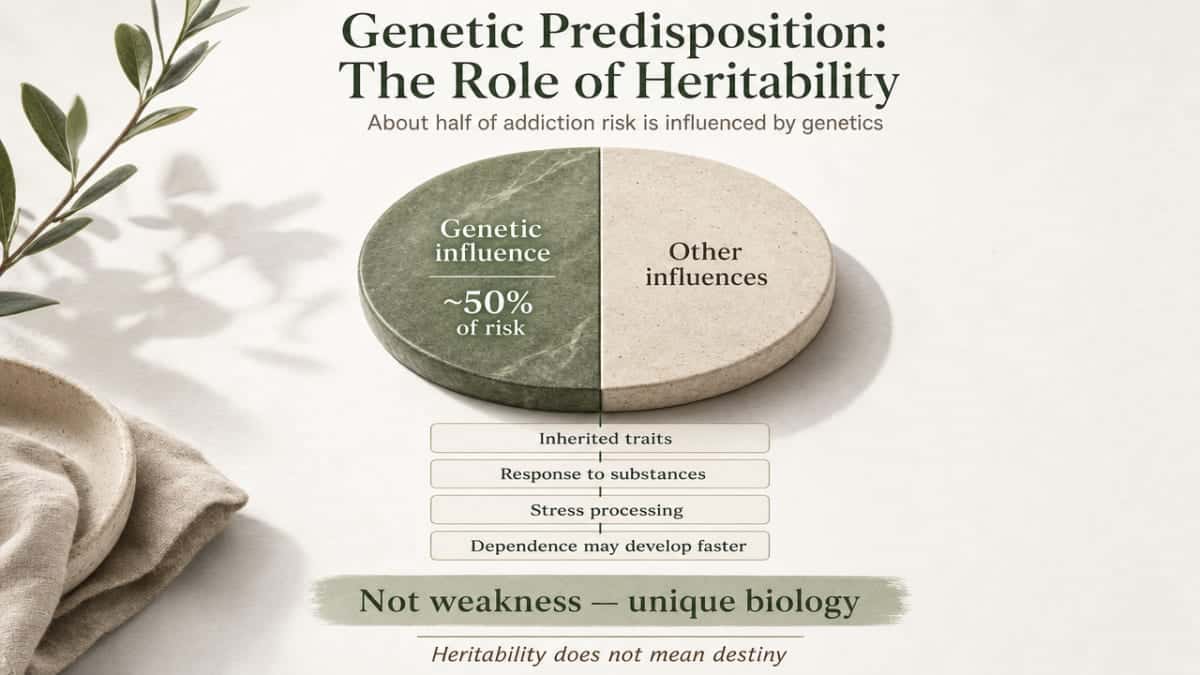
If addiction is present in your family history, you might worry about your own risk. This concern is valid, and understanding the science behind it is important. Research shows that approximately half of a person’s risk for addiction is influenced by their genetic makeup 1. This figure, derived from decades of studies on various substance use disorders, highlights the significant impact of inherited traits.
This genetic component can explain why some individuals experience substances differently, feeling an immediate and profound effect that others do not. It suggests that your biological wiring can shape how your brain and body react to substances, how your nervous system processes stress, and how quickly dependence can develop. This is not a sign of weakness but a reflection of your unique biology.
However, this 50% heritability does not mean your future is predetermined. It’s a population-level statistic, indicating how much variation in risk across a group is linked to genetic differences. The other half of the risk is influenced by environmental factors, personal experiences, timing, and individual choices. This understanding is crucial for trauma-informed care, which focuses on addressing these modifiable factors.
Shared Vulnerability Across Different Substances
Recent genetic research has revealed that much of the inherited risk for addiction is not specific to a single substance but represents a more general vulnerability. This means that a predisposition can manifest with various substances, depending on what is available.
A large genomic study involving over a million individuals identified 19 distinct genetic markers associated with a shared addiction risk that spans alcohol, tobacco, opioids, and cannabis 6. This finding aligns with observations where individuals might switch from one substance to another, such as stopping alcohol but increasing tobacco use. The underlying drive for relief remains, even if the substance changes.
For trauma survivors, this insight is particularly relevant. If you’ve found yourself substituting one coping mechanism for another, it’s often the same underlying nervous system seeking relief through a different avenue. Treatment that only targets the substance without addressing the deeper emotional and physiological needs may overlook this crucial aspect. The substance is merely a symptom; the underlying wiring and emotional wounds are the core issues.
The Impact of Trauma on the Nervous System
How Early Stress Influences the Search for Relief
Growing up in an unpredictable or unsafe environment can program the nervous system to perceive the world as inherently dangerous. This constant state of vigilance, developed in response to chronic early stress, does not simply disappear in adulthood. Experiences such as abuse, violence, neglect, or significant loss increase vulnerability to substance use disorder 3. This is not due to a lack of resilience but because these experiences alter the body’s systems for managing threat and self-soothing, keeping them on high alert.
Internally, this can manifest as a persistent sense of unease, difficulty sleeping without aid, an exaggerated startle response, and chronic exhaustion. When a substance like alcohol, opioids, or cannabis is introduced, it can temporarily quiet this internal alarm, providing a much-needed respite. This immediate relief can make the substance incredibly difficult to relinquish, especially when the underlying alarm system remains active. Recognizing this dynamic is a critical step toward understanding and addressing the root causes of substance use.
Emotion Regulation: A Key Link Between PTSD and Substance Use
A significant, yet often overlooked, aspect of the trauma-substance use connection is emotion regulation. This refers to the capacity to manage intense emotions without being overwhelmed. For individuals with PTSD or unresolved trauma, this ability is frequently compromised.
A 2026 systematic review exploring the relationship between PTSD and substance use highlighted that difficulties in regulating both negative and positive emotions play a role 8. It’s intuitive that substances might be used to dampen overwhelming negative feelings like grief, fear, or shame. However, the review also noted that positive emotions can be challenging for trauma survivors. If one has been constantly on guard, feelings of joy or calm can feel unfamiliar or even threatening. Substances that flatten emotional extremes, both highs and lows, can become appealing. While the evidence base is still developing, the consistent reports from trauma survivors underscore that when emotions are overwhelming, anything that provides a sense of control or dampens their intensity becomes difficult to abandon.
Therefore, developing emotion regulation skills, rather than merely abstaining from substances, is a fundamental component of effective recovery.
Poly-victimization and the Bidirectional Cycle in Youth
The impact of trauma is compounded when individuals experience multiple forms of harm, a phenomenon known as poly-victimization. This refers to a pattern of various traumatic events, such as abuse combined with a parent’s overdose, or neglect alongside bullying. A recent review on co-occurring trauma- and stressor-related disorders and substance use in young people found that youth who have experienced multiple traumas face the highest risk for developing both conditions 7.
This relationship is bidirectional: trauma increases the likelihood of substance use, and substance use, in turn, can increase vulnerability to further trauma by placing individuals in risky situations or lowering their defenses. This creates a feedback loop that can accelerate during adolescence and young adulthood. For parents of struggling teenagers or young adults reflecting on their own past, this cycle explains how complex their situation can become. Addressing this loop requires treating the underlying trauma concurrently with substance use, rather than sequentially.
The Progression from Substance Use to Addiction
Distinguishing Initial Use from Persistent Dependence
It’s important to differentiate between why someone begins using substances and why some individuals become unable to stop. These are often distinct questions with different answers. People initiate substance use for a multitude of reasons: curiosity, social influence, medical prescriptions, or as a way to cope with stress or undiagnosed mental health conditions 2. The majority of individuals who try a substance do not develop a substance use disorder, even with highly addictive substances.
The transition from occasional use to persistent dependence is complex and multifactorial 2. For those with trauma histories, specific factors increase this risk: a nervous system already in a state of heightened arousal, untreated PTSD or depression that substances temporarily alleviate, a genetic predisposition, and early initiation of use when the brain is still developing. If you’ve struggled to stop while others seem to manage, it’s crucial to understand that the reasons for starting are not the same as the reasons for getting stuck. The initial use might be driven by external factors or pain, while continued use becomes entrenched due to how that pain interacts with an individual’s biological and psychological makeup.
Developmental Timing: The Impact of Early Substance Use
The age at which substance use begins significantly influences the risk of developing addiction. The brain continues to develop until the mid-twenties, with the prefrontal cortex—responsible for judgment, impulse control, and planning—being one of the last areas to mature. When substances are introduced during adolescence, they can disrupt this developmental process, affecting brain structure, function, and executive cognitive abilities for years 13.
Early initiation increases the risk of later addiction because the developing brain learns that substances offer a quick path to feeling better. This lesson becomes deeply ingrained during a period of high brain plasticity. When a trauma history is also present—such as abuse, neglect, or chronic stress—the impact of early substance use is even more pronounced. Many trauma-exposed young people begin using substances earlier precisely because their pain started earlier, and substances offered a perceived solution before other coping mechanisms could be developed.
If this describes your experience, it’s important to recognize that these circumstances were beyond your control as a child. Understanding the long-term effects of early substance use highlights why adult recovery often requires more than just stopping the substance; it involves developing the emotional regulation skills that were not fostered during those formative years.
The Interplay of Risk Factors Leading to Substance Use Disorder
Substance use disorder arises from the convergence of multiple risk factors rather than a single cause. These factors, including genetics, adverse childhood experiences, developmental stage, mental health conditions, and environmental influences, each contribute to an increased likelihood of developing the disorder 12. When several of these elements are present in an individual’s life, the risk escalates significantly.
Consider a scenario where an individual has a family history of addiction, experienced a challenging childhood, developed undiagnosed depression in adolescence, and began using substances at a young age to cope. Subsequent life stressors, such as divorce or loss, can further entrench substance use. This accumulation of factors creates a “pileup” rather than a single, identifiable cause.
Effective Treatment Approaches for Trauma-Informed Substance Use
Integrated, Trauma-Focused Care: Sobriety Not a Prerequisite
A common misconception in addiction treatment is the requirement for abstinence before addressing underlying trauma. However, current scientific understanding challenges this approach. A review on co-occurring PTSD and substance use disorder clearly states that individuals do not need to be abstinent to begin or benefit from evidence-based PTSD treatment 9. For trauma survivors, demanding sobriety first can be counterproductive, as trauma often fuels substance use. Removing the coping mechanism without addressing its root cause can leave the nervous system seeking alternative forms of relief.
Integrated, trauma-focused care simultaneously addresses both substance use and trauma. This involves therapies specifically designed for trauma, such as EMDR or trauma-focused cognitive behavioral therapy, alongside substance use treatment. Reviews of trauma-informed care in substance use settings have shown that these integrated practices lead to reduced substance use, fewer trauma symptoms, and improved treatment retention 11. High retention rates are critical for successful recovery. If previous treatments were unsuccessful, it might be due to a model that failed to address the interconnectedness of trauma and substance use.
Insights from Prevention Research on Trauma-Informed Programs
While the benefits of trauma-informed care are increasingly recognized, it’s important to understand the nuances of the research. A 2025 systematic review of trauma-informed prevention programs for young people found that while 18 studies reported significant decreases in mental health issues like depression, anxiety, and PTSD symptoms, only 2 showed significant reductions in substance use outcomes 10.
This gap suggests that trauma-informed interventions may have a more direct and immediate impact on mental health, which then indirectly influences substance use. When emotion regulation improves, PTSD symptoms lessen, and depression lifts, the drive to use substances often diminishes. The research, though still evolving and with some methodological limitations, supports the idea that addressing mental health is a vital step in reducing substance use. It indicates that while trauma-informed care may not directly eliminate substance use in all prevention contexts, it creates the necessary foundation for recovery by improving underlying mental health and coping mechanisms.
Moving Forward with Understanding
Understanding the complex interplay of genetics, trauma, mental health, and developmental factors can profoundly change how you view your own journey with substance use. Recognizing that your nervous system may have been constantly on alert, or that a substance provided relief when nothing else did, shifts the narrative from shame to accurate self-awareness.
Research consistently points to the effectiveness of integrated care for individuals with trauma exposure. This approach moves beyond mere willpower, offering treatment that addresses substance use, underlying trauma, and co-occurring mental health symptoms simultaneously. Integrated dual-diagnosis treatment is specifically designed for this complex interaction, and it’s important to remember that you do not need to be perfectly sober to begin this process 9.
If previous attempts at recovery were unsuccessful, it’s likely not due to a lack of desire on your part. Instead, it may be that those approaches failed to address the fundamental reasons why the substance was serving a purpose in your life. Effective, comprehensive care is available to help you navigate these layers.
Ready to Talk About What’s Really Behind It?
Connect with someone who understands the deeper reasons for substance use and can help you take your next step.
Ready to Address the Roots of Substance Use?
Connect with someone who understands trauma-informed addiction care and discuss your next steps in confidence.

Frequently Asked Questions
Is addiction a choice or a disease?
Neither label fully captures the complexity of addiction. It develops through an interaction of biological, environmental, and developmental factors, meaning no single element is solely responsible 2. While initial substance use might involve a choice, the subsequent brain changes, especially in individuals with trauma or genetic vulnerabilities, are not simply a matter of willpower. Labeling it a disease acknowledges the biological components, but focusing solely on choice overlooks the majority of contributing factors.
If addiction runs in my family, am I destined to develop it?
No, a family history of addiction indicates an increased inherited risk, but it is not a predetermined outcome. Heritability describes how genetic differences influence risk across a population, not an individual’s destiny 5. Many individuals from high-risk families never develop a substance use disorder, and many who do find successful paths to recovery. Knowing your family history serves as valuable information, prompting earlier awareness and proactive measures, rather than a definitive prediction.
Can unresolved trauma truly cause substance abuse, or is that an excuse?
Unresolved trauma is a significant risk factor for substance use disorder and is not an excuse. Experiences such as abuse, violence, neglect, or the loss of a primary caregiver genuinely increase vulnerability to substance use 3. A nervous system conditioned by trauma to be constantly on guard does not spontaneously return to a state of calm. Understanding this direct link is essential for developing effective, targeted treatment. Recognizing the cause is not about excusing behavior but about opening the door to meaningful change.
Do I need to be sober before starting trauma therapy?
No, it is not necessary to be sober before beginning trauma therapy. Current scientific consensus, as highlighted in reviews on co-occurring PTSD and substance use disorder, indicates that individuals can start and benefit from evidence-based PTSD treatment without being abstinent 9. Integrated, trauma-focused care is designed to meet you where you are, rather than imposing a prerequisite that can be a barrier to treatment.
Why did my substance use worsen over time, even though it started as a coping mechanism?
Substance use often escalates because the initial coping mechanism becomes less effective over time. While substances may initially quiet distress, the underlying issues—such as trauma, emotion regulation deficits, or other mental health symptoms—remain unaddressed 8. As tolerance develops and dependence sets in, the relief provided by the substance diminishes, while the negative consequences increase. This progression reflects the substance’s inability to sustain the burden of unresolved issues, rather than a personal failing.
What kind of treatment addresses the root causes, not just the substance use?
Integrated dual-diagnosis care is designed to treat both substance use and co-occurring mental health conditions or underlying trauma simultaneously. Implementation reviews of trauma-informed care in substance use settings demonstrate that these practices lead to reduced substance use, decreased trauma symptoms, and improved treatment retention 11. Look for programs that offer therapies like EMDR or trauma-focused cognitive behavioral therapy alongside substance use treatment, emphasizing a holistic approach rather than a sequential one.
References
- Understanding Drug Use and Addiction DrugFacts. https://nida.nih.gov/publications/drugfacts/understanding-drug-use-addiction
- Drug Misuse and Addiction | National Institute on Drug Abuse (NIDA). https://nida.nih.gov/publications/drugs-brains-behavior-science-addiction/drug-misuse-addiction
- Trauma and Stress | National Institute on Drug Abuse (NIDA). https://nida.nih.gov/research-topics/trauma-and-stress
- Health Topics: Genetics and Alcohol Use Disorder. https://www.niaaa.nih.gov/alcohols-effects-health/alcohol-topics/health-topics-genetics-alcohol-use-disorder
- Genetics of substance use disorders: a review – PMC. https://pmc.ncbi.nlm.nih.gov/articles/PMC8477224/
- New NIH study reveals shared genetic markers underlying substance use disorders. https://nida.nih.gov/news-events/news-releases/2023/03/new-nih-study-reveals-shared-genetic-markers-underlying-substance-use-disorders
- Co-occurring trauma- and stressor-related and substance …. https://pubmed.ncbi.nlm.nih.gov/39606025/
- Emotion Regulation in the Association Between Posttraumatic …. https://pubmed.ncbi.nlm.nih.gov/41312874/
- Treatment of comorbid posttraumatic stress disorder and substance …. https://pubmed.ncbi.nlm.nih.gov/38857125/
- Effectiveness, efficacy, acceptability, and feasibility of trauma …. https://pubmed.ncbi.nlm.nih.gov/39501606/
- A Systematic Review of Trauma Informed Care in Substance Use …. https://pubmed.ncbi.nlm.nih.gov/39641885/
- Substance use disorders: a comprehensive update of classification …. https://pmc.ncbi.nlm.nih.gov/articles/PMC10168177/
- Adolescent Brain Development, Substance Use, and … – PMC. https://pmc.ncbi.nlm.nih.gov/articles/PMC3700608/