
Wellbutrin Abuse: Signs, Dangers, and Getting Help
Key Takeaways
- Bupropion isn’t a controlled substance, but its dopamine activity creates a modest reward signal some people chase through higher doses, crushing, or snorting — particularly adolescents and young adults 1.
- Seizure risk jumps almost tenfold between 450 mg and 600 mg per day, and roughly 30% of bupropion overdoses result in seizures, making dose creep genuinely dangerous 3, 6.
- Extended-release formulations can trigger seizures up to 24 hours after ingestion, so someone who ‘looks fine’ after a suspected overdose still needs poison control or emergency evaluation 4.
- Misuse often grows out of undertreated depression, so the next step is an honest conversation with the prescriber — not stopping the medication abruptly or switching it without integrated dual-diagnosis assessment 9.
What misuse of bupropion actually looks like
If you’re here, you probably already have a hunch. Maybe you’ve been taking an extra tablet on hard days. Maybe you’ve watched someone crush their pills, or noticed the bottle empties faster than the refill date suggests. Either way, you deserve a straight answer about what misuse of this medication actually looks like — not a scare piece, not a shrug.
Bupropion is not a classic drug of abuse. It’s not a controlled substance, and most people who take it as prescribed do fine. But it does have a real misuse profile, and clinicians have been paying closer attention to it. A 2023 systematic review of how this misuse shows up in real patients concluded that bupropion has genuine misuse potential in certain populations and that screening for it tends to be thin in everyday practice 2.
In plain terms, misuse usually looks like one of a few things:
- Taking more than the prescribed dose to chase a lift in mood or energy
- Crushing and snorting tablets
- Combining bupropion with stimulants, alcohol, or other substances to amplify an effect
US poison-center data shows these cases skew younger — adolescents and young adults make up most of them — and the most common medical consequences are a racing heart and seizures 1.
That’s the honest shape of it. Real, identifiable, and worth taking seriously — without pretending it’s something it isn’t.
Why a non-controlled antidepressant gets misused at all
Here’s the part that confuses most people: bupropion isn’t a controlled substance. It’s not in the same legal category as Adderall, Xanax, or oxycodone. So why does it show up in misuse case reports at all?
The answer sits in how the drug works. Bupropion blocks the reuptake of two brain chemicals — norepinephrine and dopamine. Dopamine is the one that matters here. Most antidepressants, like SSRIs, mostly leave dopamine alone. Bupropion doesn’t. That mild dopamine effect is part of why it can lift energy, sharpen focus, and help some people stop smoking. It’s also why, at very high doses or when crushed and snorted, some people report a stimulant-like effect.
You may have seen Wellbutrin compared to cocaine in headlines. That comparison comes from a specific place in the literature. A 2023 systematic review of bupropion misuse in American prisons synthesized case reports describing intranasal use, and the most commonly reported motivation was a “cocaine-like high” 7. That finding is real, but it’s narrow. It describes a specific population using a specific route — not what happens when someone takes their prescribed dose with breakfast.
The honest picture is this: bupropion has a modest reward signal that most people simply don’t notice at therapeutic doses. Push the dose higher, or change the route, and that signal becomes something a small number of people chase. It’s a quieter risk than a controlled stimulant, but it’s a real one, and clinicians have only recently started screening for it consistently 2.
The dose-seizure relationship: the single most important number to know
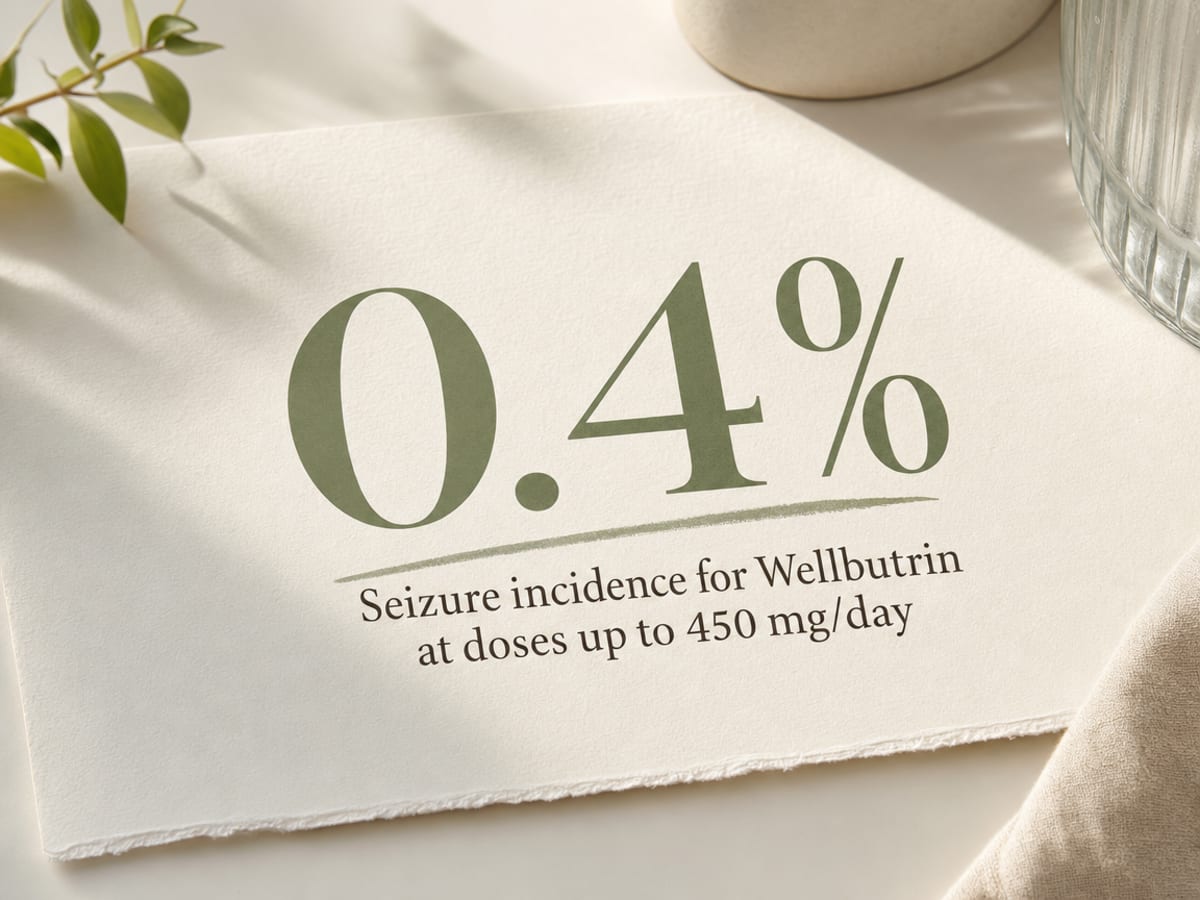
If you remember one number from this entire article, make it this one: 0.4%.
That’s the seizure rate the FDA prescribing information lists for people taking Wellbutrin at therapeutic doses, meaning up to 450 mg per day 3. Four people out of every thousand. Low, but not zero. And the same label tells you what happens when you push past that ceiling: seizure risk increases almost tenfold between 450 mg/day and 600 mg/day 3.
Read that again. Not double. Not triple. Roughly ten times higher, with one extra tablet’s worth of dose creep.
This is the data point that makes Wellbutrin different from the kind of medication you can quietly fudge. With some drugs, taking a little extra is uncomfortable but not catastrophic. With bupropion, the curve doesn’t rise gently — it jumps. The medication lowers your seizure threshold even at prescribed doses, and the higher you go, the closer that threshold gets to where your brain actually is on a given day 5.
What pushes a person over that line is rarely dramatic. It’s an extra 150 mg tablet on a stressful afternoon. It’s doubling up after a missed dose. It’s crushing an extended-release pill to feel it faster, which delivers the whole day’s dose in minutes. It’s drinking on top of it, or stacking it with a stimulant, both of which lower the seizure threshold further.
If you’re already taking more than your prescription, you’re not necessarily in immediate danger. But you are standing in the part of the curve where the math turns against you fast. That’s worth a phone call to your prescriber today, not next week. You don’t have to disclose everything in one conversation. You just have to start one.
Signs you (or someone you love) have crossed from use into misuse
Behavioral and physical signs in the person taking it
The line between a side effect and a sign of misuse isn’t always obvious, especially in the first weeks of treatment. Bupropion is known for making people feel a little wired at first — jittery hands, trouble sleeping, a dry mouth, a faster heartbeat. Those things often settle within a couple of weeks. They are not, on their own, evidence that anything is wrong.
What’s worth paying attention to is what changes after the startup window, and what you find yourself doing around the medication itself.
On the physical side, misuse tends to show up as a heart rate that feels persistently fast or pounding, not just on a stressful afternoon. Tachycardia is one of the most common findings in poison-center cases coded as bupropion abuse, alongside seizures, with most cases clustered in adolescents and young adults 1. Other physical signs include:
- Tremor that’s getting worse instead of better
- Sweating without a clear reason
- Appetite that’s dropped off a cliff
- A kind of buzzing restlessness that doesn’t let you sit down
The behavioral signs are quieter and often harder to admit:
- Running out of a refill four or five days early
- Counting tablets
- Crushing pills, or thinking about it
- Taking an extra dose on days you feel low
- Hiding the bottle
- Drinking on top of it because the effect feels stronger that way
- Feeling sharp irritation when a dose is delayed
None of these mean you’re a bad person. They mean the medication is doing something for you that the prescription alone isn’t covering, and that pattern deserves a conversation with your prescriber 2.
What a worried partner, parent, or friend tends to notice first
If you’re reading this section, the audience shifts. You’re not the one taking the medication. You’re the person watching, and you’ve probably been watching for a while.
The signs you notice are usually different from the signs the person taking it feels. They feel the heartbeat; you see the restlessness. They feel the low mood between doses; you see the snap of irritation when the bottle isn’t where they left it. What loved ones tend to flag first, in case after case reviewed in the clinical literature, falls into a few buckets 2.
There’s the rhythm of refills. Prescriptions running out earlier than the calendar allows. A new pharmacy showing up on a receipt. A second prescriber. Then there’s the change around the medication itself — taking pills in private when it used to be casual, defensiveness if you ask how the dose is going, a bottle that’s been moved or hidden.
Physical changes register too. A racing pulse you can feel through a hug. Weight that’s dropping fast. Sleep that’s collapsed into a few hours a night. Irritability or agitation that doesn’t match the situation. In some case reports, hallucinations or unusual confusion have been documented at higher exposures 8.
You don’t need a confession to raise it. “I’ve noticed you seem really wound up lately, and I want to understand what’s going on” is enough of an opening. You’re not accusing. You’re showing up.
What an overdose looks like — and why extended-release matters
An overdose on bupropion rarely looks like a movie scene. There’s no dramatic slump, no immediate collapse. That’s part of what makes it dangerous. Someone can take a serious amount, feel keyed up but not catastrophically wrong, and assume they got away with it. Then, hours later, the floor gives out.
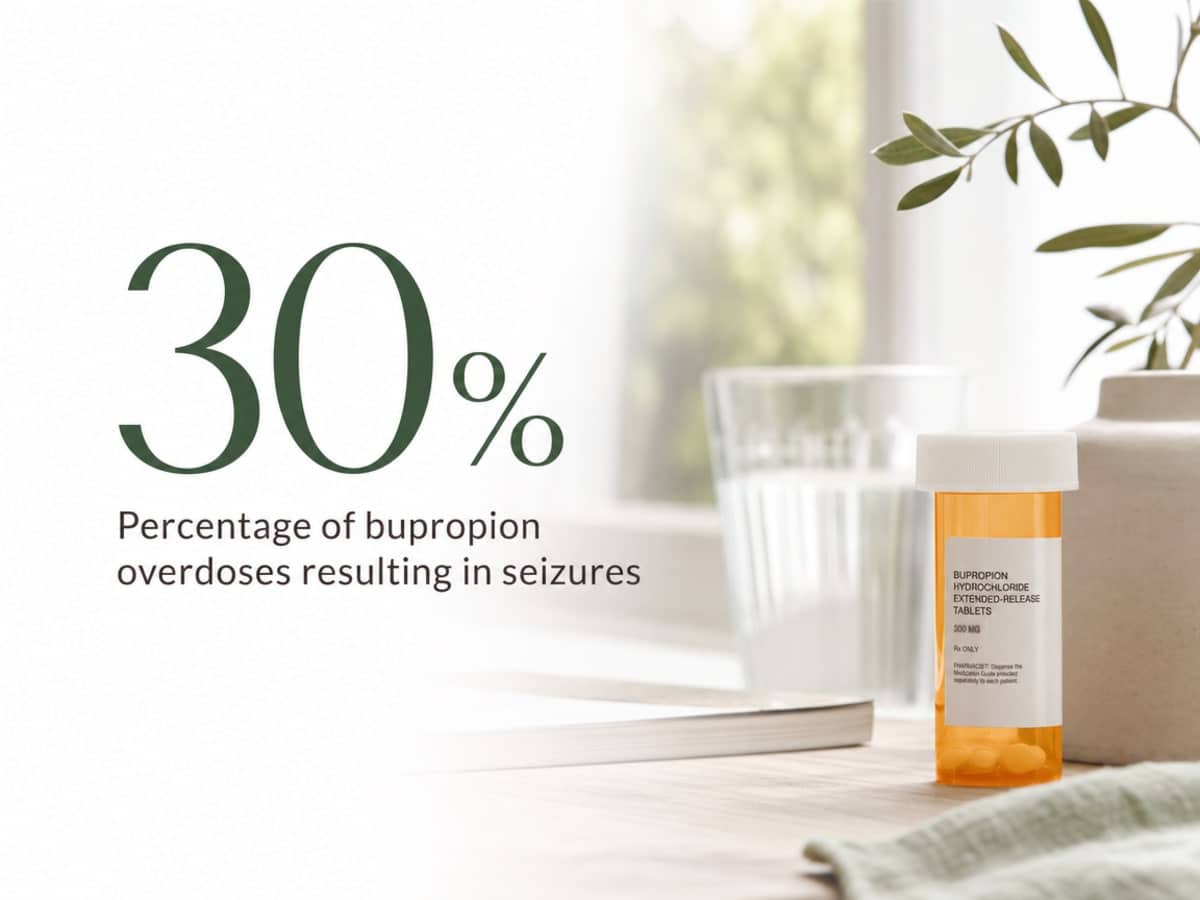
Here’s the figure to hold onto: roughly 30% of bupropion overdoses result in seizures, and poison-control guidance is to keep the person under 24-hour observation on telemetry for any intentional overdose 6. That’s nearly one in three. It’s not a fringe outcome. It’s the most likely serious complication, and it’s the one that drives the monitoring recommendation.
The early signs are easy to dismiss because they overlap with anxiety. Heart racing. Hands shaking. Agitation, sometimes confusion. A blood pressure that’s climbed without a clear cause. In larger overdoses, the picture sharpens into hallucinations, irregular heart rhythms, and seizures that can come in clusters 4. The median dose linked to seizures in overdose is around 4.4 grams — about ten times a typical daily prescription 5.
That’s why “they look fine now” is not a safe assessment after a suspected overdose on extended-release bupropion. If you’re not sure how much was taken, or if you find an empty bottle that shouldn’t be empty, call Poison Control (1-800-222-1222 in the US) or go to an emergency department. Bring the bottle. Tell them it’s the extended-release form if it is. You are not overreacting. You are doing the one thing that matches what the medication actually does.
When misuse and depression are tangled together
Here’s the part that most articles skip: a lot of Wellbutrin misuse doesn’t start as recreational use. It starts as self-treatment that drifted. The medication was helping. The depression was still there. So you took a little more, because a little more felt like a little more relief.
That’s not a character flaw. That’s what depression does when a medication seems to be working but the dose isn’t quite catching the whole weight of what you’re carrying. The 2023 systematic review of how bupropion misuse actually presents in clinic noted that many of these cases sit in patients with existing mood disorders and prior substance use histories — populations where the line between dose adjustment and misuse can blur without anyone naming it 2.
This matters for one practical reason: stopping the medication on your own is not the safe move you might think it is. If depression is part of what’s driving the higher doses, pulling the drug abruptly can leave you worse off than when you started — lower mood, more cravings, fewer tools. Bupropion is still recommended in major depression treatment guidelines as a first- or second-line option for a reason; it works for a lot of people when it’s dosed and monitored well 9.
The honest read on your situation isn’t “the medication is the problem” or “the depression is the problem.” It’s usually both, braided together. That’s the knot a prescriber needs to see in one piece, not pulled apart in panic. Bring the whole picture to the conversation. The point isn’t to confess. The point is to get the treatment plan to match what’s actually happening.
What treatment looks like when both conditions need attention
Honest assessment, not a swap or a cold stop
The first step isn’t a decision about the medication. It’s an honest conversation with someone qualified to hear it.
A good assessment looks at three things at once:
- How much bupropion you’re actually taking and how (oral, crushed, snorted, combined with anything else)
- What the underlying mood or anxiety picture looks like right now
- What else is in the mix — alcohol, stimulants, prior substance use, family history
A 2023 systematic review of bupropion misuse presentations made the same point clinicians have been making quietly for years: screening for this is uneven, and the patients who need it most often don’t get asked 2. So you may need to volunteer information that no one thought to ask for.
What an assessment is not is a quick swap to a different antidepressant or a cold stop. Switching medications without addressing why the dose crept up tends to recreate the same pattern with a new pill. Stopping abruptly can drop you back into the depression that started this in the first place. Neither move solves anything. The point of the assessment is to see the whole shape of what’s happening so the next step actually fits.
Integrated dual-diagnosis care and what it includes
When misuse and a mental health condition show up together, treating them in separate buildings rarely works. The depression makes the misuse harder to interrupt. The misuse makes the depression harder to treat. Integrated dual-diagnosis care puts both under one clinical roof, with one team that talks to itself.
In practice, that usually includes a psychiatric provider who can adjust or taper bupropion safely — sometimes continuing it at a controlled dose, sometimes transitioning to a different antidepressant, sometimes pairing it with a different class entirely. Bupropion remains a first- or second-line option in major depression guidelines for good reason, and a careful clinician will weigh keeping you on it against the risks of the pattern you’ve been in 9. The medication conversation is rarely all-or-nothing.
Alongside the prescribing piece, integrated care typically pulls in:
- Individual therapy (often cognitive behavioral therapy)
- Group work with other people sorting through similar tangles
- Family sessions when the people closest to you have been pulled into the pattern
The intensity scales to what you need. Some people do well in outpatient or intensive outpatient programs while keeping their jobs. Others need a residential stretch to reset. Medication-assisted treatment is on the table when other substances are involved.
Ohio context: prescription misuse and access to care
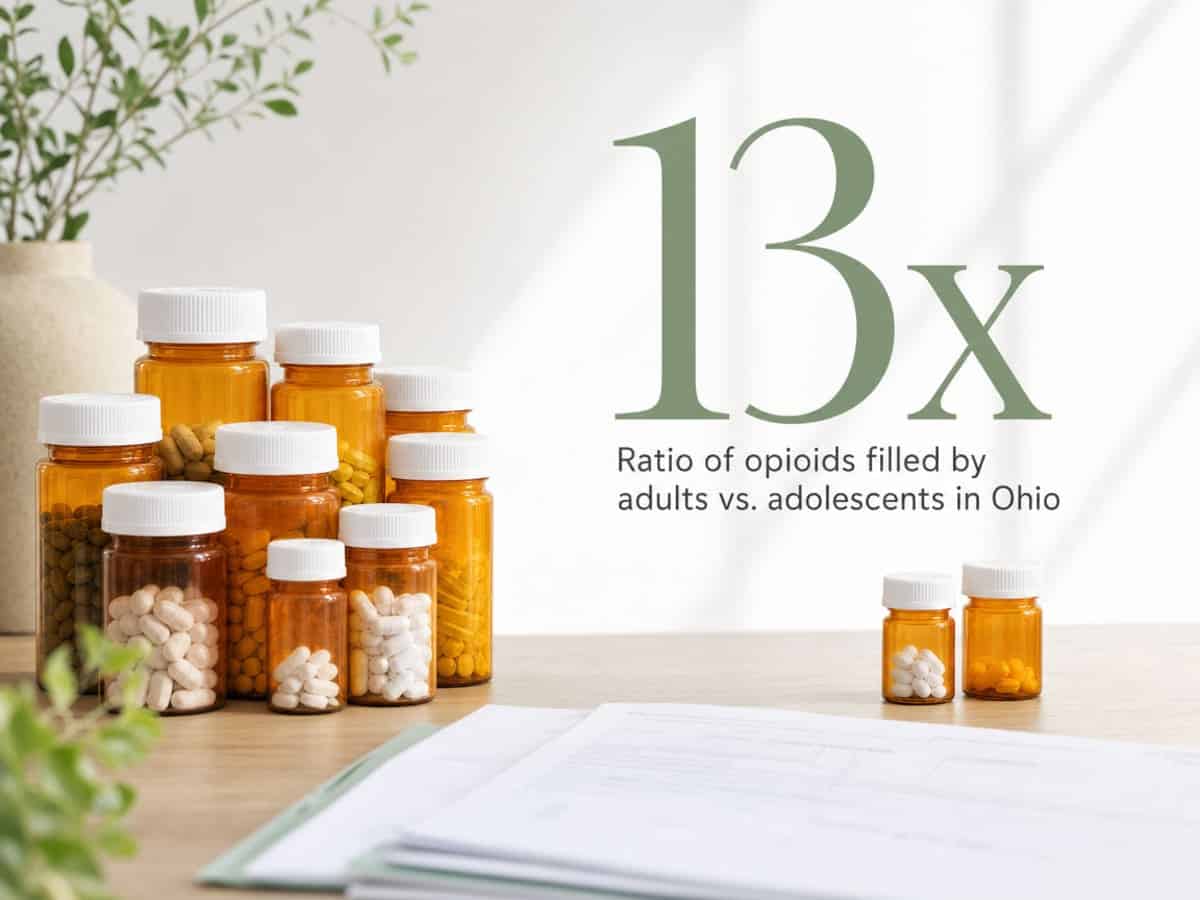
If you’re in Ohio, the prescription drug landscape around you matters more than people sometimes realize. Adults in Ohio fill roughly 13 times more opioid prescriptions than adolescents, and that adult prescribing volume is significantly linked to adolescent misuse showing up in treatment 12. That’s an opioid statistic, not a Wellbutrin one — but it tells you something about the environment. Prescription medications move through households here, and the resources to address that have to be local, not theoretical.
Access to integrated treatment isn’t even across the state. A 2023 review of office-based addiction treatment in Ohio documented real geographic gaps in who can get evidence-based care without driving an hour 13. If you’re trying to find help, that means asking specifically for a program that handles both addiction and mental health together, not one or the other. Ask about psychiatric coverage. Ask whether they’ll coordinate with your current prescriber. The right program will answer those questions in plain language.
If you’re the one reading this about yourself
If you’ve made it this far, you already know something is off. That counts. A lot of people never get to this paragraph because they never let themselves ask the question.
You don’t have to call yourself an addict to make the next move. You don’t have to have a story that matches anyone else’s. What you need is one honest conversation with the person who writes your prescription. Not a confession speech — just enough truth that the plan can change. Something like: “I’ve been taking more than you prescribed, and I want help figuring out what to do.” That sentence is the whole door.
Don’t stop the medication on your own before that call. If depression is part of what’s been driving the higher doses, an abrupt stop tends to make things worse, not better 9. Keep taking the prescribed dose until someone with prescribing authority tells you otherwise.
If today feels like too much, pick the smallest version. Send a message through your patient portal. Call the office and ask for the next available appointment. You don’t have to fix this in one afternoon. You have to start it.
If you’re watching someone you love
You probably noticed something months ago and told yourself you were imagining it. You weren’t.
The hardest part of loving someone who’s misusing a prescription is that you don’t get to fix it for them. What you can do is stop carrying it alone. Say what you’ve seen, in plain language, without a script. “I’ve noticed the bottle is empty earlier than it should be, and I’m worried about you.” That sentence doesn’t require them to agree. It just puts the truth in the room.
If you find an empty bottle and aren’t sure how much was taken — especially of the extended-release form — call Poison Control (1-800-222-1222) or go to an emergency department. Bring the bottle. Seizures from extended-release bupropion can show up many hours after the dose 4. “They look fine” is not the same as safe.
You can’t make them call their prescriber. You can offer to sit with them while they do, or to drive them to an assessment. That’s not control. That’s company.
Reach Out Now for Confidential Wellbutrin Support
Speak with someone who truly understands prescription challenges—support is always available, whenever you’re ready.
Take the First Step Away from Wellbutrin Misuse
Connect with someone who truly understands prescription dependence and your path to recovery.
Frequently Asked Questions
Can you actually get high from Wellbutrin?
At prescribed doses, most people feel nothing like a high. At high oral doses or when crushed and snorted, a small number of people report a stimulant-like effect — described in prison case reports as a “cocaine-like high” via intranasal use 7. That route also carries the highest seizure risk, which is why it shows up in the literature so often.
Is Wellbutrin a controlled substance?
No. Bupropion is not scheduled by the DEA, which is why you don’t see the same prescribing restrictions as Adderall or Xanax. That doesn’t mean it carries no misuse risk. A 2023 systematic review found real misuse potential in specific populations and called for better screening in routine practice 2.
What dose of Wellbutrin causes seizures?
Seizures can happen even at therapeutic doses 5. The FDA label puts the rate at about 0.4% for daily doses up to 450 mg, and the risk increases almost tenfold between 450 and 600 mg per day 3. In overdose, the median dose linked to seizures is roughly 4.4 grams 5. There is no “safe” amount to take above what your prescriber ordered.
Should I stop taking Wellbutrin if I think I’m misusing it?
No — not on your own. If depression or anxiety is part of what’s been driving the higher doses, stopping cold tends to make things worse. Bupropion is still a first- or second-line antidepressant in major depression guidelines, and the right next step is a conversation with your prescriber, not a unilateral stop 9. Keep taking the prescribed dose until someone with prescribing authority adjusts the plan.
What should I do if someone has taken too much Wellbutrin?
Call Poison Control at 1-800-222-1222 or go to an emergency department. Bring the bottle. If it’s the extended-release form, say so — seizures can show up up to 24 hours after ingestion, which is why poison control recommends 24-hour telemetry observation for intentional overdose 4, 6. “They look fine now” is not a safe assessment.
Can you treat depression and Wellbutrin misuse at the same time?
Yes, and that’s usually the right approach. Integrated dual-diagnosis care addresses both conditions with one coordinated team — a prescriber who can taper or adjust the medication, therapy for the depression underneath, and support for any other substances in the mix. Treating them separately tends to leave one half of the picture unattended, which is often what started the drift in the first place 2.
References
- Bupropion “Abuse” Reported to US Poison Centers. https://pubmed.ncbi.nlm.nih.gov/27504927/
- Clinical Presentations of Bupropion Prescription Drug Misuse. https://pubmed.ncbi.nlm.nih.gov/38656298/
- Wellbutrin (bupropion hydrochloride) tablets prescribing information. https://www.accessdata.fda.gov/drugsatfda_docs/label/2011/018644s043lbl.pdf
- Bupropion Toxicity. https://www.ncbi.nlm.nih.gov/sites/books/NBK580478/
- Bupropion abuse and overdose. https://pmc.ncbi.nlm.nih.gov/articles/PMC4162783/
- Bupropion – Utah Poison Control Center Fact Sheet. https://poisoncontrol.utah.edu/sites/g/files/zrelqx281/files/media/documents/2024/FF-Bupropion_071423_NEW.pdf
- A Systematic Review of Abuse or Overprescription of Bupropion in American Prisons and a Synthesis of Case Reports. https://pmc.ncbi.nlm.nih.gov/articles/PMC10104426/
- A Systematic Review of Abuse or Overprescription of Bupropion in American Prisons. https://www.ncbi.nlm.nih.gov/pmc/articles/PMC10104426/
- Review of Guidelines on Bupropion for Depression. https://www.ncbi.nlm.nih.gov/books/NBK609607/
- Association of bupropion and stimulant use disorder in health claims data. https://pmc.ncbi.nlm.nih.gov/articles/PMC6371318/
- What is the scope of prescription drug misuse in the United States?. https://nida.nih.gov/publications/research-reports/misuse-prescription-drugs/what-scope-prescription-drug-misuse
- Statewide Opioid Prescriptions and the Prevalence of Adolescent Opioid Misuse in Ohio. https://www.ncbi.nlm.nih.gov/pmc/articles/PMC5357590/
- A Descriptive Study on Opioid Misuse Prevalence and Office-Based Buprenorphine Access in Ohio. https://pmc.ncbi.nlm.nih.gov/articles/PMC10151104/
- Supplementary PDF: A Systematic Review of Abuse or Overprescription of Bupropion in American Prisons. https://www.ncbi.nlm.nih.gov/pmc/articles/PMC10104426/pdf/main.pdf