
How IOP Addiction Treatment Fits a Working Schedule
Key Takeaways

- IOP sits at ASAM Level 2.1, requiring 9 to 19 hours of treatment across 3 to 5 days, designed to fit around a standard workweek rather than replace it 5, 7.
- Three schedule archetypes make this practical for working adults: early-morning sessions before 10 AM, weeknight-plus-Saturday evening tracks, or hybrid telehealth with one in-person weekend block.
- ADA protections let you request a modified schedule or leave for ongoing medical treatment without disclosing your diagnosis, and your medical information must be kept in a confidential file 3, 4.
- Outcomes for IOP are comparable to inpatient care for adults matched to the right level, and telehealth retention data from Kentucky and Ohio shows virtual delivery is not a downgrade 2, 8.
The Fear Behind the Search: Treatment Without Losing Your Job
You typed “iop addiction treatment” into the search bar at 11:47 PM, after the kids were asleep, after one more drink than you meant to have, after another day of holding it together at work. And the first question in your head probably wasn’t clinical. It was logistical. Can I do this without my boss finding out? Without burning through every day of PTO? Without losing the job that pays the mortgage?
That fear is reasonable, and you are not alone in it. SAMHSA’s 2023 National Survey on Drug Use and Health shows that millions of working-age adults meet criteria for a substance use disorder, and only a fraction reach treatment in any given year 9. The gap between “I know something needs to change” and “I called someone” is often built out of exactly the worry you are carrying right now.
Here is what the next sections will give you: a clear picture of how an Intensive Outpatient Program actually slots into a 40-hour workweek, what the law says about your right to attend treatment without losing your job 3, 4, and what the evidence shows about whether outpatient care can really do the job 2. You do not have to disappear from your career to get well. That is the whole point of this level of care.
What ASAM Level 2.1 Actually Means for Your Week
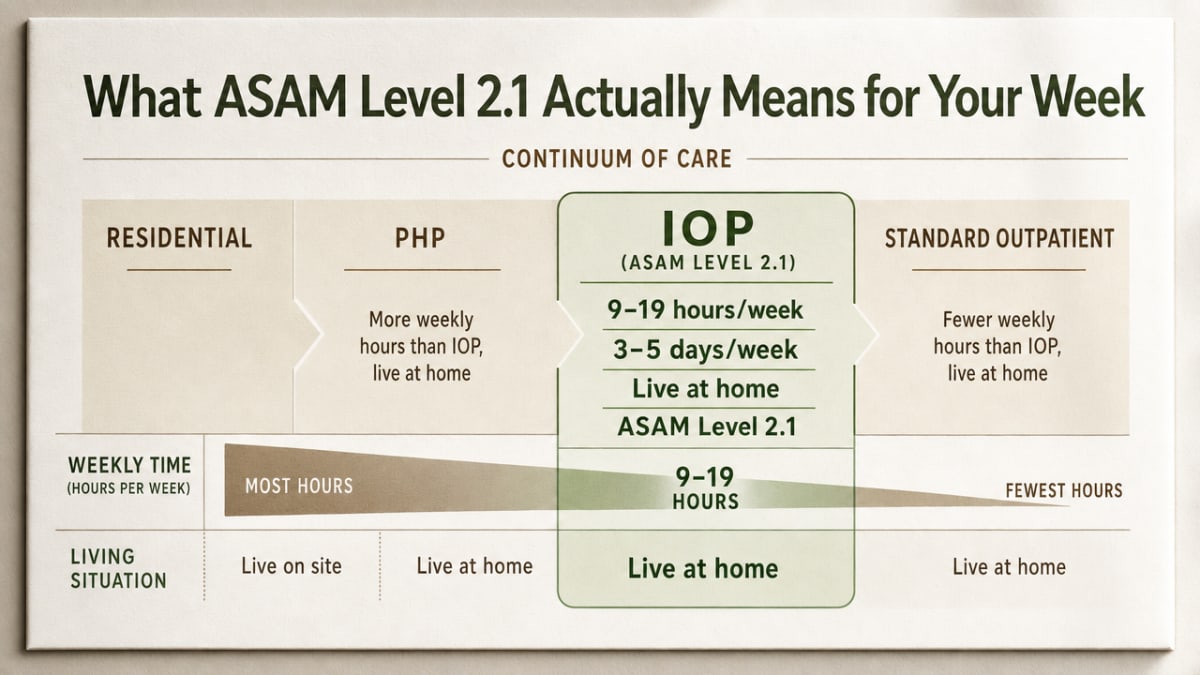
Intensive Outpatient Program is a clinical category, not a marketing term. Under the American Society of Addiction Medicine’s continuum of care, it sits at Level 2.1, and SAMHSA’s Treatment Improvement Protocol defines it as structured programming of nine or more hours per week spread across three to five days 5. Pennsylvania’s Department of Drug and Alcohol Programs puts a ceiling on that range at 19 hours per week, which is the working definition most state regulators use 7. So when a program calls itself an IOP, you can hold them to that math: somewhere between 9 and 19 hours, in 3 to 5 sessions, every week.
That hour count is the whole reason this level of care exists for someone with a job. Here is how the time math compares across the continuum, drawing on SAMHSA’s TIP definition and the Pennsylvania DDAP service characteristics 5, 7:
| Level of Care | Weekly Time Commitment | Where You Live |
|---|---|---|
| Residential | 24/7 on site | Treatment facility |
| Partial Hospitalization (PHP) | ~20–30 hours, typically weekdays | Home |
| Intensive Outpatient (Level 2.1) | 9–19 hours over 3–5 days | Home |
| Standard Outpatient | 1–2 hours per week | Home |
Look at that middle row again. Nine to nineteen hours. Even at the high end, that is roughly half of a standard workday spread across an entire week. Most programs land closer to the floor — three sessions of three hours each, totaling nine — which can fit before your day starts, after it ends, or in a single weekend block depending on how the program is built.
What fills those hours is consistent across well-run programs: group therapy, individual counseling, psychoeducation, and recovery skills practice you carry back into your real life 5, 6. Nebraska’s service definition calls this “community-based” treatment for a reason — the assumption is that you will practice new skills in your natural environment, including at work, between sessions 6. You are not removed from your life to get well. You stay in it on purpose.
Three Schedule Archetypes That Work Around a 40-Hour Week
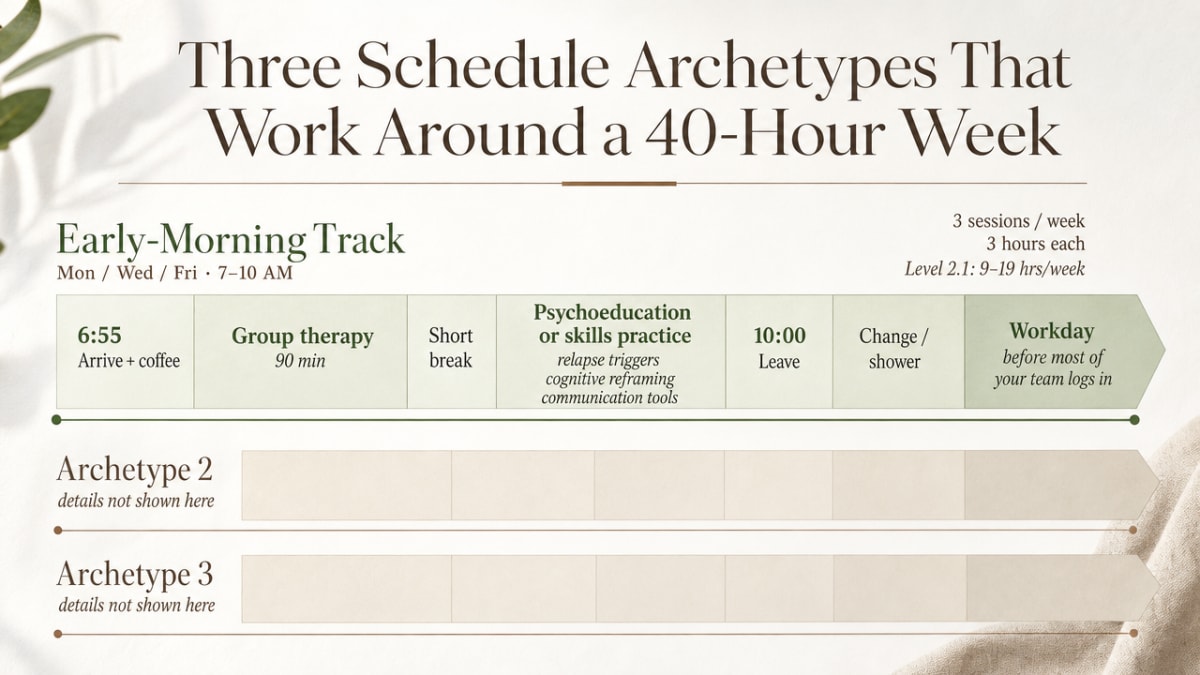
Early-Morning Track: Monday/Wednesday/Friday, 7-10 AM
If you are the kind of person who would rather lose sleep than miss a 9 AM meeting, the early-morning track is probably the one you keep mentally circling. Three sessions per week, three hours each, finished before most of your team has logged in. That puts you at the lower end of the 9-to-19-hour Level 2.1 range, which is exactly where many programs build their starter block 7.
A typical morning looks like this: you arrive at 6:55 AM, settle in with coffee, and the first 90 minutes are group therapy. After a short break, you move into a psychoeducation block or skills practice — relapse triggers, cognitive reframing, communication tools you can actually use in your 2 PM one-on-one 5, 6. You leave at 10, shower or change at home or the office gym, and you are at your desk by 10:30.
The trade is real. You will be tired on session days, especially the first two weeks. You will need to protect your evenings so you can sleep. But you keep your standard workday mostly intact, and you do not have to explain a late morning to anyone other than yourself.
Evening Track: Tuesday/Thursday Plus Saturday Morning, 6-9 PM
For most working adults, the evening track is the path of least resistance. Two weeknight blocks plus a Saturday morning gives you nine structured hours without touching your workday at all. Pennsylvania’s Level 2.1 guidance explicitly allows services to be delivered at varied times so programs can accommodate community integration and client needs — which is the regulatory way of saying evening IOPs exist on purpose 7.
Your Tuesday looks normal until 5:45 PM. You leave the office, grab something to eat in the car, and you are in a group room by 6. Three hours later you are home. Thursday repeats. Saturday morning is the steadier one — a longer group, an individual counseling check-in, sometimes a family session if your spouse or partner is part of the work 5, 6.
The honest cost is your social and family time. The first few weeks, missing a Tuesday dinner or a Saturday morning with your kids will sting. Talk to the people who share those hours with you before week one, not after. The schedule is sustainable. The surprise is what breaks people, not the time itself.
Hybrid Telehealth Track: Virtual Weekdays, In-Person Weekend
If you travel for work, live 40 minutes from the nearest treatment center, or simply cannot square a commute with school pickup, the hybrid telehealth track is built for you. Two or three weeknight groups happen over secure video — you log in from a closed door at home, headphones on — and one in-person session anchors the week, usually on a Saturday morning.
A 2024 peer-reviewed study of a fully remote SUD IOP found that participants sustained engagement over time and maintained or increased days of abstinence, which tells you virtual delivery is not a watered-down version of the real thing 1. The in-person weekend block matters too. It is where you do the things that work better in a room — body-language cues in group, a urine screen if your program uses one, a face-to-face individual counseling hour 5.
The discipline this track requires is environmental. A locked door. A spouse who knows not to knock. A laptop that is not also running Slack. If you can build that boundary for three hours, twice a week, the hybrid track gives you the most flexibility of the three.
Does Outpatient Care Actually Work? The Evidence
Here is the question you probably have not asked out loud yet: if I do not go away somewhere, will this actually stick? It is a fair worry. The cultural image of “real” addiction treatment is a 30-day stay at a residential facility, not three sessions a week before work.
The evidence does not support that image. A systematic review of the IOP literature found a high degree of consistency that intensive outpatient programs produce outcomes comparable to inpatient treatment for most individuals when patients are matched to the right level of care 2. That last clause matters. Comparable outcomes are not promised to everyone — someone in active withdrawal, someone without safe housing, someone whose home environment is the trigger, may need a higher level of care first. The review is talking about adults who can safely live at home and stay engaged in their lives, which is the exact population reading this article.
The same review acknowledges what is still unsettled: IOP programs vary in structure, the number of randomized controlled trials is limited, and questions remain about optimal intensity and duration 2. That is honest science, not a hedge. What it tells you is that picking a well-structured program matters more than picking a level of care more disruptive than you need.
Virtual IOP and the Retention Data From Kentucky and Ohio
If you live in Ohio, the most relevant piece of evidence for virtual treatment was published in your backyard. In October 2023, the National Institute on Drug Abuse reported on a Medicaid data analysis that compared people who started buprenorphine for opioid use disorder via telehealth against people who started in person. The headline finding pushes back on the assumption that screen-based care is a step down 8.
In Kentucky, 48% of people who initiated buprenorphine through telehealth stayed in treatment for at least 90 days, compared with 44% who started in person. In Ohio, the numbers were lower across the board but moved in the same direction: 32% telehealth versus 28% in person 8. Those are not enormous gaps, and the analysis is about medication initiation specifically rather than full IOP programming. But the direction matters. Telehealth did not punish retention. In two states with very different opioid landscapes, the remote group held on slightly longer.
Read that against what you already know about your own week. Ninety days is roughly the duration of a full IOP arc. If a delivery format helps you stay in treatment through the months when relapse risk is highest, that is the format worth taking seriously — especially when the alternative is a commute that eats your lunch hour or a parking lot you have to explain to a coworker.
One honest note before you bank too much on these numbers: the Ohio retention rates are lower than Kentucky’s in both groups, which the NIDA brief attributes partly to differences in Medicaid populations and service availability 8. Virtual care is not a magic equalizer. It is a tool that removes specific friction — drive time, childcare gaps, the awkward midday absence — so that the harder work of actually showing up has a better chance of happening. For a working adult weighing whether a hybrid or fully virtual track counts as “real” treatment, this is the data point that settles the question.
Your Legal Footing: ADA Accommodations and Workplace Privacy
What You Can Request Without Disclosing a Diagnosis
You do not have to walk into your manager’s office and say the word “addiction” to get the schedule you need. The Americans with Disabilities Act lets you request a reasonable accommodation for a serious health condition without naming the diagnosis in detail, and EEOC guidance is clear that the request itself is what triggers the conversation, not a confession 3. What you are asking for is a change in how things are normally done at work — a later start time three days a week, a protected lunch hour, a remote-work block on Tuesday evenings — because you are receiving ongoing medical treatment.
Here is what that conversation can actually sound like:“I’m starting a course of medical treatment that requires me to be off-site three mornings a week for the next 12 weeks. I’d like to discuss adjusting my schedule.”That is enough to start the interactive process the ADA requires your employer to engage in 3. You may be asked for documentation from your treatment provider confirming that you have a condition that needs accommodation and what schedule adjustment is needed. Your provider can write that note without listing your specific diagnosis on the form.
Your medical information is also protected. Anything you share has to be kept in a separate, confidential file, not in your general personnel record, and your manager is not entitled to the clinical details 3. That protection is the part most people do not realize they have.
Modified Schedules and Leave for Treatment
The two accommodations most relevant to an IOP schedule are the same two the U.S. Commission on Civil Rights flagged in its ADA analysis of substance use disorders: a modified work schedule so you can attend treatment or support meetings, and a leave of absence when treatment requires more time than a schedule shift can absorb 4. Both are recognized as reasonable accommodations for an employee in recovery, provided you can still perform the essential functions of your job and you are not currently using illegal drugs 4.
For most working adults in IOP, the modified schedule is the cleaner ask. You are not requesting time off — you are requesting that your hours move. A 7-to-10 AM treatment block followed by a 10:30 AM start at your desk is a schedule change, not a leave. An evening track touches no work hours at all and may not require a formal accommodation request, though documenting one still protects you if priorities collide later.
Leave becomes the right tool when IOP overlaps a stretch of intensive work — the first two weeks, a medical-leave bridge from PHP, or a flare-up of a co-occurring condition. Employers can push back when an accommodation would cause significant difficulty or expense, which is the standard EEOC describes 3. That is a real limit, not a reason to skip the request. Most schedule modifications for a 9-to-19-hour weekly commitment do not come close to that threshold.
What a Tuesday Evening Group Actually Looks Like
You park at 5:52 PM. The lot is half-full of cars that look like yours — sedans with car seats in the back, a pickup with a contractor’s ladder, an SUV with a work badge still clipped to the visor. Nobody is making eye contact yet. That is fine. By week three, you will recognize half of them.
The first hour is group therapy, usually eight to twelve people in a circle with one or two clinicians. Someone shares first because they always do. You do not have to. The early weeks, your job is mostly to listen and notice that other people in business clothes are saying out loud what you have only thought in your kitchen at midnight. SAMHSA’s protocol describes group as the central component of IOP for a reason — it is where the work actually happens 5.
A short break around 7. People check phones, refill water, step outside. The second block is psychoeducation or skills practice — relapse triggers, how to handle a work happy hour, what to say when a client orders a second bottle of wine 5, 6. Concrete tools, not abstract recovery talk. You write things down. You try one on Wednesday and it works, or it does not, and you bring that back to group on Thursday.
The last 30 minutes some weeks are an individual check-in with your counselor. Other weeks the group stays together for closing. You are in your car by 9:05, home by 9:30, and the only person who knows where you were is you.
How to Tell If IOP Is the Right Level for You
IOP is built for a specific kind of person, and matching yourself to it honestly matters more than picking the most or least intensive option you can find. The clinical question is whether you can safely live at home and stay engaged in daily life while doing real treatment work 5. Most working adults can. Some cannot, and the line is worth drawing carefully.
You are likely a fit for IOP if you are not in active, dangerous withdrawal, your home is reasonably stable, the people you live with are not actively using around you, and you can keep showing up to work without your use becoming a safety issue for yourself or anyone else. Co-occurring depression, anxiety, or PTSD does not disqualify you — IOPs are designed to treat substance use and mental health symptoms together when both are present 6.
You probably need a higher level of care first if detox is medically risky, if your home environment is the trigger you cannot get away from, or if recent outpatient attempts have not held. That is not failure. It is sequencing. Many people step down from residential or PHP into IOP once the acute window is past 5.
One thing to skip: self-diagnosing the level. A clinical assessment from an admissions team takes about an hour and uses the same ASAM criteria the rest of this article references. Call. Let them tell you where you actually fit.
Making the First Call Without Tipping Off Your Employer
The hardest part is the dial tone. You can read every word on this page and still freeze when the phone is in your hand. So here is the lowest-risk way to start: call SAMHSA’s National Helpline at 1-800-662-HELP. It is free, confidential, and runs 24/7, which means you can call from your car at lunch or from your couch at 10 PM, and no one needs a referral or insurance card to talk to you 10. They will connect you to local treatment options without putting anything in writing that touches your employer.
If you would rather skip the middle step, call a local IOP admissions line directly. Use your personal cell, not your work phone. Do it outside work hours or from a private space, not the open-plan kitchen. The intake call usually takes 30 to 45 minutes and covers your history, your insurance, and a clinical assessment that determines the right level of care. Your employer is not contacted, and HIPAA protects what you share 3.
One call. That is the whole task today. Everything after that — schedule, accommodation request, first session — gets built once a real human on the other end of the line has heard your name.
Speak With an Admissions Specialist Right Now
Get immediate answers about scheduling IOP treatment that fits your work and life commitments.
Talk Through Flexible Recovery Options For Professionals
Explore therapy schedules that fit your work life and support your ongoing recovery goals.
Frequently Asked Questions
How many hours per week will I actually spend in IOP?
Do I have to tell my employer I’m in addiction treatment?
No. If you request a schedule accommodation under the ADA, you can describe it as ongoing medical treatment without naming the diagnosis. EEOC guidance requires your employer to keep any medical information in a separate, confidential file, not in your general personnel record 3. Your manager is entitled to know you need an adjustment, not the clinical details behind it.
Is virtual IOP as effective as attending in person?
The evidence so far says yes for most working adults. A 2024 study of a fully remote SUD IOP found participants sustained engagement and maintained or increased days of abstinence 1. Separately, NIDA’s analysis of Kentucky and Ohio Medicaid data showed telehealth buprenorphine initiation produced slightly better 90-day retention than in-person starts 8. Virtual is a real option, not a downgrade.
Can I use FMLA or ADA accommodations to attend IOP sessions?
Yes, both can apply. The U.S. Commission on Civil Rights notes that a modified work schedule to attend treatment and a leave of absence for treatment are both recognized as reasonable accommodations under the ADA for an employee in recovery, as long as you can perform essential job functions and are not currently using illegal drugs 4. For a 9-to-19-hour weekly commitment, a schedule shift is usually the cleaner request than leave.
How do I know if I need IOP versus standard outpatient or residential care?
Standard outpatient is 1 to 2 hours per week and works when symptoms are mild and stable. Residential is 24/7 and fits active withdrawal, unsafe housing, or a home environment that is itself the trigger. IOP sits in between for adults who can safely live at home while doing intensive work 5. A clinical assessment using ASAM criteria — usually a 45-minute call — will place you accurately.
How long does a typical IOP last from start to finish?
Most IOP arcs run roughly 8 to 12 weeks, though duration varies by program and clinical need 2. The 90-day window matters because it covers the stretch when relapse risk is highest, which is part of why retention data at that mark is the benchmark researchers track 8. After IOP, many people step down to standard outpatient or aftercare for ongoing support.
References
- Patient Engagement in Providing Telehealth SUD IOP Treatment. https://pmc.ncbi.nlm.nih.gov/articles/PMC11675410/
- Substance Abuse Intensive Outpatient Programs: Assessing the Evidence. https://pmc.ncbi.nlm.nih.gov/articles/PMC4152944/
- Depression, PTSD, & Other Mental Health Conditions in the Workplace: Your Legal Rights. https://www.eeoc.gov/laws/guidance/depression-ptsd-other-mental-health-conditions-workplace-your-legal-rights
- Substance Abuse under the ADA. https://www.usccr.gov/files/pubs/ada/ch4.htm
- Chapter 3. Intensive Outpatient Treatment and the Continuum of Care. https://www.ncbi.nlm.nih.gov/books/NBK64088/
- Adult Substance Use Disorder Intensive Outpatient Level 2.1 – Nebraska DHHS Service Definition. https://dhhs.ne.gov/Behavioral%20Health%20Service%20Definitions/Adult%20Substance%20Use%20Disorder%20Intensive%20Outpatient%20Level%202.1.pdf
- LEVEL 2.1 INTENSIVE OUTPATIENT SERVICES BY SERVICE CHARACTERISTICS. https://www.pa.gov/content/dam/copapwp-pagov/en/ddap/documents/documents/asam/level%202.1%20by%20service%20characteristics.pdf
- Telehealth supports retention in treatment for opioid use disorder. https://nida.nih.gov/news-events/news-releases/2023/10/telehealth-supports-retention-in-treatment-for-opioid-use-disorder
- 2023 National Survey on Drug Use and Health (NSDUH) Releases. https://www.samhsa.gov/data/data-we-collect/nsduh-national-survey-drug-use-and-health/national-releases/2023
- National Helpline for Mental Health, Drug, Alcohol Issues – SAMHSA. https://www.samhsa.gov/find-help/helplines/national-helpline
- MLN901705 – Telehealth & Remote Monitoring – CMS. https://www.cms.gov/files/document/mln901705-telehealth-remote-monitoring.pdf