
Ativan and Addiction: How Dependence Develops
Key Takeaways
- Tolerance, physical dependence, and addiction describe three distinct experiences, and many people taking Ativan as prescribed develop dependence without ever meeting criteria for a substance use disorder 11.
- Dependence risk climbs sharply after four weeks of regular use, yet real-world lorazepam courses for insomnia average closer to nine weeks, leaving many patients past the guideline ceiling without warning 4, 6.
- Stopping Ativan abruptly can trigger seizures and other life-threatening reactions, so a slow, symptom-paced taper, often with a diazepam cross-titration for long-term users, is the safer path 11, 5.
- Tapers stick when the underlying anxiety, trauma, or insomnia is treated in parallel through therapy and non-benzodiazepine options, since psychiatric stability and treatment engagement predict successful discontinuation 13.
When Your Prescription Stops Feeling Like Medicine
Maybe it started with panic attacks that wouldn’t let you sleep. Maybe a doctor handed you a small white pill after a loss, a surgery, or a stretch of insomnia that wouldn’t break. You took it the way the bottle told you to. And for a while, it worked.
Then something quieter shifted. The same dose stopped doing what it used to. The hours before your next pill started to feel longer, edgier. You noticed your hand reaching for the bottle a little earlier, or your chest tightening when you realized you’d forgotten a dose at work. If you’ve started searching for answers about Ativan and addiction, you are probably somewhere in that gap, the one between “this is helping me” and “I don’t know how to stop.”
Here is what you need to hear first: if you followed every instruction on the label and still ended up here, that is not a character problem. It is pharmacology. The FDA updated its Boxed Warning on benzodiazepines specifically because physical dependence can develop even when the medication is taken exactly as prescribed 11. You are not the exception. You are the pattern the warning was written for.
This guide walks you through what is happening, what the words mean, and what a safe way out actually looks like.
Tolerance, Dependence, and Addiction Are Not the Same Thing
Three Words People Use Interchangeably (and Why That Matters for You)
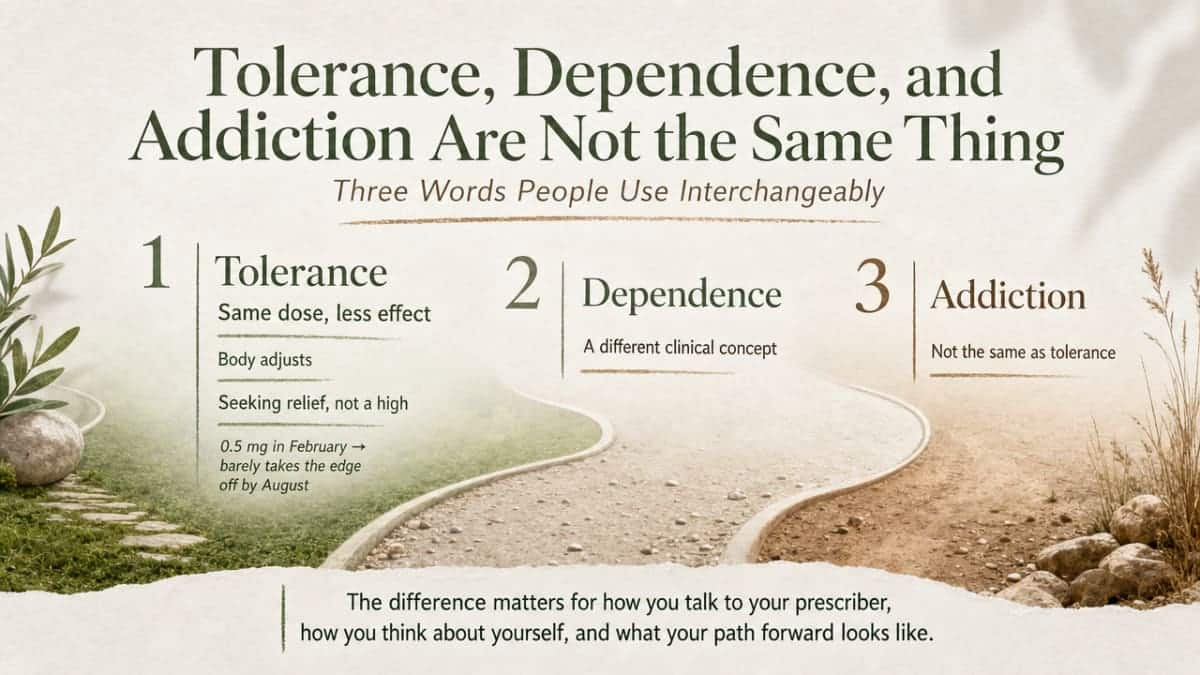
One of the hardest parts of being where you are right now is not having the right words for it. You might catch yourself thinking, “I’m addicted to my anxiety medication,” and then feel a wave of shame on top of everything else. But the word you actually need may not be addiction at all. It may be tolerance. Or physical dependence. Those are three different things, and the difference matters for how you talk to your prescriber, how you think about yourself, and what your path forward looks like.
- Tolerance
- is when the same dose stops doing what it used to. The 0.5 mg that calmed your chest in February barely takes the edge off by August. Your body has adjusted. You are not chasing a high; you are chasing the relief you used to get.
- Physical dependence
- is when your body has adapted to the medication being present, so when the level drops, you feel it. Sweaty palms before your next dose. A racing heart at 3 a.m. if you forgot the bedtime pill. The FDA’s updated Boxed Warning on benzodiazepines is clear that this can happen even when you take the medication exactly as prescribed 11. It is not a sign you did something wrong. It is the predictable response of a nervous system that has been told, chemically, to expect this drug.
- Addiction
- clinically called a substance use disorder, is different. It involves compulsive use that continues despite real harm to your life, your relationships, your work. Taking more than prescribed. Doctor shopping. Using the pill to feel something other than calm. Many people who are physically dependent on Ativan never meet criteria for addiction. Naming what you actually have, instead of what you fear you have, is the first piece of real ground to stand on.
What Ativan Is Actually Doing in Your Brain
Ativan works by amplifying a brain chemical called GABA, which is your nervous system’s main brake pedal. GABA tells overfiring neurons to slow down. That is why a panic attack softens within twenty minutes of a dose, why a racing mind quiets enough to let sleep in. The drug is, in a real sense, doing exactly what you asked it to do.
The trouble starts with how your brain responds to the help. When GABA’s brake is pressed harder, day after day, your brain tries to balance the scales. It quiets its own GABA signaling and turns up the excitatory side of the system 2. Now you need the medication just to feel level. Take it away, and the brakes are loose while the accelerator is stuck down. That is what rebound anxiety, insomnia, and the jittery feeling between doses actually are, at the cellular level.
None of this is willpower. It is your brain doing exactly what brains do when a chemical is present long enough to feel like the new normal. Understanding that may not change your symptoms today, but it can change how you talk to yourself about them.
How Fast Dependence Can Happen on a Normal Prescription
The Four-Week Line Most People Cross Without Realizing
Four weeks. That is the number worth tattooing on the inside of your wrist if you are starting Ativan, or the number worth knowing if you are already past it. International prescribing and deprescribing guidance converges on the same threshold: benzodiazepines, when they are used at all, should generally be restricted to short courses under four weeks because the risk of dependence climbs sharply after that point 4.
One often-cited figure comes from a qualitative study of older women on chronic benzodiazepines, which reported that roughly 35% of people taking these medications regularly for four weeks or longer go on to develop dependence, with most daily users meeting dependence criteria after four to six months 3. The study population was narrow, mostly older women already on long-term therapy, so the precise percentage will not apply cleanly to a 34-year-old taking Ativan for postpartum panic. But the direction it points in is consistent across the literature: the longer you take it, the more likely your body is to adapt.
Here is what makes the four-week line so easy to cross without noticing. A doctor writes “as needed for anxiety” on a script for thirty 0.5 mg tablets. You use one most nights to sleep through racing thoughts. By the time you finish the bottle, you have been on lorazepam nightly for about a month. You ask for a refill because it is working. No one flags it. Nothing in that sequence required you to do a single thing wrong. It is the default path, and it lands a lot of people exactly where you are.
The Gap Between Guidelines and Real Prescribing
If the guideline is four weeks, what is actually happening in exam rooms? Something close to the opposite. A 2023 study of long-term benzodiazepine use in chronic insomnia found that the average lorazepam treatment course ran about 62 days, roughly 8.9 weeks, with many patients receiving repeat prescriptions after that 6. That is more than double the upper edge of what international guidance recommends 4.
Sit with that for a second. The recommended ceiling is under four weeks. The real-world average for lorazepam in insomnia is almost nine. If you have been on Ativan for two months and you are now feeling like you cannot stop, you are not somehow uniquely vulnerable or weak. You are sitting inside a mismatch between what the science says and what the prescription pad actually does.
The gap exists for understandable reasons. Anxiety and insomnia are miserable. Ativan works fast. Office visits are short. Alternatives like cognitive behavioral therapy for insomnia or SSRIs for anxiety take weeks to start helping and require referrals that may have a waitlist. So the prescription gets continued, the bottle gets refilled, and the four-week line slides past in the rearview mirror without anyone treating it as a milestone.
None of this absolves the system, but it does reframe your situation. You did not engineer your way into dependence. You followed a prescription that was, statistically, longer than it should have been. That is a starting point for a conversation with your prescriber, not a verdict on your character. The next step is recognizing what dependence actually feels like from the inside, so you can describe it accurately when you have that conversation.
Signs You May Have Crossed the Line
Physical Signals Between Doses
Your body will usually tell you before your mind catches up. The clues show up in the hours between doses, especially with a short-acting medication like lorazepam that leaves your bloodstream quickly.
You might notice a tight, jittery feeling that arrives mid-afternoon if your morning dose was at 8 a.m. Hands that tremble a little when you reach for coffee. A heartbeat you can feel in your throat. Sweat on your palms or upper lip for no reason you can name. Sleep that breaks at 3 or 4 a.m. and will not come back until you take the next pill. Some people feel a sharp pull of nausea, a headache that sits behind the eyes, or muscles that ache like a low-grade flu.
None of those symptoms mean something is wrong with you. They mean your nervous system has adapted to the medication and is signaling its absence 11. If you can predict, almost to the hour, when you will start feeling “off” before your next dose, that pattern is information worth bringing to your prescriber.
The Psychological Shift: When the Medication Starts Running Your Day
The mental signals are quieter and harder to admit, partly because they feel like personality instead of pharmacology. But they follow a recognizable shape.
You start tracking the bottle. You know exactly how many pills are left, where the next refill falls on the calendar, and what time you took the last dose without having to check. Travel feels different now; you would not leave the house for a weekend without the bottle, and the thought of running out causes a small spike of panic that has nothing to do with your original anxiety. You may find yourself rehearsing what you will say at the next appointment to make sure the prescription continues.
There is often a layer of rebound anxiety underneath all of this, anxiety that feels worse than what first sent you to a doctor 2. That is not your old condition returning at full volume. It is your brain, with its GABA system quieted by long exposure, struggling to settle itself between doses. Knowing the difference helps you describe what is happening without blaming yourself for it.
When It Has Tipped Into Addiction (Not Just Dependence)
Most readers who recognize themselves in the sections above are physically dependent, not addicted. The line into substance use disorder is a different one, and it has specific markers worth being honest about.
- You are taking more than prescribed, more often, and the dose keeps creeping up despite your intention to hold it steady.
- You have asked more than one doctor for a prescription without telling each one about the others.
- You are using Ativan with alcohol or opioids to amplify the effect, a combination the FDA specifically warns can be life-threatening 11.
- You have lied to someone you love about your use.
- Work, parenting, or driving has been affected, and you have kept using anyway.
If any of those describe you, the path forward is the same medically supervised taper, but the supports around it need to be more intensive. That is not a verdict. It is a treatment plan with more hands on it.
The Anxiety, Insomnia, or Trauma Underneath the Prescription
Why Treating Ativan Alone Usually Fails
Here is the thing nobody tells you when they hand you a tapering schedule: if all you do is remove the medication, you are left alone in a room with the reason you started taking it. The panic attacks. The 2 a.m. ceiling-staring. The trauma response that made your body feel like it was sitting on a live wire. Ativan did not invent those problems. It muted them. Pull the mute button and the volume comes back, sometimes louder than you remember.
This is why so many tapers stall or reverse. People get a few weeks in, the original anxiety surges back through the gap, and the most logical thing in the world is to reach for the bottle that worked before. That is not weakness. That is an untreated condition asserting itself.
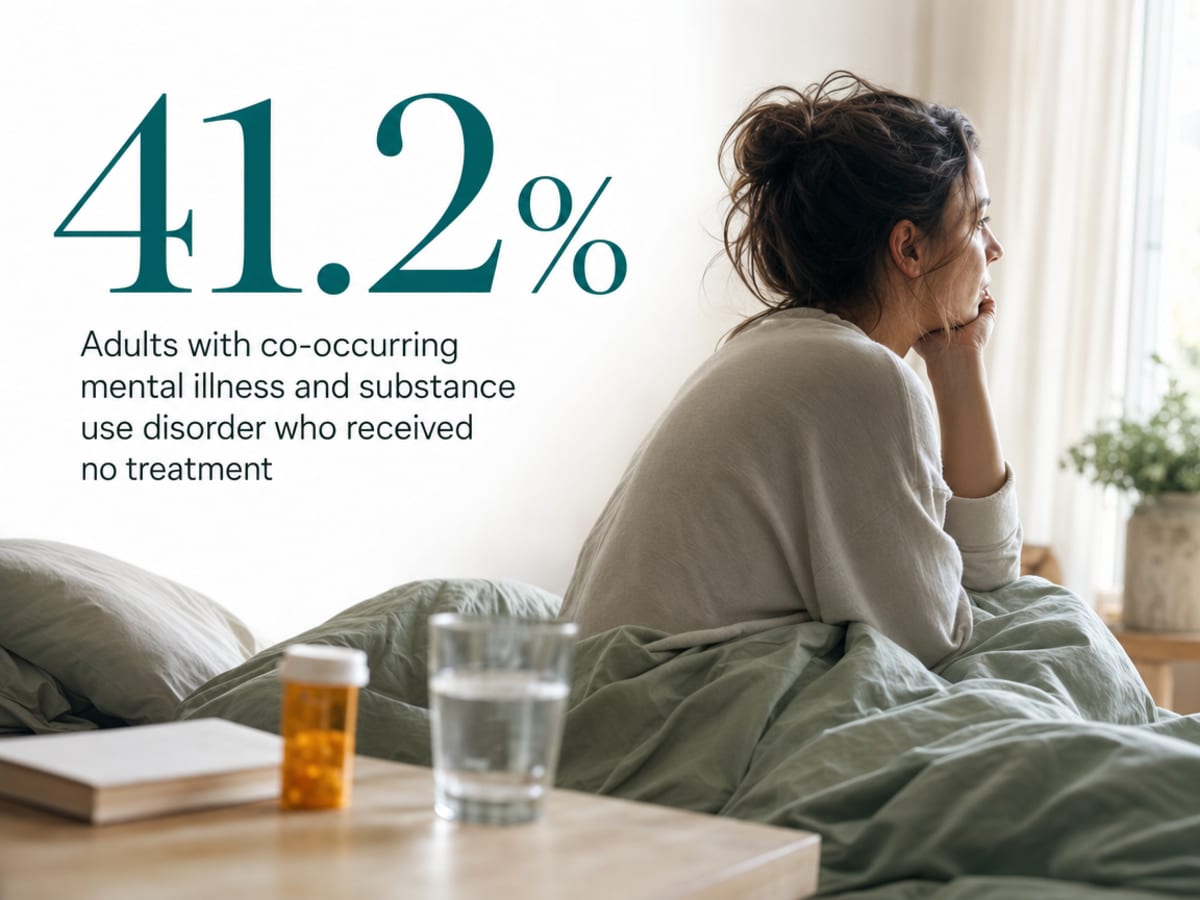
The scale of this overlap is bigger than most people realize. In 2024, an estimated 21.2 million U.S. adults had co-occurring mental illness and a substance use disorder, and 41.2% of them received neither mental health nor substance use treatment that year 9. If you are sitting at the intersection of an anxiety disorder and a benzodiazepine you cannot stop, you are in a very crowded room with very few hands offering help.
What Integrated Care Actually Looks Like
Integrated care means the people treating your Ativan dependence and the people treating your anxiety, PTSD, or insomnia are the same team, in the same building, looking at the same chart. Not a referral six weeks out. Not a taper plan from one office and a therapy plan from another that never speak. SAMHSA frames this as the standard for anyone living with both a mental health condition and a substance use issue, precisely because the two feed each other 8.
In practice, that usually looks like a taper schedule running alongside cognitive behavioral therapy for the original anxiety or insomnia, trauma-focused work like EMDR if PTSD is part of the picture, and a non-benzodiazepine medication strategy your prescriber adjusts as your dose drops. Group support, sleep retraining, and family sessions tend to fill in around the edges.
The reason this matters for your odds: research on patients with co-occurring substance use disorders found that psychiatric stability and active treatment engagement are among the strongest predictors of successfully discontinuing benzodiazepines 13. Treat the anxiety, and the taper has somewhere to land.
Getting Off Ativan Safely: How a Taper Actually Works
Why You Cannot Just Stop
The good news inside that warning is just as important. A gradual, supervised taper is the thing that prevents the dangerous version of withdrawal. You are not stuck choosing between staying on the medication forever and a frightening crash. There is a middle path, and it is the one your prescriber is trained to walk with you. The next step is understanding what that pacing actually looks like, so you can ask for it by name.
Taper Pacing, Diazepam Cross-Titration, and Holding Steady
A starting point you will see in clinical references for lorazepam is a reduction of about 0.5 mg every three days, used as a baseline when someone has been on a relatively short course and is otherwise stable 1. That pacing is a floor, not a ceiling. If you have been on Ativan for months or years, three days between cuts is almost always too fast.
State health authority tapering guidance suggests that for anyone on benzodiazepines longer than a year, the safer move is to first transition from a short-acting agent like lorazepam to a longer-acting one like diazepam over several weeks, then taper from there with at least one week between dose reductions, often longer based on how your symptoms respond 5. The reason for the cross-titration is simple: lorazepam leaves your bloodstream quickly, which means the gap between doses can feel like a small withdrawal four times a day. Diazepam lingers, smoothing the curve, so each dose cut feels less like a cliff.
The piece that catches most people off guard is the role of holding steady. A taper is not a downward staircase you march down on schedule. Some weeks you cut. Some weeks you hold the new dose for two, three, even four weeks while your nervous system catches up. Increasing the dose when symptoms flare is generally discouraged, because it resets the adaptation clock 5. Pausing is allowed. Pausing is, in fact, often the smartest thing you can do.
Cutting a dose by even a small amount and holding steady through a hard week is real progress. The slow version is the version that works.
What the Withdrawal Timeline Tends to Look Like
Timelines vary widely from person to person, but a rough shape is useful so you know what is normal and what is not. With a short-acting medication like lorazepam, the first acute symptoms — sharper anxiety, sleep disruption, sweating, a wired feeling — can begin within 24 to 48 hours of a meaningful dose cut. The first one to two weeks after a reduction tend to be the loudest, then the noise usually softens as your nervous system recalibrates to the new level.
Some symptoms can linger longer in waves. You might have a good week, then a rougher one for no clear reason, then steady ground again. That up-and-down pattern is not a sign the taper is failing. It is the GABA system slowly rebuilding its own signaling after a long period of being dialed down 2.
What Makes Tapering Stick
The people who get all the way off Ativan and stay off usually share a few things, and almost none of them have to do with willpower. Research on patients with co-occurring substance use disorders found that the strongest predictors of successful benzodiazepine discontinuation were active treatment engagement and psychiatric stability 13. Translated out of study language: the taper sticks when the original anxiety, trauma, or insomnia is also being treated, and when you are not doing it alone.
That tells you what to build around the dose reductions. A therapist who knows what benzodiazepine withdrawal looks like, so a hard week does not get misread as your old anxiety roaring back. A prescriber who answers messages within a day or two when you need to pause a cut. A non-benzodiazepine plan for the underlying condition — CBT for insomnia, trauma-focused therapy, an SSRI or buspirone trial — running in parallel so there is something catching you as the medication steps down.
The smaller, less visible things matter too. A sleep window you protect. One person who knows you are tapering and will pick up the phone at 11 p.m. A willingness to hold a dose for three weeks instead of forcing the next cut on schedule. Each of those is a small win, and small wins are what this is made of.
Start Your Recovery from Ativan Dependence Today
Connect with a caring specialist to discuss your next step toward safe, supportive recovery from Ativan dependence.
Talk About Next Steps for Ativan Dependence
Share your story and explore safe, non-judgmental support for managing Ativan dependence.

Frequently Asked Questions
Can I taper off Ativan at home, or do I need a facility?
Many people taper at home with a prescriber guiding the pace, regular check-ins, and a therapist on the other line. A facility becomes the safer call when you have been on Ativan for more than a year, are on higher doses, drink alcohol or use opioids alongside it, or have a history of seizures. Abrupt cuts can be life-threatening, which is why supervision in some form is non-negotiable 11.
How long do withdrawal symptoms last, and what is protracted withdrawal (PAWS)?
Acute symptoms usually peak in the first one to two weeks after a dose cut and ease as your nervous system catches up. Some people experience a longer pattern called protracted withdrawal, where waves of anxiety, sleep disruption, or sensory sensitivity come and go for months. That is your GABA system slowly rebuilding its signaling 2. The waves get further apart over time.
Will my original anxiety or insomnia come back worse once I stop Ativan?
Often the first weeks feel worse than your original condition, but most of that intensity is rebound, not your baseline returning. Your brain has been operating with a chemical brake pressed down, and removing it temporarily exposes an over-revved system 2. With non-benzodiazepine treatment running alongside the taper — CBT, an SSRI trial, trauma-focused therapy — your true baseline tends to settle out lower than the rebound peak suggests.
Does being dependent on Ativan mean I have an addiction on my medical record?
No. Physical dependence on a prescribed medication is a recognized clinical state, not the same diagnosis as a substance use disorder. The FDA’s updated Boxed Warning makes clear that dependence can occur even with consistent therapeutic use 11. Your chart may note dependence or the taper plan, but that is a treatment detail, not an addiction label. Ask your prescriber how they are documenting it if it matters to you.
What should I do if I missed a dose and feel withdrawal starting?
Take the missed dose as soon as you remember, unless your next scheduled dose is close — in that case, skip the missed one rather than doubling up. Then call your prescriber to flag what happened. Do not try to make up for it by adding extra later. If symptoms include any seizure activity, severe confusion, or hallucinations, treat it as an emergency 11.
How do I talk to my prescriber if I think I need to come off Ativan?
Bring specifics, not apologies. Tell them how long you have been on it, the dose and timing, whether you feel symptoms between doses, and that you want a gradual, symptom-paced taper. Ask whether a transition to diazepam makes sense if you have been on it more than a year 5. Ask what non-benzodiazepine treatment will run alongside the taper. You are asking for a plan, not a favor.
References
- Lorazepam – StatPearls – NCBI Bookshelf. https://www.ncbi.nlm.nih.gov/books/NBK532890/
- Benzodiazepines: Uses, Dangers, and Clinical Considerations. https://pmc.ncbi.nlm.nih.gov/articles/PMC8629021/
- Perceptions of Benzodiazepine Dependence Among Women Age 65 and Older. https://pmc.ncbi.nlm.nih.gov/articles/PMC4205187/
- Prescribing and deprescribing guidance for benzodiazepine and benzodiazepine receptor agonist use in adults with depression, anxiety, and insomnia: an international scoping review. https://pmc.ncbi.nlm.nih.gov/articles/PMC10955669/
- How to approach a benzodiazepine taper. https://www.oregon.gov/oha/HPA/DSI-Pharmacy/MHCAGDocs/Tapering-Benzodiazepines.pdf
- Long-term use of benzodiazepines in chronic insomnia. https://pmc.ncbi.nlm.nih.gov/articles/PMC10433200/
- Results from the 2024 National Survey on Drug Use and Health. https://www.samhsa.gov/data/sites/default/files/reports/rpt56287/2024-nsduh-annual-national-report.pdf
- Co-Occurring Disorders and Other Health Conditions. https://www.samhsa.gov/substance-use/treatment/co-occurring-disorders
- Release of the 2024 National Survey on Drug Use and Health: Leveraging the Latest Substance Use and Mental Health Data to Make America Healthy Again. https://www.samhsa.gov/blog/release-2024-nsduh-leveraging-latest-substance-use-mental-health-data-make-america-healthy-again
- Common Comorbidities with Substance Use Disorders Research Report. https://www.ncbi.nlm.nih.gov/books/NBK571451/
- FDA requiring Boxed Warning updated to improve safe use of benzodiazepine drug class. https://www.fda.gov/drugs/drug-safety-and-availability/fda-requires-boxed-warning-updated-improve-safe-use-benzodiazepine-drug-class
- Benzodiazepine use and risk of falls in older adults: A systematic review. https://pmc.ncbi.nlm.nih.gov/articles/PMC4707790/
- Predictors of benzodiazepine discontinuation in patients with substance use disorders. https://pubmed.ncbi.nlm.nih.gov/28121191/