
What Do Addiction Recovery Statistics Really Mean?
Key Takeaways
- Recovery statistics blur three different questions: short-term relapse after treatment, mid-range remission within a year, and lifetime resolution — each with its own honest range of outcomes.
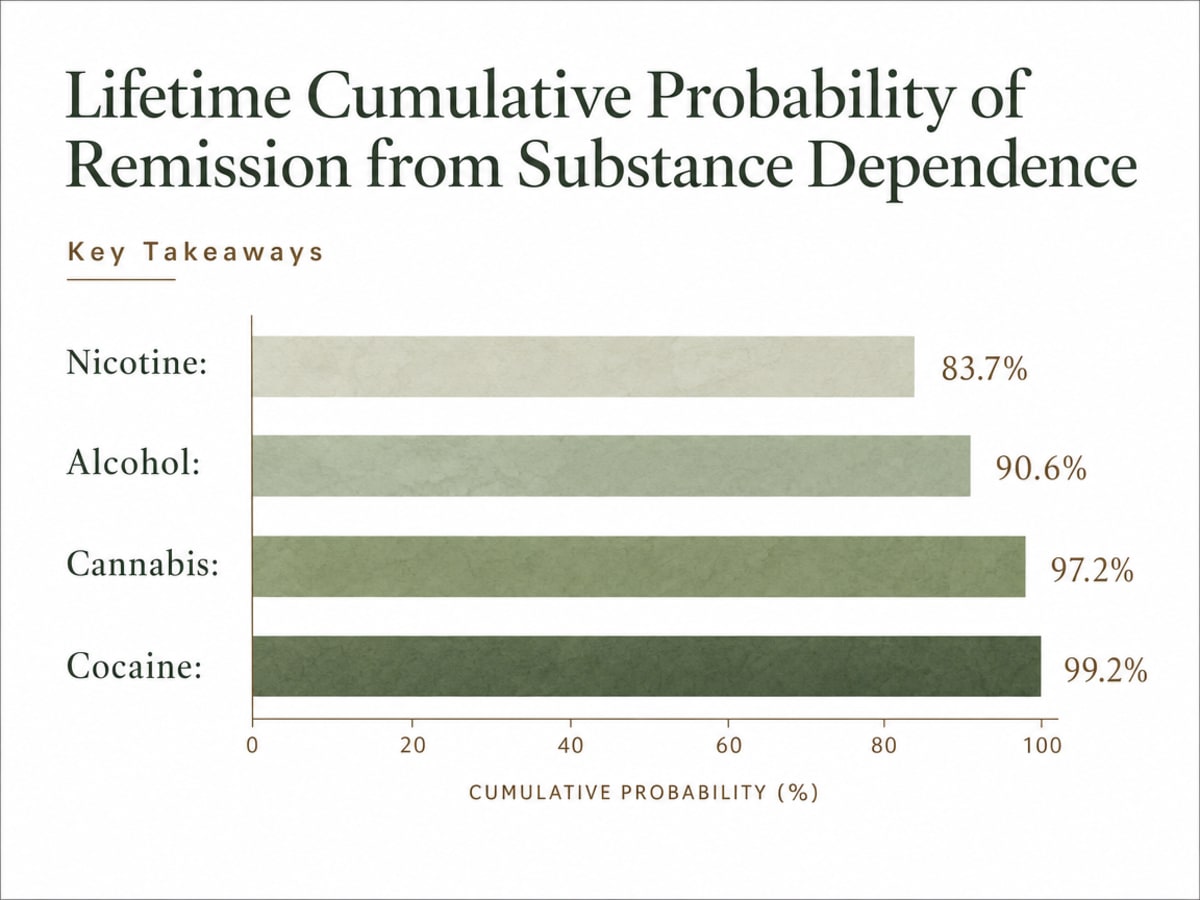
- The 40–60% relapse figure compares addiction to other chronic illnesses, while lifetime data shows cumulative remission above 80% for nicotine and over 90% for alcohol, cannabis, and cocaine 2.
- For dual diagnosis, psychiatric comorbidity raises short-term relapse risk and lowers remission hazards, so treatment that actively addresses both conditions together carries more weight than any single program label 9.
- Continuing care over years, stable social support, and integrated attention to mental health are the variables that consistently move outcomes — far more than the intensity of any single treatment episode 11.
Why the Same Numbers Tell Three Different Stories
If you’ve been reading about addiction recovery, you’ve probably hit a wall of contradictions. One page tells you 40 to 60 percent of people relapse after treatment 7. The next page tells you that more than 80 percent of people eventually remit from substance dependence 12. Both are true. They’re just measuring different things, on different timescales, in different populations.
That mismatch matters, especially if you’re carrying a substance use disorder alongside PTSD, depression, anxiety, or another mental health condition. The headline numbers were rarely built with you specifically in mind, and reading them as a single forecast for your life is a fast way to feel either falsely reassured or unfairly doomed.
Here’s the short version of what’s actually going on. Recovery statistics tend to collapse three very different questions into one figure: What happens in the first year after someone leaves treatment? What happens over the next several years? And what happens across an entire lifetime? Each question has its own answer, its own study design, and its own honest range of outcomes.
The rest of this piece pulls those three timescales apart so you can read any statistic you encounter with a clearer eye, and then looks at what shifts the odds for someone in your situation.
The Three Timescales Hidden Inside One Statistic
Short-Term Relapse: What the 40–60% Figure Actually Describes
You’ve almost certainly seen this one: 40 to 60 percent of people with a substance use disorder relapse. That figure comes from the National Institute on Drug Abuse, and it’s accurate as far as it goes 7. The problem is what it gets used to mean.
NIDA cites that range to make a specific point: relapse rates for addiction are roughly similar to the rates at which people with diabetes, hypertension, or asthma stop following their treatment plans and see their condition flare 7. The framing isn’t “most people fail.” It’s “this is a chronic health condition, and chronic health conditions don’t resolve cleanly on the first try.” Read that way, 40 to 60 percent is a comparison to other illnesses you’d treat without shame, not a verdict on whether recovery is realistic.
Here’s what the number doesn’t tell you:
- It doesn’t specify how long after treatment the relapse happened.
- It doesn’t distinguish between someone who used once and got back on track within a week, and someone who returned to daily use for years.
- It doesn’t account for whether the person had any continuing care, social support, or treatment for a co-occurring mental health condition.
- And it absolutely doesn’t predict where any individual person will be in five or ten years.
If you’re sitting with a dual diagnosis, the relapse figure is also worth reading with an extra grain of salt. Psychiatric comorbidity is one of the variables that raises short-term relapse risk, which the rest of this article will return to. Knowing that doesn’t make the number scarier — it makes it more honest. You’re not reading a statistic about you. You’re reading a statistic about a broad clinical population, and your situation has specific levers that population averages can’t see.
Mid-Range Remission: The First Year After Treatment
Zoom in closer than “lifetime” and the picture looks rougher. One recent clinical study following patients with alcohol and substance use disorders found that only 39 percent remained in remission across a one-year follow-up after treatment 9. If you’re early in recovery and reading that, it can land hard.
So let’s give it the same scrutiny as the 40–60 percent figure. That 39 percent comes from a clinical sample — people who entered formal treatment, which means their problem was severe enough to land them there in the first place. The study also identified specific predictors that pulled the number down: ongoing stress, weak social support, and psychiatric comorbidity 9. Strip those factors out and the rate looks different. Stack them up and it looks worse.
The first year after treatment is, for almost everyone, the hardest stretch. Your brain is still recalibrating. Your routines, relationships, and coping tools are under construction. If you also carry depression, PTSD, anxiety, or bipolar disorder, your nervous system is doing two demanding jobs at once. A one-year snapshot catches you mid-rebuild.
What’s worth holding onto: a setback inside that first year is not the end of the story. It’s a data point in a much longer arc, and the longer arc looks meaningfully different from the one-year window. The next section is where that becomes visible.
Lifetime Resolution: The Number Most Headlines Miss
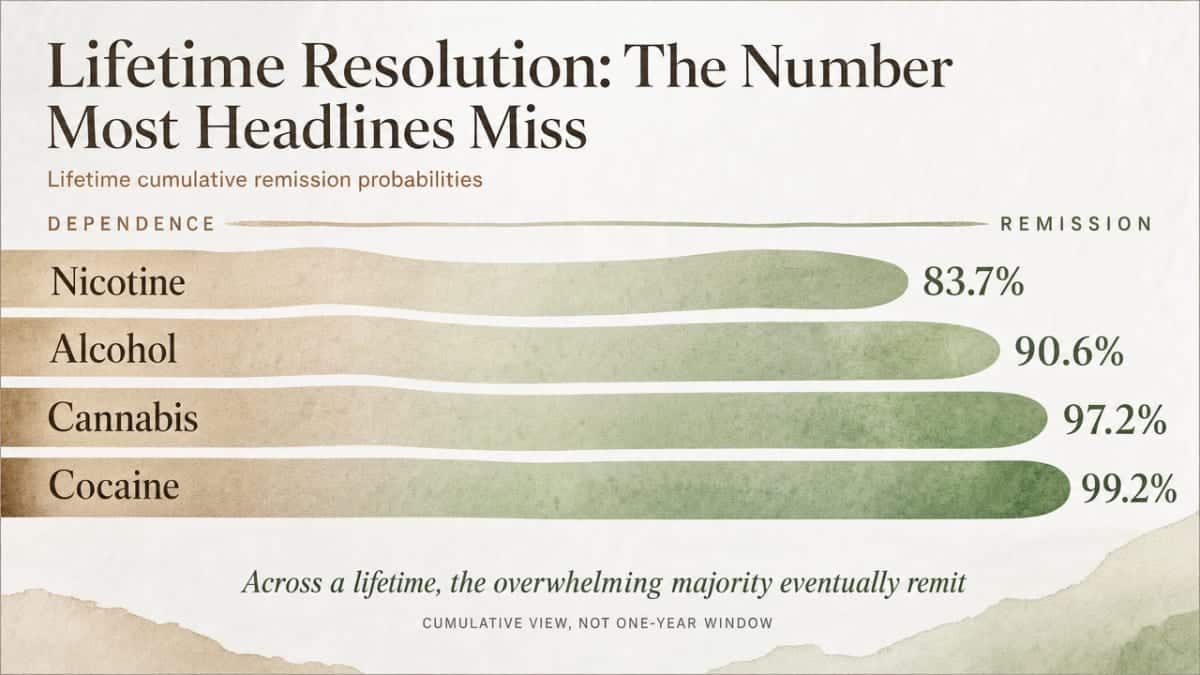
Step back from the one-year window and the numbers reorganize themselves. When researchers used the National Epidemiologic Survey on Alcohol and Related Conditions to track lifetime outcomes, the cumulative probability of remission from dependence was 83.7 percent for nicotine, 90.6 percent for alcohol, 97.2 percent for cannabis, and 99.2 percent for cocaine 2. Read that again. Across a lifetime, the overwhelming majority of people with dependence on these substances eventually remit.
This is not a fringe finding. A separate NIH-backed review pulled the same kind of data together and concluded that remission rates for addictive disorders range from 57 to 83 percent, with cumulative lifetime probabilities above 80 to 90 percent for several substances — directly challenging the popular framing of addiction as an invariably chronic, relapsing condition 12. The authors argue that the chronic-relapsing narrative leaks into public consciousness in part because clinical studies oversample the most severe cases and follow them for short windows.
A few honest caveats. “Eventually” can mean a long time. Median time to remission from onset of dependence is roughly 26 years for nicotine, 14 for alcohol, 6 for cannabis, and 5 for cocaine 10. Lifetime remission doesn’t promise an easy road. It also doesn’t erase the people who don’t remit, who are real and whose stories matter. And remission hazards are lower for people with certain psychiatric comorbidities, which is the dual-diagnosis caveat that runs through this entire piece 2.
What changes when you let this number into the room: short-term relapse stops feeling like prophecy. The first year is the hardest sample of the trajectory, not the trajectory itself. If you’re rebuilding after a setback, the population data says most people in your shoes get there. That’s not a guarantee for you specifically. It’s a meaningful counterweight to the doom that the 40–60 percent figure can drop on a hard day.
Comparing the Numbers Side by Side
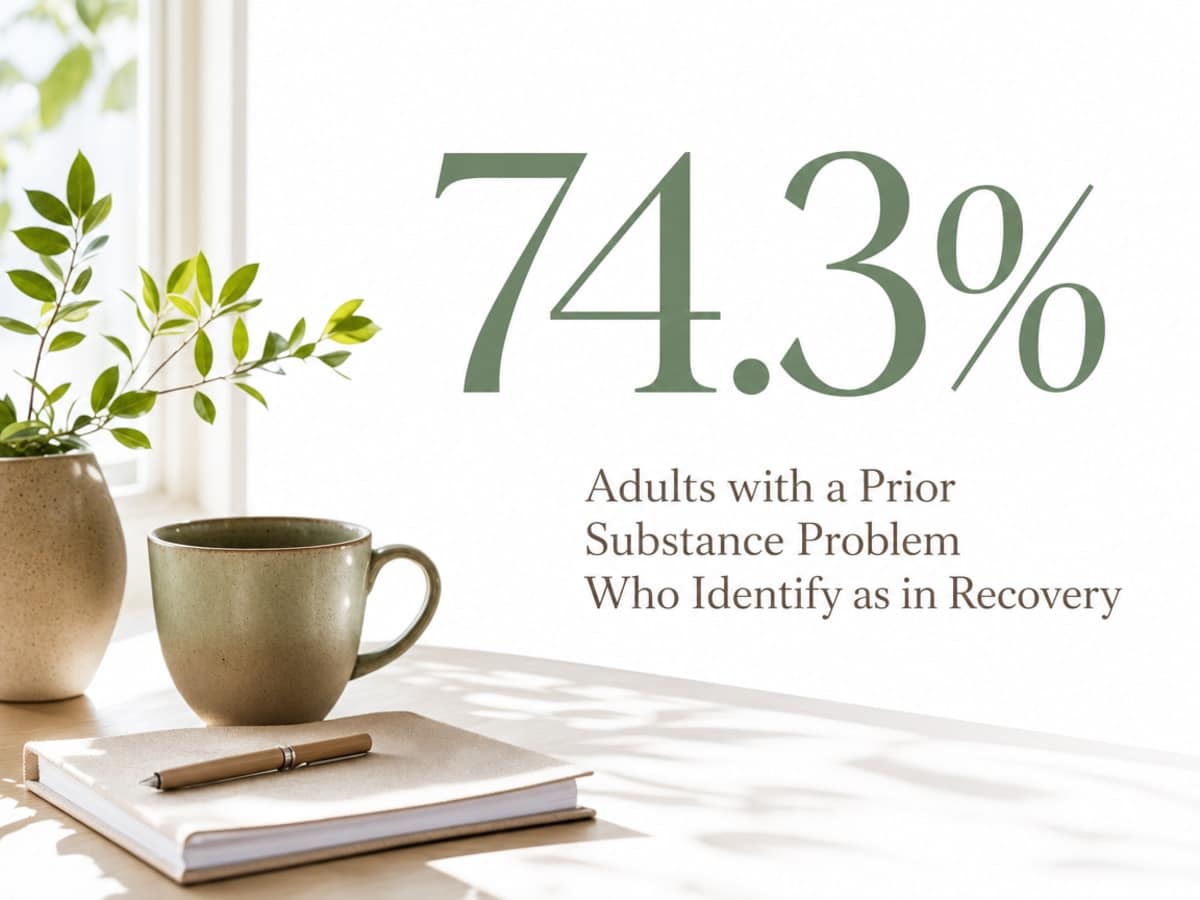
Put the three figures next to each other and the argument of this whole article gets blunt. At one year after treatment, roughly 39 percent of patients in a recent clinical study remained in remission 9. Among U.S. adults who once had a drug or alcohol problem, 74.3 percent — about 23.5 million people — describe themselves as in recovery or recovered 8. And across a full lifetime, cumulative remission probabilities for dependence run above 80 percent for nicotine and above 90 percent for alcohol, cannabis, and cocaine 2.
These are not three competing answers to the same question. They are answers to three different questions, asked of three different groups of people.
The 39 percent comes from a clinical cohort — people who had entered formal treatment, followed for twelve months 9. It tells you how rough the first year tends to be, especially for patients carrying psychiatric comorbidity, weak social support, or chronic stress. It is a near-view of the hardest stretch of the trajectory.
The 74.3 percent comes from a national household survey that asked adults with a past problem whether they consider themselves in recovery now 8. It is self-report, which has limits — but it captures a population that the clinical literature often misses, including people whose recovery never involved a treatment center.
The 80 to 90-plus percent comes from epidemiologic data tracking dependence remission across entire lives 2. It includes people who took decades to get there and people who got there in months. It includes setbacks, restarts, and quiet remissions nobody clinically documented.
When You Carry Both a Substance Problem and a Mental Health Condition
How Common Dual Diagnosis Actually Is
If you’ve ever felt like the standard recovery statistics weren’t quite built for you, your instinct is correct. The general population a study samples and the population you belong to overlap, but they aren’t the same.
More than one in four adults living with serious mental health problems also has a substance use problem 15. That’s not a rare edge case. That’s a quarter of a major clinical population. The conditions cluster together for reasons that won’t surprise you: shared risk factors, self-medication patterns, the way one condition can destabilize the other, and trauma histories that touch both.
What this means for reading statistics: when a headline number comes from a sample of “people with substance use disorder,” a sizable share of those people are carrying what you’re carrying. They’re already inside the data. But the studies rarely break out outcomes for the dual-diagnosis subgroup, which is why population averages can feel both familiar and slightly off.
The other thing worth naming: comorbid psychiatric conditions are repeatedly identified as a predictor of higher short-term relapse risk after treatment 9. Knowing that isn’t meant to discourage you. It’s meant to clarify why your situation deserves treatment that takes both conditions seriously, not a protocol built for one.
What Integrated Care Does and Doesn’t Promise
Integrated treatment — addressing your substance use and your mental health condition in the same program, by a team that talks to each other — is the standard of care for dual diagnosis. SAMHSA recommends it, clinicians recommend it, and the logic is hard to argue with: treating depression while ignoring drinking, or treating drinking while ignoring PTSD, leaves the system that keeps you stuck mostly intact 5, 6.
Here’s the part most consumer-facing content glosses over. The randomized trial evidence on whether integrated programs produce dramatically better substance use and functional outcomes than usual care is mixed. A review of integrated treatment for alcohol use disorder and serious mental illness found that the evidence supporting superior efficacy remains limited, with some systematic reviews showing no significant differences in substance use, functioning, or life satisfaction compared to standard care 4. That’s worth sitting with rather than dismissing.
It doesn’t mean integrated care isn’t worth seeking out. It means the label “integrated” varies wildly in what it actually looks like on the ground. Programs that genuinely coordinate care — same team, same chart, same treatment plan addressing both conditions — operate differently from programs that simply share a building.
What to take from this: if you’re choosing or already in care, the questions worth asking are practical:
- Is your therapist talking to your prescriber?
- Is your trauma work timed and paced around your recovery?
- Are your medications being managed by someone who knows your substance history?
Integrated care isn’t a guarantee that your numbers will look better. It is, when implemented well, a setup that doesn’t ask you to be two separate patients in two separate systems.
The outcome data won’t promise you a specific result. The structural argument is still sound: both conditions are real, both are treatable, and treating them together respects how they actually behave in your life 6.
The Predictors That Actually Move Your Odds
Continuing Care Over Years, Not Weeks
If there’s one variable in the literature that consistently bends outcomes in the direction you want, it’s the length of the engagement, not the intensity of any single episode. A longitudinal study in a large managed-care system found that people who stayed connected to continuing care — routine primary care plus specialty addiction and psychiatric services as needed — had roughly twice the odds of remission at follow-up compared to those who didn’t 11. That’s a real shift, and it comes from staying in contact, not from doing something heroic.
The implication is unflattering to how a lot of treatment gets packaged. A 30-day stay, even a good one, is the beginning of a multi-year process, not the project itself. The brain changes, the relationship rebuilds, the medication adjustments, the trauma work — those take time and a team you can call.
For dual diagnosis, this is especially load-bearing. You need someone managing your psychiatric medication who knows your substance history, and someone managing your recovery who knows your diagnosis. Continuing care is what keeps that conversation going after the discharge paperwork is signed.
Social Context, Stress, and Psychiatric Comorbidity
The same one-year clinical study that produced the 39 percent remission figure also catalogued why people relapsed, and the list is worth memorizing:
- Chronic stress
- Weak social support
- Untreated psychiatric comorbidity 9
NESARC-III data pulls in the same direction, finding that stressful life events are a common correlate of persistent or recurrent substance use disorder across substances 13.
Read that as practical information, not as a threat. The factors driving relapse are the same factors driving most of human struggle, and several of them are modifiable. A stable place to live, people who know what you’re doing and root for it, and active treatment for your depression, PTSD, or anxiety aren’t optional extras stacked on top of “real” recovery. In the data, they are recovery.
Psychiatric comorbidity raises short-term risk, yes 9. It also lowers remission hazards in long-term epidemiologic data 2. Both things are true, and both are reasons your mental health condition needs its own seat at the table — not as a complication to manage around, but as a condition being actively treated alongside the substance use.
Recovery Without (or Alongside) Formal Treatment
Here’s a piece of the picture most clinical literature understates: a lot of recovery happens outside treatment centers. A nationally representative study found that 9.1 percent of U.S. adults report having resolved a significant alcohol or drug problem — tens of millions of people — and the pathways they took were genuinely varied. Some went through formal treatment. Others relied on mutual-help groups. A meaningful share got there through what researchers call natural recovery, without specialty services at all 1.
That doesn’t make treatment unnecessary. For dual diagnosis especially, going it alone is a steeper climb — psychiatric medication, trauma work, and substance recovery are hard to coordinate from your kitchen table. But the data should change how you read your own situation. If you’ve worked with a therapist, leaned on a recovery community, made changes during a sober stretch between programs, or quietly resolved a problem years ago that no chart ever recorded, that counts. The studies that produce headline statistics often miss it entirely.
The practical read: formal treatment is one route among several, and the routes often blend. What the population data keeps showing is that resolution is common across all of them 1.
What ‘Success’ Means in Modern Outcome Research
One reason recovery statistics feel slippery is that researchers themselves have moved past a single definition of “success.” A 2025 systematic review of substance use disorder treatment outcomes catalogued the measures studies actually use, and the list is long:
- Adherence
- Engagement
- Relapse
- Readmission
- Retention
- Abstinence
- Dropout
- Quality of life 14
Different studies pick different endpoints, which is part of why two papers on the “same” question can land on numbers that look incompatible.
The shift is meaningful for you. Abstinence is still tracked, but it’s no longer the only marker that counts as a good outcome. Reduced use, longer stretches between episodes, better functioning at work and at home, fewer hospitalizations, and improvements in how your life actually feels are all being measured as real progress 14. For dual diagnosis, that broader frame matters even more, because mental health stabilization rarely shows up as a clean before-and-after.
When you read a study or a program’s outcome numbers, the useful question isn’t “did everyone stay sober?” It’s “what did they measure, over how long, and does that match what recovery looks like for me?”
Reading Your Own Numbers Honestly
So what do you do with all of this on a Tuesday afternoon, when the statistics feel personal and the next year feels long?
Start by naming which number you’re actually looking at. Is it a one-year clinical follow-up, a self-report survey, or a lifetime epidemiologic estimate? Each tells you something different, and none of them tells you your future. The honest read is that early recovery is statistically the hardest stretch, and the long arc, for most people with dependence, bends toward remission 12.
Then look at the levers the research keeps pointing to: continuing care that lasts years rather than weeks, integrated attention to your mental health condition alongside the substance use, and the social context around you 11, 9. Those aren’t soft extras. In the data, they’re where the odds actually move.
If you’re carrying both diagnoses and trying to find care that treats them together, that’s a reasonable place to put your energy next — and a reasonable conversation to start with a team like Arrow Passage Recovery.
Talk With Someone Who Understands Recovery Statistics
Connect directly for honest answers about your recovery journey and what statistics really mean for you.
Talk with Someone Who Understands Dual Recovery
Get support interpreting recovery statistics for your unique dual diagnosis experience and next steps.
Frequently Asked Questions
Does a 40–60% relapse rate mean I’ll probably relapse?
Not exactly. The 40–60% figure from NIDA describes how often people with substance use disorders return to use, and it’s framed as comparable to how people with diabetes or asthma struggle to stick with treatment plans 7. It’s a population average across short windows, not a forecast for you. Your continuing care, social support, and treatment for any co-occurring condition all shift where you land in that range.
If lifetime remission rates are so high, why do short-term studies look so discouraging?
Short-term studies usually follow clinical samples — people whose problem was severe enough to enter treatment — for a single year, when the first twelve months are statistically the hardest stretch 9. Lifetime studies follow broader populations across decades and catch the slow remitters, the restarts, and the quiet resolutions. Both are accurate; they’re measuring different parts of the same trajectory 12.
How do recovery statistics change when I have both a substance use disorder and a mental health condition?
Psychiatric comorbidity is consistently linked to higher short-term relapse risk after treatment 9 and somewhat lower remission hazards in long-term data 2. That doesn’t erase the broader pattern of eventual remission — it does mean your situation deserves treatment that addresses both conditions actively. More than one in four adults with serious mental health problems also has a substance use problem, so you’re not an outlier in the data 15.
Does integrated treatment for dual diagnosis actually improve my odds?
SAMHSA and most clinical guidelines recommend integrated care, and the structural argument is sound: treating both conditions together respects how they actually behave 6. The honest caveat is that randomized trial evidence on superior substance and functional outcomes versus usual care is mixed, partly because “integrated” varies a lot in practice 4. Well-implemented coordination — same team, shared plan — is what the model actually requires.
Can people recover without going through formal treatment?
Yes, and it happens more than headlines suggest. A nationally representative study found 9.1% of U.S. adults report resolving a significant alcohol or drug problem, through formal treatment, mutual-help groups, or natural recovery without specialty services 1. For dual diagnosis, going entirely alone is harder because psychiatric medication and trauma work need clinical support, but informal paths still count and often blend with formal care over time.
What does ‘success’ mean in modern addiction treatment research?
It’s no longer just abstinence. A 2025 systematic review of SUD treatment outcomes catalogued the measures studies actually use — adherence, engagement, relapse, readmission, retention, abstinence, dropout, and quality of life 14. Reduced use, longer stretches between episodes, better daily functioning, and fewer hospitalizations all register as real progress. When you read program outcomes, ask what they measured and over how long before you compare numbers.
References
- Prevalence and pathways of recovery from drug and alcohol problems in the United States population: Implications for practice, research, and policy. https://pmc.ncbi.nlm.nih.gov/articles/PMC6076174/
- Probability and predictors of remission from lifetime nicotine, alcohol, cannabis or cocaine dependence: results from the National Epidemiologic Survey on Alcohol and Related Conditions. https://pubmed.ncbi.nlm.nih.gov/21077975/
- Probability and predictors of transition from first use to dependence on nicotine, alcohol, cannabis, and cocaine: Results of the National Epidemiologic Survey on Alcohol and Related Conditions (NESARC). https://pubmed.ncbi.nlm.nih.gov/21145178/
- Integrating treatment for co-occurring mental health conditions into alcohol use disorder treatment. https://pmc.ncbi.nlm.nih.gov/articles/PMC6799972/
- Managing life with co-occurring disorders. https://www.samhsa.gov/mental-health/serious-mental-illness/co-occurring-disorders
- Co-occurring disorders and other health conditions (treatment). https://www.samhsa.gov/substance-use/treatment/co-occurring-disorders
- Drugs, Brains, and Behavior: The Science of Addiction – Treatment and Recovery. https://nida.nih.gov/publications/drugs-brains-behavior-science-addiction/treatment-recovery
- SAMHSA Releases Annual National Survey on Drug Use and Health. https://www.samhsa.gov/newsroom/press-announcements/20250728/samhsa-releases-annual-national-survey-on-drug-use-and-health
- Factors Associated with Relapses in Alcohol and Substance Use Disorders. https://pmc.ncbi.nlm.nih.gov/articles/PMC11075040/
- Probability and predictors of remission from life-time nicotine, alcohol, cannabis or cocaine dependence: Results from the National Epidemiologic Survey on Alcohol and Related Conditions. https://pmc.ncbi.nlm.nih.gov/articles/PMC3227547/
- Continuing care and long-term substance use outcomes in managed care: early evidence for a primary care–based model. https://pmc.ncbi.nlm.nih.gov/articles/PMC3242696/
- Is addiction really a chronic relapsing disorder?. https://pmc.ncbi.nlm.nih.gov/articles/PMC7739524/
- Persistence/recurrence and remission from DSM-5 substance use disorders in a nationally representative sample. https://pmc.ncbi.nlm.nih.gov/articles/PMC6237097/
- Substance use disorder treatment outcomes: A systematic review. https://pmc.ncbi.nlm.nih.gov/articles/PMC12180564/
- Mental health and substance use co-occurring disorders. https://www.samhsa.gov/mental-health/what-is-mental-health/conditions/co-occurring-disorders