
Key Takeaways
- Cleveland families often cycle through treatment because most programs handle addiction or mental health separately, while co-occurring conditions need one team treating both on a single plan 1, 4.
- Local risk has shifted: fentanyl was present in 90% of Cuyahoga County accidental opioid overdose deaths, raising the stakes of leaving untreated anxiety, PTSD, or depression driving substance use 7.
- You don’t need a formal psychiatric diagnosis to start — about two-thirds of Ohio drug court participants report serious symptoms while only a quarter have a diagnosis on paper 8.
- Before committing, compare programs on three things: one shared treatment plan, a psychiatric prescriber on staff, and whether relapse is treated as clinical information rather than grounds for discharge 4.
What Cleveland families keep running into when addiction and mental health overlap
You’ve probably been here before. Maybe your husband finished a 30-day program in Lakewood and came home sober, then stopped sleeping, stopped eating, and picked up again by week six. Maybe your daughter got a depression diagnosis at 17 and started drinking to quiet it down, and now nobody seems sure which came first. Maybe you’re the one making the call for yourself, sitting in your car outside a Giant Eagle, tired of being told you’re two separate problems that need two separate lines of care.
That split — addiction on one side, mental health on the other — is the pattern Cleveland families keep hitting. And it isn’t a story about willpower or bad luck. Co-occurring mental illness and substance use is common. SAMHSA’s 2024 national survey estimates about 21.2 million U.S. adults had both in the past year 5. In the Cleveland-Elyria-Mentor metro, the same survey tracks meaningful rates of substance use disorder and major depressive episodes side by side 12.
What follows is a plain-language guide to what real integrated treatment looks like locally, how to tell whether a program actually treats both conditions at once, and what the road from first call to steady footing tends to involve. You don’t have to figure this out alone, and you don’t have to keep repeating the same loop.
Why past treatment may not have worked — and what that says about the system, not you
The ‘get sober first, then we’ll deal with the trauma’ problem
If you’ve heard some version of “let’s get you clean, and then we’ll look at the anxiety,” you’re not imagining that split. It’s still the default in a lot of places. You go to a treatment center for the drinking or the pills, and the trauma, the panic attacks, the depression that made drinking feel like the only working tool — those get parked for later.
The trouble is that “later” often doesn’t come. You leave treatment with the substance handled on paper, but the reason you were using never got touched. So the nightmares come back. The 3 a.m. dread comes back. And the thing that used to quiet it comes back too.
SAMHSA is pretty direct about this: integrated care for co-occurring disorders is linked to reduced substance use and improvement in psychiatric symptoms at the same time 4. Treating one and postponing the other isn’t a gentler path. For a lot of people, it’s the path that leads right back to the emergency room.
How few programs are actually built to treat both at once
Here’s the piece nobody tends to say out loud when you’re standing in an intake office: most programs, in Ohio and across the country, aren’t structured to treat both sides of what you’re carrying. They may be excellent at one lane. They may even mean it when they say they “handle” dual diagnosis. But structurally, they’re set up for addiction or for mental health — not both, running together, on one plan.
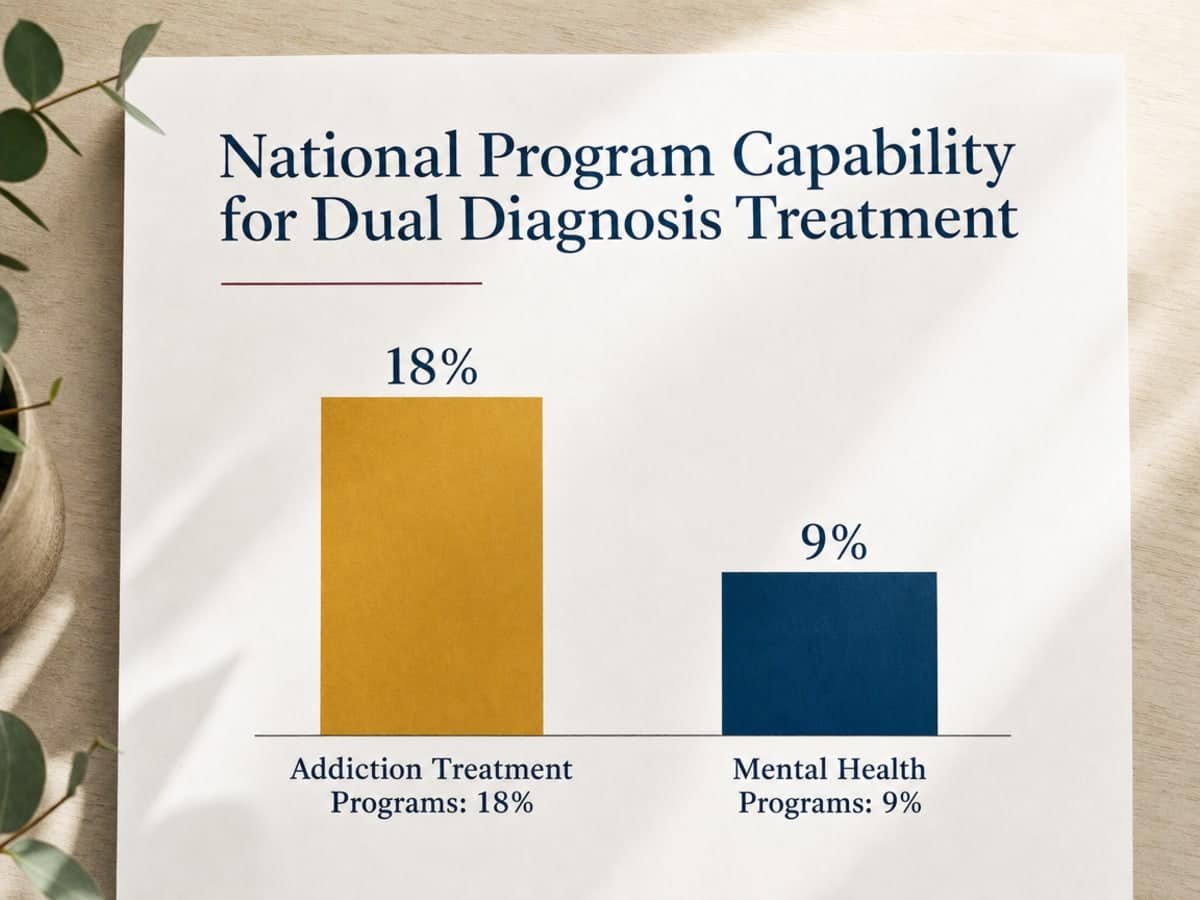
A national survey of treatment programs used two standardized measuring tools — the DDCAT for addiction programs and the DDCMHT for mental health programs — to check whether services were actually capable of treating co-occurring disorders. About 18% of addiction treatment programs and roughly 9% of mental health programs met the criteria for “dual diagnosis capable” care 1. This was a program-level review of what staffing, screening, and clinical practices programs had in place, not a study of patient outcomes. But the takeaway lands hard: the majority of programs you might have walked into were, by design, built for one condition.
Read that number for what it is. If your last program didn’t seem to know what to do with your PTSD, or brushed off your bipolar meds, or told your family member their depression would “lift once they stopped drinking” — that wasn’t a personal failure. That was the odds. You were probably inside one of the roughly 80% or 90% of programs that weren’t fully equipped for what you brought in the door.
What co-occurring disorders actually look like in Cuyahoga County
Local numbers that shape the risk: fentanyl saturation and who is dying
The Cleveland you’re living in right now is not the Cleveland of a decade ago when it comes to drug supply. That matters, because the risk math you’re carrying — especially if you have untreated anxiety, PTSD, or depression driving your use — is not the same risk math your cousin faced in 2013.
In a peer-reviewed review of accidental opioid-related overdose deaths in Cuyahoga County, fentanyl and its analogs were present in 90% of decedents, and the number of African American decedents rose roughly four-fold over a two-year window 7. That’s not a scare stat. It’s the practical shape of what “one bad night” now means here. A pill that looks like something from a pharmacy may not be. A bag that used to feel predictable isn’t. And the person most likely to use alone, or use more when the trauma flares, is often the same person who’s been told for years that their mental health can wait.
You already know this in your body. The point of naming the numbers is this: if you’re using to quiet a symptom, the supply has changed enough that treating only one side of what’s going on is a bet with worse odds than it used to be.
When symptoms are real but a diagnosis hasn’t been made yet
Something you may not have been told: you don’t need a folder full of diagnoses to have a co-occurring problem. A lot of people carrying real symptoms have never sat across from a psychiatrist long enough to get one on paper.
Ohio’s own courtroom data makes that gap visible. In training material prepared for problem-solving courts, roughly two-thirds — about 66.7% — of drug court participants report serious mental health symptoms, while only about 25% have a formally diagnosed Axis I disorder like major depression, bipolar disorder, PTSD, or another anxiety disorder 8. Read that twice. The symptoms are there. The chart entry, in most cases, isn’t.
If that mirrors your experience — you know something’s off, you’ve known for years, but nobody has ever put a name on it — you’re not making it up, and you’re not exaggerating to justify your use. You’re in the majority. A dual diagnosis capable program should be able to start assessing what’s happening from the first week, not send you away to “come back with a diagnosis first.” You bring the symptoms. Assessing them is their job.
How common this really is — you are not the exception
One of the quiet cruelties of co-occurring disorders is the feeling that you’re the strange case. The one who drinks and has panic attacks. The one whose depression got worse after they quit. The one whose PTSD flared the moment the pills stopped.
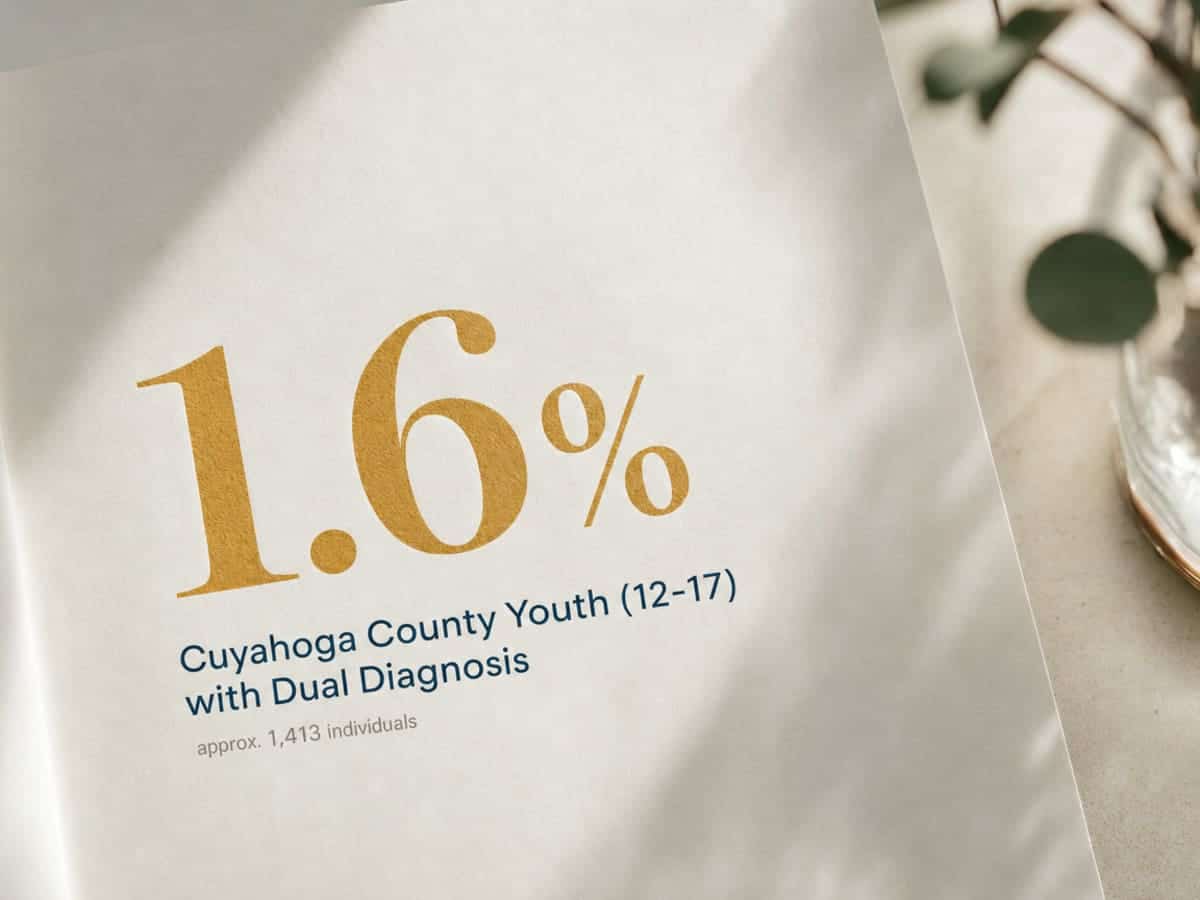
You are not the strange case. A national study of adults with either a psychiatric disorder or a substance use disorder found that dual diagnosis shows up in about 25.8% of those with any psychiatric disorder and 36.5% of those with any substance use disorder 9. Roughly one in four on one side. More than one in three on the other. In Cuyahoga County specifically, the 2020 needs assessment estimated that around 1,413 youth ages 12 to 17 — about 1.6% of that age group — carry both a major depressive episode and substance dependence or abuse 6. That’s a classroom in every high school.
Whatever you’ve been telling yourself about being an outlier, the data doesn’t back it up. You’re inside a very well-documented pattern, and that pattern has treatment models built for it.
Integrated, co-located, coordinated: the words that decide your care
The three models, in plain English
When you start calling around, you’ll hear the same phrase from almost every program: “Yes, we treat dual diagnosis.” That phrase covers three very different setups, and the difference matters more than the marketing does.
- Coordinated care
- Means you have an addiction provider and a mental health provider, and they talk to each other. Sometimes. You’re still the one driving to two buildings, keeping two intake stories straight, and hoping the therapist and the counselor sync up on your meds. It’s better than nothing. It’s not the same thing as integrated care.
- Co-located care
- Means both services live under one roof. Same waiting room, maybe even the same front desk. Your addiction counselor is down the hall from your psychiatrist. That’s useful. But two people in the same building isn’t automatically one team.
- Fully integrated care
- Means one clinical team, one treatment plan, both conditions treated at the same time by providers who share your chart, your goals, and your setbacks.
SAMHSA describes these three tiers directly and points to integrated treatment as the model linked with reduced substance use and improvement in psychiatric symptoms at once 4. When you ask a Cleveland program which of the three they actually run, listen for the answer that includes one plan, not two.
‘No wrong door’ — what it means when you make the first call
You might not know which door you’re supposed to walk through. Are you an addiction patient with anxiety, or an anxiety patient who drinks? The good news: it’s not your job to sort that out before you call.
The “no wrong door” principle, promoted by SAMHSA and echoed in the national program-capability research, means a well-built system should meet you wherever you enter — addiction line, mental health line, ER, primary care — and route you into care that treats both sides 4, 1. You shouldn’t have to hang up and dial a different number because you led with the wrong symptom.
If a Cleveland program tells you to “call the mental health side first, then come back,” that’s a signal. A dual diagnosis capable program takes the whole call.
How to vet a Cleveland program before you commit
Questions to ask on the phone
The first call is where a lot gets decided, and you don’t have to be a clinician to run it well. You’re allowed to interview them. That’s the reframe: the intake coordinator is not a gatekeeper you have to impress. They’re the person you’re deciding whether to trust with two conditions at once.
Keep a short list next to the phone. These questions do real work:
- Do you treat both my substance use and my mental health at the same time, on one treatment plan? Listen for “one plan, one team.” If the answer drifts into “we’ll refer you out for the mental health piece,” that’s coordinated care, not integrated care 4.
- Who prescribes my psychiatric medications, and are they on staff? A psychiatrist or psychiatric nurse practitioner inside the program is a different animal than a referral across town.
- Do I need a mental health diagnosis before I start? The right answer is no. Assessment is part of the work 8.
- Will you keep me if I relapse? A program that discharges you for using is not built for dual diagnosis.
- What does your team do when the trauma work stirs things up and I want to use? You want a specific answer, not a slogan.
Write down what they say. If two programs give you very different answers to the same question, that gap is your data.
Signals that a program is dual diagnosis capable, not just dual diagnosis marketed
Marketing is cheap. Structure is not. Here’s what to listen and look for once you’re past the sales language.
Green flags. One shared chart across your addiction counselor and your prescriber. A psychiatric provider embedded in the program, not consulted from outside. Screening for trauma, depression, anxiety, and bipolar symptoms during the first week — not at week six. Willingness to keep your existing psychiatric meds stable while you stabilize on the substance side. Language about the “no wrong door” approach, meaning they take the whole call regardless of which symptom you led with 4. Family involvement offered, not just tolerated.
Yellow and red flags. “Get sober first, then we’ll refer you out for the depression.” A program that can’t tell you who prescribes your psychiatric medications. Any hint that a relapse means automatic discharge. Vague answers about how the addiction team and mental health team actually communicate. Remember, the national program-capability data suggests most programs weren’t built for both sides at once 1— so a vague answer usually means the honest one is “we’re not really set up for this.”
Evidence that integrated care actually changes outcomes in Ohio
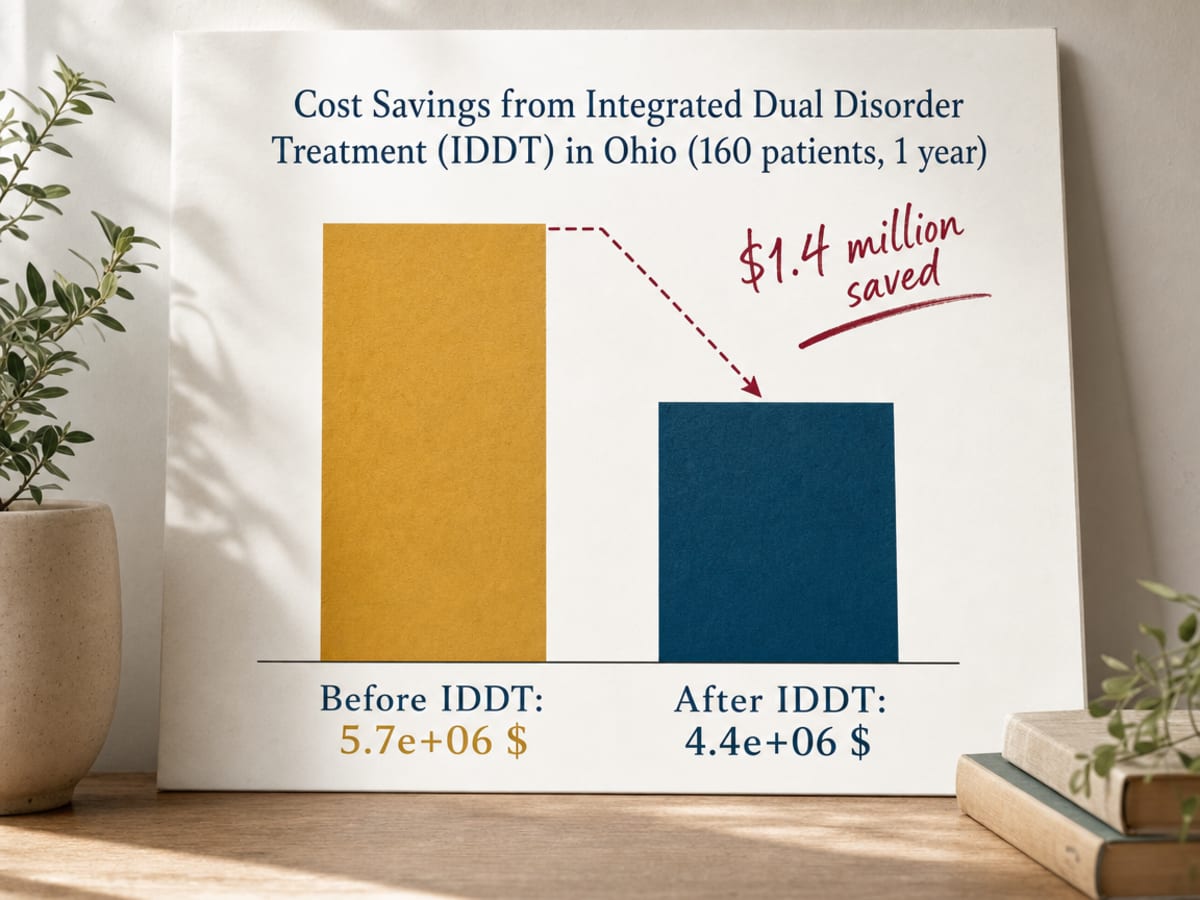
Here’s the part that isn’t a promise from a brochure. It’s a claims-data analysis, run on Ohio Medicaid beneficiaries, right here in the state you live in.
A few things to hold with that number. This was an initial analysis focused on high utilizers — people who were already using a lot of care because nothing was working. It’s not a randomized trial, and it doesn’t tell you exactly what your outcome will be. What it does tell you is that when Ohio finally put both conditions on one plan, the churn slowed down. Fewer emergency room trips. Fewer inpatient stays. Fewer crisis calls at 2 a.m.
Translate that from a spreadsheet back into a life. Cost going down for the system usually means the person stopped needing rescue as often. It means sleeping in the same bed for months in a row. It means the ER staff stops recognizing you by name. Integrated care isn’t a nicer version of the same treatment you already tried — it’s a structurally different approach, and Ohio’s own numbers show it moves the needle.
What the first 90 days can actually look like
From first call to intake
The first call is usually shorter than you expect. Fifteen, twenty minutes. Someone asks what’s been going on, what you’re using, what else is happening — the sleep, the panic, the flashbacks, the fights at home. If they’re set up for dual diagnosis, they don’t make you pick a lane. They take the whole story.
From there, most Cleveland-area programs move to a fuller assessment within a few days. That’s where a real integrated team screens for trauma, depression, anxiety, bipolar symptoms, and substance use in the same sitting — not one intake for the addiction side and a separate one to schedule later 4. Bring your medication list. Bring the name of anyone who’s prescribed for you before, even if it was years ago. If you have an old diagnosis that never fit, say so out loud. That’s useful information, not a complaint.
Detox, stabilization, and the myth of ‘sober first’
If you need medical detox, that comes first — not because your mental health can wait, but because your body needs to be safe before deeper work can start. Detox typically runs three to seven days for alcohol, opioids, or benzodiazepines. That’s a medical timeline, not a moral one.
Here’s the piece that gets lost. In an integrated program, the psychiatric work doesn’t sit on a shelf while you detox. Your existing psychiatric medications generally stay stable. A prescriber checks in. Someone asks how the nightmares are, not just how the cravings are. The trauma work — the deeper EMDR or exposure pieces — may wait a few weeks until you’re steady enough to do it without unraveling. That’s clinical pacing, not “get sober first, then we’ll deal with it.” SAMHSA is clear that treating both together is what’s linked to reduced substance use and improvement in psychiatric symptoms at the same time 4. Pacing is not the same as postponing.
What steady progress looks like in real life
Ninety days in, the wins are quieter than the movies make them look. You sleep through the night three times in a row. You have one honest conversation with your therapist about what actually happened when you were fifteen. You go a full week without a panic attack in the grocery store parking lot. You take your medication at the same time every day for a month and stop bracing for it to stop working.
Those are the markers. Not a certificate, not a big speech. Small, repeatable things. If you’re on an integrated team, your addiction counselor and your prescriber both know when you had a hard weekend, and neither one is surprised. You stop having to explain yourself twice. That’s what steady looks like — and for a lot of people in Cleveland, it’s the first time the ground has held.
If you’re the family member making the call
A quick shift in who this is for: if you’re the spouse, parent, adult child, or sibling doing the research, the rest of this guide still applies — but a few things are yours specifically.
First, you don’t need their permission to gather information. Calling a program, asking the vetting questions from earlier, and learning what integrated care looks like is work you can do tonight, without waking anyone up. Bring what you know: the substances, the sleep, the mood swings, the missed work, any old prescriptions. You are not tattling. You are handing a clinical team the pieces they need.
Second, the person you love doesn’t have to accept a label to get help. Many people carrying real symptoms have never had a formal diagnosis on paper 8. A dual diagnosis capable program can assess without demanding that someone call themselves an addict or agree they’re mentally ill on day one.
Third — take care of yourself in this. Family involvement helps, but you can’t out-love a co-occurring disorder alone.
A steadier next step
If you’ve read this far, you already know more than most people who walk into an intake office. You know the difference between coordinated, co-located, and fully integrated care. You know what to ask on the phone. You know that if a program says “get sober first,” you’re allowed to keep dialing.
The next step is small. One call. One assessment. One team that takes the whole story on the first try. That’s what teams like Arrow Passage Recovery are built for — both conditions, one plan, in a setting close to home. You don’t have to have it all figured out before you pick up the phone.
Start Your Cleveland Dual Diagnosis Journey Today
Connect right now for supportive guidance tailored to your dual diagnosis needs in Cleveland.
Start Your Dual Diagnosis Recovery Conversation Today
Connect with a supportive professional to explore next steps for integrated mental health and addiction care.
Frequently Asked Questions
Will I have to detox and get sober before anyone treats my mental health?
No. Medical detox comes first only when your body needs it to be safe, and it typically runs three to seven days. In an integrated program, your psychiatric care doesn’t pause during detox — a prescriber checks in, meds generally stay stable, and both conditions get treated together on one plan 4.
What if I don’t have a formal mental health diagnosis yet?
You don’t need one to start. In Ohio drug court populations, about two-thirds of participants report serious mental health symptoms while only about a quarter carry a formal Axis I diagnosis 8. A dual diagnosis capable program screens and assesses during the first week — bringing symptoms is enough.
How do I know if a Cleveland program is actually equipped to treat both conditions at the same time?
Ask three things: Is there one treatment plan or two? Is a psychiatric prescriber on staff, not referred out? Will you be kept if you relapse? Fully integrated care means one team sharing your chart — not coordinated referrals across town 4. Vague answers usually mean the honest one is no.
Does Ohio Medicaid or private insurance cover dual diagnosis treatment?
Ohio Medicaid has covered Integrated Dual Disorder Treatment for people with severe mental illness and co-occurring substance use disorders — the claims-data analysis behind IDDT’s cost savings drew from Medicaid beneficiaries directly 2. Private plans vary. Call the program and ask them to verify your specific benefits before intake.
My family member won’t call themselves an addict or accept a mental illness label. Can they still get help?
Yes. Labels aren’t the price of admission. Many people with real symptoms have never had a formal diagnosis on paper 8, and a dual diagnosis capable program can assess without demanding self-identification on day one. You can call, ask questions, and gather information tonight without their permission.
What happens if I relapse during treatment?
In a program built for dual diagnosis, a relapse is clinical information, not grounds for discharge. Your addiction counselor and prescriber both learn what happened, adjust the plan, and keep going. If a program tells you relapse means you’re out, that’s a signal it isn’t structured for co-occurring care 4.
References
- Dual diagnosis capability in mental health and addiction treatment services: a national survey of programs. https://pmc.ncbi.nlm.nih.gov/articles/PMC3594447/
- Data analysis of Integrated Dual Disorder Treatment reveals cost savings for State of Ohio. https://case.edu/socialwork/centerforebp/stories/data-analysis-integrated-dual-disorder-treatment-reveals-cost-savings-state-ohio
- Integrated Co-Occurring Treatment. https://case.edu/socialwork/begun/consultation-and-training/center-innovative-practices-cip/evidence-based-interventions/integrated-co-occurring-treatment
- Managing Life with Co-Occurring Disorders. https://www.samhsa.gov/mental-health/serious-mental-illness/co-occurring-disorders
- Co-Occurring Disorders and Other Health Conditions. https://www.samhsa.gov/substance-use/treatment/co-occurring-disorders
- Alcohol, Drug Addiction and Mental Health Services Board of Cuyahoga County: Needs Assessment 2020. https://health.csuohio.edu/sites/default/files/CuyahogaCountyNeedsAssessment2020.pdf
- Trends in opioid overdose fatalities in Cuyahoga County, Ohio. https://pmc.ncbi.nlm.nih.gov/articles/PMC9948855/
- Co-Occurring Disorders: Expanding your Court’s Treatment Options. https://www.supremecourt.ohio.gov/sites/specDockets/2019/materials/D4/D4.pdf
- Rates and correlates of dual diagnosis among adults with psychiatric disorders and substance use disorders in the United States. https://pubmed.ncbi.nlm.nih.gov/35834863/
- Prevalence of Dual Diagnoses among Children and Adolescents with Mental Health and Substance Use Disorders. https://pmc.ncbi.nlm.nih.gov/articles/PMC9955022/
- SAMHSA Releases Annual National Survey on Drug Use and Health. https://www.samhsa.gov/newsroom/press-announcements/20250728/samhsa-releases-annual-national-survey-on-drug-use-and-health
- Substance Use and Mental Disorders in the Cleveland-Elyria-Mentor, OH Metro Area. https://www.samhsa.gov/data/sites/default/files/NSDUHMetroBriefReports/NSDUHMetroBriefReports/NSDUH-Metro-Cleveland.pdf