
How to Find a Safe Alcohol & Drug Recovery Center
Key Takeaways
- Verify state licensure first, confirming the license is active and its category authorizes residential care, since Ohio DBH oversees more than 2,300 behavioral health providers 13, 14.
- Check accreditation through CARF, COA, or The Joint Commission directories, treating it as a baseline quality floor rather than a guarantee of your outcome 8, 15.
- Confirm on-site medical capability for withdrawal, including nursing coverage and FDA-approved medications, because unmanaged alcohol or benzodiazepine detox can trigger seizures 10.
- Look for ASAM-based assessment that matches you to the right level of care instead of slotting everyone into the same 30-day track 10.
- Choose a program where one clinical team treats addiction and mental health together, since integrated care outperforms parallel or sequential treatment for co-occurring conditions 2, 3.
- Require a written discharge plan with scheduled follow-up, continued medications, and step-down care, because continuity after residential is a tracked quality measure 6.
What ‘safe’ actually means when you’re choosing a place to detox
If you’re reading this while shaky, hungover, or one bad night away from another crisis, take a breath. Looking at recovery centers when you still feel the pull of using is one of the hardest things a person can do. You’re already doing the work.
Here’s the thing nobody tells you: “safe” doesn’t mean the pictures on the website look calming. It doesn’t mean the dining room has nice chairs. It doesn’t mean a celebrity went there. Those are marketing choices. They tell you almost nothing about whether you’ll be okay during your first 72 hours off alcohol or opioids, and whether you’ll still be okay six months after you walk out the door.
Safe means something specific. It means the building is licensed by your state to provide the level of care you actually need 13. It means a nationally recognized body has reviewed the program against quality standards 15. It means there are people on-site who can manage your withdrawal medically, treat the depression or PTSD riding alongside your addiction, and hand you off to real follow-up care when residential ends.
This guide walks you through how to check each of those things yourself, in one afternoon, before you commit to anything.
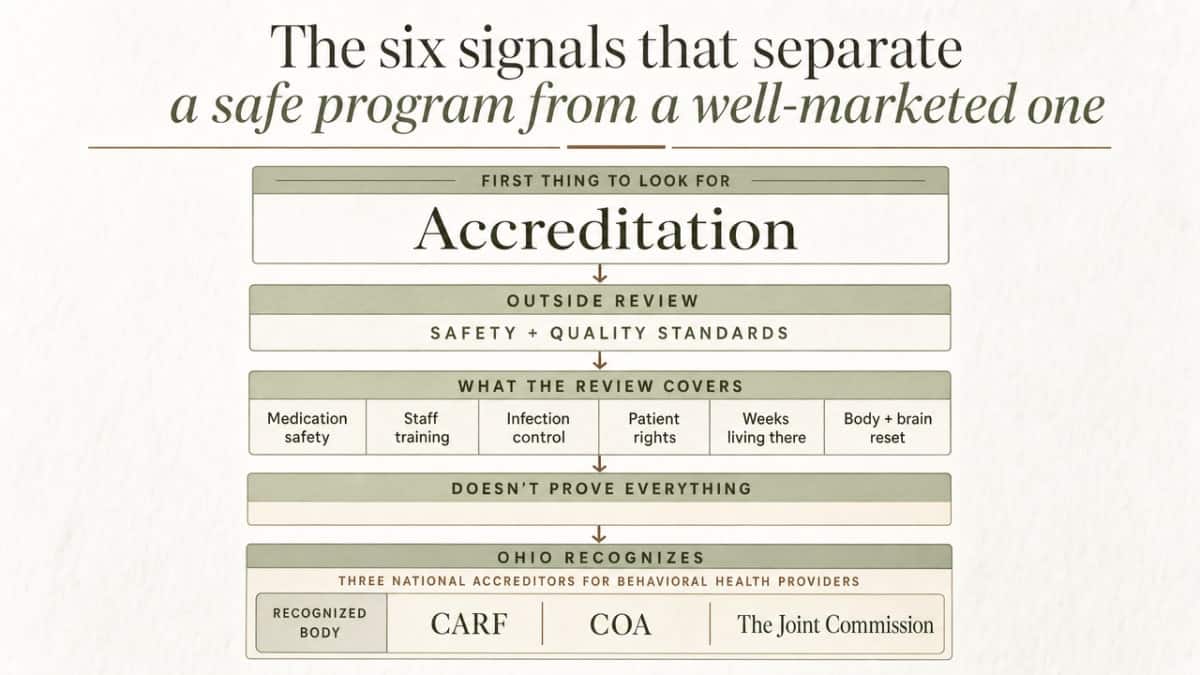
The six signals that separate a safe program from a well-marketed one
Accreditation from a recognized body (and what it does and doesn’t promise)
Accreditation is the first thing to look for, but you should know exactly what it means before you treat it as proof of anything. When a center is accredited, an outside organization has reviewed how it runs against a set of safety and quality standards. The Joint Commission, for example, exists to evaluate health care organizations and push them toward safer, more effective care 15. That review covers things like medication safety, staff training, infection control, and patient rights. Those are not small details when you’re going to spend weeks living somewhere while your body and brain reset.
In Ohio, the Department of Behavioral Health formally recognizes three national accreditors for behavioral health providers: CARF, COA, and The Joint Commission 8. If a center claims accreditation from one of these bodies, you can verify it directly through the accreditor’s online directory. If the name on the website is something you’ve never heard of, or the seal isn’t searchable, treat that as a flag.
Here’s what accreditation does not promise: it is not a guarantee of a good outcome for you specifically 15. It tells you the program has met a baseline. It does not tell you how kind the night staff is at 3 a.m. Use it as a floor, not a ceiling.
Active state licensure you can look up yourself
Accreditation is voluntary. State licensure isn’t. A residential recovery center operating in Ohio has to be licensed by the Department of Behavioral Health, which oversees more than 2,300 behavioral health providers across the state and holds them to specific rules and standards 13. No license, no legal operation. It’s that simple.
The piece most people miss: licenses come in categories. Ohio DBH issues different license and certificate types depending on the services a provider offers, including residential treatment 14. A center licensed only for outpatient counseling is not authorized to run a residential program where you sleep on-site. If the website talks about “24/7 inpatient detox” but the license type on file doesn’t cover that, something is off.
You can look this up yourself. Go to the Ohio DBH licensure page, search the provider name, and check two things: is the license active, and does the license category match what they’re selling you? If the answer to either question is no, or if you can’t find them in the directory at all, stop there. You don’t have to call. You don’t owe anyone an explanation. Move on to the next center on your list.
On-site medical capability for withdrawal
Detox is the part people are most scared of, and they’re right to be. Coming off alcohol or benzodiazepines without medical supervision can cause seizures. Opioid withdrawal isn’t usually deadly, but it’s brutal enough that people leave treatment to make it stop. A safe center has medical staff on-site who can manage your symptoms, watch your vitals, and use FDA-approved medications when they’re appropriate.
Evidence-based addiction care includes screening, full assessment, medication-assisted treatment, and ongoing health monitoring as baseline practices, not extras 10. Ask directly: is there a nurse on the unit overnight? Is there a doctor on call? Can they prescribe buprenorphine, methadone referral, or comfort medications for alcohol withdrawal during the first week?
If a program tells you they do “social detox” with no medical staff and no medications, that may be appropriate for very mild cases, but it is not safe for moderate or severe alcohol or opioid dependence. You deserve a clear answer about who is in the building and what they can actually do if your blood pressure spikes at 2 a.m. on day three. If the person on the phone hesitates, ask again or call somewhere else.
ASAM-matched level of care, not a one-size program
The American Society of Addiction Medicine publishes criteria that match each person to a specific level of care, from outpatient counseling up through medically managed inpatient. A safe center uses ASAM-based placement as part of its assessment process rather than slotting everyone into the same 30-day program regardless of what they actually need 10.
Why this matters for you: if you have severe withdrawal risk, unstable housing, or a psychiatric condition that needs close monitoring, you may need a higher level of care than the facility’s standard residential track. If your situation is more stable, you may need less. A program that does a real ASAM assessment is one that has thought about whether their setting is the right fit for you, not just whether your insurance will pay.
Ask the admissions person what assessment they use and what happens if their level of care isn’t the right match. A good answer includes a referral, not a hard sell. A program that says everyone needs exactly what they offer is selling, not assessing.
Dual-diagnosis care that is integrated, not bolted on
If you also live with depression, anxiety, PTSD, bipolar disorder, or another mental health condition, you’re not unusual. Co-occurrence between alcohol use disorder and mental health conditions is common, and people with both face worse health outcomes than those with either alone 2. A program that treats only the addiction and tells you to handle the rest later is not actually treating you.
The research is clear that integrated care, where the same clinical team addresses both conditions at the same time, leads to better outcomes than parallel or sequential treatment 2. The historical separation of addiction treatment from mental health services has created real obstacles to coordinated care, and you can still feel it on the ground today when programs claim to handle both but really don’t 11.
Look for what’s sometimes called “co-occurring capable” care, meaning mental health is built into assessment, treatment planning, and the day-to-day program rather than offered as an occasional add-on 3. Ask: who prescribes psychiatric medications? Do therapists carry caseloads of dual-diagnosis clients, or does someone visit once a week? If your trauma history comes up in group, what happens next? The answers tell you whether integration is real or just on the brochure.
A written plan for the weeks after you leave
The last signal is the one most programs gloss over: what happens on day 31. A safe center plans for your discharge from the day you walk in. Continuity of care after residential treatment and after medically managed withdrawal are tracked quality measures used by states and Medicaid to grade programs 6. If a center cares about being measured well, it cares about handing you off cleanly.
Ask what the discharge plan looks like in writing. A real one includes a scheduled follow-up appointment, ideally within a week of leaving. It includes a prescriber if you’re on medication for opioid or alcohol use disorder, because pharmacotherapy for opioid use disorder is itself a tracked quality measure and abrupt gaps are dangerous 6. It includes a step-down option like partial hospitalization or intensive outpatient, peer support connections, and a phone number for the people who treated you.
If the admissions team can’t describe what aftercare looks like, or if “aftercare” is a 12-step meeting list printed on the way out, that’s not a plan. That’s a wave goodbye. You deserve more than a wave on the day you leave.
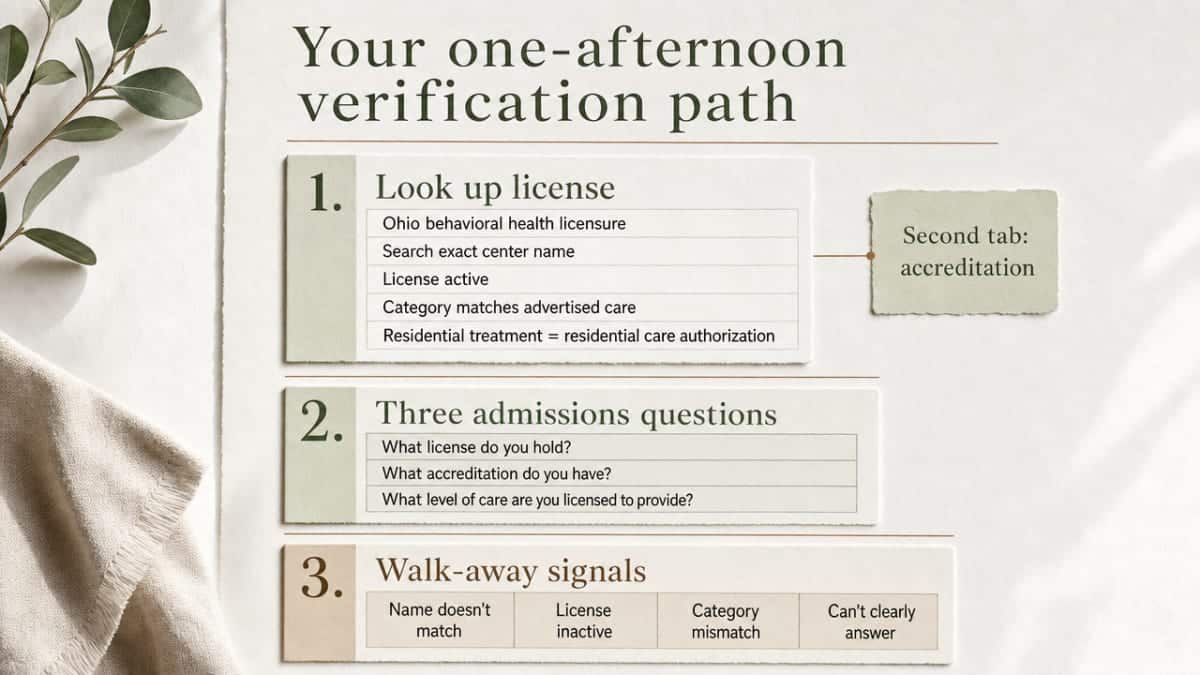
Your one-afternoon verification path
Step one: look up the license and accreditation before you call
Start here, before you dial anyone. Doing the lookups first means you walk into the phone call already knowing something concrete, and that little bit of ground under your feet matters when you’re tired and scared.
Open two browser tabs. In the first, go to the Ohio Department of Behavioral Health licensure and certification page, the regulator that oversees more than 2,300 behavioral health providers in the state 13. Search the exact name of the center. Confirm the license is active and check that the license category matches what they’re advertising, because Ohio issues different license and certificate types for different service models 14. A facility selling “residential treatment” needs a license that authorizes residential care.
In the second tab, check accreditation. Ohio DBH recognizes CARF, COA, and The Joint Commission as the national accreditors for behavioral health 8. Each one has a public directory. Type the center’s name in. If they claim a seal but you can’t find them listed, that’s not a small thing.
Write down what you find. License number, accreditor, date of last review. You’re allowed to take five minutes for this. It already counts as progress.
Step two: the three questions to ask on the admissions call
The admissions call is the part most people dread. You don’t have to perform. You don’t have to explain your whole history. You only have to ask three things and listen carefully to how the person answers. A good admissions team will not rush you, and they will not be annoyed that you came prepared.
- Question one: what evidence-based treatments do you use, and how do you decide which one fits me? NIAAA tells people choosing alcohol programs to ask exactly this, because evidence-based methods are the floor for safe care 1. You want to hear specific names: cognitive behavioral therapy, motivational enhancement, medications for alcohol or opioid use disorder. You also want to hear that they use ASAM criteria or a similar structured assessment to match you to the right level of care 10.
- Question two: do you treat mental health conditions at the same time as the addiction, with the same team? Integrated care for co-occurring conditions is associated with better outcomes than treating them separately 2. Listen for whether a prescriber and a therapist work together on your plan, or whether mental health is something someone “visits” the program to provide.
- Question three: what does my plan look like the week after I leave? Continuity of care after residential treatment is a tracked quality measure, and a program that can describe a real handoff is a program that pays attention to it 6. You’re not being demanding. You’re asking the right questions.
Step three: the two answers that should make you walk away
Most centers will give you reasonable answers. Some won’t, and you need to know what those sound like so you can trust your gut when you hear them.
The first walk-away answer is some version of “we don’t really do medications here” when you have moderate-to-severe alcohol or opioid use. Medication-assisted treatment is part of baseline evidence-based care, and pharmacotherapy for opioid use disorder is itself a quality measure that safe programs are expected to support 10, 6. A center that talks people out of FDA-approved medications, or doesn’t offer them at all for opioid use, is asking you to take on extra risk so the program can stick to its preferred philosophy. That risk lands on you, not them.
The second walk-away answer is vagueness about discharge. If you ask what happens on day 31 and you get “we’ll figure that out closer to the time” or “we give you a meeting list,” that’s not a plan. A program that hasn’t thought about your next week hasn’t thought about your safety after the doors close behind you.
You’re allowed to hang up. You’re allowed to say “thank you, I’ll think about it,” and then call the next center on your list. Trusting your gut here is part of getting well.
How long a safe stay usually lasts
You will see a lot of 28-day and 30-day programs. That length isn’t based on what your brain needs. It’s based on what early insurance plans were willing to pay for, decades ago, and it stuck.
So when a program offers you 30 days and stops there, ask what comes next. A safe answer sounds like: “You’ll step down to PHP for a few weeks, then IOP, and we’ll keep your prescriber and therapist consistent.” An unsafe answer sounds like: “After 30 days you’re discharged with a meeting list.”
If 90 days of any setting feels impossible right now, that’s okay. Start with what you can say yes to today. Ask the admissions team to map out how the program plans to keep you connected to care for at least three months total, even if your bed days are shorter. That map is what “long enough” actually looks like.
Psychological safety: trauma-informed care, not just locked doors
Physical safety is the part you can see. Locked medication carts, a nurse at the desk, a clean room. Psychological safety is harder to spot from a website, but it matters just as much, because trauma and PTSD show up at high rates in people who land in residential addiction treatment 4. If you’ve been through something hard, and the program doesn’t account for that, the place that’s supposed to help you can quietly make things worse.
Trauma-informed care isn’t a poster on the wall. It’s a way of running a program built on a few core principles:
- physical and emotional safety,
- trustworthiness and transparency about what’s happening to you,
- peer support from people who’ve been there,
- collaboration between you and your treatment team,
- and empowerment so you have real choices in your own care 4, 5.
SAMHSA highlights trauma as a cross-cutting priority in behavioral health because so much of what brings people into treatment connects back to it 5.
What this looks like on the ground: staff who explain procedures before doing them, not after. Group rules that let you pass when a topic is too much. Private spaces to step away when you’re overwhelmed. Same-gender options if that matters for your history. A response to a hard moment that sounds like “let’s slow this down” instead of “you’re being resistant.”
Ask the admissions team how staff are trained in trauma-informed practice, and what happens if a group session brings up something heavy for you. A program that has thought about this will have a real answer. One that hasn’t will sound surprised by the question. You deserve to feel safe in your own skin while you do this work.
What ‘safety’ means after discharge
The riskiest stretch in recovery isn’t always the first night of detox. For many people, it’s the first month back in the world, when the structure is gone and the cravings aren’t. That’s why a safe program treats discharge as a clinical event, not a checkout.
Relapse prevention has known ingredients: ongoing therapy, medications when they’re indicated, monitoring, peer support, and a real follow-up schedule 12. A safe center builds those into your plan before you leave, not after you’ve already missed an appointment. If you’re on buprenorphine or naltrexone, you should know who is prescribing your next refill and when. If you’ve been seeing a therapist in residential, you should know whether they hand you off to a specific clinician or to a waiting list.
Setbacks happen. Returns to drinking or using are common enough that NIAAA warns against treating one residential stay as a finish line 1. A safe program plans for that too. Ask what happens if you slip in week two after discharge. The answer should sound like “call us, we adjust the plan” — not silence.
If you’re calling for someone you love
A quick note for the person doing this research on someone else’s behalf: you’re carrying something heavy, and you’re doing it well. The same six signals apply when you call on behalf of a partner, child, parent, or friend. License lookup first. Accreditation directory second. Then the three questions about evidence-based care, integrated mental health treatment, and what happens after discharge 1.
A few things change when it’s not your body going through detox. Ask whether the program includes family therapy or family education, because relapse prevention works better when the people around the person in treatment understand what’s coming 12. Ask whether they communicate with you during the stay, and what privacy rules apply. Your loved one may need to sign a release for you to get updates, and a good program will explain that calmly instead of brushing past it.
One last thing. You can do the verification work, but you can’t do the saying yes. That part belongs to them. Bring them what you found, sit with them while they read it, and let them make the call.
Ready to Start Real Recovery? Talk Now
Connect immediately with a caring specialist who will guide you through your next steps toward a safer recovery.
Talk Confidentially About Your Next Recovery Step
Get expert guidance tailored to your unique recovery journey in a private, supportive setting.
Frequently Asked Questions
How do I check if a recovery center is actually licensed in Ohio?
Go to the Ohio Department of Behavioral Health licensure and certification page and search the center by name. DBH oversees more than 2,300 behavioral health providers in the state 13. Confirm the license is active and that the license category matches the service they’re advertising, since Ohio issues different license types for residential, outpatient, and other models 14.
Is a 30-day program long enough, or do I need to stay longer?
Thirty days is a starting point, not a finish line. NIDA’s research-based guide reports that many people with addiction need at least three months of treatment to significantly reduce or stop drug use 7. That doesn’t mean three months in a residential bed. It often means residential, then partial hospitalization, then intensive outpatient, with continuous follow-up care across the full stretch.
What’s the difference between accreditation and state licensure?
Licensure is required. The state grants it and can revoke it. Accreditation is voluntary review by an outside body like The Joint Commission, whose mission is to evaluate health care organizations and push toward safer care 15. Ohio DBH recognizes CARF, COA, and The Joint Commission as accreditors 8. A safe center usually has both. Accreditation signals quality, not guaranteed outcomes.
What if I have depression, anxiety, or PTSD along with my addiction?
You’re not unusual, and you need a program built for both. Co-occurrence between substance use and mental health conditions is common and tied to worse outcomes than either alone 2. Look for integrated care, where one team handles both at the same time. Programs sometimes call this co-occurring capable, meaning mental health is woven into assessment and daily treatment, not bolted on 3.
What questions should I ask on the admissions call?
Ask three things. What evidence-based treatments do you use, and how do you decide which fits me 1? Do you treat mental health conditions at the same time as the addiction, with the same team 2? What does my plan look like the week after I leave 6? A good admissions team will answer specifically and won’t rush you off the phone.
What happens if I relapse during or after treatment?
Setbacks happen, and NIAAA explicitly warns against treating one residential stay as a cure 1. A safe program plans for this. Relapse prevention works through ongoing therapy, medications when indicated, monitoring, peer support, and scheduled follow-up 12. If you slip after discharge, the answer should be a phone call and a plan adjustment, not shame. Ask the program directly how they respond.
References
- Treatment for Alcohol Problems: Finding and Getting Help. https://www.niaaa.nih.gov/publications/brochures-and-fact-sheets/treatment-alcohol-problems-finding-and-getting-help
- Integrating Treatment for Co-Occurring Mental Health Conditions. https://pmc.ncbi.nlm.nih.gov/articles/PMC6799972/
- Co-Occurring Capable Program Guidelines. https://portal.ct.gov/-/media/dmhas/cosig/codcapableprogrampdf.pdf
- Study protocol: implementing and evaluating a trauma-informed model of care in residential SUD treatment. https://pmc.ncbi.nlm.nih.gov/articles/PMC10572352/
- Practical Guide for Implementing a Trauma-Informed Approach. https://www.wicourts.gov/courts/programs/problemsolving/docs/traumainformedapproach.pdf
- Reducing Substance Use Disorders: Quality Measures. https://www.medicaid.gov/resources-for-states/innovation-accelerator-program/functional-areas/quality-measurement/reducing-substance-use-disorders-quality-measures
- Principles of Drug Addiction: A Research-Based Guide (Third Edition). https://nida.nih.gov/sites/default/files/podat-3rdEd-508.pdf
- National Accreditation – Ohio Department of Behavioral Health. https://dbh.ohio.gov/wps/portal/gov/dbh/supporting-providers/licensure-and-certification/community-behavioral-health-services-cbhs/national-accreditation
- Behavioral Health Handbook. https://ohioauditor.gov/publications/docs/BH_Handbook_2024.pdf
- Evidence-Based Practices for Identifying and Treating Substance Use Disorders. https://www.ncbi.nlm.nih.gov/books/NBK598907/
- Health Care Systems and Substance Use Disorders. https://www.ncbi.nlm.nih.gov/books/NBK424848/
- Addiction Relapse Prevention – StatPearls. https://www.ncbi.nlm.nih.gov/books/NBK551500/
- Licensure and Certification – Ohio Department of Behavioral Health. https://dbh.ohio.gov/supporting-providers/licensure-and-certification
- Types of Licenses and Certificates. https://dbh.ohio.gov/wps/portal/gov/dbh/supporting-providers/licensure-and-certification/types-of-licenses-and-certificates
- The Joint Commission – StatPearls – NCBI Bookshelf – NIH. https://www.ncbi.nlm.nih.gov/books/NBK557846/