
Choosing an Alcohol Treatment Program
Key Takeaways
- Match the level of care to clinical severity using the ASAM continuum and a six-dimension assessment, not to marketing or assumptions about what sounds serious enough.
- For most people with AUD, intensive outpatient and residential produce equivalent outcomes when severity is matched; residential’s edge appears only with severe impairment or unsafe environments 5.
- Prioritize programs that prescribe or coordinate the three FDA-approved medications — naltrexone, acamprosate, and disulfiram — alongside evidence-based therapies and integrated co-occurring mental health care 6.
- Bring a written question set to every admissions call, verify benefits in writing, and expect aftercare planning to start on day one rather than at discharge.
Start with the decision in front of you
If you’re reading this, you’ve already done the hardest part: you’ve stopped pretending the drinking isn’t a problem. That counts. Whether you’re sorting through this for yourself or for someone you love, the next move isn’t to pick a brand or chase a glossy website. It’s to figure out what kind of care actually fits the situation in front of you.
Alcohol use disorder is a treatable medical condition, and there’s solid evidence behind several different ways to treat it 3. The catch is that no single program works for everyone, and the level of care you need depends on how severe the drinking has become, what your body and mind are doing, and what your life looks like outside the program 3.
This guide walks you through the decision the way a clinician would: starting with severity and safety, moving to what evidence-based treatment actually includes, then giving you the specific questions to ask before you sign anything. You don’t have to get every answer perfect. You just have to make the next call.
Match the level of care to the severity, not the marketing
The ASAM levels of care, in plain language
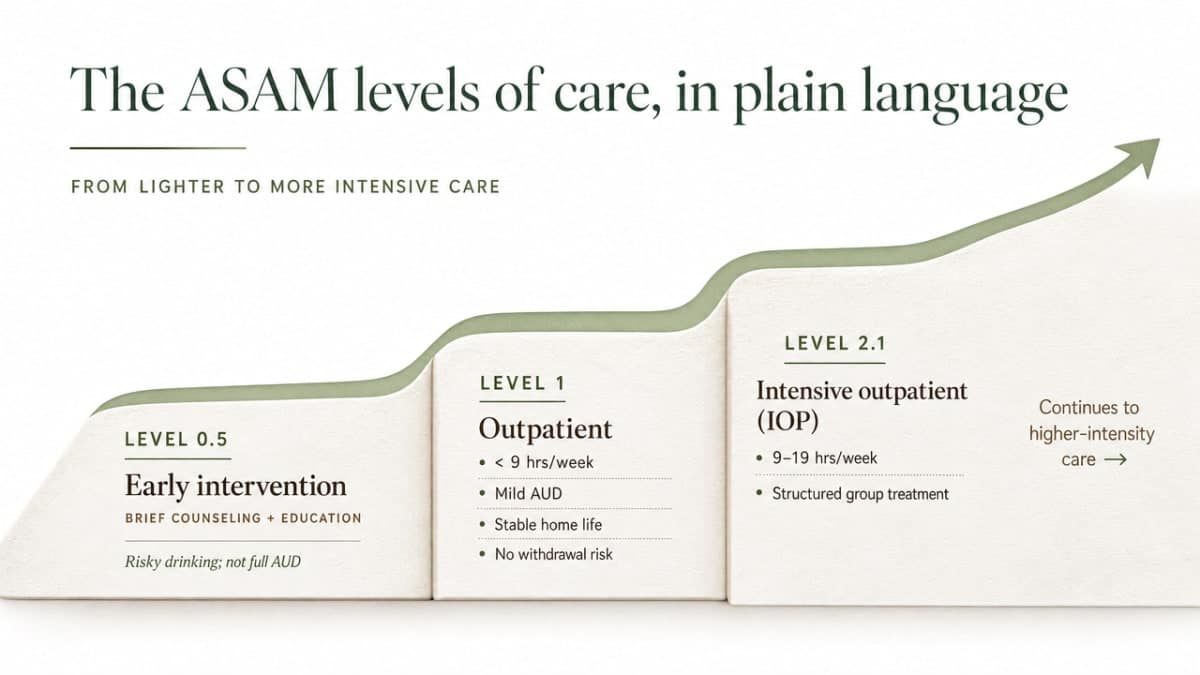
Most quality programs in the U.S. organize themselves around something called the ASAM Criteria, a framework that sorts alcohol treatment into a continuum from light to intensive. Knowing the rough shape of that continuum is the single most useful thing you can do before you start making phone calls. It lets you stop comparing brochures and start comparing actual care.
Here’s the continuum in plain terms, drawn from how state Medicaid agencies and clinicians use it 10:
- Level 0.5 — Early intervention. Brief counseling and education for people whose drinking is risky but doesn’t yet meet full criteria for AUD.
- Level 1 — Outpatient. Fewer than nine hours per week of therapy and medical visits. Fits people with mild AUD, stable home life, and no withdrawal risk.
- Level 2.1 — Intensive outpatient (IOP). Nine to 19 hours per week of structured group and individual therapy. You sleep at home.
- Level 2.5 — Partial hospitalization (PHP). 20 or more hours per week, essentially a day program. Strong fit when you need daily structure but have safe housing.
- Level 3.x — Residential and inpatient. 24-hour care in a non-hospital setting, from low-intensity sober environments to clinically managed residential programs for severe AUD or unstable home situations.
- Level 4 — Medically managed intensive inpatient. Hospital-based care for severe withdrawal, medical complications, or psychiatric crisis.
The ASAM goal isn’t to push you up the ladder. It’s to recommend the least intensive program that can keep you safe and actually work 11. A good assessor explains why a level fits, not just which one they’re slotting you into.
The six dimensions a good assessment will actually cover
How does a clinician land on a level? They walk through six dimensions, and you should expect to be asked about all of them during an honest intake 11. If an admissions call jumps straight to bed availability without these questions, that tells you something.
- Acute intoxication and withdrawal risk. How much, how often, when was your last drink, have you had seizures or DTs before? This decides whether you need medical detox before anything else.
- Biomedical conditions. Liver issues, blood pressure, pregnancy, chronic pain, medications you take. Drinking interacts with all of it.
- Emotional, behavioral, or cognitive conditions. Depression, anxiety, trauma history, suicidal thoughts, memory problems. Roughly half of people with AUD have a co-occurring mental health condition that needs care alongside the drinking.
- Readiness to change. Not whether you’re “motivated enough” — whether you’re contemplating, preparing, or already acting. This shapes which therapies fit.
- Relapse and continued-use potential. Triggers, prior treatment attempts, how quickly you return to drinking when you try to stop.
- Recovery environment. Who you live with, whether alcohol is in the house, work demands, transportation, childcare, legal stuff.
Two people drinking the same amount can land at different levels because dimensions four through six look completely different. A nurse with stable housing and a supportive partner has different needs than someone living with an actively drinking roommate. A program that takes the time to ask is doing its job. A program that doesn’t is selling you a bed.

What the IOP vs. residential evidence really says
One of the most common assumptions families bring to this decision is that residential rehab is automatically the strongest option, and that anything less is settling. The research doesn’t back that up — with one important caveat.
A peer-reviewed review in Psychiatric Services synthesized randomized and quasi-experimental studies comparing intensive outpatient programs with inpatient or residential care. The authors concluded that studies“consistently reported equivalent reductions in problem severity and increases in days abstinent”between the two settings, and rated the evidence for IOPs as high 5. For most people with alcohol use disorder, IOP and residential produce comparable outcomes when severity is matched.
What this means in practice: don’t pay for residential care because it sounds more serious or more committed. Pay for it because the assessment — those six dimensions — actually points there. And don’t dismiss IOP because it feels too easy. For mild-to-moderate AUD with decent recovery supports at home, the evidence says it can do the same work. The level of care is a clinical decision. The marketing is not.
Evidence-based treatment, defined by what is on the menu
The three FDA-approved medications for AUD
Here’s the single most useful filter you can apply to any program: ask whether they prescribe medications for alcohol use disorder, and if not, whether they coordinate access to them through a partnering provider. The NIAAA Navigator explicitly recommends prioritizing programs that offer at least one of the three FDA-approved AUD medications 6. If the answer is a vague “we focus on the spiritual side” or “we don’t really do that here,” you’ve learned something important.
The three medications:
- Naltrexone (oral or monthly injection)
- Reduces cravings and the rewarding effect of alcohol if you do drink. Often the first-line choice for people who can take it.
- Acamprosate
- Helps stabilize brain chemistry after you’ve stopped drinking, easing the protracted withdrawal that drives many people back. Taken three times a day.
- Disulfiram
- Causes an unpleasant reaction if you drink, used as a deterrent for people who want that structure and have supportive supervision.
NIAAA is direct that medications and behavioral treatments are “about equally effective” for AUD, and that combining them is often the strongest approach 12. The NCBI clinical review goes further and notes that despite this evidence, medications remain significantly underused — which makes their presence on a program’s menu a real quality signal, not a checkbox 4. Ask, and listen for specifics.
Therapies with the research behind them
The therapy side of a quality program shouldn’t be mysterious. There are a handful of approaches with serious evidence behind them, and a good program names them and tells you why they use what they use.
You’re looking for some mix of these: cognitive behavioral therapy, which targets the thoughts and triggers that drive drinking; motivational enhancement therapy, which works on ambivalence rather than pretending you’re 100% ready; contingency management, which uses concrete reinforcement for treatment goals; and structured family or couples therapy when the home life is part of the picture 2. Mutual-support groups like AA or SMART Recovery aren’t a substitute for clinical treatment, but they pair well with it 12.
What you don’t want is a program that can only describe its therapy as “group” and “individual.” Those are formats, not methods. Ask which evidence-based models the clinical team is trained in, and how progress gets measured during your stay. The VA/DoD guideline frames measurement-based care as a hallmark of quality — meaning your symptoms and goals get tracked over time, not just discussed 1. That’s what separates a real treatment plan from a schedule of activities.
Co-occurring mental health care, integrated not referred out
If you’re dealing with depression, anxiety, trauma, bipolar disorder, or any other mental health condition alongside the drinking, the program you choose needs to treat both at the same time, under the same roof, by clinicians talking to each other. The VA/DoD guideline is explicit that co-occurring conditions should be addressed in coordinated care, not punted to a separate appointment six weeks out 1.
This matters because untreated mental health symptoms are one of the most reliable paths back to drinking. If your anxiety isn’t being addressed, alcohol is going to keep looking like the fastest fix. If trauma is sitting underneath the drinking, abstinence alone tends not to hold.
Ask directly: Do you treat dual diagnosis on-site? Are psychiatric providers part of the treatment team, or do I have to go elsewhere for medication management? How do the therapy sessions connect to what the psychiatrist is doing? A program that integrates these answers — and doesn’t make you the messenger between two systems — is doing the harder, better work 1.
The question set to bring to every program call
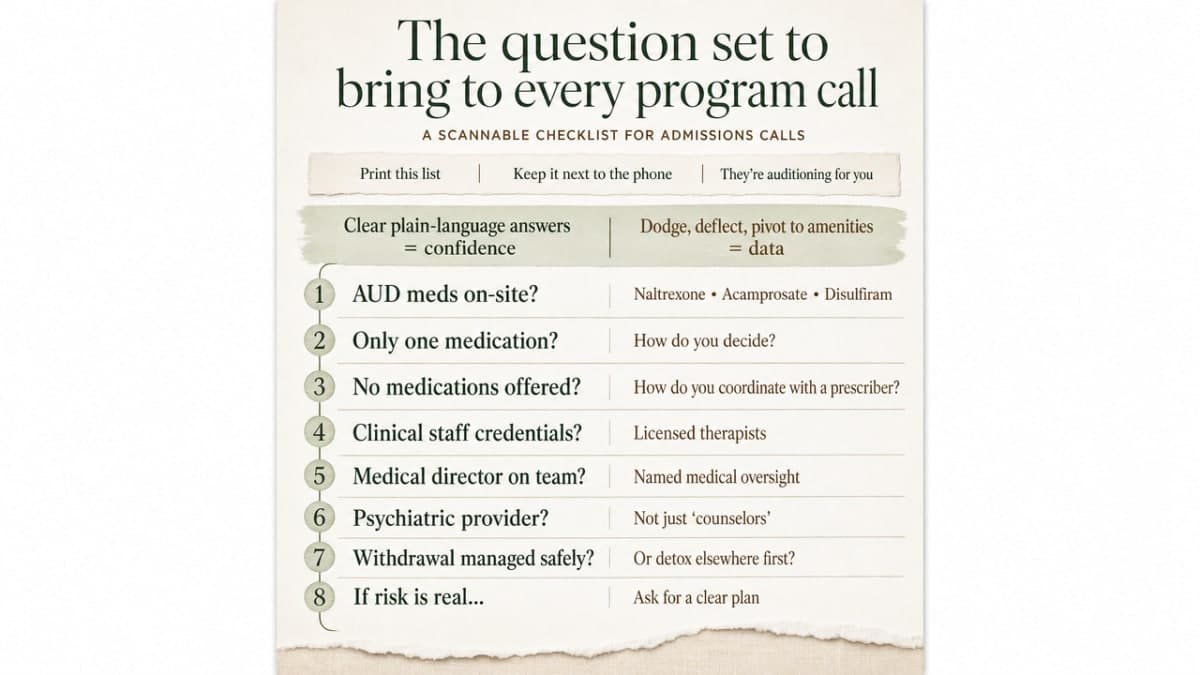
Print this list. Keep it next to the phone. When you call an admissions line, you’re not auditioning for the program — they’re auditioning for you. A confident program answers these questions in plain language. A weaker one will dodge, deflect, or pivot to amenities. Both responses are data 6.
- Which FDA-approved medications for AUD do you prescribe on-site? Naltrexone, acamprosate, and disulfiram should all be familiar names. If they only offer one, ask how they decide. If they offer none, ask how they coordinate with a prescriber 6.
- What are the credentials of the clinical staff? You want licensed therapists, a medical director, and a psychiatric provider on the team — not just “counselors” with unspecified training 1.
- Can you manage alcohol withdrawal safely, or do I detox somewhere else first? If withdrawal is a real risk for you, this answer determines whether the program is even the right starting point.
- How do you treat co-occurring mental health conditions? Listen for “on-site,” “integrated,” and “same treatment team.” Listen against “we’ll refer you out” 1.
- How is family involved? Quality programs build in family education and structured sessions, not just visiting hours 6.
- What does the written aftercare plan look like, and when do you start building it? The answer should be “from day one,” with specifics about step-down care, medications, and recovery supports.
- Are you accredited, by whom, and what’s your state license status? Accreditation through bodies like CARF or The Joint Commission is a baseline, not a brag 9.
- How do you measure my progress during treatment? You want to hear about validated symptom tracking and goal review, not just “check-ins” 1.
You don’t have to grill anyone. Read the questions in order, take notes, and trust your gut on tone. The right program will sound relieved that you’re asking.
Red flags that should slow you down
Not every program that calls itself evidence-based actually is. A few patterns show up often enough that they’re worth naming.
- Guaranteed success rates. No legitimate program promises a percentage. AUD is a chronic condition, and recovery often takes more than one episode of care 3. A guarantee is marketing, not medicine.
- Pressure to commit on the first call. If admissions is pushing you toward a deposit before a clinical assessment, the bed is the product. The treatment is supposed to be.
- No medical director, or vague answers about who prescribes. Programs that can’t name their medical leadership rarely deliver real pharmacotherapy or safe withdrawal management 1.
- Amenities pitched before clinical specifics. Pools and equine therapy aren’t disqualifying, but if you hear about them before you hear about medications and licensed clinicians, the priorities are inverted 6.
- No accreditation, or evasive answers about state licensure. CARF or Joint Commission accreditation plus an active state license is the floor 9.
- Refusal to share an aftercare plan template. If they can’t describe what happens after discharge, they haven’t planned for it.
Trust the pattern, not the single answer. One soft response is noise. Three is a signal.
Paying for it: insurance, Medicaid, and what to verify
Cost shouldn’t decide your level of care, but it will shape your options, and it helps to know what to confirm before the first call ends. Most major commercial plans cover alcohol treatment across the continuum — outpatient, IOP, PHP, residential, and detox — and Ohio Medicaid covers SUD services structured around ASAM levels of care 10. The question isn’t usually whether something is covered. It’s which levels, for how long, and with what authorization.
Ask the program’s admissions team to verify your benefits in writing before you commit. You want specifics: what levels of care are approved, how many days or sessions, whether prior authorization is required, and what your out-of-pocket exposure looks like. Ask whether medications for AUD are covered under your medical or pharmacy benefit, since naltrexone, acamprosate, and disulfiram are often billed differently 12.
If you’re uninsured or stuck, call the SAMHSA National Helpline — free, confidential, 24/7 — for referrals to programs with sliding-scale fees or state-funded slots 13.
Ohio-specific context most national articles skip
Recovery housing standards under Ohio law
If residential or intensive outpatient treatment is part of your plan, recovery housing — what most people call sober living — often becomes the bridge between structured care and going home. Ohio actually has a statute on this. Section 340.034 of the Ohio Revised Code sets standards for recovery housing and spells out when local boards of alcohol, drug addiction, and mental health services may operate recovery residences 14. That regulatory floor matters because the recovery housing market includes both well-run, accountable residences and informal houses with little oversight.
When a program offers or recommends a specific recovery house, ask whether it meets state recovery housing standards and who oversees it. A program with thoughtful step-down options has usually done that homework for you. A program that hands you a list and wishes you luck has not.
When a family is facing involuntary treatment
This part is for families, and it’s heavy. If someone you love has severe alcohol use disorder, refuses care, and is in real danger — repeated hospitalizations, suicidal behavior, life-threatening withdrawal — Ohio law gives you a narrow legal path. Under Section 5119.91 of the Ohio Revised Code, a probate court can order involuntary treatment for alcohol or other drug abuse when specific criteria are met, through a petition process with evidentiary standards 15.
Treat this as a last resort, not a first move. Civil commitment for addiction is legally complex and emotionally costly, and outcomes vary. Before you go near a probate filing, talk to an attorney familiar with Ohio’s process, the person’s existing treatment team if there is one, and a clinician who can document the medical risk. A petition isn’t a substitute for the conversation you’ve been avoiding. Sometimes, though, it’s what keeps someone alive long enough to have it.
Aftercare is part of the program, not an add-on
Here’s the part most brochures rush past: the day you finish residential or PHP is not the day treatment ends. AUD behaves like a chronic condition, and CDC is direct that recovery often requires more than one episode of care over time 3. That isn’t a failure mode. It’s the actual shape of the work.
What you want to hear from a program is that aftercare planning starts on day one, not in the discharge meeting. A real plan names the next level of care (often a step down from residential to PHP or IOP), keeps your medications going without a gap, schedules your first outpatient appointment before you leave, and connects you to recovery supports like mutual-help groups or recovery housing that meets Ohio standards 14. NIDA frames ongoing recovery support as a core principle of evidence-based treatment, not an optional extra 2.
Ask to see a sample aftercare plan. If it’s a photocopied sheet with phone numbers, keep looking.
The next phone call
You don’t need a perfect plan to take the next step. You need a phone, a notebook, and twenty minutes.
Start with one of two numbers. Call SAMHSA’s National Helpline at 1-800-662-HELP for free, confidential referrals any hour of the day 13. Or call a local program directly and run through the question set you printed earlier. Either way, you’re not committing to anything. You’re gathering information.
If the call goes well, ask for a clinical assessment, not just a bed quote. If it doesn’t, hang up and try another number. The right program will earn the second conversation.
One call today. That’s the whole assignment.
Connect Now for Immediate Alcohol Recovery Support
Get real answers and next steps for starting your alcohol treatment journey today.
Ready to Talk About Your Recovery Options?
Get expert guidance tailored to your unique recovery path in a supportive, confidential setting.
Frequently Asked Questions
How do I know if I need detox before starting an alcohol treatment program?
If you drink heavily every day, have had withdrawal seizures or DTs in the past, or feel shaky, sweaty, or anxious within hours of your last drink, assume you need medical detox before anything else. Alcohol withdrawal can be life-threatening. A clinical assessment will sort this out fast — ask the program directly whether they manage withdrawal on-site or refer you out first 4.
Are medications like naltrexone or acamprosate really necessary, or can therapy alone work?
Therapy alone helps many people, but you’re leaving a tool on the table. NIAAA is clear that medications and behavioral treatments are about equally effective for AUD, and combining them is often stronger than either alone 12. The three FDA-approved options — naltrexone, acamprosate, and disulfiram — remain underused despite solid evidence 4. A program that doesn’t even offer or coordinate them is missing something basic.
Is residential rehab better than intensive outpatient for alcohol use disorder?
Not automatically. A peer-reviewed review found that intensive outpatient and residential care produce equivalent reductions in problem severity and increases in days abstinent for most people when severity is matched 5. Residential’s clear advantage shows up among the most severely impaired — significant withdrawal risk, medical instability, or unsafe home environments 5. Let the assessment, not the price tag or brochure, decide.
Will Medicaid or insurance cover alcohol treatment in Ohio?
Generally, yes. Ohio Medicaid covers SUD services structured around ASAM levels of care, and most commercial plans cover the full continuum — outpatient through residential and detox 10. The real questions are which levels, for how many days, whether prior authorization is required, and how medications are billed 12. Ask the admissions team to verify your benefits in writing before you commit to anything.
What should I do if a family member refuses treatment but is in serious danger?
Start with the people already in their life — a primary care doctor, an existing therapist, or a trusted friend who can have the hard conversation. Call the SAMHSA National Helpline for guidance on next steps 13. As a last resort, Ohio Revised Code Section 5119.91 allows probate courts to order involuntary treatment when specific criteria are met 15. Talk to an attorney before filing.
How long does alcohol treatment take, and what happens after the program ends?
There’s no fixed timeline. AUD behaves like a chronic condition, and CDC notes that recovery often requires more than one episode of care over time 3. Residential might run a few weeks, IOP runs several weeks to months, and aftercare — step-down therapy, ongoing medications, mutual-help groups, recovery housing — continues well past discharge 2. Treatment ending isn’t the goal. Staying in recovery is.
References
- Management of Substance Use Disorder (SUD) (2021). https://www.healthquality.va.gov/guidelines/mh/sud/
- Treatment | National Institute on Drug Abuse (NIDA). https://nida.nih.gov/research-topics/treatment
- Treatment of Substance Use Disorders | Overdose Prevention – CDC. https://www.cdc.gov/overdose-prevention/treatment/index.html
- Treatment of Alcohol Use Disorder – NCBI Bookshelf. https://www.ncbi.nlm.nih.gov/books/NBK561234/
- Substance Abuse Intensive Outpatient Programs: Assessing the Evidence. https://pmc.ncbi.nlm.nih.gov/articles/PMC4152944/
- How to Find Alcohol Treatment | Navigator | NIAAA. https://alcoholtreatment.niaaa.nih.gov/how-to-find-alcohol-treatment
- NIAAA Alcohol Treatment Navigator (for patients) | The Academy. https://integrationacademy.ahrq.gov/resources/11771
- Evidence-Based Practices Resource Center – SAMHSA. https://www.samhsa.gov/libraries/evidence-based-practices-resource-center
- Substance Use Disorders: Statutes, Regulations, and Guidelines. https://www.samhsa.gov/substance-use/treatment/statutes-regulations-guidelines
- Overview of Substance Use Disorder (SUD) Care Clinical Guidelines. https://www.medicaid.gov/state-resource-center/innovation-accelerator-program/iap-downloads/reducing-substance-use-disorders/asam-resource-guide.pdf
- The ASAM Criteria® (AHCCCS brochure). https://www.azahcccs.gov/PlansProviders/Downloads/CurrentProviders/ASAMCriteriaBrochure.pdf
- Recommend Evidence-Based Treatment: Know the Options. https://www.niaaa.nih.gov/health-professionals-communities/core-resource-on-alcohol/recommend-evidence-based-treatment-know-options
- National Helpline for Mental Health, Drug, Alcohol Issues. https://www.samhsa.gov/find-help/national-helpline
- Section 340.034 | Recovery housing. – Ohio Laws. https://codes.ohio.gov/ohio-revised-code/section-340.034
- Section 5119.91 | Involuntary treatment for alcohol and other drug abuse. – Ohio Laws. https://codes.ohio.gov/ohio-revised-code/section-5119.91