
Why Withdrawal Can Trigger an Alcoholic Seizure
Key Takeaways
- Withdrawal seizures stem from a rebound effect: chronic drinking suppresses GABA and amplifies glutamate, so removing alcohol leaves the brain with no brake and a stuck accelerator 1, 2.
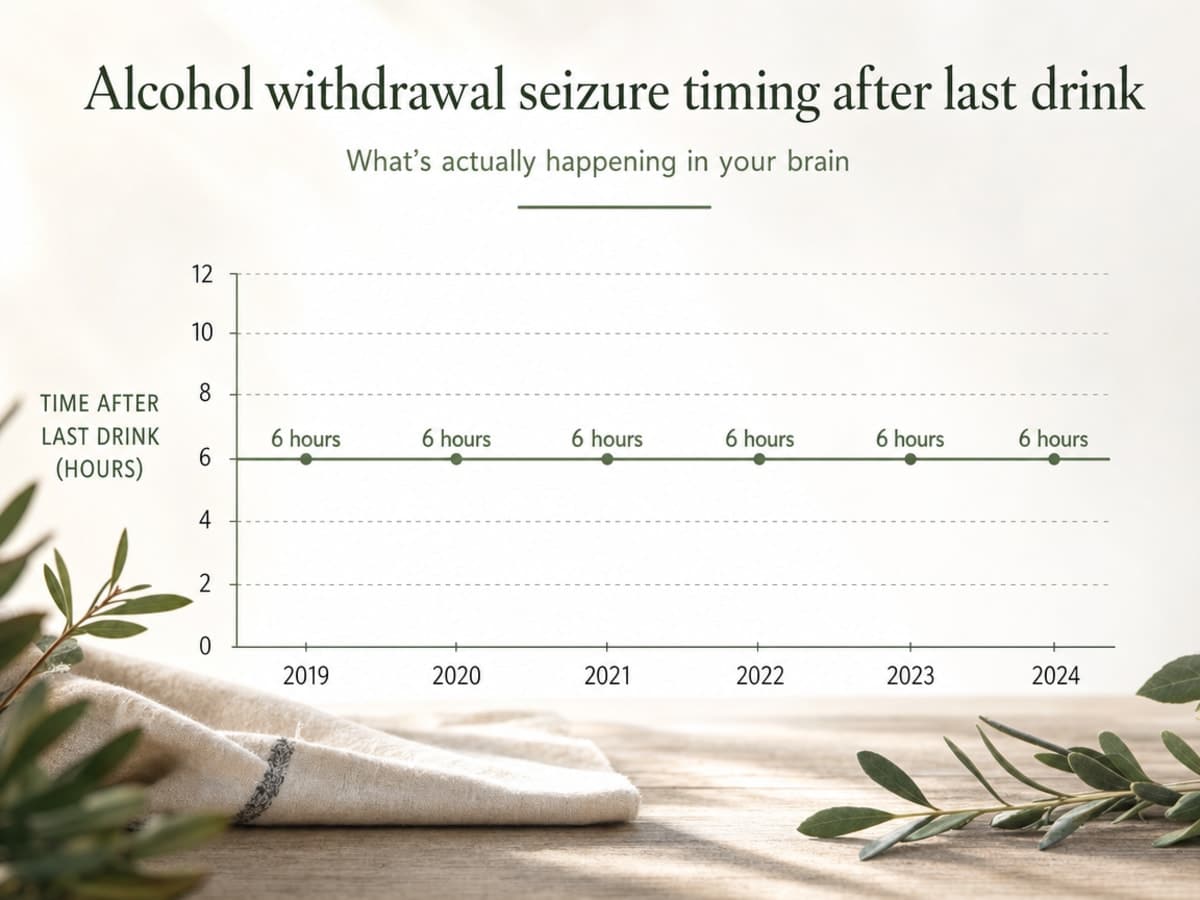
- The danger zone is narrow and predictable. Seizure risk opens 6 hours after the last drink, peaks near 24 hours, and delirium tremens can emerge between 48 and 72 hours 12.
- Prior withdrawal seizures, past delirium tremens, heavy daily drinking, seizure disorders, or serious comorbidities push someone firmly into the supervised-detox category rather than an at-home taper 3, 4.
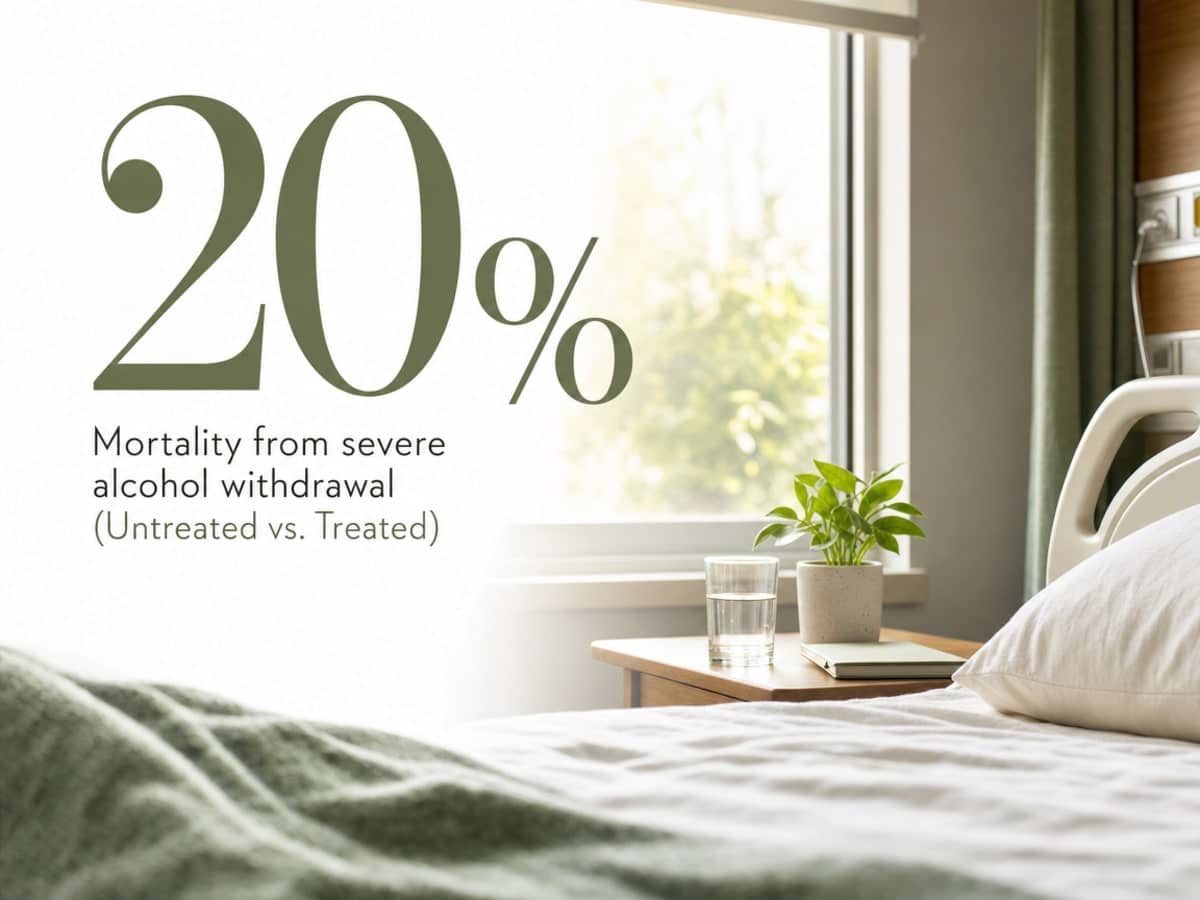
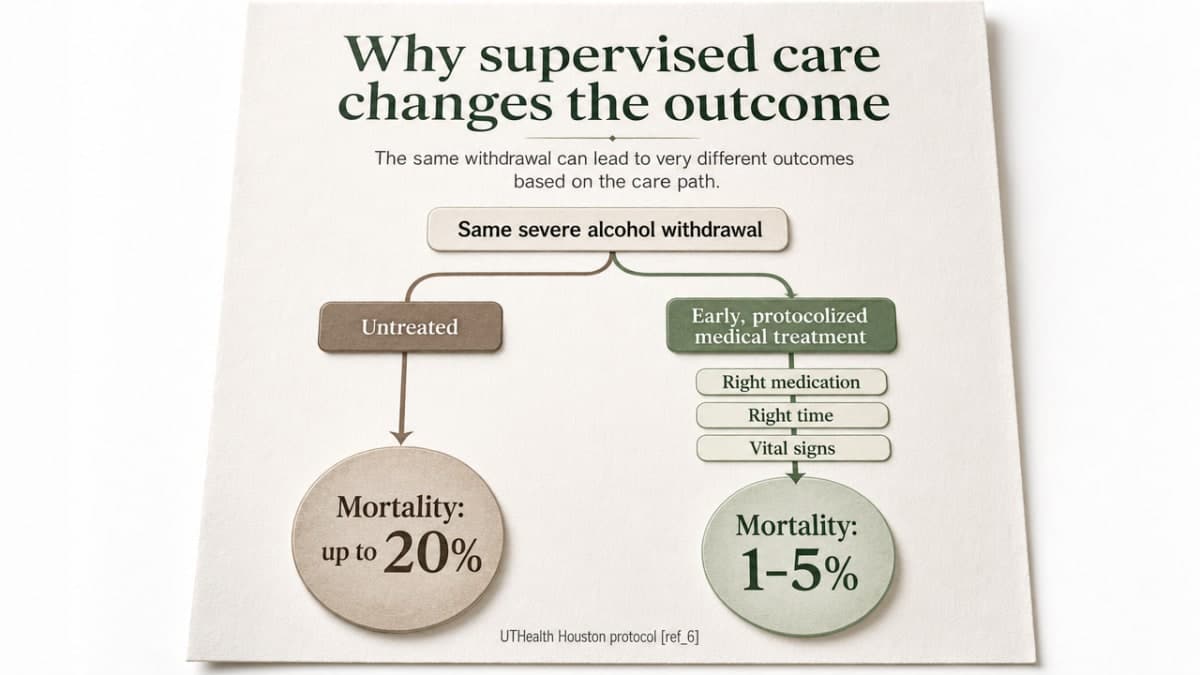
- Medical supervision dramatically changes outcomes: untreated severe withdrawal mortality can hit 20 percent, but symptom-triggered benzodiazepines, CIWA-Ar monitoring, and thiamine bring it down to 1–5 percent 6, 11.
If you’re reading this with shaky hands, start here
If it’s 2 a.m. and your hands won’t stop trembling, or you’re watching someone you love sweat through the sheets and you don’t know if this is normal — you’re already doing the right thing by looking for answers. That impulse to understand what’s happening is not nothing. It’s the first move toward keeping yourself, or them, safe.
Here’s the honest version: an alcoholic seizure during withdrawal is not a freak accident, and it’s not a sign of weak willpower. It’s what can happen when a brain that has spent months or years adjusting to alcohol suddenly loses it. Most withdrawal seizures occur somewhere between 6 and 48 hours after the last drink, with risk peaking around the 24-hour mark 12. That’s a narrow, predictable window — which means it’s also a window that medical care is built to manage.
This article will walk you through what’s actually happening inside your brain, how to tell if you’re in the higher-risk group, what the first 72 hours can look like, and what supervised detox actually involves. No moralizing. No scare tactics. Just the information you need to make a real decision about tonight, tomorrow morning, and the days after that. If you’re scared, that fear is data. Keep reading.
What’s actually happening in your brain
The brake and the accelerator: GABA, glutamate, and the rebound effect
Think of your brain as a car with two main pedals. The brake is GABA — your brain’s main calming chemical. When GABA fires, neurons slow down. You feel calm, sleepy, less anxious. The accelerator is glutamate — your brain’s main go-faster chemical. When glutamate fires, neurons get excited, alert, ready to react.
In a brain that isn’t dependent on alcohol, these two pedals stay roughly balanced. You feel calm when you should feel calm. You feel alert when you should feel alert.
Alcohol changes that balance. Every drink presses down hard on the GABA brake. That’s why drinking feels relaxing at first — your brain is being slowed from the outside. But your brain doesn’t like being slowed against its will, so over weeks and months of heavy drinking, it adapts. It reduces its own GABA sensitivity and quietly turns up the glutamate accelerator to compensate 1, 2. Now, with alcohol on board, you feel close to normal. Without it, you don’t.
This is what physical dependence actually is — not a moral failing, but a brain that has rewired itself around a chemical it now expects. Researchers describe it as the brain’s central nervous system adapting to the chronic presence of alcohol
so that the sudden absence of that alcohol creates a problem 8.
Here’s where the danger comes in. When you stop drinking, the alcohol leaves your system within hours. The GABA brake is still weakened. The glutamate accelerator is still floored. For a stretch of time, there’s nothing slowing the brain down — and a whole lot pushing it forward. That mismatch is called the rebound effect, and it’s why withdrawal feels the way it does. The shaking, the racing heart, the sweat, the anxiety that feels like it’s coming from nowhere — that’s your brain running with the accelerator stuck and no brake to press 2, 10.
If you’ve ever wondered why you feel worse the morning after you tried to stop than you did when you were drinking, this is the answer. Your brain isn’t punishing you. It’s trying to drive a car with one pedal.
Why a seizure is the brain’s circuit breaker tripping
Now picture that stuck accelerator running for hours. Glutamate keeps firing. Neurons that should rest don’t rest. The whole system gets louder and louder until, in some people, it crosses a threshold — and the electrical activity in the brain goes from agitated to chaotic. That’s a seizure.
In clinical terms, this is generalized CNS hyperexcitability — the brain’s normal rhythms breaking down because there’s not enough inhibition to keep excitation in check 1, 2. In plain terms, it’s your brain’s circuit breaker tripping because the load got too high.
This is why a withdrawal seizure isn’t random and isn’t a sign that something is uniquely wrong with you. It’s a predictable response from a brain that adapted to alcohol and then lost it suddenly. The same mechanism that made you feel anxious and shaky at hour twelve can, in a higher-risk body, escalate to a seizure by hour twenty-four 9.
Most of these are generalized tonic-clonic seizures — the kind people picture when they hear the word “seizure.” They usually last a minute or two. Some people have one. Others have several clustered over a few hours 12. Either way, the seizure itself isn’t the end of the story. It’s a flashing red light that the brain has crossed into territory where things can get worse — including delirium tremens, which is a separate and more dangerous problem we’ll get to in a later section.
The takeaway here is simple: if you understand the brake-and-accelerator imbalance, you understand why a seizure can happen even when you’re “doing the right thing” by quitting. Quitting isn’t the cause. Quitting without support is what leaves the imbalance unmanaged.
What the first 72 hours actually look like
If you can pinpoint your last drink, you can roughly map where you are on the danger curve. That’s useful, because withdrawal isn’t a vague fog — it moves through fairly predictable phases, and knowing which one you’re in changes what you should do next.
Hours 0 to 6 — the first signals. Mild symptoms often begin within about six hours of your last drink 6. You might notice your hands trembling when you reach for a cup. Your heart feels faster than it should. Sleep gets thin or impossible. Anxiety creeps in for no reason you can name, and a low-grade nausea sits behind your ribs. This is your brain noticing the alcohol is gone and starting to overshoot in the other direction 2. It’s uncomfortable, but it’s the quietest part of the curve.
Hours 6 to 24 — the window opens. This is where withdrawal seizures become possible. Acute symptomatic seizures usually emerge 6 to 48 hours after the last drink 9, and Harvard Health notes that the risk peaks around the 24-hour mark, with several seizures sometimes clustering across a few hours 12. Symptoms in this stretch get louder: heavier sweating, blood pressure climbing, a tremor you can’t hide, and for some people, brief hallucinations — seeing shadows move, hearing voices or sounds that aren’t there. Those hallucinations alone are not delirium tremens. They’re a warning that your brain is running hot.
Hours 24 to 48 — peak seizure risk. If a withdrawal seizure is going to happen, this is the most likely window 6, 12. Most are generalized tonic-clonic — a sudden loss of consciousness, muscle stiffening, then rhythmic jerking, usually lasting a minute or two. You don’t get a clear warning. That’s the hardest part of this stage to accept: you can feel like you’re “getting through it” right up until the moment you aren’t.
Hours 48 to 72 — the delirium tremens window. For a smaller group of people, withdrawal escalates into delirium tremens (DTs): severe confusion, agitation, fever, racing heart, and vivid hallucinations that feel completely real. DTs typically appear 48 to 72 hours after the last drink and are the most dangerous form of withdrawal — fatal without prompt medical care 12. An untreated seizure earlier in the timeline raises the odds that things will progress this far 6.
Two honest notes about this timeline. First, it’s a guide, not a guarantee. Some people seize earlier; some people who feel fine at 30 hours get hit at 40. Second, the curve doesn’t end at 72 hours — sleep, mood, and cravings keep settling for weeks. But the acute medical danger zone, the one this article is about, lives mostly inside these three days. If you’re inside that window right now and you’ve been drinking heavily and daily, that’s exactly the situation a supervised detox is built for.
How to know if you’re high-risk
The risk factors that actually escalate seizure odds
Not every person who stops drinking will have a seizure. But some people are walking into withdrawal with the dial already turned up, and it helps to know honestly where you stand before you decide whether to ride this out at home or get under medical supervision.
Clinicians use a fairly consistent set of red flags to decide who needs inpatient or residential detox instead of an outpatient taper. NICE guidance specifically points to a history of withdrawal seizures, a history of delirium tremens, very high daily alcohol intake, and significant medical or psychiatric comorbidities as reasons to move someone into a 24/7 supervised setting 3. Hospital-based guidelines layer on a few more: any current seizures or DTs are absolute admission criteria, and so is being assessed as high-risk for developing them 4.
Translated out of clinical language, the honest checklist looks like this:
- You’ve had a withdrawal seizure before. Even one. Even years ago. This is the single strongest predictor that it could happen again 3, 4.
- You’ve had delirium tremens before — the confusion-and-hallucination stage of severe withdrawal.
- You’ve been drinking heavily every day for weeks, months, or longer, especially if you drink to avoid feeling sick in the morning.
- You have a seizure disorder like epilepsy, or you’re on medications for one.
- You have other significant medical conditions — heart problems, liver disease, uncontrolled diabetes, a recent head injury, an infection you’ve been ignoring 3.
- You don’t have a sober adult who can stay with you around the clock for the next several days.
If you can check even one of these, you’re not in the “taper at home with a friend” category. That’s not a judgment — it’s the same line a doctor would draw if you walked into their office and showed them the same information. The goal isn’t to scare you out of trying. It’s to make sure the version of you that quits is also the version of you that wakes up tomorrow.
Why a prior bad withdrawal makes the next one worse
If you’ve been through withdrawal before and it got ugly — a seizure, a trip to the ER, a night of hallucinations you don’t fully remember — there’s something specific you need to know. The next withdrawal is not a clean slate. It’s often harder.
Researchers describe this pattern bluntly: a history of withdrawal seizures or delirium tremens increases the risk of complicated withdrawal in subsequent episodes 9. StatPearls puts the clinical implication even more plainly, noting that people with a history of withdrawal seizures or DTs are at particularly high risk and should be managed in an inpatient setting 8.
There’s a name for this in addiction medicine — sometimes called the kindling effect. Each severe withdrawal seems to leave the brain a little more primed to overreact the next time alcohol drops away. It’s as if the threshold for that circuit breaker to trip keeps lowering. People are sometimes surprised by this. They think, “I got through the last one — I can get through this one.” The science says the opposite. The fact that you got through the last one, especially if it included a seizure, is the reason this one deserves more support, not less.
If that’s you, please don’t read it as bad news. Read it as the most useful piece of information you can hand to a care team: “I’ve done this before, and here’s what happened.”
Why supervised care changes the outcome
Read that again if you need to. The same withdrawal — same person, same drinking history, same shaky morning — has wildly different odds depending on whether a clinical team is watching. The intervention isn’t exotic. It’s the right medication at the right time, vital signs checked on a schedule, a benzodiazepine ready before a seizure rather than after, and someone in the room who knows the difference between hour-twelve tremor and hour-twenty-four warning signs 10, 11. Systematic reviews of withdrawal management consistently land in the same place: structured, symptom-monitored care reduces seizures and the cascading complications that follow 11.
This is what supervised care actually buys you. Not comfort, although there is some of that. Not a cure for the underlying drinking, which is a longer conversation. What it buys you is the difference between a withdrawal that ends with you sleeping through the worst of it and a withdrawal that ends in an ambulance — or doesn’t end at all. If you’ve been drinking heavily and daily, or if any of the risk factors from the previous section sound like you, the math here isn’t really a debate. It’s a 24/7 setting, with people trained to catch the moment your body needs help, before your body has to ask in the language of a seizure.
What medically supervised detox actually looks like
If you’ve never been inside a detox unit, the word probably conjures something either scarier or more clinical than the reality. A medically supervised detox is, at its most basic, a place where someone is paying close attention to your body during the exact hours your brain is most likely to misfire — and where the medication that prevents that misfire is already in the building.
The first few hours are mostly assessment. A clinician asks how much you’ve been drinking, when your last drink was, what your withdrawal has looked like in the past, what other medications and medical conditions you’re carrying. Most programs use a standardized scoring tool — the CIWA-Ar is the common one — to measure your symptoms on a regular schedule: tremor, sweating, heart rate, anxiety, nausea, any signs of confusion or hallucination 5. That score is what drives the medication plan. It’s not someone guessing.
The medication itself is almost always a benzodiazepine. Across guidelines and systematic reviews, benzodiazepines have the strongest evidence base for preventing withdrawal seizures and delirium, and they’re given on a symptom-triggered schedule rather than a fixed clock — meaning your dose responds to how your body is actually doing, not a textbook average 10, 11. One thing worth knowing if you’ve been to an ER before and gotten something else: hospital-based guidance explicitly advises against using phenytoin for alcohol-withdrawal seizures 4. If you were offered it somewhere and it didn’t help, that’s why.
Around the medication, a few quieter things are happening. Thiamine and other vitamins are given early, because long-term heavy drinking depletes them and the brain needs them to recover safely 5. Vital signs get checked on a schedule. If you’ve come in with seizures already, guidelines recommend keeping you under inpatient monitoring for at least 36 to 48 hours to catch any further seizure activity or the start of delirium tremens 11. Sleep, hydration, and food come back online in small steps. Someone is in the hallway at 3 a.m.
What it doesn’t look like, for most people, is restraints or a locked psychiatric ward. A residential detox setting is usually a quiet room, a bed, regular check-ins, and staff who have seen this exact stretch of hours hundreds of times before. The point of the setup isn’t to control you. It’s to make sure that when your brain hits its loudest hour, the response is already in the room — not twenty minutes away in an ambulance.
After the seizure window closes: what comes next
If you make it past hour 72 without a seizure or delirium, the most dangerous part of this is behind you. That’s real. Take a breath. But the brain that just rebounded doesn’t reset to normal overnight, and pretending it does is how people end up back at hour zero a few weeks later.
For the next several days to a few weeks, expect sleep to stay strange — fragmented, light, full of vivid dreams. Mood will swing. Anxiety can show up in waves that feel disconnected from anything happening in your day. Cravings often get louder, not quieter, once the physical symptoms fade, because the same neurotransmitter systems that drove the seizure window are still recalibrating 2. This is your brain learning to run without the chemical it had been leaning on. It takes longer than you’d expect.
The other piece worth knowing: each severe withdrawal can leave the brain more sensitive to the next one 8, 9. That means the work right after detox — therapy, medication support, a plan that isn’t just “try harder” — is what protects the next quarter of your life, not just the next week. Detox keeps you alive through the storm. What comes after is what keeps you from walking back into it.
Breaking the silence: telling someone you need help
Here’s something a lot of articles skip: many people who’ve had a withdrawal seizure never tell anyone. Not their partner. Not the ER doctor who saw them the next morning. Not the family member sleeping in the next room. Sometimes it’s shame. Sometimes it’s a quiet bargain with yourself that if no one knows, it didn’t really count.
If that’s you, please hear this clearly. The seizure happened. Hiding it doesn’t undo it — it only takes the single most important piece of medical information off the table for whoever tries to help you next. Prior withdrawal seizures are the strongest signal a clinician has that you need a 24/7 setting this time 3, 8. Without that detail, they’re working blind.
You don’t need a speech. One sentence is enough. I’ve been drinking heavily for a while, I’m scared to stop alone, and I’ve had a seizure before.
That’s it. Say it to a partner, a sibling, a doctor, or the SAMHSA helpline at 1-800-662-HELP, which is free, confidential, and answers 24/7 7. The hardest sentence of your life is also the one that opens the door.
Get 24/7 Support for Alcohol Withdrawal Risks
Connect immediately with professionals for safe, medically supervised withdrawal guidance and stabilization.
Frequently Asked Questions
How long after my last drink could a withdrawal seizure happen?
Most withdrawal seizures happen between 6 and 48 hours after your last drink, with the risk peaking around the 24-hour mark 12. Mild symptoms like tremor and anxiety often show up first, around six hours in 6. If you’re inside that window and you’ve been drinking heavily and daily, that’s exactly the stretch a supervised detox is built to watch.
Can you have a seizure from alcohol withdrawal even if you’ve never had one before?
Yes. A first withdrawal seizure can happen to someone with no seizure history and no warning. The mechanism is your brain rebounding from suppressed GABA activity and overactive glutamate signaling after alcohol leaves your system 1, 2. You don’t need a prior diagnosis for that imbalance to cross the threshold into a seizure, especially after long periods of heavy daily drinking.
Is it safe to detox from alcohol at home?
For some light or moderate drinkers without risk factors, an outpatient taper can be reasonable. It’s not safe if you’ve had a prior withdrawal seizure or delirium tremens, drink heavily every day, have a seizure disorder, carry significant medical conditions, or don’t have a sober adult with you around the clock 3, 4. Any one of those puts you in the supervised-detox category.
What should I do if someone is having a seizure during alcohol withdrawal?
Call 911 immediately. While you wait, ease them to the floor, turn them on their side, clear hard objects away, and cushion their head. Don’t hold them down. Don’t put anything in their mouth. Time the seizure if you can. After it ends, tell paramedics it’s alcohol withdrawal and mention any prior seizures — that detail changes treatment decisions and lowers the risk of more seizures or delirium tremens 6.
Why does a prior bad withdrawal make the next one more dangerous?
Each severe withdrawal seems to leave the brain more primed to overreact the next time alcohol drops away. A history of withdrawal seizures or delirium tremens raises the odds of complicated withdrawal in later episodes 9, which is why guidelines specifically flag those patients for inpatient care 8. Getting through it last time isn’t reassurance — it’s the strongest argument for more support this time, not less.
What does medically supervised detox actually involve?
A clinician assesses your drinking history and risk factors, then uses a tool like the CIWA-Ar to score your symptoms on a regular schedule 5. Benzodiazepines are given on a symptom-triggered basis to prevent seizures and delirium 10, 11. Thiamine and vitamins come early, vital signs get checked often, and staff stay close through the highest-risk hours. If you’ve already had a seizure, monitoring continues for at least 36–48 hours 11.
References
- GABAergic signaling in alcohol use disorder and withdrawal. https://pmc.ncbi.nlm.nih.gov/articles/PMC10623140/
- Neurochemical mechanisms of alcohol withdrawal. https://pmc.ncbi.nlm.nih.gov/articles/PMC6943828/
- Harmful drinking and alcohol dependence: advice from recent NICE guidelines. https://pmc.ncbi.nlm.nih.gov/articles/PMC3223772/
- Assessment and management of alcohol dependence and withdrawal in general hospital settings. https://pmc.ncbi.nlm.nih.gov/articles/PMC4953492/
- Alcohol Withdrawal in Hospitalized Patients. https://www.ncbi.nlm.nih.gov/books/NBK604324/
- Alcohol Withdrawal Prevention & Treatment (UTHealth Houston protocol). https://med.uth.edu/surgery/alcoholwithdrawl/
- National Helpline for Mental Health, Drug, Alcohol Issues (SAMHSA). https://www.samhsa.gov/find-help/helplines/national-helpline
- Alcohol Withdrawal Syndrome – StatPearls – NCBI Bookshelf. https://www.ncbi.nlm.nih.gov/books/NBK441882/
- Alcohol withdrawal syndrome: mechanisms, manifestations, and management. https://pmc.ncbi.nlm.nih.gov/articles/PMC6084325/
- Alcohol Withdrawal Syndrome: Benzodiazepines and Beyond. https://pmc.ncbi.nlm.nih.gov/articles/PMC4606320/
- Clinical management of alcohol withdrawal: A systematic review. https://pmc.ncbi.nlm.nih.gov/articles/PMC4085800/
- Alcohol Withdrawal. https://www.health.harvard.edu/diseases-and-conditions/alcohol-withdrawal-a-to-z