
Key Takeaways
- Alcohol use disorder is heritable but not predetermined, with twin and adoption studies consistently placing genetic influence at roughly half of overall risk 1, 7.
- There is no single alcoholism gene. Risk is polygenic, with at least 29 identified loci and metabolism genes like ADH1B and ALDH2 carrying the clearest signals 6, 4.
- The non-genetic half of risk responds to early-life stress, trauma, and drinking environments, and epigenetic changes mean lived experience leaves measurable biological marks 7, 8.
- Because AUD shares genetic vulnerabilities with depression, anxiety, PTSD, and ADHD, treating only the drinking tends to fail without integrated dual-diagnosis care 13, 5.
The Question Behind the Question: Did Our Family Cause This?
If you’re reading this, you’re probably not asking out of curiosity. You’re asking because someone you love is drinking in a way that scares you, and somewhere in the back of your mind, a quieter question keeps surfacing: Did we do this? Did I do this?
Maybe there was an uncle who drank himself out of every job he ever had. A grandmother who kept wine in the laundry room. A father whose moods you learned to read before you learned long division. Now you’re watching your spouse pour another glass, or your adult child cancel another dinner, and the family tree feels less like history and more like a warning.
That fear deserves a real answer, not a brochure answer. So here’s the truth, up front: alcoholism is not a purely genetic disease, but it is a heritable one. Researchers describe alcohol dependence as a complex genetic condition shaped by many small biological influences working alongside life experience 4. The National Institute on Alcohol Abuse and Alcoholism calls alcohol use disorder a chronic brain disorder, not a moral failing or a character defect 3.
What that means for you, sitting at your kitchen table with this article open: your family history is real information. It is not a verdict. The person you love is not doomed by their last name, and you are not the architect of their addiction. Both of those things can be true at once, and the rest of this article is going to show you why.
The Honest Answer: Heritable, Not Predetermined
Here is what the science actually says, and you deserve to hear it straight: roughly half of the risk for alcohol use disorder is inherited. The rest comes from the life your loved one has lived, the brain chemistry they were born into, the stressors they’ve weathered, and the world that put a drink in their hand at certain moments.
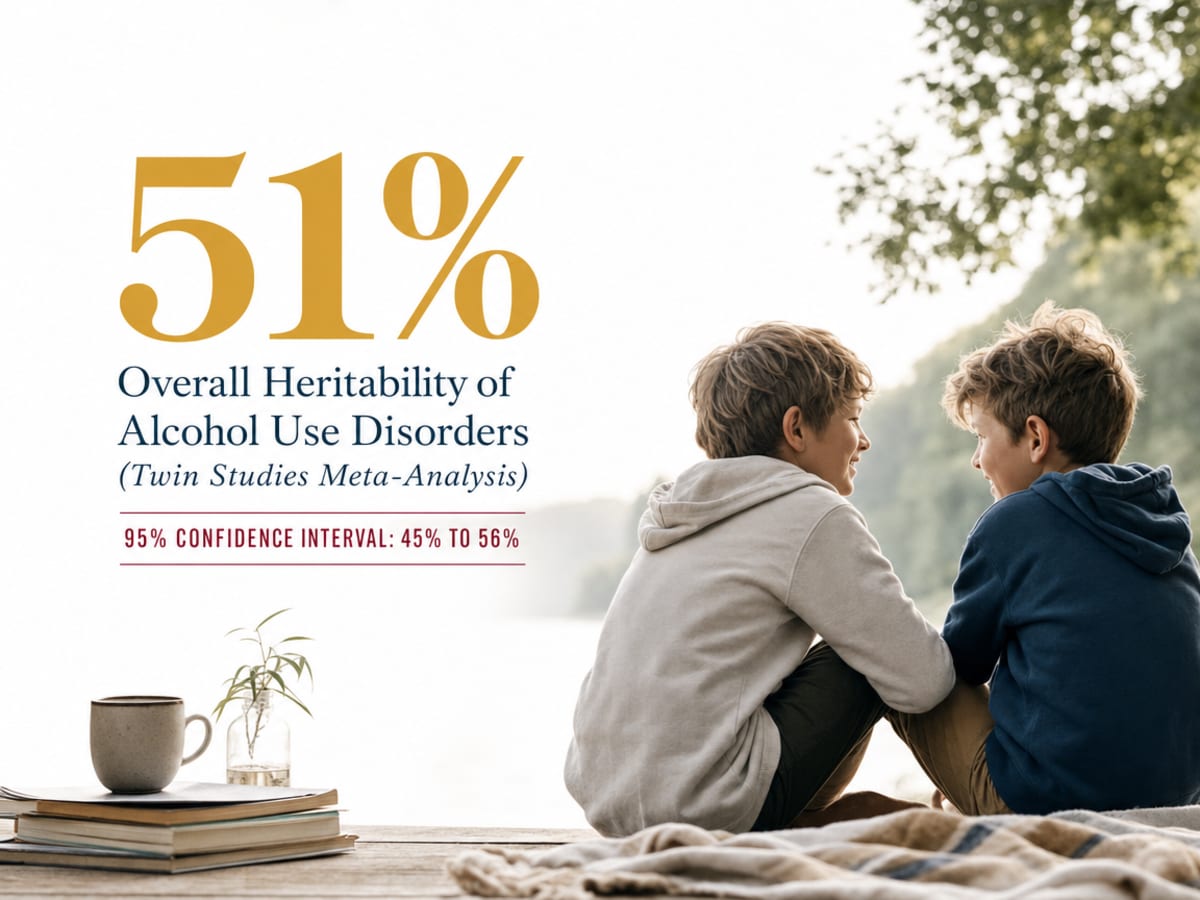
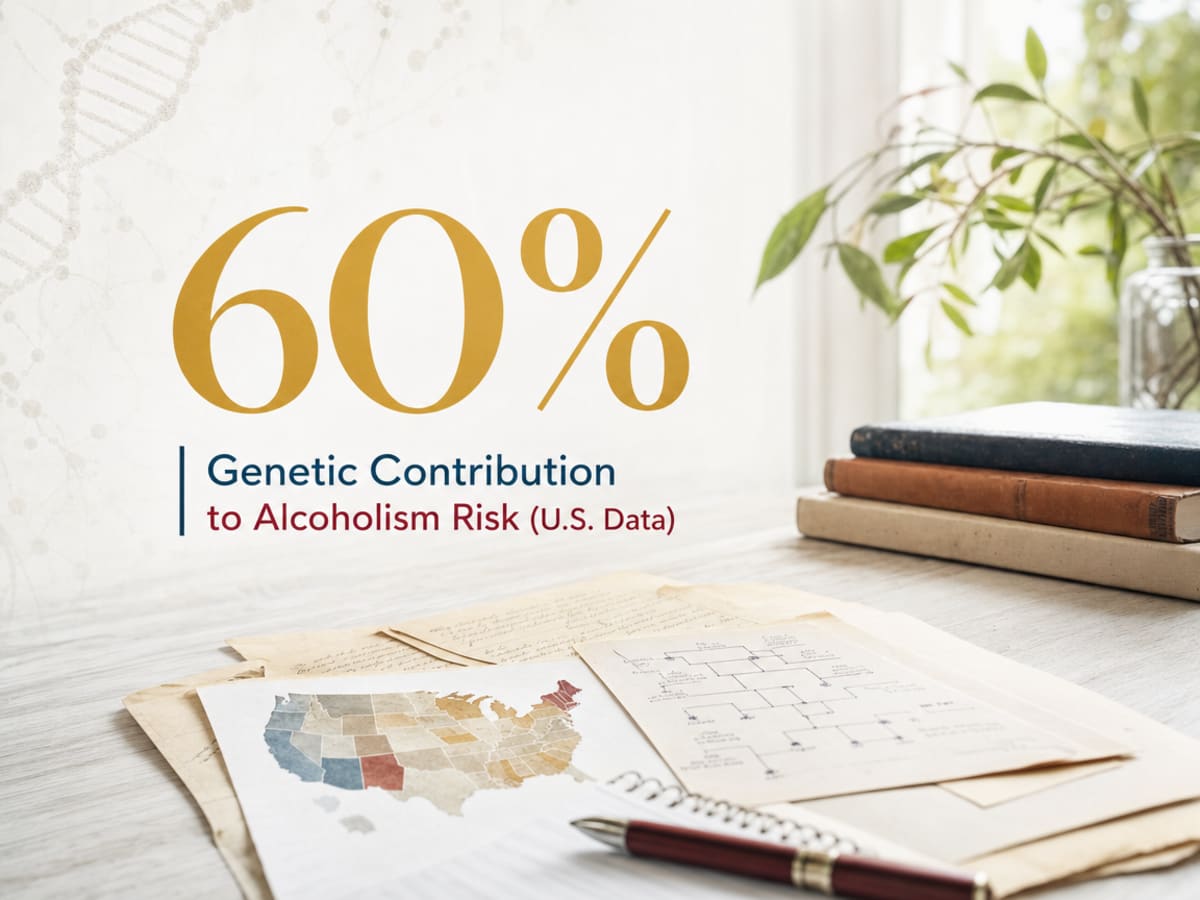
The largest meta-analysis of twin and adoption studies puts the heritability of alcohol use disorders at about 51%, with a confidence range between 45% and 56% 1. A separate review of U.S. twin and adoption data lands a bit higher, around 60% 2. A third major review of how genes and environment interact concludes that heritability sits at roughly 50%, meaning genetic and environmental influences carry nearly equal weight 7. Three different research teams, three different methods, and they all converge on the same neighborhood: about half.
That convergence matters. When independent studies using different populations and different designs keep arriving at the same answer, you can trust it. Alcoholism is not 10% genetic. It is not 90% genetic. It is meaningfully, measurably heritable, and meaningfully, measurably shaped by everything else.
The Collaborative Study on the Genetics of Alcoholism (COGA), one of the longest-running research projects on inherited alcohol risk, makes this point directly to families: genes account for a substantial portion of risk, but they do not make alcoholism inevitable 14. The same way a family history of heart disease does not mean every child will have a heart attack, a family history of alcoholism does not seal anyone’s fate.
This is also why “about half” is, in a strange way, good news. If alcoholism were 95% genetic, treatment would be a holding pattern. If it were 95% environmental, families like yours would carry impossible amounts of blame. The actual number leaves room for both compassion and action. The biology is real. So is everything you can still influence — and there is more of that than you might think.
There Is No Single ‘Alcoholism Gene’
The Genes Researchers Actually Talk About
If you’ve ever wondered whether scientists could point to one rogue gene and say, there it is, that’s the one — the honest answer is no. They’ve been looking for decades. What they’ve found instead is a long list of small contributors, each one nudging risk up or down by a little.
The two genes with the clearest, most replicated link to alcohol risk are ADH1B and ALDH2, both of which control how your body breaks down alcohol 4. Certain variants of these genes are actually protective. People who carry them feel sick when they drink — flushing, nausea, a racing heart — which makes heavy drinking unpleasant enough to discourage it. NIH researchers describe these protective variants as carrying odds ratios in the range of 0.2 to 0.4, meaning carriers are substantially less likely to develop alcohol dependence 4. If your loved one drinks comfortably and easily, they likely don’t carry these protective variants. That isn’t a moral fact about them. It’s a metabolic one.
Beyond metabolism, researchers have identified a handful of brain-related genes connected to dopamine signaling, reward processing, and stress response. The dopamine receptor gene DRD2, for example, has been studied for its role in how the brain registers pleasure and craving 10.
None of these genes act alone, and none of them function as an on-off switch. A person can carry several risk-associated variants and never develop a drinking problem. Another person can carry few of them and still end up in the grip of addiction because of trauma, mental illness, or environment. The genetics matter — they just don’t decide the outcome by themselves. That nuance is exactly why a swab test in the mail can’t tell you what’s coming for your son or your spouse.
Polygenic Risk in Plain English
Here’s the word researchers use for what’s actually going on: polygenic. It means “many genes.” And in the case of alcohol use disorder, “many” is not an exaggeration.
A landmark Yale-led genetic study identified 29 separate risk loci for problematic alcohol use. Of those, 10 had been spotted in earlier research and 19 were brand new discoveries 6. Picture that for a moment. Twenty-nine different spots on the human genome, each one carrying a tiny piece of the risk. Not one gene. Not even five. Twenty-nine — and that number will likely keep growing as larger studies come in.
Think of polygenic risk like the volume on an old stereo with dozens of small dials instead of one big knob. Each dial turns the sound up or down a little. Most people have some dials turned up and some turned down, and the final volume depends on the whole pattern, not any single one. Two siblings raised in the same house can inherit very different combinations of those dials from the same parents. That’s why one adult child in a family can struggle with alcohol while another barely drinks.
For you, the practical takeaway is this: when a relative says, “our family has the alcoholism gene,” they’re using a shortcut that isn’t quite right. What your family actually has is a pattern — a constellation of small inherited tendencies that, combined with stress, mental health, and exposure, raises the odds. Patterns are real. Patterns are worth taking seriously. But patterns are not prophecies, and no clinic in the country can read your DNA and tell you who in your family will or won’t develop a drinking problem.
How Environment, Stress, and Trauma Turn the Volume Up
The 50/50 Reality of Gene-Environment Interaction
If genes are half the story, what fills the other half? The short answer: life. The longer answer is the part that actually helps you understand what happened to your loved one.
Researchers studying gene-environment interaction describe alcoholism and drug dependence as conditions where genetic and environmental influences are roughly equally important, with heritability landing near 50% across the literature 7. That second 50% is not a vague mystery. It includes:
- early-life stress
- chronic adversity
- exposure to drinking environments
- social pressure
- the timing of when someone first picks up a glass
The same review identifies early-life stress specifically as a predictor of adolescent problem drinking and adult alcohol dependence 7.
Here is where the volume metaphor from earlier becomes useful again. Inherited risk sets where some of the dials start. Life experience walks over and turns certain dials up. A person born with moderate genetic vulnerability who grows up in a stable home, develops good stress-coping skills, and waits until adulthood to drink may never cross the line into a use disorder. That same person, dropped into a household marked by violence, untreated mental illness, or constant instability, may cross it by age nineteen.
This is not about blame. The point of gene-environment research is not to hand families a new way to feel guilty. It is to explain why two siblings can share a genome’s worth of overlap and walk completely different paths. One absorbed a divorce at age seven. One didn’t. One had a coach who noticed when things got bad. One didn’t. One started drinking at fifteen to manage anxiety nobody recognized. One waited.
For you, watching someone you love struggle right now, the practical meaning of the 50/50 reality is this: the genetic half is fixed, but the environmental half is still in motion. Stable housing, treatment for underlying mental health conditions, distance from heavy-drinking social circles, and structured support all act on that second 50%. They are not soft variables. They are half of the equation.
Epigenetics: Why Lived Experience Leaves a Mark
There is a third layer to this story that bridges biology and experience, and it has a name worth knowing: epigenetics. The word sounds intimidating. The idea is not.
Your genes are the instructions. Epigenetics is what decides which instructions get read out loud and which stay quiet. Stress, trauma, prolonged alcohol exposure, and other life events can chemically tag genes in ways that change how active they are, without changing the underlying DNA itself. A recent review on alcohol and gene regulation describes how drinking impacts gene expression through DNA methylation, histone modifications, and microRNA changes 8. NIDA points to the same mechanism more broadly, noting that environmental experiences can modify gene expression in ways that influence addiction vulnerability 12.
What does that mean at the kitchen table? It means the old debate between “nature” and “nurture” was never the right frame. Nurture becomes nature. The trauma your loved one carried into their twenties may have biologically adjusted how certain risk-related genes behave. The years of heavy drinking may have left their own epigenetic fingerprints on top of the inherited ones.
This is hard news and hopeful news at once. Hard, because it confirms that life leaves real biological traces — what happened to your loved one was not just emotional, it was cellular. Hopeful, because epigenetic changes are not necessarily one-way. Treatment, recovery, reduced stress, and sustained sobriety can shift the picture too. The biology that responded to harm can also respond to healing.
Why Treating the Drinking Alone Usually Fails
If you’ve watched someone you love go to rehab, come home sober, and slip back within months, you already know something the older treatment model was slow to admit: pulling the alcohol out doesn’t fix what was underneath it.
The genetics research helps explain why. The same inherited vulnerabilities that raise the odds of alcohol use disorder also raise the odds of depression, anxiety, PTSD, and ADHD. NIDA describes substance use disorders and other mental illnesses as sharing overlapping genetic vulnerabilities, overlapping brain regions, and overlapping environmental risk factors like trauma 13. A multi-ancestry genome-wide study of more than a million people found significant genetic overlap between problematic alcohol use and other psychiatric disorders, pointing to shared biological pathways rather than two separate problems that happen to show up in the same person 5.
So when your spouse drinks to quiet a panic that has been there since their twenties, or your adult child drinks to muffle a depression that started long before college, the drinking is not the whole disease. It is the most visible part of a wider picture. The NIAAA notes that depression, post-traumatic stress disorder, and ADHD are commonly comorbid with AUD and each raises the risk of developing it 3.
Treatment that only removes the alcohol leaves the underlying condition intact. The anxiety is still there. The trauma memories are still there. The brain still doesn’t produce the relief it learned to expect from a glass. Within weeks or months, the original problem reasserts itself, and the most familiar solution is sitting on a shelf at the grocery store.
This is the case for integrated, dual-diagnosis care — treating the mental health condition and the alcohol use disorder at the same time, by the same clinical team, in the same plan. It is not a luxury add-on. It is the response the biology of co-occurring conditions actually calls for. When the depression gets real treatment, when the trauma gets EMDR or another evidence-based therapy, when the anxiety has a path forward that isn’t liquid, the drinking has less work to do. That is how the second half of the equation — the part that isn’t fixed genetics — starts to move.
If You’re a Spouse or Adult Child Worried About Your Own Risk
So far, this article has been about the person you love. But somewhere around the second or third paragraph, another thought probably surfaced: What about me?
If you grew up with a parent who drank, or you’re married to someone whose drinking is sliding downhill, you have a right to ask that question without feeling selfish about it. The same research that explains your loved one’s risk also applies to you, and you deserve a straight answer.
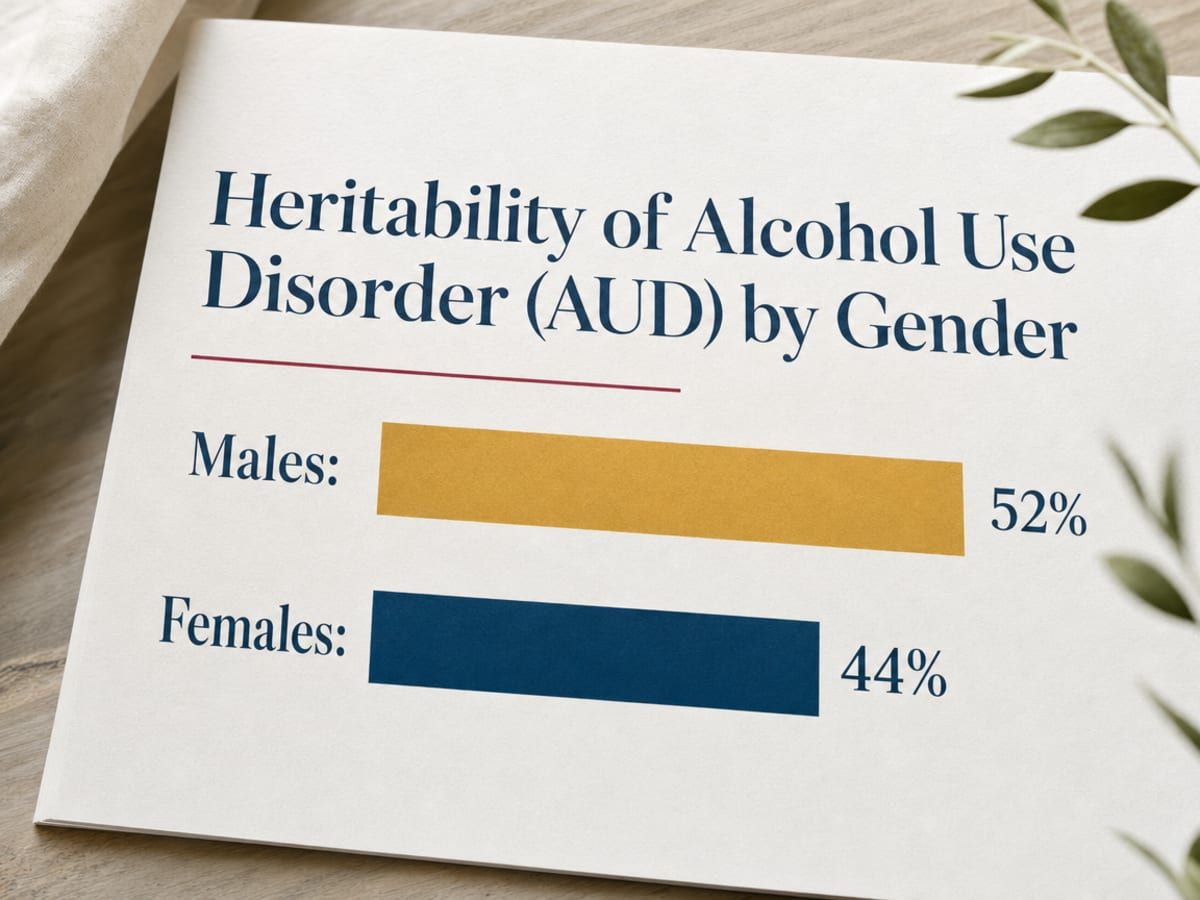
Here is one piece of it. The twin meta-analysis that anchors the heritability conversation actually breaks the number out by sex: heritability of alcohol use disorder is estimated at about 52% in males and about 44% in females 1. Those numbers are close enough that the headline doesn’t change — inherited biology matters meaningfully for both — but they’re different enough to be worth noticing. If you’re a son of someone with AUD, your inherited slice of risk is, on average, slightly larger than your sister’s. Neither number is a sentence. Both are signals.
What does a signal like that actually mean for your life? A few practical things, none of them dramatic.
You are not required to drink. Plenty of adults with strong family histories of AUD choose to skip alcohol entirely or keep it to rare, light occasions, and they live full social lives. That is a reasonable response to family history, not an overreaction.
You are allowed to pay attention. Earlier onset of drinking is associated with higher genetic risk profiles, and COGA research has linked high polygenic risk scores to younger age of onset of AUD in young adults 15. If you have teenage children, that finding matters. Delaying first use and noticing early patterns are within your reach.
You are allowed to get support of your own. A spouse watching a partner relapse, or an adult child sorting through what their childhood actually was, often benefits from individual therapy or a group like Al-Anon — regardless of whether you ever develop a drinking problem yourself. Caring for someone with AUD is its own load, and your nervous system is keeping score.
The point is not to scare you into vigilance. The point is that your risk is real, manageable, and far from inevitable. Knowing where you stand is what lets you act early instead of late.
What Families Can Actually Do With This Information
You came into this article looking for an answer about biology. You’re leaving with something more useful: a map of where you still have leverage. Genetics set part of the terrain. They did not pour the drinks, and they will not run the recovery. Here is what actually moves the needle for families in your position.
Take the family history seriously, but treat it as data, not doom. Write down what you actually know. Which relatives struggled, at what ages, alongside what other conditions — depression, anxiety, untreated trauma, chronic pain. That timeline is something a good clinician can use. It tells them what to screen for, what medications to be cautious with, and which co-occurring conditions are likely riding underneath the drinking. You are not gossiping. You are handing a treatment team the context they need.
Push for an assessment that looks at the whole person, not just the alcohol. Because shared genetic vulnerabilities link AUD to depression, anxiety, PTSD, and ADHD 13, a program that treats only the substance use leaves half the wiring untouched. Ask directly whether the facility evaluates and treats co-occurring mental health conditions in the same plan, with the same team. “Yes, we refer out” is a different answer than “yes, we do it here.” The second is what the biology actually calls for.
Act on age of onset, especially with younger family members. Higher polygenic risk has been linked to earlier onset of AUD in young adults 15, which means delay is its own form of prevention. If you have a teenager or young adult in the family, conversations about waiting, alternatives to drinking-centered socializing, and honest information about family history are not lectures — they are early intervention.
Change what you can change in the environment. The second half of the risk equation responds to real-world adjustments: stable housing, treatment for trauma, fewer heavy-drinking social settings, sleep, structure, support. None of these are silver bullets. Stacked together, they meaningfully shift the half of risk that genes don’t control.
Get your own support. Whatever happens with your loved one, you are running a marathon that started before you knew you’d entered it. Therapy, a family support group, a trusted clinician of your own — these are not extras. They are how you stay steady enough to be useful. Recovery in a family rarely happens alone, and the work Arrow Passage Recovery does with families reflects what the research has been saying all along: the person struggling, the people who love them, and the conditions underneath the drinking all belong in the same conversation.
Talk to a Specialist About Alcoholism Recovery
Get answers and guidance for next steps in dual diagnosis alcohol treatment, right when you need it most.
Discuss Personalized Support for Alcohol Use Recovery
Get expert guidance to explore compassionate, tailored treatment for alcohol-related struggles.
Frequently Asked Questions
If alcoholism runs in our family, will my child or grandchild definitely develop it?
No. A family history raises the odds, but it does not seal the outcome. Researchers studying inherited risk are clear that genes contribute a substantial share of vulnerability without making alcoholism inevitable 14. Plenty of people with strong family histories never develop a drinking problem, and plenty without one do. Treat the history as useful information for screening and early conversations, not as a forecast about any specific person you love.
Is there a genetic test that can tell us if someone will become an alcoholic?
No. There is no routine genetic test used to diagnose or predict addiction, and NIDA says so directly 12. Because risk involves many small genetic contributors interacting with stress, mental health, and environment, no current swab or blood test can tell you what’s coming for a specific person. A careful clinical assessment that includes family history and co-occurring conditions is far more useful than any consumer DNA kit.
My loved one didn’t grow up around drinking. How can alcoholism still be ‘genetic’ for them?
Because the inherited part of risk lives in biology, not in what someone saw at the dinner table. U.S. twin and adoption data show that shared family environment plays a smaller role than people assume, while genetic effects account for a large portion of the variance in alcoholism risk 2. Your loved one can carry inherited vulnerability through metabolism, stress response, or reward signaling even if no one in the house ever opened a bottle.
Does inherited risk mean my loved one can’t recover?
Not at all. Heritability describes how risk varies across a population, not whether any one person can get well. AUD is a treatable chronic brain disorder, and inherited vulnerability does not block recovery any more than family history blocks treatment for diabetes or heart disease 3. What helps most is care that addresses both the drinking and any underlying mental health conditions, alongside changes in stress, support, and environment.
Why does my loved one also struggle with depression or anxiety alongside the drinking?
Because they are not two unrelated problems. Substance use disorders and mental illnesses share overlapping genetic vulnerabilities, overlapping brain regions, and overlapping environmental risk factors like trauma 13. That biological overlap is why depression, PTSD, and anxiety so often sit underneath an alcohol use disorder. It is also why treating only the alcohol tends to fall short, and why integrated dual-diagnosis care, addressing both conditions together, gives your loved one a stronger footing.
I’m an adult child of an alcoholic. Should I never drink at all?
That is your call, and either answer can be reasonable. Your inherited risk is real but not deterministic, and many adults with family histories choose to abstain or drink rarely and lightly without feeling deprived. Paying attention to age of first use matters too, since higher genetic risk has been linked to earlier onset of AUD in young adults 15. If you notice your own drinking creeping up, that’s worth talking to a clinician about sooner rather than later.
References
- The heritability of alcohol use disorders: a meta-analysis of twin and adoption studies. https://pmc.ncbi.nlm.nih.gov/articles/PMC4345133/
- Genetic Influences on Alcoholism Risk: A Review of Adoption and Twin Studies. https://pmc.ncbi.nlm.nih.gov/articles/PMC6875767/
- Understanding Alcohol Use Disorder. https://www.niaaa.nih.gov/publications/brochures-and-fact-sheets/understanding-alcohol-use-disorder
- Genetics and alcoholism. https://pmc.ncbi.nlm.nih.gov/articles/PMC4056340/
- Multi-ancestry study of the genetics of problematic alcohol use in 1.1 million individuals. https://www.nature.com/articles/s41591-023-02653-5
- Understanding Genetic Influences on Problematic Alcohol Use. https://www.addictionpolicy.org/post/2020-yale-study-and-update-on-the-genetic-risk-for-alcohol-use-disorder
- The Influence of Gene–Environment Interactions on the Development of Alcoholism and Drug Dependence. https://pmc.ncbi.nlm.nih.gov/articles/PMC3470472/
- Epigenetic Influences on Alcohol Use Disorder. https://www.oxjournal.org/epigenetic-influences-on-alcohol-use-disorder/
- The heritability of alcohol abuse and dependence: a meta-analysis of behavior genetic research. https://pubmed.ncbi.nlm.nih.gov/12211366/
- Alcoholism and genetics. https://www.ebsco.com/research-starters/health-and-medicine/alcoholism-and-genetics
- World Mental Health Report 2022: Transforming mental health for all (sections on alcohol use and risk factors). https://www.who.int/publications/i/item/9789240052734
- Genetics and Epigenetics of Addiction. https://www.drugabuse.gov/publications/drugfacts/genetics-epigenetics-addiction
- Comorbidity: Substance Use Disorders and Other Mental Illnesses. https://www.drugabuse.gov/publications/drugfacts/comorbidity-substance-use-disorders-other-mental-illnesses
- Heritability | COGA Alcohol Use Disorder Study. https://cogastudy.org/aud/heritability/
- High Polygenic Risk Scores Are Associated With Age of Onset of Alcohol Use Disorder in Young Adults. https://cogastudy.org/young-adults-at-risk/