
How to Find an Alcoholism Treatment Program That Works
Key Takeaways
- Assess your own drinking pattern, withdrawal risk, mental health, and home stability before comparing programs, because effective treatment gets matched to your specific picture rather than to whoever calls back first.
- Use the four ASAM levels of care, outpatient, intensive outpatient or PHP, residential, and intensive inpatient, to match clinical intensity to severity, medical risk, and the stability of your environment 10.
- Insist on access to FDA-approved medications, since naltrexone and acamprosate are first-line for moderate to severe alcohol use disorder yet remain underused across the field 11.
- Pressure-test dual-diagnosis claims by asking who prescribes psychiatric medications, how they handle existing prescriptions, and which named trauma therapies they use, because integrated care outperforms sequential treatment 6.
- Bring ten specific intake questions to every call so you can hear the difference between scripted responses and a program that runs on real clinical assessment, staffing, and accreditation.
- Look for named, evidence-based therapies on the menu, including CBT, motivational interviewing, twelve-step facilitation, and family work, rather than vague language like personalized or holistic 9.
- Treat continuing care and mutual-help connections as part of the program, with written step-down plans, scheduled follow-ups, and a clinical response to relapse rather than discharge 3.
- If you are not ready to commit, the SAMHSA National Helpline and a primary care visit are lower-stakes entry points that can connect you to options and medications 8.
Start by locating yourself, not by shopping
Before you compare programs, take a breath and figure out where you actually are. The search results will throw glossy campuses and 28-day promises at you, and almost none of that matters until you know your own picture: how much you drink, what happens when you stop, what else is going on in your head, and what kind of life you can step away from this week.
That self-locating work isn’t a side task. It is the task. Effective alcohol treatment gets matched to severity, medical risk, co-occurring mental health conditions, and your goals, not to whichever facility called you back first 2. The same person can need a medically supervised detox in one moment and a weekly outpatient session six months later, and both can be the right level of care at the right time 10.
So three honest questions, before anything else.
What happens to your body when you go a day without drinking? Shaking hands, sweating, racing heart, or a past seizure puts withdrawal safety at the top of the list 3. Are you also dealing with depression, anxiety, PTSD, or bipolar symptoms? If yes, you need a program that treats both at once, not in sequence 6. And what does your home look like right now: a stable place with people who can support sobriety, or the same rooms where the drinking happened?
Your answers point you toward a level of care. The rest of this guide helps you pressure-test the programs that claim to deliver it.
Match the level of care to your actual situation
The four ASAM levels of care, translated
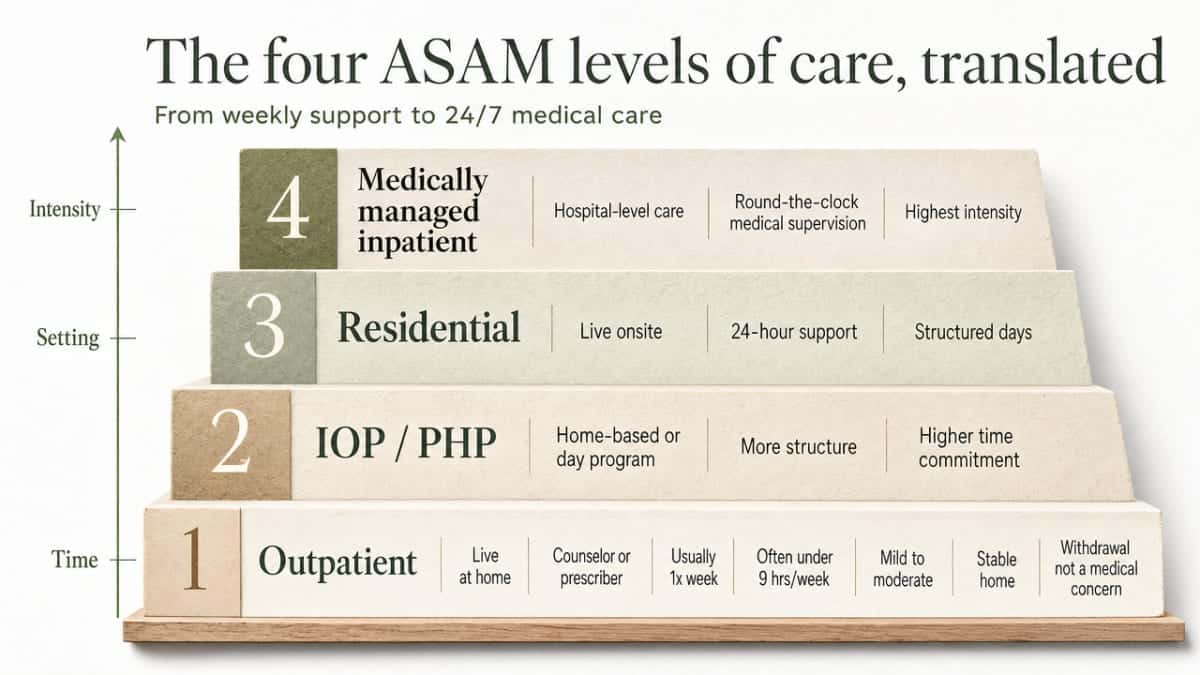
Alcohol treatment in the United States gets organized along four basic levels of care, defined by the American Society of Addiction Medicine and used by most reputable programs and insurance plans 10. They scale from a weekly therapy hour to round-the-clock medical supervision, and a good program will tell you which level they think you need and why.
Here is what each one actually looks like in real life.
- Outpatient. You live at home and meet with a counselor or prescriber, usually once a week, sometimes twice. Total time commitment is often under nine hours a week. This works when your drinking is mild to moderate, your home is stable, withdrawal is not a medical concern, and you do not have an untreated mental health condition pulling you back to the bottle 10.
- Intensive outpatient or partial hospitalization (IOP/PHP). You still sleep in your own bed, but treatment becomes a real schedule. IOPs typically run nine to twenty hours per week of group therapy, individual counseling, family sessions, and relapse-prevention work. PHP is the same idea at a higher dose, often five or six hours a day, five days a week. Both can include medical and psychiatric care 2.
- Residential. You live at the facility for a defined stretch, usually a few weeks to a few months, with twenty-four-hour staff, structured programming, and a clinical team that can manage medications and co-occurring conditions in one place 2. This is the right call when your home environment is unsafe for sobriety, prior outpatient attempts have not held, or you need to step out of your life to interrupt the cycle.
- Intensive inpatient. The most medically supervised setting, often in a hospital or specialized unit, for people who need monitored withdrawal management or have serious medical and psychiatric complications 2. Stays are usually short and aimed at stabilization, then you step down to residential, PHP, or IOP.
Self-locate first. Then call.
When withdrawal makes detox the right starting point
If you have been drinking heavily and daily for weeks or longer, you may already know the morning signs: hands that won’t steady, sweat through the sheets, a heart that races before you’ve moved. Add a history of seizures, delirium tremens, or any prior complicated withdrawal, and ambulatory detox is no longer safe. You need a medically supervised setting where someone can watch your vitals, medicate symptoms, and intervene if things turn 3.
Residential or intensive inpatient detox in those situations is not a luxury upgrade. It is the right starting point. A few days to a week of stabilization gets you through the dangerous window so the real treatment work can begin 2.
If your drinking has been lighter or more intermittent and you do not have those warning signs, an outpatient prescriber may be able to support withdrawal with medications and close check-ins. Ask. Do not guess.
Why intensive outpatient can be the right answer, not the budget answer
If you cannot disappear from your job, your kids, or your caregiving responsibilities for thirty days, you have not failed a purity test. You are most adults with alcohol use disorder.
The evidence on intensive outpatient programs is more reassuring than the rehab brochures suggest. Peer-reviewed reviews conclude that IOPs are as effective as inpatient treatment for most individuals when the program offers high-quality, evidence-based services and patients are appropriately matched 4. The active ingredients in good IOP look a lot like the active ingredients in good residential care: group therapy several times a week, individual counseling, family involvement, relapse-prevention skills, and access to medications 4.
What IOP is not built for: anyone whose home environment makes sobriety impossible from day one, anyone who needs medical detox first, and anyone whose untreated psychiatric symptoms keep derailing outpatient attempts. Those situations belong in residential or PHP, at least to start 2.
If your situation fits IOP, treat it as a clinical choice, not a compromise. Ask the program how many hours per week, how groups are structured, whether prescribers are on staff, and how they handle a slip. A program that treats IOP as a serious level of care, not a downgrade, is the one to call back.
Treat medication access as a non-negotiable
The three FDA-approved medications and who each one fits
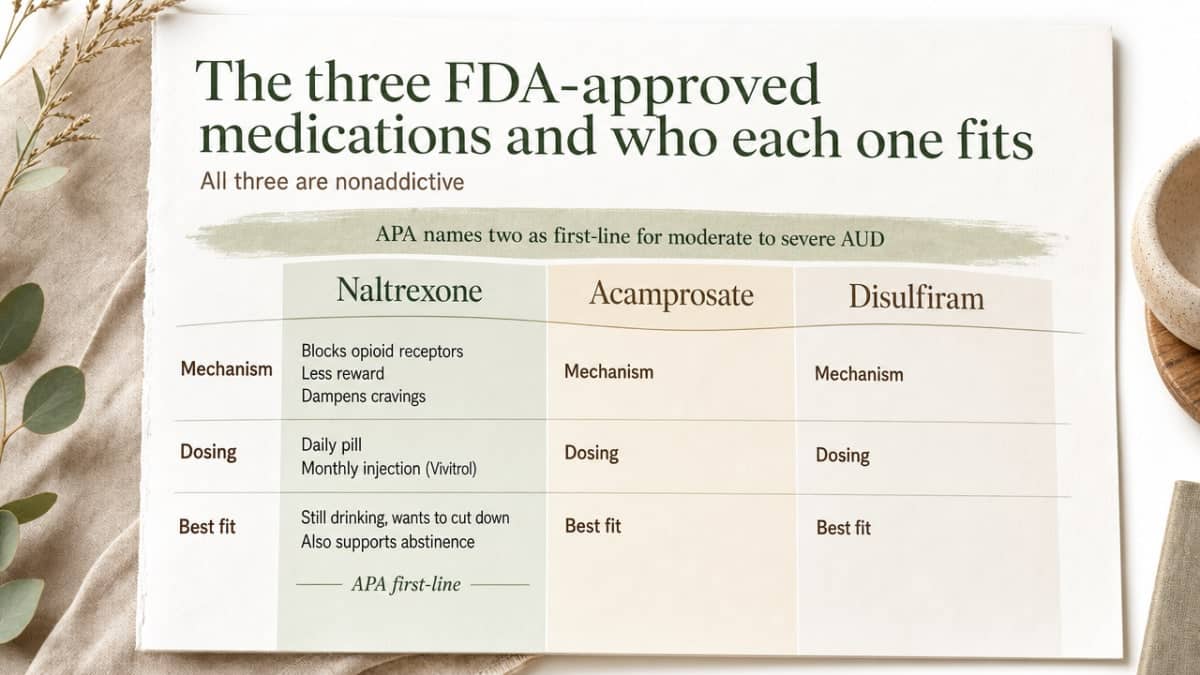
Here is a fact that most rehab brochures bury: three medications are approved in the United States to help people stop or reduce drinking, and all three are nonaddictive 3. The American Psychiatric Association names two of them as first-line treatment for moderate to severe alcohol use disorder 11. If you are evaluating a program and medications are an afterthought, you are looking at the wrong program.
- Naltrexone. Blocks the opioid receptors that make drinking feel rewarding, which dampens cravings and the pull of a first drink. It comes two ways: a daily oral pill, and a once-monthly extended-release injection called Vivitrol. The injection helps if you know you’ll forget pills or talk yourself out of them on a hard day. Naltrexone fits people who are still drinking and want to cut down, as well as people working toward abstinence. It cannot be used if you take opioid pain medication 11.
- Acamprosate. Helps your brain reset after long-term drinking by easing the low-grade anxiety, restlessness, and sleep disruption that pull people back to alcohol in early recovery. Taken three times a day, which is the main drawback. Best fit: you have already stopped drinking and want to stay stopped. Safe for people on opioids and people with liver issues, where naltrexone may not work 11.
- Disulfiram. The old one. It does not reduce cravings; it makes you violently ill if you drink. That deterrent works for highly motivated people in stable situations, often with someone helping with daily dosing. Not first-line, but a real tool when other medications haven’t fit 11.
The APA guideline puts naltrexone and acamprosate ahead of the rest because the evidence for reducing heavy drinking and supporting abstinence is strongest 11. Despite that, these medications are underused across the field 1. That is the gap between what works and what gets offered. Knowing the three names by heart is how you close it on your own intake call.
What to do when a program shrugs at medication
Ask directly: “Do you offer FDA-approved medications for alcohol use disorder, and is a prescriber on staff?” Listen to what comes back.
A good answer names naltrexone and acamprosate without hesitation, explains that a physician or nurse practitioner evaluates every patient for medication, and treats medication as one tool alongside therapy, not a separate track 1. A program that says medication is available “if you want it” is doing the bare minimum. A program that says they prefer an abstinence-only approach and discourages medication is out of step with current guidelines 11.
If the program you like has weak medication access, you have options. You can keep that program for the therapy and groups and get medication through your primary care doctor or a telehealth prescriber. Many primary care providers now prescribe naltrexone and acamprosate as part of general medical care 1.
You do not have to choose between a program that fits your schedule and a program that takes medication seriously. You just have to ask the question and not accept a shrug. Cravings are a biological reality. Treating them like one changes what early recovery actually feels like.
Vet dual-diagnosis capability before you commit
If you’ve been drinking on top of depression, anxiety, PTSD, ADHD, or bipolar symptoms, the program you choose has to treat both at the same time. Not in sequence. Not “we’ll address that once you’re sober.” At the same time. Integrated care produces better outcomes than splitting the two problems across two providers, and the evidence on that is consistent enough that any program worth your call should already know it 6.
The hard part is that almost every facility says it does dual diagnosis. The phrase is on the website. The phrase is in the brochure. What you’re testing for is whether it’s actually built in.
Three questions get you most of the way there.
First: Who diagnoses and treats my mental health condition, and are they on your staff or referred out? A real dual-diagnosis program has a psychiatrist or psychiatric nurse practitioner who sees you regularly, not a counselor who refers you to someone across town. Integrated care means one team, one chart, one treatment plan 12.
Second: How do you handle psychiatric medications during treatment? The answer should be matter-of-fact. They continue or adjust your antidepressants, mood stabilizers, or non-stimulant ADHD medications as clinically indicated. A program that pressures you off psychiatric medications to “see how you do sober” is not equipped to treat you.
Third: What therapies do you use for trauma specifically? If PTSD is part of your picture, you want to hear named modalities: EMDR, trauma-focused CBT, cognitive processing therapy. Generic “trauma-informed care” is a baseline, not a treatment.
Research on residential dual-diagnosis programs shows substantial improvements in both drinking and psychiatric symptoms when both are treated together 5. That outcome doesn’t come from a checkbox on a website. It comes from staffing, training, and a clinical model that takes your whole picture seriously. Make the program prove it on the phone before you sign anything.
Ten intake-call questions and what a good answer sounds like
You don’t need a clinical degree to vet a program. You need ten questions and the patience to listen for what comes back. Write these down before you dial. If you’re helping a family member, you make the call.
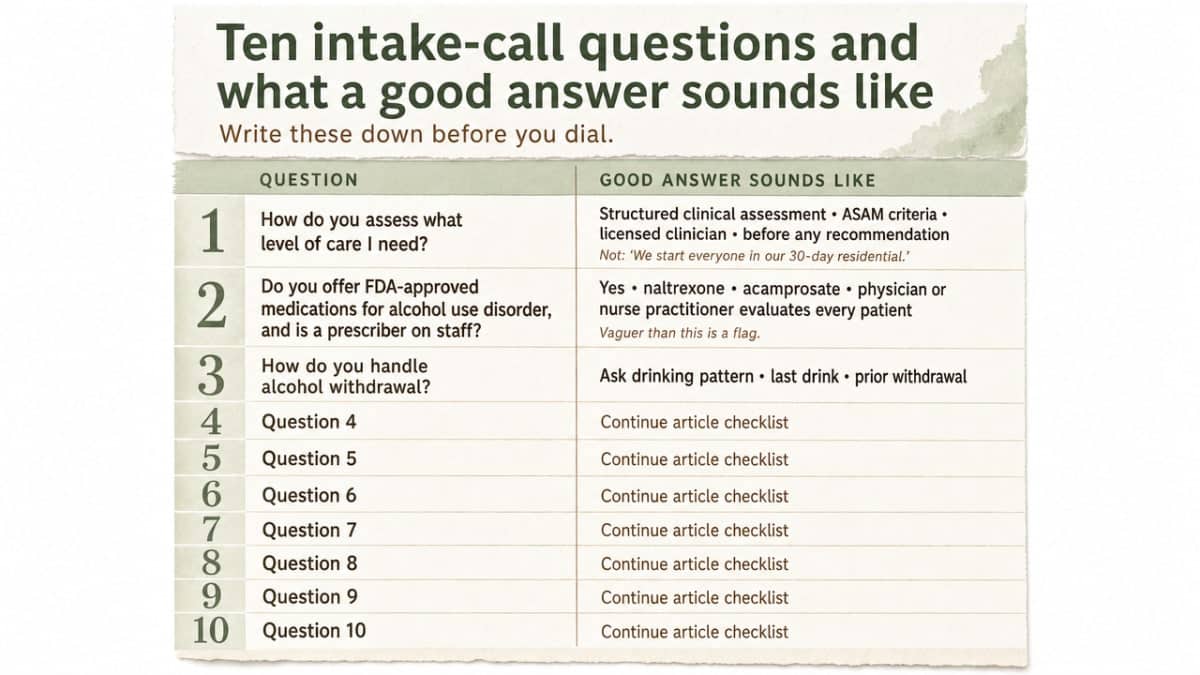
- 1. How do you assess what level of care I need? Good answer: a structured clinical assessment using ASAM criteria, done by a licensed clinician, before any recommendation 2. Bad answer: “We start everyone in our 30-day residential.”
- 2. Do you offer FDA-approved medications for alcohol use disorder, and is a prescriber on staff? Good answer: yes, naltrexone and acamprosate are routinely offered, and a physician or nurse practitioner evaluates every patient 11. Anything vaguer than that is a flag.
- 3. How do you handle alcohol withdrawal? Good answer: they ask about your drinking pattern, last drink, and prior withdrawals in the first few minutes, and they have a clear medical pathway for monitored detox or a partner who does 3.
- 4. What does your dual-diagnosis care actually look like? Good answer: a psychiatric prescriber on staff, integrated treatment planning, and continuation of your existing psychiatric medications when clinically appropriate 6.
- 5. Which therapies do your counselors use? Good answer: named, evidence-based modalities, such as cognitive behavioral therapy, motivational interviewing, and 12-step facilitation, not “a personalized approach” 9.
- 6. How do you involve family? Good answer: structured family sessions, education, and an option for couples or family therapy where it fits 4.
- 7. What happens after I finish the program? Good answer: continuing-care planning starts at intake, with a written step-down plan, scheduled follow-ups, and warm handoffs to outpatient providers and mutual-help groups 3.
- 8. How do you handle a slip or a relapse? Good answer: they treat it clinically, adjust the plan, and don’t discharge you for using. Relapse is part of a chronic condition, not a failure of character 3.
- 9. Are you accredited and licensed, and who oversees clinical quality? Good answer: a named national accreditor, state licensure, and a clinical director you can identify by name and credential 2.
- 10. What does this cost, and what will my insurance cover? Good answer: a clear breakdown of in-network status, what’s covered at each level of care, and what the out-of-pocket estimate looks like before you commit.
You will hear the difference between a program reading from a script and a program that does this work seriously. Trust that difference. If the person on the phone can’t answer five of these, hang up and call the next one.
Therapies that should be on the menu
The therapy menu matters as much as the level of care. Two programs that both call themselves “residential” can run on completely different clinical engines, and the difference shows up in your outcomes six months later. You want named, evidence-based modalities, delivered by people trained in them, not a generic blend that the brochure calls “holistic.”
Four belong on any serious AUD program’s menu.
- Cognitive behavioral therapy (CBT). Teaches you to spot the thoughts and situations that drive drinking and to build different responses. The backbone of most evidence-based programs 9.
- Motivational interviewing and motivational enhancement therapy. Helps you work through the ambivalence that almost everyone brings into treatment. Particularly useful early, when part of you still wants to drink 12.
- Twelve-step facilitation. A structured clinical approach that links you into AA or similar mutual-help groups. The meta-analysis evidence is striking: AA and 12-step facilitation produce similar benefits to CBT across drinking outcomes, with an edge for long-term continuous abstinence and lower healthcare costs 7. If you’ve written off the 12 steps, the data is worth a second look.
- Family or couples therapy. Drinking happens inside relationships, and recovery does too. Programs that fold family into the work get better traction 4.
Trauma-specific care, contingency management, and mindfulness-based approaches round out a strong menu when they fit your picture 12. Ask which modalities a program actually uses and who is trained in them. “Personalized” is not a therapy.
Continuing care and mutual help are part of the program, not afterthoughts
The honest truth about alcohol use disorder is that it behaves like a chronic condition, not a broken bone. Stays in residential or PHP get you through the most dangerous and disorienting stretch. They do not, on their own, carry you through year one. What carries you through year one is what the program builds with you for after.
So ask, on the intake call, what continuing care actually looks like. A serious program treats the step-down as part of the work, not paperwork at discharge. That means a written plan before you leave, scheduled outpatient appointments already on the calendar, a prescriber who continues your medications without a gap, and a warm handoff to a counselor in your community 3. If the answer you get is “we’ll figure that out at the end,” you have your answer.
Mutual help belongs in the same conversation. The meta-analysis evidence on Alcoholics Anonymous and 12-step facilitation is stronger than its reputation in some circles: AA and TSF produce benefits similar to CBT across drinking outcomes, with an edge for long-term continuous abstinence and lower healthcare costs over time 7. You do not have to love every meeting you walk into. You do need somewhere to keep showing up after the program ends. If AA is not your fit, SMART Recovery, Refuge Recovery, and women-specific or LGBTQ-specific groups exist, and a good program helps you find one that holds.
Relapse is not a discharge offense. NIAAA is direct that follow-up care is critical given the chronic, relapsing nature of AUD 3. Ask how the program handles a slip. The right answer adjusts the plan and keeps you in care.
If you’re not ready to call a specific program yet
Reading this far is not nothing. You’re already doing the work of figuring out what good looks like before you spend money and emotional energy on the wrong door. If you’re not ready to dial a specific program today, start somewhere lower-stakes.
The SAMHSA National Helpline is free, confidential, and answers around the clock, every day of the year, in English and Spanish 8. The people on the other end don’t sell anything. They take your situation and point you toward local treatment options, including programs that take your insurance 8.
A primary care visit is another quiet entry point. Many primary care providers now screen for alcohol use disorder, prescribe naltrexone or acamprosate, and refer to specialty care when needed 1.
One call. One appointment. That’s the next step.
Ready to Start Your Recovery Journey Today?
Connect with a caring specialist to begin your personalized treatment plan—support is available any time you need it.
Ready to Take the Next Step Forward?
Connect with a supportive expert to explore personalized treatment options for your recovery journey.
Frequently Asked Questions
How do I know if I need residential treatment or if outpatient is enough?
The honest answer comes from a clinical assessment using ASAM criteria, not a gut call 2. Residential makes sense when your home isn’t safe for sobriety, prior outpatient attempts haven’t held, or untreated psychiatric symptoms keep pulling you off track. Intensive outpatient can match inpatient outcomes for many people when the program is high-quality and you’re appropriately matched 4. Get assessed first.
Is medication really necessary, or can I get sober without it?
People stop drinking without medication, and people use medication to make stopping more sustainable. The American Psychiatric Association recommends naltrexone or acamprosate as first-line for moderate to severe alcohol use disorder because the evidence for reducing heavy drinking and supporting abstinence is strongest 11. All three FDA-approved AUD medications are nonaddictive and work alongside counseling 3. Treating cravings as biology is not weakness.
What does ‘dual diagnosis’ mean and why should I ask about it?
Dual diagnosis means you have a substance use disorder and a co-occurring mental health condition, like depression, anxiety, PTSD, or bipolar disorder. Ask about it because integrated treatment, where one team treats both at once, produces better outcomes than addressing them separately or in sequence 6. Programs that delay psychiatric care until you’re “sober enough” are working against the evidence and against you 12.
Is alcohol withdrawal actually dangerous enough to need medical supervision?
Yes, for some people. Alcohol is one of the few substances where unmanaged withdrawal can cause seizures or delirium tremens, which is why ASAM treats withdrawal management as its own clinical decision 2. If you drink heavily and daily, have shaking, sweating, or racing heart in the morning, or have a history of complicated withdrawals, you need a medically supervised setting before treatment begins 3.
Do I have to go to AA or work the 12 steps for treatment to work?
No, but don’t dismiss it on reputation. The meta-analysis evidence shows AA and 12-step facilitation produce benefits similar to CBT across drinking outcomes, with an edge for long-term continuous abstinence and lower healthcare costs 7. If AA isn’t your fit, SMART Recovery, Refuge Recovery, and identity-specific groups exist. What matters is having somewhere to keep showing up after formal treatment ends.
What should I do if I’m not ready to commit to a specific program yet?
Start with one lower-stakes call. The SAMHSA National Helpline is free, confidential, and answers 24/7, every day of the year, in English and Spanish, and they don’t sell anything, they just connect you to local options 8. A primary care visit is another quiet entry point, since many primary care providers now screen for AUD, prescribe naltrexone or acamprosate, and refer to specialty care 1.
References
- Treatment of Alcohol Use Disorder. https://www.ncbi.nlm.nih.gov/books/NBK561234/
- Treatment Programs for Substance Use Disorder. https://www.ncbi.nlm.nih.gov/books/NBK584391/
- Treatment for Alcohol Problems: Finding and Getting Help. https://www.niaaa.nih.gov/publications/brochures-and-fact-sheets/treatment-alcohol-problems-finding-and-getting-help
- Substance Abuse Intensive Outpatient Programs: Assessing the Evidence. https://pmc.ncbi.nlm.nih.gov/articles/PMC4152944/
- The effects of residential dual diagnosis treatment on alcohol abuse. https://pmc.ncbi.nlm.nih.gov/articles/PMC5576155/
- The effectiveness of integrated treatment in patients with substance use disorders co-occurring with anxiety and/or depression: a group randomized trial. https://pmc.ncbi.nlm.nih.gov/articles/PMC3974008/
- Alcoholics Anonymous and 12-Step Facilitation Treatments for Alcohol Use Disorder: A Systematic Review and Meta-analysis. https://pmc.ncbi.nlm.nih.gov/articles/PMC8060988/
- National Helpline for Mental Health, Drug, Alcohol Issues – SAMHSA. https://www.samhsa.gov/find-help/helplines/national-helpline
- Core Resource on Alcohol. https://www.niaaa.nih.gov/health-professionals-communities/core-resource-on-alcohol
- What Types of Alcohol Treatment Are Available?. https://alcoholtreatment.niaaa.nih.gov/what-to-know/types-of-alcohol-treatment
- The American Psychiatric Association Practice Guideline for the Pharmacological Treatment of Patients With Alcohol Use Disorder. https://pubmed.ncbi.nlm.nih.gov/29301420/
- Finding Help for Co-Occurring Substance Use and Mental Disorders. https://www.nimh.nih.gov/health/topics/substance-use-and-mental-health