
Key Takeaways
- Clinicians no longer diagnose people as ‘alcoholics’ — they use alcohol use disorder, a spectrum ranging from mild to severe based on 11 criteria measured over a year 1.
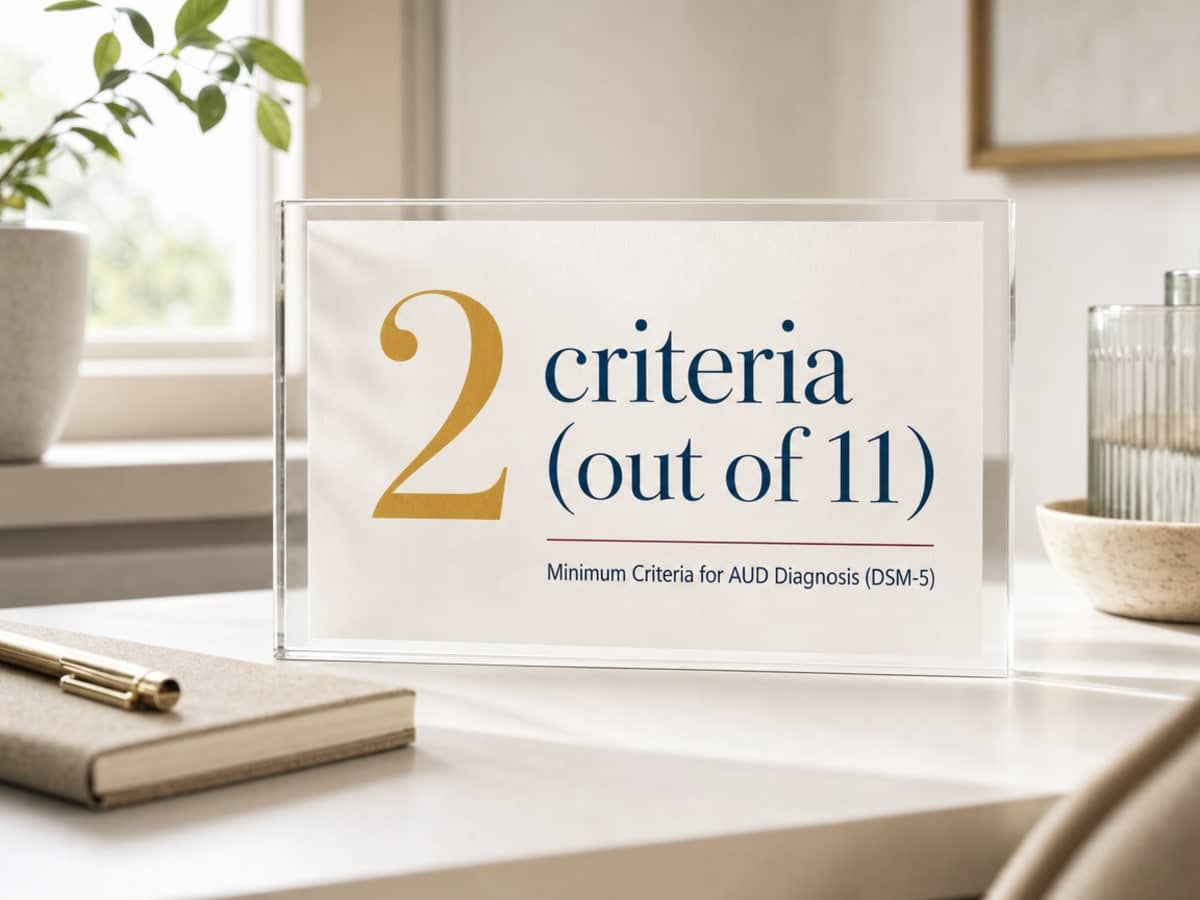
- Meeting just two of the 11 criteria qualifies as mild AUD, meaning you don’t need to hit rock bottom for your drinking pattern to warrant attention 5.
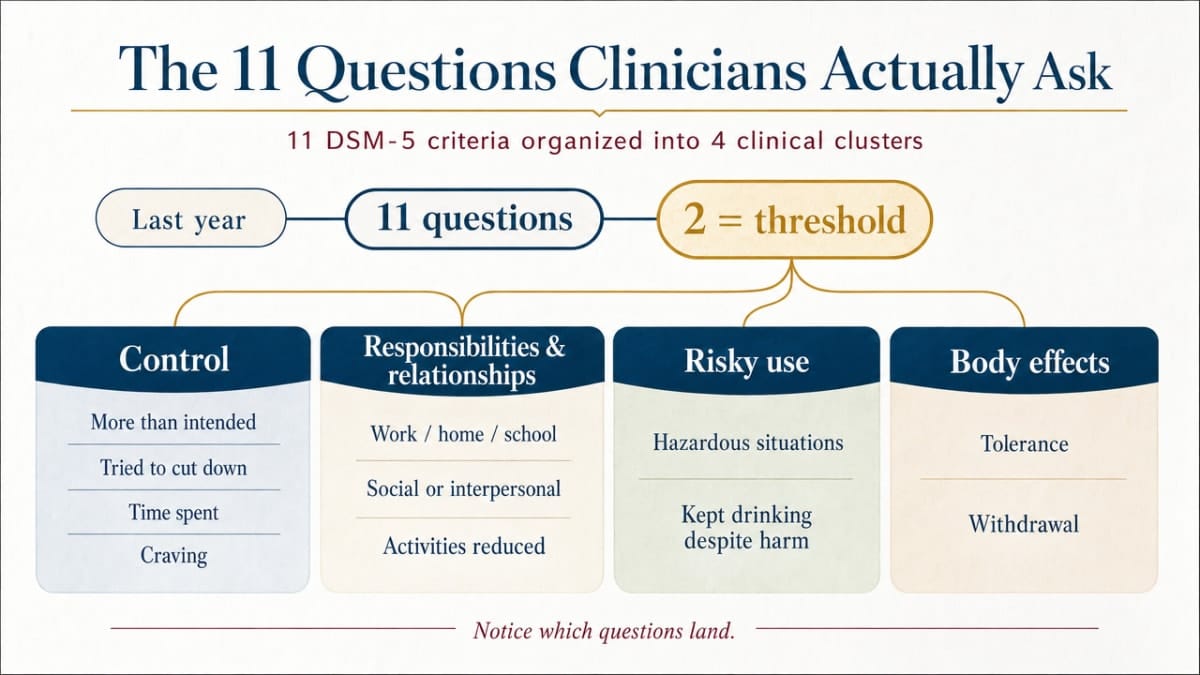
- The 11 criteria cluster into four areas: impaired control, social impairment, risky use, and physical signs like tolerance and withdrawal 6.
- Heavy daily drinkers should never quit cold turkey alone — withdrawal can trigger seizures or delirium tremens, which is why medically supervised detox exists 4.
The Question Itself Is a Signal
If you’re here, something already told you to look. Maybe it was the second morning this week you woke up counting backward through last night, trying to remember when you stopped. Maybe your partner made a face you can’t unsee. Maybe you just wanted to know, quietly, without anyone watching.
That impulse matters. People who don’t have any relationship with their drinking don’t type this into a search bar at 11 p.m. The question is doing work for you — it’s asking you to be honest before your body or your life makes the choice louder.
Here’s what this article won’t do: it won’t hand you a verdict. The word “alcoholic” carries a lot of weight, and it’s also not really how clinicians talk about drinking anymore. What they use instead is a spectrum called alcohol use disorder, or AUD, which ranges from mild to severe 2. Where you land on that spectrum — and what to do about it — is a much more useful conversation than yes or no.
So take a breath. Reading this is already a step.
Why ‘Alcoholic’ Is No Longer the Right Question
The word “alcoholic” comes with a picture attached. Usually it’s someone at the bottom of something — a job lost, a car in a ditch, a family that stopped answering the phone. If you don’t match that picture, it’s easy to close the browser and tell yourself you’re fine. That’s exactly the problem with the word.
Clinicians don’t use it as a diagnosis anymore. In 2013, the DSM-5 folded the old categories of “alcohol abuse” and “alcohol dependence” into a single condition called alcohol use disorder, or AUD, and reframed it as a spectrum rather than a yes-or-no identity 1. The National Institute on Alcohol Abuse and Alcoholism defines AUD as an impaired ability to stop or control drinking despite social, work, or health consequences — and notes that this single term now covers what people have historically called abuse, dependence, addiction, and alcoholism 2.
The spectrum has three tiers, based on how many of 11 specific criteria you meet in a 12-month period 1:
- Mild AUD: 2 to 3 criteria
- Moderate AUD: 4 to 5 criteria
- Severe AUD: 6 or more criteria
Two matters. That’s the entry point. You don’t need to hit rock bottom, lose a job, or drink in the morning to qualify for the mild end of this spectrum. Plenty of people who would never call themselves an alcoholic meet criteria for mild AUD — and that’s actually good news, because milder patterns are easier to interrupt before they harden.
So the more honest question isn’t “Am I an alcoholic, yes or no?” It’s “Where does my drinking sit on this spectrum right now, and is it moving in a direction I want?” That’s a question you can actually answer — and a question that points somewhere useful.
The 11 Questions Clinicians Actually Ask
When a clinician sits down to figure out whether someone has AUD, they’re not looking for a stereotype. They’re working through a specific list of 11 things that can happen in a person’s life over the course of a year 1. Meeting two of them is the threshold 5.
The list splits into four natural groups: how much control you still have, what drinking is doing to your relationships and responsibilities, whether you’re drinking in situations that could hurt you, and what your body is now doing on its own 6. Reading these isn’t a diagnosis. Think of it as trying on the questions honestly, one at a time, and noticing which ones land.
You don’t need to score yourself out of 11 right now. If a couple of these describe your last year with more accuracy than you’d like, that’s worth knowing — and worth talking to someone about.
Impaired Control: When Drinking Stops Listening to You
This first group is about the gap between what you meant to do and what actually happened. Four of the 11 criteria live here 5.
The first is drinking more, or for longer, than you planned. You opened one bottle of wine with dinner and the second one is somehow also empty. You went out for “just one” and closed the bar.
The second is wanting to cut down and not being able to. Maybe you’ve done Dry January. Maybe you’ve told yourself “only on weekends” or “never during the week” and watched those rules quietly erode by Wednesday. The rules aren’t the problem. The fact that they keep breaking is.
The third is time. A lot of your week is now spent drinking, getting ready to drink, or recovering from drinking — the slow Sunday morning, the afternoon nap that eats the day, the grocery run that includes a stop you didn’t mention 7.
The fourth is craving. Not just wanting a drink at the end of a hard day, but a pull that shows up on its own — in a meeting, in traffic, at 3 p.m. on a Tuesday. Craving was added as a criterion in the DSM-5 specifically because clinicians recognized it as a signal people themselves could feel 1.
Social Impairment: What’s Getting Crowded Out
The next three criteria ask what drinking is costing you in the parts of your life that used to matter 6.
One: you’re not showing up the way you used to. Deadlines are slipping. You called out sick after a Thursday night that got away from you. Your kid asked you to read the bedtime book and you said you were too tired, again. It doesn’t have to be dramatic. It just has to be a pattern.
Two: it’s causing friction with people you love, and you keep drinking anyway. Your partner has stopped bringing it up because bringing it up doesn’t change anything. A friend said something once and now you don’t see that friend as much. The argument itself might be about the drinking, or it might be about everything the drinking is making you not do 7.
Three: things you used to care about have gotten quiet. The gym membership you don’t use. The Sunday hikes that turned into Sunday hangovers. The hobby that used to be yours before happy hour became the default plan. When drinking crowds out what you used to love, that counts — even if nobody else has noticed yet.
Risky Use: Drinking in Situations That Used to Feel Off-Limits
Two criteria live in this group, and they’re the ones people are hardest on themselves about later 6.
The first is drinking in situations where it’s physically dangerous. Getting behind the wheel when you know you shouldn’t. Mixing alcohol with medication your doctor told you not to mix it with. Swimming, boating, using tools, walking home through a part of town you wouldn’t walk through sober. You may have gotten away with it. That’s not the same as it being safe.
The second is continuing to drink even though you know it’s making a physical or mental health problem worse. Your doctor mentioned your liver numbers. Your therapist connected your anxiety spikes to the mornings after. You have GERD, or high blood pressure, or you’re on an antidepressant, and you know the drinking is part of the picture — and you’re still drinking 5.
Knowing and stopping are two different things. That gap between them is exactly what this criterion is measuring. It’s not a character flaw. It’s a signal that alcohol has more say in your decisions than you do right now.
Physical Signs: Tolerance, Withdrawal, and What Your Body Is Telling You
The last two criteria are the ones your body writes for you, whether you want them or not 6.
Tolerance means it takes more alcohol to get the same effect. The two-drink buzz you had at 25 is now four drinks that barely register. You can “handle your liquor” in a way your friends comment on. That isn’t a party trick — it’s your nervous system adapting to a substance it now expects. Tolerance is one of the clearest signs your brain chemistry has shifted 1.
Withdrawal is the flip side. When you don’t drink for a day or two, something happens: your hands shake in the morning, you sweat through the sheets, your heart races, you feel anxious or nauseated for no obvious reason, you can’t sleep. Some people take a drink to make those feelings go away and don’t yet realize that’s what they’re doing. That’s withdrawal, and it’s the criterion that matters most for your safety.
The Self-Screens: AUDIT, AUDIT-C, and CAGE
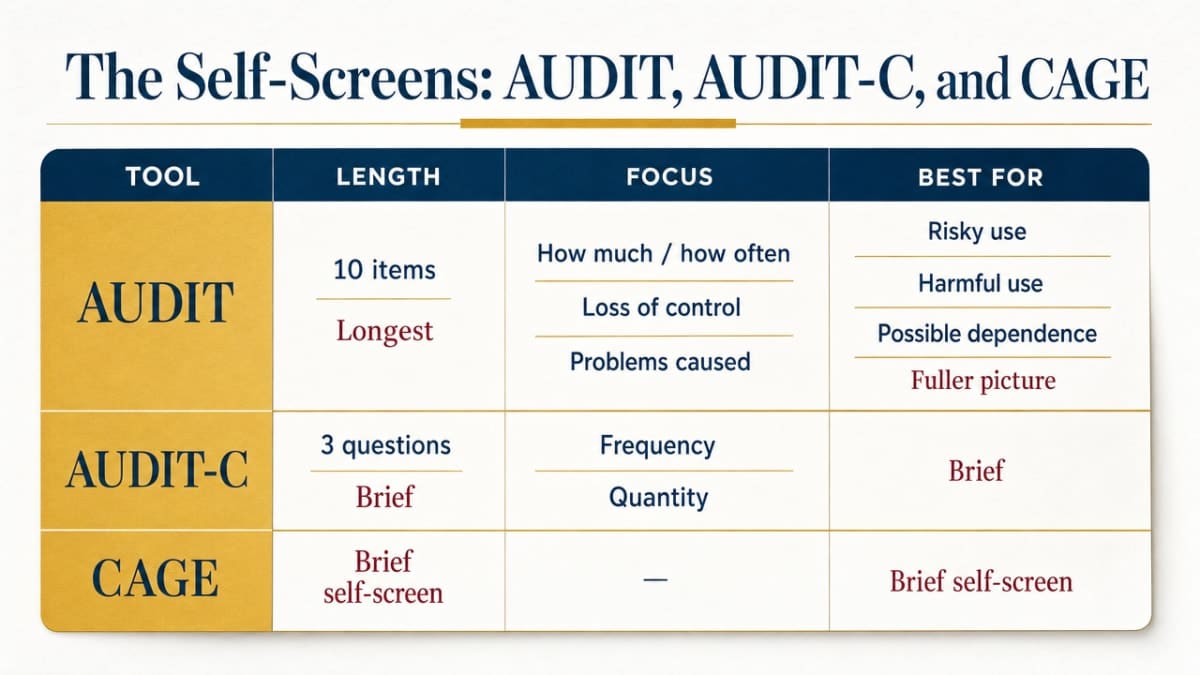
If the 11 criteria felt too close to home, the next step a lot of people take is a self-screen. There are three you’ll see most often, and they’re not interchangeable — they ask different things, at different lengths, for different situations.
AUDIT is the longest and most detailed. Developed by the World Health Organization, it’s a 10-item questionnaire that looks at how much and how often you drink, whether you’ve lost control, and whether drinking has caused problems for you or the people around you. Scoring ranges sort readers into risky use, harmful use, and possible alcohol dependence — which is why it’s the tool clinicians reach for when they want a fuller picture than a single visit allows 8.
AUDIT-C is the short version: just the first three AUDIT questions, focused on frequency and quantity. It’s one of the two brief screens recommended by the U.S. Preventive Services Task Force for routine use in primary care, because a doctor can run it in about a minute during a regular appointment 9. A positive AUDIT-C doesn’t diagnose anything — it flags that a longer conversation is warranted.
CAGE is four yes/no questions, and it’s less about how much you drink and more about how you feel about it: Have you felt you should Cut down? Have people Annoyed you by criticizing your drinking? Have you felt Guilty about it? Have you ever needed a morning drink — an Eye-opener — to steady your nerves or shake a hangover? Scores run from 0 to 4. A score of 2 or higher is considered clinically significant, and many primary care guidelines actually recommend lowering that threshold to 1 to catch more people who need a real conversation 10.
Here’s how they compare at a glance:
| Tool | Questions | What It Measures | Threshold for Follow-Up |
|---|---|---|---|
| AUDIT | 10 | Consumption, loss of control, harm — stratified into risky, harmful, and possible dependence | Elevated scores in any band 8 |
| AUDIT-C | 3 | Frequency and quantity of drinking (brief screen) | Positive screen prompts fuller assessment 9 |
| CAGE | 4 | Subjective experience: guilt, criticism, cutting down, morning drinking | Score of 2+ clinically significant; 1+ in primary care 10 |
A quick word about what these screens can and can’t do. They’re a starting point, not a diagnosis. If you score into a concerning band on any of them, that’s a signal to talk to a clinician — not a moment to panic, and not proof you’re “fine” if your score is low. Some people minimize on paper what they’d admit out loud to someone they trust. If the criteria you read a minute ago felt more accurate than your screen score, believe the criteria.
When Drinking Started as Coping: The Mental Health Layer
A lot of drinking doesn’t start because someone loves the taste of bourbon. It starts because a glass of wine turns the volume down on a day that was too loud. It starts because you can’t sleep, or because the intrusive thoughts get quieter, or because a social situation that used to feel manageable now feels like standing on a stage. If any of that sounds familiar, you’re not weak — you’re self-medicating something.
This matters for the question you came here to answer, because AUD rarely travels alone. Anxiety, depression, PTSD, unresolved trauma, ADHD, chronic pain — any of these can turn a nightly drink from a wind-down into a load-bearing wall. And NIAAA is clear that AUD is a brain disorder that can cause lasting changes, which is part of why relying on willpower alone tends to fail people who have another condition running underneath 3.
Here’s the trap: if you get sober without treating what the drinking was covering, the original problem is still there — often louder, because alcohol was suppressing it. That’s when people relapse and blame themselves, when what actually happened is that only half the picture got treated.
Integrated care exists for exactly this reason. When a program evaluates you, ask whether they treat co-occurring mental health conditions alongside the drinking, not in a separate building six months later. The two are one conversation.
What Happens After You Answer Honestly
So let’s say you sat with the 11 criteria and a few of them landed. Or a screening score came back higher than you were hoping. What now?
The honest answer is that nothing terrible happens next — no one gets called, no one shows up at your door, no permanent record gets created. What comes next is a sequence of choices that you get to make at your own pace, with information you don’t have yet. A professional evaluation, if your body needs it a supervised detox, care matched to how severe things actually are, and a plan for staying well after the acute part is over. Each of those has its own shape, and none of them require you to identify as anything before you walk in.
A Professional Evaluation Is Not a Verdict
An evaluation is a conversation, not a courtroom. A clinician — usually a physician, nurse practitioner, licensed counselor, or addiction specialist — will ask you about your drinking patterns, your medical history, your mental health, your family, and what your life actually looks like day to day. They’re building a picture, not writing a sentence.
What comes out of that conversation is a working assessment: whether you meet criteria for AUD, and if so, where on the mild-to-severe range your pattern sits, plus any co-occurring conditions like anxiety or depression that need to be part of the plan 4. From there, they’ll talk with you about options that fit your severity and your circumstances — not a one-size recommendation.
You can walk in undecided. You can ask questions. You can leave without committing to anything and think about it for a week. The evaluation exists to give you a clearer map of where you are. What you do with the map is still yours.
Detox: Why Some People Cannot Safely Stop on Their Own
If you’ve been drinking heavily and daily for a while, your nervous system has adapted. Alcohol has become part of how your brain regulates itself. Take it away suddenly, and your body doesn’t just feel uncomfortable — it can go into a physiological crisis.
Mild withdrawal shows up as shakes, sweating, anxiety, insomnia, and nausea in the first day or two after your last drink. That alone is miserable enough to send most people back to the bottle. But severe withdrawal is a different category of problem: seizures, hallucinations, dangerous swings in blood pressure and heart rate, and delirium tremens — a condition that can be fatal without medical care.
Medically supervised detox is the answer to this. In an inpatient detox setting, clinicians monitor your vitals around the clock, use medications like benzodiazepines to prevent seizures and calm the nervous system, and keep you safe during the days when your body is recalibrating. It’s not a punishment or a moral hurdle. It’s a medical procedure that gets you to the other side intact so the actual recovery work can begin 4. If you’re drinking heavily every day, please don’t quit alone — call your doctor or a treatment center first.
Matching Care to Severity: From Brief Intervention to Residential
Not everyone with AUD needs the same intensity of care. NIAAA’s clinical guidance is clear that severity levels should guide treatment intensity — the goal is care that matches where you actually are, not the most or the least available option 4. Think of it as a ladder with rungs at different heights, and the right rung is the one that meets your situation.
At the lower rungs, someone with mild AUD and no withdrawal risk might get a lot of traction from a brief intervention with their primary care doctor, a few sessions of outpatient counseling, and a shift in their routines. That’s it. No residential stay required.
Moving up the ladder, standard outpatient counseling gives you weekly therapy while you live your normal life. Intensive outpatient (IOP) turns that up to multiple sessions per week, usually in the evenings so you can keep working. Partial hospitalization (PHP) is more intensive still — most of the day, several days a week, but you sleep at home.
Residential treatment sits near the top of the ladder. You live at the facility for a period of weeks, in a structured environment with 24/7 medical and clinical support, individual and group therapy, and no access to alcohol. It’s the right rung when the drinking has been severe, when previous outpatient attempts haven’t held, when co-occurring conditions need close monitoring, or when your home environment makes recovery there unrealistic. Medically supervised detox usually sits just before residential care for people whose bodies need that step first.
You don’t have to know which rung you belong on. That’s what the evaluation is for.
Relapse Prevention Is the Long Game
Here’s something that’s easy to miss when you’re focused on getting through the first few weeks: the acute part of treatment is not the whole treatment. AUD can cause lasting changes in the brain that make people vulnerable to relapse long after the physical withdrawal is over 3. That’s not a character indictment — it’s biology. And it’s why the plan matters as much as the detox.
Relapse prevention is the ongoing work of building a life that doesn’t need alcohol to function. It usually includes some combination of continuing therapy, medications that reduce craving when they’re appropriate, peer support like 12-step or SMART Recovery meetings, family involvement, and concrete plans for the moments that used to trigger drinking — the deadline, the fight, the anniversary, the flight home.
Aftercare programs and step-down levels of care exist for this reason. Someone might leave residential treatment and move into an intensive outpatient program, then into weekly counseling, then into a monthly check-in — a slow, deliberate return to normal life with scaffolding still in place. Recovery is less a finish line than a direction you keep walking.
If You’re Reading This About Someone You Love
Maybe you’re not the one drinking. Maybe you’ve been watching, quietly, and this search was for them.
A few things worth knowing. You can’t argue someone into recovery, and ultimatums delivered in anger rarely land. What tends to work better is honesty in a calm moment — naming what you’ve seen, how it’s affecting you, and what you’re worried about, without a script and without a diagnosis attached. You don’t have to prove they have AUD. That’s a clinician’s job 4.
And take care of yourself, too. Al-Anon, family therapy, and your own counselor exist because loving someone through this is its own weight. You’re allowed to need support while you offer it.
Talk to Someone Who Understands Right Now
Connect immediately for confidential support and guidance about your next steps.
Talk With Someone Who Understands Your Struggle
Get honest feedback and explore next steps for lasting change, entirely confidential and judgment-free.
Frequently Asked Questions
Can I be a ‘functioning alcoholic’ if I still hold down my job and relationships?
Yes. The phrase gets used a lot, but it’s not a clinical category — it usually describes someone with mild or moderate AUD who’s still meeting most external obligations. Functioning is not the same as fine. AUD is defined by impaired control and continued drinking despite consequences, not by whether you’re currently getting away with it 2.
Is it dangerous to stop drinking on my own if I drink heavily every day?
It can be. Heavy daily drinkers can experience severe withdrawal — seizures, dangerous vital sign swings, and delirium tremens — that requires medical care. Please don’t quit cold turkey alone. Call your doctor, an urgent care, or a treatment center and ask about medically supervised detox, which uses monitoring and medications to keep you safe while your body recalibrates 4.
How do I tell my family or partner that I think I have a drinking problem?
Pick a calm moment, not the middle of a fight. Keep it simple: what you’ve noticed about your own drinking, why you’re worried, and what you’re thinking about doing next — like getting an evaluation. You don’t have to label yourself or promise a plan you haven’t made yet. Most people who love you will be relieved you said something.
Do I have to identify as an alcoholic to get help or go to treatment?
No. Clinicians use alcohol use disorder as a spectrum diagnosis and don’t require you to adopt any identity to receive care 2. You can walk into an evaluation saying “I’m worried about my drinking and I want to know more.” Some peer support programs use the word alcoholic culturally, but plenty of treatment and recovery paths don’t require it at all.
What’s the difference between heavy drinking and alcohol use disorder?
Heavy drinking describes a quantity pattern — how much and how often. AUD is a diagnosis based on whether that drinking is causing loss of control, cravings, harm, tolerance, withdrawal, or damage to your life, measured against 11 specific criteria 5. You can drink heavily without meeting AUD criteria, and you can meet AUD criteria without drinking every day. They overlap, but they’re not the same thing.
If I only drink on weekends, can I still have a problem?
Yes. AUD isn’t about the calendar — it’s about what happens when you do drink and how it affects the rest of your life. If your weekend drinking includes loss of control, blackouts, risky behavior, guilt, or friction with people you love, those count as criteria regardless of how many dry weekdays surround them 5. A screening tool or evaluation can help clarify where you stand.
References
- Alcohol Use Disorder: A Comparison Between DSM–IV and DSM–5. https://www.niaaa.nih.gov/publications/brochures-and-fact-sheets/alcohol-use-disorder-comparison-between-dsm
- Understanding Alcohol Use Disorder. https://www.niaaa.nih.gov/publications/brochures-and-fact-sheets/understanding-alcohol-use-disorder
- Health Topics: Alcohol Use Disorder. https://www.niaaa.nih.gov/alcohols-effects-health/alcohol-topics/health-topics-alcohol-use-disorder
- Alcohol Use Disorder: From Risk to Diagnosis to Recovery. https://www.niaaa.nih.gov/health-professionals-communities/core-resource-on-alcohol/alcohol-use-disorder-risk-diagnosis-recovery
- Alcohol Use Disorder (AUD). https://medlineplus.gov/alcoholusedisorderaud.html
- A. Substance Use Disorders Criteria. https://webcampus.med.drexel.edu/nida/module_2/content/5_0_AbuseOrDependence.htm
- Substance Use Disorders vs. Substance Abuse and Dependence. https://addiction-certificate.psychiatry.ufl.edu/about-the-program/articles/substance-use-disorders-vs-substance-abuse-and-dependence/
- Alcohol Use Disorders Identification Test (AUDIT). https://nida.nih.gov/sites/default/files/files/AUDIT.pdf
- Screen and Assess: Use Quick, Effective Methods. https://www.niaaa.nih.gov/health-professionals-communities/core-resource-on-alcohol/screen-and-assess-use-quick-effective-methods
- CAGE Substance Abuse Screening Tool. https://portal.ct.gov/-/media/dph/maternal-mortality/cage-substance-screening-tool.pdf