
Can an Alcoholic Quit Cold Turkey?
Key Takeaways
- Quitting cold turkey means stopping all at once with no medical buffer, which is harmless for light drinkers but potentially fatal for anyone whose nervous system has physically adapted to heavy, sustained alcohol use 1.
- Withdrawal symptoms can begin within 8 hours, with seizures possible between 6 and 48 hours and delirium tremens clustering at the 24 to 72 hour peak 2, 4, 8.
- Each unsupervised withdrawal episode rewires the brain through kindling, so prior successful quits actually raise the risk of faster, harsher, seizure-prone withdrawals the next time 3, 4.
- Medically supervised detox uses symptom-triggered benzodiazepines, fluids, vitamins, and round-the-clock monitoring to interrupt the dangerous window, then hands off to integrated care for the mood and anxiety symptoms that drive early relapse 8, 9.
The Honest Answer in the First 80 Words
Here’s the straight answer: yes, you can stop drinking — but if your body is physically dependent on alcohol, stopping cold turkey at home can kill you. Heavy, long-term drinkers who quit suddenly risk seizures, hallucinations, and a complication called delirium tremens that carries real mortality without treatment 2, 8. The decision to quit isn’t the danger. Quitting without medical support is.
If you’ve been drinking heavily for months or years, daily or near-daily, please don’t tough this out alone. A supervised detox isn’t a sign of weakness. It’s what makes the next chapter survivable 1.
You’re already doing something brave by asking the question. The rest of this article will walk you through exactly what your body goes through in the first five days, who can stop unaided and who absolutely cannot, and what to do tonight if you or someone you love is sitting on a kitchen counter staring at a bottle and wondering what’s safe.
What ‘Cold Turkey’ Actually Means When Your Body Is Dependent
“Cold turkey” just means stopping all at once, with nothing to soften the drop. For someone who drinks a glass of wine on weekends, that’s a non-event. For a body that has been soaked in alcohol for months or years, it’s something else entirely.
Here’s what’s happening under the hood. Alcohol is a depressant. Drink it heavily for long enough, and your brain compensates by cranking up its excitatory chemistry and dialing down its calming chemistry. Your nervous system rebuilds itself around the assumption that alcohol will keep showing up. That’s physical dependence — not a character flaw, not weakness, just biology adapting to a repeated input.
Then you stop. The alcohol leaves. The compensations don’t. Your nervous system is suddenly running with the brakes off and the gas pedal stuck down 1.
That’s why a dependent drinker who quits cold turkey can shake, sweat through the sheets, feel their heart race, and in serious cases, seize. The symptoms aren’t the alcohol still in your system. They’re the absence of it 8.
This is also why “I can handle it, I’ve quit before” isn’t the reassurance it sounds like. If you’ve been through withdrawal once and white-knuckled your way out, your brain remembers. The next time can hit harder and faster 3.
So when you read “cold turkey” in the rest of this article, picture that: a nervous system that learned to live with alcohol, suddenly asked to function without it, with no medical buffer in between 1.
The First 5 Days: An Hour-by-Hour Withdrawal Timeline
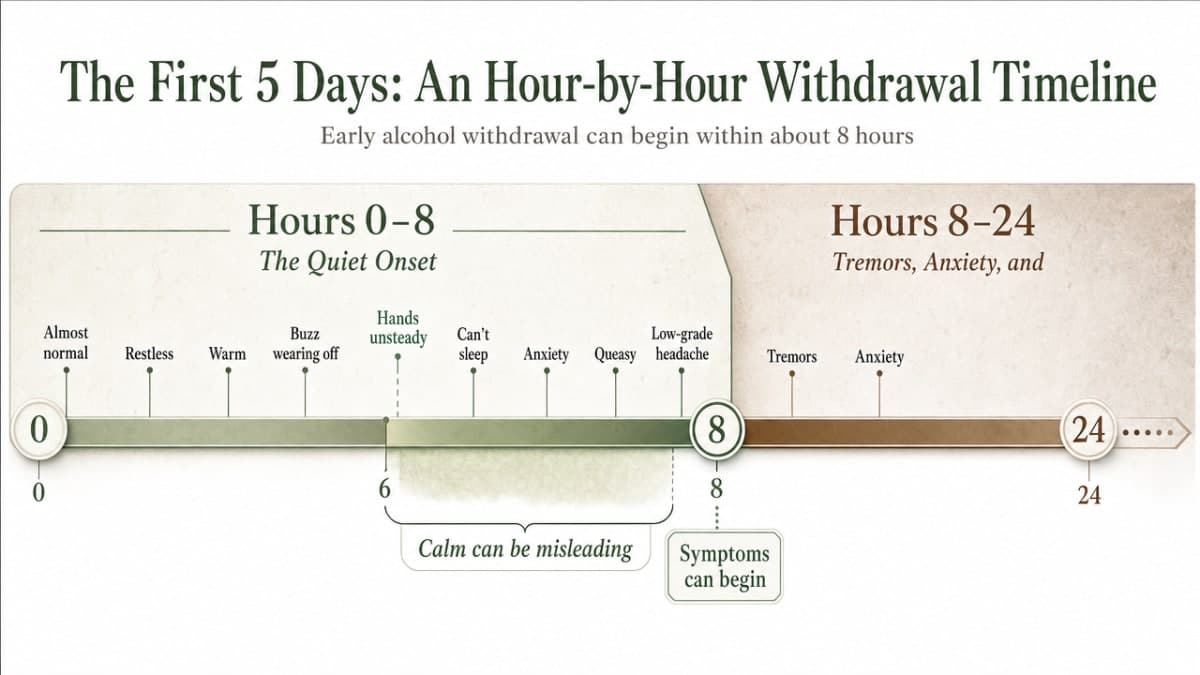
Hours 0–8: The Quiet Onset
The first few hours after your last drink are usually deceptive. You might feel almost normal. A little restless, maybe. A bit warm. Some people describe it as the buzz wearing off in slow motion.
Then, somewhere around hour six or seven, your hands start to feel unsteady when you reach for a glass of water. Your sleep, if you try to lie down, won’t come. Anxiety hums in your chest for no clear reason. You might feel queasy or notice a low-grade headache settling in.
Withdrawal symptoms can begin within about 8 hours of your last drink for someone who’s been drinking heavily 2. The quietness of this window is part of what makes cold turkey so risky — you feel okay enough to talk yourself out of calling anyone. Don’t let the calm fool you. What’s coming next moves fast.
Hours 8–24: Tremors, Anxiety, and the Seizure Window Opens
By the time you hit the second day’s sunrise, your body is no longer pretending. The tremors that started as a shaky grip are now visible from across the room. Your heart pounds when you stand up. Sweat soaks the back of your shirt even though the room isn’t warm. Nausea makes the idea of food unbearable. Anxiety, which had been humming, is now shouting.
This is also when the most dangerous early complication can show up: a withdrawal seizure. Generalized tonic-clonic seizures — the kind where someone loses consciousness and convulses — typically strike between 6 and 48 hours after the last drink in people with significant dependence 4. There’s often no warning. You don’t get a chance to brace.
If you’ve ever had a withdrawal seizure before, your risk this time is higher 3. If you take other sedating medications, drink heavily every day, or have other medical conditions, the risk climbs further 1.
This is the window where “I’ll just push through tonight” becomes a gamble with stakes you can’t see. If you’re shaking hard, your heart is racing, or you feel like something is genuinely wrong, this is the moment to call someone. Not tomorrow. Now.
Hours 24–72: Peak Danger and Delirium Tremens
Days two and three are when withdrawal turns from miserable to dangerous. Symptoms peak between 24 and 72 hours after your last drink, and this is the window where the most serious complications cluster 2.
Here’s how the timing stacks up across the first five days. Symptoms can begin within about 8 hours. The seizure window opens roughly 6 to 48 hours in 4. Severity climbs sharply through hours 24 to 72, peaking there before most people start to improve by around day 5 2, 5. If you were to plot symptom intensity on a graph, you’d see a steep upward curve through day one, a jagged plateau across days two and three, and then a slow descent. Day two and day three are the tall part of that curve.
This is when delirium tremens — usually shortened to DTs — can appear. DTs aren’t just bad shakes. It’s severe confusion, vivid hallucinations (people often see insects, shadows, or figures that aren’t there), disorientation about where you are or who’s with you, a racing heart, dangerously high blood pressure, and a high fever. Untreated, DTs carry real mortality. With prompt benzodiazepine treatment and monitoring, that risk drops dramatically 8.
Not everyone gets DTs. Roughly speaking, it’s the heaviest, longest-term drinkers, those with prior severe withdrawals, and those with other medical problems who are most likely to land here 1. But “not everyone” is cold comfort when you’re the one who does.
Day 3 to Day 5: The Slow Climb Down
If you make it through the 72-hour peak without a seizure or DTs, the worst of the physical storm usually starts to ease. Tremors soften. The heart rate settles. Sleep, broken and strange, begins to return in fragments. By around day five, most people’s acute symptoms have meaningfully improved 5.
That doesn’t mean you’re fine.
Anxiety, low mood, irritability, and trouble sleeping often linger well past the acute window 9. Some people feel emotionally raw in a way they weren’t prepared for — like the alcohol had been muffling something, and now there’s no muffler. Cravings can spike at unexpected moments, especially in familiar environments where you used to drink.
The physical danger curve is bending down. The recovery work is just starting. What you do on day six matters as much as surviving day three.
Who Can Stop Unaided and Who Cannot
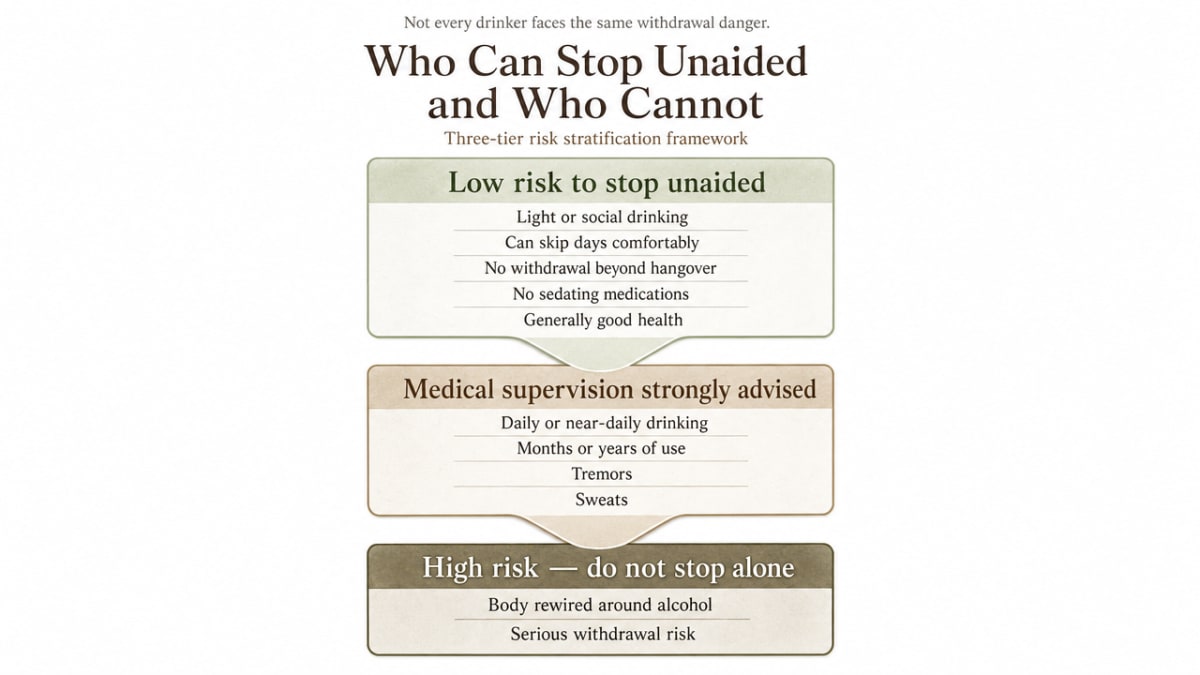
Not every drinker who decides to quit is in the same kind of danger. The honest split looks like this: a person who drinks moderately, occasionally, or even heavily but for a short stretch usually won’t have a medically serious withdrawal. A person whose body has rewired itself around alcohol over months or years is in a different category entirely 1.
Here’s a way to locate yourself or your loved one on the risk map.
- Low risk to stop unaided.
- You drink lightly or socially. You can skip days without your hands shaking or your chest tightening. You’ve never had a withdrawal symptom worse than a hangover. You’re not taking benzodiazepines, opioids, or other sedating medications. You’re in generally good health.
- Medical supervision strongly advised.
- You drink daily or near-daily. You’ve been at it for months or years. You’ve felt tremors, sweats, or sharp morning anxiety the few times you’ve tried to cut back. You’re older, or you live with conditions like heart disease, liver disease, diabetes, depression, or anxiety. You take other medications that affect your nervous system 1. Pregnancy puts you here too — withdrawal needs to be managed for both of you, not toughed out.
- Detox is urgent. Do not try this at home.
- You drink heavily every day, often from morning on. You’ve had a withdrawal seizure before, or delirium tremens before. You’ve been through detox more than once. You’re mixing alcohol with benzodiazepines or other sedatives. You have a seizure disorder, serious heart problems, or a recent head injury 1, 7. For you, cold turkey isn’t quitting — it’s a medical emergency waiting for a start time.
If you’re somewhere between tiers and unsure, treat the higher tier as your answer. The cost of being cautious is a phone call. The cost of being wrong the other direction can be your life 7.
The Kindling Effect: Why Each Cold-Turkey Attempt Gets More Dangerous
If you’ve quit before and made it through, there’s a part of you that probably thinks you can do it again the same way. Maybe rougher than last time, maybe not. But survivable. You’ve got data on yourself.
Here’s the part that data is missing.
Researchers call it kindling. Each time your brain goes through alcohol withdrawal and then gets soaked in alcohol again, it changes a little. The next withdrawal tends to come on faster, hit harder, and carry a higher risk of seizure than the one before 3. The brain circuits involved in withdrawal seizures appear to become more excitable with repeated cycles, the way a fire catches faster on wood that’s already been scorched 4.
This is why someone on their fifth unsupervised attempt can have a seizure on day one when their first attempt only gave them shakes and bad sleep. Your nervous system isn’t starting from scratch each time. It’s keeping score.
It also means the reassurance of “I’ve done this before” can quietly become the reason this time goes badly. The history that feels protective is actually the risk factor 3.
None of this is meant to scare you out of quitting. You should quit. The point is that the path matters as much as the decision. Kindling is one of the strongest medical arguments for doing this with supervision — not someday, but the next time you stop. A monitored detox interrupts the cycle. It treats the withdrawal that’s coming with medication that calms the over-firing nervous system, which both protects you now and lowers the stakes of any future episode 8.
If you’ve been through this more than once, you’re not weak. You’re someone whose biology has been changed by repeated exposure. That deserves medical care, not another solo attempt.
Warning Signs That Mean Call 911 Right Now
If you’re standing in a kitchen or a bedroom right now trying to decide whether what you’re seeing is bad enough to call for help, the answer is almost always yes. Don’t read this whole article first. Read this section.
Call 911 immediately if you or your loved one experiences any of the following during withdrawal:
- A seizure of any kind. Convulsions, loss of consciousness, sudden stiffening, or uncontrolled shaking. One seizure means the next can come fast 2.
- Hallucinations. Seeing insects, shadows, faces, or hearing voices that aren’t there.
- Severe confusion. Not knowing where they are, what day it is, or who you are. Disoriented speech that doesn’t track 2.
- High fever, racing heart, or dangerously high blood pressure. A pounding pulse you can see in their neck, skin that’s hot to the touch, breathing that looks labored.
- Repeated vomiting with inability to keep down water, especially paired with confusion.
- Chest pain or a sudden change in alertness.
Any one of these can signal delirium tremens, which is a medical emergency 2. Don’t drive them yourself if they’re seizing or losing awareness. Call 911.
If symptoms are uncomfortable but not in the list above — heavy shakes, sweating, anxiety, trouble sleeping — and you need a non-emergency path to help right now, the SAMHSA National Helpline is free, confidential, and answers 24/7 at 1-800-662-HELP (4357). They can connect you to local detox and treatment resources within minutes 6.
You will not be in trouble for calling. Paramedics and helpline staff have heard this exact story tonight already.
What Medically Supervised Detox Actually Looks Like
If the phrase “medical detox” makes you picture a hospital ward with bright lights and a clipboard at the foot of the bed, that’s not quite it. A residential detox is closer to a quiet, monitored room where the storm in your nervous system can pass without taking you with it.
Here’s what’s actually happening clinically. On intake, a team takes a careful history — how much you drink, for how long, what other substances and medications are in the mix, any prior withdrawals, seizure history, medical conditions, mental health concerns. That assessment determines your risk tier and your medication plan 1. You’re not being interviewed for worthiness. You’re being safety-checked.
The cornerstone of treatment is usually a benzodiazepine, dosed on a symptom-triggered schedule using a standardized scale that tracks tremor, sweating, pulse, anxiety, and orientation. As your symptoms climb, the medication goes up to meet them. As you stabilize, doses taper. Benzodiazepines work because they quiet the over-firing nervous system that cold turkey leaves exposed — and the evidence is clear that timely, adequate dosing dramatically reduces seizures and the mortality risk of delirium tremens 8.
Around that, you get the unglamorous but essential pieces: IV or oral fluids, thiamine and other vitamins to protect your brain from deficiencies common in long-term drinkers, anti-nausea medication, and someone checking your vitals through the night so a rising heart rate or fever gets caught early, not at 3 a.m. by accident 1.
You also get something cold turkey at home cannot offer: people who have seen this exact thing many times before. Nurses who aren’t afraid of your symptoms. A physician who can adjust your plan in real time if you’re heading toward severe withdrawal 10. And, for the heaviest cases, the ability to escalate care without losing hours to a 911 call.
Detox typically runs three to seven days, lining up with the acute withdrawal window. It isn’t the whole of recovery — it’s the part that makes the rest possible.
After Detox: Mood, Anxiety, and Why the Real Work Starts on Day 6
Here’s something nobody warns you about. You finish detox. The shaking is gone, the vitals are stable, the staff is genuinely proud of you. And then somewhere around day six or seven, the floor drops out emotionally.
This isn’t failure. It’s biology catching up.
Depressive symptoms often intensify in early abstinence, and they can stay loud for weeks before the brain’s own chemistry rebalances 9. Anxiety does the same — sometimes worse than it was when you were drinking, because the alcohol that quieted it for years is no longer in the room 11. Sleep stays broken. Mornings feel longer than they should. Small things — a song, a smell, a Tuesday — can level you.
What matters about this stretch is what’s happening to your relapse risk. Untreated mood and anxiety symptoms in early recovery are some of the strongest predictors of going back to drinking 9, 11. The brain that just survived withdrawal is looking for a way to feel normal again, and the fastest answer it remembers is alcohol.
This is why detox alone, however well-run, isn’t a treatment plan. It’s the first chapter. The real work is integrated care that treats the drinking and the mood at the same time — therapy, structured days, medication when appropriate, people around you who know what week six tends to feel like 9. If you’ve been carrying depression, anxiety, PTSD, or trauma alongside the drinking, those don’t disappear when the alcohol does. They get clearer, which is both the opening and the danger.
Day six isn’t the finish line. It’s the start of the part where you get to build something.
If You’re Reading This for Someone You Love
You’ve probably been watching this longer than they know. The mornings that start with a shaky hand. The bottles you find and don’t mention. The promise they made last Sunday that didn’t make it to Tuesday.
Here’s what you need to hold onto tonight. You can’t out-love someone’s withdrawal. If they’ve been drinking heavily for a long time and they’ve decided to stop on the couch this weekend, the danger isn’t whether they have the willpower. The danger is what their nervous system does when the alcohol leaves 1. Your job isn’t to coach them through it. Your job is to make sure they don’t go through it alone.
A few things that actually help. Don’t pour out the bottles and walk away — sudden, unsupervised cessation in a dependent drinker is exactly the scenario that lands people in the ER 10. Stay with them, or have someone there. Watch for confusion, fever, hallucinations, or any seizure activity, and call 911 the moment you see them 2. Keep the SAMHSA helpline number where you can find it fast: 1-800-662-HELP. They’ll walk you through options in real time 6.
And if they refuse help right now — that’s not the end of the conversation. It’s the start of a longer one.
A Safer Next Step Tonight
If you’ve read this far, you already know more than you did an hour ago. You know your body. You know whether the risk tier in this article describes a stranger or describes you.
So here’s what tonight can actually look like.
Pick up your phone and call the SAMHSA National Helpline at 1-800-662-HELP (4357). It’s free, confidential, and answers around the clock 6. Tell them what you’ve been drinking, for how long, and that you’re thinking about stopping. They will help you find a medically supervised detox near you, often within the same day. If you’re in Ohio, Arrow Passage Recovery is one of those options — accredited, residential, with 24/7 medical support through the acute window.
You don’t have to have it figured out before you call. You just have to make the call.
The bravery was already in the question. Now use it for the phone.
Talk Now With 24/7 Detox Support Specialists
Get immediate guidance and reassurance for safe alcohol withdrawal, right when you need it most.
Ready to safely take the next step?
Connect with a professional for guidance on safe alcohol withdrawal and personalized recovery support.
Frequently Asked Questions
How long does alcohol withdrawal last?
For most people, acute withdrawal symptoms start within about 8 hours of the last drink, peak between 24 and 72 hours, and noticeably improve by around day five 2, 5. But “acute” isn’t the whole story. Sleep problems, anxiety, and low mood can stretch on for weeks as your brain rebalances 9. The dangerous window is short. The recovery window is longer.
Can you actually die from quitting alcohol cold turkey?
Yes. For someone physically dependent on alcohol, abrupt cessation can trigger seizures and delirium tremens, both of which carry real mortality risk without treatment 2, 8. Most people who reach medical care recover fully, but “most” isn’t a number you want to gamble on at home. The risk is concentrated in heavy, long-term drinkers, those with prior severe withdrawals, and those with medical comorbidities 1.
What are the first signs that withdrawal is becoming dangerous?
Worsening tremors, a racing heart, soaking sweats, and rising anxiety in the first 24 hours are warning shots. Real emergencies are a seizure of any kind, hallucinations (seeing or hearing things that aren’t there), severe confusion about time or place, high fever, or chest pain 2. Any of those, call 911. Don’t wait to see if it gets worse.
Is it safe to detox at home if I taper instead of stopping suddenly?
A self-managed taper is safer than cold turkey, but it isn’t medically safe for someone with significant dependence. Without supervision, people miscount, drink to symptoms, or stall partway and end up back at baseline. A monitored detox uses benzodiazepines dosed to your actual symptoms, which is more reliable than a beer-by-beer countdown at home 8. Call SAMHSA at 1-800-662-HELP first 6.
How much do you have to drink before withdrawal becomes risky?
There’s no clean cutoff, but risk climbs with daily or near-daily heavy drinking sustained over months or years 1. If you shake, sweat, or feel sharp anxiety in the morning until you drink, your body is already dependent. Prior withdrawal episodes, seizures, older age, pregnancy, or sedative use raise the stakes further 1, 7. When unsure, assume you need supervision.
What should I do if my loved one refuses to go to detox?
Stay calm and stay present. Don’t pour out the bottles and walk away — sudden unsupervised cessation is exactly what lands dependent drinkers in the ER 10. Keep watch for seizures, confusion, fever, or hallucinations and call 911 if any appear 2. Save the SAMHSA helpline, 1-800-662-HELP, where you can reach it quickly 6. Refusal tonight isn’t refusal forever.
References
- Alcohol Withdrawal Syndrome – StatPearls – NCBI Bookshelf. https://www.ncbi.nlm.nih.gov/books/NBK441882/
- Alcohol withdrawal: MedlinePlus Medical Encyclopedia. https://medlineplus.gov/ency/article/000764.htm
- Complications of Alcohol Withdrawal: Pathophysiological Insights. https://pmc.ncbi.nlm.nih.gov/articles/PMC6761825/
- Update on the Neurobiology of Alcohol Withdrawal Seizures. https://pmc.ncbi.nlm.nih.gov/articles/PMC1312739/
- Alcohol Withdrawal – Harvard Health Publishing. https://www.health.harvard.edu/diseases-and-conditions/alcohol-withdrawal-a-to-z
- National Helpline for Mental Health, Drug, Alcohol Issues – SAMHSA. https://www.samhsa.gov/find-help/helplines/national-helpline
- Alcohol Withdrawal in the Hospitalized Patient – NCBI (older but foundational chapter). https://www.ncbi.nlm.nih.gov/books/NBK64054/
- Alcohol Withdrawal Syndrome: Mechanisms, Manifestations, and Management. https://www.ncbi.nlm.nih.gov/pmc/articles/PMC6084325/
- Alcohol Use Disorder and Depressive Disorders. https://www.ncbi.nlm.nih.gov/pmc/articles/PMC4606320/
- Alcohol Withdrawal Management in the Emergency Department. https://www.ncbi.nlm.nih.gov/pmc/articles/PMC3860472/
- Co-occurring Alcohol Use Disorder and Anxiety Disorders. https://www.ncbi.nlm.nih.gov/pmc/articles/PMC3181620/