
Can You Get Addicted to CBD?
Key Takeaways
- Purified CBD is not addictive the way opioids, benzodiazepines, or alcohol are: human abuse potential studies show low drug-liking scores and no withdrawal syndrome when use stops 8, 13.
- The real risks for people in recovery aren’t dependence but liver strain at high doses, interactions with psychiatric and addiction medications, and sedation stacking with alcohol or CNS depressants 4, 6.
- Product quality is a serious concern: 76% of hemp-derived CBD products were mislabeled for CBD or THC content, with some containing heavy metals, which can also trigger failed drug tests 17.
- Even without classic addiction, leaning on a daily dropper for anxiety, sleep, or PTSD can quietly replace evidence-based treatment, and current research doesn’t support CBD as a substitute for established care 16.
The Honest Answer in Under a Minute
Short version: CBD by itself is not addictive in the way opioids, benzodiazepines, or alcohol are. In controlled human testing, purified CBD did not produce drug-liking scores that matched alprazolam or dronabinol, and it did not behave like a drug of abuse in non-dependent recreational users 8. People who stopped taking therapeutic CBD in trials did not show a classic withdrawal syndrome 13. So if you are asking whether a CBD gummy will hook you the way Xanax or oxycodone can, the answer is no.
That said, “not addictive” is not the same as “safe for everyone in recovery.” The risks that actually matter for you sit somewhere else: high doses can stress your liver 4, CBD can change how your psychiatric and addiction medications work 6, most products on the shelf are mislabeled 17, and leaning on a daily dropper to manage anxiety or sleep can quietly replace the work that real treatment does. That’s the honest picture, and the rest of this guide walks through it.
What the Research Actually Says About CBD and Dependence
Why Purified CBD Scores Low on Abuse Potential
When researchers want to know if a drug can hook people, they run something called a human abuse potential study. Healthy adults who use recreational drugs are given the test substance and compared against known reinforcers, then asked how much they liked it, whether they’d take it again, and how it made them feel. It’s a blunt tool, but it’s the one regulators trust.
Purified CBD has been through this gauntlet. In the study submitted to the FDA for Epidiolex approval, single doses of CBD given to non-dependent adult recreational drug users produced drug-liking scores lower than alprazolam (a benzodiazepine you know as Xanax) and lower than dronabinol (synthetic THC) 8. The pattern of responses did not look like a drug of abuse. People didn’t chase the feeling. They didn’t report the kind of euphoria that drives repeat use.
A broader review of abuse liability across cannabis-derived products reached the same conclusion: CBD lacks the intoxicating and reinforcing properties that make THC and synthetic cannabinoids habit-forming, and its abuse potential appears minimal by comparison 1. The pharmacology backs this up. CBD doesn’t flood your reward circuits the way classical drugs of abuse do.
That’s a real finding, and you deserve to hear it plainly. If your worry is that a CBD product will hijack your reward system the way alcohol or opioids did, the data we have right now says it doesn’t work that way. Hold onto that. The risks worth your attention sit elsewhere, and we’ll get to them.
No Withdrawal Syndrome When People Stop
Addiction has a physical signature: stop the substance, and your body protests. Shakes, sweats, racing heart, insomnia, a wave of anxiety that feels like the floor dropping out. If you’ve been through alcohol or benzo withdrawal, you know exactly what that means.
CBD doesn’t appear to produce that signature. In a Phase IIa trial that gave people with cannabis use disorder daily CBD for several weeks and then stopped, researchers looked specifically for a discontinuation syndrome and didn’t find one. Participants didn’t show signs of CBD dependence, and stopping the CBD didn’t trigger a withdrawal pattern of its own 13. The same trial actually found that CBD was associated with reduced cannabis withdrawal symptoms in people trying to quit cannabis 13.
That matters for how you read your own experience. If you’ve been taking a daily CBD tincture for sleep and you stop, you may notice your sleep gets worse again. That’s not withdrawal. That’s the original problem coming back into view, the way it would if you stopped a sleep mask or a white-noise machine. Knowing the difference helps you make calmer decisions instead of panicked ones.
Where the THC Confusion Comes From
A lot of the fear around CBD addiction is really fear about cannabis addiction, and the two get tangled because they come from the same plant. Cannabis dependence is real. It’s tied to high-potency THC, frequent use, and products with low CBD content 2. The classic cases of cannabis use disorder and substance-induced psychosis described in the literature involve heavy, long-term exposure to potent THC, not CBD 2, 14.
CBD itself doesn’t produce the high. It doesn’t carry the same dependence risk. In some research it appears to soften THC-related harms rather than add to them 2. So when someone says “cannabis is addictive,” they’re usually right, but they’re talking about a THC story, not a CBD story.
The catch is that the product on your shelf may not be cleanly one or the other. That’s a different problem from pharmacology, and it’s where a lot of the real-world risk hides for people in recovery. We’ll unpack it later in the guide.
The Risks That Actually Matter If You’re in Recovery
High-Dose CBD and Your Liver
Here’s where the conversation about CBD safety gets real for you. Your liver is the organ that processes almost every substance you put in your body, and if you’ve spent years drinking heavily, taking opioids, or running through prescription medications, it may already be working harder than it should. CBD asks for a piece of that same workload.
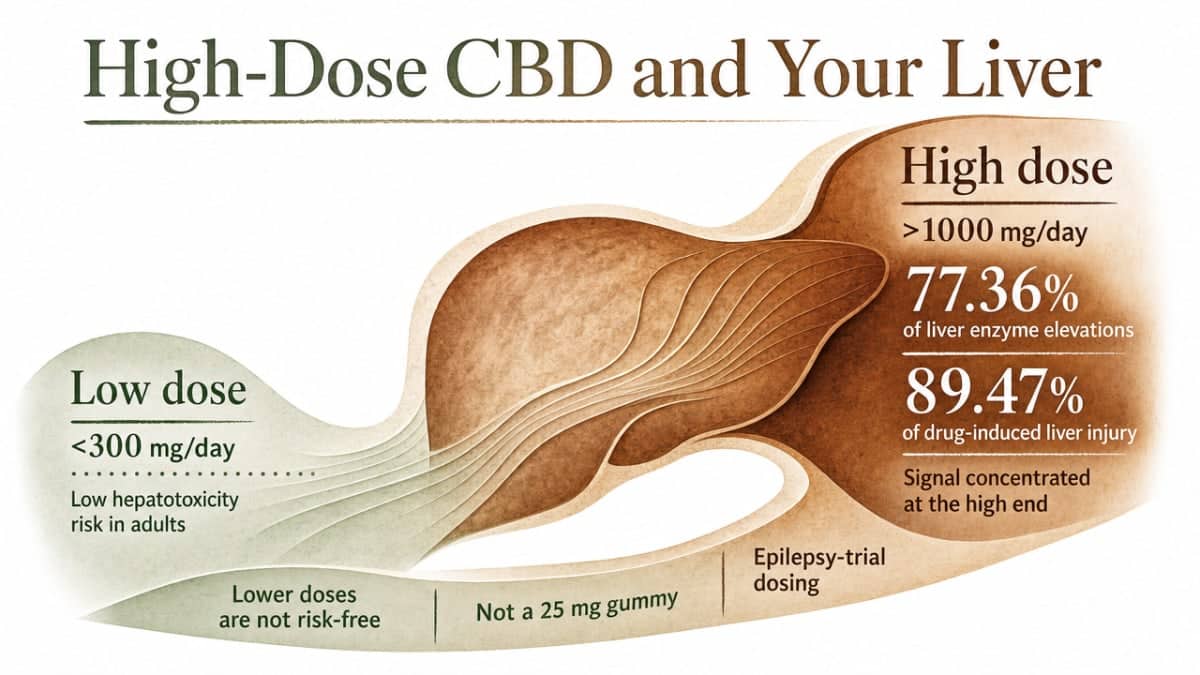
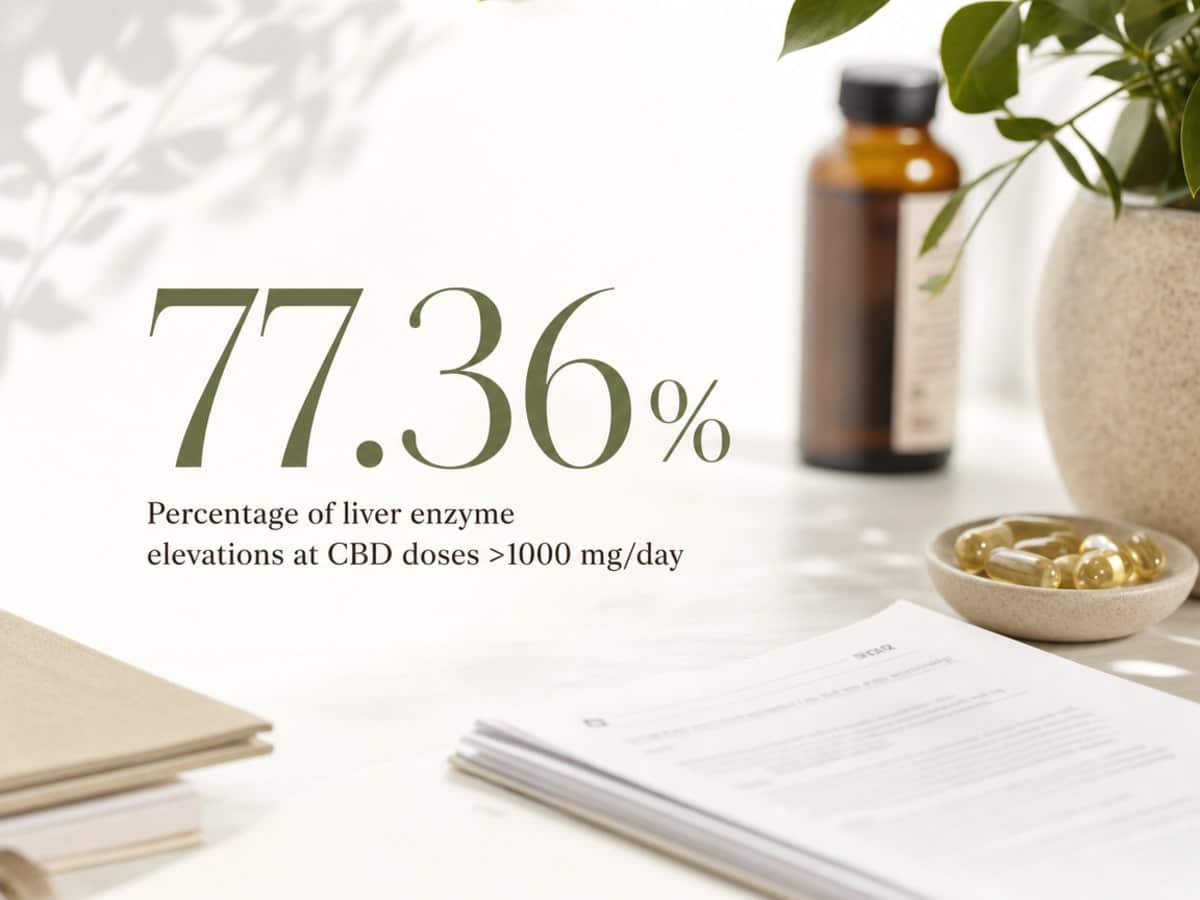
The dose-response story is striking. A 2024 meta-analysis found that 77.36% of CBD-related liver enzyme elevations and 89.47% of drug-induced liver injury cases happened at doses greater than 1000 mg per day 4. Doses below 300 mg per day in adults showed low hepatotoxicity risk 4. Translation: the liver signal is heavily concentrated at the high end, the kind of dosing used in epilepsy trials, not in a 25 mg gummy from a wellness shop.
That doesn’t mean lower doses are risk-free. An FDA randomized trial still observed an increased risk of liver enzyme elevation at labeled doses, and the risk climbs further when CBD is combined with certain antiepileptic drugs like valproate 7, 4. Clinical guidance now treats CBD-associated liver injury as a recognized adverse drug reaction, with most cases resolving within two weeks to four months after the dose drops or stops 5.
Drug Interactions With Psychiatric and Addiction Medications
If you’re in dual diagnosis treatment, your medication list probably isn’t short. SSRIs for depression. A mood stabilizer. Maybe buprenorphine or naltrexone. Something for sleep. Something for blood pressure. CBD doesn’t sit politely alongside that list.
CBD is metabolized by the same liver enzymes (CYP3A4 and CYP2C19, among others) that break down many psychiatric and addiction medications. The FDA puts it plainly: CBD “can affect how other drugs you are taking work, potentially causing serious side effects” 6. That can mean your antidepressant builds up to a higher level than your prescriber intended. It can mean a benzodiazepine you’re tapering off lingers longer than expected. It can mean a blood thinner becomes unpredictable.
The 2025 Epidiolex label reinforces this point with updated guidance on liver monitoring and drug interactions, because real-world prescribing keeps surfacing the same issue: CBD changes the math on medications you’re already taking 9. For someone in recovery, those medications are often the scaffolding holding the day together. You don’t want to wobble that without knowing.
This isn’t a reason to panic about a one-time use. It is a reason to bring any CBD product, including over-the-counter tinctures and gummies, to your prescriber and pharmacist before you start a daily routine. They can flag which of your medications share a metabolic pathway with CBD and decide whether monitoring or a dose adjustment makes sense.
Sedation Stacking: CBD With Alcohol, Benzos, and Sleep Aids
One of the most underappreciated CBD risks isn’t dramatic. It’s a sleepy afternoon that turns into a fall on the stairs, a missed exit on the highway, a foggy morning at work that you blame on poor sleep.
CBD can cause drowsiness on its own. When you combine it with alcohol or central nervous system depressants, the FDA warns that it “increases the risk of sedation and drowsiness, which can lead to injuries” 6. Somnolence is also one of the most commonly reported CBD side effects in clinical trials 3. Stack a CBD gummy on top of a glass of wine, a Klonopin prescription, or a Z-drug for sleep, and the sedation can be more than additive.
For someone in recovery, this matters in two ways. If you’re on a benzodiazepine taper, adding CBD on your own can mask how the taper is actually going. If you’re newly sober and your tolerance to depressants has dropped, even a modest combination can hit harder than you expect. The risk isn’t usually a hospital trip. It’s quieter than that: a slower reaction time the morning after, a deeper sleep that turns into a missed alarm, a sense of being a step behind your life. Watch for that pattern.
Mood and Suicidality Signals Worth Knowing
This part is harder to talk about, and you deserve to hear it anyway. CBD products carry the same psychiatric warning attached to other antiepileptic drugs: they may increase the risk of suicidal thoughts and behavior, and patients are advised to monitor for changes in mood or behavior 9. A narrative review of CBD across psychiatric conditions noted that some studies have reported depressive symptoms and even suicidal ideation as potential adverse effects 15.
If you’re already managing depression, PTSD, or a recent suicide attempt as part of your dual diagnosis care, this is not a small footnote. It’s a reason to loop your psychiatrist into any decision about starting CBD, and a reason to tell someone you trust if your mood shifts in the first few weeks of use. That isn’t weakness. That’s exactly how high-quality recovery looks: you notice changes early, you say them out loud, and you adjust the plan before the change becomes a crisis.
The Mislabeling Problem: You May Not Be Taking What You Think
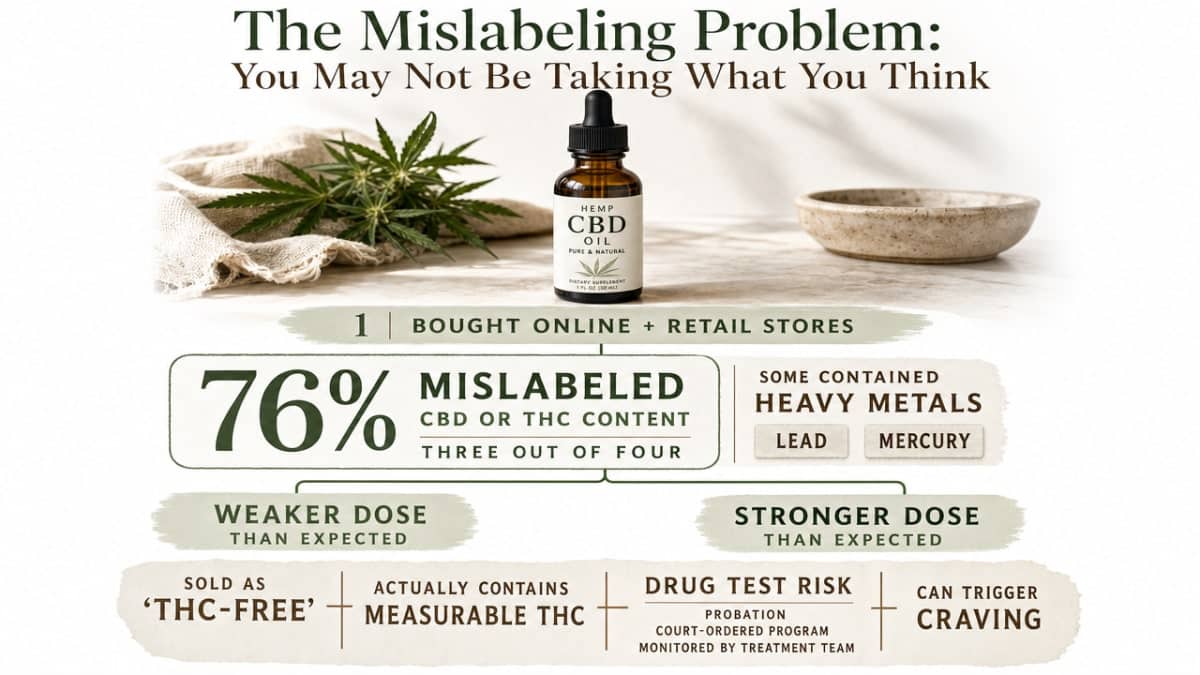
This is the part of the CBD conversation that should make you pause hardest, because it has nothing to do with what CBD does in your body and everything to do with what’s actually in the bottle. A Johns Hopkins analysis of hemp-derived CBD products bought online and in retail stores found that 76% were mislabeled for CBD or THC content, and some contained heavy metals like lead and mercury 17. Three out of four. That’s not a fringe problem with knockoff brands. That’s the shelf.
For most consumers, mislabeling means a weaker or stronger dose than expected. For you, it can mean something more serious. A product sold as “THC-free” that actually contains measurable THC can show up on a drug test, which matters if you’re on probation, in a court-ordered program, or being monitored by a treatment team. It can also trigger cravings or a relapse pattern your recovery has worked hard to quiet, because your brain doesn’t care what the label promised.
The heavy metal piece adds another layer for anyone already protecting a stressed liver or kidneys 17. The FDA has also flagged that, outside of approved prescription products like Epidiolex, CBD products on the market have not been evaluated for safety and effectiveness, and the agency continues to receive adverse event reports tied to them 18.
The Psychological Pull: When CBD Becomes a Coping Pattern
Self-Medicating Anxiety, Sleep, and PTSD
Here’s the part of the CBD story that pharmacology can’t fully explain. You can take a substance that scores low on abuse potential and still build a relationship with it that looks a lot like the relationships that got you into trouble before.
Think about why someone in recovery reaches for a dropper in the first place. It’s rarely curiosity. It’s usually a 2 a.m. ceiling stare. A panic spike before a family dinner. The specific kind of body tension that PTSD plants in your shoulders and won’t let go of. CBD gets reached for because something hurts, and the marketing promises it will help.
A study of young adults with hazardous alcohol use found that 76% reported using cannabis to cope with anxiety, sleep problems, depression, pain, loneliness, social discomfort, and concentration issues 12. That research measured cannabis broadly, not CBD specifically, and the population was narrower than yours might be. But the behavioral pattern it describes, reaching for a cannabinoid instead of for treatment, is the one that should sound familiar.
When the dropper becomes the first move instead of the breathing exercise, the call to your sponsor, or the appointment you’ve been putting off, you’ve recreated the architecture of self-medication with a softer-looking substance in the middle of it.
What the Evidence Says (and Doesn’t Say) About CBD for Mental Health
You may have read confident claims that CBD treats anxiety, PTSD, or depression. Those claims run ahead of the evidence.
A systematic review pulling together cannabinoid research for mood disorders, anxiety disorders, and PTSD found only eight very small studies and concluded that the evidence was insufficient to recommend CBD or medical cannabis for any of these conditions 16. A broader narrative review reached a similar place: CBD shows some signal in early anxiety and psychosis research, but the studies are small, and a few have actually reported depressive symptoms and suicidal ideation as adverse effects 15.
That doesn’t mean CBD is useless or that your subjective relief is fake. Feeling calmer after a dose is a real experience. It just means the science hasn’t shown that CBD outperforms placebo in a reliable way for the conditions you’re most likely managing. And if your anxiety, sleep, or PTSD symptoms are part of a dual diagnosis picture, you have treatments with much stronger evidence on the shelf: CBT, EMDR for trauma, properly dosed psychiatric medication, and sleep-focused behavioral therapy. CBD is not a substitute for any of them.
Signs CBD Use Is Becoming a Problem in Recovery
Even without classic addiction, a habit can quietly take up real estate in your life. Watch for these patterns:
- You reach for CBD before you’ve tried the coping skills you learned in treatment.
- The dose has been creeping up, and a 25 mg gummy now feels like nothing.
- You feel anxious about leaving the house without it, even though missing a dose doesn’t produce physical symptoms.
- You’re using it to get through situations you used to handle, or to numb feelings your therapist is trying to help you process.
- You’ve started hiding the bottle, downplaying how often you use it, or skipping it on appointment days so labs look clean.
- You’re stacking it with alcohol, a benzodiazepine, or a sleep aid to get a stronger effect.
- Sleep, anxiety, or mood is actually getting worse, and your response is to take more.
If two or three of these ring true, that’s worth saying out loud to your therapist or prescriber this week, not next month. The behavior pattern is the signal, not the substance.
CBD as an Adjunct in Substance Use Disorder Research
You may have seen headlines suggesting CBD could help people quit opioids or cannabis. Those headlines aren’t fabricated, but they’re running ahead of what the science can actually deliver to your treatment plan today.
A 2022 review of CBD across substance use disorders found early signals that CBD may reduce cravings, abstinence-related anxiety, and some withdrawal symptoms in opioid, cannabis, and alcohol use disorder models, with a generally favorable safety profile 10. A 2025 systematic review focused specifically on opioid use disorder reached a similar conclusion: CBD shows potential for addressing cravings and anxiety during abstinence in people with OUD, and it appears well tolerated, though findings on withdrawal and rewarding effects are mixed 11. The Phase IIa cannabis use disorder trial mentioned earlier also pointed in a hopeful direction for people trying to quit cannabis 13.
Here’s the part to hold onto. Every one of these reviews ends in the same place: the evidence is limited, the studies are small, and CBD is not an established, evidence-based treatment for any substance use disorder 10, 11. It is being studied as a possible adjunct, meaning something a clinician might one day add to standard care, not a replacement for buprenorphine, methadone, naltrexone, counseling, or the structured treatment that actually keeps people in recovery.
If your prescriber raises CBD as part of a research protocol or a carefully monitored plan, that’s a different conversation than buying a tincture at a gas station. The promising research doesn’t translate into a green light at the checkout counter yet.
Talking to Your Treatment Team Before You Try CBD
Before you open a bottle, have one real conversation with the people already on your side. Bring the exact product, dose, and frequency you’re considering. Ask three questions: Does this interact with anything I’m taking? Should we run baseline liver enzymes? What should we watch for in the first month 6, 5?
Tell your psychiatrist if depression, PTSD, or recent suicidal thoughts are part of your history, because mood and behavior changes warrant closer monitoring on any cannabinoid 9. Tell your sponsor or therapist too. Not for permission, but so someone besides you is paying attention to whether the dropper is solving a problem or quietly becoming one.
If you’re in dual diagnosis care at a place like Arrow Passage Recovery, this is the kind of decision your team is built to walk through with you. You don’t have to figure it out alone, and you don’t have to be ashamed of asking.
Talk To Someone About CBD And Recovery
Get clear answers about CBD use and addiction concerns in a confidential, supportive conversation.
Talk Through CBD Concerns With a Specialist
Get clarity on CBD use and addiction risks in a safe, judgment-free conversation.
Frequently Asked Questions
Is CBD physically addictive like opioids or benzodiazepines?
No. In a human abuse potential study, purified CBD produced lower drug-liking scores than alprazolam or dronabinol and didn’t show the pattern of a drug of abuse in non-dependent users 8. A broader review reached the same conclusion: CBD’s abuse liability is minimal compared with THC 1. The pharmacology that drives opioid or benzo dependence simply isn’t there.
Will I fail a drug test if I use CBD?
Possibly. Standard drug panels look for THC, not CBD, but a Johns Hopkins analysis found that 76% of hemp-derived CBD products were mislabeled for CBD or THC content 17. A product sold as “THC-free” can still contain enough THC to trigger a positive screen. If you’re on probation or court-ordered monitoring, that risk is real. Demand a current third-party certificate of analysis before using anything.
Can CBD interact with my psychiatric or addiction medications?
Yes, and this is one of the bigger risks for you. The FDA states plainly that CBD “can affect how other drugs you are taking work, potentially causing serious side effects” 6. The 2025 Epidiolex label reinforces the same point with updated guidance on drug interactions and monitoring 9. Bring the exact product to your prescriber and pharmacist before you start a daily routine.
Is it safe to use CBD if I have a history of substance use disorder?
Safer than many alternatives, but not automatic. CBD itself shows low abuse potential 1, yet mislabeling, drug interactions, and sedation stacking with alcohol or CNS depressants still raise injury risk 6, 17. The harder question is behavioral: if a daily dropper is replacing the coping work of treatment, that pattern matters more than the molecule. Loop in your treatment team before deciding.
How much CBD is too much for my liver?
Risk climbs sharply at the high end. A 2024 meta-analysis found that most CBD-related liver enzyme elevations and drug-induced liver injury cases occurred at doses above 1000 mg per day, while doses under 300 mg per day in adults showed low hepatotoxicity risk 4. Clinical guidance recommends baseline and follow-up liver enzymes for higher-dose or higher-risk patients 5. Ask for that bloodwork.
Does CBD actually treat anxiety, PTSD, or sleep problems?
The marketing is ahead of the evidence. A systematic review found only eight very small studies of cannabinoids for mood disorders, anxiety, and PTSD and concluded the evidence was insufficient to recommend CBD for these conditions 16. Some reviews even flag depressive symptoms and suicidal ideation as possible adverse effects 15. Treatments like CBT, EMDR, and properly dosed medication have far stronger support.
References
- Considering abuse liability and neurocognitive effects of cannabis and cannabis-derived products for medicinal use. https://pmc.ncbi.nlm.nih.gov/articles/PMC7279709/
- Cannabis-based medicines and cannabis dependence. https://pmc.ncbi.nlm.nih.gov/articles/PMC8278552/
- Update on Cannabidiol Clinical Toxicity and Adverse Effects. https://pmc.ncbi.nlm.nih.gov/articles/PMC10556379/
- Metabolism and liver toxicity of cannabidiol. https://pmc.ncbi.nlm.nih.gov/articles/PMC11404724/
- Clinical guidance for cannabidiol-associated hepatotoxicity. https://pmc.ncbi.nlm.nih.gov/articles/PMC11660223/
- What You Need to Know (And What We’re Working to Find Out) About Products Containing Cannabis or Cannabis-derived Compounds, Including CBD. https://www.fda.gov/consumers/consumer-updates/what-you-need-know-and-what-were-working-find-out-about-products-containing-cannabis-or-cannabis
- CDER Investigators Address the Safety of CBD in a Randomized Trial. https://www.fda.gov/drugs/regulatory-science-action/cder-investigators-address-safety-cbd-randomized-trial
- EPIDIOLEX (cannabidiol) oral solution – Initial Prescribing Information. https://www.accessdata.fda.gov/drugsatfda_docs/label/2018/210365lbl.pdf
- EPIDIOLEX (cannabidiol) oral solution – 2025 Prescribing Information. https://www.accessdata.fda.gov/drugsatfda_docs/label/2025/210365s023lbl.pdf
- Cannabidiol and substance use disorder: dream or reality. https://pmc.ncbi.nlm.nih.gov/articles/PMC9157244/
- The Potential Use of Cannabidiol in the Treatment of Opioid Use Disorder: A Systematic Review. https://pmc.ncbi.nlm.nih.gov/articles/PMC12104536/
- Predicting Self-Medication with Cannabis in Young Adults with Hazardous Alcohol Use. https://pmc.ncbi.nlm.nih.gov/articles/PMC8834899/
- Cannabidiol for the treatment of cannabis use disorder: Phase IIa proof-of-concept study. https://pmc.ncbi.nlm.nih.gov/articles/PMC7116091/
- Psychotic Risk Associated With Cannabinoid Use: A Case Report of Cannabis-Related Delusional Infestation. https://pmc.ncbi.nlm.nih.gov/articles/PMC12875676/
- The Impact of Cannabidiol on Psychiatric and Medical Conditions. https://pmc.ncbi.nlm.nih.gov/articles/PMC7331870/
- Evidence for Use of Cannabinoids in Mood Disorders, Anxiety Disorders, and PTSD: A Systematic Review. https://pmc.ncbi.nlm.nih.gov/articles/PMC8857699/
- Unregulated Hemp-derived CBD and THC Products are Often Mislabeled and May Contain Heavy Metals. https://drexel.edu/cannabis-research/research/research-highlights/2022/August/hemp-derived-cbd-thc-products-mislabeled/
- FDA Regulation of Cannabis and Cannabis-Derived Products: Questions and Answers. https://www.fda.gov/news-events/public-health-focus/fda-regulation-cannabis-and-cannabis-derived-products-including-cannabidiol-cbd