
I’m an Alcoholic. What Do I Do Now?
Key Takeaways
- Before quitting, identify your withdrawal risk lane—daily heavy drinking with a history of shakes, seizures, or DTs requires medically supervised detox, not a self-managed quit 6, 14.
- Effective care stacks three lanes together: behavioral therapy like CBT, FDA-approved medications such as naltrexone or acamprosate, and mutual-support meetings—not one chosen over the others 1, 15.
- Fewer than one in four people who got AUD treatment in 2023 received medication for it, so be prepared to name naltrexone or acamprosate at your appointment and ask why if it’s skipped 10, 15.
- If anxiety, depression, or trauma is also driving the drinking, say both out loud to your clinician and insist on integrated dual-diagnosis care that treats them in the same plan 3, 11.
You said it out loud. Here’s what the next 72 hours actually look like.
Saying “I’m an alcoholic“—to yourself, to someone you love, to the screen on your phone at 6 a.m.—is a bigger moment than most people will ever understand. You don’t need to justify it. You don’t need a DUI, a hospital visit, or a dramatic rock-bottom story to make it count. You said the thing. That’s the hardest sentence in the language, and you already got through it.
Now comes the part nobody warns you about: the next three days matter more than the label does.
The next 72 hours are not about willpower. They’re about sequencing a few specific decisions in the right order. Whether you need medical supervision before you stop drinking. Whether to call your primary care doctor today or wait until Monday. Whether to tell the person sleeping in the next room, and what words to use if you do. None of this is a personality test. It’s triage.
The standard of care for alcohol use disorder combines behavioral therapy, medication, and support—often all three 1. You don’t have to figure that out tonight. You just have to take the next right step, and this guide will walk you through what that looks like, in order.
Before You Pour Out the Bottle: The Withdrawal Question
Why stopping cold turkey can be dangerous
Here’s something nobody tells you in the movies: for some heavy drinkers, the safest move is not to stop drinking. Not yet. Not without help.
Your brain has been swimming in alcohol every day for months or years. To keep you functional, it has cranked up its excitatory chemistry to push back against the sedative effect of the booze. When you suddenly pull the alcohol away, that ramped-up nervous system has nothing to push against. The result can be tremors and sweats within hours, hallucinations within a day, and—at the severe end—withdrawal seizures or delirium tremens, which carry real mortality risk and require hospital-level care 6, 14.
This is not a scare tactic. It’s the reason every major clinical guideline treats withdrawal management as its own discipline, separate from long-term recovery 14. A person who has two glasses of wine with dinner most nights is in a different category than someone who needs a drink to stop the shakes by lunchtime. Both deserve help. Only one of them might need a doctor’s hands on the steering wheel during the first 72 hours.
Before you dramatically empty bottles down the sink, take ten minutes to figure out which category you’re actually in.
A self-check for withdrawal risk
You don’t need a clinician to start this conversation with yourself. You just need to answer a few questions honestly. The goal isn’t to diagnose anything; it’s to figure out who you need to call in the morning.
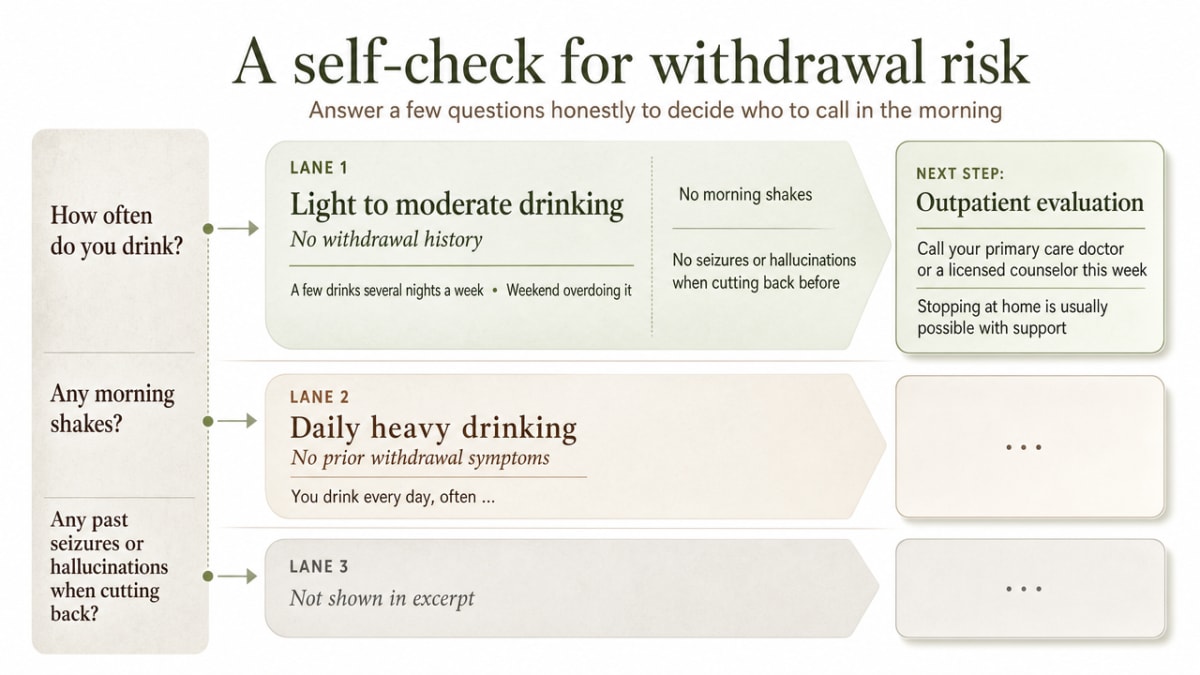
Clinical guidelines for alcohol withdrawal sort people into roughly three lanes based on drinking pattern and history 6, 14:
Lane 1 — Light to moderate drinking, no withdrawal history. A few drinks several nights a week, weekend overdoing it, no morning shakes, no history of seizures or hallucinations when you’ve cut back before. Your next step is an outpatient evaluation. Call your primary care doctor or a licensed counselor this week. You can almost certainly stop drinking at home with support, though that doesn’t mean you should go it alone emotionally.
Lane 2 — Daily heavy drinking, no prior withdrawal symptoms. You drink every day, often more than you intended, but you’ve never had seizures, severe shakes, or hallucinations when you’ve tried to cut back. Your next step is an ambulatory detox screening—a clinical assessment that decides whether you can taper safely at home with medication and check-ins, or whether you need a higher level of care.
Lane 3 — Daily heavy drinking with a withdrawal history. You’ve had the morning shakes. You’ve had a withdrawal seizure. You’ve been told you had DTs. You drink first thing to keep symptoms at bay. Your next step is medically supervised detox, not a self-managed quit. Call your doctor today or, if symptoms are already starting, go to an emergency department 6, 14.
What medically supervised detox actually involves
If you land in Lane 3, the word “detox” probably sounds like a TV scene: a locked room, restraints, sweating it out alone. The reality is much more boring, and that’s the point.
Medically supervised detox is a short stay—usually a few days to a week—in a setting where clinicians monitor your vital signs, score your withdrawal symptoms on a structured scale, and use medication (commonly benzodiazepines, sometimes other agents) to keep your nervous system from spiraling 6, 14. You sleep. You eat. You’re checked on through the night. If symptoms escalate, the response is already in the room.
Detox is not treatment for alcohol use disorder. It’s the bridge that gets you safely to treatment 4. The week you spend stabilizing is the week your brain stops being in chemical emergency mode, which is the only state from which any of the longer-term work—therapy, medication, support—can actually take hold. Saying yes to detox when you need it isn’t weakness. It’s the move that makes everything after it possible.
The Three Treatment Lanes That Actually Work
Behavioral therapy: the work that rewires the habit
Behavioral therapy is the slowest-sounding option on the menu and the one that does the deepest work. It’s where you figure out what alcohol has been doing for you—numbing, rewarding, smoothing over, helping you sleep, helping you talk to people—and what’s going to do those jobs instead.
There is not one therapy for alcohol use disorder. There’s a menu, and the names matter because they tell you what you’re signing up for 3, 7:
- Cognitive-behavioral therapy (CBT). Identifies the thoughts and triggers that lead to drinking and rewires your response to them. The most studied option.
- Motivational enhancement therapy. Short-term work that strengthens your own reasons for changing. Useful when ambivalence is loud.
- Relapse prevention. A specific skill set for handling cravings, high-risk situations, and slips without spiraling.
- Contingency management. Concrete rewards for verified sobriety. Sounds odd; works surprisingly well.
- Behavioral couples therapy. Brings the person you live with into the work, which matters because they’re already in it.
You don’t need to memorize this list. You need to know it exists, so that when a therapist or program describes what they do, you can ask whether it’s one of these. “What’s your approach?” is a fair question. “CBT and relapse prevention” is a fair answer. “We just talk” is a reason to keep looking.
FDA-approved medications most people are never offered
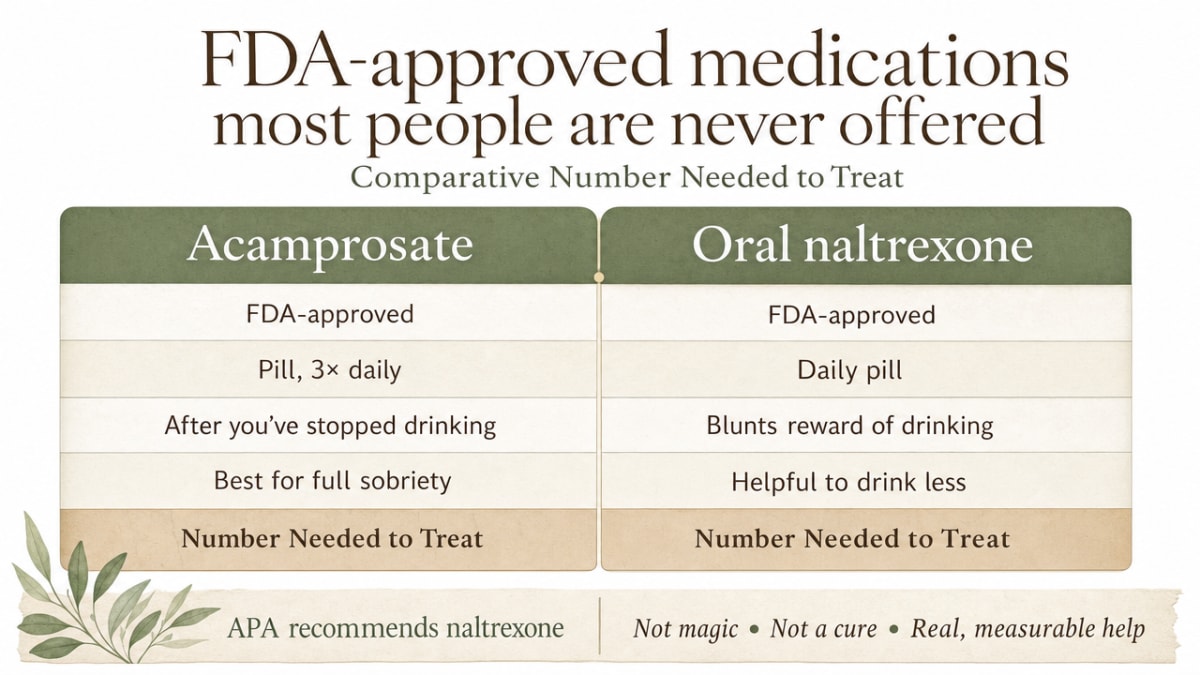
Here’s the part of the conversation that almost nobody had with you before today: there are FDA-approved medications for alcohol use disorder, and they work 13, 15. Not magic. Not a cure. But real, measurable help that your primary care doctor can prescribe.
The three main options 13, 15:
- Naltrexone. Available as a daily pill or a monthly injection. Blunts the reward of drinking, so the third drink feels less like the first. Helpful for people who want to drink less or who can’t stop thinking about it.
- Acamprosate. A pill taken three times a day. Helps the brain settle after you’ve stopped drinking. Best for people aiming at full sobriety.
- Disulfiram. Makes you sick if you drink. A deterrent, not a craving reducer. Works for some people, especially with daily support.
The American Psychiatric Association recommends naltrexone or acamprosate as first-line treatment for moderate-to-severe AUD 15. That’s not a fringe opinion—it’s the guideline.
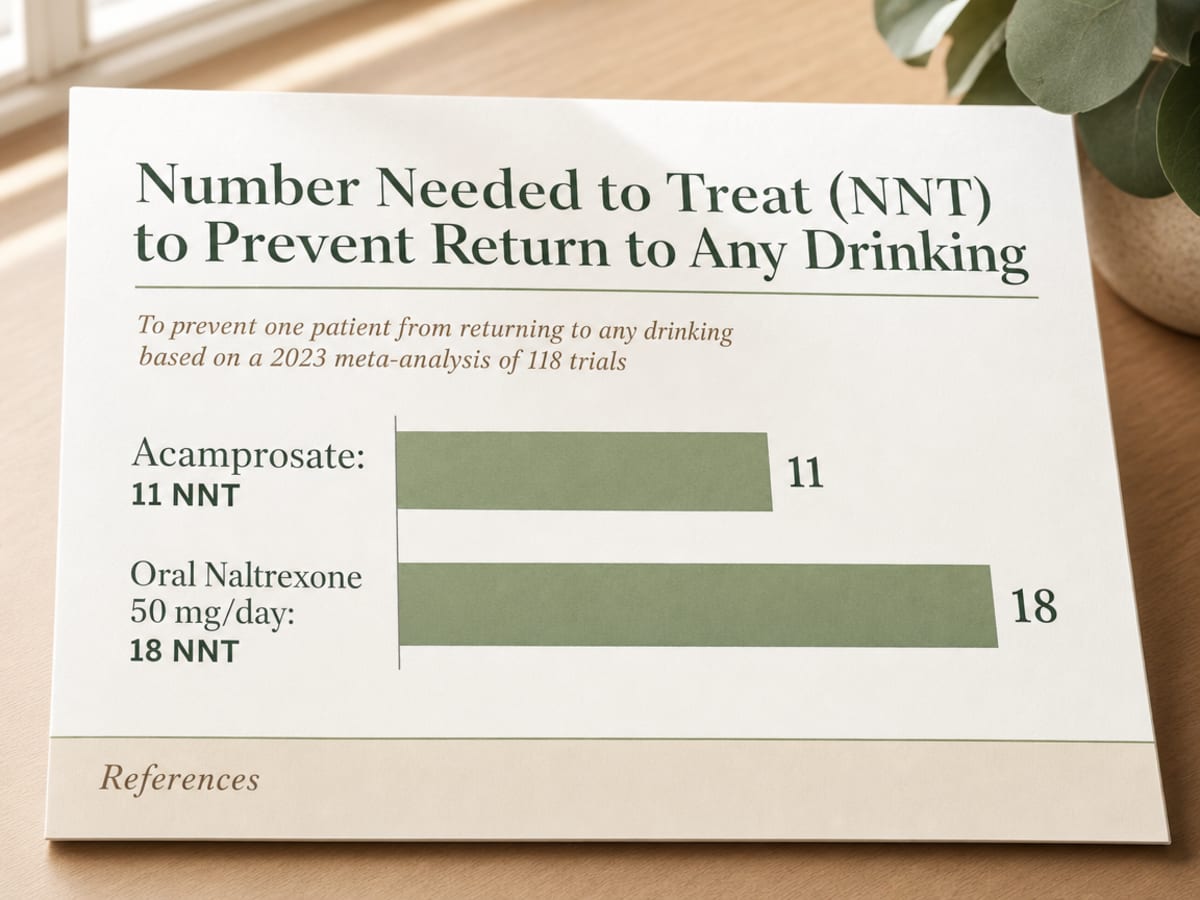
How well do they work? A 2023 meta-analysis pooled 118 clinical trials and 20,976 participants and calculated the Number Needed to Treat—how many people have to take the medication for one extra person to avoid returning to any drinking 2. For acamprosate, the NNT was 11. For oral naltrexone at 50 mg/day, the NNT was 18 2. To put that in perspective, statins for heart disease prevention typically have NNTs in the same range, and nobody calls those experimental.
If your doctor doesn’t bring up medication, you bring it up. Use the names. Say: “I’d like to talk about naltrexone or acamprosate.” If they’re not familiar enough to prescribe, ask for a referral to someone who is. This is a conversation you’re allowed to start.
Mutual-support and peer recovery: AA, SMART, and the rest
You may have already pictured this part: a basement, a circle of folding chairs, coffee that’s been on since 5 a.m. Alcoholics Anonymous is the best-known mutual-support option, and for many people it does something therapy and medication can’t—it puts you in a room with people who’ve been exactly where you are and don’t need anything explained.
It’s not the only room, though. SMART Recovery uses a CBT-based approach and skips the spiritual framing. Refuge Recovery draws on Buddhist practice. LifeRing and Women for Sobriety exist. So do online meetings, which matter if you live somewhere small or you’re not ready to be seen yet 11, 13.
The clinical version of this lane is called 12-step facilitation—structured therapy that helps you engage with a 12-step program, with evidence behind it 3, 7. Mutual support tends to do its best work alongside professional treatment, not instead of it 13. Try a meeting. Try a different one if the first feels wrong. The first room is not the verdict on every room.
Why these three stack instead of compete
The mistake almost everyone makes—including some clinicians—is treating these as competing answers to the same question. Therapy or medication or AA. Pick a lane.
That’s not how this works. A combination of pharmacologic and behavioral treatment is the standard of care for AUD 1. Medication quiets the craving so therapy can get through. Therapy gives you the skills for the moments medication doesn’t cover. A meeting on Tuesday night gives you a room full of people who get it, which neither a prescription nor a 50-minute session can do.
You don’t have to start all three at once. Most people don’t. You start with what’s available this week, then add the next piece when you’re steady enough to. The goal isn’t a perfect plan on day one. It’s a plan that has room to grow.
Matching Your Life to a Level of Care
Outpatient, intensive outpatient, partial hospitalization, residential
Once you know your withdrawal lane, the next question is how much structure you actually need around the rest of your life. “Treatment” isn’t one thing. It’s a ladder, and each rung trades off intensity against how much of your normal week stays intact.
Standard outpatient. One to a few hours a week of individual or group therapy, often paired with medication from your primary care doctor or a prescriber. You keep your job, your kids, your routine. Good fit if your drinking is identified relatively early and you have a stable home.
Intensive outpatient (IOP). Nine to fifteen hours a week, usually three evenings or mornings, so people can still work. Group therapy is the engine. You go home at night.
Partial hospitalization (PHP). A full clinical day, five days a week, without overnight stays. Built for people who need real structure but have a safe place to sleep.
Residential. You live on-site. Twenty-four-hour clinical and emotional support, full days of therapy, medication management, no access to alcohol. The right call when home isn’t safe to recover in, when previous outpatient attempts haven’t held, or when co-occurring mental health needs are too loud to manage from the outside 11, 13.
You’re not locked into the first rung you pick. Most people step down as they stabilize, and some step up when a plan stops working. Pick the level that matches this month, not the rest of your life.
The treatment gap nobody warns you about
Here’s a number worth knowing before you walk into anyone’s office. In the 2023 National Survey on Drug Use and Health, about 2.3 million people ages 12 and older with past-year AUD received any alcohol use treatment. Only roughly 554,000 of them received medication for it 10.
Read that again. Of the people who got help at all, fewer than one in four were offered the FDA-approved medications that the American Psychiatric Association recommends as first-line care for moderate-to-severe AUD 15. That’s not because the medications don’t work. It’s because the system that’s supposed to offer them often doesn’t.
What that means for you, sitting on the edge of your bed this morning: you may have to ask. You may have to ask twice. If the first program or clinician you reach skips medication entirely, that’s not a sign medication isn’t appropriate for you—it’s a sign to ask why it’s not on the table. Bring the names. Bring the guideline. Bring a friend to the appointment if it helps you stay specific. The gap is wide, and the way across it is usually a question you raise out loud.
If Anxiety, Depression, or Trauma Is Also in the Picture
You probably already know this part, even if you’ve never said it: the drinking isn’t just about the drinking. It’s about the 3 a.m. anxiety. The flatness that won’t lift. The thing that happened years ago that you don’t talk about. Alcohol was doing a job. If you take it away without addressing the job, the pressure that built up underneath comes straight to the surface.
This is what clinicians call dual diagnosis—an alcohol use disorder alongside anxiety, depression, PTSD, bipolar disorder, or unresolved trauma. Treating only the drinking when the other piece is also live is one of the most common reasons recovery doesn’t hold. The behavioral therapies that work for alcohol use disorder—CBT, motivational enhancement, relapse prevention—are the same family of treatments that work for these conditions, which is why integrated care exists 3, 11.
When you talk to a clinician this week, say both things out loud. “I drink too much, and I think I’ve also been depressed for a long time.” “The drinking started after my deployment.” “My anxiety is the loudest thing in my head.” The provider who treats both at once, in the same plan, is the one you want. Asking them to is allowed.
How to Tell Your Doctor, Your Partner, and Your Boss This Week
The doctor’s visit: exact words to use
You don’t need a speech. You need one clear sentence and the willingness to sit through the silence after it.
Try this, out loud, before the appointment:“I think I have a drinking problem, and I want to talk about treatment.”That’s the whole opening. If saying “alcoholic” feels easier, use that. Your doctor isn’t grading your vocabulary.
Then give them the specifics that actually shape the plan: how much you drink on a typical day, how early in the day, how long this has been your pattern, and whether you’ve ever had shakes, sweats, seizures, or hallucinations when you cut back. These are the data points that decide whether you can taper at home or need supervised detox 6, 14.
Before you leave, ask the question most patients never get to:“Can we talk about medication for alcohol use disorder—naltrexone or acamprosate?”If the answer is vague, ask for a referral to someone who prescribes them 15, 16. You’re allowed to advocate.
Telling the people you live with
This conversation is harder than the doctor’s office, because the person across from you already has a stake in your drinking. They’ve been waiting, worrying, or pretending not to notice. Whatever you say will land in soil that’s already been worked.
Keep it short.“I’ve realized I have a problem with alcohol. I’m seeing a doctor this week, and I’d like your support.”That’s enough. You don’t owe a confessional inventory of every bad night. You’re announcing a direction, not litigating the past.
Expect a range of reactions—relief, anger, tears, suspicion, all of which are fair. If your partner wants to be involved in the work, behavioral couples therapy is an evidence-based option you can ask a clinician about 3, 7. If they need time to trust the change, give them time. Their feelings are not an emergency you have to solve today.
Work, time off, and what you don’t owe anyone
Your employer does not need your diagnosis. They need to know you’ll be out, or working a modified schedule, for medical reasons. That’s the sentence.
If you need time for detox, intensive outpatient, or residential care, treatment for alcohol use disorder is a medical condition covered under the same federal protections as other health issues—FMLA in many cases, and the ADA in many others. A short note from your treating clinician saying you require medical leave is usually all HR needs. You do not have to write “alcoholism” anywhere.
Tell the people who genuinely need to know, in the language you choose. Everyone else can have “a health issue.” Protecting your privacy this week is not dishonesty. It’s a reasonable boundary while you do the actual work.
What Day One Through Day Thirty Tends to Feel Like
Nobody can promise you a timeline. But there’s a rough shape to the first month that’s worth knowing, because the worst stretch usually isn’t the part you’re picturing.
Days 1–4. If you’re going through withdrawal, this is the loudest physical window—sleep is bad, your hands aren’t steady, your appetite is gone, and your mood swings on the hour. If you’re in supervised detox, medication takes the sharpest edges off 6. If you’re tapering at home with clinical guidance, you’ll feel it more, but it passes.
Days 5–14. The body quiets. The head gets loud. This is when a lot of people are surprised by how raw everything feels—every emotion you’ve been drinking at for years arrives without a buffer. Starting therapy and, if appropriate, medication during this window matters 1, 11. You’re not falling apart. You’re feeling, on time, what alcohol had been postponing.
Days 15–30. Sleep starts coming back. Food tastes like food again. Cravings don’t vanish, but they get shorter and more predictable. You begin to trust that this is something you can actually do—not forever yet, but today, and then tomorrow. That’s the foundation everything else gets built on.
When 24/7 Structured Care Is the Right Call
Outpatient works for a lot of people. It doesn’t work for everyone, and there’s no prize for trying the lowest rung first when your situation is louder than that.
Residential care—living on-site with round-the-clock medical and emotional support—becomes the right call when home isn’t safe to recover in, when previous outpatient attempts haven’t held, when withdrawal risk is high, or when a co-occurring condition like PTSD or severe depression needs treatment in the same building as the drinking 11, 13. If that’s where you are, Arrow Passage Recovery offers that level of care. Make the call today.
Ready for help? Speak to someone now
Connect with a supportive professional who understands what you’re going through and can guide your next steps.
Start Your Next Step Toward Lasting Sobriety
Talk privately with a specialist about your needs and what recovery could look like for you.
Frequently Asked Questions
Is it safe to just stop drinking on my own?
It depends on how much and how long you’ve been drinking. If you’ve had morning shakes, a withdrawal seizure, or a history of DTs, stopping cold turkey can be dangerous and you need medically supervised detox 6, 14. If you drink daily and heavily without those symptoms, get an ambulatory detox screening before you quit. Lighter patterns can usually be handled outpatient with clinical support.
Do I have to go to rehab, or can I get treatment while living at home?
Many people recover without ever sleeping in a facility. Standard outpatient, intensive outpatient (IOP), and partial hospitalization (PHP) let you keep your home and often your job 11, 13. Residential care becomes the right call when home isn’t safe to recover in, when outpatient hasn’t held, or when withdrawal risk and mental health needs are high enough to need 24/7 support.
What are the FDA-approved medications for alcohol use disorder, and how do I get them?
Three medications are FDA-approved: naltrexone (daily pill or monthly injection), acamprosate (a pill three times a day), and disulfiram 13, 15. The American Psychiatric Association recommends naltrexone or acamprosate as first-line for moderate-to-severe AUD 15. Your primary care doctor can prescribe them. If they’re not comfortable, ask for a referral. Say the names out loud at the appointment.
Do I have to go to AA to get sober?
No. AA helps a lot of people, but it’s one lane, not the only one. SMART Recovery, Refuge Recovery, LifeRing, Women for Sobriety, and online meetings are real options 11, 13. Mutual support works best alongside behavioral therapy and, when appropriate, medication—not as a replacement for them. Try a meeting. Try a different one if the first feels wrong.
What should I say to my doctor when I tell them I think I’m an alcoholic?
Open with one clear sentence: “I think I have a drinking problem, and I want to talk about treatment.” Then give specifics—how much, how early in the day, how long, and whether you’ve had shakes, seizures, or hallucinations when cutting back 6, 14. Before you leave, ask: “Can we talk about naltrexone or acamprosate?” 15. That’s the whole script.
What if my anxiety, depression, or trauma is part of why I drink?
Then treat both, in the same plan. Treating only the drinking when anxiety, depression, PTSD, or unresolved trauma is also active is one of the biggest reasons recovery doesn’t hold. Integrated dual-diagnosis care uses behavioral therapies—CBT, motivational enhancement, relapse prevention—that work for both 3, 11. Say both things out loud to your clinician and ask for a provider who treats them together.
References
- Treatment of Alcohol Use Disorder – NCBI Bookshelf – NIH. https://www.ncbi.nlm.nih.gov/books/NBK561234/
- Pharmacotherapy for Alcohol Use Disorder: A Systematic Review and Meta-analysis. https://pmc.ncbi.nlm.nih.gov/articles/PMC10630900/
- Behavioral Treatments for Alcohol Use Disorder and Post-Traumatic Stress Disorder. https://pmc.ncbi.nlm.nih.gov/articles/PMC6561400/
- A Narrative Review of Current and Emerging Trends in the Treatment of Alcohol Withdrawal Syndrome and Alcohol Use Disorder. https://pmc.ncbi.nlm.nih.gov/articles/PMC10969323/
- Alcohol Use Disorder: Screening, Evaluation, and Management – NCBI Bookshelf. https://www.ncbi.nlm.nih.gov/books/NBK436003/
- Alcohol Withdrawal in Hospitalized Patients – NCBI Bookshelf – NIH. https://www.ncbi.nlm.nih.gov/books/NBK604324/
- VA/DoD Clinical Practice Guideline for the Management of Substance Use Disorder. https://www.healthquality.va.gov/guidelines/MH/sud/VADoDSUDCPGProviderSummary.pdf
- Screening for Alcohol Use and Brief Counseling of Adults. https://www.cdc.gov/mmwr/volumes/69/wr/mm6910a3.htm
- Alcohol Screening and Brief Intervention (SBI) – CDC. https://www.cdc.gov/alcohol-pregnancy/hcp/alcoholsbi/index.html
- Alcohol Treatment in the United States. https://www.niaaa.nih.gov/alcohols-effects-health/alcohol-topics-z/alcohol-facts-and-statistics/alcohol-treatment-united-states
- Understanding Alcohol Use Disorder. https://www.niaaa.nih.gov/publications/brochures-and-fact-sheets/understanding-alcohol-use-disorder
- Recommend Evidence-Based Treatment: Know the Options. https://www.niaaa.nih.gov/health-professionals-communities/core-resource-on-alcohol/recommend-evidence-based-treatment-know-options
- Treatment for Alcohol Problems: Finding and Getting Help. https://www.niaaa.nih.gov/publications/brochures-and-fact-sheets/treatment-alcohol-problems-finding-and-getting-help
- The ASAM Clinical Practice Guideline on Alcohol Withdrawal Management. https://pubmed.ncbi.nlm.nih.gov/32511109/
- The American Psychiatric Association Practice Guideline for the Pharmacological Treatment of Patients With Alcohol Use Disorder. https://pubmed.ncbi.nlm.nih.gov/29301420/
- Incorporating Alcohol Pharmacotherapies Into Medical Practice (NCBI Bookshelf). https://www.ncbi.nlm.nih.gov/books/NBK64041/