
What to Look For in Inpatient Drug Treatment Centers
Key Takeaways
- Programs that offer a bed before conducting a multidimensional assessment are selling slots, not care; insist admissions walk you through how they match level of care to withdrawal risk, mental health, and home environment 2.
- Treating substance use without addressing co-occurring mental health conditions sets up relapse; choose a facility where one team handles psychiatry, therapy, and addiction in the same building from day one 15, 1.
- A locked door isn’t the same as psychological safety; trauma-informed programs train staff in SAMHSA’s principles around searches, group facilitation, and de-escalation rather than leaving responses to whoever is on shift 7, 8.
- Families sidelined as visitors miss a clinical lever that improves entry, retention, and outcomes; look for separate intake interviews, scheduled family therapy, and a named family therapist you can actually reach 10, 9.
- Treating discharge as the finish line ignores that meaningful change typically requires at least three months of treatment across a continuum; aftercare with named providers and appointments should be built in week one, not handed over on the way out 13, 4.
The 15-Minute Admissions Call That Tells You Everything
You’re tired. You’ve probably already had a hard conversation this week, maybe today. And now you’re scrolling through facility websites that all look the same, with the same sunlit lobby photos and the same promises of “personalized care.” That exhaustion is real, and it’s not a flaw in your judgment. It’s the reason you need a sharper filter than the brochure.
Here’s the good news: you don’t have to become a clinician to choose well. You just have to recognize the small list of mistakes that separate a serious inpatient program from a marginal one. Most of them surface in the first 15 minutes of an admissions call, if you know what to listen for.
This article isn’t a generic checklist. It’s a tour of five specific decision errors families make under pressure, paired with the questions that expose them. You’ll learn why a standardized intake assessment matters more than a fancy campus 2, why the mental health side of the equation is often where programs quietly fall short 15, and why an aftercare plan should already exist before your loved one is admitted 4. Take a breath. You’re asking the right questions by being here.
Mistake One: Accepting a Program That Skips the Real Assessment
Why a Multidimensional Intake Matters Before Anyone Packs a Bag
If the first phone call ends with “great, we have a bed open Tuesday” before anyone has asked you a real question, pause. That isn’t admissions. That’s intake-as-sales.
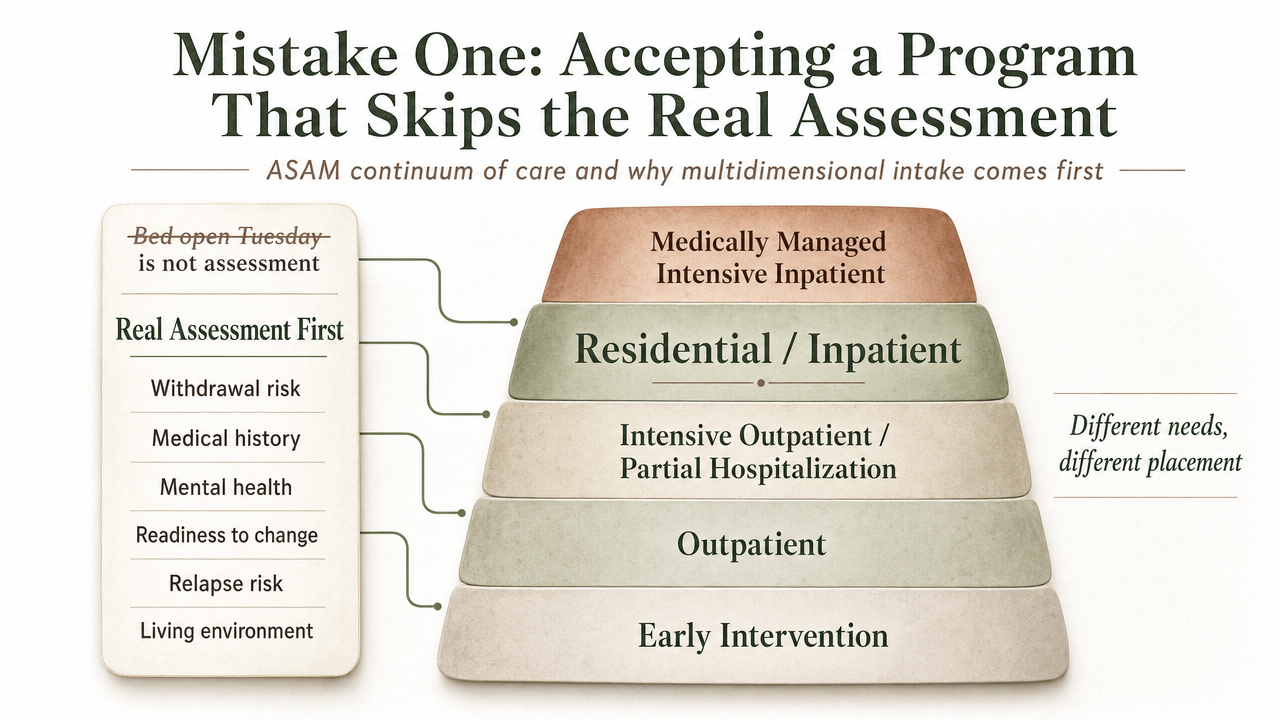
A serious program runs a multidimensional assessment before placement. That means a structured conversation that looks at withdrawal risk, medical history, mental health, readiness to change, relapse risk, and the living environment your loved one will return to. Each of those dimensions changes the answer to what kind of care they actually need 2. A 22-year-old on benzodiazepines who lives alone after a recent suicide attempt doesn’t belong in the same program as a 45-year-old with two decades of alcohol use and a stable spouse at home, even if both are walking through the same lobby door.
This is the principle behind effective treatment: care matched to multiple needs, not just the drug 14. When a facility skips this step, what you’re really being sold is a slot, not a plan. The fix is small and powerful. Ask the admissions coordinator to walk you through, in plain language, how they assess someone before deciding the level of care. The depth of that answer tells you almost everything.
The ASAM Continuum and Where Inpatient Actually Fits
You’ll hear the phrase “level of care” thrown around on tours and websites. It isn’t marketing language. It comes from the American Society of Addiction Medicine, and it describes five clinical levels along a continuum, each meant for a different intensity of need 2.
Here’s the short version, in human terms:
- Level 0.5 — Early Intervention. Education and brief screening for people who show risk but don’t yet meet criteria for a substance use disorder.
- Level I — Outpatient. Fewer than nine hours of services per week. For people with mild symptoms and a stable home life.
- Level II — Intensive Outpatient or Partial Hospitalization. Nine or more structured hours weekly, sometimes most of the day. For people who need real clinical contact but can sleep at home safely.
- Level III — Residential or Inpatient. 24-hour structured care in a non-hospital setting. For people whose environment, mental health, or relapse risk makes living at home unsafe right now.
- Level IV — Medically Managed Intensive Inpatient. Hospital-based, with physicians and nurses on the unit. For acute withdrawal, severe medical issues, or psychiatric crisis 2.
Why does this matter to you? Because a facility that admits every caller to Level III, regardless of what the assessment shows, isn’t matching care to need. They’re matching care to their available beds. The continuum exists precisely so people don’t get parked in the wrong intensity. If the program you’re calling can’t tell you which level their main service is, or can’t explain why it fits your loved one specifically, that’s a placement decision being made for the wrong reason.
What a Good Intake Call Sounds Like vs. a Red Flag
You don’t need a clinical background to hear the difference. You just need to know what the call should cover.
A solid intake call asks about withdrawal history, current medications, prior treatment episodes, mental health diagnoses, suicide risk, what’s been happening at home, and what your loved one actually wants out of this. It also tells you who will be doing a deeper clinical assessment in the first 24 to 72 hours, and how the treatment plan will change based on what’s found 14. You should hear the words “individualized” and have it backed up with specifics, not slogans.
Red flags sound like this: a guarantee of success, a flat 30-day program offered before any assessment, vague answers about who provides medical oversight, or pressure to admit today because “the bed won’t be here tomorrow.” Urgency is sometimes real. Manufactured urgency is a sales tactic.
One more sign worth trusting: a good admissions counselor will sometimes tell you their program isn’t the right fit and point you elsewhere. That honesty is rare, and it’s exactly the kind of judgment you want in the people taking care of someone you love.
Mistake Two: Treating the Addiction While Ignoring the Mental Health Side
The Integration Gap Most Families Never Hear About
Here’s the part of the conversation that often gets skipped on a tour: addiction rarely travels alone. Depression, anxiety, PTSD, bipolar disorder, ADHD, untreated trauma from years ago — these are the conditions that frequently sit underneath the drinking or the pills. If a program treats only the substance use and leaves the rest for someone else to figure out later, your loved one walks back into the same internal weather they were trying to escape.
The size of this gap is worth feeling. In one analysis of co-occurring disorders, only 6.6% of individuals with both a substance use disorder and a non-serious mental health disorder reported receiving treatment for both conditions 15. That figure measures self-reported receipt of any treatment for each side, not the quality of integration inside a single program, but the direction is clear. Most people with two problems get help with one, at best.
Questions That Surface Integrated Care vs. Parallel Care
You don’t need to use the word “integrated” on the call. You just need to ask three questions and listen to how the answers fit together.
First: “Do you have a psychiatrist on staff, and how often will my husband see them?” A real answer names a person or a role, gives a frequency (often a psychiatric evaluation in the first week and follow-ups during the stay), and explains who manages psychiatric medications. A weak answer points to a telehealth contractor seen once, or sends you to an outside provider after discharge.
Second: “If she’s already on medication for anxiety or depression, will your team continue and adjust it, or will that be paused?” Pausing psychiatric meds during early recovery without a clear clinical reason is a warning sign.
Third: “How does the therapy schedule address mental health, not just substance use?” You want to hear specific modalities — cognitive behavioral therapy, EMDR for trauma, trauma-focused group work — and a treatment plan that names the mental health diagnosis alongside the substance use diagnosis 14. If the answer is some version of “we focus on the addiction first and worry about the rest later,” that’s the gap you came here to avoid.
Mistake Three: Confusing ‘Safe’ With ‘Trauma-Informed’
What Safety Actually Means Inside a Residential Unit
When a tour guide says “our facility is safe,” they usually mean the doors lock, the staff is awake at night, and there are no sharp objects in the bathroom. Those things matter. They aren’t the whole picture.
Safety inside a residential unit has a physical layer and a psychological layer, and the second one is where programs quietly differ. A unit can be physically secure and still feel unsafe to someone with a trauma history — too much shouting in groups, surprise room searches without warning, a staff member who corners a patient in a hallway to “have a talk,” rigid rules enforced by tone rather than relationship. Each of those moments can pull a survivor right back into the body memory of whatever happened to them years ago.
A trauma-informed program treats psychological safety as part of clinical care, not as a hospitality concern. That means policies around physical contact, room entry, group facilitation, and de-escalation are written down and trained, not left to whoever is on shift 8. Ask the tour guide what happens during a difficult moment on the unit. The specificity of the answer is the answer.
The Five Principles That Separate a Calm Lobby From a Trauma-Informed Program
SAMHSA’s framework gives you five concrete principles to listen for, and you can hold any facility up against them without needing a clinical vocabulary 7.
- Safety. Patients and staff feel physically and emotionally safe. Look for clear protocols on searches, room entries, and how staff respond when someone is dysregulated.
- Trustworthiness and transparency. Decisions about treatment, medication changes, and family contact are explained, not handed down. Your loved one should know what’s happening next and why.
- Peer support. People in recovery are part of the program’s fabric, not just guest speakers. Peer specialists on staff are a strong sign.
- Collaboration. The treatment plan is built with the patient, not at them. Goals are negotiated, not assigned.
- Empowerment, voice, and choice. Patients have real say in their care, even small choices, and their strengths are part of the plan.
A program built on these principles actively works to avoid re-traumatization in everyday practice — the way groups are run, how a relapse on the unit is handled, how a patient is told a family visit was canceled 7, 8. Ask how staff are trained in trauma-informed care and how often. “We sent the clinical team to a workshop two years ago” is a different answer than “every new hire completes trauma-informed training in their first 30 days, with quarterly refreshers.” You’re listening for it being part of the building, not a poster on the wall.
Mistake Four: Letting the Family Be Sidelined
Why Your Involvement Is a Clinical Variable, Not Sentimentality
Somewhere in the first week, a program will tell you what your role is supposed to be. Listen carefully to that conversation, because how a facility treats you tells you a lot about how it treats outcomes.
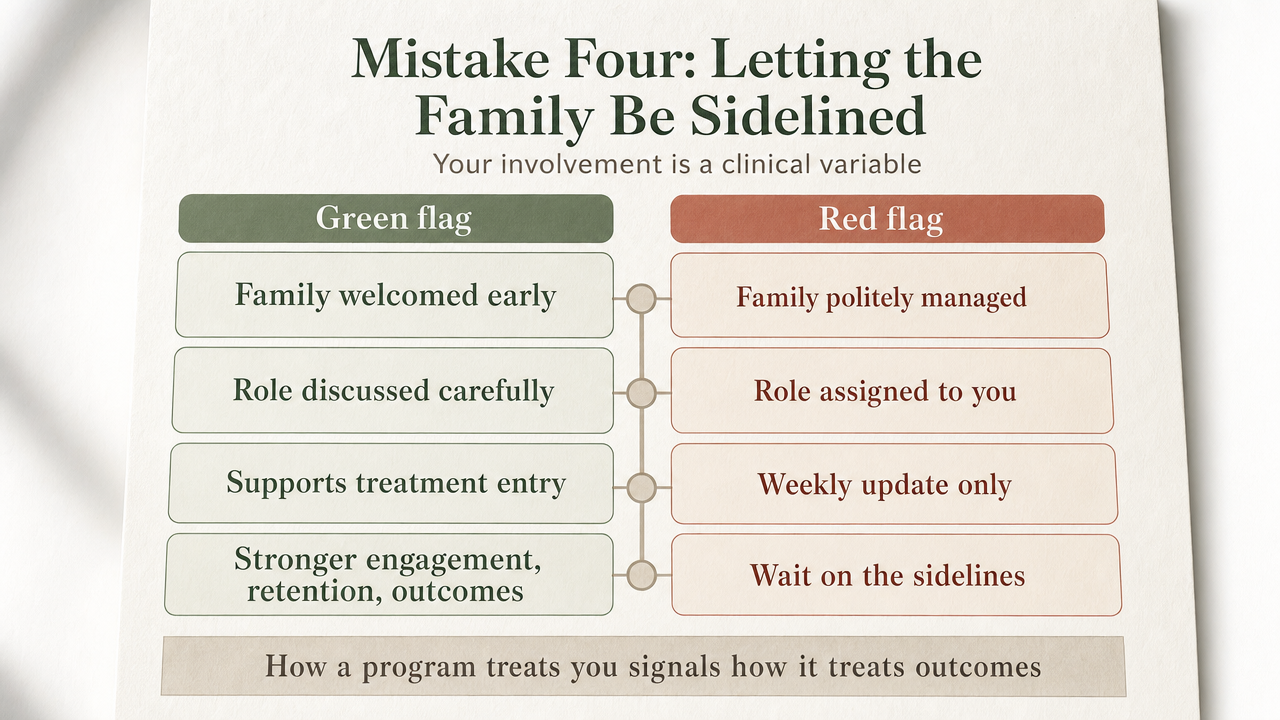
A lot of families come in expecting to be politely managed. You drop your loved one off, sign some paperwork, get a weekly phone update, and wait. That model isn’t neutral. It’s a clinical choice, and the evidence pushes the other direction. Family involvement is linked to better treatment entry, stronger engagement, longer retention, and improved outcomes across the substance use continuum 10. In many cases, patients enter treatment in the first place because of a concerned family member’s persistence, and that same involvement keeps them engaged once they’re inside 9.
So when you wonder if you’re being a nuisance by asking for a call back from the family therapist, you aren’t. You’re a clinical variable. The shame and exhaustion you’re carrying — the late-night searches, the tense dinners, the lying you’ve been doing to your own parents about how bad it’s gotten — that’s the same system the program needs to work with, not around. A facility that treats you as part of the treatment plan, not a visitor pass, is doing the harder, better version of this work.
Green Flag vs. Red Flag: How Programs Actually Engage Families
The difference between programs that involve families and ones that perform involving them is usually visible in the first two weeks. Hold any facility up against these signals.
- Assessment. Green flag: the intake team interviews you separately about what you’ve observed, the history at home, and what’s worked or failed before 2. Red flag: nobody calls you after admission day except for billing.
- Dual-diagnosis communication. Green flag: a clinician explains the mental health and substance use plan together, with your loved one’s consent, and tells you which symptoms to watch for after discharge 14. Red flag: “We can’t discuss anything” used as a blanket policy rather than a HIPAA conversation about what your loved one is willing to share.
- Family programming. Green flag: scheduled family therapy sessions, a multi-family education group, and a named family therapist whose voicemail you actually have 9, 10. Red flag: a single “family day” near discharge framed as the entire offering.
- Aftercare planning. Green flag: you’re brought into discharge planning by week two, with a written plan that names the outpatient provider, the medication prescriber, and the support group meeting times 13. Red flag: discharge paperwork handed to your loved one on the way out the door, with a list of phone numbers and a wish of good luck.
Print this list. Bring it to the tour. The facility that earns four green flags is the one worth the drive.
Mistake Five: Treating Discharge Day as the Finish Line
Why 30 Days Is Often the Beginning, Not the End
The 30-day program is the most familiar shape in this industry, and it’s familiar for a reason: it fits insurance benefit cycles, it fits the calendar a family can hold together, and it fits a story that has a tidy ending. The clinical reality is messier.
NIDA’s research-based guidance is that most people with addiction need at least three months in treatment to meaningfully reduce or stop drug use, and that longer durations tend to produce better outcomes 13. Read that carefully. It isn’t a promise, and it doesn’t mean three months of inpatient. It means three months of treatment — which could be 30 days of residential care followed by a structured step-down through partial hospitalization, intensive outpatient, and ongoing therapy. The continuum of care is the unit of measurement, not the residential stay.
This matters because gains made in a structured residential setting can erode without continuity. Longitudinal research on women with co-occurring disorders found that while many maintained improvements after residential treatment, some outcomes declined over time, with stability varying across domains 4. That’s not a reason to despair. It’s a reason to insist that discharge planning starts in week one, not week four.
What an Aftercare Plan Should Already Include Before Admission
Before you sign anything, ask the admissions coordinator what the aftercare plan typically looks like for someone in your loved one’s situation. A serious program can describe this in concrete terms on day one.
A real plan names specifics, not categories. It identifies the outpatient clinician your loved one will see, with a first appointment scheduled before discharge. It names who will prescribe and manage any medications for addiction or mental health, and how refills bridge the gap between settings 1. It includes a relapse-prevention plan written by the patient, not handed to them. It addresses housing, work, and any legal or medical issues that follow them home 14. It names the support group meetings — time, location, format — not just “attend AA.” And it brings you into the planning conversation by the second week, with your role spelled out.
If the answer to “what does aftercare look like?” is a folder handed over on the last morning, that’s the finish-line mistake. The discharge date is a transition, not a graduation.
Accreditation, Licensing, and Cost: The Floor, Not the Ceiling
You’re going to see badges on every facility website. Joint Commission. CARF. State licensure. Medicare certification. These matter, and you should absolutely confirm them. But they’re the floor of what a real program offers, not the ceiling.
State licensing means a facility has cleared baseline operational requirements. Accreditation means an outside body has reviewed clinical practices against published standards. Hospital-based inpatient units that take Medicare must meet conditions of participation covering treatment services, staffing, and patient rights 16. That’s a meaningful safety net. It does not tell you whether the program assesses people properly, treats co-occurring conditions in the same building, involves families, or plans aftercare before discharge. Those are the differentiators you’ve been reading about. Accreditation gets a facility into the conversation. It doesn’t win the conversation.
Cost works the same way. The honest answer is that inpatient care is expensive, and what you pay depends on your insurance plan, the length of stay, and whether the facility is in-network. Ask three direct questions on the admissions call: Is your program in-network with my insurance? What does a verification of benefits actually show for residential treatment? And what happens financially if the clinical team recommends a longer stay than insurance initially authorizes 3? A serious program will walk you through this without flinching. A marginal one will dodge or quote a flat number before knowing your coverage. The willingness to be transparent about money is a quiet signal about how the rest of the work gets done.
Where to Start This Week
You don’t have to do all of this by Friday. You do have to do three things.
- Call SAMHSA’s National Helpline at 1-800-662-HELP. It’s free, confidential, and runs 24/7. They can point you toward licensed local options without selling you anything 5.
- Cross-check names against SAMHSA’s national treatment directory to confirm licensing and the specific services each facility actually provides 12.
- Pick two or three programs and run the same admissions call: ask about the assessment, the psychiatrist, the family therapist, and what aftercare looks like on day one.
You’re already doing the hard part. If you’d like a team that treats integrated dual-diagnosis care and family involvement as part of the work, not an add-on, Arrow Passage Recovery is one place to start that conversation.
Speak With a Compassionate Intake Specialist Now
Connect directly for immediate guidance and next steps in starting inpatient treatment.
Talk With a Specialist About Inpatient Care Options
Connect one-on-one to explore personalized residential treatment plans for your loved one’s unique needs.
Frequently Asked Questions
How long should my loved one stay in inpatient drug treatment?
There’s no single right number. NIDA’s research-based guidance points to at least three months of treatment overall for meaningful reduction in drug use, with longer durations generally producing better outcomes 13. That total can be split across residential care and a structured step-down. Push back if a facility quotes a flat length before completing an assessment.
What’s the difference between dual-diagnosis care and a facility that just treats addiction?
Dual-diagnosis care treats the substance use and the mental health condition together, with the same team, in the same building, from day one 1. A facility that “treats addiction” alone often refers psychiatric care out, which leaves your loved one managing two systems. Ask whether a psychiatrist is on staff and how they coordinate with the addiction therapist.
How involved will I be allowed to be during my family member’s treatment?
That depends heavily on the program and on what your loved one consents to share. Strong programs treat your involvement as part of the clinical plan, with scheduled family therapy, education groups, and a named family therapist you can reach 9, 10. Privacy law shapes what staff can disclose, but a good team works with your loved one on what to share.
What questions should I ask on the first admissions call?
Four worth asking: How do you assess someone before deciding the level of care 2? Do you have a psychiatrist on staff and how often will my loved one see them? How does your team involve families during the stay? What does the aftercare plan typically look like, and when do you start building it? The specificity of the answers is the answer.
Is accreditation enough to know a facility is high quality?
No. Accreditation, state licensing, and Medicare conditions of participation set a baseline for safety, staffing, and patient rights 16. They don’t tell you whether the program assesses people properly, treats co-occurring conditions in the same building, involves families, or plans aftercare before discharge. Treat the badges as the entry ticket, then evaluate the clinical practices behind them.
What should an aftercare plan look like before my loved one is discharged?
A real plan names specifics: the outpatient clinician with a first appointment booked, who prescribes and manages medications, a patient-written relapse-prevention plan, named support group meetings, and attention to housing, work, and legal needs 14. It also brings you in by the second week. Residential gains can erode without that continuity, so plan-building should start in week one, not on discharge morning 4.
References
- Treatment | National Institute on Drug Abuse (NIDA). https://nida.nih.gov/research-topics/treatment
- Chapter 3. Intensive Outpatient Treatment and the Continuum of Care. https://www.ncbi.nlm.nih.gov/books/NBK64088/
- Chapter 5—Specialized Substance Abuse Treatment Programs. https://www.ncbi.nlm.nih.gov/books/NBK64815/
- Stability of Outcomes Following Residential Drug Treatment for Women With Co-occurring Disorders. https://pmc.ncbi.nlm.nih.gov/articles/PMC3146302/
- National Helpline for Mental Health, Drug, Alcohol Issues – SAMHSA. https://www.samhsa.gov/find-help/helplines/national-helpline
- 2022 National Survey on Drug Use and Health (NSDUH) Releases. https://www.samhsa.gov/data/data-we-collect/nsduh-national-survey-drug-use-and-health/national-releases/2022
- Trauma-Informed Approaches and Programs. https://www.samhsa.gov/mental-health/trauma-violence/trauma-informed-approaches-programs
- Trauma-Informed Care in Behavioral Health Services. https://www.ncbi.nlm.nih.gov/books/NBK207195/
- Retention Toolkit: Family Involvement. https://adai.uw.edu/retentiontoolkit/family.htm
- Family Involvement in Treatment and Recovery for Substance Use Disorders: A Narrative Review and Conceptual Framework. https://pmc.ncbi.nlm.nih.gov/articles/PMC8380649/
- Treatment Types for Mental Health, Drugs and Alcohol. https://www.samhsa.gov/find-support/learn-about-treatment/types-of-treatment
- 2023 National Directory of Drug and Alcohol Use Treatment Facilities. https://www.samhsa.gov/data/report/2023-national-directory-of-drug-and-alcohol-use-treatment-facilities
- Principles of Drug Addiction Treatment: A Research-Based Guide (Third Edition). https://nida.nih.gov/sites/default/files/podat-3rdEd-508.pdf
- Table 4.2, Principles of Effective Treatment for Substance Use Disorders. https://www.ncbi.nlm.nih.gov/books/NBK424859/table/ch4.t2/
- Co-Occurring Disorders in Substance Abuse Treatment: Issues and Prospects. https://pmc.ncbi.nlm.nih.gov/articles/PMC2200799/
- Psychiatric Hospitals. https://www.cms.gov/medicare/health-safety-standards/certification-compliance/psychiatric-hospitals