
How to Choose Inpatient Drug Treatment Near Me
Key Takeaways
- Start the search by clinical fit, not zip code, since a closer program that can’t manage your detox or co-occurring conditions isn’t actually closer to recovery.
- Learn how inpatient, residential, PHP, IOP, and outpatient differ, because the label on a website matters less than what staff and structure are present at 2 a.m.
- Withdrawal shakes, repeated failed attempts to quit, an unsafe home, and untreated mental health symptoms are signals that 24-hour care matches what’s actually happening.
- Treat detox as a medical event with on-site nursing, monitoring, and FDA-approved medications, since alcohol and benzodiazepine withdrawal can trigger seizures 3.
- Verify state licensure, counselor credentials, named evidence-based therapies, detox coordination, dual-diagnosis capability, and a written aftercare plan before admitting 8, 14, 15.
- Expect integrated dual-diagnosis care where the therapist and prescriber share one chart, because mental health and substance use feed each other and need treatment in the same room 7.
- Use a seven-question intake call covering license, detox protocol, psychiatric care, named therapies, insurance, discharge plan, and family involvement to test whether a program is real.
- Ask about fees, insurance verification, Medicaid protections, and sliding-scale or state-funded beds, and plan for at least a month with length driven by clinical need 2, 13.
What “near me” should really mean when you’re searching for help
You typed those words into a search bar for a reason. Maybe you’re tired. Maybe you’re scared of what tomorrow morning will feel like. Maybe someone you love is sitting in the next room and you haven’t told them you’re looking. Whatever brought you here, the fact that you’re reading this is real, and it counts.
Here’s something most articles won’t say out loud: “near me” is the wrong first question. Distance matters, but it isn’t what decides whether a program can help you stop using. What decides that is fit. Is the program built for what your body is doing right now? Can it handle withdrawal safely? Can it treat your anxiety, depression, or trauma at the same time as your drug use? Does it have a real plan for the week after you walk out the front door?
So let’s reframe the search. Start with what you need clinically. Then ask how close you can get it.
Inpatient, residential, and the other words you’ll see on program websites
Program websites toss around five or six words that sound like they mean the same thing. They don’t. Knowing the difference saves you from calling a place that can’t actually take care of you.
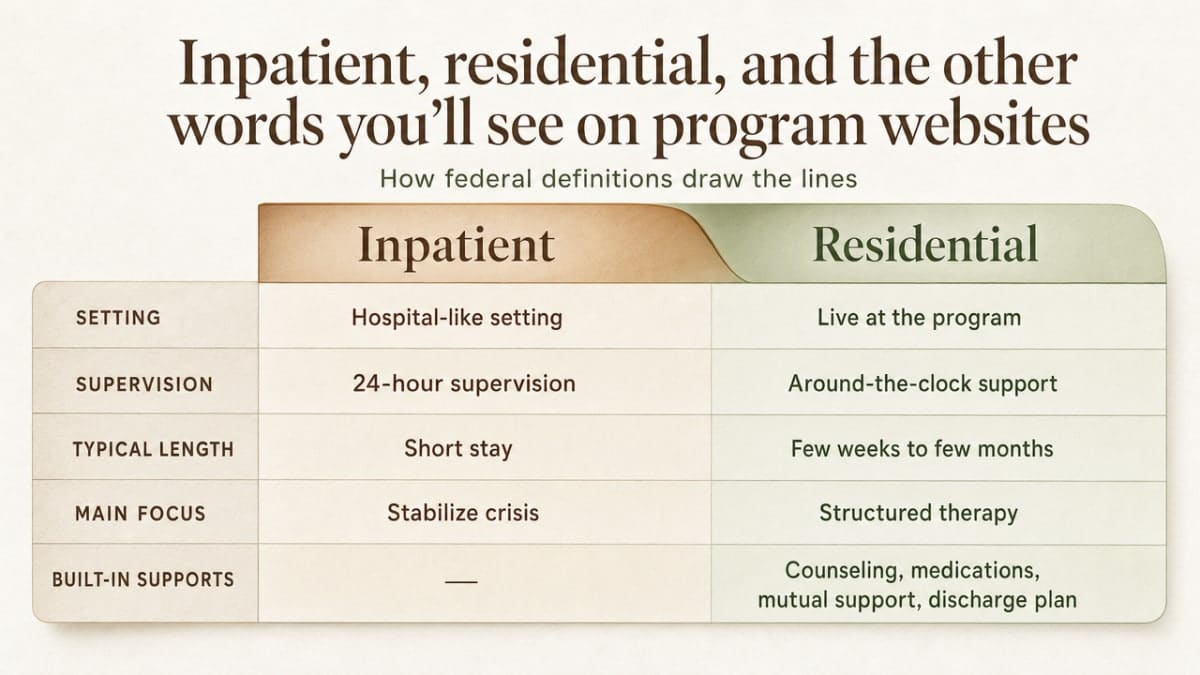
Here’s how the federal agencies draw the lines. SAMHSA defines inpatient care as care for people who need 24-hour supervision, usually in a hospital-like setting, often short and focused on stabilizing a medical or psychiatric crisis. Residential care means you live at the program for an extended stretch, typically a few weeks to a few months, with structured therapy and support around the clock 2. NIDA puts it the same way: residential programs are inpatient programs that provide extended care over weeks to months, with counseling, medications, mutual support, and a discharge plan built in 1.
Then there’s the step-down language. Partial hospitalization (PHP) is intensive daytime treatment, often five to six hours a day, but you sleep at home or in sober housing. Intensive outpatient (IOP) is usually nine or more hours a week, scheduled around work or school. Standard outpatient is weekly therapy and medication management. SAMHSA also describes interim care, which is a bridge service for people waiting for a residential bed to open 2.
| Level of care | Who it fits | Typical length | 24-hour supervision? |
|---|---|---|---|
| Inpatient (hospital-based) | Acute withdrawal risk, medical or psychiatric crisis | Days to about a week | Yes 2 |
| Residential | Severe use, unsafe home environment, need for structure | A few weeks to a few months 1 | Yes 2 |
| PHP | Stable medically, still need daily clinical support | 2–4 weeks, most days | No |
| IOP | Working or parenting, ready for more independence | 8–12 weeks, several days a week | No |
| Outpatient | Maintenance, relapse prevention, ongoing therapy | Ongoing | No 2 |
When a website says “rehab,” ask which of these levels they actually run. Many programs offer more than one. The label matters less than what the day looks like and who is on staff at 2 a.m.
Signs your body and life need 24-hour care right now
You probably already know the answer in your gut. But guts get drowned out by shame, by tolerance, by the voice that says you can handle one more night. So here are the signals worth taking seriously, the ones that mean a residential bed is the safer option than another morning alone with this.
Your body has stopped giving you a choice. If you wake up shaking, sweating, throwing up, or unable to function until you use again, that’s physical dependence. Withdrawal from alcohol, benzodiazepines like Xanax or Klonopin, or opioids isn’t something to tough out at home. CDC notes that recovery often involves medication for cravings and withdrawal and may require checking into a rehabilitation facility for that exact reason 3. Alcohol and benzo withdrawal in particular can cause seizures. You need a nurse on the unit, not a YouTube video.
You’ve tried to stop and couldn’t, more than once. Maybe you made it three days. Maybe you made it three weeks. The pattern of trying, slipping, and trying again isn’t a character flaw. It’s a sign your brain needs more structure than willpower alone can provide. NIDA describes residential care as extended inpatient treatment built around counseling, medications, and mutual support, lasting a few weeks to a few months because that’s often what it takes 1.
Your home is part of the problem. If your roommate uses, your partner uses, or your stash is in the next drawer, you are not detoxing in that house. Twenty-four-hour care means physical distance from your supply and from the people who keep handing it to you.
Something else is going on, too. Panic attacks. Flashbacks. Nights you can’t remember. Thoughts of not being here anymore. Co-occurring mental health conditions sit underneath a lot of active addiction, and SAMHSA defines this overlap as a co-occurring disorder requiring integrated care 7. Trying to treat one without the other rarely holds.
You’re using to function, not to feel good. When the drug stops being a high and becomes the thing that gets you to work, to sleep, to the grocery store, that’s a different stage. It needs a different setting.
If two or three of these are true for you right now, that’s your answer. Inpatient isn’t an overreaction. It’s the level of care that matches what’s actually happening.
Detox is a medical event, not a willpower test
Let’s name something the recovery industry sometimes glosses over: detox can kill you if it’s the wrong substance and the wrong setting. Not always, not for everyone, but often enough that the question of where you detox matters as much as whether you do.
Alcohol withdrawal can trigger seizures and delirium tremens. Benzodiazepine withdrawal, especially after long-term use of Klonopin, Xanax, Ativan, or Valium, carries the same seizure risk and sometimes requires a slow medical taper rather than a quick stop. Opioid withdrawal usually isn’t fatal on its own, but the dehydration, vomiting, and crushing depression can push people back to using at doses their tolerance can no longer handle, and that’s when overdose happens. CDC notes that recovery often involves medication for cravings and withdrawal and may require checking into a rehabilitation facility for that exact reason 3.
A real medical detox means a few specific things:
- A licensed nurse or physician assesses you at intake.
- Someone monitors your vitals through the night.
- There are medications on hand to manage symptoms, including FDA-approved medications for opioid use disorder when appropriate, which SAMHSA regulates under federal opioid treatment program rules 6.
- And detox is connected to what comes next, not handed off at the door.
If a program tells you to “just get through the first few days at home” before you arrive, that’s not a detox plan. That’s a liability shuffle. Ask whether detox happens on-site, whether it’s medically supervised around the clock, and what the protocol looks like for your specific substance.
Verify the program before you pack a bag
Before you say yes to a bed, do twenty minutes of homework. It feels strange to vet a place when you’re already exhausted, but this is the part that protects you from a glossy website and a phone voice that sounded warm. A real program will welcome these questions. A questionable one will get cagey.
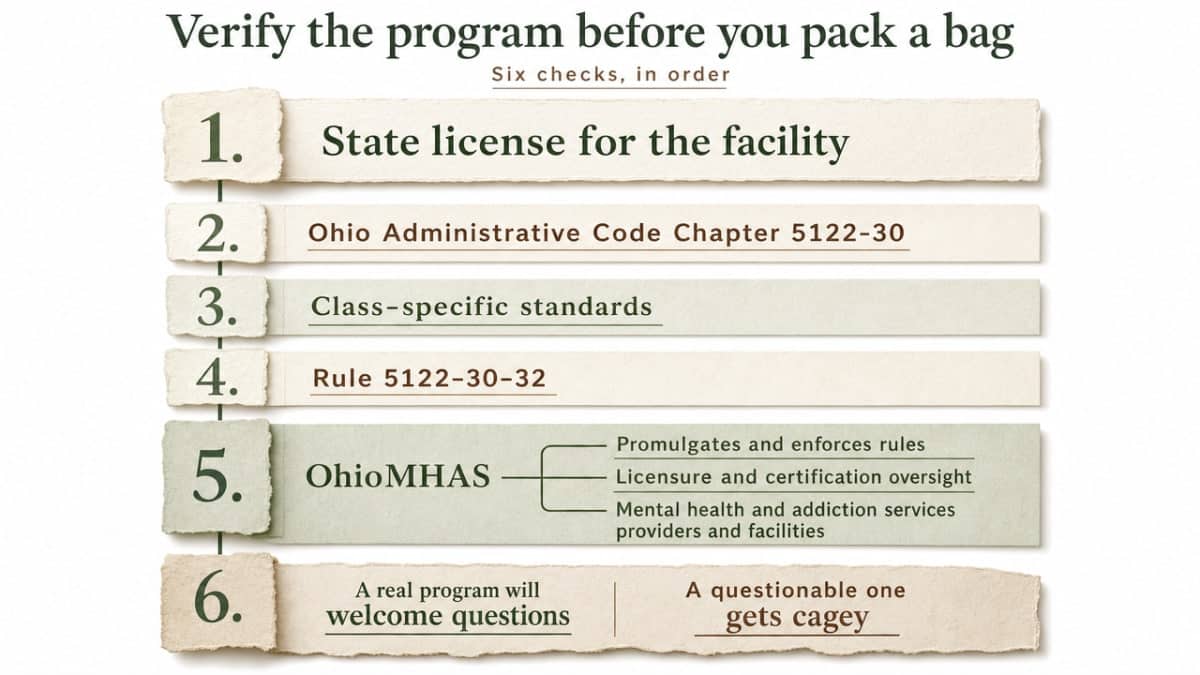
Here are the six things to confirm, in roughly the order they matter.
- State license for the facility. In Ohio, residential treatment facilities are licensed under Ohio Administrative Code Chapter 5122-30, with class-specific standards spelled out in rules like 5122-30-32 8, 9. OhioMHAS is the agency that promulgates and enforces these rules, and the 2024 Behavioral Health Handbook from the Ohio Auditor of State confirms OhioMHAS oversees licensure and certification of mental health and addiction services providers and facilities 10. The legal backbone for that authority is Chapter 5119 of the Ohio Revised Code, which covers alcohol and drug addiction services certified by the director of behavioral health 12. Ask for the program’s license number and class. A licensed program will tell you.
- Individual counselor credentials. The facility license is one layer; the people in the therapy room are another. Ohio’s public eLicense look-up, run through OCDP, lets anyone verify CDCA, LCDC II, LCDC III, and LICDC or LICDC-CS credentials for the counselor who will actually be working with you 14. If a staff bio lists initials you can’t find on that lookup, that’s worth a follow-up question.
- Evidence-based therapies, named specifically. “We use proven methods” isn’t an answer. Ask which ones. SAMHSA maintains an Evidence-Based Practices Resource Center where validated approaches for substance use and mental health are catalogued 15, and SAMHSA/CSAT Treatment Improvement Protocols spell out best-practice guidelines for substance abuse treatment 16. Cognitive behavioral therapy, motivational interviewing, EMDR for trauma, and medication-assisted treatment are common, named entries. Marketing buzzwords are not.
- On-site or tightly coordinated medical detox. If you’ll need withdrawal management, the program should either run detox on the unit or have a written handoff with a medical facility, including medications for cravings and withdrawal where appropriate 3. Ask what happens hour by hour during your first 72 hours.
- Real dual-diagnosis capability. Co-occurring disorders, meaning a mental health condition alongside a substance use disorder, are common and need integrated treatment rather than two separate care teams who never talk 7. Ask who prescribes psychiatric medication, how often you’ll see them, and whether your therapist and prescriber share notes.
- A written aftercare plan before discharge. NIDA describes residential care as inpatient care of a few weeks to a few months that should include discharge referrals and continuing support 1. Ask whether they help you line up PHP, IOP, sober living, or outpatient therapy before you leave, not the morning of.
If a program clears all six, you’re not just choosing a place that’s close. You’re choosing one that can actually do the job.
Dual diagnosis is the default, not a luxury feature
If you’re using, something else is usually riding along. Maybe it’s the panic that hits before you even open your eyes. Maybe it’s a memory you’d do anything to stop replaying. Maybe it’s a depression so flat you can’t remember the last time food tasted like anything. Whatever it is, it didn’t show up by accident, and it won’t disappear just because you stop using.
SAMHSA defines a co-occurring disorder as the coexistence of a mental health disorder and a substance use disorder, and the federal guidance is clear that these conditions should be treated together rather than in separate hallways with separate teams who never compare notes 7. That matters because the old model, get sober first and we’ll deal with your mental health later, leaves people white-knuckling withdrawal while the exact symptoms that drove them to use in the first place go untouched.
So when you’re looking at a program, dual-diagnosis care isn’t a premium add-on. It’s the baseline. Ask who the prescribing psychiatrist or psychiatric nurse practitioner is, how often you’ll actually see them, and whether your therapist and your prescriber share the same chart. Ask how they handle trauma specifically, because PTSD and substance use travel together more often than not, and trauma-focused therapies like EMDR or cognitive processing therapy show up in SAMHSA’s evidence-based practices catalog for a reason 15.
If a program treats mental health as something they refer out for, keep looking. The two conditions feed each other. They need to be treated in the same room.
The first phone call: what to ask intake and what their answers should sound like
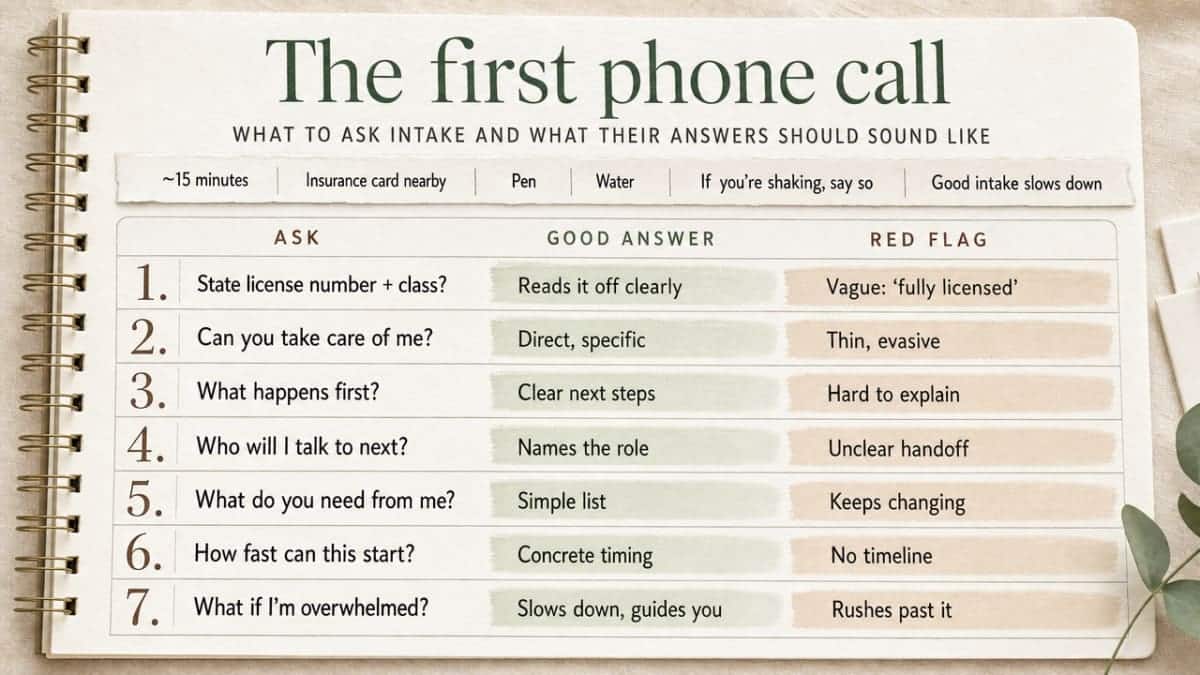
The hardest part of the first phone call isn’t the questions. It’s picking up the phone. Once someone says hello, your job is to find out, in about fifteen minutes, whether this place can actually take care of you. You don’t need a clipboard. You need a short list and a willingness to keep going if the answers feel thin.
Have your insurance card nearby if you have one. A pen. A glass of water. If you’re shaking, say so. A good intake coordinator has heard it before and will slow down.
- “What’s your state license number and class?” A real program will rattle this off or read it to you. In Ohio, residential facilities operate under specific class designations spelled out in administrative rule, and the intake person should know which one applies to their building 8. Vague answers like “we’re fully licensed, don’t worry about that” are not answers.
- “What does detox look like for someone using what I’m using?” Name your substance. Name how much, how often, and when you last used. Listen for whether detox happens on-site with medical staff, or whether they’ll send you somewhere else first. CDC guidance is clear that withdrawal often requires medication for cravings and symptoms and may require a rehabilitation facility setting 3. You want to hear about a nurse, a physician or nurse practitioner, and a specific protocol, not “we’ll figure it out when you get here.”
- “Who treats my mental health while I’m there?” Ask for the title of the person who prescribes psychiatric medication and how often you’ll see them. Co-occurring mental health and substance use conditions need integrated treatment, not a referral out the side door 7. If the prescriber is on-site weekly and shares records with your therapist, that’s the answer you want.
- “Which therapies do you use, by name?” You’re looking for specific words: cognitive behavioral therapy, motivational interviewing, EMDR, contingency management, medication-assisted treatment. These are the kinds of approaches catalogued in SAMHSA’s evidence-based practices resource and the CSAT Treatment Improvement Protocols 15, 16. “Holistic” and “individualized” are fine as additions, but they shouldn’t be the whole list.
- “What does my insurance cover, and what happens if I’m on Medicaid?” A real intake team verifies benefits while you’re on the phone or calls you back the same day. If you’re on Ohio Medicaid, ask how they handle outside medically necessary services, since state rule lets you receive certain services from practitioners not affiliated with the residential program during your stay 13. SAMHSA also notes that program costs vary, so it’s reasonable to ask for a written estimate of what you’ll owe 2.
- “What’s the discharge plan?” Ask this on day one, not day twenty. NIDA describes residential care as extended inpatient treatment that runs a few weeks to a few months and should include discharge referrals to continuing support 1. You want to hear about PHP, IOP, sober living, outpatient therapy, and a named case manager who helps you line it up.
- “Can my family be involved, and how?” Whether it’s a partner, a parent, or a sibling, the person who drove you to the curb deserves a structured way in. Ask about family therapy sessions, visiting hours, and how the program communicates with the people who love you while respecting your privacy.
If the person on the other end gets defensive at any of these, that tells you something. If they walk through each one without flinching, that tells you something too. You’re not being difficult. You’re choosing where you’ll sleep for the next month.
What affects cost, coverage, and how long you’ll stay
Money is the question people are most ashamed to ask and the one that decides the most. So let’s put it on the table.
Cost varies a lot between programs, and SAMHSA is explicit that each program sets its own fees, which is why two facilities ten miles apart can quote you very different numbers for the same level of care 2. What drives that range is straightforward: whether detox happens on-site, how long you stay, whether psychiatric prescribing is built in, the staff-to-patient ratio, and whether the building is a hospital wing or a home-like residential setting. NIDA describes residential care as running a few weeks to a few months, and length of stay is usually the single biggest cost lever 1.
Insurance is where most readers actually land. If you have a commercial plan, ask intake to verify benefits while you’re on the phone and to send you a written estimate of your out-of-pocket cost before you admit. If you’re on Ohio Medicaid, you have a specific protection worth knowing: under state rule, you can still receive medically necessary services from practitioners not affiliated with the residential program during your stay, which matters if you already see a psychiatrist or primary care doctor you trust 13.
If you don’t have insurance, don’t hang up. Call the SAMHSA National Helpline, which is free, confidential, and open 24/7, and ask specifically about state-funded beds, sliding-scale programs, and waitlists in your area 4. Some programs hold a percentage of beds for uninsured or underinsured admissions. You won’t know until you ask.
Length of stay isn’t a number you pick off a menu. It’s a clinical decision based on your substance, your history, your mental health, and how the first week goes. Plan for at least a month. Be open to longer if your team recommends it.
After inpatient: the part most programs underplay
Inpatient is a chapter, not the book. The week you walk out the front door is statistically one of the riskiest stretches in recovery, because your tolerance has dropped, your routine is wide open, and the same triggers are still waiting in the parking lot. A program that treats discharge as an afterthought is leaving you on the most dangerous step.
NIDA frames residential care as extended inpatient treatment that runs a few weeks to a few months and should include discharge referrals and continuing support built into the stay itself 1. That’s the standard to hold a program to. Not a printed list of phone numbers handed over at checkout. A real plan that started the week you arrived.
Ask what your step-down looks like before you admit. A strong continuing-care plan usually layers a few things:
- Partial hospitalization or intensive outpatient for the first stretch home
- Weekly individual therapy
- Ongoing psychiatric medication management if you’re being treated for co-occurring conditions 7
- A mutual support group you actually want to attend
- A named case manager who follows up by phone in the first 72 hours after discharge
SAMHSA’s evidence-based practices catalog includes continuing care models for exactly this reason 15.
Sober living, family therapy, and help getting back to work belong in the same conversation. If you don’t have a safe place to sleep, the clinical work you did inside doesn’t get to take root. CDC guidance on substance use treatment also notes that medications for cravings and withdrawal often continue past the inpatient setting, so ask who prescribes them and where you’ll pick them up 3.
One more thing worth saying plainly: relapse, if it happens, is information, not failure. A program that prepares you for that possibility, with a clear plan to come back in, is treating you like a person in long-term recovery rather than a discharge statistic.
If today is the day you make the call
You don’t have to feel ready. Ready is a story people tell after the fact. What you have to do is pick up the phone.
If you want a person on the other end before you start dialing programs, the SAMHSA National Helpline is free, confidential, and open 24/7, every day of the year, and can point you toward local options 4. If you’d rather start with a map, FindTreatment.gov, the Buprenorphine Practitioner Locator, and the Opioid Treatment Program Directory are the federal tools built for exactly this search 5.
When you call a program, keep your checklist next to you. License number. Detox plan for your substance. Who treats your mental health. Named therapies. Insurance or sliding scale. Discharge plan. Family involvement. If a place answers all seven without flinching, you’ve found a real one. Arrow Passage Recovery is one option in Ohio, and there are others.
Whatever you decide, the version of you reading this right now did something hard. Make the call while that’s still true.
Talk With a 24/7 Admissions Specialist Today
Connect immediately with someone who understands your situation and can help guide your next steps.
Talk With Someone Who Understands Your Journey
Get real answers about safe, structured inpatient treatment options for lasting recovery—no judgment, just support.
Frequently Asked Questions
How do I know if I need inpatient treatment instead of outpatient?
If you wake up in withdrawal, can’t string together more than a few days sober on your own, or your home environment keeps pulling you back, inpatient is the safer match. CDC notes that recovery often requires medication for cravings and withdrawal and may mean checking into a rehabilitation facility for that reason 3. Twenty-four-hour care exists for exactly this moment.
How can I verify that an inpatient program near me is actually licensed?
Ask for the facility’s license number. In Ohio, residential treatment facilities are licensed under Ohio Administrative Code Chapter 5122-30, and OhioMHAS oversees licensure and certification of addiction service providers 8, 10. For the counselor working with you, use the Ohio eLicense public look-up to verify CDCA, LCDC II, LCDC III, or LICDC credentials 14. A real program shares this information without hesitation.
What should I ask during the first phone call to a treatment center?
Keep it to seven questions: license number, detox plan for your specific substance, who treats your mental health, which therapies they use by name, insurance and sliding-scale options, discharge plan, and family involvement. Named evidence-based therapies like CBT, EMDR, and medication-assisted treatment should appear in their answers, consistent with SAMHSA’s evidence-based practices catalog 15. Vague reassurance isn’t an answer.
Will inpatient treatment handle both my drug use and my mental health?
A program built for dual diagnosis will. SAMHSA defines co-occurring disorders as the coexistence of a mental health disorder and a substance use disorder, and federal guidance supports integrated treatment rather than separated care 7. Ask who prescribes psychiatric medication on-site, how often you’ll see them, and whether your therapist and prescriber share the same chart. If mental health gets referred out, keep looking.
How long does inpatient drug treatment usually last?
NIDA describes residential care as inpatient treatment that runs a few weeks to a few months, with counseling, medications, and discharge referrals built in 1. The exact length depends on your substance, your history, your mental health, and how the first week goes. Plan for at least a month. Stay open to longer if your clinical team recommends it. Length isn’t something you pick off a menu.
What if I can’t afford inpatient treatment or don’t have insurance?
Call the SAMHSA National Helpline at 1-800-662-HELP. It’s free, confidential, and open 24/7, 365 days a year, and the staff can point you toward state-funded beds, sliding-scale programs, and waitlists 4. SAMHSA also notes that each program sets its own fees, so costs vary widely 2. If you’re on Ohio Medicaid, residential coverage exists under state rule 13. Ask. Don’t assume no.
References
- Treatment | National Institute on Drug Abuse (NIDA) – NIH. https://nida.nih.gov/research-topics/treatment
- Treatment Types for Mental Health, Drugs and Alcohol | SAMHSA. https://www.samhsa.gov/find-support/learn-about-treatment/types-of-treatment
- Treatment of Substance Use Disorders | Overdose Prevention – CDC. https://www.cdc.gov/overdose-prevention/treatment/index.html
- National Helpline for Mental Health, Drug, Alcohol Issues | SAMHSA. https://www.samhsa.gov/find-help/helplines/national-helpline
- Treatment Locators: Mental Health, Drug, Alcohol Issues | SAMHSA. https://www.samhsa.gov/find-help/locators
- Substance Use Disorders: Statutes, Regulations, and Guidelines | SAMHSA. https://www.samhsa.gov/substance-use/treatment/statutes-regulations-guidelines
- Co-Occurring Disorders and Other Health Conditions | SAMHSA. https://www.samhsa.gov/substance-use/treatment/co-occurring-disorders
- Chapter 5122-30 – Ohio Administrative Code. https://codes.ohio.gov/ohio-administrative-code/chapter-5122-30
- Rule 5122-30-32 – Ohio Administrative Code. https://codes.ohio.gov/ohio-administrative-code/rule-5122-30-32
- Behavioral health handbook – Ohio Auditor of State. https://www.ohioauditor.gov/publications/docs/BH_Handbook_2024.pdf
- Starting your Residential Facility Class 2. https://dbh.ohio.gov/wps/portal/gov/mha/supporting-providers/housing-providers/documents/starting-your-residential-facility-clas
- Chapter 5119 – Ohio Revised Code. https://codes.ohio.gov/ohio-revised-code/chapter-5119
- Rule 5160-27-09 | Substance use disorder treatment … – Ohio Laws. https://codes.ohio.gov/ohio-administrative-code/rule-5160-27-09
- License Verification for the Public. https://ocdp.ohio.gov/wps/portal/gov/ocdp/already-licensed/license-verification-for-the-public
- Evidence-Based Practices Resource Center – SAMHSA. https://www.samhsa.gov/libraries/evidence-based-practices-resource-center
- SAMHSA/CSAT Treatment Improvement Protocols – NCBI Bookshelf. https://www.ncbi.nlm.nih.gov/books/NBK82999/
- Mental Health, Alcohol Use, and Substance Use Resources … – CDC. https://www.cdc.gov/niosh/bulletin/2023/mental-health-substance-use.html