
IOP Sober Living: What to Expect After Residential Care
Key Takeaways
- Pairing IOP with sober living covers both the clinical hour and the other 165 hours a week, closing the gap that either option leaves on its own.
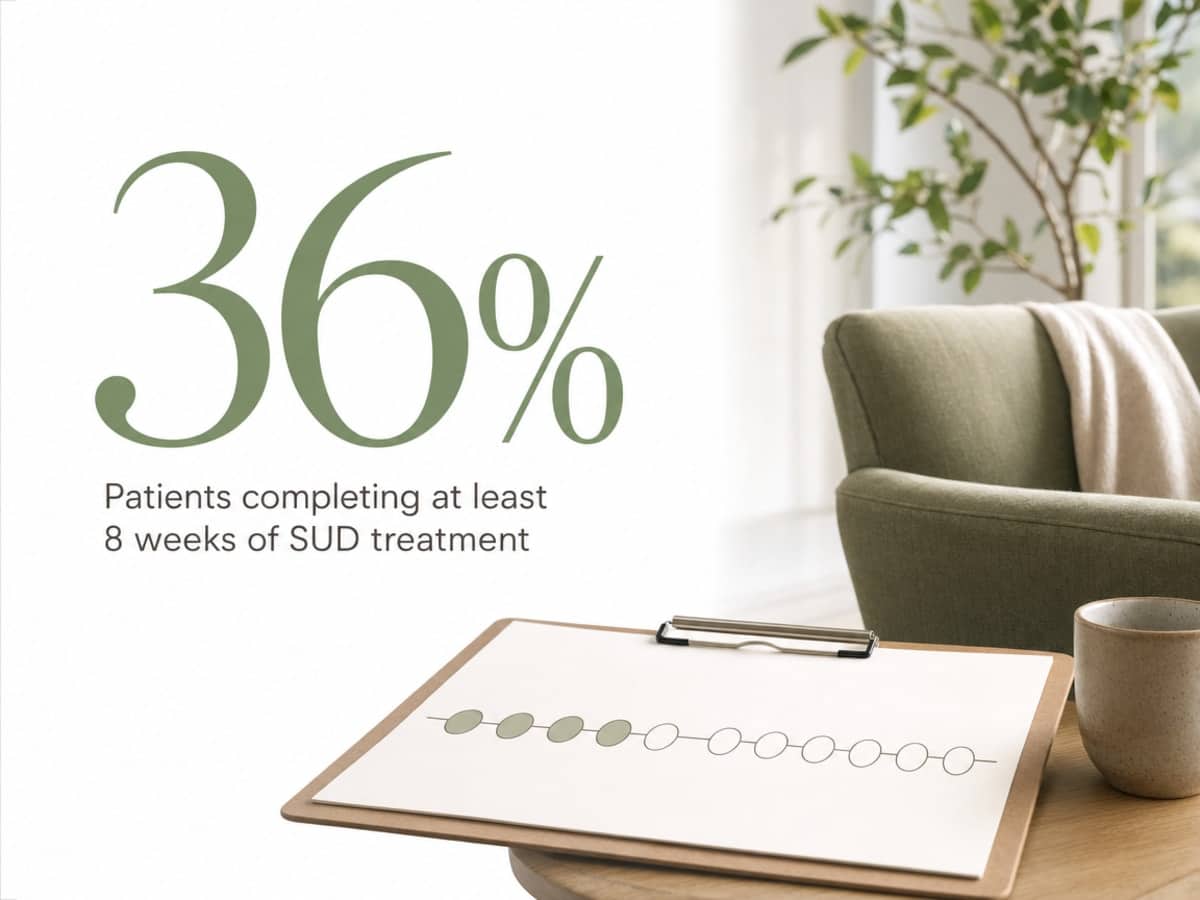
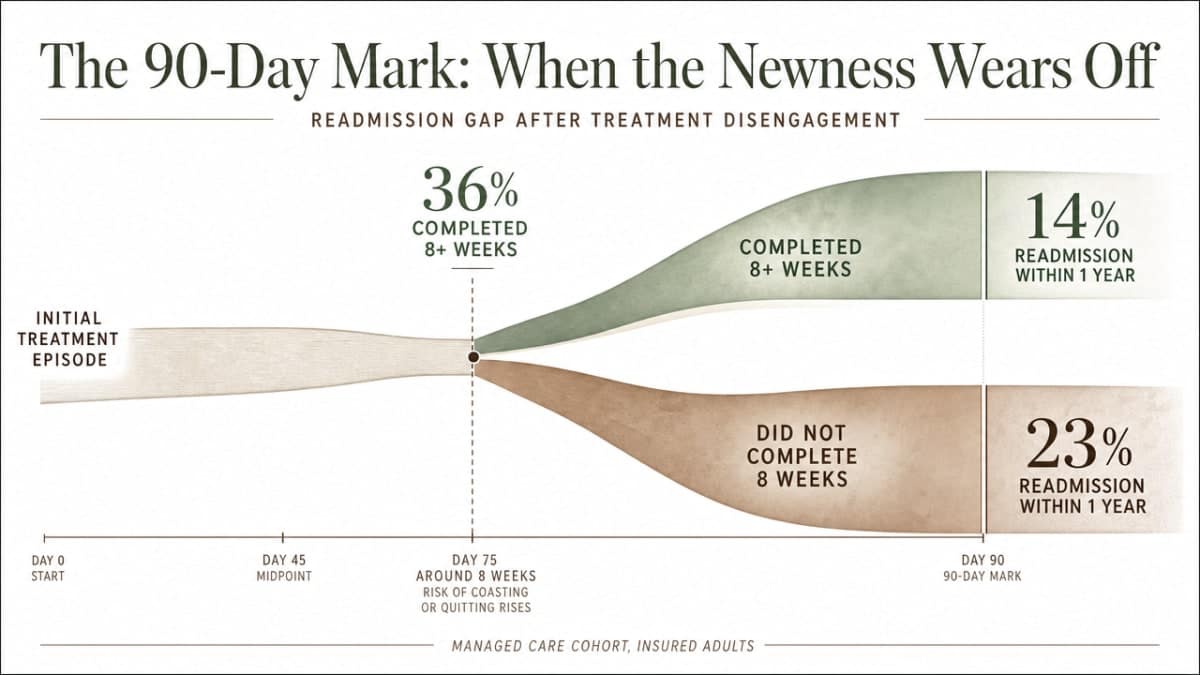
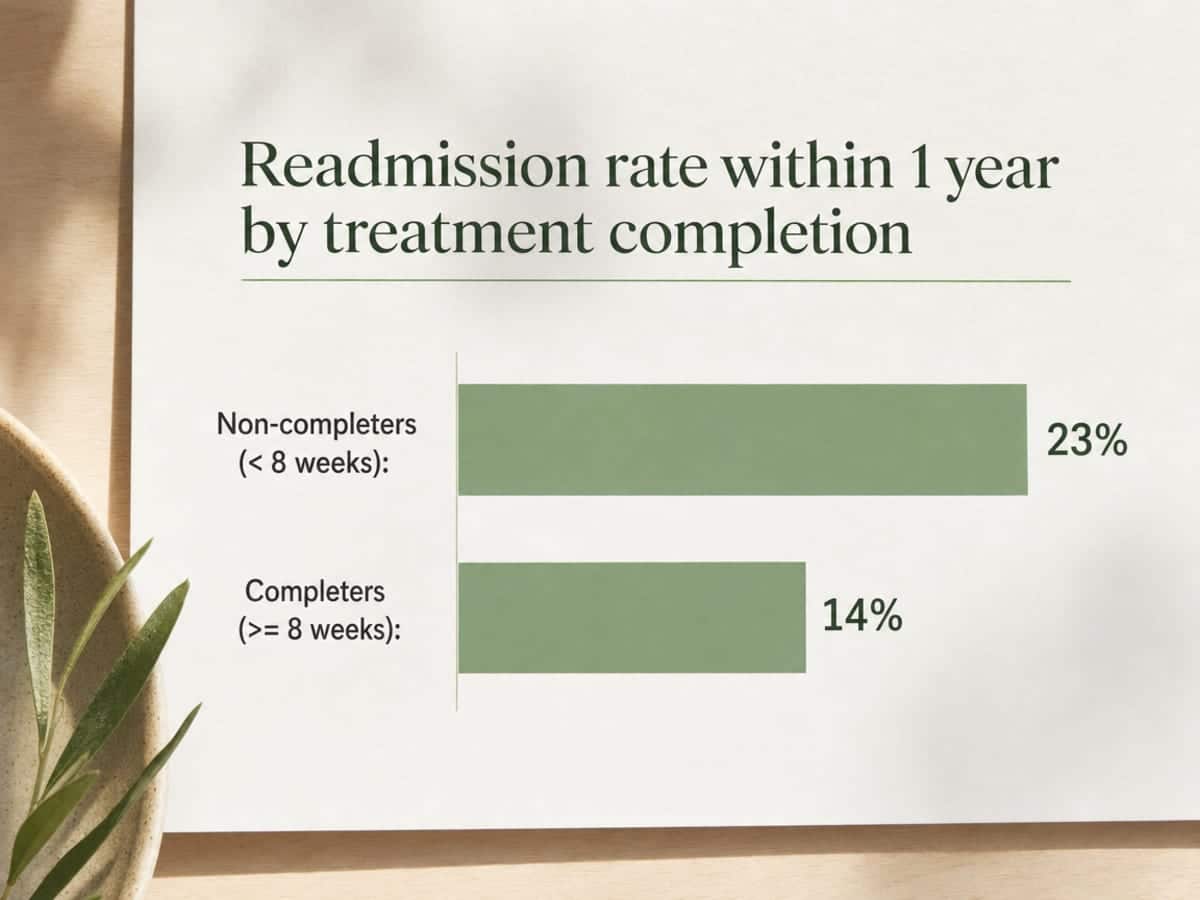
- The 90-day mark is the highest-risk moment to disengage; patients who completed eight or more weeks had a 14% readmission rate versus 23% for those who fell short 1.
- Choose a sober house by certification, peer governance, and stay length, since residents who remained six months or longer showed stronger abstinence, employment, and self-efficacy outcomes 8.
- Sustained, lower-intensity continuing care lasting 12 months or more, with integrated mental health treatment and active mutual-help involvement, drives the gains 2, 13.
The Quiet Chapter Where Recovery Actually Sticks
The last morning at residential care feels enormous. You pack a duffel bag, sign discharge papers, hug people who watched you fall apart and come back together, and then someone drives you home. By dinner, the world is louder than you remembered. That feeling, somewhere between relief and free-fall, is normal. It is also the moment most people misunderstand what comes next.
Residential treatment is the loud chapter. It interrupts the crisis, stabilizes your body, and gives you a vocabulary for what happened. But the chapter where recovery actually consolidates into a life is the quieter one that starts now: intensive outpatient sessions a few days a week, a bed in a sober house with people on the same page, a sponsor’s number in your phone, and a calendar that slowly fills with meetings, work, and ordinary Tuesday nights.
That quieter chapter is not a graduation. It is the work. Continuing care research is consistent on this point: longer durations of structured support, often 12 months or more, outperform shorter, more intense episodes 2. Substance use disorder responds to ongoing management much like other chronic conditions, which is why repeated touchpoints and gradual step-downs matter more than any single program length 5.
What follows is a map of the first year. Not a promise, not a checklist. A realistic picture of what to expect, what to ask for, and what good looks like when the applause from residential has faded.
How IOP and Sober Living Actually Fit Together
What IOP Looks Like on a Tuesday
Picture a Tuesday three weeks after discharge. Your alarm goes off at 6:45. You shower, eat something, and drive to a clinical building that looks more like a counselor’s office than a hospital. From 9 a.m. to noon, you sit in group with seven or eight other people working through the same week you are. There is a check-in. There is a topic, maybe coping with cravings at work, maybe a family role-play. There is a clinician guiding it. You leave by lunch.
That is one shape of intensive outpatient. Other people in your group will do an evening track instead, 5:30 to 8:30, so they can keep a daytime job. Most IOPs run nine to twelve clinical hours a week, usually three sessions, sometimes spread across three or four days. You will likely have an individual therapy hour mixed in, plus a med-management appointment if you take psychiatric or addiction medications.
What surprises most people stepping down from residential is how ordinary the rest of the day feels. You go to work. You pick up groceries. You eat dinner with housemates. The review evidence supports this shape: when matched correctly to the patient, IOP produces outcomes comparable to inpatient care, with the difference being that you build the new habits inside your actual life rather than inside a facility 14.
What Sober Living Looks Like at 6:30 a.m.
The kitchen light is already on when you come down. Someone is making coffee. Someone else is signing out on a whiteboard near the door because they have an early shift. The house manager, usually a peer further along in recovery, is at the table with a clipboard. You initial next to your name for the morning check-in. You take a breathalyzer if it is that kind of house, and most are.
A recovery residence in Ohio is defined in state law as an alcohol- and drug-free living environment with peer support 9. In practice, that translates into a set of small daily rituals:
- chores assigned on a rotation
- a curfew on weeknights
- mandatory house meetings once a week
- random drug screens
- rules about overnight guests
You pay rent, usually weekly. You buy your own food. You are not in treatment when you are in the house. You are just living, with structure.
The first few mornings feel strange because nothing is being done to you. No one is taking your vitals. No one is reminding you to journal. The structure is real, but it is the structure of a household, not a unit. Most people find that within ten days the rhythm settles, and the house starts to feel less like a rule and more like a floor under their feet.
Why Pairing the Two Beats Doing Either Alone
IOP gives you the clinical hour. Sober living gives you the other 165 hours in the week. Either one alone leaves a gap the early months will find.
If you do IOP from a chaotic home, the work you did in group on Tuesday morning gets undone by Tuesday night. If you live in a sober house without any clinical care, you get peer accountability but no one is helping you work through the trauma, the cravings, or the medications that brought you to residential in the first place. The randomized trial of Oxford House sober living found higher rates of continuous abstinence and lower incarceration over two years when people had structured peer-run housing alongside the rest of their recovery plan 7.
The two pieces compensate for each other. The clinical hour treats what is in your head. The house regulates what is around your body. Stack them, and the early months get a wider margin for the days you wobble.
Your First Two Weeks Out of Residential
The first night back is the one nobody warns you about. The bed feels different. The room is too quiet, or too loud. You might sleep nine hours and still feel tired, or stare at the ceiling at 3 a.m. running through every face from the unit. This is not a sign that residential didn’t work. It is just your nervous system catching up to the fact that no one is checking on you every two hours.
Days one through three are mostly logistics. You confirm your IOP intake time. You move what little you brought into your room at the sober house. You sign a resident agreement, hand over emergency contacts, and learn where the breathalyzer lives. If you take medications, you sort them into a weekly pillbox. Small acts. They matter more than they feel.
By the end of week one, you will have sat through your first outpatient group as a person who sleeps somewhere else now. Expect it to feel strange. The room will be smaller than residential and the conversation more grounded in laundry, bosses, and phone calls with parents than in detox war stories. That shift is the point.
Week two is when the small wobbles show up. A craving on the drive home. A text from someone you used to use with. A housemate you find irritating. None of this means you are failing. Engagement research suggests that the people who stay in continuing care the longest tend to come in with stronger recovery resources and a positive read on their treatment environment 3. Translation: keep showing up, keep telling the truth in group, and let yourself like the people around you. That is the work of the first fourteen days.
The 90-Day Mark: When the Newness Wears Off
Something shifts around day 75. The structure that felt like a lifeline in week two starts to feel like a schedule. You have heard your own story in group enough times that you can predict which sentence comes next. The sober house chores are no longer novel. The drive to IOP is muscle memory. You are not in crisis, which is exactly when the temptation to coast or quit shows up.
The 90-day mark is when your IOP team should be talking with you about a step-down, not a step-off. That might look like dropping from three groups a week to two, or moving from morning IOP to a weekly outpatient session plus a check-in with your therapist. The shape changes. The connection does not. Continuing care works best when intensity tapers gradually rather than ending in a clean break 4.
If you feel the urge to declare yourself done, say it out loud in group instead of acting on it. That sentence, spoken in a room full of people who have felt the same thing, is often the difference between week 12 and week 52.
Six Months In: Tapering Without Falling Off
Six months out, you barely recognize the person who packed that duffel bag. You have a job, or you have school, or you have a routine that resembles one. The cravings are quieter, not gone. You have a sponsor whose voicemail you know. You have housemates whose coffee mugs you can identify in the sink. This is the part nobody photographs, and it is also the part where the real consolidation happens.
By month six, most people are no longer in full IOP. You may be down to a weekly therapy session, a monthly med check, and two or three mutual-help meetings a week. The continuing-care research is direct about this shape: the best outcomes come from sustained, lower-intensity support that runs at least 12 months, not from front-loaded programs that end at week 12 2. The taper is not the reward for being done. It is the design.
Sober living follows a similar arc. Women in Oxford House recovery housing who stayed six months or longer had significantly better substance use, employment, and self-efficacy outcomes than those who left earlier 8. That finding maps to something most residents feel by month six: the house has stopped being a placeholder and started being a place. Leaving it on a schedule someone else set, just because insurance or savings tightened, is a decision worth slowing down.
If you are tempted to step off entirely, name what you would lose. The Tuesday group. The 6:30 a.m. kitchen. The phone number you actually call. Then talk to your clinician about a slower taper, not a hard stop. Falling off at month six is rarely about one bad day. It is about removing too many supports at once.
Mental Health Care Doesn’t Pause When You Leave Residential
Keeping Your Psychiatrist, Medications, and Therapist in the Loop
The pillbox is not optional. If residential put you on a mood stabilizer, an SSRI, buprenorphine or naltrexone for cravings, or a sleep medication to get you through the first weeks, those prescriptions need a doctor on the outside who knows the whole story. Before discharge, you should leave with a med list, a few weeks of refills, and a named psychiatrist or nurse practitioner already scheduled.
If that handoff did not happen, fix it in week one. Call the outpatient program’s intake line and ask who manages medications. Ask your IOP therapist to release records to your new prescriber. Bring the discharge summary to the first appointment, even if you have to print it yourself.
Therapy continuity matters in the same way. The clinician you trusted in residential is probably not the one you see now, and that switch is a real loss. Tell the new therapist what worked last time and what did not. Patients with stronger recovery resources and a positive read on their treatment environment stay engaged in continuing care longer 3, and a therapist who actually fits you is part of that resource. If the first match is wrong, ask for a different one. That is not quitting. That is doing the work correctly.
When IOP and Sober Living Treat Dual Diagnosis as One Problem
If you have a diagnosis underneath the addiction, depression, PTSD, anxiety, bipolar disorder, the two cannot be treated on separate floors of your life. Studies of co-occurring disorders consistently show that integrated care, where the same team addresses substance use and mental health together, produces better clinical outcomes and lower substance use than treating each in isolation 13. That word, integrated, matters. It means your therapist knows about your medication changes. Your prescriber knows about the trauma work in group. Your sober house manager knows you take something for sleep and does not raise an eyebrow when you head to bed at 9.
Ask plainly at intake: does this IOP treat dual diagnosis, or does it refer the mental health side somewhere else? If the answer is referral, ask how the two teams talk to each other and how often. Silence between providers is where relapse hides.
The sober house plays a quieter role here. A good house does not pretend to be clinical, but it knows the difference between a bad week and a psychiatric emergency, and it knows whose number to call.
Mutual-Help Meetings: Why Showing Up Isn’t the Whole Story
By month two, someone in your IOP group will ask if you have a home group yet. A home group is the AA, NA, or alternative meeting you commit to weekly, the one where people learn your name and notice when you are not there. It is a small commitment with an outsized return, and it is the easiest entry point into the part of recovery that outlasts any program.
The case for showing up is straightforward. In a long-term follow-up summarized in a review of mutual-help groups, 72.7% of patients who attended any 12-step meetings reported past-6-month abstinence from illicit drugs at the two-year mark, a rate well above non-attenders 12. That is a striking gap, and it is worth being honest about what it means: people who keep going to meetings two years out are also people who have built other supports around themselves. Meetings correlate with abstinence. They do not single-handedly cause it.
What the research does pin down is which parts of meeting life actually move the needle. Patients who got specifically involved, having a sponsor, doing service work, working steps with someone, did better than patients who just attended 11. Sitting in the back row counting minutes is not the same intervention as raising your hand, calling someone between meetings, and helping set up chairs.
So when your IOP counselor pushes you to get a sponsor in the first 60 days, that is not a formality. The phone number you actually use on a hard Thursday night is the one that changes the trajectory. If 12-step is not the right fit for you, SMART Recovery, Refuge Recovery, and secular alternatives produce similar peer-accountability effects when you engage at the same depth. The format matters less than whether you participate like a member, not a visitor.
How to Tell a Good Sober Living Home From a Bad One
Not every house with a sign out front is the same. The label “sober living” is loose in most states, and the gap between a well-run residence and a rented house collecting weekly cash can be wide. You are the one who has to spot the difference, often during a single tour, often while you are still tired.
Start with certification. In Ohio, recovery housing residences are defined in state law as alcohol- and drug-free living environments providing peer support, and certified homes are tracked by the state behavioral health department 9. Ask whether the home is certified through the state recovery housing registry. A real answer comes with a name and a level. A vague answer is itself an answer.
Then ask about governance. Peer-run models like the ones studied in the Oxford House trial showed higher continuous abstinence and lower incarceration over two years than usual aftercare, in part because residents share responsibility for the house rather than rent rooms from an absent owner 7. You want to hear that house decisions, new resident votes, and rule enforcement involve the residents, not just a manager who shows up on Sundays.
Ask about length of stay. Women in Oxford Houses who stayed six months or longer had significantly better substance use, employment, and self-efficacy outcomes than shorter-stay residents 8. A house that quietly turns people over every 30 days is optimizing for beds, not recovery. A house that expects three to six months minimum, and supports residents staying longer, is built for the work.
Walk through it. The kitchen should be clean enough that people cook. There should be a posted chore chart, a posted meeting schedule, and a visible drug-test log. Ask what happens after a relapse: a thoughtful house has a clear, compassionate protocol, not an instant eviction and not a shrug. Ask how the house communicates with your IOP. Silence between the two is where the early months get lost.
What Families and Partners Should Expect, Too
If you are the partner, parent, sibling, or friend reading this alongside someone in early recovery, the first month back will test you, too. You will want to ask how group went. You will want to count the meetings. You will notice the phone going quiet at 9 p.m. and wonder. None of that vigilance is wrong. Most of it just needs somewhere to go that is not the kitchen table at 7 a.m.
Expect the work to be slower than it looks from the outside. Continuing care research shows that sustained, lower-intensity support over many months drives the gains, not dramatic week-to-week change 4. A good week in month two might look like three groups attended, one hard conversation with a sponsor, and a Saturday spent doing laundry. That is the shape of progress.
Ask the IOP whether family sessions are part of the program and when. Go when invited. Save the bigger questions for that room, not the car ride home. And take care of your own footing: a support group for families, your own therapist, a friend who listens without giving advice. Your steadiness is part of the environment your person is recovering inside.
Speak With Someone About Your Next Recovery Step
Get answers and support for a smooth IOP or sober living transition.
Discuss Your Next Steps for Sustained Recovery
Get personalized guidance for transitioning from residential care to IOP and sober living with confidence.
Frequently Asked Questions
How long should I stay in IOP after residential treatment?
Plan for months, not weeks. Most people start with 9 to 12 clinical hours a week and taper over time. Continuing care research consistently finds that planned durations of 12 months or more outperform shorter episodes 2. The shape that works is intensive at first, lighter as you stabilize, with the connection kept open the whole way.
Do I have to live in sober living while I’m in IOP?
You do not have to, but the two reinforce each other. IOP covers the clinical hours. Sober living covers the other 165 hours a week. A randomized trial of Oxford House recovery housing found higher continuous abstinence and lower incarceration over two years compared with usual aftercare 7. If your home environment is unstable or full of triggers, sober living gives the early months a floor.
Can I keep my psychiatrist and medications while in IOP and sober living?
Yes, and you should. Mood stabilizers, antidepressants, sleep medications, and addiction medications like buprenorphine or naltrexone continue across levels of care. Ask your IOP at intake whether they manage medications in-house or coordinate with an outside prescriber. A reputable sober house allows prescribed medications and stores controlled ones safely. Integrated care for co-occurring disorders consistently produces better outcomes than splitting the work across disconnected teams 13.
What makes a sober living home worth choosing?
Certification, peer governance, and length-of-stay expectations. In Ohio, recovery housing is defined in state law as a drug- and alcohol-free environment with peer support, and certified homes are tracked by the state 9. Ask about house meetings, drug testing, and the relapse protocol. Women in Oxford Houses who stayed six months or longer had significantly better substance use, employment, and self-efficacy outcomes than shorter-stay residents 8.
Do I have to go to 12-step meetings to stay sober?
No, but you do need a peer support network of some kind. AA and NA are the most common because they are everywhere and free. SMART Recovery, Refuge Recovery, and other secular options produce similar effects when you engage at the same depth. What the evidence pins down is involvement, not attendance alone: having a sponsor and doing service work track with better outcomes than sitting quietly in the back 11.
What happens if I relapse during IOP or sober living?
A relapse is information, not a verdict. A thoughtful sober house has a protocol: safety first, an honest conversation, often a brief return to higher-intensity care, then a structured path back. Your IOP team can step you up to partial hospitalization or residential if needed. Substance use disorder is a chronic condition that often takes multiple treatment episodes 5. Tell someone the same day. That call is the work.
References
- Continuing Care and Long-Term Substance Use Outcomes in Managed Care. https://pmc.ncbi.nlm.nih.gov/articles/PMC3242696/
- How effective is continuing care for substance use disorders?. https://pmc.ncbi.nlm.nih.gov/articles/PMC3840113/
- Predictors of engagement in continuing care following residential addiction treatment for adults. https://pubmed.ncbi.nlm.nih.gov/16417977/
- Impact of Continuing Care on Recovery From Substance Use Disorder. https://pmc.ncbi.nlm.nih.gov/articles/PMC7813220/
- Treatment. https://nida.nih.gov/research-topics/treatment
- Rule 5160-27-09 | Substance use disorder treatment services. https://codes.ohio.gov/ohio-administrative-code/rule-5160-27-09
- Oxford House Recovery Homes: Characteristics and Effectiveness. https://pmc.ncbi.nlm.nih.gov/articles/PMC2888149/
- Oxford Recovery Housing: Length of stay correlated with improved outcomes for women previously involved with the criminal justice system. https://pmc.ncbi.nlm.nih.gov/articles/PMC4826029/
- Recovery Housing Residences. https://dbh.ohio.gov/supporting-providers/housing-providers/recovery-housing-residences
- Associations of housing stress with later substance use outcomes. https://pmc.ncbi.nlm.nih.gov/articles/PMC12926885/
- Involvement in 12-step activities and treatment outcomes. https://pmc.ncbi.nlm.nih.gov/articles/PMC3558929/
- The Role of Mutual-Help Groups in Extending the Framework of Treatment. https://pmc.ncbi.nlm.nih.gov/articles/PMC3860535/
- Integrated vs non-integrated treatment outcomes in dual diagnosis populations. https://pmc.ncbi.nlm.nih.gov/articles/PMC10157410/
- Substance Abuse Intensive Outpatient Programs: Assessing the Evidence. https://pmc.ncbi.nlm.nih.gov/articles/PMC4152944/
- The Continuing Care Model of Substance Use Treatment: What Works, and When Is ‘Enough,’ Enough?. https://pmc.ncbi.nlm.nih.gov/articles/PMC4007701/