
Is NyQuil Addictive? Addiction vs. Dependence
Key Takeaways
- NyQuil isn’t addictive like opioids, but it contains four active ingredients with distinct risks: DXM can cause real addiction at high doses 7, while doxylamine drives nightly sleep dependence 11.
- Dependence is a biological adjustment where the body needs a dose to feel normal, while addiction involves compulsive use despite harm and loss of control — the two can overlap but require different responses 12, 13.
- Nightly use often masks untreated anxiety, depression, or trauma, and the acetaminophen inside carries a hard liver ceiling that’s easy to cross with daily dosing and any regular drinking 1, 14.
- Stopping looks different for each ingredient — doxylamine causes rebound insomnia, high-dose DXM triggers documented withdrawal, and a tapered plan with medical and mental health support beats white-knuckling cold turkey 3, 11.
The Honest Answer to a Question You’re Probably Asking at 2 a.m.
If you’re searching this at 2 a.m. with the cap still in your hand, here’s the straight answer: NyQuil isn’t “addictive” the way heroin or Xanax are addictive. But that’s not really the question you’re asking, is it.
The real question is whether what you’ve been doing — a swig every night to fall asleep, a little more when your chest feels tight, a second dose when the first one stops working — is becoming a problem. And the honest answer to that one is: it can, and the bottle is hiding more than you think.
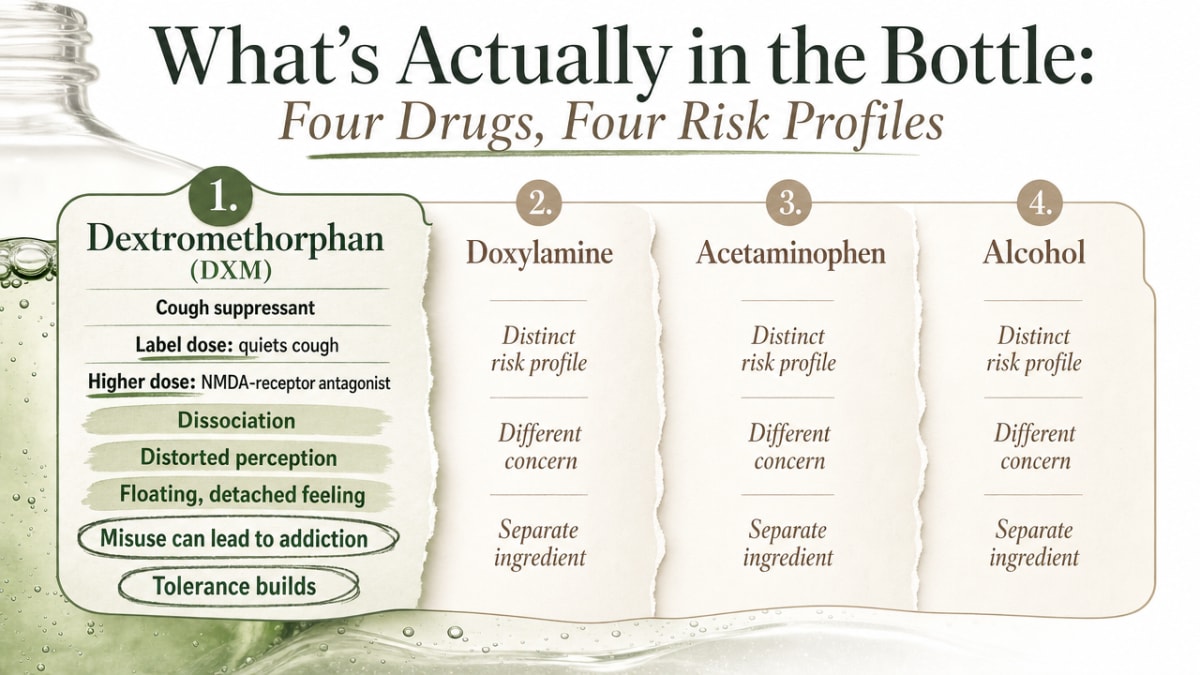
NyQuil is four drugs in one. Dextromethorphan (DXM) can cause real addiction at high doses, and federal health agencies say so plainly 7. Doxylamine, the antihistamine that knocks you out, can leave you unable to sleep without it 11. The acetaminophen inside has a hard ceiling your liver doesn’t forgive 1. Some formulations include alcohol on top of that 14.
So if you’re worried, you’re not being dramatic. You’re paying attention. Keep reading — the next part untangles dependence from addiction, because the difference changes what you do next.
Dependence vs. Addiction: Why the Distinction Changes Everything
Here’s the part most articles fumble, and it’s the part that matters most to you tonight.
- Physical dependence
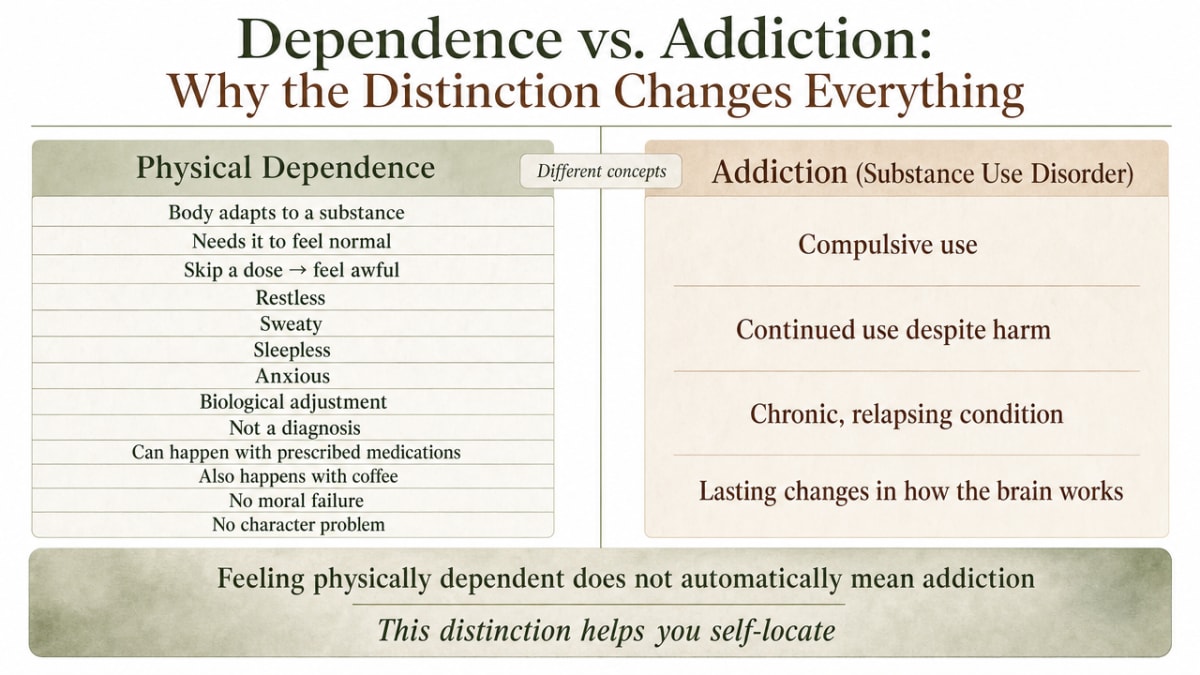
- Means your body has gotten used to a substance and needs it to feel normal. Skip a dose and you feel awful — restless, sweaty, sleepless, anxious. Your body is asking for something it has come to expect. That’s it. No moral failure, no broken brain, no character problem. People become physically dependent on coffee, on blood pressure medication, on antidepressants taken exactly as prescribed. Dependence is a biological adjustment, not a diagnosis 13.
- Addiction
- Is a different animal. The clinical name is substance use disorder, and the gold-standard definition from NIDA and SAMHSA describes it as a chronic, relapsing condition marked by compulsive use, continued use despite real harm, and lasting changes in how the brain handles reward and stress 12. Addiction is about the loss of choice. You want to stop, you’ve tried to stop, and something keeps pulling you back even when the cost is mounting — sleep, work, relationships, your health.
The two can overlap, but they don’t have to. Here’s what that looks like with the bottle in your hand:
If you’ve been taking NyQuil at the labeled dose every night for months to fall asleep, and you genuinely can’t sleep without it anymore, you may be physically dependent on the doxylamine. That’s real, and it deserves attention — but it isn’t addiction.
If you’ve been pushing past the label dose because the regular amount stopped working, hiding bottles, drinking it during the day to take the edge off, telling yourself you’ll quit Monday and Monday keeps moving — that’s drifting into substance use disorder territory, even if no withdrawal symptoms have shown up yet 2.
And you can have both. Someone using high-dose dextromethorphan for the dissociative effect can develop a documented withdrawal syndrome and meet criteria for a use disorder at the same time 3.
Why does this distinction change everything? Because the path forward is different for each one. Physical dependence on a sleep aid often resolves with a tapered plan and treatment of whatever is actually keeping you awake — anxiety, trauma, untreated depression. A substance use disorder calls for a different level of care, often integrated with mental health treatment, because the thing driving the use is rarely just the drug.
You don’t have to know which one you’re in right now. You just have to know they’re not the same — and that asking the question is already a step most people never take.
What’s Actually in the Bottle: Four Drugs, Four Risk Profiles
Dextromethorphan (DXM): The Ingredient That Can Cause Real Addiction
DXM is the cough suppressant in NyQuil, and it’s the ingredient that does the heaviest lifting when people talk about NyQuil “addiction.” At the dose on the label, it quiets a cough. At higher doses, it does something else entirely — it acts as an NMDA-receptor antagonist, the same class as ketamine and PCP, producing dissociation, distorted perception, and a floating, detached feeling that some users chase on purpose 4.
The federal government is unambiguous on this point. NIDA’s plain-language guidance states that misuse of DXM can lead to addiction, full stop, despite its OTC status 7. That isn’t a hedge or a maybe. It’s the official position.
What does that look like in practice? Tolerance builds. The amount that used to put you under stops working, so you take more. Cravings show up. There’s a published case of a patient on chronic high-dose DXM who, when he stopped, went through a documented withdrawal syndrome — cravings, autonomic symptoms, functional impairment — the same shape of withdrawal you’d expect from a substance the world already labels “addictive” 3.
If you’ve been using NyQuil at label doses for a cold, none of this is your story. The DXM addiction risk lives in the pattern of taking far more than the bottle says, repeatedly, for the effect — not the cough.
Doxylamine: The Reason You Can’t Sleep Without It Anymore
Doxylamine is the sedating antihistamine in the green bottle. It’s why fifteen minutes after a dose your eyelids feel like they have weights on them. It’s also the ingredient most quietly responsible for the pattern that brought you here.
Doxylamine is not classically classified as addictive. There’s no euphoria, no high, no chasing the feeling. What it does have is something the research describes plainly: most people who use it persistently to sleep report a rebound of insomnia when they stop or cut back 11. Your body adapts. The receptors it acts on adjust. Take it away, and sleep doesn’t just return to baseline — it gets worse than baseline for a stretch, sometimes for weeks.
That’s the trap. You took NyQuil for three nights during a bad week. Night four without it, you couldn’t sleep. So you reached for the bottle again, and now it’s been eight months. You don’t feel “high.” You feel like you can’t function without it.
This is dependence on a sleep aid, not addiction in the DSM-5 sense — and the fix isn’t willpower. It’s treating whatever is actually keeping you awake, and tapering the doxylamine with a plan instead of cold turkey.
Acetaminophen and Alcohol: The Quiet Liver Problem
Here’s the risk almost nobody factors in until something goes wrong.
The problem is how easy it is to cross without realizing. You take NyQuil for sleep. You take a Tylenol for a headache the next morning. You have wine with dinner. Now stack that pattern across weeks of nightly use, and the math gets ugly fast.
The risk isn’t theoretical. There are published cases of unintentional liver injury directly attributed to NyQuil ingestion — a liquid cold remedy containing acetaminophen combined with 25% alcohol in the formulations studied 14. Two patients, real hospitalizations, no overdose intent.
This is the part of the conversation that gets skipped because it isn’t “addiction.” But for someone using NyQuil nightly, the liver risk can land long before any addiction diagnosis would. Your pattern matters here even if your dose looks fine on paper.
Why You Reach for the Green Bottle Every Night
Let’s slow down on the part nobody wants to say out loud.
You probably didn’t start with a plan to take NyQuil every night. It started with a cold, or a stressful week, or one of those nights where your brain wouldn’t stop running and the bottle was already in the cabinet. It worked. You slept. So you reached for it again.
For a lot of people, the green bottle is doing a job that something else should be doing. If you live with anxiety that gets louder when the lights go off, NyQuil quiets it. If you carry trauma that visits at night, NyQuil dulls the edge. If depression has flattened your sleep into something thin and broken, NyQuil drops you into something that at least looks like rest. The drowsiness from doxylamine isn’t selective — it doesn’t just put your cough to sleep, it puts the whole anxious, racing, replaying version of you to sleep too 1.
That’s not weakness. That’s a person trying to solve a real problem with the tool that’s legal, cheap, and twelve feet from the bed.
The trouble is what the bottle isn’t doing. It isn’t treating the anxiety. It isn’t processing the trauma. It isn’t lifting the depression. Researchers have looked at whether dextromethorphan, the cough suppressant inside NyQuil, helps depression when added to standard treatment, and the honest answer is that the evidence is mixed and underwhelming — one chart review found no meaningful difference in how quickly depressive symptoms improved 6. The bottle isn’t medicine for what’s actually wrong. It’s a pause button.
That matters because every night you press pause is a night the underlying thing goes untreated. The anxiety gets louder when you skip a dose, so you don’t skip. The depression gets harder to name because you’re sleeping, technically, so what’s the problem. The pattern protects the thing underneath from ever being looked at directly.
If you’ve recognized yourself anywhere in the last three paragraphs, that recognition is the work. You’re not in trouble for using a coping tool. You’re just ready, maybe for the first time, to ask what you’ve actually been coping with.
The Sleep Trap: How Nightly NyQuil Becomes Rebound Insomnia
This is the pattern most people don’t see coming, so it deserves its own spotlight.
It starts innocently. A cold knocks you flat for three nights, and the green bottle does exactly what the label promises — you sleep. The cold clears, but the next night you’re wired at midnight, staring at the ceiling. One more dose, you tell yourself. Just to reset. Then it’s a week. Then a month. Then you realize you haven’t fallen asleep without it since something you can’t quite remember.
Here’s what’s happening underneath. Doxylamine, the sedating antihistamine in NyQuil, isn’t just sedating you in the moment — it’s training your sleep system to expect it. When you stop, your sleep doesn’t quietly return to where it was before. It rebounds in the wrong direction. Research on persistent doxylamine users found that most of them reported a rebound of insomnia when they tried to stop or cut back 11. So night one without the bottle is worse than any night you had before you started. Night two can be worse than night one. Your nervous system feels like it’s been unplugged from something it didn’t know it needed.
That rebound is the trap. You interpret the bad night as proof you “need” NyQuil, when really you’re watching withdrawal masquerade as your original insomnia. So you reach for the bottle. Sleep returns. The story you tell yourself — I just can’t sleep without it — calcifies a little more.
If you’ve been on this loop for months, you’re not addicted in the textbook sense. You’re caught in a physical dependence on a sleep aid that was never designed for nightly long-term use, often with anxiety or depression sitting underneath it, unaddressed. The way out isn’t white-knuckling a cold-turkey night. It’s a tapered plan, usually paired with treatment for whatever was actually keeping you awake in the first place — because the rebound is real, and going through it alone is why most people give up and reach for the bottle again by night three.
A Self-Check You Can Actually Use Tonight
You don’t need a clinician to start being honest with yourself. You just need a few minutes and a willingness to read the questions slowly.
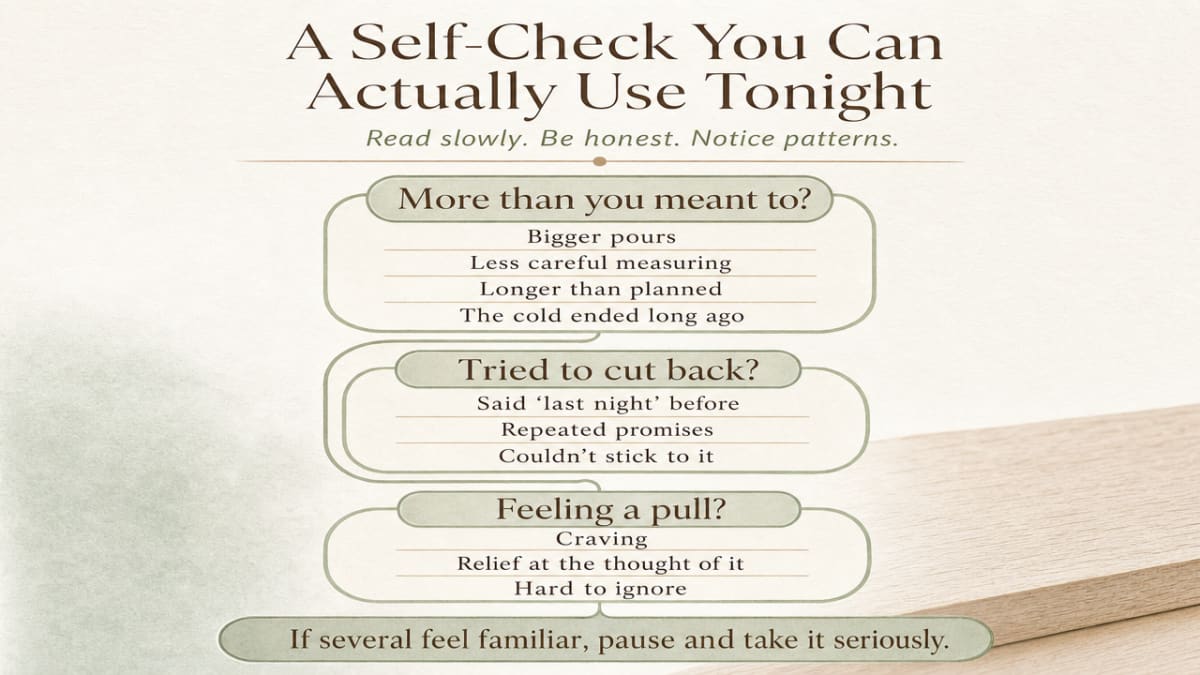
The DSM-5 criteria for substance use disorder aren’t a personality test. They’re a list of behaviors and physiological signals that, taken together, describe when use has stopped being a choice and started being a problem 2. Translated into the bottle on your nightstand, they sound like this:
- Are you taking more NyQuil than you meant to, or for longer than you planned? The cold ended six months ago. The pour got bigger somewhere along the way. You measure less carefully than you used to.
- Have you tried to cut back and couldn’t? Maybe you told yourself last Sunday was the last night. Maybe you’ve said that a dozen Sundays in a row 2.
- Is there a pull toward it — a craving, a small relief when you remember the bottle is there? Not necessarily a dramatic urge. Just the quiet sense that the evening doesn’t feel right until you’ve had your dose.
- Are you spending real time thinking about it, getting it, recovering from it? Driving to a different store because the closer one was out. Feeling foggy until mid-morning and pushing through it.
- Is something in your life slipping? Work, parenting, a relationship, your own basic sense of being present. The mornings feel heavier than they should.
- Are you still using it even though you know it’s hurting you? The headache after, the dry mouth, the suspicion that your liver isn’t loving this, the way you feel mentally underwater for an extra hour each day.
- Are you hiding it? From your partner, your doctor, yourself. Tucking the bottle behind something. Not mentioning it on the intake form.
If one of these landed, that’s worth noticing. If three or four did, that’s information your future self will want you to have acted on. The DSM uses a count like this to rate severity — mild, moderate, severe — but you don’t have to diagnose yourself tonight 2. You just have to notice what’s true.
And notice this too: every honest answer you just gave yourself is the opposite of denial. That’s not nothing. That’s the part of you that wants out of the loop already doing its job.
When High-Dose DXM Becomes a Psychiatric Emergency
There’s a line in the DXM conversation that needs to be named plainly, because crossing it changes the conversation from “problem to work on” to “get help now.”
If you or someone you love is in that zone, please don’t try to ride it out at home. Severe DXM use disorder with psychotic features has required hospitalization, antipsychotic medication, and mood stabilizers to bring people back 4. Combined with other depressants — alcohol, sleep meds, opioids — high-dose DXM can also cause hypoxic brain injury, which is exactly as serious as it sounds 5.
For anyone already managing depression, PTSD, bipolar disorder, or a psychotic-spectrum condition, the stakes are higher again. The dissociation isn’t just unpleasant. It can crack open suicidal thinking, worsen mood symptoms, and blur the line between a psychiatric crisis and a drug effect until even clinicians need labs to tell them apart.
If this paragraph describes the situation you’re in tonight, the right next step isn’t another article. Call 911 or go to an emergency department. Withdrawal from chronic high-dose DXM is real 3, and it should be done with medical supervision, not alone in a bedroom.
What Stopping Looks Like — and Why It’s Not the Same for Each Ingredient
Here’s where a lot of well-meaning advice goes sideways: people treat “quitting NyQuil” like one decision, when it’s actually three or four different decisions stacked on top of each other. The plan depends on which ingredient your body has gotten used to, and how hard you’ve been leaning on it.
If the pattern has been nightly use at label doses for sleep, the main thing your body is missing when you stop is the doxylamine. Expect a rough patch. Most persistent doxylamine users describe a rebound of insomnia when they stop or cut back — sometimes worse than the sleep problem that started the whole thing 11. That stretch can last days to a few weeks. A slow taper, not a clean break, is usually kinder to your nervous system, and pairing it with treatment for whatever was driving the wakefulness — anxiety, trauma, depression — keeps the rebound from sending you straight back to the cabinet.
If the pattern has been high-dose DXM use for the effect, the picture is different. Real withdrawal has been documented — cravings, autonomic symptoms, functional impairment — in patients who had been using chronically and stopped 3. This is not a willpower problem. Coming off high-dose DXM, especially if there’s a psychiatric history underneath, belongs in a supervised setting where someone can watch for mood crashes, suicidal thinking, or the dissociation flipping into something worse 4.
And the acetaminophen piece doesn’t have a withdrawal at all — it just has a quiet bill your liver has been keeping. Stopping is the easy part. Getting checked is the part to actually do, especially if nightly use has been going on for months alongside any drinking 14.
What to take from this: don’t try to white-knuckle a single Tuesday night and call it a plan. Match the plan to the pattern, and get a second set of eyes on it.
How to Get Real Help (Including for the Thing Underneath)
Here’s the part that matters most: noticing your pattern is the hard part. Asking for help is the smaller step, even though it doesn’t feel that way tonight.
If the bottle has become a nightly fixture, start with a real conversation with a primary care doctor or a therapist. Bring the actual numbers — how much, how often, how long. No editing. They’ve heard worse and they’re not going to call the cops. What they can do is check your liver, taper you off the doxylamine without the rebound week sending you back to the cabinet 11, and screen for the anxiety, depression, or trauma that’s been quietly running the show.
If you’re not sure where to start, SAMHSA runs a free, confidential helpline at 1-800-662-HELP (4357), 24 hours a day, every day of the year, and they can point you toward treatment in your area 15. You don’t need insurance figured out to call. You don’t need a diagnosis. You just need a phone.
For anyone whose use lines up with depression, PTSD, anxiety, or a mood disorder, integrated dual-diagnosis care is the version of treatment that actually works — one team treating the substance use and the mental health condition together, instead of bouncing you between two systems that don’t talk to each other. That’s the shape of care programs like Arrow Passage Recovery are built around, and it’s the right ask whether the green bottle has been your problem for six months or six years.
You already did the hardest thing by reading this far. The next call is smaller than it feels.
Talk to a Specialist About NyQuil Concerns
Get clear guidance on NyQuil addiction and next steps in real time.
Talk with someone about NyQuil dependence today
Get guidance on addressing NyQuil use and mental health concerns in a confidential conversation.
Frequently Asked Questions
Is it bad to take NyQuil every night to sleep?
It’s not what the label is designed for, and over time it sets up two problems. First, the doxylamine inside trains your sleep system to need it, so stopping often triggers rebound insomnia 11. Second, you’re stacking nightly acetaminophen doses, which the liver doesn’t forgive when combined with regular drinking 1. If you’ve been at it for months, talk to a doctor about a taper.
What’s the difference between being dependent on NyQuil and being addicted to it?
Dependence means your body needs the dose to feel normal — skip it and you feel awful, but you’re not chasing it 13. Addiction, clinically called substance use disorder, is compulsive use that continues despite real harm, with loss of control over how much or how often 12. You can be dependent without being addicted. You can also be both. The path forward looks different for each.
Can you actually get addicted to an over-the-counter medicine like NyQuil?
Yes, when it comes to the dextromethorphan inside. NIDA states plainly that misuse of DXM can lead to addiction, despite its OTC status 7. At high doses people develop tolerance, cravings, and a documented withdrawal syndrome when they stop 3. The label-dose cough user isn’t the person at risk — it’s the pattern of taking far more than directed, repeatedly, for the dissociative effect rather than the cold.
What happens if I stop taking NyQuil after using it nightly for months?
Expect a rough patch with sleep. Most persistent doxylamine users report rebound insomnia worse than their original sleep problem when they stop or cut back 11. It can last days to a few weeks. If you’ve been using high-dose DXM, you may also see cravings and autonomic symptoms 3. A tapered plan with medical guidance is gentler than cold turkey, and it keeps you out of the cabinet by night three.
How much NyQuil is too much, and when does it become dangerous?
Two ceilings matter. The acetaminophen inside has a hard limit — severe liver damage may occur above 4,000 mg in 24 hours, or with regular drinking 1, and unintentional liver injury from NyQuil has been documented in real cases 14. For DXM, doses around 1,500 mg a day can produce PCP-like psychosis with hallucinations and paranoia 4. Either zone is an emergency, not a wait-and-see.
If I’m using NyQuil to cope with anxiety or depression, where do I start?
Start by naming it out loud to someone who can help — a primary care doctor, a therapist, or SAMHSA’s free, confidential helpline at 1-800-662-HELP, which runs 24/7 15. The bottle isn’t treating the anxiety or depression underneath, it’s just pausing it. Integrated dual-diagnosis care treats both at once, which is what actually breaks the loop. You don’t need answers before that first call — just the willingness to make it.
References
- Label: VICKS NYQUIL COLD AND FLU – acetaminophen, dextromethorphan HBr, doxylamine succinate. https://dailymed.nlm.nih.gov/dailymed/drugInfo.cfm?setid=fc9a6f7e-32c1-9ded-e053-6294a90a9dcc
- A. Substance Use Disorders Criteria. https://webcampus.med.drexel.edu/nida/module_2/content/5_0_AbuseOrDependence.htm
- Dextromethorphan Withdrawal and Dependence Syndrome. https://pmc.ncbi.nlm.nih.gov/articles/PMC2925345/
- Dextromethorphan in Cough Syrup: The Poor Man’s Psychosis. https://pmc.ncbi.nlm.nih.gov/articles/PMC5601090/
- Cough and Cold Medicine Abuse (PDF). https://studentaffairs.fresnostate.edu/health/alcoholandotherdrugs/documents/drugfacts_coughandcoldmed.pdf
- Evaluation of dextromethorphan with select antidepressant therapy for the treatment of depression. https://pmc.ncbi.nlm.nih.gov/articles/PMC6398352/
- Over-the-Counter Medicines DrugFacts. https://nida.nih.gov/publications/drugfacts/over-counter-medicines
- Dextromethorphan Abuse in Adolescence. https://pmc.ncbi.nlm.nih.gov/articles/PMC2257867/
- Trends in dextromethorphan cough and cold products: 2000–2015 National Poison Data System intentional abuse exposure calls. https://pubmed.ncbi.nlm.nih.gov/29260900/
- Monitoring trends in dextromethorphan abuse using the National Poison Data System: 2000–2010. https://pubmed.ncbi.nlm.nih.gov/21740139/
- Misuse and Dependence on Non-Prescription Codeine Analgesics or Sedative H1 Antihistamines: A Cross-Sectional Investigation. https://pmc.ncbi.nlm.nih.gov/articles/PMC3789666/
- Substance Use Disorder defined by NIDA and SAMHSA. https://wyoleg.gov/InterimCommittee/2020/10-20201105Handoutfor6JtMHSACraig11.4.20.pdf
- Opioids: Understanding Addiction Versus Dependence. https://www.hss.edu/health-library/conditions-and-treatments/understanding-addiction-versus-dependence
- Nyquil-associated liver injury. https://pubmed.ncbi.nlm.nih.gov/2929565/
- National Helpline for Mental Health, Drug, Alcohol Issues – SAMHSA. https://www.samhsa.gov/find-help/helplines/national-helpline