
Ketamine Addiction and Your Mental Health
Key Takeaways
- Ketamine dependence is real but looks different from alcohol or opioid addiction, showing up as tolerance, cravings, solo use, and continued use despite bladder pain or worsening mood 1, 13.
- Supervised Spravato carries a much smaller dependence risk than non-medical use because of REMS monitoring and post-dose observation, though between-session cravings still deserve direct conversation with your prescriber 2, 10.
- Bladder pain, memory gaps, and worsening depression or anxiety are early signals worth taking seriously, and ketamine cystitis tends to improve with abstinence but worsen without it 4, 5.
- Quitting ketamine without treating the underlying depression, PTSD, or anxiety leaves the original pain in place, which is why dual-diagnosis care under one coordinated clinical team tends to work better 14, 15.
When the Same Drug Helps and Hurts
If you are reading this because something feels off, that instinct is worth trusting. Maybe you started Spravato for a depression that would not lift, and now you are quietly counting the hours until your next session. Maybe the bumps at parties became weeknight bumps alone, and your bladder has started telling you things you do not want to hear. Maybe you are a partner or parent who has watched someone you love drift further into a fog you cannot reach.
Ketamine is genuinely strange in this way. The same molecule shows real promise for treatment-resistant depression, PTSD, and even some substance use disorders, while heavy use is linked to memory problems, depression, anxiety, psychosis, and bladder injury 1. It can help and it can harm, sometimes inside the same person. That is not a contradiction you imagined. It is the actual clinical picture.
This article will not pick a side in the “is ketamine good or bad” debate, because that question is not useful to you. What you need is a clearer map: what dependence with ketamine actually looks like, how it tangles with the mood or trauma condition you may already be carrying, what warning signs are worth taking seriously, and why treating only one half of the problem tends to leave the other half waiting.
Is Ketamine Actually Addictive?
What Dependence Looks Like With Ketamine
The short answer is yes, ketamine can be addictive, but the picture looks different than what you might expect from alcohol or opioids. There is no neat withdrawal syndrome to point to, no detox timeline you can circle on a calendar. What clinicians watch for instead is a cluster of behaviors and body changes that, taken together, point to a problem.
Heavy ketamine use is linked to tolerance, craving, and continued use despite real harm, alongside memory problems, depression, anxiety, psychosis, and bladder injury 1. That last word, “despite,” is the one that matters most. If you have noticed that the dose you used to take barely registers now, that you think about your next bump in the middle of work, or that you keep using even though your bladder hurts or your mood is sliding, those are the signs the literature is describing.
The lived picture, drawn from a primary care review, includes cravings and physical discomfort when people try to quit, and at high doses the profound detachment from reality called the k-hole 13. Some people chase that detachment on purpose. Others arrive at it by accident after the dose that used to feel manageable stops being enough.
If any of this is starting to sound familiar, you are not failing some character test. You are noticing something real about a drug that does, in fact, have addictive potential, even if its withdrawal looks fuzzier than the textbook examples 13. Noticing is the first useful thing.
The Supervised-Treatment Question: Can Spravato Patients Become Dependent?
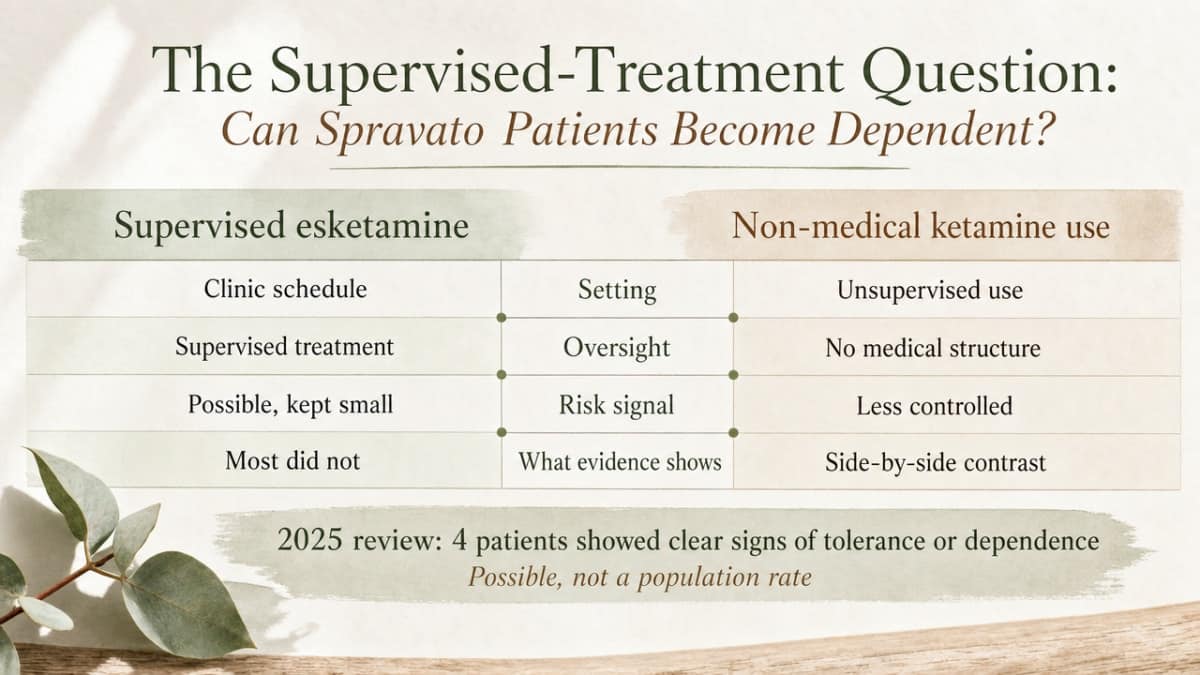
If you are receiving esketamine for treatment-resistant depression, you have probably wondered this in the parking lot after a session. It is a fair question, and the honest answer is that the risk exists but the setting is built to keep it small.
A 2025 review looking specifically at whether therapeutic ketamine for depression triggers tolerance or dependence found that, across the included studies, four patients showed clear signs of tolerance or dependence while most did not 2. Four patients is a narrow signal in a heterogeneous body of research, not a population rate. It tells you the phenomenon is possible, not that it is likely for any given person on a clinic schedule.
The structural differences between supervised esketamine and non-medical ketamine are worth seeing side by side. Spravato is a Schedule III drug dispensed only through certified healthcare settings under a REMS program, with patients monitored on site for at least two hours after each dose because of sedation, dissociation, and respiratory depression risks 10. The VA’s national protocol layers in REMS enrollment, restricted access, and structured tracking of abuse and misuse signals 11. Non-medical ketamine has none of that: no certified setting, no clinician watching the dose, no observation period, no record of how often you used last month.
That distinction is the point. If you are on Spravato, the question to bring to your prescriber is not whether to stop, but how dependence is being monitored across your treatment course.
How Ketamine Use Tangles With Depression, PTSD, and Anxiety
Why People With Mood and Trauma Histories End Up Here
There is a reason ketamine finds people who are already carrying something heavy. If you live with depression, the world can feel like it is happening behind glass. If you live with PTSD, your body keeps score in ways that do not switch off when the day ends. Anxiety hums underneath both. Ketamine, especially at higher doses, offers a temporary off-switch for all of it. The detachment that worries clinicians is, for some users, exactly the point.
That overlap is not just anecdotal. A 2025 study found that ketamine use was more common among people in substance use treatment than those not in treatment, and that association persisted across several SUD categories 14. The authors are careful, and so should you be: this is association, not causation. It does not mean ketamine caused the other problems, or that everyone in treatment is using ketamine. It does suggest that ketamine exposure tends to cluster with other substance use and the kinds of complicated histories that bring people into care.
If you have used ketamine to quiet a panic spiral, to dull a trauma memory that will not stay buried, or to feel anything at all on a flat depressive day, you are not unusual. You are doing what humans do when a substance happens to match the shape of a wound. Recognizing that pattern is not a confession. It is information you can finally do something with.
The Paradox: A Treatment for Conditions It Can Also Worsen
Here is the part that makes ketamine genuinely confusing. A 2024 meta-analysis found supportive evidence for ketamine in PTSD, OCD, and alcohol use disorders, though the number of randomized controlled trials remains small 6. Other 2025 reviews report preliminary efficacy signals for ketamine in alcohol, cocaine, opioid, and cannabis use disorders, with the consistent caveat of small samples and limited randomized data 7, 8. Some evidence even suggests ketamine infusion paired with psychotherapy may help promote abstinence in alcohol and cocaine use 15. The same drug you may be worried about is being studied as a treatment for the conditions you may be self-medicating.
And yet. Heavy ketamine use is linked to depression, anxiety, and psychosis 1. Common adverse effects, even in clinical settings, include dissociation, anxiety, and confusion 12. A drug that lifts depression in a monitored two-hour session can deepen it when used alone at 2 a.m. The dose, the setting, the frequency, and the person all matter.
Warning Signs You Can Actually Notice
Behavioral and Psychological Patterns
The warning signs that actually matter are not the dramatic ones. They are quiet, easy to explain away, and they tend to show up in your calendar before they show up in your body.
Watch for the dose that used to feel like enough. Tolerance is one of the clearest behavioral markers, and it often gets reframed as a tolerance “to” the experience rather than a problem with it 1. Watch for the rearranging. If you have moved appointments, skipped meals, or cut a conversation short because you wanted to use sooner, that is craving doing what craving does 13. Watch for the using alone. Use that used to be social, occasional, or tied to a specific setting and is now solo and routine is a pattern worth naming out loud.
Watch for the mood drift in the wrong direction. Dissociation, anxiety, and confusion are common even in clinical settings 12, and heavy non-medical use is linked to worsening depression, anxiety, and in some cases psychosis 1. If the thing you started using to feel less depressed has been making you feel more depressed, that is information.
And watch for the memory gaps. Lost hours, lost conversations, lost where-did-I-put-this moments stacking up week over week deserve attention. Noticing any of this does not mean you have failed. It means you are paying enough attention to do something about it.
Bladder Pain and Other Physical Signals
If your bladder hurts, your body is telling you something the rest of the literature has been slow to say plainly. Ketamine-induced uropathy is one of the most distinctive harms of chronic use, and it can show up well before anyone would describe their use as out of control 1.
The early signals are easy to dismiss. You are going to the bathroom more often than your friends. You wake up at night to pee when you never used to. There is a burning sensation that comes and goes. The urgency feels disproportionate to how much liquid you actually drank. Over time, some people develop blood in the urine, persistent pelvic pain, and a bladder that has physically shrunk in capacity. National guidelines for ketamine cystitis describe available therapies as limited and non-specific, with abstinence remaining central to recovery 4. There is no pill that fixes this while you keep using.
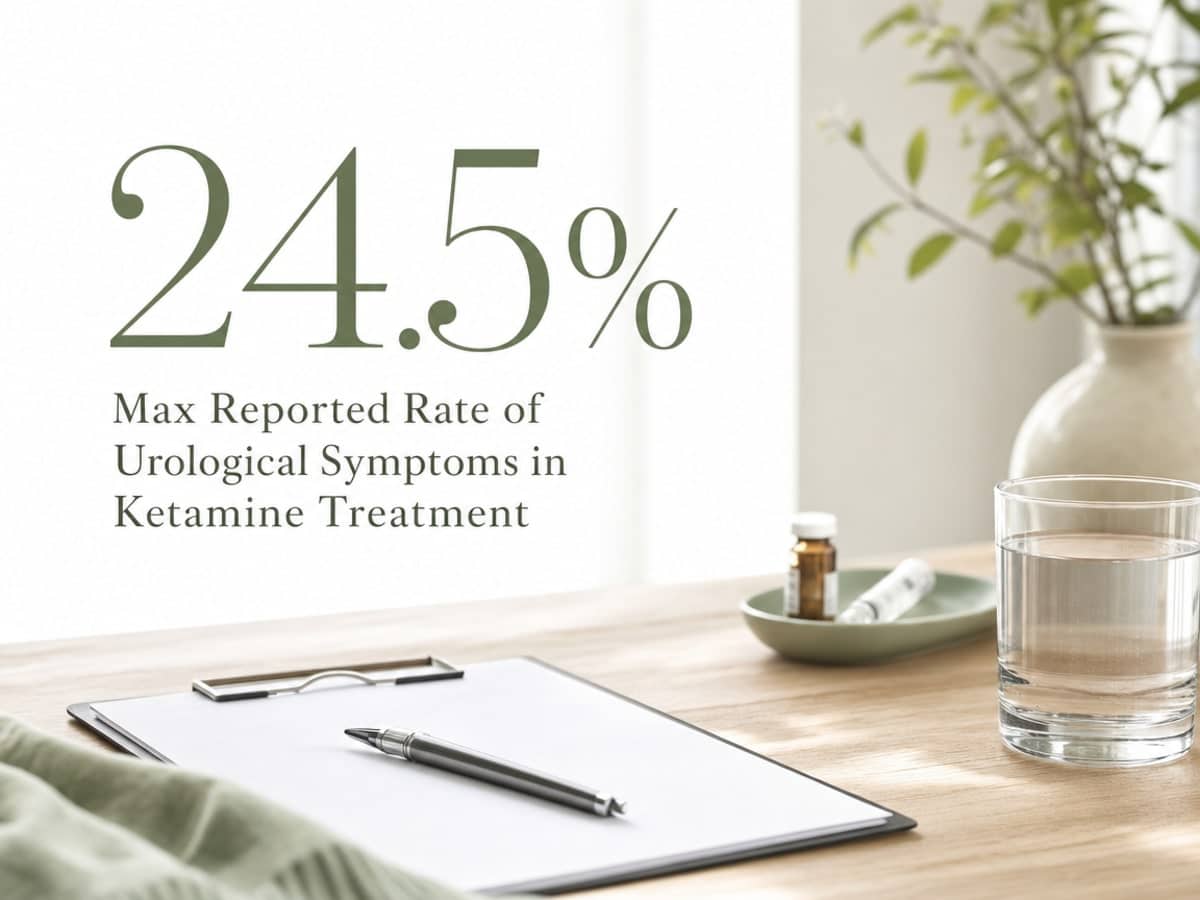
Even under medical supervision, urinary symptoms are not zero. A 2025 systematic review of patients receiving ketamine for psychiatric conditions found urological symptoms reported in 0% to 24.5% of patients across studies, usually mild to moderate, with only 15% of those studies rated as low risk of bias 5. The honest reading of that range is wide uncertainty, not a clean rate you can plan around.
Other physical signals worth noticing: elevated blood pressure, nausea, and lingering confusion after use are common adverse effects 12. If you are using outside a monitored setting and any of these are stacking up, that is the body asking for a different plan. Bladder symptoms in particular tend to improve with stopping, and they tend to get worse without it 4.
The Rising Numbers and What They Do (and Don’t) Mean
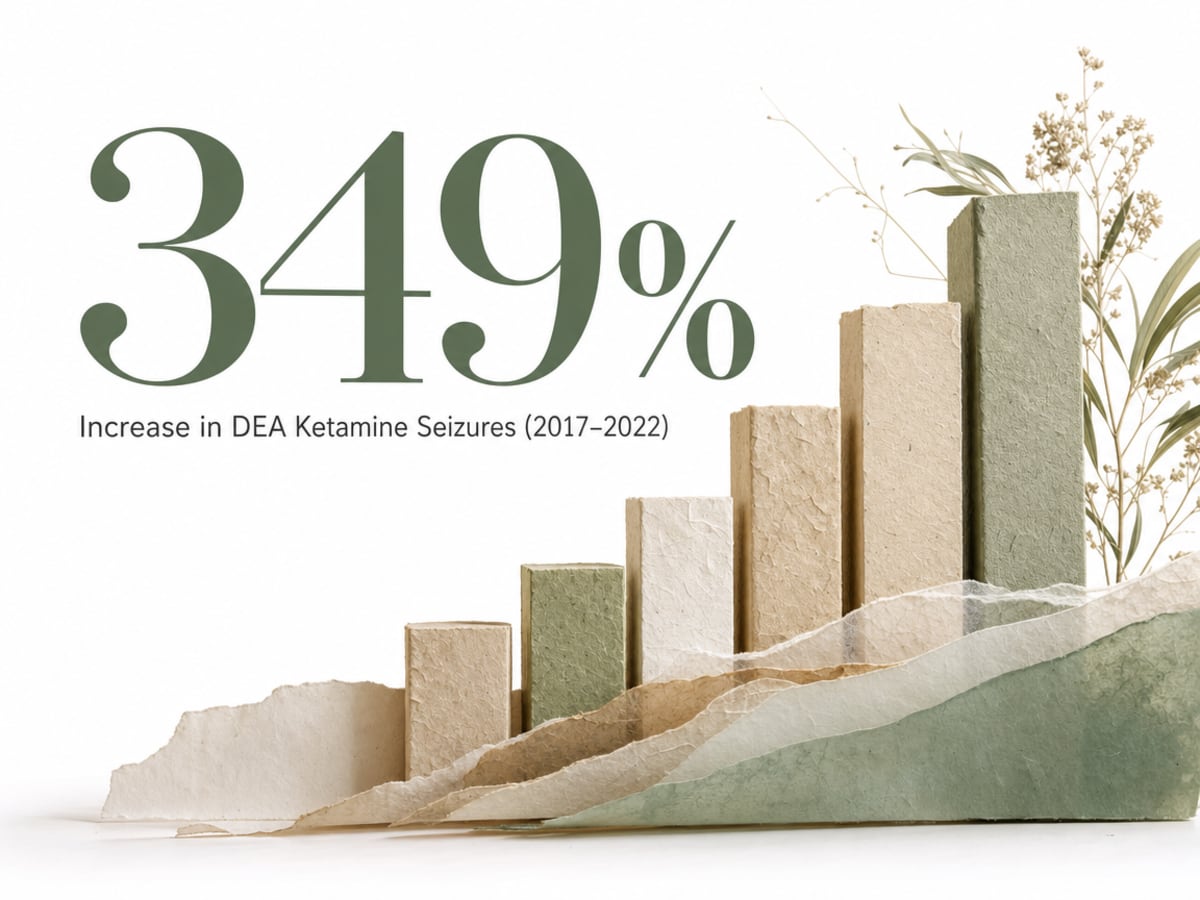
You have probably seen the headlines. Ketamine is having a moment in the news, and not the flattering kind. Between 2017 and 2022, DEA ketamine seizures rose by 349% 9. That is a real number, and it is worth taking seriously. It is also worth reading carefully, because what it measures matters as much as how big it is.
Seizures are a supply-side enforcement indicator. They count what the DEA intercepted, not how many people are using. A jump that steep tells you that more non-prescribed ketamine is moving through unregulated channels, that enforcement is paying closer attention, or both. It does not tell you that the user population grew by 349%, and anyone presenting it that way is stretching the data past what it can hold.
What the trend does suggest is that ketamine has moved out of the corners it used to occupy. The 2026 analysis describing the seizure increase frames non-prescribed ketamine use as an emerging public-health issue rather than a fringe concern 9. More supply tends to mean more exposure, and more exposure tends to mean more people landing in the territory the rest of this article describes: tolerance creeping up, bladder pain that will not quit, mood symptoms that are harder to separate from the substance itself.
For you, the practical read is simpler than the headlines. You are not imagining that ketamine is more available, more visible, and more tangled up with mental health questions than it was a few years ago. If your own use has shifted in that same window, that is part of a larger pattern, not a personal failure. The numbers do not diagnose you. They just confirm that you are not the only one asking these questions right now.
What Withdrawal and Quitting Actually Look Like
Here is where you deserve honesty more than a tidy protocol. Ketamine withdrawal is not opioid withdrawal, and it is not alcohol withdrawal. There is no fever curve, no shaking timeline, no medication regimen with strong evidence behind it. The 2024 systematic review on pharmacological management of ketamine use disorder pulled together twelve studies and 368 participants, and the authors described the evidence as very low quality 3. That is the actual state of the science. Anyone selling you a clean detox map is filling in blanks the literature has not.
What people do report, in primary care settings, is cravings and physical discomfort when they try to quit 13. That can mean restlessness, sleep that will not come, a flat or anxious mood that feels heavier than usual, and a pull toward use that gets loud in the evenings. Some people describe a rebound of the depression or trauma symptoms ketamine was muting. That rebound is not proof you need ketamine. It is proof the underlying condition was still there the whole time, waiting.
The practical takeaway is not that quitting is impossible. It is that quitting alone, without support for the mood or trauma piece, tends to feel worse than it has to. A medically supervised setting can manage sleep, anxiety spikes, and the bladder symptoms that often improve once use stops 4. A therapist can help with the cravings that show up when the substance is no longer doing the emotional work. If you are thinking about stopping, that thought is already a step. The next one is asking for help shaped to both halves of what you are carrying.
Why Dual-Diagnosis Care Is the Honest Answer
Treating the Substance Use and the Psychiatric Condition Together
If you have read this far, you already know the trap. Stopping ketamine without treating the depression, PTSD, or anxiety underneath leaves the original pain where it has always been. Treating the psychiatric condition without addressing the substance use leaves the escape hatch open, and that hatch tends to get used on the hard days. Dual-diagnosis care exists because pulling these two threads at the same time is the only way most people actually get free of either.
The research keeps pointing in this direction even when it does not mean to. The 2025 association study found ketamine use clustered with other substance use in treatment populations, which means people walking into treatment for one thing often have ketamine in the mix too 14. The 2024 pharmacological review made clear that there is no strong medication protocol for ketamine use disorder on its own 3. And even the studies looking at ketamine as a possible therapy for alcohol or cocaine use disorders found their best signals when ketamine infusion was paired with psychotherapy, not given as a standalone fix 15. The pattern is consistent: medication without therapy underperforms, and therapy without addressing the substance underperforms.
What integrated care looks like in practice is less mysterious than the label suggests. The same clinical team coordinates psychiatric medication, trauma-focused therapy like EMDR or CBT, and substance use support. Your prescriber knows about your ketamine history. Your therapist knows what your medications are doing. Nobody is asking you to repeat the same intake story to four different people who never compare notes. That coordination matters because relapse and symptom flares often share triggers, and a team that sees both can respond to both.
What to Ask Your Prescriber or a Treatment Program
Walking into this conversation can feel impossible, especially if you have not been fully honest about your use yet. Bring questions instead of confessions. Questions give you somewhere to stand.
If you are on Spravato, ask your prescriber how dependence is being tracked across your treatment course, what would prompt a change in your dosing schedule, and how your depression scores are trending alongside your between-session cravings. The REMS framework already builds in monitoring during sessions 10, 11, but the between-session picture is where you need to advocate for yourself.
If you are looking at a treatment program, the questions get more specific. Does the program treat psychiatric conditions and substance use under one clinical team, or refer them out separately? What therapies are offered for trauma and mood symptoms, not just for substance use? How are bladder symptoms handled medically while you stabilize, given that abstinence is central to cystitis recovery and the available therapies are limited 4? What does aftercare look like at three months, six months, a year?
You do not need perfect answers from yourself before you make the call. Noticing was the first step. Asking is the next one. If you are in Ohio and want a program built specifically around treating substance use and co-occurring mental health conditions in the same place, Arrow Passage Recovery is one option worth a conversation.
Talk Through Ketamine Addiction and Mental Health
Connect with an expert who understands dual diagnosis complexities and can help you start the next step.
Take the Next Step Toward Balanced Recovery
Talk with a specialist about your mental health and ketamine use—every conversation moves you forward.
Frequently Asked Questions
Is ketamine actually addictive, or is that overblown?
It is addictive, though the picture looks different from alcohol or opioids. Regular heavy use is linked to tolerance, craving, and continued use despite real harm 1. The withdrawal syndrome is less clearly defined than for some other drugs, but people trying to quit often report cravings and physical discomfort 13. Not overblown, just shaped differently than the textbook examples.
I’m on Spravato for depression. Should I be worried about becoming dependent?
Worry is reasonable, panic is not. A 2025 review of therapeutic ketamine for depression found four patients across the included studies with clear signs of tolerance or dependence, while most did not 2. The REMS framework requires monitoring for at least two hours after each session 10. Talk to your prescriber about how between-session cravings and dosing changes are being tracked over time.
What does ketamine withdrawal feel like, and how long does it last?
The honest answer is that the evidence is thin. The 2024 review of pharmacological management called the evidence very low quality 3. What people describe is cravings, restlessness, poor sleep, low or anxious mood, and a rebound of the depression or trauma symptoms ketamine was muting 13. Timelines vary by person and use pattern, which is why supervised support helps.
Why does my bladder hurt, and will it get better if I stop?
That pain is likely ketamine-induced cystitis, one of the most distinctive harms of chronic use 1. National guidelines describe available therapies as limited and non-specific, with abstinence remaining central to recovery 4. Many people see improvement once they stop, especially with earlier symptoms. Continued use tends to make it worse. A urologist familiar with ketamine cystitis should be part of your care.
Can ketamine treatment make my depression, PTSD, or anxiety worse?
Sometimes, yes. A 2024 meta-analysis found supportive evidence for ketamine in PTSD, OCD, and alcohol use disorders, though randomized trials are still limited 6. At the same time, heavy use is linked to depression, anxiety, and psychosis 1, and dissociation, anxiety, and confusion are common adverse effects even in clinical settings 12. Dose, frequency, setting, and your underlying condition all change the answer.
How do I find a program that treats both my ketamine use and my mental health condition?
Ask whether psychiatric care and substance use treatment happen under one clinical team, not as separate referrals. Ask what trauma and mood therapies are offered, how bladder symptoms are managed medically, and what aftercare looks like past ninety days. Ketamine use often clusters with other substance use in treatment populations 14, so a program experienced with co-occurring conditions matters more than a ketamine-specific label.
References
- Ketamine | National Institute on Drug Abuse (NIDA) – NIH. https://nida.nih.gov/research-topics/ketamine
- Is there a risk of addiction to ketamine during the treatment of depression?. https://pubmed.ncbi.nlm.nih.gov/39688236/
- The Pharmacological Management of Ketamine Use Disorder. https://pubmed.ncbi.nlm.nih.gov/38922637/
- Management of ketamine cystitis: National guidelines. https://pubmed.ncbi.nlm.nih.gov/39368630/
- Urological symptoms following ketamine treatment for psychiatric disorders. https://pubmed.ncbi.nlm.nih.gov/40583492/
- Ketamine for the Treatment of Psychiatric Disorders. https://pubmed.ncbi.nlm.nih.gov/39564613/
- Safety and efficacy of ketamine for the treatment of patients with alcohol use disorder. https://pubmed.ncbi.nlm.nih.gov/40773768/
- Role of ketamine in the treatment of substance use disorders. https://pubmed.ncbi.nlm.nih.gov/40320049/
- The Emerging Crisis in Non-Prescribed Ketamine Use. https://pubmed.ncbi.nlm.nih.gov/41622770/
- SPRAVATO® (esketamine) nasal spray, CIII. https://www.accessdata.fda.gov/drugsatfda_docs/label/2025/211243s016lbl.pdf
- Intranasal Esketamine for Treatment Resistant Depression – VA.gov. https://www.va.gov/formularyadvisor/DOC_PDF/CRE_Intranasal_Esketamine_for_Depression_National_Protocol_Rev_Oct_2025_.pdf
- Ketamine Therapy for Psychiatric Disorders and Chronic Pain. https://www.oregon.gov/osbn/Documents/Resource_AANA_KetamineTherapyForPsychiatricDisorders_2024.pdf
- Ketamine misuse: an update for primary care. https://pmc.ncbi.nlm.nih.gov/articles/PMC9888585/
- Associations between substance use treatment and ketamine use. https://pmc.ncbi.nlm.nih.gov/articles/PMC12757446/
- Ketamine for Adults With Substance Use Disorders. https://www.ncbi.nlm.nih.gov/books/NBK602506/
- Systematic review of parenteral ketamine for managing acute agitation. https://pubmed.ncbi.nlm.nih.gov/39724793/