
Nyquil Addiction, Anxiety, and Insomnia: The Connection
Key Takeaways
- Nyquil’s nighttime formula combines acetaminophen, dextromethorphan, and doxylamine, a sedating antihistamine the FDA label says shouldn’t be used beyond two weeks without medical advice 14.
- Insomnia and anxiety share overlapping neural circuits and feed each other, so nightly doxylamine quiets symptoms temporarily while leaving the underlying dysregulated system untreated 4.
- Dependence signs include tolerance, hiding use, foggy mornings, daytime preoccupation, and rebound anxiety or insomnia when skipping doses, matching documented doxylamine withdrawal patterns 1.
- Integrated dual diagnosis care, CBT-I as first-line for chronic insomnia 12, and trauma-focused therapy alongside substance treatment 9address the full pattern instead of one piece.
The green bottle on the nightstand
If you’ve been reaching for the green bottle most nights, you’re not weak. You’re tired. Probably anxious. Maybe replaying a conversation from work at 11 p.m. or staring at a ceiling that’s gotten very familiar at 3 a.m. Somewhere along the way, what started as a cold remedy became the thing that finally turns your brain down.
Here’s what you already suspect: this isn’t really about a cough anymore. The cold cleared up months ago. The bottle stayed. And lately, when you think about going to bed without it, your chest gets a little tight.
That pattern has a name, and it’s more common than the label on the box would suggest. Nyquil’s nighttime formula combines acetaminophen, dextromethorphan, and doxylamine succinate, the same first-generation antihistamine sold as a standalone sleep aid with a clear warning not to use it for more than two weeks without a doctor’s advice 14. Nightly use, for months, with rising tolerance, isn’t what the product was built for.
You’re not here to be lectured about that. You’re here because you want to understand what’s actually happening, what the ingredients are doing, why stopping feels harder than it should, and what kind of help works when the problem underneath is anxiety, insomnia, or trauma you’ve been quietly carrying. That’s what this guide is for. No shaming, no minimizing. Just the science, the honest pattern, and a way forward that treats the whole picture, not just the bottle.
What’s actually in a nighttime dose
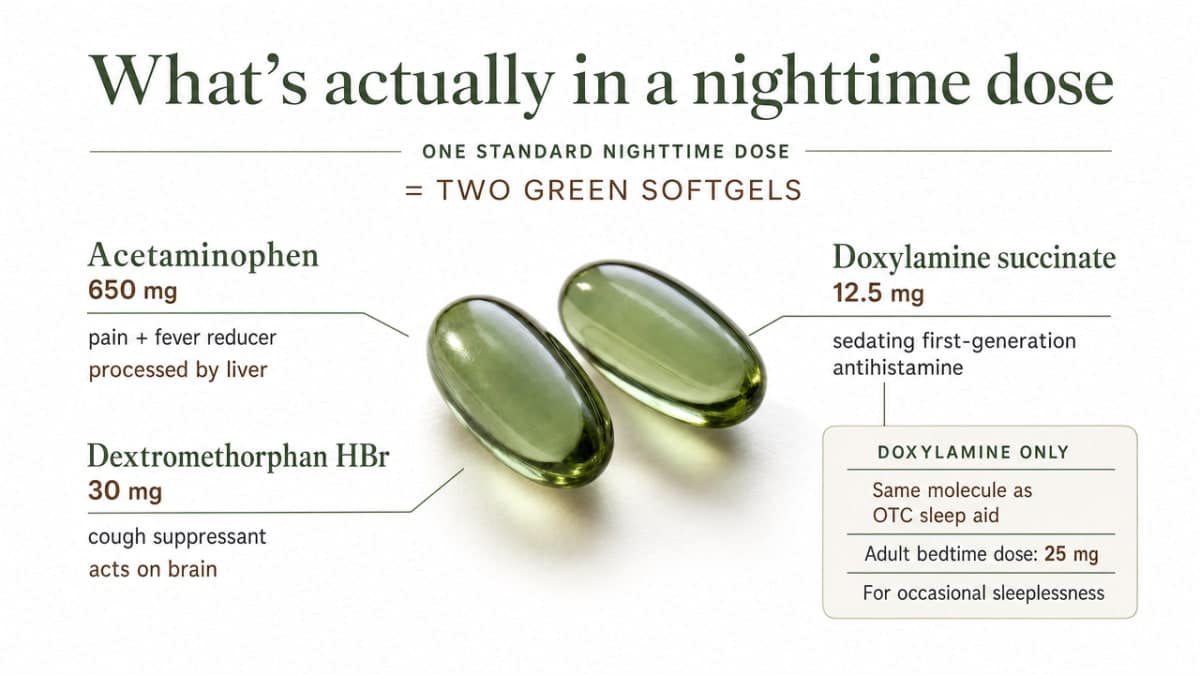
One green softgel of Nyquil Cold and Flu contains three active ingredients, and each one is doing something different to your body while you sleep. The FDA-registered label lists them per dose: acetaminophen 325 mg (pain and fever reducer, processed by your liver), dextromethorphan HBr 15 mg (cough suppressant that acts on the brain), and doxylamine succinate 6.25 mg (a sedating first-generation antihistamine) 13. A standard nighttime dose is two softgels, so you’re taking roughly 650 mg of acetaminophen, 30 mg of dextromethorphan, and 12.5 mg of doxylamine every time you reach for it.
That doxylamine number matters. It’s the same molecule sold on its own as an OTC sleep aid, where the recommended adult dose is 25 mg at bedtime, and the label explicitly tells you the product is for “occasional sleeplessness” and should not be used for more than two weeks without a doctor’s advice 14. Nyquil delivers about half that hypnotic dose, but if you’ve been taking it nightly for months, you’ve quietly passed the use window the FDA wrote on a separate box for the exact same drug.
Here’s what each ingredient is actually doing once it’s in you:
- Doxylamine is the reason you feel heavy and slow within thirty minutes. It blocks histamine receptors in your brain, which produces sedation, but it also blocks acetylcholine, which is why you wake up with cottonmouth, blurry vision, and a foggy head. Its half-life is long for a sleep aid, around ten hours, so a meaningful amount is still circulating during your morning meeting.
- Dextromethorphan doesn’t sedate you in the same way doxylamine does. At standard doses it suppresses cough through a brain pathway, but at higher doses it acts on NMDA receptors and produces dissociative effects 7. At one or two softgels you’re not in that territory. It still adds to the overall CNS depression layered on top of the antihistamine.
- Acetaminophen is the quiet one. It’s not doing anything to help you sleep. It’s there because the product is built for colds, and it’s metabolized by the same liver enzymes that handle alcohol and many other medications. The label warns plainly against combining Nyquil with other acetaminophen products or with alcohol, and against exceeding the recommended dose 13. That warning lives on the box because the risk is real, not theoretical.
So when you swallow your nightly dose, you’re taking a sedating antihistamine designed for short-term use, a cough suppressant you don’t need, and a painkiller that’s quietly stressing your liver. None of that is what the product was built for. It’s worth knowing what you’ve actually been doing every night.
Why you keep reaching for it: the self-medication loop
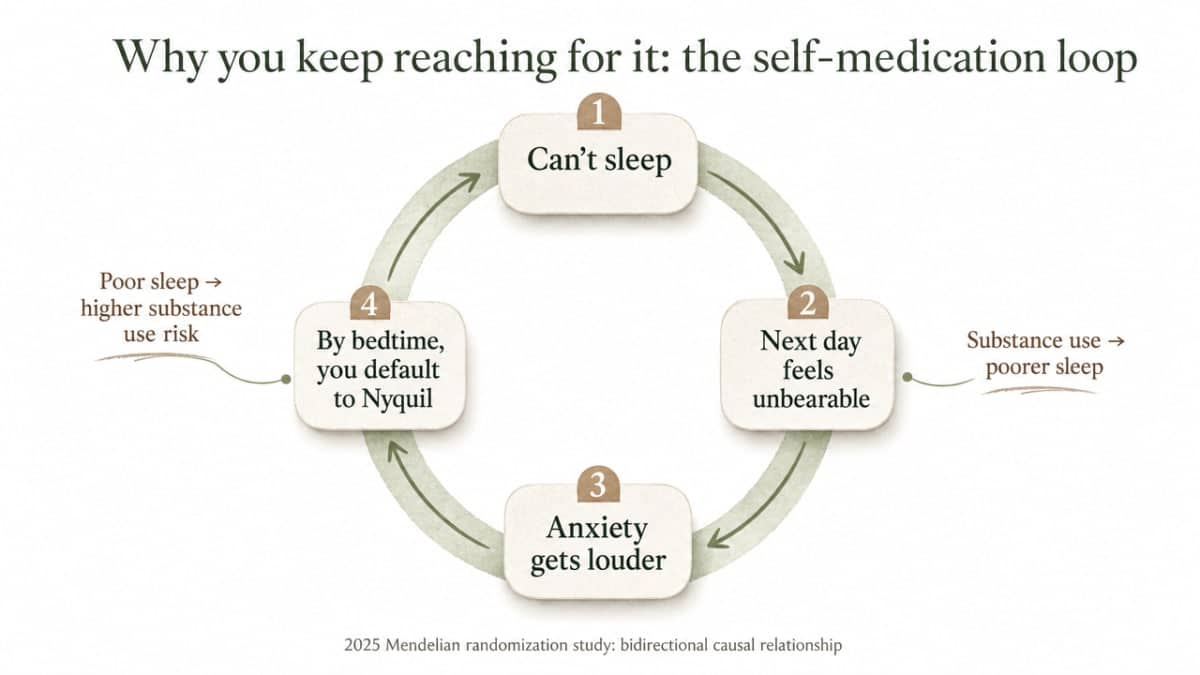
Here’s the part that gets missed in most warnings about OTC sleep aids: you didn’t start taking Nyquil every night because you wanted a drug. You started because you couldn’t sleep, and the nights you didn’t sleep, the next day felt unbearable. The anxiety was louder. The work email at 11 p.m. hit harder. By bedtime, you weren’t choosing the green bottle so much as defaulting to it.
That’s a loop, and it has a real mechanism behind it. A 2025 Mendelian randomization study, which uses genetic variants to infer cause rather than just correlation, found a bidirectional causal relationship between insomnia and substance use. Poor sleep raises the risk of substance use, and substance use raises the risk of poor sleep 3. It’s a genetic inference study, not a clinical trial, so it doesn’t prove what happens in any one person’s bedroom. But it lines up with what clinicians have seen for decades: the two feed each other.
Anxiety sits right in the middle of that loop. A 2024 systematic review of insomnia and anxiety disorders found that the two conditions share overlapping neural circuits and often travel together with depression and substance use 4. Insomnia is described as both a risk factor for anxiety and a symptom of it. Which means the 3 a.m. ceiling stare and the looping worry aren’t two separate problems. They’re the same dysregulated system showing up at different times of day.
So the loop looks like this: anxiety keeps you awake. Sleeplessness raises tomorrow’s anxiety. Doxylamine quiets things down enough to fall asleep, but the next morning you wake up foggy and slow, which makes the day harder to manage, which raises evening anxiety again. By night three, the bottle isn’t a choice. It’s the only thing standing between you and another bad morning.
None of this means you’re weak. It means you found something that worked in the short term for a problem that needs longer-term treatment. The loop is doing exactly what loops do, which is repeat. The way out isn’t more willpower at bedtime. It’s treating both ends of the cycle at once.
When nightly Nyquil has crossed a line
You probably already know, somewhere under the surface, that this isn’t a cold thing anymore. But it can be hard to put a name on when occasional use turned into a habit you’d rather not name out loud. The label on the doxylamine sleep aid box is unusually clear about this: it’s for “occasional sleeplessness” and should not be used for more than two weeks without a doctor’s advice 14. Most people who develop a real dependence have blown past that window without thinking about it.
The case literature backs up what clinicians see in offices every week. A peer-reviewed report on doxylamine addiction documents a patient who escalated doses over time, developed withdrawal symptoms when stopping, and had untreated psychiatric symptoms underneath the use 1. The pattern there isn’t dramatic. It looks a lot like ordinary nightly use that quietly got bigger.
Here’s a checklist of behaviors that tend to show up when nightly Nyquil has crossed from cold remedy into dependence pattern. You don’t need all of these. Two or three is enough to take seriously:
- You’re still taking it after the cold cleared up. Weeks or months past any actual symptoms, the bottle is still part of bedtime. Sometimes you tell yourself a cough is “coming back” so the use feels justified.
- One dose stopped being enough. You started with one softgel, then two, and lately you’ve wondered if three would work better. That’s tolerance, and it’s exactly the dose-escalation pattern the case report describes 1.
- The nights you don’t take it feel awful. Racing thoughts, restless legs, a wired-but-tired feeling that won’t quit. Doxylamine has a long half-life, and stopping it after months of nightly use can produce real rebound insomnia and anxiety.
- You think about it during the day. Around 4 p.m., you start mentally checking whether there’s enough in the bottle. You make sure to buy a backup before you run out.
- You hide it, or you’ve started buying it at a different store. Not because anyone confronted you. Just because it would be uncomfortable to explain.
- Mornings are foggy and slow. You’re sleeping more hours but waking up feeling worse, with a dry mouth and a brain that takes until lunch to come online.
- You’ve combined it with a glass of wine or another sedating med, even though the label warns plainly not to 14. It made the sleep deeper, so you did it again.
- You’ve tried to stop and couldn’t. You went two nights without it, slept badly, felt anxious, and went back. Maybe more than once.
If any of that sounds familiar, you’re not in some rare clinical category. You’re in a pattern that has been documented, has a mechanism behind it, and has actual treatment. The point of naming it isn’t to scare you. It’s to give you something accurate to bring to a clinician, instead of “I think I’m just tired.”
The risks most articles skip
Most warnings about nighttime cold medicine stop at “don’t take more than the label says.” That’s not wrong, but it misses what nightly use over months actually does to two organ systems and one brain pathway. If you’ve been on this pattern for a while, these are the parts worth knowing about.
Acetaminophen and your liver at nightly doses
Two softgels deliver 650 mg of acetaminophen on top of whatever else you’ve taken that day 13. If you had a headache at 2 p.m. and grabbed two Tylenol, you’re already at about 1,300 mg before bed. The label warns plainly against combining Nyquil with other acetaminophen products and against drinking alcohol while taking it 13. That warning is on the box because acetaminophen is metabolized by the same liver enzymes that handle alcohol, and the byproduct of that process is toxic to liver cells when it accumulates.
You probably won’t feel your liver complaining. That’s part of the problem. Damage from chronic acetaminophen exposure tends to be quiet until it isn’t. A glass of wine with dinner plus two softgels at bedtime, repeated four or five nights a week, is exactly the combination the label tells you to avoid, and most people doing it have no idea they’ve stacked the risk.
Dextromethorphan, dissociation, and what high doses do
At the standard nighttime dose, dextromethorphan is mostly along for the ride. It suppresses cough through a brain pathway and adds a layer of CNS depression to the doxylamine. You’re not getting recreational effects from one or two softgels.
What’s worth knowing is what happens when people start chasing a better sleep by taking more. Dextromethorphan is reviewed in the clinical literature as a drug with real abuse potential at higher doses, where it acts on NMDA receptors and produces dissociative effects, hallucinations, agitation, and in some cases psychosis 7. The article describing those effects calls dextromethorphan abuse “a significant public health issue” precisely because it’s cheap, OTC, and carries a low perceived risk 7.
If you’ve found yourself taking three or four softgels because two stopped working, you’re moving into territory the cough-suppressant dose was never designed for. That’s also the territory where combining it with alcohol or another sedating medication becomes dangerous fast, the same combination the doxylamine label specifically warns against 14. The risk isn’t a slow liver problem at that point. It’s an acute one.
What stopping actually feels like
Let’s be honest about what happens when you decide one night that tonight’s the night you skip it. The first few hours feel fine. You read a little, scroll a little, turn off the light. Then around midnight, your eyes are wide open and your legs won’t stop moving. By 2 a.m., your heart is going faster than it should be. By 3 a.m., the anxiety you’ve been outrunning for months is sitting on your chest, and the bottle is twelve feet away in the bathroom cabinet.
That’s not weakness. That’s rebound. Doxylamine has a long half-life and a real receptor profile, and after months of nightly use, your brain has adjusted to having it onboard. Take it away suddenly and you get the opposite of what the drug was doing: wired instead of sedated, anxious instead of calm, awake instead of asleep. Case reports of doxylamine addiction describe exactly this pattern of withdrawal when patients try to stop on their own 1.
Why willpower isn’t the variable
If you’ve tried to quit and ended up back at the bottle, the conclusion you probably reached about yourself is wrong. The variable here isn’t your discipline. It’s the fact that two of the conditions driving the use, insomnia and anxiety, are biologically wired to feed each other, and the drug you’ve been using temporarily flattens both of them at the same time.
A 2013 systematic review of sleep disturbances, anxiety, and depression found the relationship between them is clearly bidirectional, with each condition raising the risk of the others over time 6. That’s not a soft correlation. It’s a pattern that holds across populations, across decades of follow-up studies, and across diagnostic categories. When you stop the doxylamine, you don’t just lose a sleep aid. You lose the only thing that was muting both the bedtime anxiety and the rebound insomnia underneath it. Of course the second night is hard. The system you’ve been quieting comes back online, often louder than it was before you started.
There’s also a practical piece. Insomnia at the start of addiction treatment predicts earlier relapse in follow-up studies of people trying to stop substances 11. Translated: if nobody treats the sleep problem, the odds of staying off the thing that was treating the sleep problem go down. That isn’t a character flaw showing up in the data. It’s a treatment gap.
So when you hear yourself thinking “I should just be able to stop,” notice what that sentence is doing. It’s putting the whole problem inside you and leaving the actual mechanism, an untreated dual diagnosis with a long-half-life sedative on top, completely unaddressed. The way out isn’t more grit at 11 p.m. It’s getting the right things treated at the same time.
The treatment that actually fits this pattern
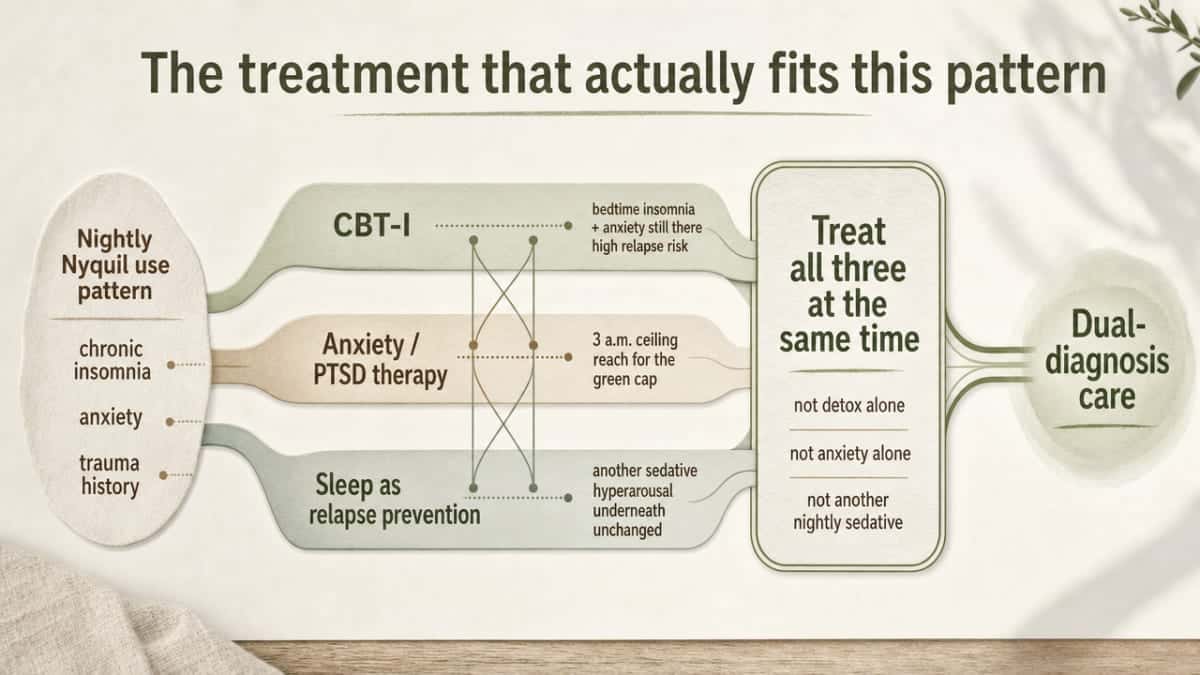
If the pattern underneath your nightly Nyquil use is some combination of chronic insomnia, anxiety, and maybe trauma you’ve been working around for years, then the treatment that fits isn’t a detox plan that ends at day fourteen. It’s an integrated approach that takes each of those threads seriously at the same time.
Here’s why the order matters. If you only treat the substance use, the insomnia and anxiety that drove the use are still sitting there at bedtime on night one of being “clean,” and the relapse risk is high. If you only treat the anxiety, you’re still staring at a 3 a.m. ceiling and reaching for the green cap by week two. If you only treat the insomnia with another sedative, you’ve swapped one nightly pill for another and haven’t touched the hyperarousal underneath. The pieces have to move together, which is what dual diagnosis care is built to do. The next three sections lay out what that actually looks like in practice.
CBT-I as the first move for chronic insomnia
The American Academy of Sleep Medicine’s guideline for chronic insomnia is direct on two points: cognitive behavioral therapy for insomnia (CBT-I) is the first-line treatment, and sedating antihistamines “are not recommended” for chronic insomnia because of limited efficacy data and anticholinergic side effects 12. That second point is exactly the category of drug you’ve been taking nightly.
CBT-I isn’t a meditation app. It’s a structured, time-limited protocol that retrains your sleep system through stimulus control, sleep restriction, and cognitive work on the bedtime worry loop. Most people see real change in four to eight sessions, and the gains tend to hold after treatment ends, which is the opposite of what happens when you stop a sedative.
Treating the anxiety or PTSD underneath
For co-occurring anxiety and substance use, the Harvard Review of Psychiatry synthesis points to integrated treatment with SSRIs or SNRIs, CBT, and exposure therapy, and flags that benzodiazepines deserve real caution in this population because they can worsen substance use outcomes even when they feel helpful in the short term 8. That matters if you’ve been wondering whether trading Nyquil for a benzo prescription is the answer. Usually it isn’t.
If trauma is part of the picture, the 2024 state-of-the-science review on PTSD and substance use disorders is worth taking seriously. It concludes that integrated, trauma-focused treatment is “safe, feasible, and effective,” and pushes back on the old idea that you have to be fully sober before doing trauma work 9. You don’t. Protocols like COPE and EMDR can run alongside substance use treatment, and for a lot of people the trauma piece is what was keeping the nights unsurvivable in the first place.
Sleep as relapse prevention, not an afterthought
Sleep disturbance has been described in the addiction literature as “a universal risk factor for relapse” across substance categories, with poor sleep at treatment entry predicting worse outcomes 10. That’s not a side note for someone whose entire pattern was built around fixing sleep. Treating the insomnia isn’t separate from staying off Nyquil. It is the relapse-prevention work. Any program that doesn’t take your sleep seriously is missing the point of why you started using in the first place.
Talking to a clinician without minimizing or catastrophizing
The hardest part of the first appointment is usually the sentence you have to say out loud. “I’ve been taking Nyquil every night for a while now” is enough. You don’t need a confession. You don’t need to perform how bad it is, or how fine you are.
What helps is being specific. Bring numbers, not adjectives. How many softgels, how many nights a week, for how many months. Whether you’ve combined it with alcohol or other sedating medication. Whether two stopped working and you went to three. Whether the nights you skip it feel like the rebound described in case reports of doxylamine dependence 1. Whether anxiety, intrusive memories, or a racing 3 a.m. brain came first, or showed up after.
Ask for an assessment that covers all three threads: the substance use, the sleep, and the anxiety or trauma underneath. If a clinician wants to handle one and refer out the rest, that’s a signal to look for integrated dual diagnosis care instead. You’re not being difficult. You’re describing the actual problem.
A more honest morning
Picture a morning where you wake up because you’re done sleeping, not because the doxylamine finally wore off. Your mouth isn’t dry. Your brain comes online before lunch. The first thing you reach for is water, not the question of whether you remembered to buy more of the green stuff.
That morning is reachable. Not in a motivational poster way. In a treatment-plan way. CBT-I retrains the sleep system that the antihistamine has been overriding. Integrated care addresses the anxiety or trauma that made bedtime feel like something to survive. Sleep gets treated as part of staying well, not as an afterthought once the substance use is “handled.”
You don’t have to white-knuckle this alone, and you don’t have to wait until it gets worse to ask for help. If the pattern in this guide sounds like your last six months, that’s information, not a verdict. A team like the one at Arrow Passage Recovery can put the pieces, sleep, anxiety, trauma, and substance use, on the same treatment plan, where they belong. The next honest morning starts with one phone call you don’t have to rehearse.
Speak With Someone Who Understands Dual Struggles
Get confidential support for Nyquil addiction, anxiety, and insomnia right when you need it most.
Discuss Your Nyquil, Anxiety, and Sleep Concerns
Connect with a professional for support tailored to your unique recovery needs.
Frequently Asked Questions
Is Nyquil actually addictive, or am I overreacting?
You’re not overreacting. Doxylamine, the sedating antihistamine in Nyquil’s nighttime formula, has documented potential for dependence when used nightly outside its short-term label window, including dose escalation and withdrawal symptoms 1. If you’ve been using it for months to fall asleep and the thought of stopping makes you anxious, that’s a real pattern worth taking to a clinician, not a personality flaw.
How long is too long to use Nyquil for sleep?
The OTC doxylamine label is direct: it’s for occasional sleeplessness and shouldn’t be used for more than two weeks without a doctor’s advice 14. If you’re past that window and still reaching for the green cap most nights, you’ve moved into chronic use the product wasn’t designed for. That’s a signal to address what’s actually keeping you awake.
What happens if I just stop taking Nyquil cold turkey?
After months of nightly use, abruptly stopping often produces rebound insomnia, racing thoughts, and a wired-but-tired feeling that can last several nights to a couple of weeks. Case literature on doxylamine dependence describes exactly this withdrawal pattern when patients try to stop unsupervised 1. It’s not dangerous in the way alcohol withdrawal is, but it’s miserable enough that most people end up back at the bottle. Tapering with clinical support works better.
Can nightly Nyquil damage my liver?
Two softgels deliver 650 mg of acetaminophen, and the label warns plainly against combining it with other acetaminophen products or with alcohol 13. Nightly use, especially paired with a glass of wine or daytime Tylenol, stacks the load on the same liver enzymes that handle alcohol. Damage is usually quiet until it isn’t. If this is your pattern, ask your doctor for liver function tests.
Why does my anxiety feel worse the day after I take it?
Doxylamine has a long half-life and produces anticholinergic effects, so you wake up foggy and slow, which makes the day harder to manage and raises evening anxiety. There’s also a deeper mechanism: insomnia and anxiety share overlapping neural circuits and feed each other, so a sedative that overrides sleep doesn’t fix the dysregulated system underneath 4. The anxiety isn’t getting treated. It’s just getting postponed until morning.
Do I need to be sober before treating my anxiety or PTSD?
No. The 2024 state-of-the-science review on PTSD and substance use disorders concludes that integrated, trauma-focused treatment is safe, feasible, and effective, and explicitly argues against delaying trauma work until you’ve achieved sustained abstinence 9. Protocols like EMDR and COPE can run alongside substance use treatment. For many people, addressing the trauma is what finally makes the nights survivable without the bottle.
References
- Doxylamine Addiction: A Case Report. https://pubmed.ncbi.nlm.nih.gov/36148572/
- Case Report of Lethal Concentrations of the Over-the-Counter Sleep Aid Doxylamine. https://pmc.ncbi.nlm.nih.gov/articles/PMC10430669/
- Causal Relationship Between Substance Use and Insomnia: A Bidirectional Mendelian Randomization Study. https://pmc.ncbi.nlm.nih.gov/articles/PMC11815086/
- Insomnia, anxiety and related disorders: a systematic review on the bidirectional relationship and neuroimaging evidence. https://pmc.ncbi.nlm.nih.gov/articles/PMC12244189/
- Unraveling the complex interplay between insomnia, anxiety, and brain networks. https://pmc.ncbi.nlm.nih.gov/articles/PMC10925950/
- A Systematic Review Assessing Bidirectionality between Sleep Disturbances, Anxiety, and Depression. https://pubmed.ncbi.nlm.nih.gov/23814343/
- Dextromethorphan in Cough Syrup: The Poor Man’s Psychosis. https://pmc.ncbi.nlm.nih.gov/articles/PMC5601090/
- Treatment of Co-occurring Anxiety Disorders and Substance Use Disorders. https://pmc.ncbi.nlm.nih.gov/articles/PMC4355945/
- State of the Science: Treatment of Comorbid Posttraumatic Stress Disorder and Substance Use Disorders. https://www.ptsd.va.gov/professional/articles/article-pdf/id1635224.pdf
- Sleep Disturbance as a Universal Risk Factor for Relapse in Addictions to Psychoactive Substances. https://pmc.ncbi.nlm.nih.gov/articles/PMC2850945/
- Insomnia at the onset of addiction treatment may be related to earlier relapses: A one-year follow-up study. https://pmc.ncbi.nlm.nih.gov/articles/PMC9475577/
- Clinical Guideline for the Evaluation and Management of Chronic Insomnia in Adults. https://pmc.ncbi.nlm.nih.gov/articles/PMC2576317/
- Vicks Nyquil Cold and Flu – Acetaminophen, dextromethorphan hydrobromide, and doxylamine succinate. https://dailymed.nlm.nih.gov/dailymed/lookup.cfm?setid=620bc3dc-099b-40bd-be22-e4c3f9c8e09d
- SLEEP AID – doxylamine succinate tablet. https://dailymed.nlm.nih.gov/dailymed/lookup.cfm?setid=489ee606-15f4-4032-a62b-35c8844f1a26