
How Outpatient Drug Treatment Works With a Job
Key Takeaways
- Match the level of care to your actual available hours: standard outpatient fits around dinner, IOP requires protected evenings, and PHP almost always demands formal leave rather than schedule tweaks.
- ADA protections and FMLA’s 12 weeks of job-protected leave cover treatment and recovery, but not current illegal drug use or absences caused by continued substance use 22, 4.
- Route disclosures through HR or an EAP rather than your direct manager, and request specific schedule accommodations without naming the diagnosis or substance 5, 7.
- Engagement quality and continuing care past the first eight weeks predict whether jobs and recovery hold, especially when mental health conditions are part of the picture 17, 19.
The Real Math of a Treatment Week Around a 40-Hour Job
Start with the calendar, not the clinical pamphlet. Before anyone tells you what kind of treatment you need, it helps to see what kind of week you actually have. A standard 40-hour job already eats Monday through Friday, roughly 9 to 5. Add commute, sleep, meals, and whatever family you go home to, and you have maybe 15 to 25 waking hours left across the week that aren’t already spoken for. That number is the real container treatment has to fit into.
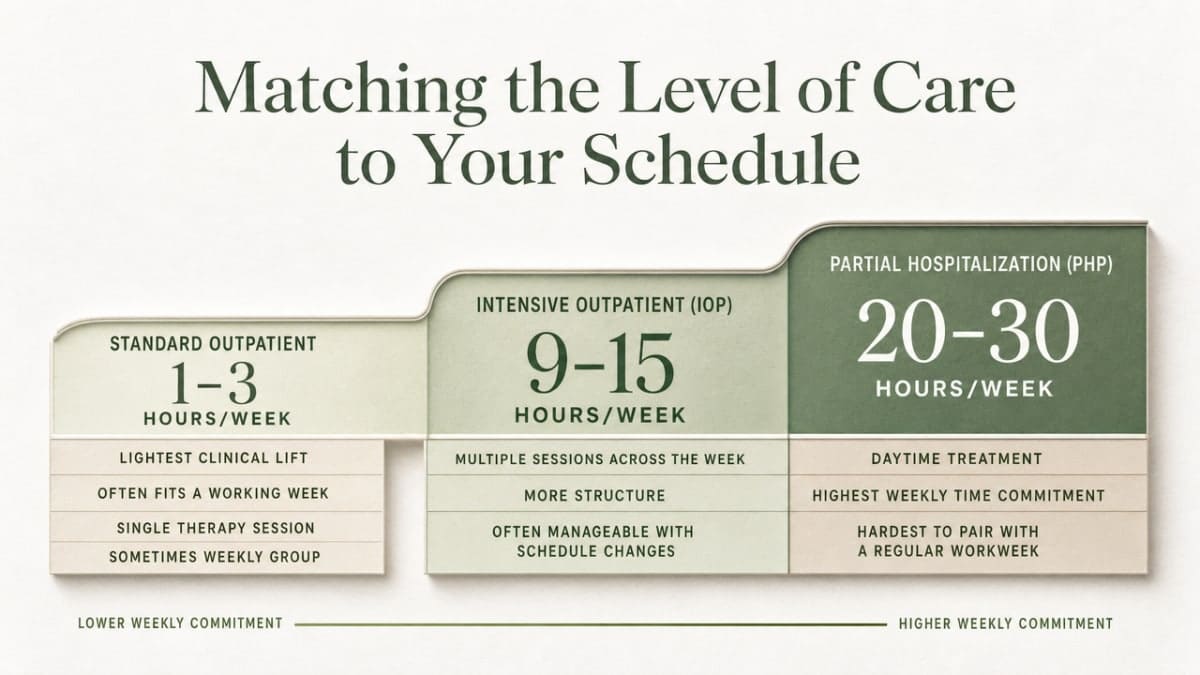
Here is what the levels of care look like when you line them up against that container. Standard outpatient typically runs 1 to 3 clinical hours a week, often a single therapy session and a group. Intensive outpatient (IOP) usually runs 9 to 12 hours, broken into three or four evening or early-morning blocks. Partial hospitalization (PHP) runs about 20 to 30 hours, which is essentially a part-time job on top of your job. Programs vary, but those ranges are the working numbers most clinicians use when matching level of care to a patient’s life 16.
Look at those ranges next to a 40-hour week and the answer gets clearer fast. Standard outpatient slides in around dinner. IOP is doable, but only if your evenings are mostly yours and your employer is flexible about the occasional 4:30 dismissal. PHP almost always requires leave, modified hours, or a temporary change in role. You are not failing if PHP is what you need. You are reading the math honestly.
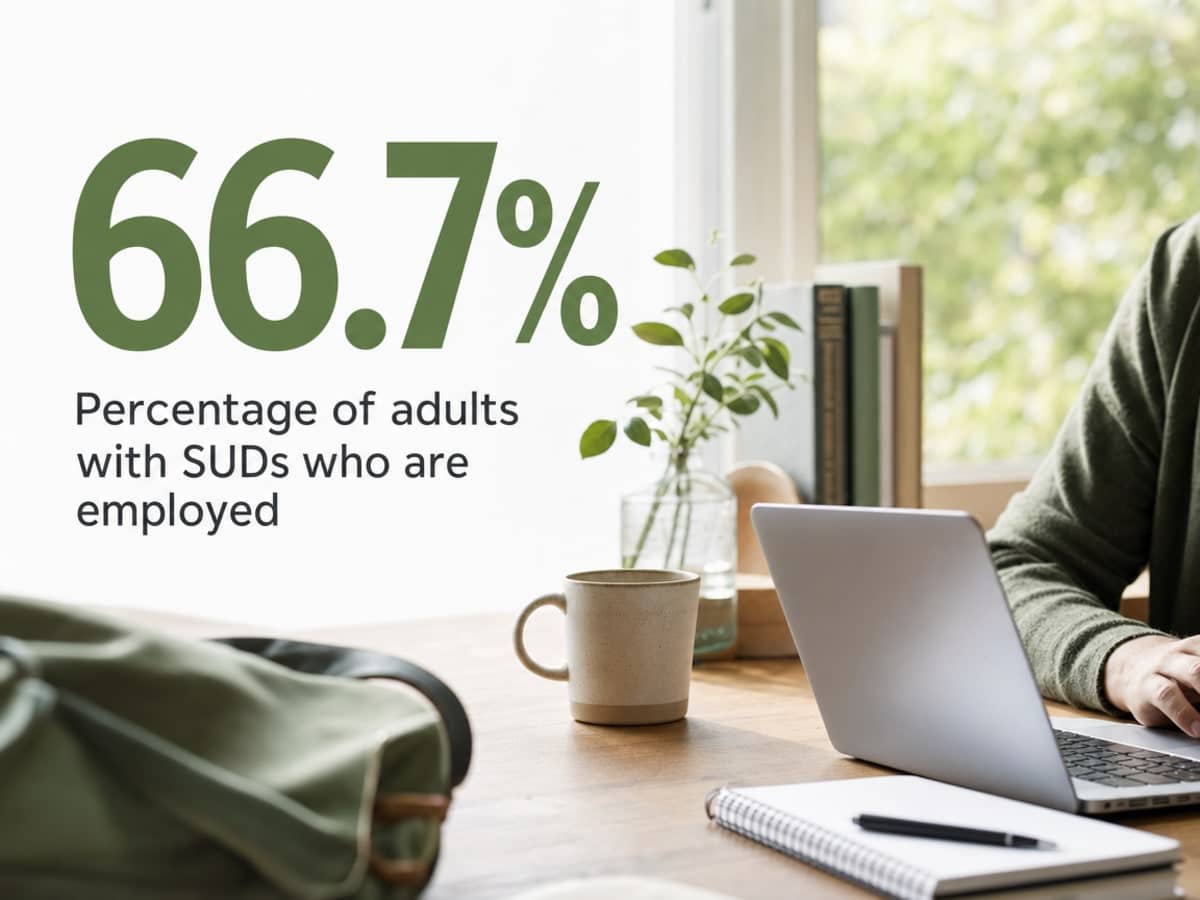
You are also not alone in trying. About two-thirds of adults with substance use disorders are working 1. This is the normal starting point, not the exception.
Matching the Level of Care to Your Schedule
Standard Outpatient: One to Three Hours a Week
Standard outpatient is the lightest clinical lift. You are looking at one to three hours a week, usually a single individual therapy session and sometimes a weekly group. Many clinics offer 7 a.m. or 6 p.m. slots specifically because they know who is in those chairs: people with jobs.
This level fits cleanly into a working week. You can often book the same time slot weekly, which makes it easy to block on your calendar without anyone asking questions. A 5:30 p.m. Tuesday appointment is a Tuesday appointment. You don’t owe an explanation for that.
Standard outpatient is the right starting point if you are stable, have already completed a higher level of care, or have a milder use pattern caught early. It is also where most people land for the long tail of recovery, six months and beyond. If you are in active crisis or just coming off detox, this level alone usually is not enough to hold you steady 16.
Intensive Outpatient (IOP): Nine to Twelve Hours, Usually in Evening Tracks
IOP is where most working adults actually land when they need real clinical structure but cannot step away from the job. You meet three to four times a week, usually for three hours each session, for somewhere between eight and twelve weeks. Evening tracks typically run 5:30 to 8:30 p.m. Morning tracks, where available, run before the standard workday starts.
The math works, but it is tight. An evening IOP plus a 40-hour week is a 52-hour commitment before sleep, meals, or family. You will be tired. That is not a flaw in the plan, it is the plan. Treatment is supposed to take real energy, and pretending otherwise sets you up to quit in week three.
What makes IOP fit a job is its predictability. You know which nights you are in group. You know when you are out. That lets you schedule deliverables, dinners, and childcare around a stable shape instead of week-to-week guessing. If your employer is willing to flex you to a 4:30 dismissal on group days, the whole thing becomes much easier to hold 5, 15.
Partial Hospitalization (PHP): When You Need Leave, Not a Schedule Hack
PHP runs 20 to 30 clinical hours a week, typically five days a week, four to six hours a day. There is no honest way to stack that on top of a full-time job. If your clinician is recommending PHP, they are telling you that your current condition needs more containment than evenings can provide 16.
That recommendation is not a failure. It is a clinical read. PHP is often the right answer after detox, after a serious relapse, or when a co-occurring mental health condition is making outpatient care unsafe on its own. Trying to white-knuckle a 40-hour week through PHP usually ends with you doing neither well.
This is where FMLA, short-term disability, or accrued PTO come in. A four-to-six-week PHP stretch with job protection is a far better outcome than losing the position because you tried to hide what you needed. The leave conversation is hard. The job loss conversation is harder.
Why Engagement, Not Enrollment, Predicts Whether the Schedule Holds
Signing up for IOP and showing up for IOP are two different things. Research on outpatient substance use treatment finds that the quality of engagement, not just enrollment, is what predicts whether people improve and stay employed 17. Translation: the people who keep their jobs and their recovery are the ones who actually sit in the chair, week after week, even when work is loud.
That means the schedule you pick has to be one you can defend. If your job runs late on Thursdays, do not pick a Thursday group. If you travel two weeks a month, you need a program with telehealth or hybrid options before you start, not after you miss your third session. Pick the version you can keep. Then keep it.
What the Law Actually Protects (and What It Doesn’t)
ADA: Recovery Is Covered, Current Illegal Use Is Not
The Americans with Disabilities Act draws a line that catches a lot of people off guard. If you are in recovery, in treatment, or have a history of substance use disorder and are not currently using illegal drugs, you can be considered a qualified individual with a disability and are entitled to reasonable accommodation 13, 23. If you are still actively using illegal drugs, that same protection does not apply 4.
That distinction matters when you decide what to disclose and when. Walking into HR and saying “I am in outpatient treatment and need to adjust my Tuesday and Thursday end times” is a protected request. Walking in mid-use, before any treatment has started, is a different legal situation.
FMLA: 12 Weeks of Unpaid, Job-Protected Leave for Treatment
The Family and Medical Leave Act gives eligible employees up to 12 weeks of unpaid, job-protected leave in a 12-month period for a serious health condition, with group health insurance continued during that time 22. Substance use treatment can qualify when it meets the FMLA’s serious health condition criteria, which generally means inpatient care or continuing treatment by a provider.
Here is the part people miss. FMLA covers time away for treatment. It does not cover absences caused by continued substance use itself 22. If you miss work on Monday because you used over the weekend, that absence is not protected. If you miss Monday because you are in an IOP intake, that is a different conversation.
To be eligible, you generally need to have worked for a covered employer for at least 12 months and 1,250 hours. Smaller employers may not be covered at all. Check before you assume.
The Accommodations You Can Actually Ask For
Abstract rights do not get you to group on time. Specific accommodations do. The EEOC explicitly lists schedule changes, unpaid leave, and modified work hours as accommodations that can be reasonable when they let a qualified employee with a disability keep working 5. The Job Accommodation Network and DOL go further and name the kinds of adjustments that map directly onto outpatient treatment.
The menu typically includes:
- Flexible scheduling so you can attend evening or early-morning sessions
- Leave for counseling appointments or support meetings
- Frequent breaks
- Modified workloads during the most intensive weeks of IOP
- Work-from-home arrangements where the job allows it 15
Not every accommodation fits every job. A safety-sensitive role or a customer-facing shift may rule some of them out. The point is that you have specific options to bring into a conversation, not just a vague request to “be understanding.”
Walk into HR with the accommodation you actually need. “I need to leave at 4:30 on Tuesdays and Thursdays for the next ten weeks for a medical treatment program” is a real request. That is the language that triggers the interactive process the EEOC describes 5.
The Employer Conversation: What to Say, to Whom, and When
Start With HR or the EAP, Not Your Direct Manager
Your first instinct may be to tell your boss. Don’t. Your direct manager is the person most likely to react emotionally, leak information accidentally, or start treating you differently in meetings. Start somewhere with a confidentiality structure already built in.
If your employer offers an Employee Assistance Program, that is usually the right first call. EAPs provide confidential assessments, treatment referrals, and short-term counseling, and they can help coordinate the handoff to an outpatient program 7. The intake is private and does not automatically flow to your manager. EAPs exist specifically as a bridge between the workplace and treatment entry 8.
No EAP? Go to HR. Ask about the process for requesting a medical accommodation. You do not have to name the diagnosis in that first conversation. You are requesting a process, not confessing a problem. HR is trained to handle protected medical information and is the right channel for triggering the interactive accommodation process described by the EEOC 5.
What to Disclose, What to Keep Private
You owe your employer less than you think. The ADA limits how much medical detail an employer can ask for, and you control the diagnosis itself 4. What you generally need to share is functional: that you have a medical condition, that you are under a provider’s care, and that you need specific adjustments to your schedule for a defined period of time.
You do not have to say “substance use disorder.” You do not have to name the drug. You do not have to describe what brought you here. “I’m in an outpatient medical treatment program” is a complete sentence. If HR pushes for more, a note from your treatment provider confirming the medical need and the schedule impact is usually enough.
Keep it to people who need to know. SAMHSA is direct: an employer cannot fire, refuse to hire, or refuse to promote someone solely because they are enrolled in a rehabilitation program 18. That protection is strongest when the information stayed in the channels designed to hold it.
Scripts for Three Common Situations
You need a recurring 4:30 dismissal for evening IOP. To HR: “I’m starting a medical treatment program that meets Monday, Wednesday, and Thursday evenings. I need to leave by 4:30 on those days for approximately ten weeks. My provider can send documentation of the medical need and the schedule. I’d like to discuss how to make up the time or adjust my workload during this period.” That is a clean accommodation request under the EEOC’s framework 5.
You need extended leave for PHP. To HR: “I need to request medical leave under FMLA for a serious health condition. My provider estimates four to six weeks. I’d like to understand how my benefits continue and what the return-to-work process looks like.” FMLA gives eligible employees up to 12 weeks of unpaid, job-protected leave with continued group health coverage 22.
Your manager notices and asks directly. “I’m dealing with a medical issue and working with HR on it. I’m staying on top of my work and I’ll let you know if anything changes that affects the team.” You don’t owe more. Loop HR in afterward so the record stays consistent.
When Mental Health Is Part of the Picture
For a lot of working adults, the substance use is only half the story. Anxiety, depression, PTSD, ADHD, or bipolar disorder is often sitting underneath, driving the use or making recovery harder to hold. If that is you, the scheduling math changes. You are not just fitting therapy around your job. You are fitting two streams of care, sometimes with two providers, around the same 40-hour week.
Integrated treatment, where the same team handles both conditions in coordinated sessions, is the model the evidence points toward for co-occurring disorders 16, 21. The practical advantage at work is real: one schedule, one set of appointments, one provider who can write a single documentation letter for HR. Trying to coordinate a separate psychiatrist, separate therapist, and separate IOP across three calendars often breaks before week four.
The long view matters here too. Research on people with co-occurring disorders shows that gains made in higher-intensity treatment hold up best when continuing outpatient care stays in place over six and twelve months 19. Translation: if mental health is part of your picture, plan for a longer outpatient tail than you might want. That is not a setback. That is what sustained recovery actually looks like when two conditions are in the room.
The Honest Limits: What the Research Says About Working Through Treatment
Here is the part most pillar articles skip. Outpatient treatment does not automatically lock in your job, and the research is clear about that. In one study of clients who started substance use disorder treatment, only 38.7% were employed at any point during the follow-up period, and community disadvantage, things like neighborhood unemployment and limited transportation, was tied to lower employment odds 10. That is a single study with a specific population, not a national headline. But the gap it points to is real: starting treatment and staying employed through treatment are two different outcomes.
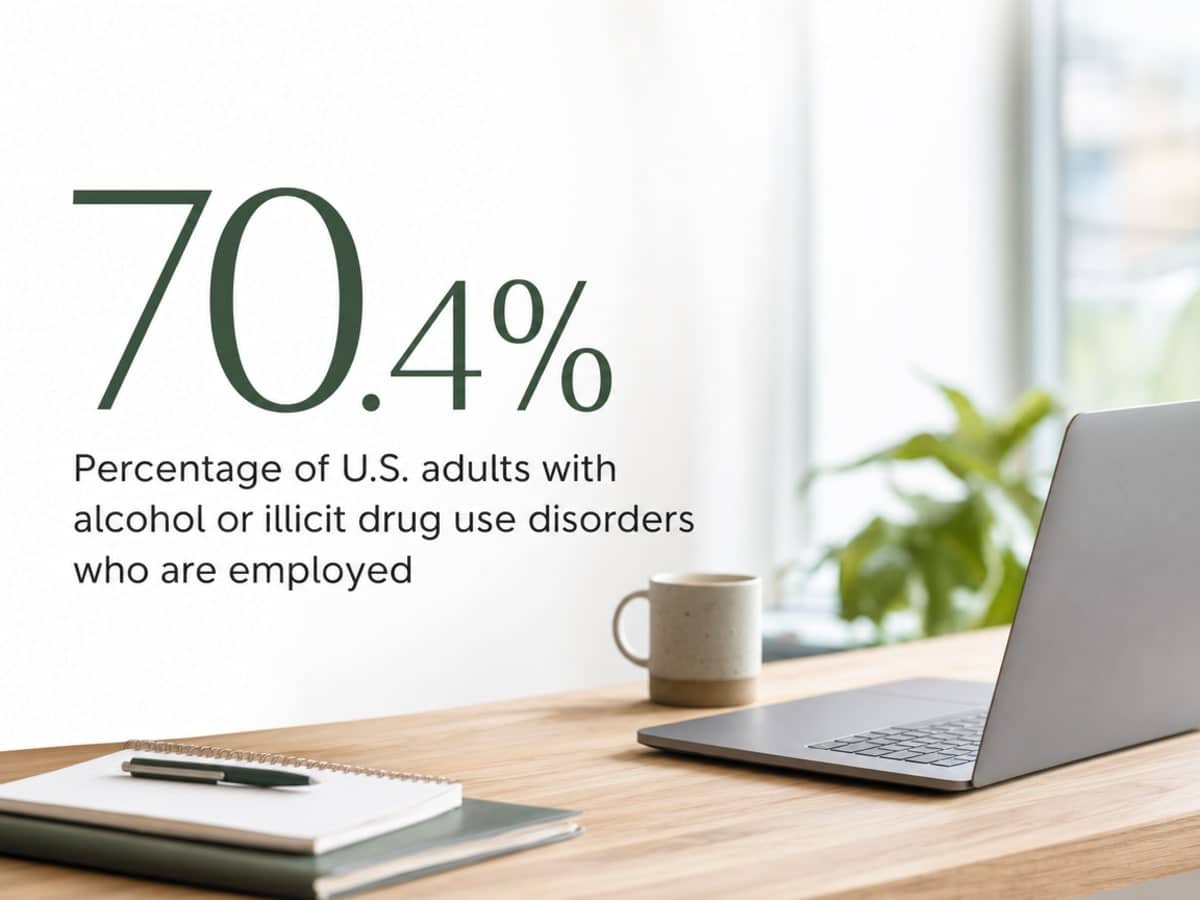
Set against the NIOSH figure that roughly two-thirds of adults with substance use disorders are working when they enter the system 1, you can see the retention problem this article is built around. The job is often already there when treatment starts. Holding onto it is the harder part.
A couple of things help close that gap. Engagement quality matters: people who actually attend their outpatient sessions, not just enroll, tend to do better on work outcomes 17. And in opioid use disorder research, employment was more likely among people who showed up more often and produced more drug-negative urine samples 11. Translation: consistency at the program and consistency with the substance both move the needle.
One more honest note. Even in structured therapeutic-workplace studies that successfully boosted employment, the jobs people landed were often part-time and low-wage 12. If you already have a stable position, protecting it is worth real effort. Rebuilding from zero is harder than most plans assume.
Building a Continuing-Care Plan That Outlasts the First Eight Weeks
Most IOP programs run eight to twelve weeks. What happens in week thirteen is where a lot of working adults quietly lose ground. The intensive structure ends, the calendar opens back up, and the job rushes in to fill the space treatment used to hold. Without a plan for that handoff, the gains made in those first weeks tend to drift.
A continuing-care plan is the bridge. It usually means stepping down from IOP to standard outpatient, one to three hours a week, plus whatever support meetings, peer recovery groups, or medication management you and your provider have built in 16. SAMHSA treats employment itself as part of that support structure, not a competing demand, because the routine of work can reinforce the routine of recovery 6. For co-occurring mental health conditions, the evidence is especially clear: outcomes are most stable when continuing services stay in place across six and twelve months, not just the first quarter 19.
Build the next phase before the current one ends. Pick your step-down therapist by week six of IOP, not week twelve. Put the standing appointment on your calendar the same way you put the IOP block there. The version of you who finishes intensive treatment will be tired and tempted to take a break. Decide now, while you are still in the chair, what the next six months actually look like.
A First-Week Checklist Before You Start Treatment
The week before your first session is when the plan either holds or unravels. Use this short list to get the moving parts in place while you still have energy to make decisions.
- Confirm your level of care and weekly hours in writing. Get the schedule from your provider as a document you can hand to HR if asked.
- Call your EAP first, then HR. EAPs offer confidential assessments and referrals and can quietly bridge you into care 7.
- Submit your accommodation request in writing. Name the schedule change you need and the timeframe. You do not have to name the diagnosis 5.
- Check FMLA eligibility if you might need extended leave: 12 months of service, 1,250 hours, covered employer 22.
- Block the sessions on your calendar as recurring “medical appointment” entries. Decide childcare and transportation before week one.
- Pick one person at home who knows the schedule and will notice if you skip.
Cross these off and the first week becomes something you walk into, not something that walks over you.
Where to Go From Here
You came into this article wanting to know if outpatient drug treatment can work alongside a job. The short answer is yes, often, when the level of care matches your week, the legal protections are used the way they were designed, and the continuing-care plan actually outlasts the first eight weeks. None of that is easy. All of it is doable.
Pick the next concrete step, not the perfect plan. Call your EAP this week, or ask HR about the medical accommodation process. Get an assessment scheduled. If you do not know where to start, SAMHSA’s National Helpline is free, confidential, and open every day 20. Arrow Passage Recovery can also walk you through a schedule that fits the job you are trying to protect.
Talk With Someone About Balancing Work And Recovery
Get support planning outpatient treatment that fits your work schedule—right when you need it most.
Discuss Flexible Outpatient Options That Fit Work
Get tailored guidance on balancing recovery support with your professional responsibilities.
Frequently Asked Questions
Do I have to tell my employer I’m in outpatient drug treatment?
No. You generally only have to share what’s needed to request an accommodation, which is that you have a medical condition under a provider’s care and need specific schedule adjustments. You do not have to name the diagnosis or the substance. A provider note confirming the medical need and schedule impact is usually enough 4, 5.
Can I be fired for going to rehab if I’m still doing my job well?
Not solely for that reason. SAMHSA states it is illegal to fire, refuse to hire, or refuse to promote someone simply because they are enrolled in a rehabilitation program or have a history of substance use 18. You still have to meet performance and conduct standards, and current illegal drug use is not protected the same way recovery is 4.
Will my insurance or EAP actually pay for IOP, and how do I check without tipping off my employer?
Call the member services number on your insurance card directly. That call is confidential and does not route through HR. If you have an EAP, the intake is also private and separate from your manager’s visibility. EAPs typically cover short-term counseling, assessments, and referrals into outpatient care, with the cost of ongoing IOP usually billed to your health plan 7, 8.
What happens if I relapse while I’m in outpatient treatment and working?
Tell your treatment team first, not your employer. They can adjust the level of care, sometimes stepping you up to PHP for a few weeks. Be aware that FMLA covers time away for treatment but not absences caused by continued use itself 22, and the ADA does not protect current illegal drug use 4. Re-engaging in care quickly is what protects both.
How long does outpatient drug treatment usually last when you’re working full-time?
IOP typically runs eight to twelve weeks at nine to twelve clinical hours, followed by a step-down to standard outpatient at one to three hours weekly for six months or more. For co-occurring conditions, plan on a longer outpatient tail: research shows gains hold up best when continuing care stays in place across six and twelve months 19.
Can I use FMLA leave a few hours at a time for therapy instead of taking weeks off?
Often yes. FMLA allows intermittent leave for a serious health condition when medically necessary, which can include leaving early for therapy or treatment appointments 22. You’ll need provider documentation, and you must meet standard FMLA eligibility: 12 months of service, 1,250 hours worked, and a covered employer. Coordinate the request through HR, not your direct manager.
References
- Workplace Supported Recovery | Substance Use and Work. https://www.cdc.gov/niosh/substance-use/workplace-supported-recovery/index.html
- Workplace Supported Recovery from Substance Use Disorders: Defining the Construct, Developing a Model, and Proposing an Agenda for Future Research. https://pmc.ncbi.nlm.nih.gov/articles/PMC10193449/
- Resources for Federal Contractors and Workers Related to Substance Use Disorder. https://www.dol.gov/agencies/ofccp/substance-use-disorder?lang=hi
- Applying Performance and Conduct Standards to Employees with Disabilities. https://www.eeoc.gov/laws/guidance/applying-performance-and-conduct-standards-employees-disabilities
- Enforcement Guidance on Reasonable Accommodation and Undue Hardship under the ADA. https://www.eeoc.gov/laws/guidance/enforcement-guidance-reasonable-accommodation-and-undue-hardship-under-ada
- Substance Use Disorders Recovery with a Focus on Employment. https://www.samhsa.gov/resource/ebp/substance-use-disorders-recovery-focus-employment
- Provide Support. https://www.samhsa.gov/substance-use/drug-free-workplace/employer-resources/toolkit/provide-support
- Employee Assistance Programs. https://www.ncbi.nlm.nih.gov/books/NBK236249/
- Working on addiction in the workplace. https://www.health.harvard.edu/blog/working-on-addiction-in-the-workplace-2017063011941
- Employment after beginning treatment for substance use disorders. https://pmc.ncbi.nlm.nih.gov/articles/PMC5830150/
- Factors associated with obtaining employment among unemployed adults in treatment for opioid use disorder. https://pmc.ncbi.nlm.nih.gov/articles/PMC8355098/
- Employment outcomes of substance use disorder patients enrolled in a therapeutic workplace. https://pmc.ncbi.nlm.nih.gov/articles/PMC7733028/
- The Americans with Disabilities Act, addiction, and recovery. https://pmc.ncbi.nlm.nih.gov/articles/PMC10961953/
- Alcoholism In The Workplace: A Handbook for Supervisors. https://www.opm.gov/policy-data-oversight/worklife/reference-materials/alcoholism-in-the-workplace-a-handbook-for-supervisors/
- Employees with Drug Addiction Accommodation and Compliance. https://www.govinfo.gov/content/pkg/GOVPUB-L41-PURL-gpo11009/pdf/GOVPUB-L41-PURL-gpo11009.pdf
- Chapter 7—Treatment Models and Settings for People With Co-Occurring Disorders. https://www.ncbi.nlm.nih.gov/books/NBK571024/
- ENGAGEMENT IN OUTPATIENT SUBSTANCE ABUSE TREATMENT AND EMPLOYMENT OUTCOMES. https://www.ncbi.nlm.nih.gov/pmc/articles/PMC3796147/
- Employer Resources: Federal Laws and Regulations. https://www.samhsa.gov/substance-use/drug-free-workplace/employer-resources/federal-laws
- Stability of Outcomes Following Residential Drug Treatment for Patients with Co-Occurring Disorders. https://pmc.ncbi.nlm.nih.gov/articles/PMC3146302/
- National Helpline for Mental Health, Drug, Alcohol Issues. https://www.samhsa.gov/find-help/helplines/national-helpline
- Chapter 7—Treatment Models and Settings for People With Co-Occurring Disorders. https://www.ncbi.nlm.nih.gov/sites/books/NBK571024/
- Family and Medical Leave Act (FMLA): Questions and Answers. https://www.dol.gov/agencies/whd/fmla/faq
- Sharing the Dream: Is the ADA Accommodating All? Chapter 4 – Substance Abuse under the ADA. https://www.usccr.gov/files/pubs/ada/ch4.htm