
Is It Safe to Quit Drinking Cold Turkey?
Key Takeaways
- Quitting alcohol cold turkey is usually safe for light or moderate drinkers, but heavy daily drinkers risk seizures or delirium tremens within 48 to 72 hours 7.
- Long-term heavy drinking rewires the brain’s GABA and glutamate balance, so sudden abstinence triggers rebound hyperexcitability that drives tremors, racing heart, and potential seizures 2.
- Prior withdrawal episodes, daily heavy use over years, medical comorbidities, or no sober support at home shift the defensible choice from home detox to inpatient care 1, 9.
- A medically supervised taper, often with benzodiazepines and symptom-triggered monitoring, lets the nervous system rebalance without the violent rebound that willpower alone cannot prevent 4, 10.
The Honest Answer Before You Pour Out the Bottle
Here’s the direct answer you came for: if you drink lightly or moderately, stopping suddenly is usually uncomfortable but safe. If your body has been getting alcohol every day for months or years, quitting cold turkey can trigger seizures or delirium tremens within 48 to 72 hours, and severe alcohol withdrawal can be life-threatening without treatment 7.
That’s not a scare tactic. It’s a physiology fact, and it’s the reason you deserve a clear read on your own situation before you make a decision tonight.
You’re probably not asking this question casually. Maybe you’ve tried before and felt shaky, sweaty, or panicky by the next afternoon and didn’t know that was withdrawal. Maybe you’ve been drinking more than you want to admit out loud. The fact that you’re reading this, sober enough to think it through, is already something. Stay with it for a few more minutes.
What follows isn’t a lecture. It’s a way to figure out which side of the risk line you’re on, what the next three days could actually feel like, and when supervised detox stops being optional and starts being the only defensible choice 1.
Why Your Body Reacts So Violently to a Sudden Stop
If you’ve been drinking heavily for a long time, your brain hasn’t been sitting still. It’s been working overtime to balance you out.
Alcohol is a depressant. It quiets the nervous system by boosting GABA, the brain chemical that calms things down, and dampening glutamate, the one that fires things up. When you drink that much for that long, your brain notices and compensates. It turns down its own GABA receptors and turns up glutamate to keep you functional. Over months and years, this becomes your new normal. You’re not relaxed when you drink anymore — you’re just less wound up than the baseline your nervous system has quietly created underneath.
Then you stop. The alcohol leaves, but the rewiring doesn’t. Suddenly your brain is running with the brakes off and the accelerator floored at the same time. That’s not a metaphor — it’s why your hands shake, your heart races, your blood pressure climbs, and your thoughts start sprinting. Researchers call this rebound hyperexcitability, and it’s the same mechanism that can tip into a seizure when the imbalance gets steep enough 2.
The complications stack from there. Autonomic hyperactivity strains your heart. Electrolytes shift. Sleep collapses. In severe cases, the whole system destabilizes into delirium tremens, which can be fatal if no one is watching 4.
This is the part worth sitting with: the violence of withdrawal isn’t a sign you’re weak. It’s a sign your body adapted exactly the way it was supposed to. You’re not fighting a bad habit. You’re asking a nervous system that rebuilt itself around alcohol to rebuild itself again, fast, without help. That’s a physiological event, not a character test — and it’s why the question of how you stop matters as much as the decision to stop.
What Actually Happens in the First 72 Hours
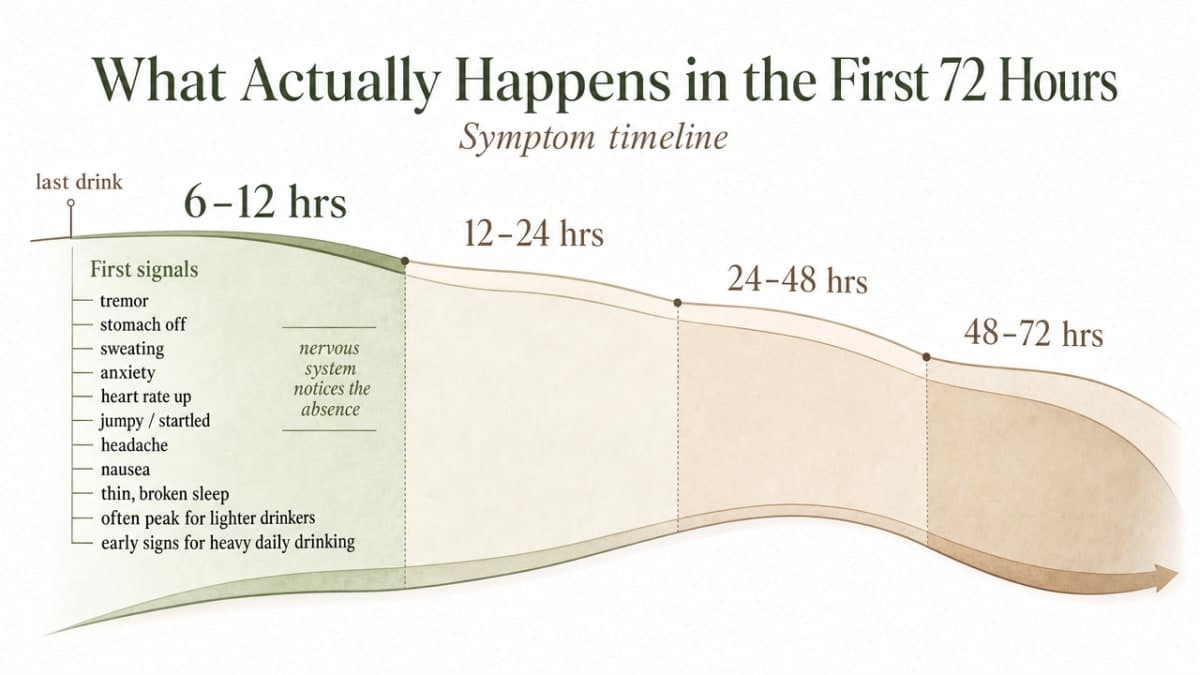
Hours 6–12: The First Signals
The first signs usually show up six to twelve hours after your last drink, sometimes before you’ve even noticed you’re sober. You might wake up with your hands trembling slightly when you reach for your phone. Your stomach feels off. You’re sweating through your shirt at room temperature. There’s a low hum of anxiety that doesn’t have a reason attached to it.
This is your nervous system noticing the absence. Heart rate creeps up. You feel jumpy, easily startled. Some people get a headache that won’t quite lift, or nausea that makes coffee feel like a bad idea. Sleep, if you got any, was thin and broken.
For lighter drinkers, this is often the peak. It’s miserable but manageable. For someone who’s been drinking heavily every day, these early signals are the opening notes of something that hasn’t crested yet 3.
Hours 12–24: Symptoms Escalate
By the end of the first day, the volume turns up. The tremor in your hands gets harder to hide. Your pulse may be running 100 or higher even when you’re sitting still. Blood pressure climbs. You’re sweating more, and the anxiety has sharpened into something closer to dread.
This is also when perception starts to slip for some people. You might catch movement in your peripheral vision that isn’t there. Sounds feel too loud. A car door slamming outside lands like a gunshot in your chest. Some people experience brief hallucinations at this stage — usually visual, sometimes auditory — while still knowing they aren’t real. Clinicians call this alcoholic hallucinosis, and it’s distinct from the full disorientation of DTs.
If you’re going to vomit, this is often when. If you’ve been undereating because alcohol has been doing the work of calories, this is when low blood sugar and electrolyte shifts start to compound everything else 4.
Hours 24–48: The Seizure Window
This is the window that turns a hard weekend into a medical event. Acute symptomatic seizures from alcohol withdrawal typically emerge 6 to 48 hours after the last drink, with the highest concentration of risk falling in the 24-to-48-hour stretch 3. They’re usually generalized tonic-clonic — the kind that drops you, stiffens your body, then shakes it, and leaves you confused and exhausted on the floor for several minutes after 2.
Most withdrawal seizures happen without warning. You don’t get an aura. You don’t feel one coming the way you might feel a panic attack building. You’re standing in the kitchen, and then you aren’t. If you live alone, no one knows you went down. If you hit your head on the way, that’s a separate emergency on top of the first one.
One seizure also raises the odds of another within the same withdrawal episode, and it’s a signal that the worst of withdrawal may still be ahead, not behind you 2. This is the point where the question isn’t whether cold turkey is uncomfortable. It’s whether someone is around to call 911.
Hours 48–72 and Beyond: When DTs Can Appear
Delirium tremens typically arrives 48 to 72 hours after your last drink, though it can show up as late as 7 to 10 days out 5. It is not just bad withdrawal. It’s a different category of event.
DTs bring severe confusion — you lose track of where you are, what day it is, who the person next to you is. Hallucinations stop feeling like hallucinations and start feeling like reality. Body temperature can spike. Heart rate and blood pressure swing dangerously. Severe agitation alternates with stretches of stupor. Without prompt treatment, DTs can kill, which is why this end of the withdrawal spectrum is handled with benzodiazepines and intensive monitoring rather than rest and fluids 10.
How to Tell Which Side of the Risk Line You’re On
The Drinking Pattern That Changes the Math
The single biggest variable isn’t how much you drank last night. It’s how much you’ve been drinking, almost every day, for how long.
A person who has two glasses of wine with dinner most nights for a year is in a different physiological situation than someone polishing off a fifth of vodka daily for three years. The first body has mild adaptation. The second has rebuilt its nervous system around alcohol the way scaffolding holds up a building under construction. Pull the scaffolding fast, and the structure flexes in dangerous ways 4.
The pattern that pushes the risk math sharply upward looks like this: daily drinking, several drinks per day, sustained over months or years, with the first drink moving earlier in the day over time. Morning drinking to steady your hands or your stomach is a particularly loud signal — it means your body has already started withdrawing overnight, and you’ve been treating that withdrawal with more alcohol without naming it.
If you can’t remember the last full day you didn’t drink, that’s not a moral failing. It’s a clinical data point. It means your nervous system has had no opportunity to recalibrate, and a sudden stop will demand that recalibration happen in 72 hours instead of slowly 1.
Prior Withdrawal History Matters More Than You Think
Here’s something most people don’t know about themselves until a clinician asks: withdrawal tends to get worse each time, not better. If you’ve quit before and had tremors, sweats, a racing heart, or a seizure — even a brief one you wrote off as something else — your next withdrawal is statistically likely to be more severe, not less 1.
This is called kindling, and it’s why prior withdrawal history is one of the first questions a detox intake asks. A person who has gone through alcohol withdrawal three or four times, even mild ones, carries different risk than a first-timer with the same drinking pattern.
So think back honestly. Have you tried to stop before? What did day two feel like? Did you shake? Did you feel like the walls were too close? Did you have a seizure, or wake up on the floor with no memory of how you got there? Did anyone ever tell you that you were confused or talking to people who weren’t in the room? Any one of those answers moves you firmly into the column where stopping without medical supervision is not a defensible choice 9.
The 5% That Changes the Conversation
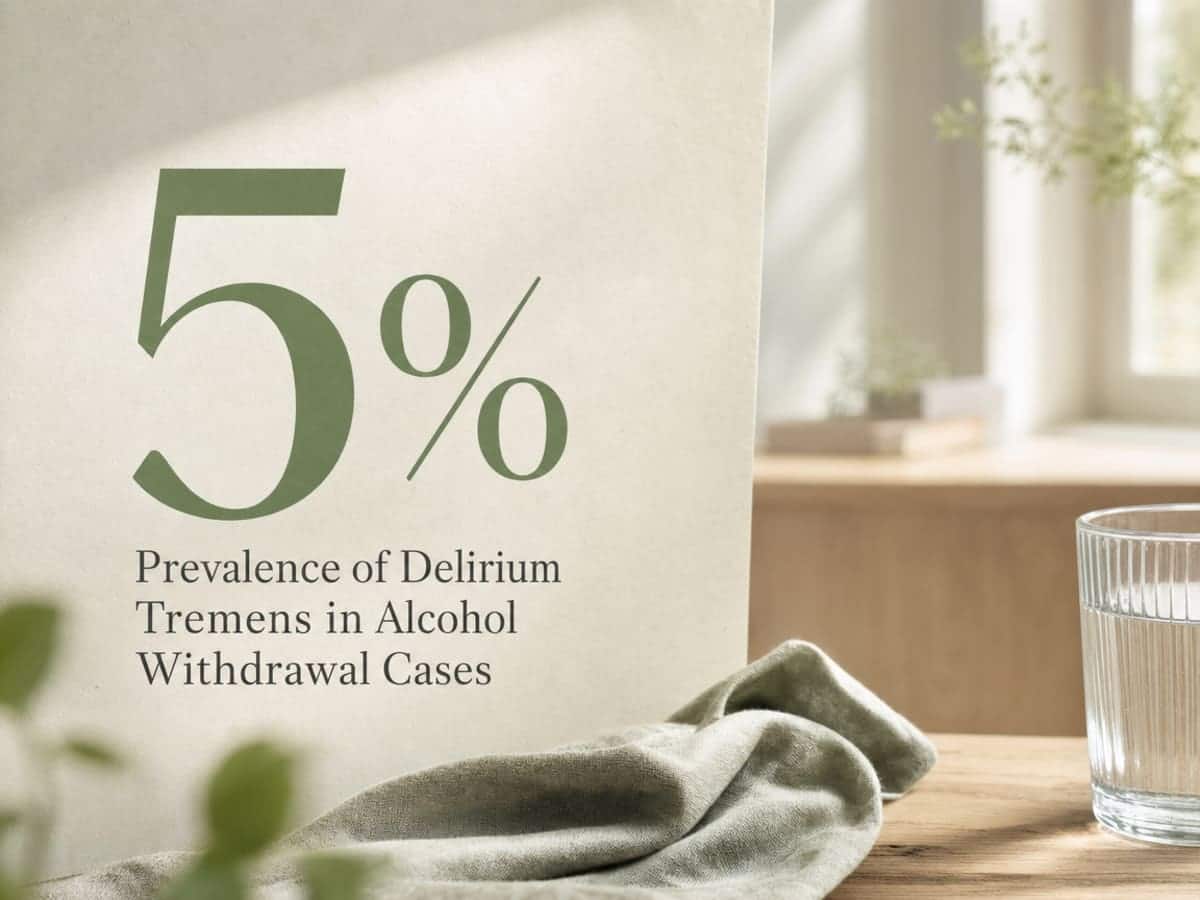
Here’s the number worth holding onto: about 5% of people who go through alcohol withdrawal develop delirium tremens 6. Read that denominator carefully. It’s not 5% of everyone who drinks. It’s not 5% of everyone who quits. It’s 5% of the population that actually enters withdrawal — meaning people whose bodies have adapted enough to react when alcohol leaves.
One in twenty sounds small until you’re the one. DTs carry a real mortality risk when untreated, and the people who develop them rarely see it coming on day one. They look like manageable cases at hour twelve and unravel at hour fifty 10.
The honest framing is this: most people who go through alcohol withdrawal will not develop DTs. But you can’t tell from the outside who the 5% will be, and the predictors — heavy long-term use, prior complicated withdrawal, medical comorbidities — are exactly the factors that should already have you talking to someone before you stop 1. The 5% isn’t a reason to panic. It’s a reason to stop guessing about which side of it you’re on.
What Supervised Detox Actually Looks Like
Outpatient Detox: When It’s a Reasonable Choice
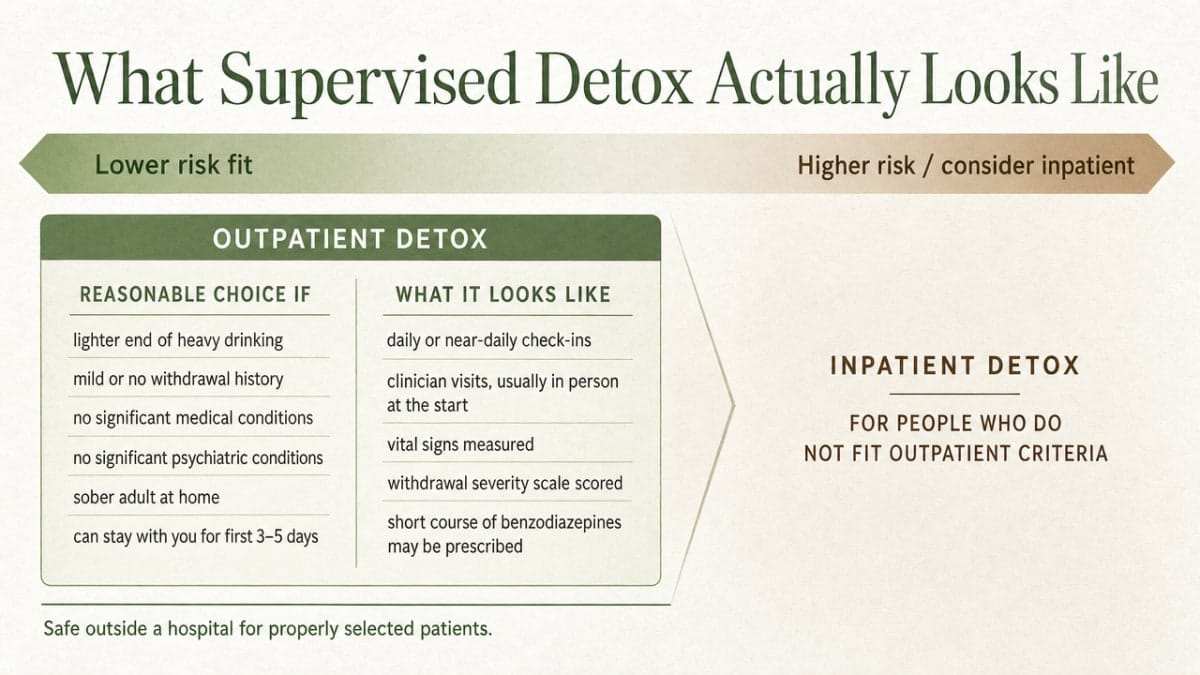
Outpatient detox isn’t a watered-down version of inpatient care. For the right person, it’s the appropriate level of care — and that person has a specific profile.
You’re likely a reasonable candidate for outpatient management if your drinking has been on the lighter end of heavy, your withdrawal history is mild or nonexistent, you have no significant medical or psychiatric conditions running in the background, and there’s a sober adult at home who can stay with you for the first three to five days. Properly selected patients can detox safely outside a hospital 8.
What it actually looks like: daily or near-daily check-ins with a clinician, usually in person at the start. Vital signs get measured. A withdrawal severity scale gets scored. You may be prescribed a short course of benzodiazepines on a tapering schedule, plus thiamine and fluids. Someone you trust holds the medication so you’re not dosing yourself in a fog.
If symptoms escalate between visits, the plan flips to inpatient. That’s the protocol, not a failure.
Inpatient or Residential Detox: When It’s the Defensible One
There’s a list of factors that, once you check even one, make inpatient detox the clinically defensible choice rather than the cautious one:
- A history of complicated withdrawal — seizures, DTs, or hospitalization for either.
- Daily heavy use sustained over years.
- Significant medical comorbidities: liver disease, heart conditions, uncontrolled diabetes, a history of head injury.
- Unstable psychiatric status, including active suicidality or untreated severe mental illness.
- No reliable sober person at home.
- Prior failed outpatient attempts 1, 9.
In a residential or hospital-based setting, the math changes in your favor in three concrete ways:
- Someone is checking your vitals every few hours around the clock, which means rising blood pressure or heart rate gets caught before it becomes a crisis.
- Medication is dosed by trained staff on a symptom-triggered protocol, so the benzodiazepines actually track what your body is doing rather than a guess from two days ago.
- If seizures or DTs appear in that 24-to-72-hour window, the response time is minutes, not however long it takes an ambulance to find your address 10.
This isn’t about being too sick to be home. It’s about not making your living room the place where a medical emergency has to be discovered.
Why Tapering Beats Willpower for Heavy Drinkers
If you’re a heavy daily drinker, the most dangerous thing you can do is decide tonight is the last drink and pour everything out before bed. Your nervous system can’t recalibrate that fast, and the steepness of the drop is what drives the worst symptoms.
A medically supervised taper — either with a slowly reducing dose of alcohol under clinical guidance, or more commonly with substitute benzodiazepines stepped down over days — lets the brain’s GABA and glutamate systems shift back toward baseline without the violent rebound 4. The endpoint is the same as cold turkey. The path doesn’t include a seizure on the bathroom floor.
Willpower isn’t the variable here. Two people with identical resolve can have completely different outcomes based on how their drinking pattern shaped their physiology. Tapering under supervision isn’t weakness. It’s the version of stopping that’s likeliest to actually end with you stopped.
“I Quit for Two Days, Felt Awful, Then Drank Again”
If this is you, read this part carefully: that wasn’t a failure of willpower. That was withdrawal.
What probably happened is your body started the cascade described earlier — shaking hands by hour twelve, racing heart by hour eighteen, the kind of dread at hour thirty that makes the walls feel wrong. You took a drink because the drink made it stop. And it did stop, almost immediately, because alcohol is the exact substance your nervous system has been demanding. That’s not weakness. That’s pharmacology doing what pharmacology does 4.
Here’s what matters more than the guilt: the fact that two days without alcohol made you feel that bad is itself the diagnostic answer to whether you can safely quit cold turkey. You can’t. Not alone. Your body has told you, in the most direct language it has, that it has adapted to daily alcohol and reacts hard when alcohol leaves. People with mild adaptation feel rough for a couple of days and then feel better. People who feel worse at hour forty than at hour twenty are showing the pattern that puts them in the population where seizures and DTs become real possibilities 1.
So the next attempt shouldn’t look like the last one. A clinician — urgent care, a primary doctor, a detox intake line — can review your drinking history, score your withdrawal risk, and either start a supervised taper or get you into a setting where the next 72 hours happen with someone watching the monitors 9. The drink you took to make it stop was information. Use it.
When to Stop Reading and Call Someone
Call 911 for the seizure, the confusion, or the chest pain. For the rest, an emergency department or an urgent care that handles withdrawal is the right next stop — not a clinic appointment three days from now. Severe alcohol withdrawal is life-threatening when it’s left to run its course, and the people who do best are the ones who arrived before the worst hours 7, 10.
If nothing on that list is happening but you’ve read this far and recognized yourself in the heavy-daily-use pattern, the call still matters. A detox intake line, an urgent care, or your primary doctor today is the difference between guessing and knowing.
After the First Week: What Detox Doesn’t Fix
If you make it through the first seven days with medical support, you’ll have done something real. Your vitals will have settled. The tremor will be gone. You’ll sleep, badly at first, then better. That’s worth naming as a win.
It’s also worth being honest about what detox isn’t. Getting alcohol out of your system handles the acute medical danger. It doesn’t handle the reasons you were drinking, the cravings that show up in week three when life gets normal again, or the rewiring your brain still has to finish over the months ahead. People who leave detox without a plan for what comes next tend to find themselves back in the same kitchen with the same bottle within weeks, and the next withdrawal is statistically harder than the last one 1.
That’s why the strongest detox programs hand you off, not out. Residential treatment, partial hospitalization, intensive outpatient, therapy for whatever’s underneath, a peer group, a follow-up plan with someone who knows your history — these aren’t extras. They’re what turns three safe days into a year you recognize. If you’re weighing where to start, a program like Arrow Passage Recovery that runs supervised detox into structured residential care is built for exactly this handoff. Detox is the door. What you walk into next is the part that decides whether the door stays closed behind you.
Talk to 24/7 Detox Specialists Right Now
Connect immediately for safe, guided alcohol withdrawal and support when considering quitting cold turkey.
Ready for Safe, Supported Alcohol Withdrawal?
Connect with experts who understand withdrawal risks and offer immediate support for your next step.
Frequently Asked Questions
Can you die from quitting drinking cold turkey?
Yes, though it’s uncommon in light or moderate drinkers. The danger lives with heavy, long-term, daily drinkers whose nervous systems have adapted to alcohol. In that group, untreated severe withdrawal can progress to seizures or delirium tremens, and DTs can be fatal without prompt treatment 7, 10. The risk isn’t theoretical, and it’s the reason supervised detox exists.
How long after your last drink is the seizure risk highest?
Acute withdrawal seizures usually appear 6 to 48 hours after your last drink, with the densest risk in the 24-to-48-hour window 3. They often arrive without warning and are typically generalized tonic-clonic. If you’re in that window and notice rising tremor, confusion, or a racing heart, you shouldn’t be alone or far from medical care 2.
What are the early warning signs that withdrawal is becoming dangerous?
Watch for a resting heart rate above 120, blood pressure that keeps climbing, a tremor you can’t steady, drenching sweats, vomiting you can’t keep down, and any confusion about where you are or what day it is. Hallucinations, fever above 101, or a seizure of any kind mean you need emergency care now, not later 7, 10.
Is it safer to taper off alcohol than to quit cold turkey?
For heavy daily drinkers, a medically supervised taper is the safer route. Stepping down gradually — usually with prescribed benzodiazepines under clinical oversight — lets your GABA and glutamate systems rebalance without the violent rebound that drives seizures 4. Tapering on your own with alcohol is risky because dosing is imprecise. The supervision is the part that matters.
Do I need inpatient detox, or can I do this at home?
If you’ve had prior withdrawal seizures, DTs, daily heavy use for years, significant medical or psychiatric conditions, or no sober adult at home, inpatient is the defensible choice 1, 9. Properly selected lower-risk patients can detox outpatient with daily clinical check-ins and medication oversight 8. The honest way to decide isn’t a self-quiz — it’s a conversation with a clinician who can score your risk and pick the level of care that fits.
I quit for a couple of days, felt terrible, and started drinking again. What does that mean?
It means your body is physically dependent, and what you felt was withdrawal, not weakness. Drinking again made the symptoms vanish because alcohol is exactly what your nervous system was demanding 4. That pattern is itself a clinical signal that you shouldn’t stop alone next time. Call a detox intake line or your doctor and let supervised care handle the next attempt 9.
References
- Alcohol Withdrawal Syndrome – StatPearls – NCBI Bookshelf. https://www.ncbi.nlm.nih.gov/books/NBK441882/
- Update on the Neurobiology of Alcohol Withdrawal Seizures. https://pmc.ncbi.nlm.nih.gov/articles/PMC1312739/
- Alcohol withdrawal syndrome: mechanisms, manifestations, and management. https://pmc.ncbi.nlm.nih.gov/articles/PMC6084325/
- Complications of Alcohol Withdrawal: Pathophysiological Insights. https://pmc.ncbi.nlm.nih.gov/articles/PMC6761825/
- Delirium tremens: MedlinePlus Medical Encyclopedia. https://medlineplus.gov/ency/article/000766.htm
- Alcohol Withdrawal – Harvard Health. https://www.health.harvard.edu/diseases-and-conditions/alcohol-withdrawal-a-to-z
- Alcohol withdrawal: MedlinePlus Medical Encyclopedia. https://medlineplus.gov/ency/article/000764.htm
- Inpatient and Outpatient Treatment for Alcohol Abuse, Alcohol Dependence and Alcohol Withdrawal. https://www.ncbi.nlm.nih.gov/books/NBK507689/
- Chapter on Alcohol Withdrawal Management (example from Treatment Improvement Protocol). https://www.ncbi.nlm.nih.gov/books/NBK64207/
- Delirium Tremens: Assessment and Management. https://pmc.ncbi.nlm.nih.gov/articles/PMC6286444/