
How to Vet a Recovery Center for Safety & Trust
Key Takeaways
- Verify state licensure by requesting the Ohio DBH license number in writing and matching the license category to the exact service your loved one needs, since outpatient, residential, and opioid treatment licenses are not interchangeable 4, 5.
- Confirm national accreditation through The Joint Commission or CARF for the specific building your loved one will enter, and ask about CMS certification when inpatient psychiatric or dual-diagnosis care is involved 8.
- Review the clinician roster for Ohio Chemical Dependency Professionals Board credentials like LCDC and LICDC, and ask about overnight staffing, prescriber access, and clinician-to-patient ratios so you know who is in the room at 2 a.m. 6, 8.
- Pressure-test the clinical model against NIDA and SAMHSA standards by asking how treatment plans are built, how length of stay is decided, how families are involved, and how co-occurring mental health conditions are treated in the same plan 9, 10.
Why verification beats reassurance when a life is on the line
You are not paranoid for asking hard questions. You are doing exactly what a person who loves someone in danger should be doing. Recovery center websites are designed to comfort you. The intake counselor sounds kind. The photos show sunlit group rooms. And still, none of that tells you whether your spouse, your child, or your parent will actually be safe inside those walls.
Here is the shift that helps: stop asking whether a center feels right. Start asking what you can verify.
That distinction matters because the federal government already treats addiction care as a place where preventable deaths happen. The CDC names drug overdose as a leading cause of preventable death in the United States, which is why treatment settings are expected to carry real medical infrastructure, not just good intentions 11. The clinical playbooks behind reputable programs, including NIDA’s research-based principles and SAMHSA’s Treatment Improvement Protocols, exist precisely because outcomes vary wildly from one facility to the next 9, 10.
So this guide hands you a checklist instead of a pep talk. Four pillars, each one verifiable through public records or a direct phone question:
- state licensure for the exact services offered,
- independent national accreditation,
- the credentials of the clinicians who will actually be in the room,
- and a clinical model that holds up against published standards.
You can do this. And by the time you finish reading, you will know what to look for, what to ignore, and what to say when admissions tries to redirect the conversation.
The four-pillar vetting framework
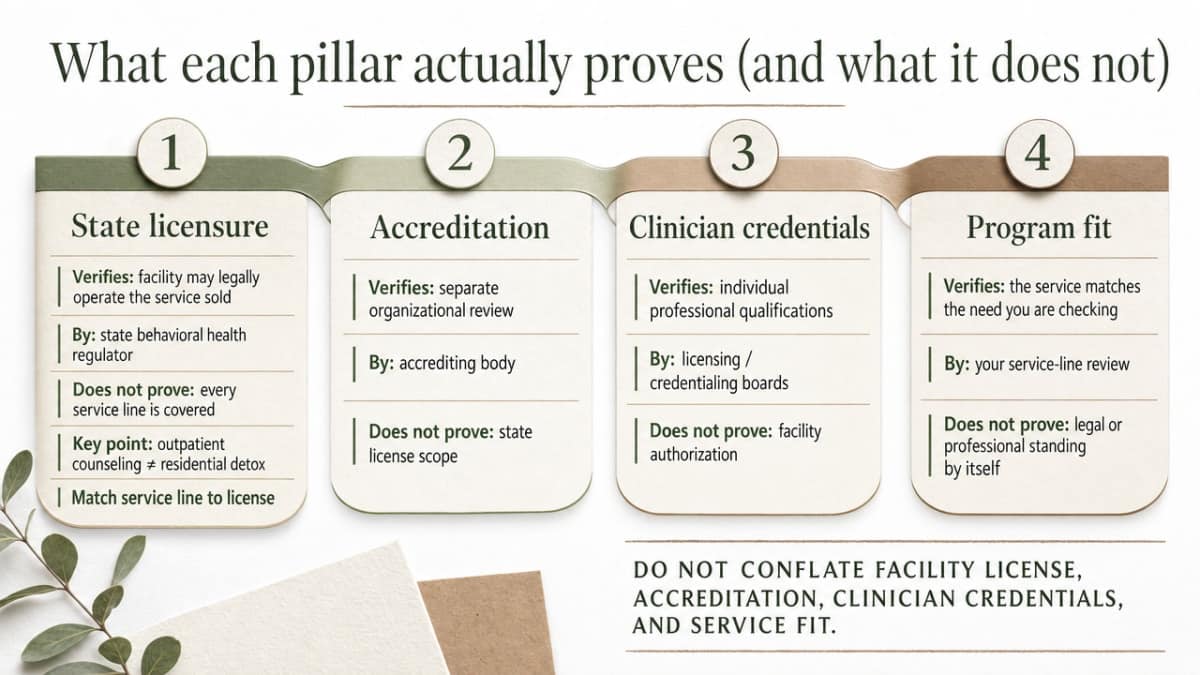
What each pillar actually proves (and what it does not)
Before you start dialing admissions lines, get clear on what each verifying body is actually responsible for. People conflate licensure, accreditation, and clinician credentials all the time, and centers count on that confusion when they answer your questions in ways that sound impressive but say nothing.
Here is how the four pillars split up.
- State licensure
- Tells you the facility itself is legally allowed to operate the specific service it is selling you. In Ohio, the Department of Behavioral Health regulates community outpatient providers, opioid treatment programs, psychiatric hospitals, and residential providers, and oversees more than 2,400 behavioral health providers across those categories 4, 5. A license to run outpatient counseling is not a license to run residential detox. The match between service line and license type is what you are checking.
- National accreditation
- Tells you an independent body has reviewed the organization against published clinical and operational standards. For facilities offering inpatient psychiatric or dual-diagnosis care, CMS layers on its own certification expectations, including records, staffing, active treatment programs, and the broader hospital conditions of participation 8. Accreditation is voluntary, but its absence is informative.
- Clinician credentialing
- Tells you the human beings in the room are individually qualified. In Ohio, the Chemical Dependency Professionals Board licenses clinicians who have specific substance use disorder training and education on top of any general counseling or nursing license 6. A licensed facility can still hire under-credentialed staff. Check both.
- Evidence-based clinical model
- Tells you the program design itself reflects what works, not just what fits in a brochure. That pillar lives in the next sections.
Pillar one: verify state licensure for the exact services offered
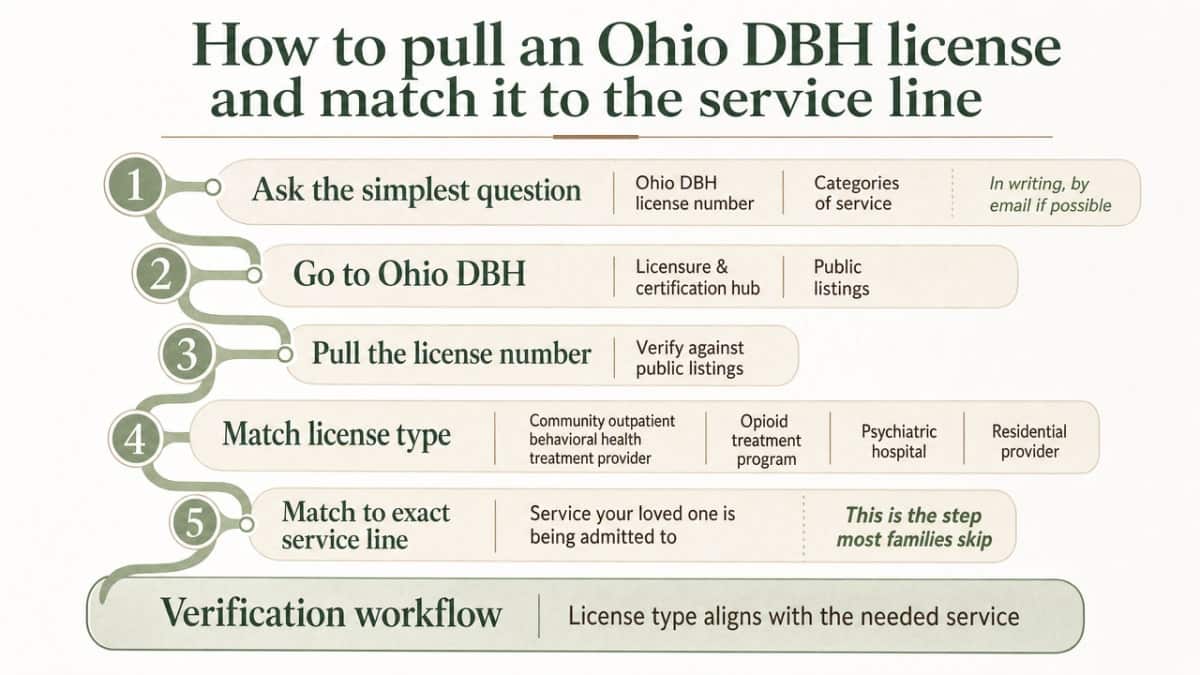
How to pull an Ohio DBH license and match it to the service line
Start with the simplest question a center should be able to answer in under a minute: what is your Ohio Department of Behavioral Health license number, and what categories of service does it cover?
If you are weighing a facility in Ohio, the Department of Behavioral Health is your first stop. The agency regulates community outpatient behavioral health treatment providers, opioid treatment programs, psychiatric hospitals, and residential providers, and it publishes the categories on its licensure and certification hub 4. Pull up that page. Then ask the center for their license number in writing, by email if possible, so you have a record you can verify against the public listings.
Once you have the number, match the license type to the exact service your loved one is being admitted to. This is the step most families skip. Ohio DBH oversees more than 2,400 behavioral health providers across distinct license and certificate categories, and those categories are not interchangeable 5. A program licensed for outpatient counseling is not authorized to run residential detox. A residential license does not automatically cover opioid treatment program services, which carry their own separate regulatory track.
So write down what your loved one actually needs:
- Medically supervised detox.
- Residential treatment.
- Dual-diagnosis psychiatric care.
Then check each one against the license categories the facility holds.
If a center tells you they “work with” a detox provider rather than running detox themselves, that is not a red flag by itself. It is a clarifying detail. It means you now need to vet the detox partner as a separate facility, with its own license number, before your loved one walks through that first door.
The phrasing to use when admissions dodges the question
Admissions counselors are trained to keep conversations warm and forward-moving. That is not malicious. It is their job. Your job is different. You need specific answers, and you may need to ask the same question two or three ways to get them.
Try this script. It is direct without being hostile.
“Can you give me the Ohio DBH license number for the residential program my husband would be admitted to, and confirm in an email that the license covers medically supervised detox?”Notice what that sentence does. It names the regulator. It names the service line. It asks for written confirmation. If the response is a general reassurance about being “fully licensed and accredited,” come back with:
“I understand. I am asking for the specific license number so I can match it against the Ohio DBH categories.”
If the answer is still vague after the second ask, you have your data point. A center that runs clean operations knows its license numbers cold and shares them without friction. You are not being rude. You are doing the work that keeps your person safe.
Pillar two: confirm national accreditation and, where relevant, CMS certification
Once you have the state license in hand, the next question is whether anyone outside Ohio has looked at this place. State licensure says the facility is allowed to operate. National accreditation says an independent body has measured how it operates against published standards.
The two most recognized accreditors in addiction treatment are The Joint Commission and CARF. Either one is a credible signal. Ask the center which one they hold, when the most recent survey was completed, and whether the accreditation covers the specific program your loved one will enter. A corporate parent can hold accreditation while a newer satellite location waits in line for its own survey. Get the answer for the building your person will actually sleep in.
For facilities that offer inpatient psychiatric care or dual-diagnosis services on a hospital license, a second layer applies. CMS certifies psychiatric hospitals against the federal conditions of participation, which require maintained records, qualified staffing, and active treatment programs designed around each patient 8. If a center markets itself as a psychiatric hospital or distinct-part psychiatric unit, ask whether it is CMS-certified and what its most recent survey found.
One practical note: accreditation reports themselves are usually not public the way restaurant inspections are. You will not get the full document. You can, and should, ask for the accreditor’s name, the certificate, and the date range it covers. A center proud of its standing will email those without hesitation.
If a facility is unaccredited, that is not automatic disqualification, but the burden of proof shifts to them. They now need to walk you through, in detail, how their clinical protocols, staffing model, and outcomes tracking compare to programs that do hold accreditation. A vague answer here, paired with anything soft in the first pillar, is enough information to keep looking.
Pillar three: read the clinician roster, not the founder bio
Ohio chemical dependency credentials and what the letters mean
A facility can be perfectly licensed and still hand your loved one off to staff who are out of their depth. That is why the third pillar is about people, not buildings.
In Ohio, the agency you want to know is the Ohio Chemical Dependency Professionals Board. It licenses clinicians who carry additional substance use disorder training and education on top of any general counseling or social work credential they already hold 6. That extra layer matters. A licensed professional counselor without the chemical dependency credential may be a fine therapist for grief or anxiety, and still not the right person to manage early-recovery cravings, withdrawal-related mood swings, or the specific relapse patterns that show up in residential care.
When you ask for the clinical roster, look for letters tied to that board. The most common ones you will see include LCDC (Licensed Chemical Dependency Counselor) at various levels, and LICDC (Licensed Independent Chemical Dependency Counselor), which is the higher independent-practice credential. You do not need to memorize every tier. You need to know that the board lists these professionals publicly and that the center should be willing to tell you which staff members carry which credentials.
Ask for it by name.“Can you send me a list of the clinicians who would work directly with my daughter, and their Ohio CDP board credentials?”If the answer dances around the question, that is your answer.
Staffing ratios, prescribers, and who is actually in the room at 2 a.m.
Daytime staffing is the easy sell. Overnight staffing is where the truth lives.
Ask three specific questions.
- Clinician-to-patient ratio: what is the ratio during the day, and what is it overnight? You are not looking for a magic number. You are looking for a center that knows its own ratios and will state them without checking with a manager.
- Prescribing: who handles prescribing? In a quality residential program, a physician, psychiatric nurse practitioner, or addiction medicine specialist is available for medication management, including medications for opioid use disorder when clinically appropriate. Ask whether prescribers are on-site, on-call, or contracted, and how quickly they can be reached overnight.
- Overnight presence: who is physically in the building at 2 a.m. when your husband cannot sleep, his anxiety is spiking, and he is thinking about leaving? A registered nurse? A behavioral health technician with no clinical license? Both? CMS expects psychiatric hospitals to maintain staffing adequate to support active treatment programs around the clock, and that same logic applies to any serious residential program 8.
You are not trying to trip anyone up. You are trying to picture the actual night your loved one might need help. If the answers are specific, you can breathe a little. If they are vague, keep asking.
Pillar four: pressure-test the clinical model against NIDA and SAMHSA standards
Individualized care, length of stay, and the multiple-needs test
A program can be licensed, accredited, and well-staffed and still hand your loved one a generic 30-day plan that ignores who they actually are. The fourth pillar is about clinical design, and the two clearest yardsticks come from NIDA’s research-based principles and SAMHSA’s Treatment Improvement Protocols 9, 10.
NIDA is direct about it: effective treatment attends to the multiple needs of the individual, not just the drug use itself 9. That means the intake conversation should cover medical history, mental health, family relationships, work or school, legal issues, and housing. If admissions cannot tell you how they assess those areas before they build a treatment plan, the plan is going to be a template.
Ask three questions on the first call. They map directly to the standards.
- How do you build the initial treatment plan, and who is involved? A green-flag answer names a comprehensive biopsychosocial assessment, a treatment team that includes a clinician and a prescriber, and the patient themselves. A red-flag answer is some version of “we follow our standard program.” SAMHSA TIPs frame assessment and cooperative care planning as baseline practice, not premium features 10.
- How is length of stay decided? NIDA notes that plans should be developed cooperatively and adjusted over time 9. A center that pre-commits everyone to exactly 28 days, regardless of progress, is running a calendar, not a clinical program.
- How are families involved? Quiet exclusion of the family is a warning sign. Coordinated involvement, with the patient’s consent, is a TIP-aligned norm 10.
Dual diagnosis: where lower-quality programs quietly fail
If your loved one has a mental health condition alongside addiction, this is the section to read twice. PTSD, depression, anxiety, bipolar disorder, and trauma do not pause while someone gets sober. Programs that treat them as background noise are the ones where relapse hits hardest.
NIDA is clear that effective treatment addresses co-occurring conditions as part of the same plan, not as an afterthought referred out to a separate provider 9. SAMHSA’s TIPs go further, with dedicated protocols on co-occurring disorders that spell out integrated assessment, coordinated medication management, and therapy that targets both conditions at once 10.
So ask the question plainly.“My wife has PTSD and an alcohol use disorder. Will the same clinical team treat both, in the same building, on the same treatment plan?”Listen for specifics:
- A psychiatric prescriber on staff.
- A trauma-informed therapy modality named by name, such as EMDR or trauma-focused CBT.
- A care plan that updates as her mental health symptoms shift in early sobriety.
Integrated dual-diagnosis care is not a marketing phrase. It is a clinical operating model. Ask the center to describe theirs in concrete terms.
The overdose-readiness and MAT litmus test
Every center will tell you they keep patients safe. Fewer can tell you how. This pillar sits a little outside the four-pillar framework because it cuts across all of them, and it is the question that matters most when the worst-case scenario is the one you are trying to prevent.
Drug overdose is a leading cause of preventable death in the United States, and the CDC frames evidence-based treatment and harm-reduction services as central to changing that number 11. Translate that into vetting language: a residential program that takes overdose risk seriously will have specific answers about specific tools. A program that does not will give you philosophy.
Ask five questions and listen for concrete responses.
- Is naloxone stocked on-site, and which staff are trained to use it?
- Do you offer medications for opioid use disorder, including buprenorphine or methadone, either directly or through a coordinated prescriber?
- What medical monitoring is in place during the first 72 hours of detox, when overdose and withdrawal complications peak?
- Who responds if a patient becomes medically unstable overnight, and how fast?
- What is the protocol for the first 30 days after discharge, when relapse risk and overdose risk are highest?
One answer deserves extra attention. If a center frames medication-assisted treatment as optional, philosophical, or something they “do not believe in,” weigh that carefully. MAT is not a lifestyle choice. For opioid use disorder in particular, access to these medications is a safety infrastructure question, and abstinence-only programs may simply lack it 11. You are allowed to ask, and you are allowed to keep looking if the answer leaves your loved one without that layer of protection.
Insurance, parity, and the affordability questions worth asking
Money is the conversation no one wants to have when someone they love is in danger. Have it anyway. Cost confusion is one of the ways families end up settling for a center that did not earn their trust.
Start with parity. Under the Mental Health Parity and Addiction Equity Act, health plans that offer mental health and substance use benefits must provide them at parity with medical and surgical care, meaning the limits, copays, and prior authorization rules cannot be stricter than what your plan applies to a cardiac admission or a surgical stay 1. If a plan is telling you that residential addiction treatment is capped at a few days while a comparable medical admission would not be, that is a question worth raising with the insurer in writing.
When you call admissions, ask three things:
- What is the all-in daily rate for the level of care being recommended?
- What does your plan cover after deductible, and what is the expected out-of-pocket?
- Will the center handle the prior authorization and any medical-necessity appeals directly with the insurer?
A center comfortable with its own value will give you numbers, not vibes.
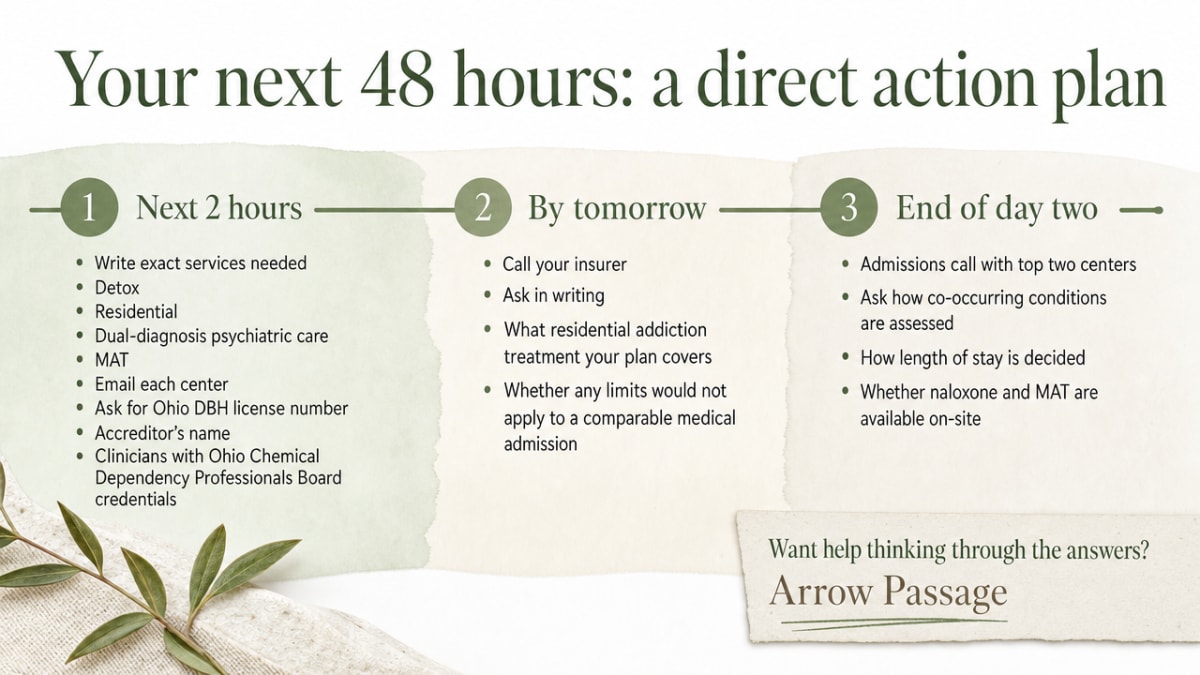
Your next 48 hours: a direct action plan
You have read enough. Now do the small, concrete things that move this forward today.
- In the next two hours, write down the exact services your loved one needs: detox, residential, dual-diagnosis psychiatric care, MAT. Email each center you are considering and ask for their Ohio DBH license number, their accreditor’s name, and a list of clinicians with Ohio Chemical Dependency Professionals Board credentials.
- By tomorrow, call your insurer and ask, in writing, what residential addiction treatment your plan covers and whether any limits would not apply to a comparable medical admission.
- By the end of day two, run a short admissions call with your top two centers. Ask how they assess co-occurring conditions, how length of stay is decided, and whether naloxone and MAT are available on-site.
If you want help thinking through the answers, Arrow Passage Recovery’s admissions team can walk you through them by phone.
Speak With an Admissions Specialist Right Now
Get immediate guidance on safe, trusted recovery options for your loved one.
Connect Now to Review Safe Recovery Options
Speak with a trusted advisor about secure, supportive care for your loved one’s recovery journey.
Frequently Asked Questions
How do I check if a recovery center is licensed in Ohio?
Go to the Ohio Department of Behavioral Health licensure and certification hub, which lists the categories the state regulates, including community outpatient, opioid treatment programs, psychiatric hospitals, and residential providers 4. Ask the center for its license number in writing, then confirm the license type matches the exact service your loved one needs.
What is the difference between state licensure and national accreditation?
State licensure means the facility is legally allowed to operate a specific service line, like residential treatment or detox. National accreditation, through bodies like The Joint Commission or CARF, means an independent reviewer has measured the program against published clinical and operational standards. Licensure is required. Accreditation is voluntary but tells you more about quality.
What credentials should the clinicians treating my loved one hold?
In Ohio, look for licensure through the Ohio Chemical Dependency Professionals Board, which credentials clinicians with specific substance use disorder training beyond a general counseling or social work license 6. Common letters include LCDC and LICDC. Ask for a list of the clinicians who will work directly with your loved one and their board-issued credentials.
Should I avoid programs that do not offer medication-assisted treatment?
For opioid use disorder, MAT access is a safety question, not a philosophy debate. The CDC frames evidence-based treatment, including medications for opioid use disorder, as central to overdose prevention 11. A program that rules out MAT entirely may lack the infrastructure to protect against overdose during early recovery. Ask whether buprenorphine or methadone is available directly or through a coordinated prescriber.
How do I know if a center can actually handle a co-occurring mental health condition?
Ask whether the same clinical team treats both conditions, in the same building, on the same plan. NIDA principles call for treatment that addresses multiple needs of the individual, not just substance use 9. Listen for a psychiatric prescriber on staff, a named trauma-informed therapy like EMDR or trauma-focused CBT, and a care plan that adjusts as mental health symptoms shift.
What questions should I ask admissions on the first phone call?
Ask five things. What is your Ohio DBH license number for this specific program? Who accredits you, and when was your last survey? Which clinicians hold Ohio Chemical Dependency Professionals Board credentials 6? How do you assess and treat co-occurring conditions? Is naloxone on-site, and is MAT available? Specific answers are a good sign. Vague reassurance is also an answer.
References
- Mental Health and Substance Use Insurance Help – HHS.gov. https://www.hhs.gov/programs/health-insurance/mental-health-substance-use-insurance-help/index.html
- CMS Behavioral Health Strategy. https://www.cms.gov/about-cms/what-we-do/cms-behavioral-health-strategy
- IBH (Innovation in Behavioral Health) Model – CMS. https://www.cms.gov/priorities/innovation/innovation-models/ibh
- Licensure and Certification – Ohio Department of Behavioral Health. https://dbh.ohio.gov/supporting-providers/licensure-and-certification
- Types of Licenses and Certificates. https://dbh.ohio.gov/wps/portal/gov/dbh/supporting-providers/licensure-and-certification/types-of-licenses-and-certificates
- Treatment – Ohio Chemical Dependency Professionals Board. https://ocdp.ohio.gov/get-certified-licensed/treatment/welcome
- MLN9560465 – Substance Use Screenings & Treatment – CMS. https://www.cms.gov/files/document/mln9560465-substance-use-screenings-treatment.pdf
- Psychiatric Hospitals – CMS. https://www.cms.gov/medicare/health-safety-standards/certification-compliance/psychiatric-hospitals
- Principles of Drug Addiction Treatment: A Research-Based Guide (Third Edition). https://nida.nih.gov/sites/default/files/podat-3rdEd-508.pdf
- SAMHSA/CSAT Treatment Improvement Protocols (TIPs). https://www.ncbi.nlm.nih.gov/books/NBK82999/
- Overdose Prevention. https://www.cdc.gov/overdose-prevention/index.html