
Key Takeaways
- Call SAMHSA’s National Helpline at 1-800-662-HELP within the first 48 hours and assemble your loved one’s ID, income proof, and medical history in one folder so every caseworker, intake nurse, and admissions counselor gets the same packet 21, 23.
- Quoted residential rates above $26,000 a month are the cash-pay starting price, not what uninsured families actually pay once SAPT slots, sliding-fee schedules, or Medicaid attach to the case 6, 17.
- Roughly one in three low-income adults with substance use disorders are uninsured or have gaps in coverage, so admissions staff and county caseworkers handle these situations routinely 7, 24.
- Run enrollment, safety-net funding, and facility outreach in parallel rather than sequence, since each track moves at a different speed and the fastest door opens care first 4, 17.
- File a Medicaid application today even if you assume denial, and check Medicare or Marketplace special enrollment for those who fall outside Medicaid’s income limits 3, 4, 5.
- Ask treatment programs directly about SAPT-funded slots, and use FQHCs or Look-Alikes for sliding-fee outpatient counseling and MAT while waiting on a residential bed 13, 15, 17.
- Push accredited facilities past the cash-pay quote by asking about scholarship beds, charity care, retroactive Medicaid billing, and step-downs from residential to PHP or IOP, and use the ED when crisis cannot wait 9, 10.
- Start medications for opioid use disorder this week through an FQHC or certified opioid treatment program rather than waiting for residential, since fewer than 1 in 5 people with OUD receive these FDA-approved medications 25.
What to do in the first 48 hours when your loved one needs rehab and has no coverage
If you are reading this with a knot in your stomach because the person you love is ready for help and you just realized they have no insurance, take one breath. You have not missed the window. Treatment for uninsured adults exists as a real, funded system, and you can start moving it today.
Here is what the next two days look like when you work it well. Call SAMHSA’s National Helpline at 1-800-662-HELP. It is free, confidential, runs 24/7 in English and Spanish, and the operators will name local programs that take uninsured patients and walk you through what to ask 21. While you have them on the line, ask specifically about state-funded treatment slots and sliding-fee providers near you 22.
Then open a notebook. Write down your loved one’s legal name, date of birth, Social Security number, current income (or zero), and any prior diagnoses. You will hand this same information to a Medicaid caseworker, a hospital intake nurse, and an admissions counselor at an accredited facility, possibly all in one afternoon 23.
You are not asking for charity. You are activating systems your tax dollars already paid for. The rest of this guide shows you how.
The sticker price versus what uninsured families actually pay
Before you make another call, it helps to know what you are actually looking at on a price sheet. A 2024 Health Affairs study cited by NIDA found that the average quoted cost of a single month at a residential addiction treatment facility was over $26,000, with many programs asking for substantial money up front 6. That number is real. It is also almost never what an uninsured family ends up paying when they work the safety-net system properly.
Hold those two facts side by side. The sticker price exists because residential care is staff-intensive, medically supervised, and often 28 days or longer. But the same federal and state infrastructure that funds rehab for low-income people is built to put a different number in front of you. Federally qualified health centers, for example, are required to charge on a sliding fee scale based only on income and family size, not on whether you have a card in your wallet 13, 16. For many families at or below the federal poverty line, behavioral health visits and medication-assisted treatment at these sites come down to a nominal fee per visit.
State-funded residential beds work differently. When a SAPT-supported program admits your loved one, the state has already paid the facility for the slot. Your out-of-pocket cost may be zero, a small co-pay tied to income, or a contribution tied to any income the person does have 17, 24. The waiting list, not the bill, is usually the harder problem.
So when an admissions counselor leads with the cash-pay rate, do not let that number end the conversation. It is the starting price for someone with no funding stream attached. Your job over the next few days is to attach one.
You are not the only family without coverage right now
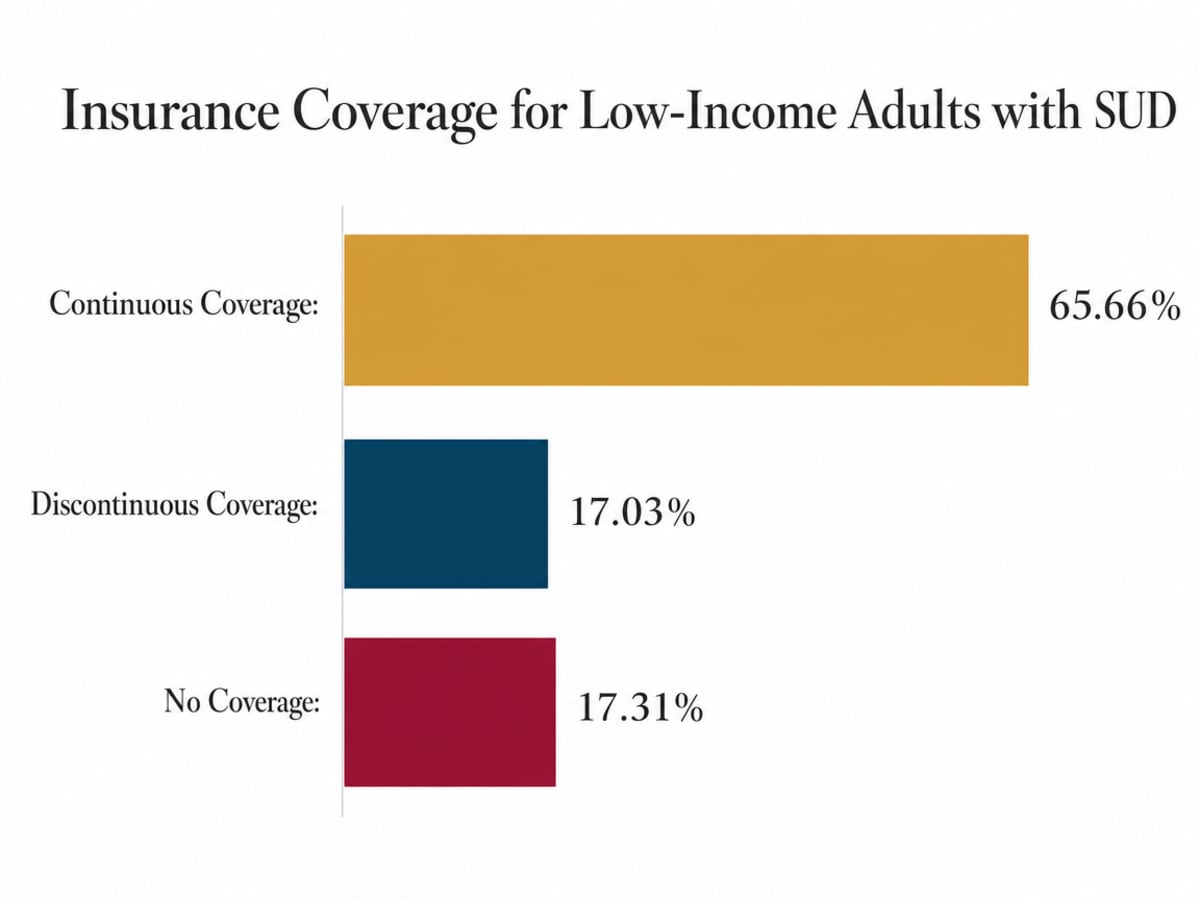
If shame is part of what you are carrying tonight, set it down. The gap your loved one is in is bigger and more common than the people in your life probably realize. A peer-reviewed study tracking low-income adults with substance use disorders after the Affordable Care Act took effect found that, across the study year, 65.66% had continuous coverage, 17.03% had discontinuous coverage, and 17.31% had no coverage at all 7. Roughly one in three of the people the system was supposed to catch were either uninsured or in and out of a plan.
That is the population your family belongs to right now, and it is the population the safety net was built to serve. The same study found that gaps in coverage were tied to reports of unmet need for treatment, which is the formal way of saying what you already feel: the bureaucracy is the problem, not your loved one’s worth.
The reason this matters for the next phone call you make is simple. Admissions counselors, county caseworkers, and FQHC intake staff see uninsured SUD patients every week. You are not asking them to do something unusual. State-funded slots, sliding-fee schedules, and block grant dollars exist precisely because Congress and state legislatures know coverage gaps are routine 17, 24. When you say “my husband has no insurance,” the person on the other end of the line should already be pulling up the right form. If they are not, call the next number on your list.
The three-track plan: run these in parallel, not in sequence
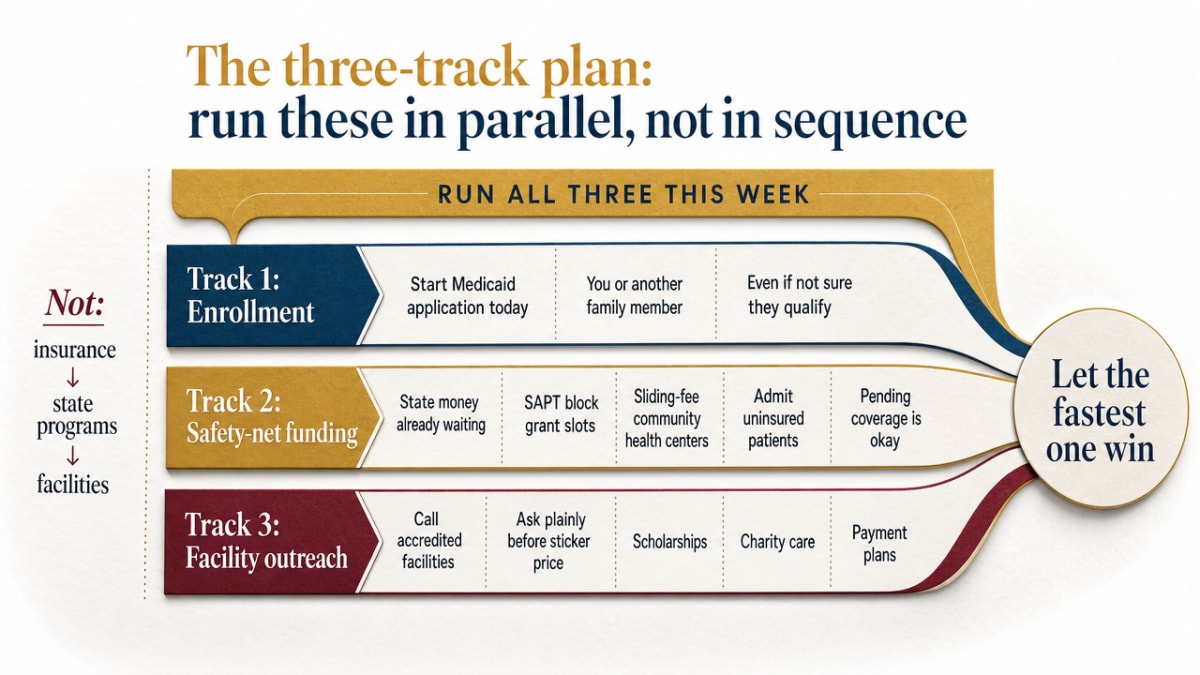
Most families lose weeks because they treat this like a checklist: try insurance first, then state programs, then call facilities. Do not do that. Each track moves at a different speed and depends on different people, so run all three this week and let the fastest one win.
Track one is enrollment. You or another family member starts a Medicaid application for your loved one today, even if you are not sure they qualify 4. Track two is the safety-net money already waiting in your state, including SAPT block grant slots and sliding-fee community health centers that admit uninsured patients regardless of pending coverage 17, 23. Track three is the phone tree of accredited facilities themselves, where you ask plainly about scholarships, charity care, and payment plans before anyone quotes you a sticker price.
Track one: enroll in coverage your loved one may already qualify for
Medicaid: the fastest path for low-income adults
Start here, even if you assume the answer is no. Many adults who walk into rehab uninsured actually qualify for Medicaid the day they apply. They have not enrolled because no one told them to, because their income just dropped, or because the last time they tried, the rules were different. Ohio expanded Medicaid years ago, and the income threshold for a single adult is higher than most families guess.
Apply online through your state Medicaid portal today, or walk into the county jobs and family services office with a photo ID and any proof of income (or a written statement of zero income). Most states process SUD-related applications quickly, and some Medicaid programs let admissions counselors at certified treatment programs help with the paperwork directly 4.
Once coverage is approved, it typically pays for detox, residential, partial hospitalization, intensive outpatient, and medication-assisted treatment at any Medicaid-participating facility. Approval can also be retroactive, meaning bills from care that started during the application window may end up covered. Ask the admissions team whether they will hold a bed or start treatment while the application is pending.
Medicare and Marketplace plans for the people Medicaid misses
If your loved one is over 65, or has been on Social Security Disability for 24 months, they likely qualify for Medicare. Medicare covers inpatient and outpatient SUD treatment, partial hospitalization, and counseling, which surprises a lot of families who assume it is only for routine medical care 3.
If income is too high for Medicaid but too low for a comfortable cash-pay plan, the federal Marketplace is the next stop. A job loss, a divorce, or losing employer coverage triggers a special enrollment period, so you do not have to wait for open enrollment. Premium tax credits often bring monthly costs into double digits for lower-income households, and once a plan is active, parity rules require it to cover SUD benefits comparably to medical care 5, 28. Pick a plan that lists the facilities you are already calling as in-network.
Track two: tap the safety-net dollars built for uninsured SUD patients
SAPT Block Grant: the federal money behind most state-funded rehab beds
Most of the state-funded rehab beds you will hear about on the phone this week trace back to one funding stream: the Substance Abuse Prevention, Treatment, and Recovery Services Block Grant. SAMHSA sends this money to every state, and states are explicitly allowed to use it to fund priority treatment and support services for individuals without insurance or for whom coverage is terminated for short periods of time
17. That sentence is the legal reason your loved one can walk into a state-contracted program tomorrow with no card and still get care.
SAMHSA itself has been blunt that the block grant remains essential even after Medicaid expansion, because so many people still fall through the cracks 24. When you call a treatment program, the question to ask is direct: “Do you have SAPT-funded slots, and is one open?” Some programs hold a fixed number of beds for this funding. Others draw from a county allocation that turns over weekly.
If a bed is not open today, ask to be put on the waiting list in writing and ask what bridge services, such as outpatient counseling or MAT, the program can start while you wait.
FQHCs and sliding-fee clinics: outpatient counseling and MAT without a bill shock
While you are waiting on a residential slot or a Medicaid decision, the person you love does not have to go without care. Federally Qualified Health Centers are required by HRSA to run a sliding fee discount program that adjusts fees based on the patient’s ability to pay, with eligibility determined solely by income and family size 13. Insurance status is not part of the formula. Whether your husband has a card or nothing, the front desk asks the same questions and applies the same schedule 16.
For families at or below the federal poverty line, that usually means a nominal fee per visit for behavioral health counseling, psychiatric medication management, and in many centers, buprenorphine or naltrexone for opioid use disorder. HRSA’s billing rules also require these centers to keep collection practices reasonable and tied to ability to pay, so a missed payment does not become a collections threat that pushes your loved one out of care 20.
If the nearest FQHC’s waitlist is long, ask about a Health Center Program Look-Alike in your county. Look-Alikes operate under the same sliding-fee requirements and serve underserved areas, often with integrated behavioral health on site 15. Bring last month’s pay stubs, an unemployment letter, or a written statement of zero income to the first appointment. That single sheet of paper sets the price.
Ohio’s navigator hub and the Residential State Supplement
If you are in Ohio, you have one phone tree that simplifies a lot of this. The Ohio Department of Mental Health and Addiction Services positions itself as the connector, stating it is ready to connect you to the services and resources that you need to support prevention, treatment, and recovery
18. Use it. Ask specifically about state-contracted SUD providers in Stark, Summit, or Cuyahoga County, and ask what the local Alcohol, Drug Addiction and Mental Health Services board (the ADAMHS board) funds for uninsured residents in your area.
One Ohio program worth knowing about for the months after detox and residential care is the Residential State Supplement. RSS provides financial and Medicaid assistance to adults with disabilities who want to live in the community,
including those with qualifying behavioral health conditions 19. It is not a treatment funding stream, but housing instability is one of the most common reasons people relapse in the first 90 days home. If your loved one will leave a program without a stable place to land, ask the discharge planner whether they qualify for RSS while they are still in treatment, not after.
Track three: call accredited facilities and ask the right questions
Scholarships, charity care, and payment plans that admissions teams rarely volunteer
When you call an accredited treatment facility, the first number you hear is almost never the last number on the table. Admissions counselors are trained to quote the cash-pay rate because that is what is on their script. They are not trained to lead with what comes next, so you have to ask.
Start with one direct question: “What financial assistance does your program offer for uninsured patients?” Then keep going:
- Ask whether the facility has scholarship beds funded by donors or a parent foundation.
- Ask whether they offer charity care or a hardship discount based on income, and what documentation they need to apply.
- Ask whether they accept SAPT-funded referrals from the county 17.
- Ask whether they will hold a bed while a Medicaid application is pending, and whether they bill retroactively if coverage is approved 4.
If the answer to all of those is no, ask about a payment plan with no interest, a reduced length of stay paired with a step-down to intensive outpatient, or a smaller upfront deposit than the one they first quoted. A 28-day residential stay can be restructured as 14 days of residential plus six weeks of PHP or IOP for a fraction of the price.
Get every number and every condition in writing before you say yes. The same facility that quoted one figure on Monday often has a different one on Wednesday once a counselor checks with their billing director.
Hospital emergency departments as an entry point, not a dead end
If the person you love is in a medical crisis tonight, an overdose, withdrawal that has turned dangerous, or a mental health emergency tied to substance use, the emergency department is the right door. Hospitals are legally required to stabilize anyone who walks in, regardless of insurance, and more of them are now staffed to start treatment in the ED itself.
The American Hospital Association has pushed Congress to expand funding for hospital programs that initiate medications for opioid use disorder and link patients to ongoing care, and many systems are building exactly that capacity 10. Ask the ED social worker two things: can the hospital start buprenorphine before discharge, and can they refer directly into a state-funded outpatient or residential bed 9. Then ask the financial counselor about charity care for the ED visit itself before you leave.
Comparing your four real funding pathways side by side
You have heard the three tracks separately. Here is what they look like next to each other, so you can decide which doors to push hardest on this week. The right answer for most families is some combination of all four, sequenced by which one opens first.
| Pathway | Typical out-of-pocket exposure | How fast it moves | Best fit |
|---|---|---|---|
| State SUD fund / SAPT-supported program | $0 to a small income-based co-pay 17, 24 | Days to weeks; depends on bed availability | Residential or detox when income is low and a slot is open |
| FQHC sliding-fee outpatient with MAT | Adjusted by income and family size; often a nominal per-visit fee 13, 16 | Often same week | Counseling, buprenorphine, or naltrexone while you wait on residential |
| Accredited private facility with scholarship plus payment plan | Quoted residential rates exceed $26,000 per month before any discount 6; reduced via scholarship, charity care, or step-down to PHP/IOP | Days, if a scholarship bed is open | When clinical need is urgent and Medicaid is not yet approved |
| Medicaid enrollment | $0 to minimal co-pays once approved 4 | Application can be processed quickly; coverage may be retroactive | Low-income adults, including many who assume they will not qualify |
Read the table as a sequencing tool, not a menu. File the Medicaid application today, start sliding-fee outpatient this week, ask every accredited facility about scholarship beds and SAPT-funded slots, and let whichever door opens first carry your loved one into care.
Medications for opioid use disorder: do not let cost push this off the plan
If opioids are part of your loved one’s story, the single most protective thing you can do this month is get them on medication, even before a residential bed opens. NIDA reports that fewer than 1 in 5 people with opioid use disorder are treated with the FDA-approved medications that reduce overdose deaths, methadone, buprenorphine, and naltrexone 25. The gap is not because the drugs are unaffordable on their own. It is because families assume medication has to wait for the “real” treatment to start. It does not.
An FQHC or Health Center Program Look-Alike with a buprenorphine prescriber can start your loved one on medication this week at a sliding-fee rate tied to income, not insurance status 13, 15. Certified opioid treatment programs dispense methadone and are often funded through the same state SUD dollars covering residential beds 4, 17. Ask the admissions counselor at every facility you call whether they can bridge with MAT during the wait. A prescription that prevents an overdose buys you the time to finish the rest of the plan.
Crowdfunding, honestly: a supplement, not a strategy
You will see GoFundMe links in your search results, and friends will suggest one within a day of finding out. It can help. It is not the plan.
The research on medical crowdfunding is sobering. A peer-reviewed analysis in the American Journal of Public Health found that campaign success tracks the strength of a person’s social network and the polish of their story far more than it tracks actual clinical need, which means the families who most need the money are often the ones least likely to raise it 27. Qualitative work with patients who turned to crowdfunding for treatment costs found they used it not just for direct medical bills but for living expenses and the hard months after care, gaps the formal system left open 8.
So treat it as bridge money. Use a campaign to cover the deposit a facility will not waive, the prescription co-pays during the Medicaid wait, or the rent your loved one needs paid while they are in a 28-day program. Do not let it replace the calls to the state, the FQHC, or the admissions office.
Your call list and paperwork stack for this week
Pin this somewhere visible. By Friday, you want each of these numbers dialed and each of these documents in one folder.
Call, in this order:
- SAMHSA National Helpline at 1-800-662-HELP for referrals to programs that take uninsured patients 21, 22.
- Your county Medicaid office or state portal to start an application today 4.
- The Ohio Department of Mental Health and Addiction Services, or your state’s equivalent, to ask which local providers hold state-funded SUD slots 18.
- The nearest federally qualified health center or Look-Alike to schedule a sliding-fee intake and ask about buprenorphine 13, 15.
- Two or three accredited residential facilities to ask, in plain words, about scholarship beds, charity care, payment plans, and whether they will hold a bed during a pending Medicaid application 17.
Stack, in one folder:
- Photo ID
- Social Security card or number
- Proof of income or a written zero-income statement
- Last month’s pay stubs or unemployment letter
- Any prior treatment records you can pull
- A single page with your loved one’s diagnoses, medications, and emergency contacts
That folder is the key that opens every door on the list.
A closing note for the family member running point
You are the one making the calls tonight, and that work counts even when no one in your house thanks you for it. The person you love did not have to decide they were ready twice, and you do not have to solve this alone in one evening.
What you are doing is real advocacy. Filing the Medicaid application, asking an admissions counselor a harder question than they expected, sitting on hold with the state for forty minutes, walking into an FQHC with a folder of pay stubs. Each of those is a door that opens a little wider for the next family behind you, too.
If you want a second set of eyes on the plan you are building, an accredited treatment team, including the one at Arrow Passage Recovery in Ohio, can walk through your options with you and tell you honestly which doors are open this week.
Connect Now for Immediate Rehab Guidance
Speak directly with a caring specialist about options for rehab without insurance.
Connect Today to Explore Recovery Payment Solutions
Get clear guidance on affordable rehab options without insurance for your loved one’s care.
Frequently Asked Questions
Can my loved one actually get into rehab today without insurance?
Yes, often within days. State-contracted programs hold SAPT-funded slots specifically for uninsured patients, and federally qualified health centers see uninsured people at sliding-fee rates the same week 17, 13. Call SAMHSA’s National Helpline at 1-800-662-HELP to find which local programs have open beds tonight 21.
What is the first phone call I should make this morning?
Call SAMHSA’s National Helpline at 1-800-662-HELP. It is free, confidential, 24/7, and the operators refer you to local programs that accept uninsured patients and sliding-fee providers in your county 21, 22. Have a notebook ready for program names, intake numbers, and what each one needs to start admission.
If a facility quotes $26,000 a month, is that what we will actually pay?
Almost never, when the safety net is working. The $26,000 figure reflects quoted residential rates in a 2024 Health Affairs adolescent study 6. Once you attach Medicaid, a SAPT-funded slot, scholarship, or charity care, your actual out-of-pocket can drop to zero or a small income-based co-pay 17, 24.
Does my loved one qualify for Medicaid even if they have never applied?
Possibly, and it is worth applying today. Many adults assume they earn too much or do not qualify, but expansion states like Ohio raised the income threshold, and a recent job loss or zero income often opens eligibility immediately. Apply through your state portal or county office; some treatment programs help with paperwork directly 4.
What if we cannot wait for paperwork and need detox right now?
Go to a hospital emergency department. Hospitals must stabilize anyone in crisis regardless of insurance, and many now start buprenorphine in the ED and link patients directly to ongoing care 9, 10. Ask the social worker about state-funded detox transfers and the financial counselor about charity care before discharge.
Should we start a GoFundMe to pay for treatment?
Treat it as bridge money, not the plan. Research shows crowdfunding success tracks social network strength more than clinical need, so families who need it most often raise the least 27. Use a campaign for deposits, prescription co-pays, or rent during a 28-day stay, after you have pursued Medicaid, SAPT slots, and sliding-fee care 8.
References
- Need help paying for substance use disorder treatment? (Minnesota CCDTF). https://mn.gov/dhs/people-we-serve/adults/health-care/alcohol-drugs-addictions/programs-and-services/ccdtf.jsp
- Mental Health and Substance Use. https://www.ncdhhs.gov/assistance/mental-health-and-substance-use-disorders
- Mental health & substance use disorders. https://www.medicare.gov/coverage/mental-health-substance-use-disorder
- Accessing and Locating Treatment (Arizona AHCCCS). https://www.azahcccs.gov/Members/BehavioralHealthServices/OpioidUseDisorderAndTreatment/Locating_Treatment.html
- The Mental Health Parity and Addiction Equity Act (MHPAEA). https://www.cms.gov/marketplace/private-health-insurance/mental-health-parity-addiction-equity
- Residential addiction treatment for adolescents is scarce and expensive. https://nida.nih.gov/news-events/news-releases/2024/01/residential-addiction-treatment-for-adolescents-is-scarce-and-expensive
- Healthcare coverage and service access for low-income adults with substance use disorders after implementation of the Affordable Care Act. https://pmc.ncbi.nlm.nih.gov/articles/PMC9086121/
- The Use of Medical Crowdfunding to Mitigate the Personal Costs of Treatment among Canadian Patients: A Qualitative Study. https://pmc.ncbi.nlm.nih.gov/articles/PMC10697184/
- Supporting Patients and Caregivers Facing Substance Use Disorders. https://www.aha.org/news/perspective/2025-09-26-supporting-patients-and-caregivers-facing-substance-use-disorders
- AHA Urges Congress to Address Addiction Treatment Barriers. https://www.aha.org/lettercomment/2024-11-20-aha-urges-congress-address-addiction-treatment-barriers
- SAMHSA Announces $40 Million in Funding Opportunities to Prevent Addiction, Child Trauma, Suicide, and Mental Illness. https://www.hhs.gov/press-room/samhsa-announces-funding-opportunities-prevent-addiction-child-trauma-suicide-mental-illness.html
- Departments of Labor, Health and Human Services, Treasury issue final rules on mental health parity requirements. https://www.dol.gov/newsroom/releases/ebsa/ebsa20240909
- Chapter 9: Sliding Fee Discount Program. https://bphc.hrsa.gov/compliance/compliance-manual/chapter9
- Sliding Fee Discount Program Site Visit Protocol. https://bphc.hrsa.gov/compliance/site-visits/site-visit-protocol/sliding-fee-discount-program
- Health Center Program Look-Alikes. https://www.hrsa.gov/opa/eligibility-and-registration/health-centers/fqhc-look-alikes
- Health Center Program Compliance Frequently Asked Questions. https://bphc.hrsa.gov/compliance/health-center-program-compliance-faqs
- Substance Use and Mental Health Block Grants. https://www.samhsa.gov/grants/block-grants
- Learn and Find Help. https://dbh.ohio.gov/get-help/learn-and-find-help
- Residential State Supplement. https://dbh.ohio.gov/get-help/recovery-supports/residential-state-supplement
- Chapter 16: Billing and Collections. https://bphc.hrsa.gov/compliance/compliance-manual/chapter16
- National Helpline for Mental Health, Drug, Alcohol Issues – SAMHSA. https://www.samhsa.gov/find-help/helplines/national-helpline
- Help for mental health, drugs, alcohol: No Insurance – SAMHSA. https://www.samhsa.gov/find-support/health-care-or-support/professional-or-program/no-insurance
- Free & Low Cost Treatment Options for Mental Health and Substance Use – SAMHSA. https://www.samhsa.gov/find-support/how-to-pay-for-treatment/free-or-low-cost-treatment
- The Substance Abuse Prevention and Treatment Block Grant is still Important even with the Expansion of Medicaid. https://www.samhsa.gov/data/report/substance-abuse-prevention-and-treatment-block-grant-still-important-even-expansion-medicaid
- Medications for Opioid Use Disorder | National Institute on Drug Abuse. https://nida.nih.gov/research-topics/medications-opioid-use-disorder
- Assessment of Annual Cost of Substance Use Disorder in US Hospitals. https://pmc.ncbi.nlm.nih.gov/articles/PMC7936257/
- Medical Crowdfunding and Disparities in Health Care Access in the United States. https://pmc.ncbi.nlm.nih.gov/articles/PMC8887155/
- Mental Health and Substance Use Disorder Parity. https://www.dol.gov/agencies/ebsa/laws-and-regulations/laws/mental-health-and-substance-use-disorder-parity
- Treatment for Alcohol Problems: Finding and Getting Help. https://www.niaaa.nih.gov/publications/brochures-and-fact-sheets/treatment-alcohol-problems-finding-and-getting-help