
10 Signs of a Functioning Alcoholic You Might Miss
Key Takeaways
- A growing pour and rising tolerance signals the body adapting to more alcohol, which is a clinical criterion for alcohol use disorder rather than proof someone handles it well 6.
- When every evening comes with a built-in justification to drink, the reasons become scaffolding for the habit, not isolated occasions.
- Using alcohol as the main tool to quiet anxiety carries a fivefold higher risk of dependence within three years compared with people who don’t drink to cope 3.
- Small acts of hiding, like an extra pour during bedtime or downplaying the count, show the disorder is already managing perception to protect itself 12.
- Weekly Sunday irritability is often mild withdrawal showing up as personality, tied to alcohol’s lingering effects on mood, sleep, and the nervous system 1.
- Memory gaps and mismatched recollections of an evening mean the brain stopped recording, reflecting AUD’s cognitive effects even in people whose days look intact 1.
- Work performance can hold while focus, stamina, and stress tolerance erode underneath, with the cost paid in energy that no longer makes it home 2, 4.
- Forgotten pickups, missed appointments, and early-ending bedtimes stack into a pattern of spillover between drinking, work stress, and family roles 4.
- Weight changes, restless sleep, rising blood pressure, and flagged liver enzymes reflect alcohol’s reach across nearly every organ system, even at non-catastrophic levels 9.
- When attempts to talk about cutting back trigger defensiveness, deflection, or short-lived promises, that’s impaired control protecting the drinking, a defining feature of AUD 6.
What you’re seeing at home is data, not disloyalty
You’ve been keeping a quiet list. The second glass that turned into a third while dinner was still cooking. The way the recycling bin sounds heavier on Tuesdays. The slight edge in your partner’s voice when you asked, gently, if maybe tonight could be a dry one.
And then you talk yourself out of the list. He still gets up for work. She still makes the school lunches. The mortgage is paid. Nobody’s been pulled over. So you fold the laundry, pour your own glass of water, and tell yourself you’re being dramatic.
You’re not being dramatic. You’re noticing.
What you’re seeing at home is information, and it deserves the same respect you’d give any other pattern in your life. People with alcohol use disorder often keep working, parenting, and paying bills for a long stretch while the drinking quietly changes who they are 6. The outside still looks like the person you married. The inside is where the shift is happening, and you’re usually the first one close enough to feel it.
This article walks through ten signs you may have already half-noticed, and what to do with what you know.
Why “functioning” is the word that keeps you stuck
The gap between how they look and how they feel
Here’s the part that might land harder than you expect: the people in treatment for alcohol use disorder almost always describe themselves as worse off than their families do. In one NIH-backed study, patients reported substantial functional impairment across work, relationships, and mental health, while their concerned family members consistently perceived greater functioning than the patients themselves reported 5.
Read that twice. The person drinking knows it’s bad. You, watching from the outside, are calibrating off what you can see. And what you can see is the version they’re working hardest to maintain.
This isn’t a failure of your attention. It’s the design of the thing. Your partner is pouring everything they have into the parts of the day you witness, which is exactly why the cracks show up in places you don’t, like the private 3 a.m. wake-ups, the ruminating commute, the quiet calculation of how much is left in the bottle. The word “functioning” is doing real damage here, because it describes the surface and tells you to ignore the basement. If you’ve been waiting for the outside to catch up to your gut, that wait could last years. Your instinct is the earlier signal.
How common this actually is
If part of you keeps thinking “but our life doesn’t look like an alcoholic’s life,” it’s worth knowing how wide the door to that diagnosis really is. In recent national survey data, about 1 in 7 men, 1 in 11 women, and 1 in 33 adolescents meet diagnostic criteria for alcohol use disorder 7. That is not a rare condition tucked into the corners of society. That is a coworker, a neighbor, a parent at pickup, a name on your holiday card list.
Most of those people are not unhoused, not unemployed, not visibly in crisis. They’re packing lunches and answering emails and showing up to the in-laws on Sunday. The reason functioning AUD is so often missed isn’t because the signs are exotic. It’s because the signs sit next to a life that still mostly works.
You’re not jumping to conclusions by taking this seriously. You’re joining millions of other households quietly doing the same math at the kitchen table.
The 10 signs spouses tend to explain away
1. The pour keeps getting bigger, and so does the tolerance
You used to share a bottle of wine over dinner and that was the night. Now the bottle is empty before the dishes are done, and a second one gets opened “just to finish the show.” The pour itself has changed too. The glass that used to be filled to a polite line is filled to the rim, and refills happen without ceremony.
Here’s what you’ve probably told yourself: he’s just unwinding, she handles it fine, nobody’s slurring. That’s the trap. Tolerance is not a sign that drinking is under control. It’s a sign that the body has adapted to more alcohol, which means more alcohol is now the baseline. Needing more to feel the same effect is one of the clinical criteria for alcohol use disorder 6. The pour growing quietly over months is the body keeping a ledger you can’t see.
2. There’s always a reason to drink tonight
Mondays are rough. Fridays earned it. Wednesday had that meeting. Saturday is Saturday. The kid’s recital went well, the kid’s recital went badly, the in-laws are coming, the in-laws just left.
You’ve probably noticed that the calendar has stopped having ordinary nights. Every evening gets a small justification attached to it, and the justifications stack so naturally that no single one feels like a red flag. This is the part where people with AUD continue drinking despite the pattern itself becoming the problem 12. The reasons aren’t lies, exactly. They’re the scaffolding that holds the habit up. If you tried to imagine a random Tuesday with no drink in it, and your stomach tightened a little, that reaction is information. The need for a reason every night usually means the reason is the drinking.
3. The unwind drink is doing the work of therapy
You know that look. The shoulders drop a quarter inch on the first sip. The jaw unclenches. The exhale is audible. You’ve probably told yourself this is just how adults decompress, and for a lot of people, occasionally, it is.
What concerns clinicians is when the drink becomes the primary tool for managing anxiety, low mood, or the residue of a hard day. In the research on co-occurring anxiety and alcohol use, people with anxiety disorders who drank specifically to cope showed a fivefold increased risk for developing alcohol dependence within three years compared with those who did not drink to cope 3. That’s a narrow finding about a specific behavior, but it points at something you may already sense. If alcohol is the only thing that quiets your partner’s mind at night, the mind is not actually getting quieter. It’s getting more dependent on a chemical pause. The anxiety, the irritability, the racing thoughts at 2 a.m. don’t go away. They go underground and come back hungrier.
4. The secrecy is small, but it’s there
It’s rarely dramatic. It’s an extra glass poured while you’re putting the kids down. A beer in the garage before coming inside. The receipt tucked into a different pocket. A casual “I only had two” when you watched the third get poured.
You’ve probably noticed and not said anything, because calling it out would feel like an accusation over something small. Small is the point. The hiding tells you that some part of your partner already knows the amount is not okay, which is why they’re managing your perception of it. People with AUD often continue drinking even when it causes problems at work, school, or home, and they often shape what others see to keep doing so 12. The secrecy isn’t betrayal. It’s the disorder protecting itself.
5. Sunday mornings have a tone
Saturday night is loose and warm. Sunday morning is short-fused. The coffee gets made in silence. A normal question about the grocery list gets a sharper answer than it deserves. By noon things soften, by evening you’re laughing again, and you tell yourself everyone is a little crabby sometimes.
Pay attention to the rhythm. When the morning-after irritability becomes a weekly weather pattern, you’re watching mild withdrawal, not personality. Alcohol affects mood, sleep, and the nervous system in ways that linger well past the last drink, and chronic use is linked to anxiety, depression, and memory problems even in people who keep functioning 1. The Sunday tone isn’t who your partner is. It’s who alcohol is making them on the back end of a heavier night.
6. The story of last night doesn’t quite match yours
You bring up something they said at dinner and they laugh it off, but the laugh is a beat too long. They don’t remember texting their sister at 11. They ask what time you came to bed, in a way that suggests they don’t know they were already there.
You’ve probably written this off as tired, as overworked, as having one too many. Memory gaps after drinking are not normal forgetfulness. They mean the brain crossed a line where it stopped recording, and AUD’s effects on memory and cognition show up even in people whose days still look intact 1. If you’ve started softly correcting their version of an evening, or worse, doubting your own, that’s not a small thing. That’s the disorder reshaping the household’s shared reality.
7. Work still happens, but something is fraying underneath
The job is intact. The reviews are still good. The paycheck still hits. So when you notice the late starts, the quiet Monday call-outs, the project that used to be effortless and now requires a closed door and a longer lunch, you tell yourself everyone has off weeks.
Heavy or dependent drinking quietly undermines workforce health and productivity long before anyone gets fired, and the effects on focus, stamina, and stress tolerance show up first in the parts of the job nobody is grading 2. Work and family domains also bleed into each other. Problems in one show up as friction in the other, and alcohol amplifies both directions 4. Your partner may still be performing. The cost of that performance is getting paid somewhere, often in the energy that used to come home to you.
8. The small misses with the kids and the calendar
The forgotten permission slip. The pickup that almost didn’t happen. The dentist appointment that got rescheduled twice. The bedtime story that ended early because Dad fell asleep on the couch with his shoes on.
Each one is explainable on its own. Stacked together, they become a pattern, and patterns are what matter. Spillover between drinking, work stress, and family roles tends to show up exactly here, in the seams of daily life that used to hold without effort 4. You’ve probably been picking up the slack and telling yourself it’s just a busy season. If the slack only flows one direction, and it’s been flowing that way for months, the busy season has a name.
9. The body is sending receipts
The weight has changed. Sleep is restless but somehow they’re tired all day. The skin looks different. There’s a low-grade stomach thing that never quite resolves. Blood pressure crept up at the last physical. They wave it off, blame the desk job, promise to start running again.
Alcohol affects nearly every organ system, and a systematic review of its effects describes consequences across the liver, heart, brain, gastrointestinal system, and immune function, even at levels that don’t look catastrophic from the outside 9. The same review notes that drinking harms the people around the drinker, not just the drinker themselves 9. You’re not imagining the changes. The body is keeping a record your partner may not be ready to read yet. If a doctor has gently flagged liver enzymes, blood pressure, or sleep, that flag is worth taking seriously now, not at the next physical.
10. The conversation about cutting back goes sideways every time
You’ve tried. Maybe in the car on the way home. Maybe after a night that scared you. Maybe in a careful, rehearsed way over coffee. The response is some version of the same thing every time. Defensiveness. A pivot to something you did. A promise to cut back that sounds real and lasts four days. Or the silent treatment that makes you feel like you’re the one who broke something.
This is one of the clearest signs you’re not dealing with a habit. You’re dealing with a disorder. A defining feature of AUD is continuing to drink despite knowing it’s causing problems, and an impaired ability to stop or control use even when someone genuinely wants to 6. If the conversation can’t happen without it turning into a fight or a vanishing act, that’s not stubbornness. That’s the part of the brain that has started protecting the drinking from anything that threatens it, including you.
Is this actually alcohol use disorder, or are you overreacting?
You’re not overreacting. You’re checking your reading against a clinical definition, which is the right instinct.
Alcohol use disorder is diagnosed on a spectrum, from mild to severe, based on how many of eleven criteria fit over the past year:
- Drinking more or longer than intended.
- Wanting to cut down and not being able to.
- Spending a lot of time drinking or recovering.
- Cravings.
- Drinking that gets in the way of work, school, or home.
- Continuing to drink despite relationship problems.
- Giving up things that used to matter.
- Drinking in situations that aren’t safe.
- Drinking even though it’s worsening a physical or mental health issue.
- Needing more for the same effect.
- Withdrawal symptoms when not drinking 6, 12.
You don’t have to be the one who decides this. A primary care doctor or a licensed counselor can. Your job is to take what you’ve noticed seriously enough to ask.
![Visualize the DSM-5 AUD severity spectrum referenced in this section, which lists the 11 criteria and the mild/moderate/severe thresholds explicitly cited from sources [ref_6] and [ref_12]](https://www.arrowpassage.com/wp-content/uploads/2026/06/signs-of-a-functioning-alcoholic-content-0.jpg "10 Signs of a Functioning Alcoholic You Might Miss 1")
Why waiting for rock bottom is the wrong plan
Somewhere along the way, you may have absorbed the idea that nothing changes until your partner crashes hard enough to want it themselves. A DUI. A blown job. A medical scare. The story goes that until then, your hands are tied.
That story is wrong, and it’s costing households years.
Most people with alcohol use disorder live in the mild-to-moderate range, and that’s exactly the window where treatment is most effective and least disruptive 6. Waiting for the severe end means waiting for more organ damage, more eroded trust, more lost time with your kids, and a brain that has spent more years rewiring itself around alcohol 9. The bottom isn’t a magical motivator. It’s just more damage to recover from.
You don’t have to stage a crisis or deliver an ultimatum tonight. You only have to stop treating early action as premature. Noticing what you’ve noticed, and asking for help while your partner still has a job and a family to protect, is the strongest position you’ll ever be in.
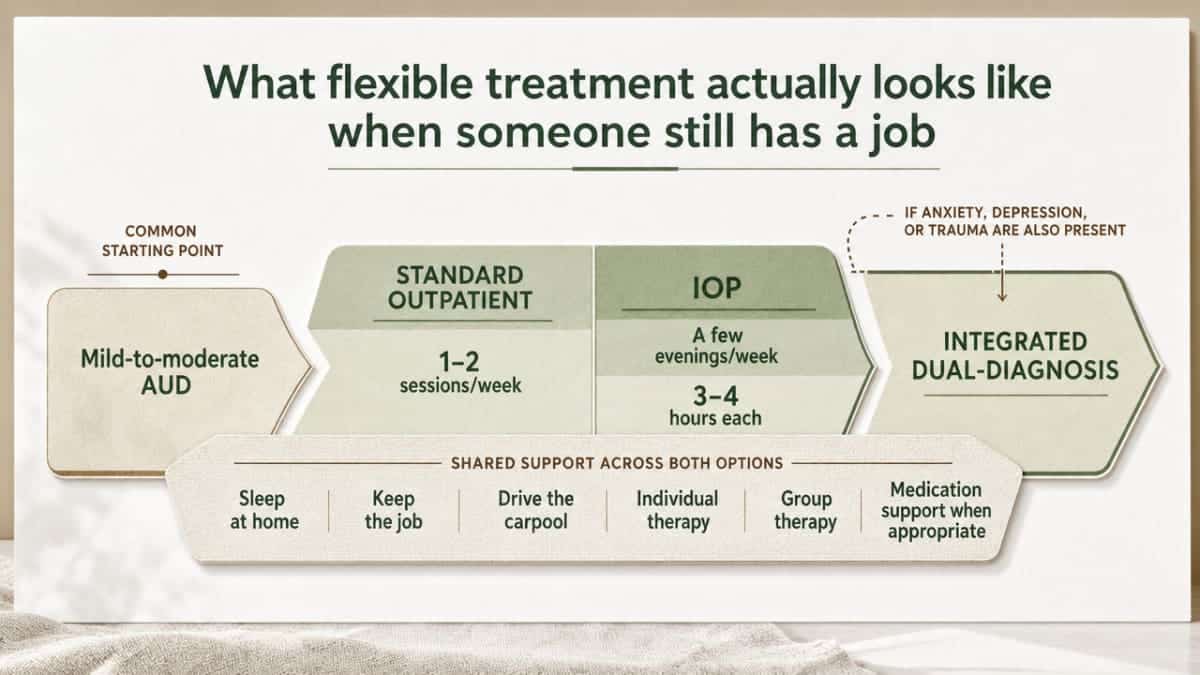
What flexible treatment actually looks like when someone still has a job
The picture in your head of “treatment” might be a 30-day inpatient stay in a place far from home. That picture is real for some people, but it isn’t the only door, and it isn’t the first one most functioning drinkers walk through.
Intensive outpatient programs (IOP) typically run a few evenings a week, three or four hours at a time. Standard outpatient is lighter, often one or two sessions a week. Both let your partner sleep at home, keep the job, drive the carpool, and still get real clinical care, including individual therapy, group therapy, and medication support when appropriate 12. For mild-to-moderate AUD, which is where most functioning drinkers actually sit, this level of care is often the right starting point 6.
If your partner is also carrying anxiety, depression, or unprocessed trauma underneath the drinking, integrated dual-diagnosis treatment matters. Treating only the alcohol while the anxiety goes untouched, or only the anxiety while the drinking continues, tends to leave the cycle intact. Coordinated care for both at the same time is the model SAMHSA points to as the more effective path 8.
Flexible doesn’t mean watered down. It means the plan fits the life you’re trying to protect.
What you can do this week
You don’t need a plan for the next year. You need a plan for the next seven days.
Start by writing down what you’ve actually seen, with dates if you can. The Sunday tone. The pour size. The missed pickup. Not as a case to prosecute, but as a record for yourself, so the next time you doubt your read, the list is there.
Call your partner’s primary care doctor and ask for a confidential conversation, or book a session for yourself with a licensed counselor who treats AUD and co-occurring anxiety or depression 8. You’re allowed to get help before your partner does. That’s often how this starts.
If you want a neutral first call, SAMHSA’s National Helpline is free, confidential, and available 24/7, with referrals to local outpatient and dual-diagnosis options 10. Ohio families looking for flexible IOP or outpatient care that fits around work and parenting can ask Arrow Passage Recovery what a first conversation looks like.
Noticing was the hard part. You’ve already done it.
Talk to Someone Who Understands Right Now
Get immediate support and guidance for concerns about high-functioning alcohol use in your loved one.
Take the First Step Toward Lasting Change
Connect with a caring expert to explore flexible, real-world treatment options that fit your family’s needs.
Frequently Asked Questions
Can someone really be an alcoholic if they still go to work every day?
Yes. Alcohol use disorder is defined by the relationship between a person and alcohol, not by whether they’ve lost a job or a license. People with AUD often keep working, parenting, and paying bills while the disorder progresses underneath 6. Holding a job is not proof everything is fine. It’s often what makes the problem easier to miss.
How do I tell the difference between heavy drinking and alcohol use disorder?
Heavy drinking is about amount. AUD is about loss of control. The clinical line is whether someone keeps drinking despite problems at work, home, or with their health, and whether they can stop when they decide to 12. If your partner has tried to cut back and couldn’t, or keeps drinking after it’s caused real harm, that’s the disorder, not just the volume.
Do we have to wait until my spouse hits rock bottom before treatment will work?
No, and waiting usually makes things harder. Most people with AUD live in the mild-to-moderate range, where treatment tends to be most effective and least disruptive to work and family life 6. The longer drinking continues, the more physical and emotional damage stacks up 9. Early action while your partner still has a life worth protecting is the stronger position.
What if my partner is also dealing with anxiety or depression?
This is more common than not, and it changes the treatment plan. When a mental health condition and a substance use disorder sit side by side, SAMHSA calls it co-occurring or dual diagnosis, and integrated care that treats both at the same time tends to work better than treating either alone 8. Ask any program you’re considering whether they handle both together.
Can my spouse get help without taking 30 days off work?
Yes. Intensive outpatient programs typically meet a few evenings a week, and standard outpatient is lighter still. Both let your partner sleep at home and keep working while getting therapy, group support, and medication when appropriate 12. For mild-to-moderate AUD, which is where most functioning drinkers actually sit, outpatient care is often the right starting point 6, not a downgrade.
How do I bring this up without starting another fight?
Pick a sober moment, not the morning after a hard night. Speak from what you’ve seen, not what you’ve concluded. “I’ve noticed” lands better than “You always.” Name one specific pattern, not the whole list. If the conversation still goes sideways, that’s information too. You can also call SAMHSA’s free, confidential helpline first for guidance on how to approach it 10.
References
- Alcohol Use and Your Health. https://www.cdc.gov/alcohol/about-alcohol-use/index.html
- Work Stress and Alcohol Use. https://pmc.ncbi.nlm.nih.gov/articles/PMC6760381/
- Co-Occurring Alcohol Use Disorder and Anxiety: Bridging Psychiatric, Psychological, and Neurobiological Perspectives. https://pmc.ncbi.nlm.nih.gov/articles/PMC6927748/
- Family, Work, Work-Family Spillover and Alcohol Abuse during Midlife. https://cde.wisc.edu/wp-content/uploads/sites/278/2019/01/cde-working-paper-1998-08.pdf
- Functioning of adults in alcohol use disorder treatment. https://pmc.ncbi.nlm.nih.gov/articles/PMC7530911/
- Understanding Alcohol Use Disorder. https://www.niaaa.nih.gov/publications/brochures-and-fact-sheets/understanding-alcohol-use-disorder
- Alcohol Use Disorder: From Risk to Diagnosis to Recovery. https://www.niaaa.nih.gov/health-professionals-communities/core-resource-on-alcohol/alcohol-use-disorder-risk-diagnosis-recovery
- Co-Occurring Disorders and Other Health Conditions. https://www.samhsa.gov/substance-use/treatment/co-occurring-disorders
- Effects of Alcohol Consumption on Various Systems of the Human Body: A Systematic Review. https://pmc.ncbi.nlm.nih.gov/articles/PMC9637453/
- National Helpline for Mental Health, Drug, Alcohol Issues. https://www.samhsa.gov/find-help/helplines/national-helpline
- Alcohol Facts and Statistics. https://www.niaaa.nih.gov/publications/brochures-and-fact-sheets/alcohol-facts-and-statistics
- Alcohol Use Disorder (AUD). https://medlineplus.gov/alcoholusedisorderaud.html