
Key Takeaways
- PCP signs cluster into three tiers: acute emergencies needing 911, behavioral patterns tracked over weeks, and lingering psychiatric symptoms that persist after use stops 1.
- Dissociation is the clinical signature — a person physically present but disconnected from their body and surroundings, often with unfocused eyes, slowed speech, and heavy movement 1.
- Call 911 for seizures, coma-like states, irregular breathing, severe hypertension, muscle rigidity, or agitation you cannot safely manage — these require emergency sedation, not waiting it out 3, 5.
- Document episodes in plain factual notes: retrograde amnesia, nystagmus, hypertension, and psychomotor agitation are the observations clinicians weigh most heavily 6.
- Episodes vary because effects are dose-dependent and often complicated by co-use with alcohol or marijuana, so run fresh triage every time rather than comparing to the last night 8, 6.
- PCP appears as powder, crystal, tablets, capsules, or liquid — and the liquid coating cigarettes or joints is what families overlook most often 12.
- A home drug test won’t settle suspicion: only about one in four clinician-diagnosed PCP cases were confirmed by urine assay, and testing cannot diagnose a use disorder 9, 16.
- When memory problems, depression, paranoia, or psychosis-like symptoms persist after use stops, that signals the need for integrated dual-diagnosis assessment rather than substance treatment alone 1.
- The next right call doesn’t require certainty or permission — SAMHSA’s National Helpline offers free, confidential treatment referral 24/7, every day of the year 14.
What You’re Actually Watching For
If you’re reading this at 2 a.m. with the lamp on, you already know something is wrong. You don’t need a checklist of twenty generic warning signs. You need to know what you’re actually looking at when your son won’t make eye contact and seems to be staring through the wall, or when your wife came home Tuesday night unable to remember the drive.
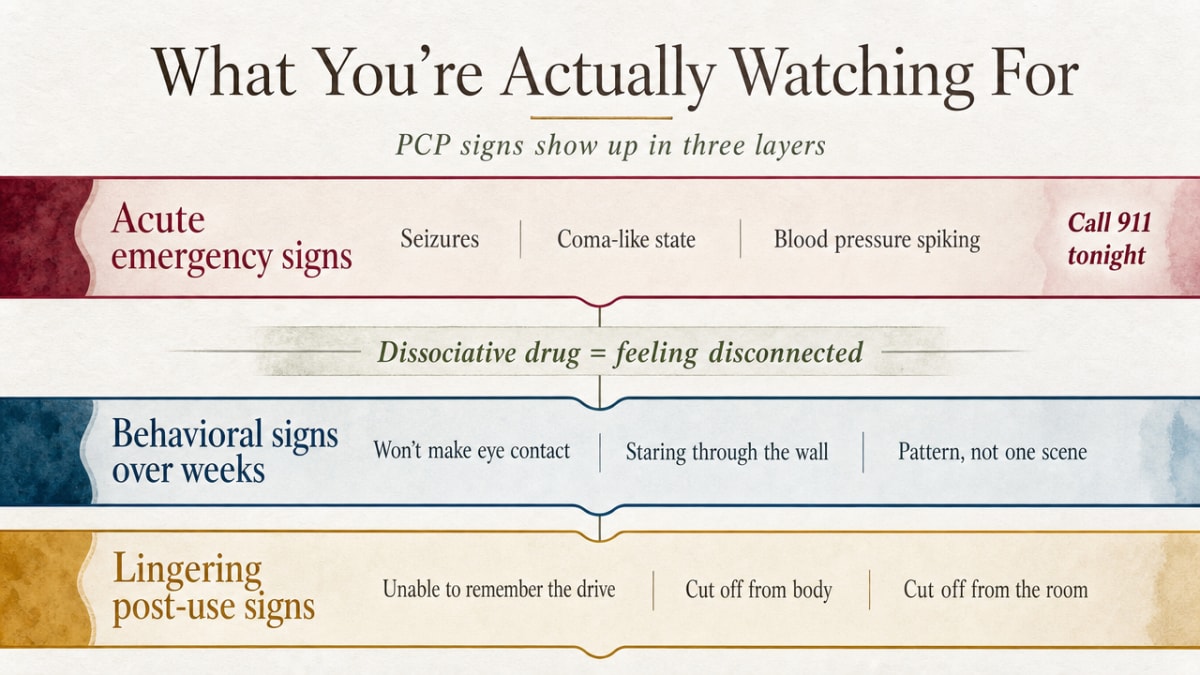
Here’s the honest frame for PCP. It’s a dissociative drug, which means it makes the person using it feel cut off from their own body and from the room they’re standing in 1. That’s the core of the experience, and it’s the core of what you’ll notice. Not one dramatic scene. A pattern.
Signs of PCP use show up in three layers, and treating them as one blurry pile is what keeps families stuck:
- There are acute signs that mean you call 911 tonight, like seizures, a coma-like state, or blood pressure spiking into emergency territory 3.
- There are behavioral signs you track over days and weeks, the kind a clinician would call retrograde amnesia or psychomotor agitation but you might just call “he can’t sit still and doesn’t remember our fight” 6.
- And there are quieter signs that linger after use stops, including memory problems, depression, and recurring psychosis-like episodes that point toward something deeper than a single bad night 1.
You’re not overreacting. You’re reading a pattern. The next sections give you the words for what you’re already seeing.
The Dissociation Pattern That Defines PCP
The thing that throws families off about PCP isn’t the loud stuff. It’s the eerie quiet in the middle of it. Your husband is sitting on the couch with his eyes open, but he isn’t there. You say his name twice and he turns his head slowly, like the sound traveled to him from another room. That gap — the one between you and the person you know — is the dissociation pattern, and it’s the clinical core of what PCP does.
NIDA describes dissociative drugs like PCP as making the user feel disconnected from their body and environment 1. Read that sentence twice. Disconnected from their body. Disconnected from the environment. That’s not poetic language. It’s what you’re watching when your daughter pulls her hand back from a hot stove a beat too late, or when your son walks into the kitchen, sits down, and doesn’t seem to register that you’re standing three feet away.
You may also notice the staring. Eyes open but unfocused, sometimes with a slow side-to-side flick clinicians call nystagmus 6. You don’t need the medical word. You’ll just notice that the eyes don’t track the way they normally do. Speech may slow down or thicken. Movements may look heavy, as if the body is wading through water — what a clinician would call ataxia 7.
Underneath that flatness, the inner experience can be turbulent. NIDA notes that dissociatives can produce fear, anxiety, and confusion alongside the detachment 1. Your loved one may seem far away one minute and suddenly panicked the next, convinced the room has shifted or that you’re someone else. The dissociation is the signature. The agitation, the paranoia, the strange sentences that don’t finish — those tend to ride on top of it.
If you’ve been telling yourself “something is off but I can’t name it,” this is often what you’ve been seeing. Not drunkenness. Not a bad mood. A person who is, in a real sense, not fully in the room with you.
Acute Signs: When to Call 911 Tonight
This is the section you came here for, even if you didn’t want to admit it. You’re scared something is happening right now and you don’t know if it crosses the line. Let’s draw that line clearly.
Call 911 if you see any of these in your loved one tonight. A seizure of any kind, even a brief one where the body stiffens and the eyes roll. A coma-like state where you can’t wake them, or where they wake briefly and slip back under. Convulsions, repeated vomiting while unresponsive, or breathing that is shallow, irregular, or stopped. MedlinePlus lists seizures, coma, and altered consciousness as overdose symptoms that need emergency care 3. You don’t wait those out. You call.
Call 911 if the agitation has crossed into something you cannot safely manage. That looks like uncontrolled thrashing, an inability to recognize you or follow any instruction, attempts to hurt themselves or anyone else, or strength and aggression that escalate when you try to calm them. PCP agitation in the emergency department often needs medication-level sedation, with benzodiazepines as the standard treatment 5. That’s not something to handle alone in a hallway.
Call 911 if their body is in trouble even when they seem outwardly quiet. A pounding pulse you can see in their neck, skin that is hot to the touch, blood pressure you suspect is spiking, or muscle rigidity so severe their limbs feel locked. Hypertension and muscle rigidity show up repeatedly in the clinical literature on PCP toxicity 7. These are not “sleep it off” symptoms.
When you call, tell the dispatcher what you’ve actually seen and that you suspect PCP or another dissociative drug. Use plain words: “He’s having a seizure,” “She won’t wake up,” “His eyes are flicking and he doesn’t know who I am.” If you know what was used and roughly when, say so. If you don’t, say that too. The medics will not judge you. They will move faster with accurate information.
While you wait, do less than you think. Move sharp objects out of reach. Lower the lights and the noise. Don’t try to restrain a person in the middle of a PCP episode unless they are about to hurt themselves or someone else, and even then, get out of the way when help arrives. Don’t force food, water, or anything to “flush it out.” Don’t try to make them throw up.
Behavioral Signs You Track Over Weeks
Most of what you’ll actually observe doesn’t happen during a single episode. It happens in the space between episodes — the Tuesday morning where your son can’t remember what he said Sunday night, the way your wife’s coordination is off when she’s pouring coffee three days after you suspected she used. This is the tier where you stop reacting and start documenting.
Start with what emergency clinicians see most often when someone arrives intoxicated on PCP. A case series of confirmed PCP intoxication patients found that the most prevalent clinical signs were retrograde amnesia, nystagmus, hypertension, and psychomotor agitation 6. That list is worth memorizing, because it tells you which observations carry the most weight when you eventually talk to a clinician or counselor.
Retrograde amnesia is the one families miss the longest. Your daughter doesn’t remember the argument you had last night. Not “doesn’t want to talk about it” — genuinely doesn’t have it. She’ll ask a question you already answered, or refer to a plan you canceled together. Write down the date and what she couldn’t recall. You don’t need a journal. The notes app on your phone is fine.
Nystagmus is the eye flicker. You’ll catch it when she’s looking at you and her eyes seem to drift sideways and snap back, almost like a glitch. It can show up horizontally, vertically, or in a slow rolling pattern. Once you’ve seen it, you’ll recognize it. Note when it happens and whether anything else is off at the same time.
Hypertension you may not catch without a cuff, but you can spot its proxies: a visible pulse in the neck, flushed skin, complaints of a pounding headache, or a heart rate you can feel through a hug. If you have a home blood pressure monitor, use it during a calm moment and write down the number.
Psychomotor agitation is the restless engine — pacing, can’t sit through a meal, hands moving constantly, switching tasks every ninety seconds. It looks different from caffeine or stress because it doesn’t track with what’s happening in the room. He paces when nothing is wrong. He’s still pacing when you ask him to sit.
Add the behavioral overlay from the broader literature: hallucinations, disorientation, brief aggressive outbursts, the heavy-footed walk clinicians call ataxia, and stretches of stupor where he’s awake but unresponsive 7. You may also notice paranoia that doesn’t fade with reassurance, or sentences that start sharply and trail off 10.
What to write down for each episode:
- the date and rough time,
- what you saw with your own eyes (not what you concluded),
- how long it lasted,
- and what they did or didn’t remember afterward.
Keep it factual. “Wednesday 9 p.m., eyes flickering side to side for about ten minutes, didn’t remember coming home.” That kind of note is what a clinician can actually use. A general impression of “acting weird” is not.
You are not building a case to win. You’re building a record so that when the conversation with a doctor, counselor, or interventionist happens, you can answer the question “what have you been seeing?” without losing your footing. That record is also for you, on the mornings when you wonder whether you imagined the whole thing.
Why One Episode Looks Confused and the Next Looks Catastrophic
One of the most disorienting parts of watching someone use PCP is how unpredictable the picture looks from one episode to the next. Sunday night your son seemed dazed, slow-moving, like he was working out a math problem he couldn’t quite finish. Two weeks later he’s pacing the kitchen at 3 a.m., convinced the neighbors are recording him, and you can’t tell if you should call 911 or wait it out.
You’re not imagining the gap. The clinical picture is dose-dependent. Low to moderate amounts tend to look like an acute confusional state — slowed speech, fogginess, the staring, mild coordination problems. Higher doses can tip into serious neurologic and cardiovascular territory, with seizures, severe hypertension, and the kind of agitation that won’t respond to anything you say 8. Same person. Same drug. Different night.
Other variables stack on top of dose. PCP is often used alongside alcohol or marijuana, and co-use blurs the symptoms and raises the risk 6. The form matters too. PCP shows up as powder, crystal, tablet, capsule, or liquid, sometimes sprinkled on something else that gets smoked 12. Your loved one may not know how much they actually took.
What this means for you: don’t grade tonight’s episode against the last one. Each time, run the same triage — is anyone in medical danger right now, or is this a documenting night? The pattern is the diagnosis. A single calm episode does not mean the next one will be.
Paraphernalia and the Quiet Evidence Around the House
You probably don’t want to be the person searching your kid’s room. Most parents I’ve talked to describe it as a line they never thought they’d cross. If you’re there, you’re there for a reason. Look carefully, and look once.
PCP doesn’t have one signature look. It shows up as white or off-white powder, crystals, tablets, capsules, or a liquid 12. The liquid form is the one families miss most often, because it’s frequently used to coat something else that gets smoked — a cigarette, a joint, or a leafy substance in a small bag. So you’re not just looking for pills. You’re looking for cigarettes that smell chemical or sharply sweet rather than like tobacco, joints stored in foil or a small jar, eyedropper bottles with no label, or a damp-looking herbal mix that doesn’t match what marijuana usually looks like.
Other quiet evidence: small glass vials, unfamiliar pipes, lighters in places lighters don’t belong, foil with burn marks, and receipts or cash withdrawals that don’t add up. Note what you saw and where. Take a photo if you need to. You’re not building a courtroom case — you’re holding onto facts so the next conversation, whether with your loved one or a clinician, starts from something real instead of a feeling you can’t quite trust.
Why a Drug Test Won’t Settle This
At some point in this, you’ve probably thought about buying a drug test at the pharmacy. A lot of parents do. It feels like the one move that turns a fog of suspicion into something you can hold in your hand. A line is there or it isn’t. You finally know.
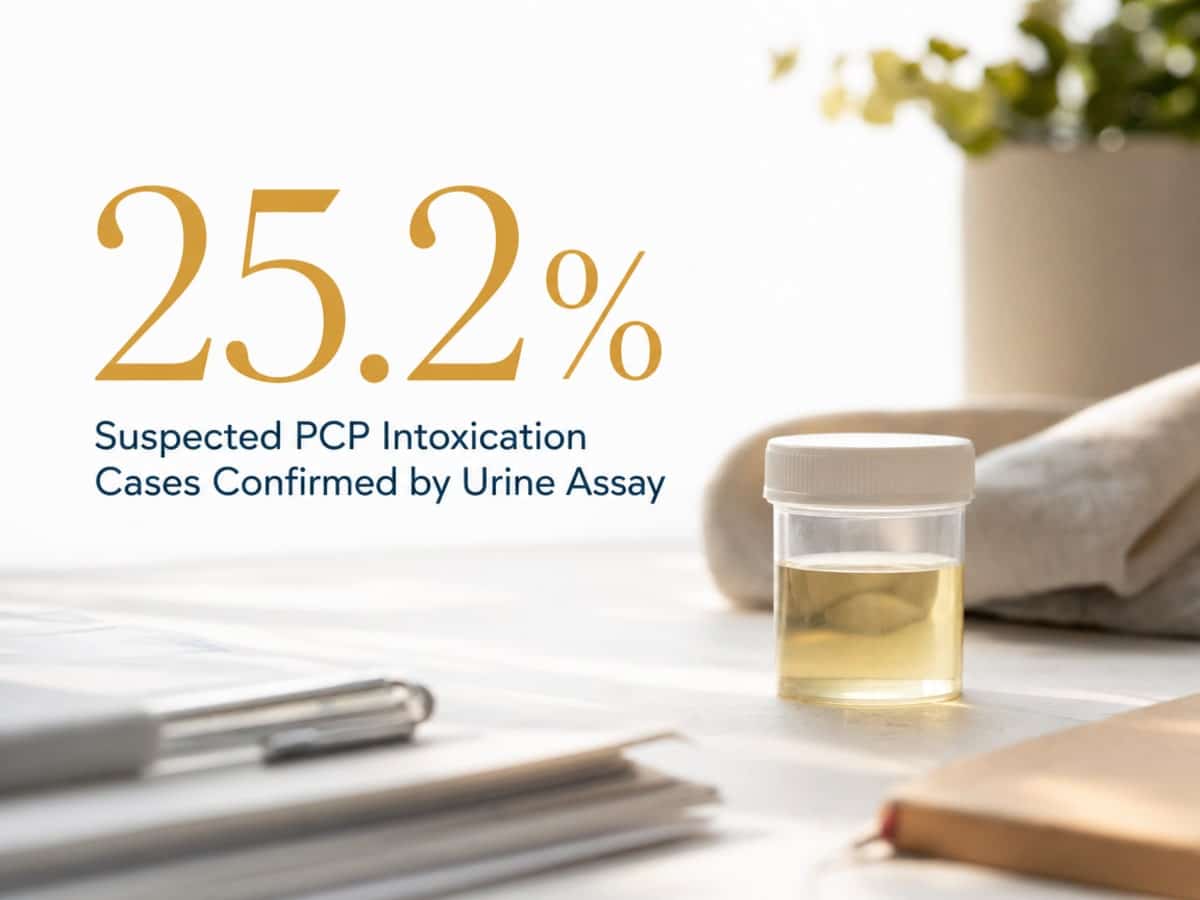
Here’s what nobody tells you before you spend the $20. A drug test is not a diagnosis, and with PCP specifically, the test can miss what your eyes already caught. In one clinical review, researchers looked at 107 consecutive patients whose doctors had diagnosed them with PCP intoxication based on how they presented. Of those 107, only 27 came back confirmed by urine assay 9. That’s roughly one in four. The other three-quarters had a clinical picture so clearly consistent with PCP that experienced physicians put it in the chart, and the lab didn’t back it up.
Sit with that for a second. The people best trained to recognize this drug were right far more often than the test was. Your test in a kitchen drawer won’t outperform them.
There are reasons for the gap. PCP shows up in urine within a narrow window that depends on dose, how often someone uses, and their metabolism. Confirmatory testing is a separate step from the initial screen, and initial screens can throw false positives from unrelated medications 16. MedlinePlus is direct about the broader limit: drug testing can’t diagnose a drug use disorder 16. It can tell you a substance was or wasn’t detected in one sample, at one moment. That’s it.
So what does this mean for you tonight? Don’t make the test the thing the whole conversation hinges on. A negative result is not proof your daughter is fine. A positive result is not, by itself, a treatment plan. What carries more weight than the strip in your hand is the record you’ve been keeping — the eye flicker on Wednesday, the missing hour on Saturday, the agitation that didn’t match anything happening in the room. That’s the pattern a clinician can actually work with. Bring your notes. The test, if you use one, is a single data point next to them, not the verdict.
When Symptoms Don’t Stop: The Dual-Diagnosis Signal
Here’s the part that scares families the most, and the part that gets explained the least. Sometimes the using stops and the symptoms don’t. Two weeks clean, and your son still hears something in the kitchen that isn’t there. A month out, and your wife still can’t hold a thread of conversation, still cries at the table without knowing why, still flinches at sounds the dog made all year. You start to wonder if the drug broke something that isn’t going to put itself back together on its own.
You’re not catastrophizing. NIDA documents that dissociative drugs like PCP can produce longer-term psychiatric effects — persistent memory and speech problems, social withdrawal, depression, and recurring psychosis-like symptoms that outlast the period of use 1. These are not the leftover hours of one bad night. They are the signal that what started as a substance problem now has a mental health problem riding alongside it, or that one was there before the drug ever entered the picture.
This is what clinicians mean by co-occurring disorders, and it changes what good care looks like. Treating the PCP use without treating the depression, the paranoia, or the cognitive symptoms tends to fail. Treating the mental health symptoms while ignoring the substance use tends to fail the same way. Integrated, dual-diagnosis treatment addresses both at once, which is the standard of care when the picture you’re describing has two layers.
What you’re looking for, specifically: symptoms that persist past the window when intoxication should have cleared. Flat affect that doesn’t lift. Hallucinations or paranoid thinking that returns without new use. Memory gaps that aren’t just about one missing night. Mood that has bottomed out and stayed there. Write these down the same way you’ve been writing down acute episodes. When you talk to a clinician, the phrase to use is, “These symptoms have continued even when they weren’t using.” That sentence reroutes the conversation toward the right kind of assessment.
Your Next Right Call
You don’t have to solve this whole thing tonight. You just have to make the next right call.
If you’re holding a record of what you’ve been seeing — the eye flicker, the missing hours, the agitation that didn’t match the room — that record is what turns a 20-minute phone conversation into something useful. Bring it. A clinician or counselor can do more with “Wednesday 9 p.m., eyes flickering, didn’t remember coming home” than with “I think he’s using.” If the symptoms have continued even when your loved one wasn’t using, say that sentence out loud. It points the assessment toward integrated, dual-diagnosis care, which is the standard when substance use and mental health symptoms are riding together 1.
If you don’t know where to start, start with the phone. SAMHSA’s National Helpline is free, confidential, and open 24 hours a day, every day of the year, and it exists for treatment referral and information 14. You don’t need a diagnosis to call. You don’t need your loved one’s permission. You can call from the car.
What’s hard about this is real. You’ve been watching someone you love come apart in slow motion and trying to figure out if you’re seeing it clearly. You are. The pattern is the diagnosis, and you’ve already started reading it. The next call — to a helpline, a primary care doctor, an assessment line at a center like Arrow Passage Recovery — is the one that moves this from your kitchen to a team that can carry some of the weight with you.
Talk to a Specialist About PCP Warning Signs
Get answers and compassionate support for concerns about PCP use in your loved one.
Talk With Experts About PCP Use Concerns
Gain clarity and next steps for supporting your loved one’s recovery from PCP use.
Frequently Asked Questions
How long do the effects of PCP last?
Acute effects typically run several hours, but they can stretch past a day depending on how much was used, what it was mixed with, and the person’s own metabolism. Low to moderate doses tend to look like a confused, fogged-out state, while higher doses can produce serious neurologic and cardiovascular problems that take longer to clear 8. Some psychiatric effects can linger well after the drug is gone 1.
Can a home drug test confirm my loved one is using PCP?
Not reliably. A drug test cannot diagnose a substance use disorder, and initial screens can produce false positives that require confirmatory follow-up 16. With PCP specifically, even clinician-diagnosed cases often aren’t confirmed by a single urine assay 9. Use a test as one data point, not the verdict. The pattern you’ve been watching — the dissociation, the missing memory, the eye flicker — carries more weight than a strip from the drawer.
When should I call 911 versus wait it out at home?
Call 911 if you see a seizure, a coma-like state you can’t rouse them from, repeated vomiting while unresponsive, irregular or stopped breathing, or signs of severe hypertension and muscle rigidity 3. Call if the agitation has crossed into uncontrollable thrashing or aggression — that level often needs medication-level sedation in the ED 5. If you’re debating, err on calling. Being told it wasn’t an emergency is a smaller problem than the alternative.
What does PCP look like, and what paraphernalia should I watch for?
PCP shows up as white or off-white powder, crystals, tablets, capsules, or a liquid 12. The liquid form is the one families miss most often, because it’s frequently used to coat a cigarette, joint, or leafy mix that gets smoked. Watch for cigarettes that smell chemical or sharply sweet, joints stored in foil or small jars, unlabeled eyedropper bottles, small glass vials, and unfamiliar pipes. Take a photo of what you saw and where.
My family member still seems off weeks after they stopped using. Is that normal?
It’s not unusual, and it’s worth taking seriously. NIDA notes that dissociative drugs like PCP can produce longer-term effects including persistent memory and speech problems, social withdrawal, depression, and recurring psychosis-like symptoms that outlast the period of use 1. When symptoms continue after the using stops, that’s the signal for an integrated, dual-diagnosis assessment — one that looks at both the substance use and the mental health picture together, not as separate problems handed to separate teams.
Where can I get help if I’m not ready to confront them yet?
You don’t need your loved one’s permission or a diagnosis to make the call. SAMHSA’s National Helpline is free, confidential, and available 24 hours a day, 365 days a year, for treatment referral and information 14. You can call from the car or a back room. A primary care doctor, a licensed counselor, or an assessment line at a treatment center can also help you plan the conversation before you ever have it.
References
- Psychedelic and Dissociative Drugs | National Institute on Drug Abuse – NIH. https://nida.nih.gov/research-topics/psychedelic-dissociative-drugs
- HALLUCINOGENS AND DISSOCIATIVE DRUGS. https://nida.nih.gov/sites/default/files/rrhalluc.pdf
- Phencyclidine overdose: MedlinePlus Medical Encyclopedia. https://medlineplus.gov/ency/article/002526.htm
- Substance use – phencyclidine (PCP) – MedlinePlus. https://medlineplus.gov/ency/patientinstructions/000797.htm
- Phencyclidine Toxicity – StatPearls – NCBI Bookshelf. https://www.ncbi.nlm.nih.gov/books/NBK507865/
- Phencyclidine Intoxication Case Series Study – PMC. https://pmc.ncbi.nlm.nih.gov/articles/PMC4547967/
- Phencyclidine – Effects on Human Performance and Behavior. https://pubmed.ncbi.nlm.nih.gov/26256594/
- Phencyclidine Intoxication: A Literature Review. https://pubmed.ncbi.nlm.nih.gov/360832/
- clinical experience in 27 cases confirmed by urine assay – PubMed. https://pubmed.ncbi.nlm.nih.gov/7224272/
- Phencyclidine (PCP): some human studies – PubMed. https://pubmed.ncbi.nlm.nih.gov/6514253/
- Emergency Department Visits Involving Phencyclidine | CBHSQ Data. https://www.samhsa.gov/data/report/dawn-report-emergency-department-visits-involving-phencyclidine
- The DAWN Report: Emergency Department Visits Involving Phencyclidine (PCP). https://www.samhsa.gov/data/sites/default/files/DAWN143/DAWN143/sr143-emergency-phencyclidine-2013.pdf
- FastStats – Emergency Department Visits – CDC. https://www.cdc.gov/nchs/fastats/emergency-department.htm
- National Helpline for Mental Health, Drug, Alcohol Issues – SAMHSA. https://www.samhsa.gov/find-help/helplines/national-helpline
- FastStats – Hypertension – CDC. https://www.cdc.gov/nchs/fastats/hypertension.htm
- Drug Testing: MedlinePlus Medical Test. https://medlineplus.gov/lab-tests/drug-testing/