
Key Takeaways
- Recovery moves as a loop, not a staircase — precontemplation, contemplation, preparation, action, and maintenance cycle through setbacks, and recurrence is a learning event rather than a reset to zero 1, 12.
- Substance use and mental health run on parallel tracks; a flare in depression, anxiety, or PTSD can pull the other track backward, which is why integrated treatment produces stronger outcomes 3, 9.
- Stop counting sober days and start tracking functional indicators — sleep, work engagement, repaired relationships, medication adherence, housing stability, and fewer crisis contacts — to read real progress 6.
- Your role shifts by stage, from witness to logistics to quiet noticer, and caregiver steadiness is itself part of the treatment plan, not a reward to claim later 13.
Why Your Loved One Keeps Moving Forward and Backward
You’ve watched it happen. A good month. A great week. Then a missed call, a strange story about where the car was, and the slow sinking feeling that something is off again. If you’ve been told recovery is a straight climb, your own eyes have been arguing with that story for a while now.
Here’s what the clinical research actually says: addiction is a chronic, relapsing condition, and many people cycle through multiple treatment episodes before reaching stable remission 5, 12. That isn’t a sign your loved one is failing. It’s the shape of the work.
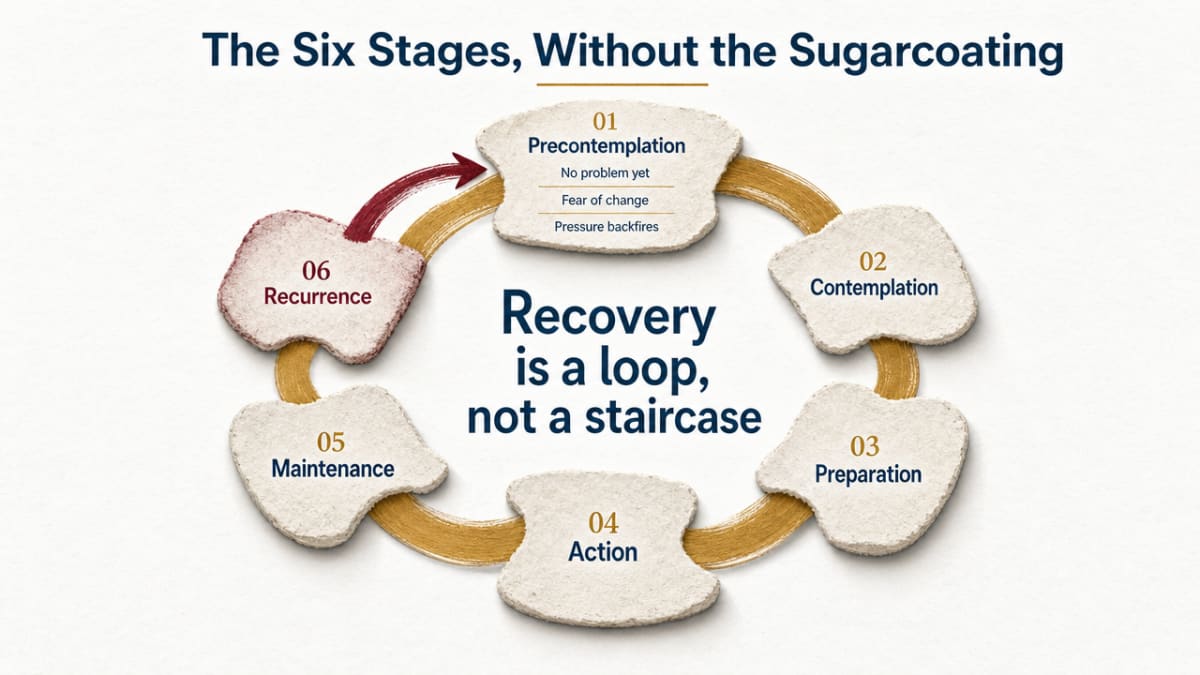
The stages model most treatment programs reference — precontemplation, contemplation, preparation, action, maintenance — was never meant to describe a one-way trip. Modern researchers frame setbacks as part of a cyclical change process, not a reset to zero 1. People move forward, loop back, gather information from the loop, and move forward again.
If a co-occurring mental health condition is in the picture, the spiral has a second thread. A depressive episode, an anxiety flare, untreated PTSD — any of these can pull the substance use side backward, even when nothing else has changed 3.
You’re not imagining the whiplash. You’re reading the terrain accurately. The rest of this guide gives you a map for it.
The Six Stages, Without the Sugarcoating
Precontemplation: When They Don’t See a Problem Yet
This is the stage where you’re alarmed and they’re annoyed. Your daughter rolls her eyes when you bring up the bottles in her car. Your husband says you’re overreacting about the late-night drinking. The math isn’t adding up for you, but inside their head, nothing is broken.
Precontemplation isn’t denial in the dramatic sense. It’s usually a quieter mix of not yet connecting the dots, real fear of what change would cost, and protection of an identity that hasn’t admitted vulnerability. Pressuring someone in this stage to commit to action tends to backfire. Research on readiness shows that people who enter treatment in precontemplation engage less and have worse outcomes than those who arrive further along 7.
What helps here isn’t an ultimatum delivered at the kitchen table. It’s planting questions they’ll think about later. “I noticed you didn’t sleep again last night — are you okay?” lands differently than “You have a drinking problem.”
Your job in this stage is mostly to stay in relationship and stay honest. You’re not going to logic them into change. You’re keeping the door open so that when ambivalence shows up, you’re still someone they can talk to.
Contemplation: The Yes-But Stage
Contemplation sounds like progress and feels like whiplash. “I know I should probably cut back, but my job is so stressful right now.” “Yeah, maybe I drink too much, but it’s not like I’m using anything hard.” The awareness is there. The willingness to act on it isn’t.
People can sit in contemplation for months or years. They’re weighing the cost of staying the same against the cost of changing, and the scales tip back and forth depending on the week. A good Tuesday with the kids tips them one way. A rough Friday at work tips them back.
What you’re listening for isn’t a promise. It’s curiosity. When your son starts asking about how outpatient programs work, or your wife mentions a coworker who got sober, those are the signals worth noticing.
Don’t pounce. Reflect what they said back to them without adding your agenda. “It sounds like you’re thinking about it” lets them keep exploring. “Great, let’s call somewhere today” usually shuts the conversation down.
Preparation: Small Moves That Look Like Nothing
Preparation is the stage that’s easy to miss because nothing dramatic happens. Your loved one might Google a treatment center at 1 a.m. and close the tab. They might tell their primary care doctor about the drinking for the first time. They might pour the last of the bottle down the sink on a Sunday night, then not mention it.
These look like nothing. They’re actually a lot.
Research on readiness shows that people in preparation engage better with treatment than those still in contemplation 7. Their brain has shifted from “if” to “how,” even if their behavior hasn’t fully caught up.
This is the stage where your practical help matters most. Offering to drive them to an assessment, helping verify insurance, sitting with them while they make the call — these are concrete acts that don’t require you to manage their feelings. Ask what would help. Then do that thing without making it a production.
Action: The Stage Everyone Thinks Is the Whole Recovery
Action is the visible stage. Detox. Residential. The first 90 days. The new vocabulary, the meetings, the sponsor, the therapist on Tuesdays. This is what most people picture when they hear the word “recovery,” and it’s also where families often exhale too soon.
Here’s the honest version: action is hard and disorienting. Your loved one may be more emotional, not less. They’re losing a coping tool they’ve leaned on for years, sometimes decades, while simultaneously trying to feel feelings they’ve been numbing. If a co-occurring condition is in the picture — depression, anxiety, PTSD, bipolar — symptoms can surface or intensify once the substance is out of the way 3.
This is also when families tend to over-celebrate or over-monitor. Both can backfire. Treating every sober week like a parade puts pressure on a fragile thing. Treating them like a suspect erodes the trust that recovery needs.
What helps: steady presence, low-drama check-ins, and protecting your own life so you don’t burn out three weeks in. The action stage is loud, but it’s not the finish line. It’s the entry point to the longer work.
Maintenance: The Long, Quiet Middle
Maintenance is where the cameras leave. The intensive program ends, the family’s adrenaline drops, and your loved one is now expected to live a regular life while doing the daily work of staying well. Six months in. A year in. Two years in.
This stage tends to surprise families because the visible structure shrinks but the vulnerability doesn’t. Relapse risk persists across maintenance, and clinical reviews emphasize that prevention is both an immediate-coping job and a long-term lifestyle job 11. Sleep, stress, relationships, untreated mental health symptoms — any of these can build pressure quietly.
You may notice your wife getting more irritable in the months after she stops outpatient. You may notice your son skipping meetings he used to find helpful. These aren’t necessarily slips. They’re often the early signals that something needs adjustment — a return to therapy, a medication check, a harder conversation about workload or a relationship.
Your role in maintenance is less heroic and more boring, in a good way. You’re a calm presence. You ask how things are going without interrogating. You notice changes without diagnosing them. And you keep living your own life, because their recovery doesn’t require your suspension.
Recurrence: A Data Point, Not a Verdict
The word “relapse” carries a lot of weight, most of it unhelpful. Clinicians increasingly use “recurrence” for a reason: it names what’s actually happening without smuggling in a moral verdict.
Here’s what the research says clearly. Relapse is part of the cyclical nature of behavior change, and the work after a slip is to debrief it, reassess where the person is in the change process, and recycle through the stage tasks with new information 1. Many people experience multiple cycles of treatment and recurrence before reaching stable, long-term remission 12. That isn’t an indictment of your loved one or of treatment. It’s the documented clinical course.
When you can hold this shape in your head, a slip stops being a catastrophe and starts being information. What happened in the days before? What stressor went unmanaged? What support quietly disappeared?
The answers to those questions are what move the spiral forward.
Where the Stage Model Breaks Down
It would be dishonest to hand you a five-stage map without telling you where the map gets things wrong.
The transtheoretical model is the most widely used framework in addiction care, and it’s useful — but the research community has been clear about its limits. Reviewers point out that the boundaries between stages are partly arbitrary, that people don’t always move through them in order, and that some behavior change looks more continuous than categorical 8. Real life doesn’t always sort itself into five clean boxes.
Here’s what that means for you at the kitchen table. Your husband might look like he’s in action on Monday — going to meetings, taking his medication, sleeping normally — and slide into something that looks more like contemplation by Thursday, questioning whether any of it is worth it. Your daughter might cycle through preparation and action in the same week. That’s not a sign she’s gaming you. It’s how the work actually moves for a lot of people.
The stages are a vocabulary, not a verdict. They help you name what you’re seeing without freezing your loved one in place. Hold them loosely. Use them to ask better questions, not to issue grades.
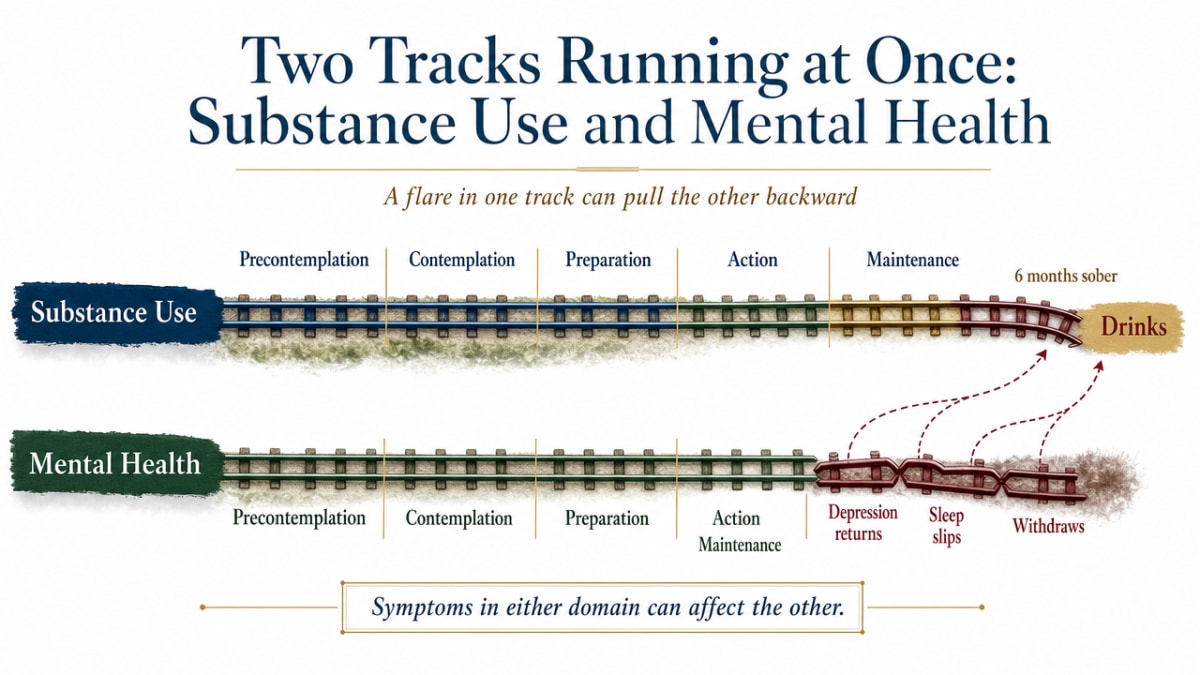
Two Tracks Running at Once: Substance Use and Mental Health
How a Flare in One Track Pulls the Other Backward
If your loved one has a co-occurring mental health condition, the stages map you just read needs a second layer. Picture two parallel tracks moving through precontemplation, contemplation, preparation, action, and maintenance at the same time — one for substance use, one for mental health. They influence each other constantly, and they don’t always move at the same speed.
Here’s what that looks like at home. Your wife has six months sober. Her depression, which had been quiet, comes back in February. Sleep slips. She stops returning her sister’s calls. Two weeks later, she drinks. The substance use track didn’t fail on its own — the mental health track flared, and it pulled the other one backward with it. SAMHSA’s guidance is direct on this point: symptoms in either domain can affect overall progress, which is why screening and treating both matters 3.
The reverse happens too. A stretch of active use will deepen anxiety, sharpen depressive symptoms, or intensify PTSD reactions. Research on integrated care shows that when both conditions are treated together, engagement and outcomes improve across substance use and psychiatric symptoms compared with treating them in separate silos 9.
So when you see a setback, don’t only ask what happened with the substance. Ask what was happening with sleep, mood, medication, and stress in the weeks before.
Why Integrated Treatment Changes the Trajectory
When a treatment program addresses only the substance use and treats the mental health condition as someone else’s problem — or vice versa — the recovery trajectory tends to stall. Your son finishes a 30-day program for opioids and is told to follow up with a psychiatrist on his own for the PTSD. Three months later, the PTSD symptoms are louder than ever, and the opioids are back. Nothing about that sequence is surprising.
Integrated treatment means both conditions are assessed, treated, and monitored together by a coordinated team, not handed off between disconnected providers. The research review on integrated care concludes that this approach is associated with better outcomes across multiple domains, including reduced substance use and reduced psychiatric symptoms 9. SAMHSA reinforces the same principle through its “no wrong door” framing — wherever someone enters the system, both conditions get screened and addressed 3.
For you, this changes what to look for and what to ask. Is the program treating the depression, the anxiety, the trauma, or the bipolar disorder as part of the plan, or is it being parked for later? If the answer is later, the trajectory you’ll watch unfold is the one where one track keeps pulling the other backward.
How to Measure Real Progress
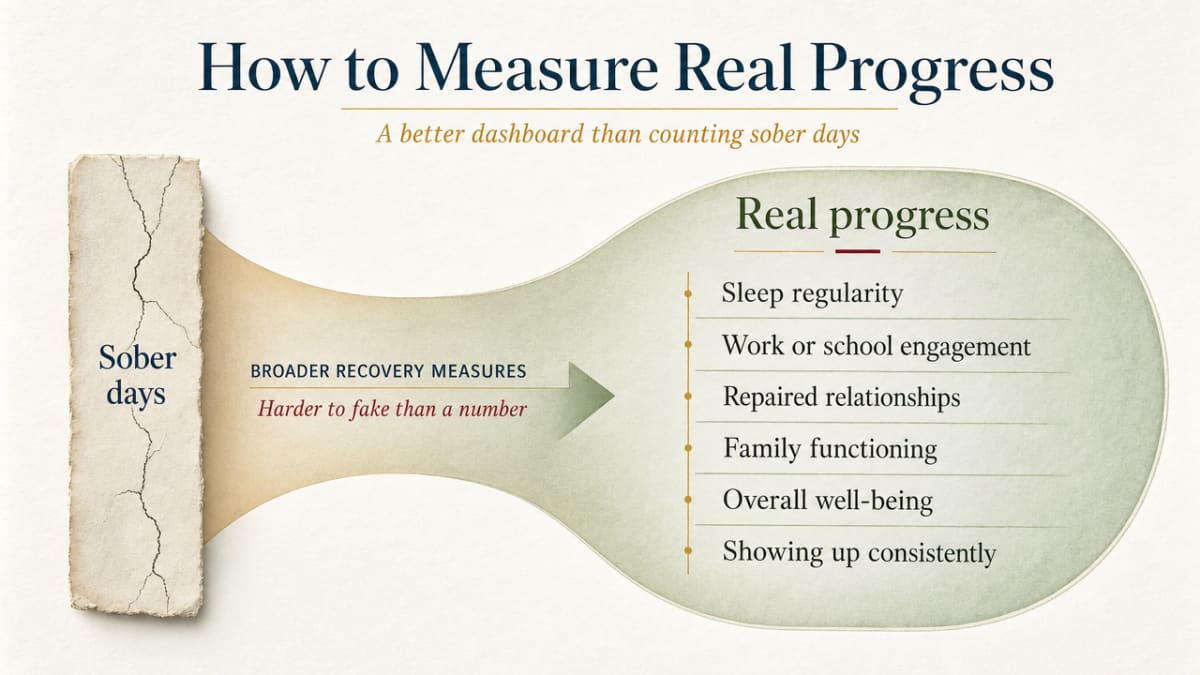
If you’re counting days, you’re probably exhausted. A sobriety streak is a single, brittle number, and when it breaks, the whole scoreboard breaks with it. That’s not a useful way to read what’s actually happening.
The long-term recovery literature suggests a better dashboard. People in sustained remission show broad gains across employment, family functioning, and overall well-being — not just the absence of substances 6. Those gains are what you can actually see at home, and they’re harder to fake than a number on a calendar.
Here are the six indicators worth tracking instead.
- Sleep regularity: is your loved one going to bed and waking up at consistent times, or has the schedule started drifting?
- Work or school engagement: are they showing up, on time, doing the thing?
- Repaired relationships: are conversations with siblings, friends, or kids getting easier and more honest, even slowly?
- Medication adherence: if there’s a prescription for the mental health side, is it being taken as written?
- Housing stability: is the living situation calm and predictable, or chaotic?
- Reduced ER or crisis contacts: are the 2 a.m. emergencies happening less often than they used to?
None of these is a single yes-or-no answer. They’re trends. A bad week on one indicator isn’t a verdict. A slow drift downward across three of them is information worth raising — gently, and without ambushing anyone with a spreadsheet.
This is also kinder to you. When you stop watching one number, you stop holding your breath every morning. You start seeing a person, getting better in the textured, uneven way people actually do.
The 48 Hours After a Slip: A Family Script
You found out. Maybe you smelled it on him. Maybe she told you herself, crying, on the back porch. Maybe a friend called. The next two days matter more than most people realize, and not because of the slip itself — because of what happens next.
The instinct is to react big. Yell, cry, threaten the program, call everyone in the family. Try not to. The clinical guidance is unusually clear here: treat the slip as a learning event, debrief what happened, reassess where your loved one is in the change process, and help them recycle into the next stage task with new information 1. That’s the script. Big reactions usually push them toward shame, and shame is the fuel that turns a slip into a longer relapse.
- In the first 24 hours, focus on safety and information. Is he physically okay? Does she need a medical evaluation? Is there a prescription that got missed, a sponsor who should be called, a therapist with an opening this week? Ask short questions and listen more than you talk.
- In the next 24 hours, help them make one concrete contact — their counselor, their psychiatrist, an integrated treatment program, or SAMHSA’s 24/7 helpline if they don’t have a provider yet 4. One call. Not a five-step plan you typed up at 3 a.m.
- Then ask the debrief question, gently: what was happening in the days before? Sleep, mood, medication, stress, a fight, an anniversary, an unmanaged symptom? That answer is the data you needed.
What Your Role Actually Looks Like at Each Stage
Your job changes as the stages change. The same behavior that helps in one stage can stall things in another, and a lot of family exhaustion comes from running the wrong play at the wrong moment.
- In precontemplation, your role is witness, not prosecutor. Stay in the relationship. Ask honest, non-leading questions. Don’t argue them into readiness — research on intake readiness shows that pressure rarely manufactures it 7.
- In contemplation, you’re a mirror. Reflect what they’re saying about wanting something different without grabbing the steering wheel. Let their ambivalence be theirs.
- In preparation, you’re logistics. Drive to the assessment. Sit with them while they call. Help with insurance paperwork. Don’t perform it.
- In action, you’re a calm presence. Less cheerleading, less surveillance. Protect your own routines so you’re still standing in month three.
- In maintenance, you’re a quiet noticer. You track the functional indicators, not the calendar. You raise a concern when you see drift across sleep, mood, or engagement — gently, once, without a lecture.
- If recurrence happens, you’re the person who doesn’t make it bigger than it is. You help with one next call and ask the debrief question. Family involvement, done this way, is associated with better engagement and outcomes 13.
Caregiver Burden Is a Clinical Variable
Here’s something most recovery articles skip: how you’re doing is not a side issue. The research on family involvement is clear that appropriate engagement from a spouse, parent, or adult child is associated with better treatment engagement and outcomes — and that families themselves often need education and support to manage the stress of being in this role over the long haul 13.
The pattern is predictable. You stop sleeping well. You cancel the plans with your sister because tonight feels unstable. You check the phone twice during meetings. You start carrying a low, constant hum of dread that doesn’t switch off when your loved one has a good week. Months of that depletes the exact resource — your steadiness — that the recovery actually needs from you.
So treat your own care as part of the treatment plan, not a reward you’ll claim once they’re better. A therapist of your own. A support group like Al-Anon or Nar-Anon. One non-recovery hour a day that belongs to you. A friend who knows the whole story.
You are allowed to put the phone in another room at night. You are allowed to keep the dinner with your sister. The version of you that lasts five years is more useful than the version that runs hot for six months and collapses.
Ready to Support the Next Step Forward?
Connect immediately for guidance tailored to your loved one’s recovery stage and current needs.
Ready to Take the Next Step Forward?
Get expert guidance to navigate each stage of your recovery journey with confidence.
Frequently Asked Questions
How long do the stages of recovery typically take?
There isn’t a clean timeline, and anyone who gives you one is guessing. Addiction is a chronic condition, and many people move through multiple treatment episodes over years before reaching stable remission 12. Action stages often run weeks to months. Maintenance is measured in years. Plan for a long horizon, not a 30-day fix.
Does a relapse mean my loved one has to start over from the beginning?
No. Clinicians treat recurrence as a learning event within a cyclical change process, not a reset to zero 1. The work is to debrief what happened, figure out where they are now in the change process, and re-engage with the next stage task. They keep what they learned. They don’t lose the months of work behind them.
What should I say to someone who doesn’t think they have a problem?
Stay in the relationship and ask honest questions instead of issuing verdicts. Pressuring a precontemplative person tends to backfire — research shows people who enter treatment at this stage engage less than those further along 7. Try “I noticed you didn’t sleep again — are you okay?” Plant the question. Let them sit with it.
Why does my loved one seem to backslide when their depression or anxiety flares?
Because both conditions are running on parallel tracks and they affect each other constantly. A flare in mood, sleep, or untreated symptoms can pull the substance use side backward even when nothing else changes 3. Integrated treatment that addresses both together produces better outcomes than treating them in separate silos 9. Look at both tracks during a setback.
How do I know if treatment is actually working if they still have bad days?
Stop watching the day counter and watch the functional indicators instead. Long-term recovery research shows real progress in employment, family functioning, and overall well-being, not just abstinence 6. Look at sleep regularity, work or school engagement, repaired relationships, medication adherence, housing stability, and fewer crisis contacts. Trends across these matter more than any single bad day.
What do I do in the first 48 hours after I find out they used again?
Stay smaller than your first instinct wants you to. Check safety, ask short questions, listen more than you talk. Help them make one concrete contact — their counselor, psychiatrist, or SAMHSA’s 24/7 helpline if they don’t have a provider 4. Then ask the debrief question: what was happening with sleep, mood, stress, or medication beforehand 1?
References
- Relapse on the Road to Recovery: Learning the Lessons of Failure in Addiction Treatment. https://pmc.ncbi.nlm.nih.gov/articles/PMC9014843/
- Chapter 5—Strategies for Working With People Who Have Co-Occurring Disorders. https://www.ncbi.nlm.nih.gov/books/NBK571013/
- Managing Life with Co-Occurring Disorders. https://www.samhsa.gov/mental-health/serious-mental-illness/co-occurring-disorders
- National Helpline for Mental Health, Drug, Alcohol Issues. https://www.samhsa.gov/find-help/helplines/national-helpline
- Treatment Approaches for Drug Addiction. https://www.drugabuse.gov/publications/drugfacts/treatment-approaches-drug-addiction
- A Life in Recovery: Long-term Recovery from Substance Use Disorders. https://www.ncbi.nlm.nih.gov/pmc/articles/PMC3860460/
- Stages of Change and Substance Use Treatment Outcomes. https://pubmed.ncbi.nlm.nih.gov/25070488/
- The Transtheoretical Model and Stages of Change: A Critique and Evaluation. https://www.ncbi.nlm.nih.gov/pmc/articles/PMC2928227/
- Integrated Treatment for Co-Occurring Disorders: Evidence and Implementation. https://pubmed.ncbi.nlm.nih.gov/23731426/
- Recovery-Oriented Systems of Care: A Perspective on the Future of Addiction Treatment. https://www.ncbi.nlm.nih.gov/pmc/articles/PMC4152944/
- Relapse Prevention and the Maintenance of Treatment Gains. https://www.ncbi.nlm.nih.gov/pmc/articles/PMC5756128/
- Chronicity of Substance Use Disorders and Recovery Processes. https://pmc.ncbi.nlm.nih.gov/articles/PMC6124692/
- Family Involvement in the Treatment and Recovery of Individuals with Substance Use Disorders. https://pmc.ncbi.nlm.nih.gov/articles/PMC4479482/