
Suboxone Dependence: Helping or Hurting Your Recovery?
Key Takeaways
- Physical dependence on buprenorphine is not the same as addiction — it’s a predictable biological adaptation, and people on medications for opioid use disorder are clinically considered to be in recovery 8.
- Mortality data shows roughly double the death rate when patients are out of buprenorphine treatment versus in it, making continued maintenance one of the strongest survival signals in the literature 5.
- Doses of 16 mg or higher and durations beyond 90 days — often 1 to 2 years — are where buprenorphine does its strongest work, and staying on it is the strongest predictor of long-term abstinence 3, 1.
- Medication creates steady ground, but sustained recovery is tied to treating what’s underneath — trauma, depression, anxiety — through integrated psychosocial care alongside the prescription 7, 2.
The Question Underneath the Question
You’ve been on Suboxone for a while now. Maybe six months. Maybe two years. And somewhere along the way, a quieter worry started showing up — at family dinners, in waiting rooms, in your own head at 2 a.m.: Am I really in recovery, or did I just swap one thing for another?
That worry deserves a real answer, not a pep talk. Because the question you’re actually asking isn’t just about a medication. It’s three questions tangled together. There’s the clinical one: is physical dependence on buprenorphine the same as opioid addiction? There’s the identity one: what does it mean about you that you still need a daily dose? And there’s the practical one: are the side effects, the appointments, the prescription bottle in the drawer — are they worth it, or are they keeping you stuck?
Here’s what the evidence keeps showing, and what this article will walk you through: staying on buprenorphine is consistently linked to lower overdose risk, better retention, and more sustained abstinence over years, not weeks 3, 4. People taking medications for opioid use disorder are considered to be in recovery — that’s not a workaround, it’s the clinical standard 8. And the discomfort you might feel about being on a long-term medication often points to something the pill alone can’t reach: the depression, trauma, or anxiety underneath the original use.
You’re not behind. You’re not cheating. You’re asking a harder, more honest question than most people ever get to.
Physical Dependence Is Not the Same as Addiction
Here’s the distinction that almost no one explains clearly when you start treatment: physical dependence and addiction are two different things, and they don’t always live in the same body.
Physical dependence means your body has adapted to a substance. If you stop suddenly, you’ll feel withdrawal. That’s it. It’s a predictable biological response, and it happens with lots of prescribed medications people take every day — antidepressants, blood pressure medications, even certain anti-seizure drugs. No one calls a person taking an SSRI for five years an addict. Their brain has adapted to a medication that’s helping them function. The same biological reality applies to buprenorphine.
Addiction is something else. Clinically, it’s marked by loss of control over use, continued use despite real harm, intense cravings, and behavior that gets narrower and more compulsive over time. It’s the 3 a.m. drive across town. It’s the lie you told your sister. It’s the job you lost. If you’re taking Suboxone as prescribed, showing up for appointments, and your life is getting wider instead of smaller — that pattern is not addiction. That’s treatment working.
The federal training materials clinicians use are explicit on this point: people taking medications for opioid use disorder are considered to be in recovery, not still in the disease 8. That same guidance notes that these medications reduce illicit opioid use, keep people engaged in treatment, and lower overdose death risk more effectively than placebo or no medication at all 8. Recovery isn’t defined by the absence of a prescription bottle. It’s defined by what your life looks like.
So when a family member asks why you’re “still on something,” or when the voice in your own head whispers that you’ve just traded one thing for another — what they’re really doing is collapsing two different clinical concepts into one stigmatized blur. Your tolerance to buprenorphine and the withdrawal you’d feel if you stopped abruptly are not evidence that you’re addicted. They’re evidence that the medication is doing what medications do.
That distinction matters because it changes the question you carry into every appointment. Instead of “how soon can I get off this?” — which is the question stigma writes for you — the more useful question becomes “is this medication still supporting the life I’m trying to build?” The first question treats your prescription like a failure to manage. The second treats it like a tool, one that the CDC and SAMHSA both recognize as a first-line treatment for a chronic medical condition.
You’re not in a gray area. You’re in treatment for an illness, using a medication that works the way medications are supposed to work. The shame you may have absorbed about that is older than the science. The science caught up. The stigma is still catching up.
What the Mortality Data Actually Says About Staying On
If you’ve ever sat in a clinic chair wondering whether the daily film under your tongue is really doing anything — or whether you’d be fine without it — there’s a number you deserve to see.
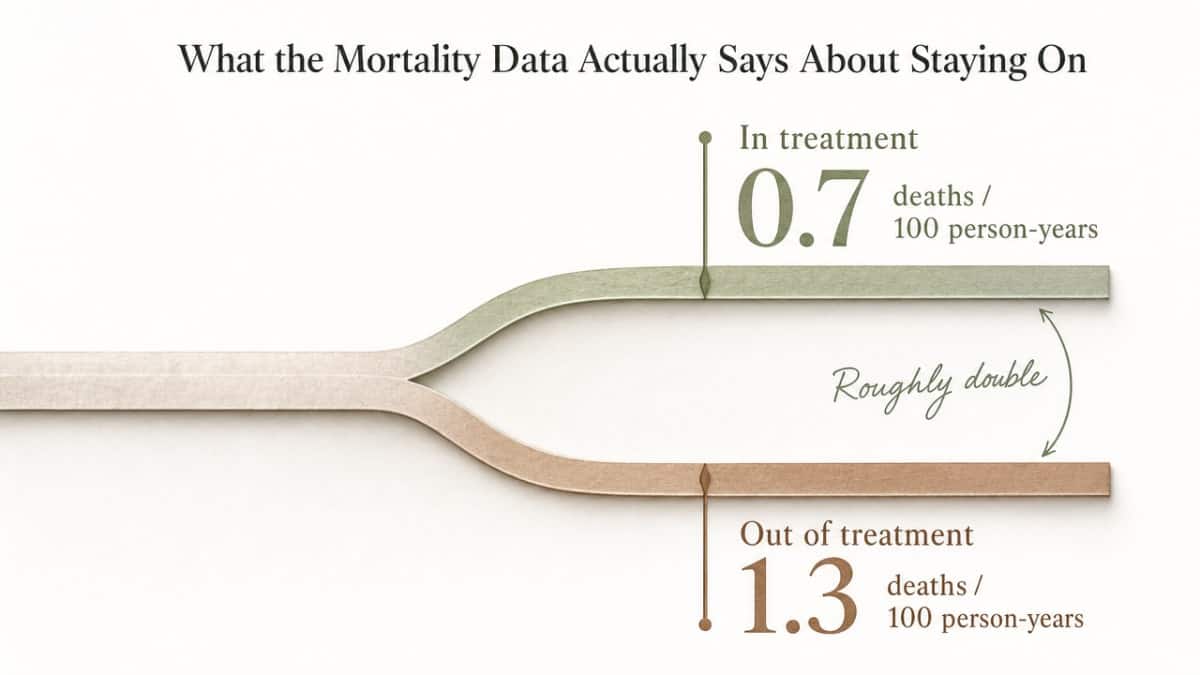
In a long-term cohort of people treated with buprenorphine maintenance, the crude mortality rate was 0.7 deaths per 100 person-years while patients were in treatment. When those same patients dropped out and were out of treatment, the rate climbed to 1.3 deaths per 100 person-years 5. Roughly double. That’s not a marginal difference. That’s the gap between two ways your story could go.
This is the piece of the picture that stigma can’t survive once you actually look at it. The worry about being on a long-term medication is real. The worry about what happens without one is bigger, and it’s backed by the math.
A few honest caveats. The 0.7 versus 1.3 figure comes from observational cohort data, not a randomized trial — people who stay in treatment differ from people who leave, and some of that difference shapes the numbers 5. The risk isn’t uniform across time, either. A CDC-linked analysis found that the risk of suicide or overdose spikes in the days right after a treatment transition, which is why discontinuation deserves a plan rather than a moment of frustration 13. We’ll come back to that when we talk about tapering.
For now, here’s the takeaway worth carrying: staying on isn’t a sign you haven’t recovered far enough. It’s one of the clearest survival signals in the entire opioid use disorder literature. Every refill is, quietly, a vote for being here next year.
Dose and Duration: The Numbers Most Articles Skip
If you’ve ever stared at your prescription bottle wondering whether you’re on too much, or whether you’ve been on it too long, this is the section that gives you something specific to hold.
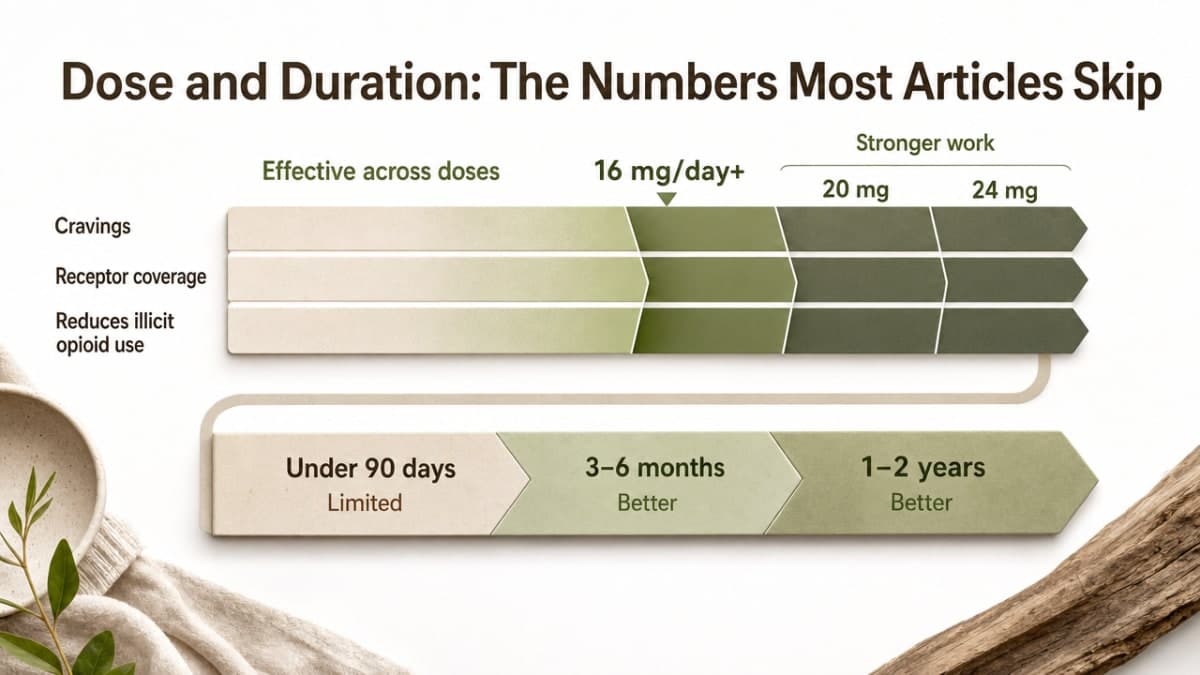
Start with dose. The synthesis of randomized trials and observational data on buprenorphine is clearer than most patient conversations make it sound: the medication is effective across low, medium, and high doses for keeping people in treatment, but doses of 16 mg per day or higher are what’s needed to significantly reduce illicit opioid use 3. That’s not a number to be embarrassed about. If you’re sitting at 16 mg, or 20 mg, or 24 mg, you’re inside the range where the medication is doing its strongest work — blunting cravings, occupying the receptors that street opioids would otherwise bind to, and giving you room to live a day without the chase. A lower dose isn’t automatically “better recovery.” In some cases, it’s just a dose that doesn’t quite cover you.
Now duration. The clinical review that shapes most prescriber guidance is direct about it: treatment participation under 90 days is of limited effectiveness, while significantly longer durations — often 3 to 6 months, and commonly 1 to 2 years — are associated with better long-term outcomes 1. Read that again. Ninety days isn’t the finish line. It’s the floor. The point below which the data stops supporting the idea that you got the benefit at all.
The same overview that establishes the dose threshold also names what may be the single most important sentence in the entire literature for someone in your position: the strongest predictor of abstinence from opioids over the long term is being on a maintenance medication 3. Not willpower. Not how many meetings you attend. Not whether you’ve forgiven yourself yet. Staying on the medication.
A 2024 longitudinal study reinforces the same direction — longer periods of buprenorphine treatment are associated with reduced risk of overdose and other adverse health outcomes, though researchers are honest that the optimal minimum duration hasn’t been pinned down 4. Translation: the science doesn’t yet know exactly how long is long enough for you specifically. What it does know is that shorter is rarely better, and that early discontinuation is one of the most common — and most costly — mistakes in the entire treatment pathway.
So when you next look at your prescription, try this reframe. The milligrams aren’t a measure of how sick you still are. They’re a measure of how much receptor coverage you need to live without using. The months aren’t a countdown. They’re an accumulation. Every month past 90 days is a month your brain is rewiring itself with the help of a tool designed for exactly that job. If your current dose is holding cravings down and your life is widening, you’re not behind schedule. You’re on it.
Side Effects You’re Probably Living With
Let’s be honest about the part most articles glide past. Buprenorphine isn’t side-effect-free, and pretending otherwise is one of the fastest ways to lose your trust. If you’ve been on Suboxone for any meaningful stretch, you probably know the list by feel before you ever saw it written down.
- Constipation is the one almost everyone deals with.
- Sleep can get weird — some people sleep harder, some lighter, some wake at 4 a.m. for months.
- Sweating, especially at night, shows up often enough that it’s worth mentioning out loud.
- Headaches in the first weeks.
- A flatter emotional range that some people describe as feeling “a step behind” their feelings.
- And the dental concerns are real — the film sits in your mouth, and dry mouth plus acidity can wear on enamel over time. Brushing after the film fully dissolves, rinsing with water, and keeping up with dental visits matters more than the standard pamphlet makes it sound.
None of this is in your head 9.
Here’s what these side effects are not: evidence the medication is harming you more than helping. They’re the friction of a tool that’s keeping you alive while you rebuild a life. Worth naming to your prescriber. Worth managing. Not worth quitting over.
The ‘Is It Being Abused?’ Worry
There’s a version of this worry that lives inside you — am I misusing this? — and a version that lives outside you, in the headlines and the in-laws: isn’t Suboxone just being abused on the street? Both deserve a straight answer.
On the inside version: if you’re taking your prescription as written, using the film the way you were taught, and being honest with your prescriber about other substances, you’re not misusing it. The naloxone in the combination product exists specifically to deter injection — it’s built to make the medication less appealing to misuse than buprenorphine alone 2. That design choice is part of why this medication, and not a full agonist, is what your prescriber chose.
On the outside version: the picture is less dramatic than the stigma suggests. A 2023 HHS Office of Inspector General review of Medicare Part D data found that almost all enrollees receiving buprenorphine obtained recommended amounts, most received the combination product, and the overall risk of misuse and diversion continued to appear low through 2022 12. That’s an older-adult federal-coverage slice, not the whole country — worth saying plainly — but it’s the most current oversight data we have.
And when diversion does happen, the research is unsentimental about why: people often use diverted buprenorphine to self-treat withdrawal because they can’t get into legitimate treatment, not to chase a high 6. That’s a story about access gaps, not about the medication failing. Your prescription isn’t the problem. It’s the version of the system that’s working.
If and When Tapering Makes Sense
Maybe the goal is still, eventually, to be off this. That’s a fair thing to want. The question isn’t whether tapering is allowed — it is — but whether it’s the right move for you, right now, and how to do it without undoing the work.
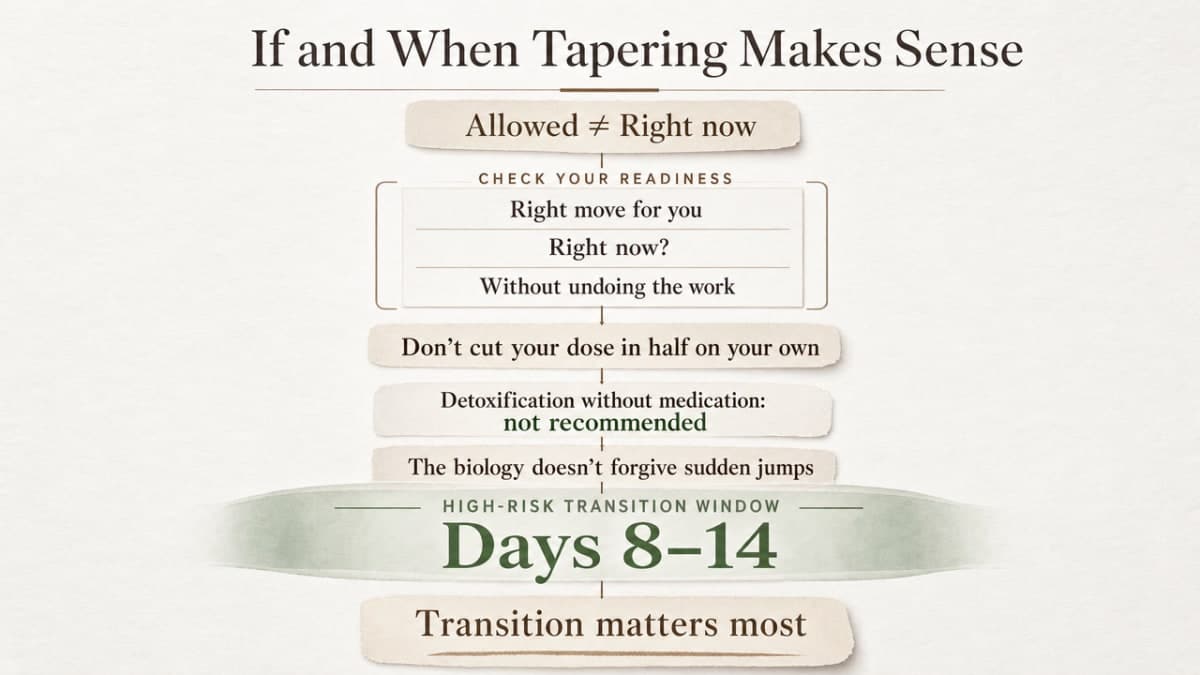
Start with what the federal guidance actually says about leaving treatment too fast. The CDC is explicit: detoxification without medication is not recommended for opioid use disorder because it increases the risk of relapse and overdose death 10. That isn’t a warning aimed at someone else. It’s aimed at the version of you that, on a hard week, might consider cutting your dose in half on your own. Don’t. The biology you’re working with doesn’t forgive that kind of jump the way it might forgive missing a workout.
The window that matters most sits right at the transition. A CDC-linked analysis found that the risk of suicide or overdose is highest 8 to 14 days from a treatment transition — the period right after a dose drops sharply or stops 13. Two weeks. That’s how narrow the danger zone is, and that’s why a real taper is measured in months of small step-downs with your prescriber, not a weekend decision.
So what does “ready” actually look like? The clinical literature is honest that the optimal minimum duration of buprenorphine treatment hasn’t been pinned down, and discontinuation decisions are individualized 4. In practice, the signals worth bringing to your prescriber are unglamorous ones:
- Cravings have been quiet for a long stretch.
- Your housing and relationships are stable.
- Your mental health is being treated rather than just surviving.
- The people you lean on know what’s coming.
The follow-up data on five-year abstinence backs this up — longer treatment duration and stronger social support are both associated with sustained recovery, not one or the other 7.
If you and your prescriber decide it’s time, the taper itself is slow and reversible. Dose drops happen in small increments, with weeks between changes, and the plan includes what to do if cravings come back — because pausing or returning to a higher dose is not a failure. It’s the plan working. The goal isn’t to prove you can white-knuckle a cut. It’s to keep the years you’ve built.
And if the answer for now is “not yet,” that’s a real answer too. Staying on isn’t postponing recovery. It’s protecting it.
Why Medication Alone Sometimes Feels Incomplete
Here’s something a lot of people on Suboxone notice but don’t say out loud: the cravings are quiet, the using is over, the days are stable — and something still feels off. A flatness. A restlessness. A grief that shows up at strange hours. The medication is doing its job. But the job it was built for is one piece of a bigger picture.
Buprenorphine works on opioid receptors. It doesn’t, on its own, treat the depression that was already there before the first pill. It doesn’t process the trauma your nervous system is still carrying. It doesn’t quiet the anxiety that made using feel like the only switch you could reach. For a lot of people in opioid recovery, the medication created the steady ground — and then the harder questions came into focus, because there was finally room to feel them.
The clinical literature backs up what your gut already knows. The long-term follow-up data on five-year abstinence shows that sustained recovery isn’t predicted by medication alone — it’s tied to longer duration of treatment and greater social support 7. The buprenorphine-naloxone clinical guidance is also direct: the medication is considered safe and effective for long-term maintenance when combined with psychosocial support, not as a standalone fix 2. And the federal training that shapes how clinicians think about recovery names this plainly — medications help blunt the effects of illicit opioids and reduce cravings so people can actually engage in recovery activities 8. The medication isn’t the recovery. It’s what makes the recovery possible.
For a lot of people, the piece that’s been missing has a name: a co-occurring mental health condition. PTSD. Major depression. Generalized anxiety. Bipolar disorder. These don’t disappear because the opioid use stopped — they often get louder, because the chemical lid is off. Treating the opioid use disorder without treating what’s underneath is like fixing a leak without checking why the pipe burst in the first place.
This is where integrated dual-diagnosis care does the work the medication can’t do alone. Therapy that addresses trauma directly. Psychiatric care that looks at the whole picture, not just the prescription that’s keeping you alive. Group work where the person across from you understands both halves of what you’re carrying. If Suboxone has given you stable footing and you still feel like something’s unfinished, that’s not a failure of the medication. That’s the medication doing exactly what it was supposed to do — clearing space for the deeper work. You’re not incomplete. You’re ready for the next layer.
What Recovery Looks Like From Here
So where does this leave you, somewhere in the middle of a treatment that’s working and a worry that won’t fully quiet down?
Recovery from here looks less like a finish line and more like a widening. The medication keeps the floor steady. Your life is what gets built on top of it — work that holds your attention, relationships that don’t require you to perform, a body that’s slowly trusting sleep again. Some of that will happen on its own as time stacks up. A lot of it will happen because you decided to treat the parts of yourself the prescription can’t reach: the trauma, the depression, the anxiety that was there long before the first pill.
If Suboxone has given you steady ground and you’re ready to look at what’s underneath it, integrated dual-diagnosis care — the kind Arrow Passage Recovery is built around — is where the medication and the deeper work meet. You don’t have to choose between staying on what’s keeping you alive and addressing what made using feel necessary in the first place. You get to do both. That’s what recovery looks like from here.
Ready to Talk About Suboxone Dependence?
Connect with a caring specialist to explore your next steps toward safer, sustainable recovery.
Discuss Suboxone Concerns With Trusted Professionals
Get guidance tailored to your unique Suboxone recovery experience in a confidential, judgment-free conversation.
Frequently Asked Questions
Does taking Suboxone mean I’m still addicted to opioids?
No. You have a physical dependence on a prescribed medication, which is different from active addiction. Addiction involves loss of control, cravings, and continued use despite harm. The federal training that shapes clinical practice is clear: people taking medications for opioid use disorder are considered to be in recovery, not still in the disease 8. If your life is widening, the medication is working.
How long is it safe to stay on Suboxone?
As long as it’s helping. The clinical literature treats buprenorphine as long-term maintenance for a chronic condition, with common durations of 3 to 6 months and often 1 to 2 years or longer, and notes that participation under 90 days has limited effectiveness 1. Longer treatment is linked to lower overdose risk and other reduced harms 4. There’s no fixed expiration date — your prescriber individualizes it.
Will I go through withdrawal if I stop Suboxone?
If you stop abruptly, yes — your body has adapted to the medication, and withdrawal is a predictable response. That’s not the same as relapse, and it’s exactly why the CDC says detoxification without medication isn’t recommended for opioid use disorder, because it raises the risk of relapse and overdose death 10. A planned, slow taper with your prescriber is the safe path. Never cut the dose on your own.
Can I drink alcohol or take other medications while on Suboxone?
Be careful, and be honest with your prescriber. Combining buprenorphine with benzodiazepines, alcohol, or other sedatives can raise overdose risk in ways the medication’s ceiling effect doesn’t fully prevent 2. That doesn’t mean every interaction is dangerous — it means your prescriber needs the full list of what you’re taking, including occasional drinks and prescriptions from other doctors, so they can flag combinations that actually matter.
Do I need therapy if Suboxone is already working for me?
The medication is part of recovery, not the whole thing. Long-term follow-up data show that sustained abstinence is tied to both longer treatment duration and greater social support, not medication alone 7. Buprenorphine-naloxone is considered safe and effective for maintenance when combined with psychosocial care 2. If depression, trauma, or anxiety still feel loud, that’s the work therapy is built for — not a sign you’re failing.
How do I know when I’m ready to taper off?
The signs are unglamorous: cravings have stayed quiet for a long stretch, your housing and relationships are stable, your mental health is being treated, and your support network knows what’s coming. The optimal minimum duration hasn’t been pinned down clinically, so the decision is individualized 4. The 8-to-14-day window after a treatment transition carries the highest risk 13— which is why a slow, prescriber-guided taper matters.
References
- Buprenorphine – StatPearls – NCBI Bookshelf. https://www.ncbi.nlm.nih.gov/books/NBK459126/
- Buprenorphine and Naloxone – StatPearls – NCBI Bookshelf. https://www.ncbi.nlm.nih.gov/books/NBK603725/
- Buprenorphine Treatment for Opioid Use Disorder: An Overview. https://pmc.ncbi.nlm.nih.gov/articles/PMC6585403/
- Impact of Long-Term Buprenorphine Treatment on Adverse Health Outcomes in Patients With Opioid Use Disorder. https://pmc.ncbi.nlm.nih.gov/articles/PMC7531057/
- Treatment of opioid dependence with buprenorphine: current update. https://pmc.ncbi.nlm.nih.gov/articles/PMC5741113/
- A Review of Buprenorphine Diversion and Misuse: The Current Evidence Base and Experiences from Around the World. https://pmc.ncbi.nlm.nih.gov/articles/PMC4177012/
- Correlates of long-term opioid abstinence after randomization to buprenorphine or methadone in a multi-site trial. https://pmc.ncbi.nlm.nih.gov/articles/PMC6224303/
- TIP 63 Part 1: Introduction to Medications for Opioid Use Disorder (training handout). https://pahs.unt.edu/images/-departments/rhs/rtp/11-pharmacotherapy-and-recovery/handout1.pdf
- What is Buprenorphine? Side Effects, Treatment & Use. https://www.samhsa.gov/substance-use/treatment/options/buprenorphine
- Opioid Use Disorder: Treating | Overdose Prevention (CDC). https://www.cdc.gov/overdose-prevention/hcp/clinical-care/opioid-use-disorder-treating.html
- Differences in Medicaid expansion effects on buprenorphine treatment for opioid use disorder by county rurality and income. https://pmc.ncbi.nlm.nih.gov/articles/PMC10590758/
- The Risk of Misuse and Diversion of Buprenorphine for Opioid Use Disorder in Medicare Part D Continues to Appear Low (2022). https://oig.hhs.gov/reports/all/2023/the-risk-of-misuse-and-diversion-of-buprenorphine-for-opioid-use-disorder-in-medicare-part-d-continues-to-appear-low-2022/
- Association Between Buprenorphine for Opioid Use Disorder and Mortality Risk. https://stacks.cdc.gov/view/cdc/226505/cdc_226505_DS1.pdf
- Access to Medications for Opioid Use Disorder in Medicaid (MACPAC June 2025, Chapter 3). https://www.macpac.gov/wp-content/uploads/2025/06/MACPAC_June-2025-Chapter-3.pdf