
Identifying Substance Abuse Symptoms in a Loved One
Key Takeaways
- Substance use rarely shows up as one obvious sign — it appears as a cluster of behavioral, physical, social, and emotional changes that persist for weeks and disrupt daily life 4.
- Stop waiting for undeniable proof and start documenting. A private log of dates, observations, and what felt different turns vague worry into the pattern data a clinician needs 9.
- Match what you’re seeing to a three-tier response: observe and document, schedule a professional assessment when signs persist, or call 911 or 988 for overdose and crisis situations 7, 13.
- Depression, anxiety, PTSD, and ADHD frequently co-occur with substance use and feed each other, so note mood shifts alongside behavioral ones and seek a clinician who screens for both 3, 11.
When your gut says something is wrong
You’ve been telling yourself it’s nothing. A late night. A bad week. A rough patch at work or school. But something in you keeps circling back to the same quiet question: what if I’m right?
If you’re reading this at 11 p.m. with your phone tilted away from the rest of the house, you already know the feeling. It’s the small math your brain keeps doing — the missing twenty dollars, the new friend you haven’t met, the bedroom door that’s been closed a lot more lately, the sentence that didn’t quite add up at dinner.
Here is the first thing worth saying clearly: trust that instinct. Families are often the earliest and most accurate observers of a developing substance use problem, because you see the patterns clinicians never get to see 9. You’re not being paranoid. You’re being attentive.
This guide will help you turn that attentiveness into something useful — a way of looking, listening, and acting that protects your loved one without pushing them further away.
Why early recognition matters right now
Here’s the part nobody likes to say out loud: the longer a substance use problem goes unnamed, the more chances it has to escalate quietly. That’s not a guilt trip. It’s the reason your noticing matters more than you think.
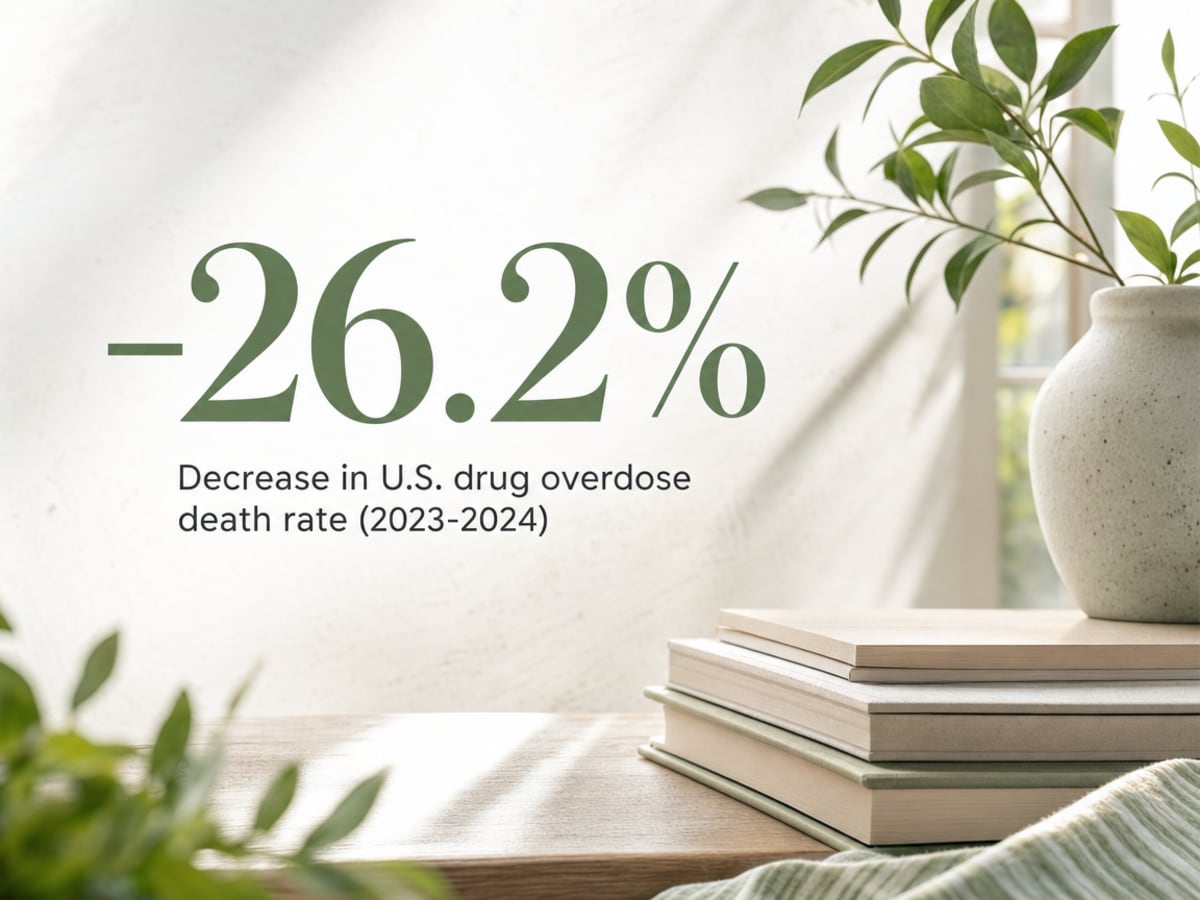
There is real, hard-earned good news in the national numbers. U.S. opioid-involved overdose deaths fell from an estimated 83,140 in 2023 to 54,743 in 2024 — a nearly 27% decline, the largest year-over-year drop on record 1. Families recognizing risk earlier, wider naloxone access, and better treatment connections are part of that story.
But 54,743 is still a staggering number of people who didn’t come home 1. Many of them lived with someone who sensed something was off weeks or months before the worst night. That someone is often a parent, a spouse, an adult child — someone exactly like you.
So the urgency here isn’t panic. It’s timing. The window between “I’m worried” and “I wish I’d said something sooner” is where your attention does the most good. You don’t need certainty to act on what you’re seeing. You just need to start watching the way this guide will show you — on purpose, with patience, and without waiting for one big moment to prove you right.

From checklist to pattern: how symptoms actually show up
If you’ve already searched “signs of substance abuse,” you’ve seen the listicles. Twenty-five bullet points. Bloodshot eyes. Mood swings. Missing money. And somewhere around bullet eleven, you started doubting yourself again — because half of those signs also describe a stressed-out teenager, a grieving spouse, or a coworker pulling double shifts.
That doubt is the problem. Real substance use rarely announces itself with one obvious sign. It shows up as a cluster — several changes, across different parts of life, that persist for weeks and start interfering with how your loved one works, sleeps, eats, or connects with the people closest to them 4.
So the skill you’re building here isn’t memorizing a checklist. It’s pattern recognition. One bad week of sleep isn’t a symptom. One bad week of sleep plus a new friend group, plus money gone from your wallet, plus a fuse that’s suddenly very short — that’s a pattern. The four categories in the next section will give you a way to sort what you’re seeing so the picture stops feeling like noise.
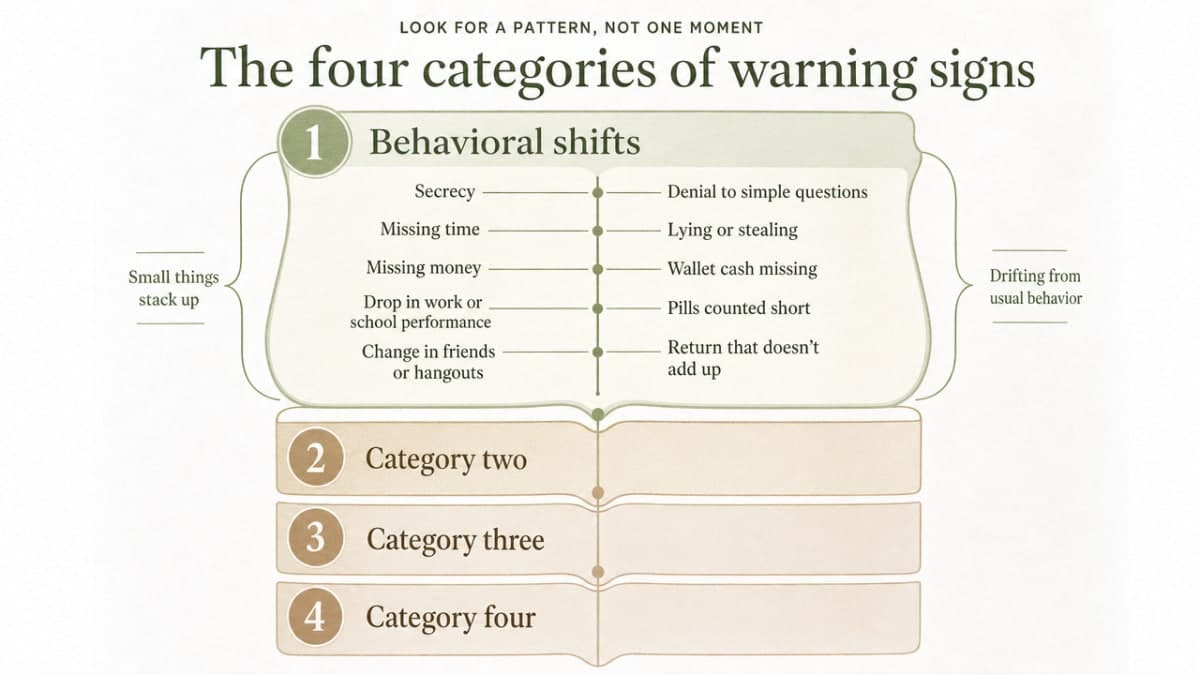
The four categories of warning signs
Behavioral shifts: secrecy, missing time, missing money
Behavior is usually where you’ll see the first cracks — and it’s also the easiest category to talk yourself out of. People go through phases. Teenagers shut their doors. Adults get private about work stress. So you wait. You watch a little longer. And the small things start to stack up.
What you’re looking for here isn’t one suspicious moment. It’s a pattern of behavior that’s drifting away from who your loved one usually is. Family-focused resources consistently flag the same cluster: a noticeable drop in performance at work or school, a sudden change in friends or hangouts, denial when you ask simple questions, and lying or stealing — small amounts of money missing from a wallet, prescription pills counted short, an Amazon return that doesn’t quite make sense 9.
Missing time is its own signal. Hours unaccounted for. A long errand that took half a day. A phone that’s suddenly always face-down or in another room. Secretive behavior — locked drawers, deleted texts, a quick tab-switch when you walk in — shows up in nearly every family guide for a reason 14.
Write down what you see. One incident is a story. Five incidents in a notebook is a pattern.
Physical tells: eyes, sleep, weight, hygiene
The body keeps score before anyone is ready to admit anything. And because you live with this person, you’ll notice things a doctor in a fifteen-minute appointment never could.
Bloodshot or glassy eyes that don’t track with allergy season. Pupils that look unusually large or unusually small in normal light. Sudden weight loss or gain over a few weeks. A face that looks puffier, or thinner, or just off in a way you can’t quite name 14.
Sleep is one of the most reliable tells. Someone using stimulants may be up at strange hours, then crash for a full day. Someone using sedatives or opioids may nod off mid-sentence on the couch, or be impossible to wake in the morning. Either direction — too much, too little, at the wrong times — counts.
Hygiene is harder, because raising it feels cruel. But a person who used to shower every morning and now goes three days, or who’s wearing the same clothes you saw yesterday and the day before, is telling you something. So is a new smell — smoke, chemicals, mouthwash used at odd times to cover something else 9. None of these alone proves anything. Together, they speak.
Social and relational changes at home and beyond
This is the category families often feel before they can name it. The dinner table got quieter. The group text went cold. The friend who used to come over every Sunday hasn’t been around in two months — and a new name keeps showing up on the phone instead.
Substance use almost always reshapes a person’s social map. Old friendships fade, especially the ones tied to activities your loved one has lost interest in. New connections appear quickly and often stay vague — first names only, no last names, no clear backstory 9.
Inside the house, watch for friction that wasn’t there before. Researchers studying families and substance use describe a familiar arc: more conflict, communication breakdowns, role changes as someone else picks up what your loved one has dropped 6. You may find yourself walking on eggshells, covering for them at work, or explaining their absence to relatives. That exhaustion you’re carrying isn’t a side issue. It’s data. Family dynamics shifting around one person is one of the most consistent early indicators of an emerging substance use problem 6.
Emotional shifts and the mental health overlap
The hardest category to read is the one that lives behind your loved one’s eyes. Moods sharpen. The fuse gets shorter. A person who used to laugh easily snaps at small things, or goes flat — present in the room but not really there.
You may see swings that don’t track with anything obvious: anxious and wired one evening, withdrawn and tearful the next morning, then irritable by dinner. Persistent sadness, new panic, anger that feels disproportionate, or a creeping hopelessness about things that used to matter — all of these belong in the emotional column 14.
Here’s what makes this category tricky. These same symptoms describe depression, anxiety, PTSD, and ADHD on their own. And substance use disorders frequently co-occur with mental illness, so a loved one struggling with one is statistically more likely to be struggling with both 3, 11. Substances and mental health symptoms also feed each other — using to take the edge off anxiety can deepen the anxiety underneath, and so on 5.
You don’t need to diagnose anything. You just need to notice that something inside your loved one has changed, and to take that change as seriously as you’d take a physical symptom. The next section explains why this overlap matters for what you do next.
Why depression, anxiety, PTSD, and ADHD muddy the picture
Here’s a frustration you may already know: every time you bring up what you’re seeing, someone has a different explanation for it. The therapist points to depression. A friend says it sounds like burnout. Your loved one mentions their old ADHD diagnosis. And you’re left wondering whether you’ve been worrying about the wrong thing the whole time.
You probably haven’t. You may just be looking at two things at once.
Substance use disorders and mental health conditions co-occur often enough that clinicians treat them as a connected problem, not separate ones 11. Depression, anxiety, PTSD, and ADHD share real overlap with substance use — and each condition can make the other worse, which is why families who try to address only one side of the picture often feel like they’re losing ground 3. Someone using to quiet anxiety may find the anxiety louder by morning. Someone medicating untreated PTSD may look, on the surface, like they’re just “struggling lately” 5.
What this means for you: don’t try to sort which came first. Note both. When you eventually talk with a professional, the fact that you saw mood changes and behavioral shifts together is exactly the kind of information that points toward integrated, dual-diagnosis care instead of a treatment plan that only addresses half of what’s happening.
The ‘waiting for proof’ trap and how to document what you see
There’s a quiet bargain a lot of families make with themselves: I’ll say something when I’m sure. Sure looks like a bottle on the dresser. Sure looks like a confession. Sure looks like one undeniable night that settles the question for good.
Here’s what helps instead: stop trying to prove it and start documenting it. Keep one private place — a notes app you’ve locked, a small notebook in a drawer no one opens, a password-protected document. Each time something stands out, write down four things: the date, what you observed, how long it lasted, and what was different about it from your loved one’s usual baseline 9.
That’s it. No conclusions. No labels. Just “Tuesday, 11:40 p.m. — slurred speech, couldn’t find car keys, slept on couch in clothes. Third time in two weeks.”
Two things happen when you do this. You stop second-guessing yourself, because the notebook does the remembering for you. And when you eventually sit down with a clinician, you’ll arrive with the kind of pattern data that turns a vague worry into a clear clinical picture — exactly what a good assessment needs to point toward the right level of care.
Telling occasional use from a developing substance use disorder
One of the quietest fears keeping you up is also one of the most reasonable: what if this is just a phase? Plenty of adults drink at weddings. Plenty of college kids try things. You don’t want to call something an emergency that turns out to be a hard year.
Here’s the line clinicians actually use. Occasional use is use that doesn’t reorganize a person’s life. A substance use disorder, by contrast, is defined by use that’s already causing problems at work, school, or home — and by a pull to keep using even after those problems show up 4. Addiction itself is described as a chronic, relapsing pattern of compulsive use that continues despite real harm 10.
So the questions that matter aren’t how much or how often. They’re harder and more honest. Is your loved one still meeting the obligations that used to come easily? Are the consequences stacking up — a warning at work, a friendship lost, a fender-bender, a missed pickup — without changing the behavior? Is the substance crowding out the things they used to love?
If the answer to any of those is yes, you’re no longer looking at occasional use. You’re looking at something that warrants an assessment.
If your loved one is a teenager: a different conversation
Parenting a teenager you’re worried about is its own kind of hard. Adolescence is supposed to look like change — new friends, new moods, a closed bedroom door. So when something feels wrong, you can’t always tell whether you’re seeing growing up or something more.
Here’s what to watch for specifically with teens: lost interest in activities they used to love, a new friend group with no real backstory, lower grades, missed classes, or skipping school altogether 8. Pair that with hygiene changes, odd sleep, or money disappearing, and you’re past normal-teen territory.
The conversation also looks different. Short and frequent beats one big sit-down. Brief check-ins in the car, after practice, while making dinner — these get further than a confrontation across the kitchen table 8. Ask, listen longer than feels comfortable, and keep the door open for next time. You don’t have to solve it in one talk. You just have to stay in the conversation.
Your escalation ladder: observe, assess, or call for help
One of the hardest parts of loving someone you’re worried about is not knowing how big a deal this is supposed to be. Is tonight a wait-and-watch night? A call-the-doctor week? Or is this the moment you stop being polite and dial 911? You shouldn’t have to guess. Here’s a simple way to map what you’re seeing to what you do next.
Tier one: observe and document. If you’re noticing changes but nothing has crossed into crisis, keep doing what the previous section described — write down what you see, when you see it, and how it differs from your loved one’s baseline. Give yourself a few weeks of notes before you draw conclusions, unless the picture gets worse fast 9.
Tier two: schedule a professional assessment. When the cluster of signs persists, or when use is clearly interfering with work, school, or home, it’s time to bring in someone trained to evaluate it 4. You don’t need your loved one’s agreement to make the first call — many outpatient programs will speak with you first, walk you through options, and help you plan the conversation. If your loved one is willing, a single intake appointment can clarify whether outpatient counseling, intensive outpatient, or a higher level of care fits. If they’re not yet willing, a clinician can still coach you on next steps.
You don’t have to know which tier you’re on every minute. You just have to know that there is one — and that moving up a rung is allowed long before you feel certain.
Opening the conversation without making things worse
You’ve been rehearsing this talk in your head for weeks, maybe months. And every version ends the same way — a door slamming, a denial, a quiet vow from your loved one to talk to you less. That fear is real, and it’s part of why so many families wait too long.
Here’s what tends to land better. Pick a sober, low-stakes moment — not the middle of an argument, not 10 p.m. after a bad night. Speak from what you’ve seen, not what you’ve concluded. “I’ve noticed you’ve been sleeping through mornings and you seemed really off on Sunday” goes further than “I think you have a problem.” Short and frequent beats one big confrontation, especially with a teenager 8.
Expect denial. It’s not proof you’re wrong — it’s often the first reflex, even when someone knows you’re right 9. Stay calm, leave the door open, and say plainly that you love them and you’re going to keep checking in. You’re not trying to win this conversation. You’re starting one that can keep happening.
What a professional assessment actually looks like
A lot of families picture an assessment as something dramatic — fluorescent lights, a clipboard, a verdict. It’s almost never that. A first appointment with an outpatient counselor or licensed clinician usually looks like a long conversation, often 60 to 90 minutes, in an office or on a secure video call.
You can expect questions about substance use history, family history, mental health, medications, sleep, work, school, and relationships 4. Because depression, anxiety, PTSD, and ADHD travel so often with substance use, a good clinician will screen for both sides of the picture rather than treating them as separate problems 3, 11. If you’ve been keeping that notebook of dates and observations, bring it. The patterns you’ve documented help the clinician see what your loved one may not say out loud.
What comes out of an assessment is a recommendation: outpatient counseling, intensive outpatient, partial hospitalization, or a residential level of care. It’s a starting place, not a sentence — and you can move with it from there.
Taking care of yourself while you stay watchful
Here’s something nobody tells the spouse, the parent, the adult child quietly running this watch: the person taking notes also needs taking care of.
You’ve been holding a lot. The covering. The covering for them at work. The not sleeping. The way every buzz of their phone hooks your stomach. That toll is real, and the research on families living with substance use is blunt about it — relatives often carry significant emotional and economic burdens alongside the person who’s struggling 6.
So while you stay watchful, stay watched-over too. Tell one trusted person what you’re seeing. Keep your own appointments. Find a support group for families — Al-Anon, Nar-Anon, or a clinician-led family group through an outpatient program. Your steadiness is part of what gets your loved one to help. You can’t be that steady alone.
Speak With a Compassionate Specialist Right Now
Get answers and immediate support for your loved one’s substance use concerns in a confidential conversation.
Talk with a Specialist About Next Steps
Get expert guidance tailored to your loved one’s unique needs in a safe, confidential conversation.
Frequently Asked Questions
How do I tell the difference between normal stress and substance use symptoms?
Stress usually loosens its grip when the trigger passes. Substance use symptoms tend to cluster across categories — behavior, physical signs, social shifts, mood — and persist for weeks while interfering with work, school, or home life 4. One bad week is stress. Several changes stacking up across different parts of life is the pattern worth taking seriously.
What should I do if I find substances or paraphernalia in my loved one’s belongings?
Don’t confront in that moment. Take a breath, secure the items safely, and write down what you found, where, and when. Then plan a calm conversation for a sober, low-stakes time using what you saw rather than accusations 8. If opioids are involved, ask a pharmacist about keeping naloxone in the house as a precaution 12.
When should I call 988 versus 911?
Call 988 if your loved one is in a mental health or suicidal crisis but is conscious, breathing, and able to talk 4. Call 911 immediately for overdose warning signs — unconsciousness, very slow or stopped breathing, or pinpoint pupils. Give naloxone if you have it, place them on their side, and stay until help arrives 7, 13.
Can mental health conditions like depression or anxiety cause symptoms that look like substance use?
Yes — and they often travel together. Depression, anxiety, PTSD, and ADHD share real overlap with substance use, and each can worsen the other 3, 5. You don’t need to sort which came first. Note both the mood changes and the behavioral shifts, and bring that picture to a clinician who screens for co-occurring disorders 11.
What if my loved one denies using when I bring it up?
Expect it. Denial is one of the most common first reactions, even when someone privately knows you’re right 9. Don’t argue the point or demand a confession. Stay calm, tell them what you’ve seen and that you love them, and keep the door open. Short, repeated check-ins land further than one big confrontation 8.
Do I need my loved one’s permission to schedule a professional assessment?
No — not to make the first call. Most outpatient programs will speak with family members directly, review what you’ve observed, and help you plan next steps before your loved one is ready 4. Your loved one will need to participate in the actual assessment, but you can do the groundwork now so the path is ready when they say yes.
References
- U.S. Overdose Deaths Decrease Almost 27% in 2024 – CDC. https://www.cdc.gov/nchs/pressroom/releases/20250514.html
- U.S. Life Expectancy Hits Record High as Drug Overdose Deaths Decrease. https://www.cdc.gov/nchs/pressroom/releases/20260129.html
- Common Comorbidities with Substance Use Disorders Research Report. https://www.ncbi.nlm.nih.gov/books/NBK571451/
- Substance use disorder: MedlinePlus Medical Encyclopedia. https://medlineplus.gov/ency/article/001522.htm
- Substance Use and Mental Health. https://www.nimh.nih.gov/health/topics/substance-use-and-mental-health
- Family and social aspects of substance use disorders and treatment. https://pmc.ncbi.nlm.nih.gov/articles/PMC4158844/
- How and When to Use Naloxone for an Opioid Overdose (Families and Caregivers). https://www.cdc.gov/overdose-prevention/media/pdfs/2024/04/Naloxone-Fact-Sheet_FamilyandCaregivers_HowandWhen_4_11_2024.pdf
- 8 tips for talking (and listening) to your teens about drugs and alcohol. https://magazine.medlineplus.gov/article/8-tips-for-talking-and-listening-to-your-teens-about-drugs-and-alcohol
- Family to Family Recovery Resource Guide. https://www.alleganyco.gov/wp-content/uploads/FamtoFamResourcesGuide.pdf
- Drug Misuse and Addiction | National Institute on Drug Abuse (NIDA). https://nida.nih.gov/publications/drugs-brains-behavior-science-addiction/drug-misuse-addiction
- Co-Occurring Disorders and Health Conditions. https://nida.nih.gov/research-topics/co-occurring-disorders-health-conditions
- What You Need to Know About Naloxone | CDC. https://www.cdc.gov/overdose-prevention/media/pdfs/Naloxone_FactSheet_FamilyandCaregivers_WhatYouNeedToKnow.pdf
- Risks and How to Reduce Them | Overdose Prevention – CDC. https://www.cdc.gov/overdose-prevention/manage-treat-pain/reduce-risks.html
- Warning Signs of Substance and Alcohol Use Disorder. https://www.ihs.gov/asab/familyfriends/warningsignsdrug/