
Key Takeaways
- Trembling hands after heavy drinking come from a rebounding nervous system: chronic alcohol suppresses GABA and ramps up glutamate, so stopping leaves the brain firing without brakes 7.
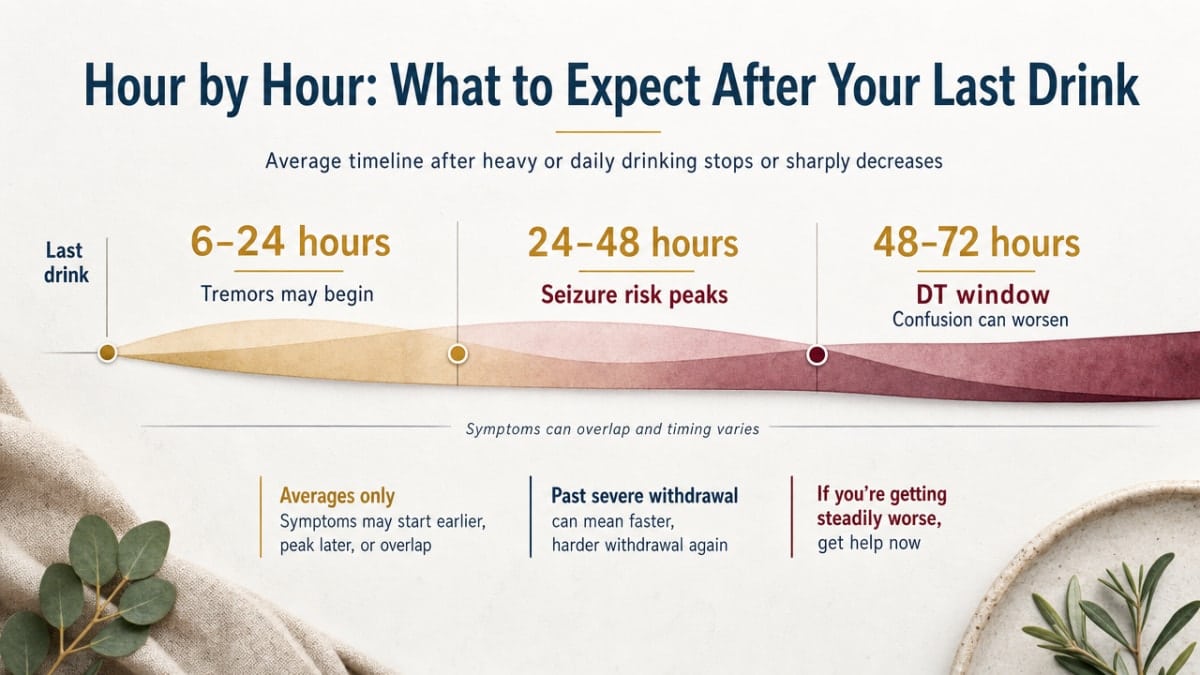
- Withdrawal follows a predictable arc, with tremor starting 6–24 hours after the last drink, seizure risk peaking at 24–48 hours, and delirium tremens emerging at 48–72 hours 1.
- Medical detox with symptom-triggered benzodiazepines like diazepam or chlordiazepoxide is the strongest path to calming the tremor safely and preventing seizures or DT 9.
- Plan for risk honestly: home detox only fits mild cases with sober support, while prior DT, seizures, confusion, fever, or hallucinations require hospital-level monitoring tonight 8.
Why Your Hands Are Shaking Right Now
If your hands are shaking right now, take a breath. You’re not weak, and you’re not imagining it. Your nervous system is doing something specific, and it has a name.
When you drink heavily for weeks, months, or years, your brain adjusts. Alcohol quiets things down, so your brain turns the volume up to compensate. Take the alcohol away — even for a few hours — and that turned-up brain starts firing without anything to soften it. One of the first places you feel that is in your hands. The shake usually shows up 6 to 24 hours after your last drink, sometimes sooner if you’ve been drinking around the clock 1.
Maybe you woke up and couldn’t hold your coffee mug steady. Maybe your fingers started buzzing in the middle of a workday and you had to sit on your hands. Maybe you noticed it for the first time when you tried to cut back, and it scared you enough to start reading. Whatever brought you here, the tremor is real information. It’s your body telling you where you are on a timeline that’s actually pretty predictable.
This article will walk you through that timeline, help you tell a mild shake from a medical emergency, and explain what real treatment looks like. You don’t have to figure this out alone, and you don’t have to decide everything in the next ten minutes. Just keep reading.
The Science of the Shake: GABA, Glutamate, and a Rebounding Brain
Here’s what’s actually happening inside your head when your hands won’t hold still. Your brain runs on a balance between two chemical signals. GABA is the calming one — it tells brain cells to slow down. Glutamate is the accelerator — it tells them to fire. In a brain that isn’t soaked in alcohol, these two stay roughly balanced, and your hands stay steady.
Alcohol shifts that balance hard. Every drink boosts GABA’s calming effect and dampens glutamate’s accelerator. That’s part of why a drink relaxes you. The problem is that your brain doesn’t want to stay sedated. So when you drink heavily for weeks, months, or years, your brain quietly turns down its own GABA receptors and turns up glutamate production to fight back. It’s trying to keep you alert despite the alcohol 7.
That adaptation works fine — as long as the alcohol keeps coming. Take it away, and the math suddenly doesn’t add up. GABA has nothing to amplify anymore, but glutamate is still running hot. The brakes are gone, and the gas pedal is stuck. Your nervous system slams into overdrive 7.
Your hands are one of the first places that overdrive shows up. The motor signals going down to your fingers get noisy and uncoordinated. Instead of one clean instruction to hold a cup, you get dozens of tiny conflicting ones. The result is the fine, fast tremor you’re feeling right now. It usually starts in the hands, sometimes spreads to the tongue or eyelids, and gets worse when you try to hold a position — like reaching for a glass of water.
This is the same biology that, in a more severe form, drives withdrawal seizures and delirium tremens. The tremor isn’t separate from those bigger risks. It’s the same rebounding brain, just earlier on the curve. Understanding that is what makes the next section — the hour-by-hour timeline — useful instead of frightening.
Hour by Hour: What to Expect After Your Last Drink
Withdrawal isn’t random. It moves through a fairly predictable arc, and knowing where you are on that arc is one of the most useful things you can learn right now. The timeline below assumes heavy or daily drinking, then a stop or a sharp cutback. If you’ve been drinking lightly or occasionally, your experience will be milder. If you’ve gone through serious withdrawal before, your timeline may move faster and hit harder — past severe withdrawal is one of the strongest predictors of severe withdrawal again 1.
One more thing before you read on: the hours below describe averages. Your body isn’t a stopwatch. Symptoms can show up earlier, peak later, or stack on top of each other. What matters most is the direction things are moving. If you’re getting steadily worse — more shaking, more sweating, more confusion — that’s the signal to get help, regardless of which hour the clock says it is 7.
6 to 24 Hours: Tremor, Anxiety, and the First Warning Signs
Somewhere between 6 and 24 hours after your last drink, the early signs show up. Your hands start to shake. Your heart picks up. You sweat more than the room warrants. Sleep feels impossible, and a low hum of anxiety sits behind everything you do 1. Some people also get a headache, nausea, or a queasy stomach that won’t settle.
This is the window where most people first notice the tremor and start looking for answers. It’s also the window where a calm decision about what comes next matters most — because what happens over the following two days depends a lot on what you do in this one.
24 to 72 Hours: When Symptoms Peak
Between 24 and 72 hours, the dial turns up. The shake that was annoying yesterday is harder to hide. Your blood pressure and heart rate climb. You may feel hot, then cold. Some people start hearing or seeing things that aren’t there — usually shadows, voices, or bugs — while still knowing those things aren’t real. That’s called alcoholic hallucinosis, and it’s different from full delirium 1.
The seizure risk is highest in roughly the 24-to-48-hour stretch 1. A withdrawal seizure can happen with no warning, even in people who’ve never had one. If you’ve had a seizure during a past withdrawal, treat this window as a hard line — you need monitored care now.
48 to 72 Hours: The Delirium Tremens Window
Delirium tremens — DT — typically begins 48 to 72 hours after the last drink, though it can show up later in some people 8. This is the dangerous one. DT isn’t just bad shakes. It’s deep confusion, severe agitation, hallucinations that feel completely real, a racing heart, fever, and dangerously unstable blood pressure. Untreated, it can be fatal.
Not everyone who shakes develops DT. The people at highest risk are those with heavy long-term use, prior DT or withdrawal seizures, other medical illness, or older age 8. If you fit any of those, you should not be alone right now, and you should not be trying to ride this out at home.
Mild Shakes or Medical Emergency: How to Tell the Difference
This is the part you need most. Not every tremor means an ambulance, and not every tremor is safe to sleep off. The line between the two is real, and you can learn to read it in a couple of minutes.
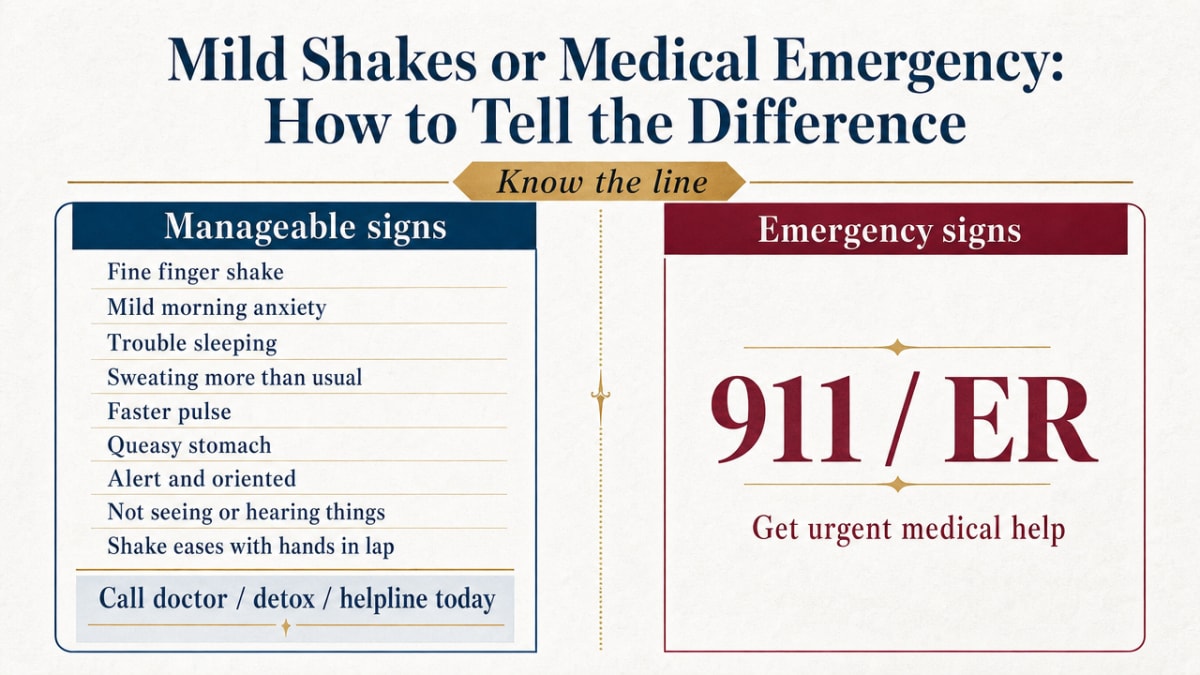
Signs you can likely manage with a same-day clinical call or scheduled detox intake: a fine shake in your fingers when you reach for something, mild morning anxiety, trouble sleeping, sweating more than usual, a faster pulse, and a queasy stomach. You’re alert. You know what day it is, where you are, and who’s in the room with you. You’re not seeing or hearing things that aren’t there. Your shake settles down a little when you rest your hands in your lap. These are real withdrawal signs, and they still deserve a phone call to a doctor, a detox program, or a helpline today — but you have time to make that call thoughtfully 1.
Clinicians use a scoring tool called the CIWA-Ar to put numbers on what you’re feeling — tremor, sweating, anxiety, nausea, agitation, and so on. A score of 8 or higher is the threshold where medication treatment starts, and higher scores trigger closer monitoring 7. You don’t need to score yourself. The tool exists because withdrawal severity is hard to eyeball, even for doctors. That’s part of why hospitals and detox units watch you in person rather than over the phone 2.
If you’re reading this and genuinely unsure which column you’re in, treat that uncertainty itself as a reason to call. A nurse on a helpline can ask you ten questions and tell you in five minutes whether you need an ER tonight or a detox bed tomorrow. You don’t have to decide alone, and you don’t have to be sure you’re “bad enough” to ask.
Why Drinking More to Stop the Shakes Is a Danger Signal
If a drink is the only thing that steadies your hands in the morning, that’s not a quirk of your personality. That’s your body telling you it has become physically dependent on alcohol. The shake calms down because you’ve topped off the GABA your brain has stopped making on its own — not because you’ve solved anything 7.
This pattern has a name in clinical settings: morning drinking, or eye-openers. It’s one of the clearest signs that withdrawal is already starting between drinks, and that the next time you try to stop, the symptoms will likely be worse than what you’re feeling now. People who drink to manage tremor are, by definition, drinking through active withdrawal — and that’s the population most likely to develop seizures or delirium tremens if they later quit without medical support 1.
You’re not failing at willpower. You’re trapped in a loop your nervous system built to survive. The way out isn’t another drink, and it isn’t quitting cold turkey alone at home. It’s getting the same kind of medication, in a controlled dose, that lets your brain ease back to baseline without firing into a seizure. If you’ve been using alcohol itself as that medication, please read the next sections carefully — this is exactly the situation medical detox was designed for.
When the Tremor Isn’t Withdrawal: Other Causes Worth Naming
If you’ve been told for years that your shake is “just nerves,” you deserve a more honest read. Not every hand tremor is alcohol withdrawal. A few other causes look similar from the outside, and telling them apart matters — both for what you do tonight and for what you do six months from now.
- Essential tremor
- A chronic movement disorder, not a withdrawal sign. It tends to run in families, often shows up earlier in adulthood, and gets worse with action — reaching for a fork, signing your name, lifting a glass — rather than at rest. Many people with essential tremor notice that a single drink temporarily calms it, which is one of the reasons it can get tangled up with heavy drinking over time. It’s treated with medications like propranolol or primidone, not benzodiazepines 6. If your shake has been there for years, in both hands, and predates your heavy drinking, this is worth raising with a doctor.
- Anxiety tremor
- Faster, finer, and tracks with how you feel emotionally. It spikes during a stressful conversation and eases when you calm down. It doesn’t come with sweating, racing heart at rest, nausea, and insomnia all stacked together the morning after no drinking.
- Caffeine, low blood sugar, certain medications, and an overactive thyroid
- All can produce a fine hand tremor too. Skipping meals while drinking heavily is a common combination, and it can amplify whatever else is going on.
Here’s the practical part. If your tremor showed up or got dramatically worse within a day of cutting back on alcohol, treat it as withdrawal until proven otherwise — the timing is the tell 7. If your hands have shaken for years independent of drinking, that’s a different conversation with a primary care doctor or neurologist, and one worth having once you’re stable. Both can be true at the same time. Sorting them out is part of what good treatment does.
What Medical Detox Actually Does for Tremor
If you’ve been picturing detox as just “riding it out somewhere safe,” it’s worth knowing what actually happens. The point of medical detox isn’t to take away your alcohol and watch you suffer. It’s to step in for the alcohol — chemically — so your nervous system has something to taper down from instead of slamming into a wall.
That matters for your hands specifically. Tremor is one of the symptoms clinicians watch most closely, because it tracks with how hyperactive your nervous system is in real time. As your dose of medication goes up and your brain quiets back down, the shake settles. As you taper off the medication over days, your brain learns to handle being awake without chemical help again. Done right, you don’t white-knuckle it. You sleep. You eat. You feel rough, but you’re not in danger of a seizure or DT in a room by yourself 1.
Detox also does something less visible. While you’re being monitored, a team checks your vitals, your hydration, your electrolytes, your blood sugar, and whether you’ve been quietly malnourished — all common in heavy drinkers, and all things that can make withdrawal worse if they aren’t corrected. Hospitals use structured scoring like CIWA-Ar to decide how often to check on you and when to give the next dose, instead of guessing 2. That’s the part that’s hard to replicate at home with good intentions and a worried partner.
Benzodiazepines and Symptom-Triggered Dosing
Benzodiazepines are the first-line treatment for alcohol withdrawal, and they’re the medications most directly responsible for stopping the shake 1. They work on the same GABA system alcohol was hitting — so they give your overstimulated brain the calming signal it’s been missing, without the toxicity of more drinking.
Long-acting versions like diazepam and chlordiazepoxide are usually preferred because they self-taper as they leave your system, which smooths out the ride 8. In a large analysis comparing withdrawal medications, diazepam was the one agent that consistently reduced delirium tremens 9. The dosing is symptom-triggered: when your CIWA-Ar score hits 8 or above, you typically get 5–10 mg of diazepam or 25–100 mg of chlordiazepoxide, then you’re reassessed every hour 7. You’re not on a fixed schedule — you get medicine when you need it, less when you don’t.
Adjunct Medications and Their Real Limits
You may have heard about other medications used in withdrawal — gabapentin, carbamazepine, valproate, sometimes clonidine or beta-blockers. These are adjuncts. They can help with specific pieces of the picture, like blood pressure, anxiety, or mild symptoms, but they don’t carry the same weight of evidence for preventing seizures and delirium tremens that benzodiazepines do 3.
That distinction matters if someone offers you a “benzo-free detox” while your hands are already shaking and you have a history of heavy daily drinking. For mild withdrawal in a low-risk person, adjuncts alone can be reasonable. For moderate-to-severe withdrawal, or anyone with prior DT or seizures, they’re not a substitute 9. In benzodiazepine-resistant cases, hospitals add phenobarbital, propofol, or dexmedetomidine in an ICU setting — another reason monitored care exists 8. Ask what your protocol actually includes before you commit.
Outpatient, Residential, or Hospital: Where Should You Detox?
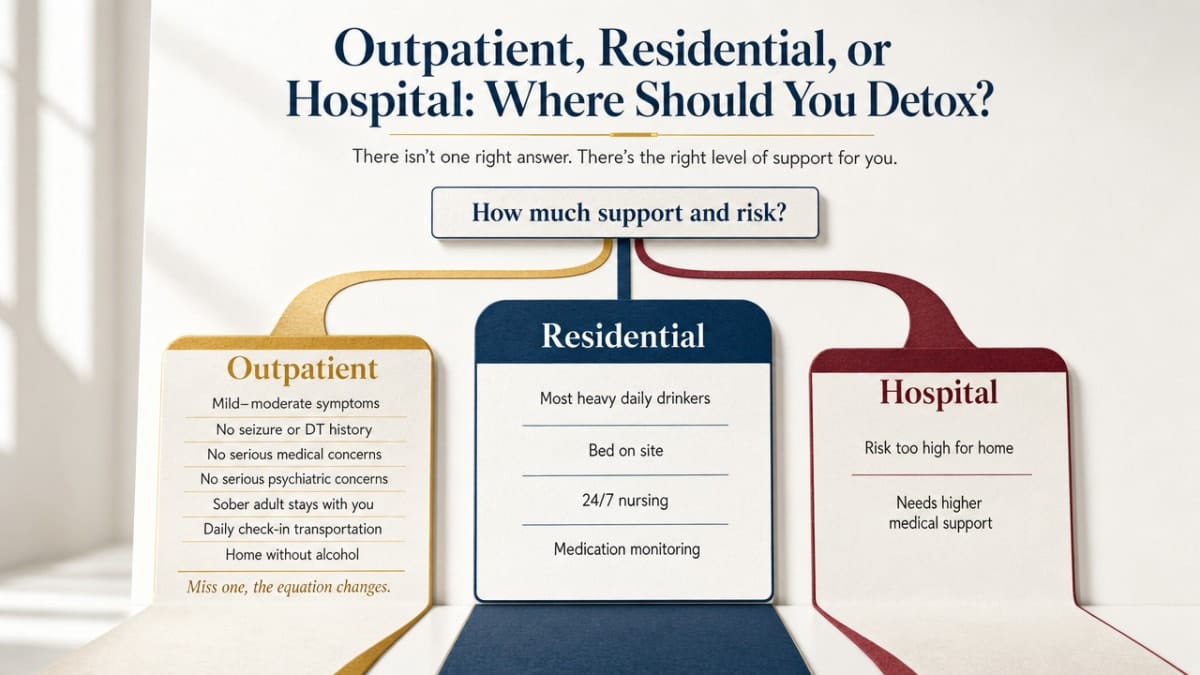
There isn’t one right answer here, but there is a right answer for you. The honest version goes like this: outpatient detox can be safe and effective for mild-to-moderate withdrawal when the right supports are in place, while residential or hospital settings exist for the people whose risk is too high to manage from a kitchen table 10.
Outpatient detox can work if your symptoms are mild, you have no history of withdrawal seizures or DT, no serious medical or psychiatric conditions pulling on you, a sober adult who can stay with you, transportation to daily check-ins, and a home that isn’t full of alcohol you’d reach for at hour 14. Miss one of those, and the equation changes 10.
Residential detox is built for the middle of the curve — and that’s most heavy daily drinkers. You get a bed, 24/7 nursing, medication on a symptom-triggered schedule, and people watching for the shift from rough to dangerous before you have to name it yourself. Tremor is one of the signs they track most closely because it moves in real time with how loud your nervous system is firing 2. You also get separation from the bottle, which sounds small until it’s 2 a.m. and your hands are buzzing.
Hospital-based detox is the right call if you’ve had DT or a withdrawal seizure before, have unstable vitals, significant heart or liver disease, a co-occurring psychiatric crisis, or symptoms that have already escalated past what an unmonitored room can handle 8. This isn’t a step up in stigma. It’s a step up in monitoring.
If you’re not sure where you fit, default up, not down. The cost of overestimating is a few days in a calmer setting than you needed. The cost of underestimating is a seizure in a bathroom.
For the Family Member Watching This Happen
This section is for the person sitting next to the drinker — the spouse, the adult child, the sibling, the friend who showed up. If that’s you, read this carefully.
You are probably scared and trying not to show it. You may have been told for months that the shaking is nothing, that a drink fixes it, that you’re overreacting. You’re not. A hand tremor in someone who drinks heavily every day is a real medical sign, and your instinct to take it seriously is correct.
Watch for the shifts that matter: confusion about the time, the place, or who you are. A fever. Sweating that soaks through a shirt. Hallucinations — your person reaching for bugs that aren’t there, or talking to someone who isn’t in the room. A seizure of any kind. Vomiting that won’t stop. A tremor so coarse they can’t lift a glass. Any of these means you call 911 now, not in the morning 8. If they’ve ever had delirium tremens or a withdrawal seizure before, that history alone is reason enough to get them into a monitored setting this time, even before symptoms escalate 8.
You are allowed to override their protests. People in withdrawal often minimize, bargain, or get irritable — that’s the nervous system talking, not their considered judgment. If they refuse the ER, you can still call SAMHSA’s free, confidential helpline at 1-800-662-HELP, which is staffed 24/7 and can walk you through your next move and local detox options 5. You don’t need their permission to ask for guidance.
What to Do in the Next Hour
You don’t have to fix everything tonight. You just have to take the next right step. Here’s what that looks like, in order.
- Stop trying to power through alone. Tell one person what’s happening — a partner, a sibling, a friend, a neighbor. You don’t owe them a polished explanation. “My hands are shaking and I’m scared” is enough.
- Look honestly at the emergency signs from earlier: confusion, fever, seizures, hallucinations that feel real, repeated vomiting, a tremor too coarse to hold a cup, or any prior history of delirium tremens or withdrawal seizures. Any one of those means call 911 or go to an emergency department now 8. A good ED won’t just stabilize you and send you home — they should connect you to ongoing addiction care before you walk out the door 4.
- If you’re not at that line but you know this isn’t going to fix itself, call SAMHSA’s free, confidential helpline at 1-800-662-HELP. It’s staffed 24 hours a day, and they can help you find detox and treatment near you tonight 5. One call. That’s the next hour.
Speak Now for Immediate Help With Alcohol Tremors
Connect instantly for guidance and support handling alcohol-related trembling hands.
Start Stabilizing Unsteady Hands and Regain Control
Connect with a professional for guidance on managing alcohol-related tremors in a safe, supportive environment.
Frequently Asked Questions
How long will my hands shake after I stop drinking?
For most people, the shake starts 6 to 24 hours after the last drink and eases over the next few days as your nervous system settles 1. The roughest stretch is usually the first 24 to 72 hours. Some people notice a lighter tremor lingering for a week or two, especially with sleep loss or stress. If your shake is getting worse instead of better past day three, that’s a reason to call a doctor.
Is it safe to detox from alcohol at home if my hands are shaking?
Sometimes, but not always. Home detox can be reasonable for mild withdrawal in someone with no history of seizures or delirium tremens, no major medical or psychiatric conditions, and a sober adult on hand 10. If you drink heavily every day, have had bad withdrawals before, or are already shaking visibly, home isn’t the safe choice. A seizure or DT in a kitchen is a different problem than in a monitored bed 8.
When should I go to the ER for alcohol shakes?
Go now if you have confusion, fever, a seizure, hallucinations that feel real, repeated vomiting, chest pain, or a tremor so coarse you can’t hold a cup or walk steadily. Any past history of delirium tremens or a withdrawal seizure also belongs in the ER column, even before symptoms peak 8. A good ER won’t just stabilize you — they should hand you off to ongoing addiction care before discharge 4.
Why do my hands shake in the morning before I drink?
Because withdrawal is already starting overnight. Your brain has adapted to constant alcohol, and a few hours without it is enough to trigger early symptoms — tremor, sweating, anxiety, a fast pulse 1. A morning drink calms the shake because it tops off the chemical signal your brain has stopped making on its own. That pattern is one of the clearest signs of physical dependence, and it tends to get worse, not better, on its own.
Can the tremor be something other than alcohol withdrawal?
Yes. Essential tremor is a chronic movement disorder that often runs in families and worsens with action like reaching or writing; it’s treated with propranolol or primidone, not benzodiazepines 6. Anxiety, caffeine, low blood sugar, certain medications, and an overactive thyroid can all cause shaking too. The clue with withdrawal is timing — if your tremor showed up or got dramatically worse within a day of cutting back on alcohol, treat it as withdrawal first 7.
What medications are used to stop withdrawal tremors?
Benzodiazepines are the first-line treatment because they calm the same GABA system alcohol was hitting 1. Long-acting options like diazepam and chlordiazepoxide are usually preferred, since they taper themselves as they leave your system 8. Dosing is symptom-triggered using the CIWA-Ar scale, with treatment typically starting at a score of 8 7. Adjuncts like gabapentin or carbamazepine can help with milder cases but don’t carry the same evidence for preventing seizures or DT 3.
References
- Alcohol Withdrawal Syndrome – StatPearls – NCBI Bookshelf. https://www.ncbi.nlm.nih.gov/books/NBK441882/
- Alcohol Withdrawal in Hospitalized Patients. https://www.ncbi.nlm.nih.gov/books/NBK604324/
- Alcohol Withdrawal Syndrome: Benzodiazepines and Beyond. https://pmc.ncbi.nlm.nih.gov/articles/PMC4606320/
- Emergency Departments Can’t Ignore Addiction. https://americanhealth.jhu.edu/addiction-emergency
- National Helpline for Mental Health, Drug, Alcohol Issues – SAMHSA. https://www.samhsa.gov/find-help/helplines/national-helpline
- Guidelines for management of essential tremor. https://pmc.ncbi.nlm.nih.gov/articles/PMC3152172/
- Alcohol withdrawal syndrome: mechanisms, manifestations, and management. https://pmc.ncbi.nlm.nih.gov/articles/PMC6084325/
- Delirium Tremens: Assessment and Management. https://pmc.ncbi.nlm.nih.gov/articles/PMC6286444/
- Pharmacotherapy for Alcohol Withdrawal: A Systematic Review and Network Meta-analysis. https://pmc.ncbi.nlm.nih.gov/articles/PMC9969997/
- 2 Settings, Levels of Care, and Patient Placement. https://www.ncbi.nlm.nih.gov/books/NBK64109/
- Alcohol Withdrawal Prevention & Treatment. https://med.uth.edu/surgery/alcoholwithdrawl/