
Key Takeaways
- The classic Jellinek stages describe a recognizable progression from social drinking into dependence, but they can’t tell you what to do next or account for individual differences 4.
- Clinicians now diagnose alcohol use disorder on a spectrum using 11 DSM-5 criteria, with two to three symptoms counting as mild, four to five moderate, and six or more severe 1.
- Recovery moves back and forth between heavy drinking, partial remission, and full remission, and even severe AUD can transition back to remission, so a relapse is a data point rather than a verdict 5.
- The right next step matches care to severity and co-occurring depression, anxiety, or withdrawal risk — ranging from outpatient counseling and medications like naltrexone to supervised detox or residential treatment 8, 10.
The moment you start asking this question
If you’re here, something already told you to look. Maybe it was the Tuesday-night glass of wine that turned into every night. Maybe it was the shakiness you started planning your morning around, or the way you’ve quietly reorganized your work calendar to absorb the hangovers. Maybe someone you love said something, and you’ve been chewing on it for weeks.
Typing “what are the stages of alcoholism” into a search bar is not a small act. It’s you, on your own, trying to figure out where you actually stand. That takes nerve. Whatever you find here, hold onto that.
You’re going to get an honest answer in this article, not a lecture. You’ll see the familiar progression from social drinking into dependence that most people come looking for. You’ll also see how clinicians actually think about alcohol use disorder today, because the old stage labels only tell half the story 1. And you’ll get a clear sense of what comes next, whether that’s a conversation with your doctor, outpatient counseling, or something more structured.
Reading on counts. It’s already a step.
The classic stages model, and why it only tells half the story
From social drinking to dependence: the Jellinek progression
For most of the 20th century, if you wanted to understand alcoholism, you looked at the work of E. M. Jellinek. He sorted drinking problems into types and traced an arc from social drinking into dependence and, hopefully, out the other side into recovery. That arc is where the stage language most people know comes from 4.
In its plainest form, the progression looks like this. You start drinking the way the people around you drink. Then drinking starts doing a job for you — taking the edge off, smoothing a long day, making a social room feel survivable. Tolerance climbs, so the same two glasses don’t reach you anymore. You drink more, and you start drinking in ways you didn’t plan to: earlier in the day, alone, around obligations you used to keep clear. The hangovers stack. Then withdrawal shows up — the morning shakes, the sweat-drenched 4 a.m. wake-up, the low hum of anxiety that only a drink seems to quiet. By the late stages in Jellinek’s framework, drinking isn’t a choice you’re making anymore. It’s the structure holding the day together.
That arc is recognizable for a reason. A lot of people read it and feel seen. Jellinek’s categories — including types like alpha alcoholism, characterized by undisciplined drinking used to manage emotional or physical discomfort — gave a vocabulary to something that used to be unspeakable 4. If reading this paragraph just made your chest tighten, that’s information. Sit with it for a second.
Why clinicians moved past stage labels
Here’s the thing the stage model can’t do: tell you what to do next.
Jellinek’s typology sorted people into categories. The trouble is that real lives don’t sort cleanly. Two people with what looks like the same “stage” can have wildly different withdrawal risk, different family histories, different depression loads, different functioning at work. A single label doesn’t capture any of that, and clinicians flagged this limitation for decades 4.
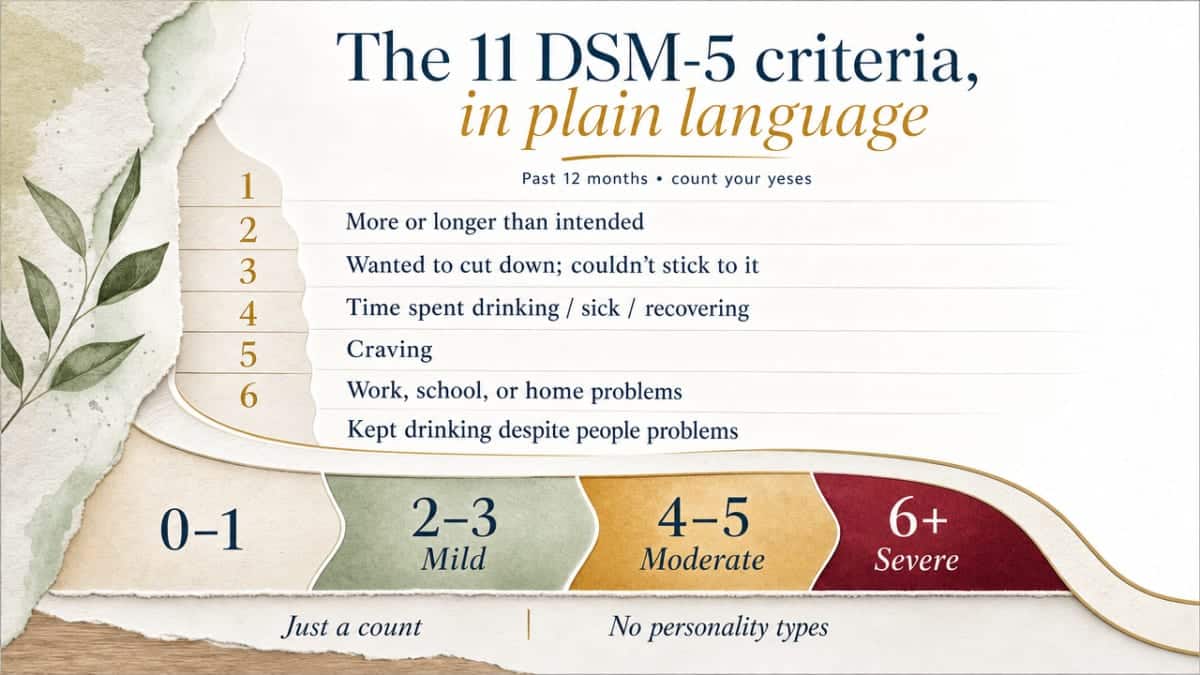
So the field shifted. The DSM-5, which is the diagnostic manual clinicians actually use, doesn’t talk about stages at all. It talks about alcohol use disorder on a spectrum — mild, moderate, or severe — based on how many of 11 specific symptoms you’ve had in the past 12 months 1. Two to three symptoms is mild. Four to five is moderate. Six or more is severe.
That sounds like a small change. It isn’t. The old model asked, what kind of alcoholic are you. The new one asks, how many of these things are happening to you right now, and how is it affecting your life. One is an identity. The other is a measurement, and measurements can change. A severe score this year can be a moderate score next year with the right care, or a mild one the year after that 5.
You’re not stuck in a stage. You’re somewhere on a spectrum, and spectrums move.
How alcoholism is actually diagnosed today
The 11 DSM-5 criteria, in plain language
When a clinician sits down with you, they’re not looking at a curve on a chart. They’re working through a list of 11 specific questions about your past 12 months. The number of yeses determines where you fall on the spectrum: 2–3 is mild alcohol use disorder, 4–5 is moderate, and 6 or more is severe 1. That’s it. No personality types, no “end-stage” labels. Just a count.
Read these slowly. Be honest with yourself. No one is grading you.
- You’ve ended up drinking more, or for longer, than you meant to.
- You’ve wanted to cut down or stop, and tried, and it didn’t stick.
- You spend a lot of time drinking, being sick from it, or recovering.
- You crave alcohol — that pull, that hum in the background of your day.
- Drinking has gotten in the way of work, school, or home responsibilities.
- You keep drinking even though it’s causing problems with people you care about.
- You’ve given up or cut back on things you used to enjoy because of drinking.
- You’ve gotten into situations while drinking, or after, that put you at risk — driving, swimming, walking home, using machinery.
- You keep drinking even though it’s making a physical or mental health problem worse.
- You need more alcohol than you used to in order to feel the same effect, or the same amount does less for you (tolerance).
- You get withdrawal symptoms when you stop — shakiness, sweating, nausea, anxiety, trouble sleeping — or you drink to avoid them.
Count your yeses. If you got two or three, that’s mild AUD by clinical standards. Four or five is moderate. Six or more is severe 1.
If that number landed harder than you expected, take a breath. A diagnosis is not a verdict. It’s a description of what’s been happening, written in language a clinician can act on. The point of the count isn’t to label you — it’s to point at the right next step. And every one of those criteria has a path out of it.
What mild, moderate, and severe really mean for daily life
A clinical label is one thing. What it looks like at 7 a.m. on a Wednesday is another.
Mild AUD often hides in plain sight. You might be the person who’s started drinking a little more than you’d like, who’s tried a dry January and felt it slip away by the second week, who notices a faint regret on weekend mornings but still functions fine. Work is intact. The kids are fed. Nobody’s worried but you — and maybe that’s exactly why you’re reading this. Mild does not mean fake. It means the pattern is real and it’s still early enough that less-intensive care, like brief counseling or outpatient support, often does the job 2.
Moderate is when the drinking starts costing you visible things. You’ve canceled plans because of how you felt. You’ve snapped at people you love and known the alcohol was part of it. The hangovers are no longer occasional, and you’ve started doing the math: how much, how late, how soon until tomorrow’s meeting. You may have tried to cut back more than once.
Severe is when alcohol has become structural. Your body needs it to feel steady. Stopping for a day brings shakiness, sweating, sleeplessness, or worse. You may be holding a job, a marriage, a household together, and still meeting six or more of those criteria — what’s sometimes called high-functioning is often severe AUD that hasn’t fallen apart yet. Severe is also the level where stopping on your own can be medically dangerous and where structured care, including supervised detox, matters most 10.
Wherever you landed, you’re not stuck there.
Why recovery is not a straight line
One of the cruelest things about the old stage models is that they made recovery sound like a one-shot exam. Climb the curve, hit bottom, climb back out, stay out. If you slipped, you started over from zero. That framing has buried a lot of people in shame they didn’t need to carry.
The data tells a different story. In a prospective study that followed people with alcohol use disorder over three years, researchers tracked how individuals moved between three states: heavy drinking, partial remission, and full remission. People didn’t march in one direction. They moved back and forth — heavy drinking to partial remission, partial remission to full remission, and sometimes back the other way. The authors concluded that a substantial portion of people with AUD can transition back to remission from heavy drinking, including people whose AUD started out severe 5.
What this means for you, on a regular Tuesday: a relapse is not proof that treatment failed or that you’re a lost cause. It’s a data point. It tells your clinician something useful about what kind of support you need next — maybe a medication adjustment, maybe a higher level of care, maybe more attention to the depression or anxiety underneath the drinking. People who reach long stretches of remission often had earlier stretches that didn’t hold. Those earlier attempts weren’t wasted. They were practice.
If you’ve tried before and it didn’t stick, you are not behind. You’re somewhere on a path that bends.
The other half of the picture: depression, anxiety, and trauma
Almost no one drinks the way you’ve been drinking just because they like the taste. There’s usually something underneath — a depression that’s been there longer than the drinking, an anxiety that drinking quiets for about an hour before it makes worse, a trauma you’ve been outrunning with a glass in your hand. If that sounds familiar, you’re not unusual. People with substance use disorders frequently have a co-occurring mental health condition, and the two feed each other in ways that make either one harder to treat alone 6, 7.
Depression is the one that shows up most often alongside alcohol. Co-occurring depression in people with AUD is linked to more severe symptoms, worse day-to-day functioning, and higher relapse rates when it isn’t treated 9. That’s not a moral failing. It’s biology and circumstance stacking on top of each other. The drinking lowers your mood, the lowered mood drives more drinking, and pretty soon you can’t tell which one started it.
Here’s why this matters for your next step. If a clinician only treats the drinking and ignores the depression, anxiety, or trauma underneath, the odds of it sticking go down. Integrated care — where someone treats both at the same time, in the same place, with providers who talk to each other — is associated with better outcomes than treating them separately 6. So when you’re thinking about what comes next, the question isn’t only how much am I drinking. It’s also what am I drinking around. Both belong on the table.
What comes next: matching care to severity, not stage
How a clinician decides what level of care fits you
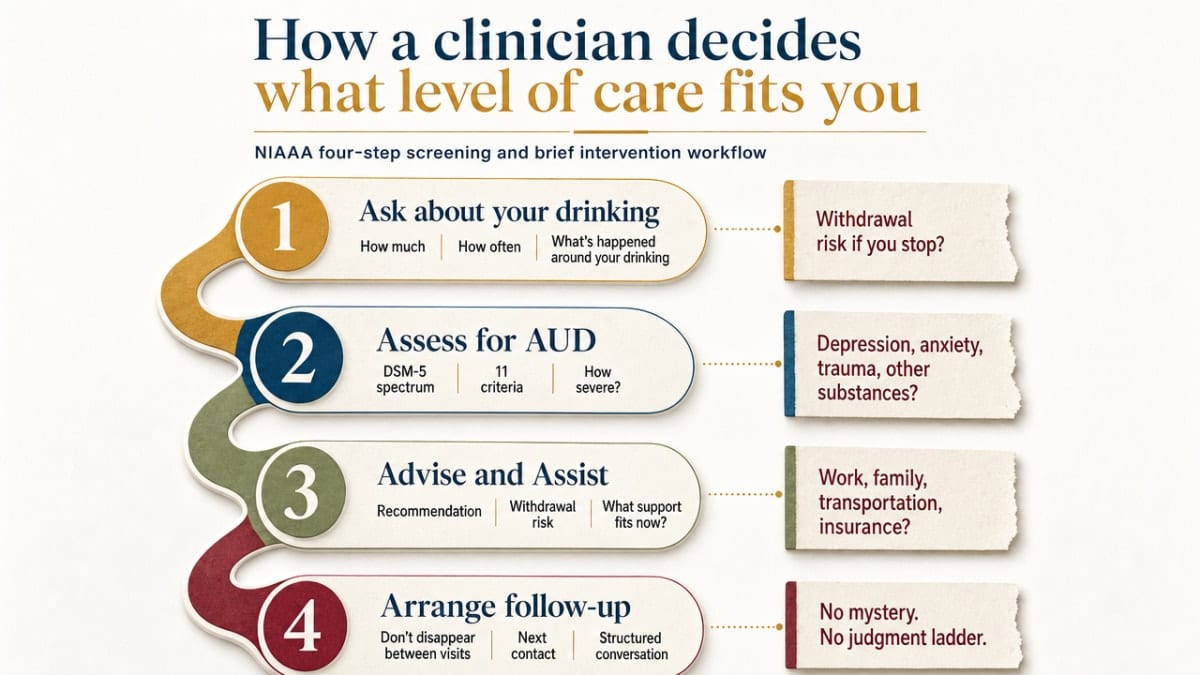
A good clinician isn’t trying to guess your stage. They’re trying to answer four practical questions: How severe is your AUD on the DSM-5 spectrum? What’s your withdrawal risk if you stop? What else is going on — depression, anxiety, trauma, other substances? And what does your life actually support right now — work, family, transportation, insurance?
NIAAA’s screening guide walks clinicians through this in four plain steps: Ask about your drinking, Assess for AUD using those 11 criteria, Advise and Assist with a recommendation, and Arrange follow-up so you don’t disappear between visits 3. That’s the whole framework. No mystery, no judgment ladder. Just a structured conversation.
The first appointment is usually shorter than people fear. You’ll talk about how much, how often, and what’s happened around your drinking. You’ll probably answer some questions about your mood, your sleep, and whether you’ve had withdrawal symptoms before. If you’ve ever had a seizure, hallucinations, or severe shakes when cutting back, say so out loud — that single piece of history changes the recommendation 10.
What comes out of that conversation isn’t a sentence handed down. It’s a match: the lowest level of care that can realistically hold what you’re carrying.
Outpatient counseling and medication options
For mild and a lot of moderate AUD, outpatient care does real work. You keep living at home, keep your job, and meet with a counselor weekly or a few times a week, depending on intensity. Cognitive behavioral therapy helps you spot the thoughts and situations that pull you toward a drink and build something else to do with them. Motivational enhancement therapy helps you find your own reasons to change rather than borrowing someone else’s 8.
Medication is the part most people don’t know about. Three FDA-approved options have evidence behind them. Naltrexone blunts the reward you get from drinking, so the second and third drink stop feeling like the first. Acamprosate steadies the brain chemistry that goes haywire in early sobriety and helps with the gnawing restlessness. Disulfiram makes you physically sick if you drink, which works for people who want a hard external brake 8. None of these are willpower replacements. They’re tools that change the math.
If you’ve got depression or anxiety alongside the drinking, this is where integrated care matters. A provider who can treat both — adjusting an antidepressant while starting naltrexone, for example — gives you a better shot than two providers who never talk 6, 9.
When detox and residential treatment are genuinely necessary
Detox itself is usually three to seven days in a setting where staff can monitor your vitals, manage symptoms with medication, and step in if things escalate. It’s not treatment. It’s what makes treatment possible.
Residential care — twenty-four-hour structured treatment in a facility — is the right next step when severe AUD is layered with serious co-occurring conditions, a history of failed outpatient attempts, an unsafe home environment, or the kind of withdrawal history that makes outpatient too thin a net 2, 10. Days are built around individual therapy, group work, medication management, and the simple gift of not having to think about the next drink for a while.
If that’s where you are, calling somewhere like Arrow Passage Recovery to ask one question is not commitment. It’s information.
Honest answers to the questions people ask next
You’ve gotten this far in the article, which means you’re probably circling a few questions you haven’t said out loud yet. Here are the ones that come up most often when people sit across from a counselor for the first time.
Am I overreacting? If you’ve counted two or three of the DSM-5 criteria honestly, you’re not overreacting — you’re meeting the clinical threshold for mild AUD 1. The fact that you’re functioning doesn’t cancel that out. Catching a pattern early is one of the best things you can do for the version of you who exists five years from now.
Will I lose my job if I get help? Most outpatient treatment is built around people who work. Evening sessions, telehealth, scheduled medication check-ins — none of that requires telling your employer anything 2. If you do need a higher level of care, the Family and Medical Leave Act covers many situations, and your HR team has likely handled this before, quietly, more times than you’d guess.
Do I have to go to AA? No. AA helps a lot of people, and it’s free, and it’s worth trying. It’s also not the only path. Cognitive behavioral therapy, motivational enhancement, medication-assisted treatment with naltrexone or acamprosate, SMART Recovery, and individual counseling all have evidence behind them 8. The best program is the one you’ll actually go to.
What if I’m not ready to stop forever? Plenty of people start treatment with the goal of cutting back rather than total abstinence, especially at the mild end of the spectrum. A clinician can work with that. For severe AUD, particularly with a withdrawal history, abstinence is usually the safer target — but you don’t have to have that figured out before the first appointment 10.
What if I’m scared? Good. That fear is taking you seriously. Make one call. Ask one question. That counts.
Take the First Step Toward Lasting Recovery
Connect with a caring expert who understands every stage of alcoholism and what comes next.
Ready to move forward from alcohol misuse?
Connect with a supportive expert to map out your next step toward lasting change.
Frequently Asked Questions
How do I know if I’m in the early stage or already have a serious problem?
The honest test is the DSM-5 criteria, not how your drinking compares to your friends’. Two or three of those 11 symptoms in the past year is mild AUD. Six or more is severe, even if you’re still functioning 1. Withdrawal symptoms when you skip a day — shakiness, sweating, sleep trouble — push you toward the serious end regardless of count. If you’re unsure, a single screening appointment will give you a real answer.
Do I have to stop drinking completely, or can I just cut back?
It depends where you are on the spectrum. At the mild end, cutting back is a legitimate clinical goal, and a counselor can help you build a plan around it 2. At the severe end, especially with any withdrawal history, abstinence is usually the safer target because controlled drinking tends to fall apart and stopping suddenly later can be dangerous 10. You don’t have to decide before the first appointment — that’s part of what the conversation sorts out.
Is it dangerous to stop drinking on my own?
For some people, yes. Alcohol is one of the few substances where withdrawal can be life-threatening. If you’ve been drinking heavily every day, if you shake or sweat when you skip a morning, or if you’ve ever had a withdrawal seizure or hallucinations, stopping cold turkey at home is genuinely risky 10. Medically supervised detox handles the first three to seven days safely. Call your doctor or a treatment line before you stop — that one call matters.
What if I’ve tried to quit before and relapsed?
You’re in the majority, and you’re not back at zero. A three-year study tracking people with AUD found they moved back and forth between heavy drinking, partial remission, and full remission — a substantial share reached remission even when their AUD started out severe 5. Earlier attempts taught your clinician something useful: what didn’t hold, what triggered the slip, what level of care you actually need. Relapse is a data point, not a verdict.
How do I talk to a family member I think is in a later stage of alcoholism?
Pick a sober moment, not the middle of a fight. Lead with what you’ve seen, not what they are — “I noticed you’ve been shaky in the mornings” lands differently than “you’re an alcoholic.” Have one concrete next step ready, like a doctor’s appointment or a screening call. If withdrawal symptoms are in the picture, mention that stopping suddenly can be medically dangerous and that supervised detox exists 10. You can’t force the choice, but you can keep the door open.
Do I need residential treatment, or can outpatient care be enough?
Outpatient care, including therapy and medications like naltrexone or acamprosate, handles most mild and moderate AUD well 8. Residential care fits when severe AUD overlaps with withdrawal risk, untreated depression or trauma, a home that makes sobriety nearly impossible, or repeated outpatient attempts that didn’t hold 2, 10. A clinician will weigh your DSM-5 severity, withdrawal history, and co-occurring conditions to recommend the lowest level of care that can realistically support you. Lowest doesn’t mean weakest — it means sustainable.
References
- Alcohol Use Disorder: A Comparison Between DSM–IV and DSM–5. https://www.niaaa.nih.gov/sites/default/files/publications/DSMfact.pdf
- Alcohol Use Disorder: Causes, Symptoms, Treatment & Help. https://www.samhsa.gov/substance-use/learn/alcohol
- A Pocket Guide for Alcohol Screening and Brief Intervention. https://medicine.tulane.edu/sites/default/files/pictures/niaa%20pocket%20guide%20alcohol.pdf
- The Classification of Alcoholics: Typology Theories From the 19th Century to the Present. https://pmc.ncbi.nlm.nih.gov/articles/PMC6876530/
- Patterns of Transitions Between Relapse to and Remission From Alcohol Use Disorder Over 3 Years. https://pmc.ncbi.nlm.nih.gov/articles/PMC7900838/
- Finding Help for Co-Occurring Substance Use and Mental Disorders. https://www.nimh.nih.gov/health/topics/substance-use-and-mental-health
- Co-Occurring Disorders and Health Conditions. https://nida.nih.gov/research-topics/co-occurring-disorders-health-conditions
- Treatment of Alcohol Use Disorder. https://pmc.ncbi.nlm.nih.gov/articles/PMC3860393/
- Alcohol Use Disorder and Depressive Disorders. https://pmc.ncbi.nlm.nih.gov/articles/PMC5513685/
- Treatment for Alcohol Problems: Finding and Getting Help. https://www.niaaa.nih.gov/publications/brochures-and-fact-sheets/treatment-alcohol-problems-finding-and-getting-help