
What Is Behavioral Health Treatment?
Key Takeaways
- Behavioral health treatment covers the prevention, diagnosis, and treatment of mental health conditions and substance use disorders together, along with the life stressors and physical symptoms tied to them 13.
- When mental health and substance use conditions co-occur, the standard of care is integrated treatment — one team, one plan, both conditions addressed simultaneously rather than in separate silos 5.
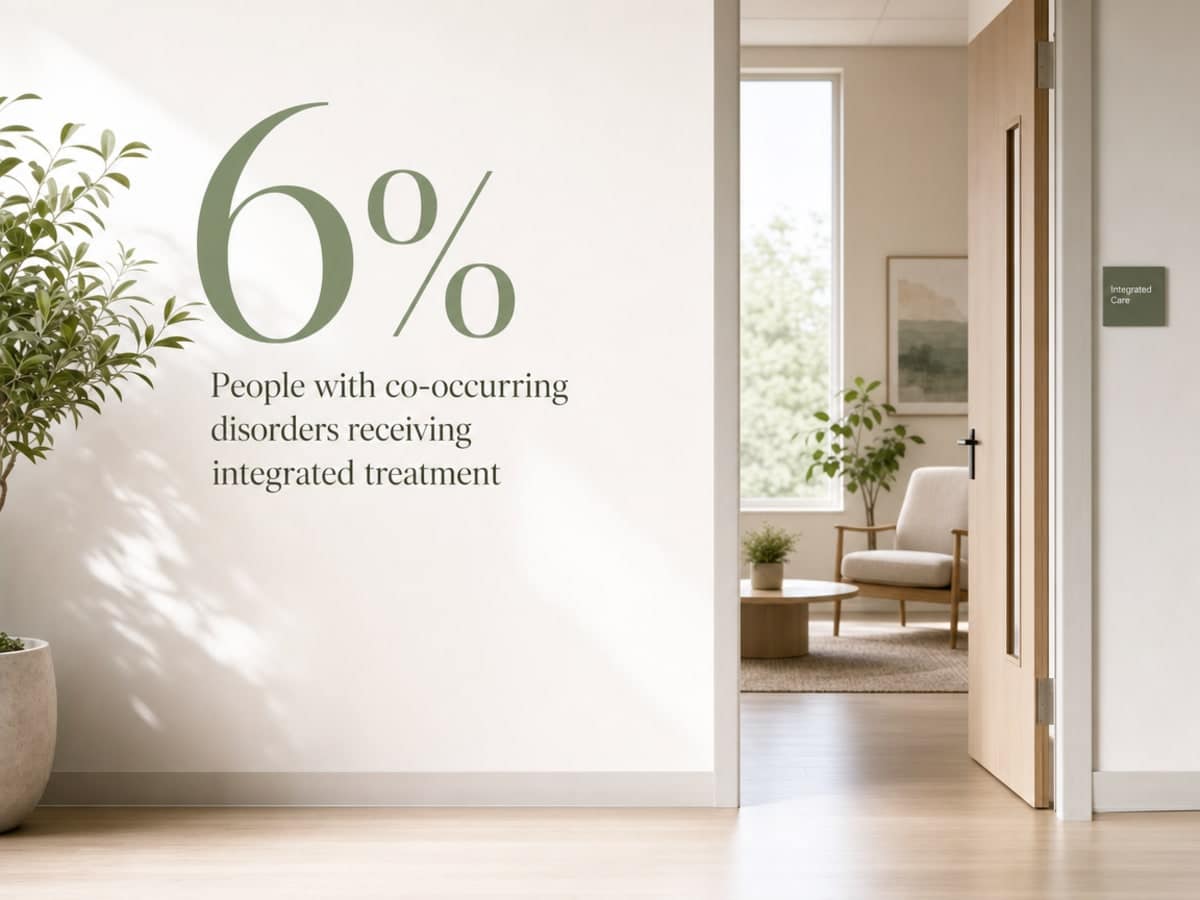
- Only about 6 percent of people with co-occurring disorders receive treatment for both conditions, so fragmented care reflects a system gap rather than personal failure 10.
- Truly integrated care means shared staff, shared records, one treatment plan, coordinated medication management, and a trauma-informed foundation — questions worth asking before committing to a program 5, 14.
When Mental Health Care and Addiction Care Refuse to Talk to Each Other
You’ve probably lived some version of this story already. A therapist who said your drinking was “outside their scope.” A rehab that handled the substance use but waved off the panic attacks, the flashbacks, the depression that started long before the first drink. A psychiatrist who adjusted your meds but never asked about the kratom in your bag.
If you’re searching for what behavioral health treatment actually is, you’re not starting from zero. You know the vocabulary. You’ve sat in the rooms. What you want is a straight answer about whether the care you’ve been offered so far is the right shape for what you’re carrying.
Here’s the short version: behavioral health treatment covers the prevention, diagnosis, and treatment of mental health conditions and substance use disorders together 13. When both are present at the same time, the standard of care isn’t two separate clinics trading voicemails. It’s one team, one plan, both conditions, at the same time 5.
The rest of this article explains what that looks like in practice, and what to ask for when you’ve already been let down by care that didn’t.
Behavioral Health Treatment, Defined Without the Hand-Waving
The Working Definition: Prevention, Diagnosis, and Treatment
Behavioral health treatment is the prevention, diagnosis, and treatment of mental health conditions and substance use disorders, along with the life stressors and physical symptoms that come with them 13. That’s the AMA’s working definition, and it’s the one worth holding onto because it names three jobs, not one.
SAMHSA frames the same territory slightly differently: the promotion of mental health and well-being, the treatment of mental and substance use disorders, and the support of people in recovery from those conditions 1. The CDC keeps it even shorter — behavioral health covers mental distress, mental health conditions, suicidal thoughts, and substance use 2.
Notice what all three definitions share. Substance use isn’t sitting in a separate category from mental health. It’s inside the same umbrella, by design.
That matters for you. If a clinic ever told you your drinking or your benzo use was a different problem to handle somewhere else, they were drawing a line that the federal agencies setting the standards don’t draw. Behavioral health treatment, as a category, was built to include both — and to include the prevention and diagnosis work that happens before anyone hands you a treatment plan.
What Counts as a Behavioral Health Condition
The list is broader than most people expect. Depression, anxiety disorders, bipolar disorder, PTSD, schizophrenia, and other psychiatric conditions all sit inside behavioral health. So do alcohol use disorder, opioid use disorder, stimulant use disorder, and every other substance use diagnosis. Suicidal thoughts and behaviors are included too 2.
The AMA adds something the other definitions leave implicit: life stressors, crises, and the physical symptoms that show up when your nervous system has been carrying too much for too long 13. Chronic insomnia after a trauma. The stomach problems that track your panic. These aren’t side issues — they’re part of what behavioral health care is supposed to address.
When you have a substance use disorder and another condition at the same time, that’s called a co-occurring disorder. NIDA notes plainly that these conditions interact and can worsen each other’s symptoms and outcomes 16. The diagnosis isn’t two separate files. It’s one clinical picture with two names on it.
The Core Modalities You’ll Actually Encounter
Psychotherapy: CBT, DBT, EMDR, and What They Each Do
Psychotherapy is the workhorse of behavioral health treatment. NIMH describes it as care that helps you identify and change troubling emotions, thoughts, and behaviors — the patterns that keep you stuck whether the trigger is a craving, a flashback, or a 3 a.m. spiral 12.
You’ve probably met some of these by name already.
- Cognitive behavioral therapy (CBT)
- The most studied of the bunch. It targets the loop between what you think, how you feel, and what you do next. For a dual diagnosis, that loop matters twice — the thought that drives a depressive crash often drives the relapse that follows it.
- Dialectical behavior therapy (DBT)
- Grew out of CBT for people whose emotions arrive at full volume. Distress tolerance, emotion regulation, interpersonal effectiveness — skills you practice on purpose, not insights you wait to feel.
- EMDR
- Built for trauma. If your substance use started as a way to outrun memories your body still holds, EMDR works directly on how those memories are stored, not just how you talk about them.
None of these are silver bullets, and none of them stand alone in a dual diagnosis plan. NIMH notes that psychotherapy and medication are the two most common forms of mental health treatment and that they’re often combined 12. In integrated care, your therapist isn’t picking one modality off a menu — they’re matching the approach to what your particular pair of conditions is actually doing.
Medication: Psychiatric Meds and MAT Under One Plan
Medication does two different jobs in behavioral health care, and in a dual diagnosis plan, both jobs need to be handled by people who are talking to each other.
The first job is psychiatric. Antidepressants, mood stabilizers, antipsychotics, anti-anxiety medications — these treat the mental health side of your diagnosis.
The second job is medication-assisted treatment, or MAT. SAMHSA includes medications for opioid, alcohol, and tobacco use disorders as a core part of behavioral health treatment, not an add-on 3. Buprenorphine, naltrexone, methadone, acamprosate — these reduce cravings and manage the physical dependence that willpower alone cannot dissolve.
Here is where fragmented care tends to fail people. A psychiatrist prescribes an SSRI without knowing you’re on buprenorphine. An MAT clinic stabilizes your opioid use but won’t touch your bipolar meds. You end up as the translator between two prescribers who never speak.
Integrated treatment is, in part, the answer to that. The peer-reviewed literature describes it as care focused on two or more conditions using multiple treatments — psychotherapy plus pharmacotherapy — coordinated under one plan rather than scattered across providers 15.
Counseling, Peer Support, and Family Involvement
The modalities above are clinical. The ones in this section are the surrounding scaffolding that holds them up.
SAMHSA lists counseling and support groups alongside outpatient, inpatient, residential, and medication options as core treatment types, and notes that many people benefit from more than one at a time 3. Individual and group counseling give you a place to practice what therapy is teaching you. Peer support — people further along in recovery, sitting in the same room — gives you proof that the work is doable.
NIMH specifically names family-based interventions as evidence-supported for people with co-occurring substance use and mental disorders 4. If the people closest to you don’t understand what you’re treating or how, they can accidentally undermine progress they’re rooting for. Bringing them into the plan, when it’s safe to do so, is part of the treatment — not separate from it.
Levels of Care, Mapped for Someone With a Dual Diagnosis
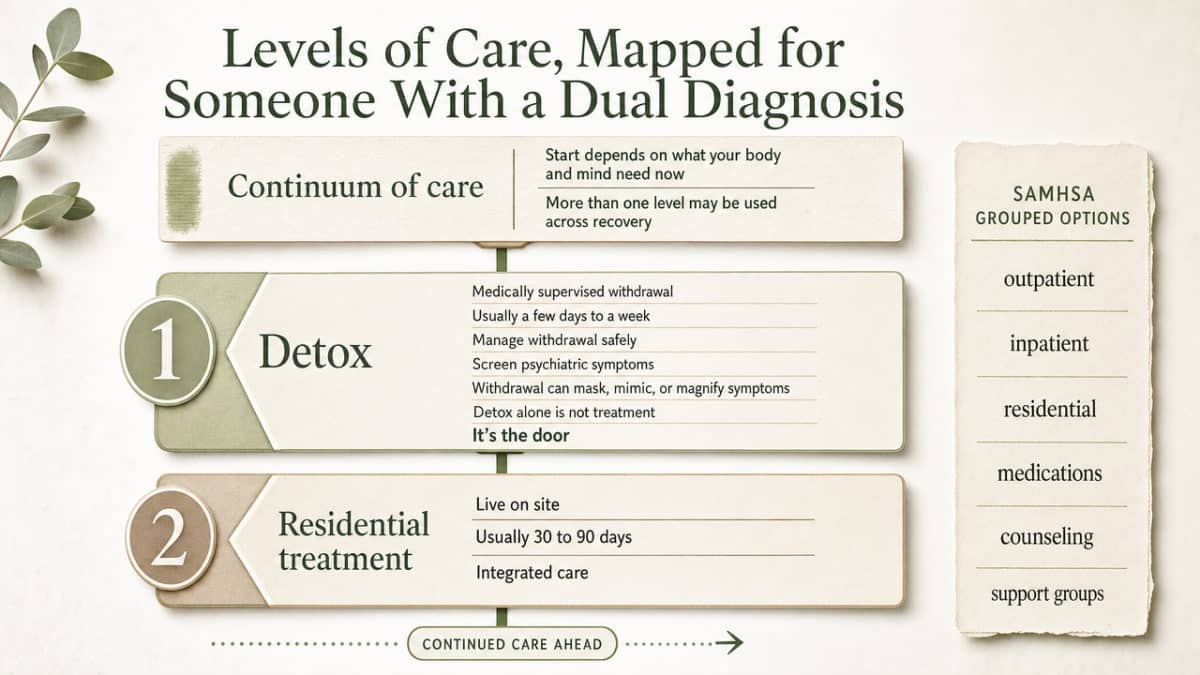
Behavioral health treatment isn’t one setting. It’s a continuum, and where you start depends on what your body and your mind need at the moment you walk in. SAMHSA groups the major options as outpatient, inpatient, residential, medications, counseling, and support groups — and notes that many people use more than one across the course of recovery 3.
Here’s what each level tends to look like when you have a dual diagnosis, not just a substance use diagnosis on its own.
- Detox
- Medically supervised withdrawal, usually a few days to a week. For a dual diagnosis, the work here is stabilization — managing withdrawal safely while screening for the psychiatric symptoms that withdrawal can mask, mimic, or magnify. Detox alone is not treatment. It’s the door.
- Residential treatment
- You live on site, usually 30 to 90 days. In an integrated program, you’re seeing a therapist and a prescriber on the same team, in the same building, who share notes about both your substance use and your psychiatric condition. The structure is intentional — it removes the daily triggers that make outpatient work harder while your medication and therapy plans get dialed in.
- Partial hospitalization (PHP)
- Day treatment, typically five days a week, six hours a day. You sleep at home or in sober living. For dual diagnosis, PHP is where deeper trauma work often starts because you have enough clinical contact to hold you through it.
- Intensive outpatient (IOP)
- Usually three days a week, three hours per session. Group therapy, individual therapy, and medication management continue, but you’re back at work or school. The mental health side stays in the plan — your IOP therapist should still be coordinating with your prescriber.
- Standard outpatient
- Weekly or twice-weekly therapy and medication check-ins. This is where most long-term care lives.
- Aftercare
- Alumni groups, ongoing therapy, peer support, relapse prevention planning. The mental health condition didn’t disappear when the substance use stabilized — aftercare is where the rest of the work continues, often for years.
You don’t have to start at the top of the ladder. You also don’t have to climb down it in order. What matters is that whichever rung you’re on, both conditions stay in the plan.
What ‘Integrated’ Actually Means (and What It Doesn’t)
Same Team, Shared Plan, Simultaneous Care
“Integrated” gets used loosely. A clinic that has a therapist down the hall from a prescriber can call itself integrated. So can a program that hands you a referral to a psychiatrist across town. Neither is what the research means by the word.
The peer-reviewed definition is specific. Integrated treatment is care that addresses both disorders concurrently, with the same provider or treatment team, under one coordinated plan 5. The substance use clinician and the mental health clinician are on the same staff, looking at the same chart, adjusting the same goals.
A second definition sharpens it further: integrated treatment focuses on two or more conditions and uses multiple modalities — psychotherapy plus pharmacotherapy — held together as one intervention rather than two parallel ones 15.
That word simultaneous is the one that matters. Sequential care says treat the substance use first, then we’ll look at the depression. Parallel care says go to your therapist on Tuesdays and your addiction counselor on Thursdays and good luck syncing them. Integrated care says both conditions are on the table from day one, in the same room, with the same people.
If you’ve spent years being told one had to wait for the other, that wasn’t your failure. It was a model that the evidence has moved past.
Trauma-Informed Care as the Layer Underneath
Integrated isn’t the only word doing real work here. Trauma-informed is the other.
SAMHSA’s guidance is direct: a large share of people in behavioral health settings carry trauma histories, and care that doesn’t recognize that can be ineffective or actively harmful 14. For dual diagnosis, this isn’t optional. Trauma is often the thread connecting why the substance use started and why the depression or anxiety won’t lift on its own.
Trauma-informed care isn’t a single technique you add. It’s how the whole program operates — how intake questions are asked, how groups are run, how staff respond when you dissociate or shut down. The point is to avoid re-creating the dynamics that hurt you in the first place.
The Access Gap You’ve Probably Already Hit
Here’s the number that explains a lot of what you’ve lived through. According to a 2024 HHS/ASPE report analyzing national outpatient data, only about 6 percent of people with co-occurring mental health and substance use disorders receive treatment for both conditions 10. Not 60 percent. Six.
That figure isn’t measuring whether integrated programs exist. It’s measuring how many people actually walk out the door having received care for both sides of their diagnosis. The other 94 percent get one, or the other, or nothing.
If you’ve been bouncing between a therapist who won’t touch your drinking and a rehab that ignored your PTSD, you weren’t unlucky. You were inside the majority experience of a system that’s still mostly designed to handle one diagnosis at a time.
The reasons behind the gap are well-documented. A review of access barriers for people with co-occurring disorders identified two main categories: personal characteristics barriers — stigma, shame, fear of losing custody or a job, ambivalence about treatment — and structural barriers like cost, insurance coverage, transportation, waitlists, and fragmented systems that require you to be the project manager of your own care 6. People with lower incomes and those experiencing homelessness face the steepest walls of all 6.
None of that is your fault. And naming it matters, because the next sections are about what care looks like when the system actually does the job it’s supposed to do.
How Adoption of Integrated Care Is Changing
The gap is real, but it’s not static. The same 2024 HHS/ASPE analysis that surfaced the access problem also tracked how integrated care has spread across outpatient facilities over time, and the direction is encouraging even if the pace is slow 10.
In 2020, roughly half of outpatient mental health and substance use treatment facilities reported having integrated care programs for people with co-occurring disorders 10. That’s a meaningful share — not yet a majority of the field by a comfortable margin, but no longer a fringe model either.
Among substance use treatment facilities specifically, the share offering integrated programs grew by about 10 percentage points between 2014 and 2020 10. A decade of slow, steady expansion. Programs that once treated addiction as a standalone problem are increasingly building mental health capacity into the same walls.
What this means for you on the ground: more programs now describe themselves as integrated than did a decade ago. That’s good news. It also means the word is doing heavier marketing work than it used to, which is exactly why the definition in the previous section matters. A facility that didn’t offer dual diagnosis care in 2014 and now puts “integrated” on its website may have genuinely built the capacity — or may have added a part-time consulting psychiatrist and a new line of copy.
The point isn’t to be cynical. It’s to know what to look for, which the next section walks through.

What the Evidence Actually Says, Honestly
Most articles on this topic stop at “integrated care works.” The fuller answer is more interesting, and more useful to you.
The base claim holds. A review of dual diagnosis capability across mental health and addiction programs describes a preponderance of evidence that integrated treatments are associated with improved patient outcomes compared with treating the two conditions in separate silos 7. That’s the consensus, and it’s why federal agencies build their guidance around it 4.
Where the picture gets more honest is in what “better outcomes” actually measures.
A study of Integrated Dual Diagnosis Treatment (IDDT) in outpatients with severe mental illness and substance use disorders found a clear reduction in the number of days patients used alcohol or drugs after the model was implemented — but no significant improvements on secondary outcomes like psychopathology or broader functioning 8. Substance use went down. Quality of life didn’t move as much as anyone hoped.
A 2023 real-world comparison in South Africa found integrated versus non-integrated outcomes varied based on context, resources, and how faithfully the model was implemented 9. The label on the program matters less than whether the program is actually delivering what the label promises.
What this means for you: integrated care is the best-supported model available, and it’s worth asking for. It is also not magic. Expect substance use to respond first. Expect the depression, the trauma symptoms, the daily functioning to take longer — and to need their own dedicated work inside the same plan.
How to Tell Whether the Care You’re Being Offered Is Integrated
You don’t have to take a program’s word for it. A few direct questions will tell you what model you’re actually being offered.
Who’s on the team, and do they share a chart? Ask whether the therapist treating your mental health condition and the clinician treating your substance use are on the same staff, and whether they document in the same record. If the answer is “we’ll send notes over,” that’s parallel care wearing an integrated label 5.
Is there one treatment plan, or two? Integrated care produces a single plan that names both diagnoses and lays out how they’ll be addressed together 15. Two separate plans stapled together is not the same thing.
How is medication coordinated? If you’re on or considering MAT, ask who prescribes it, who prescribes your psychiatric meds, and how often those prescribers talk. SAMHSA includes both inside behavioral health treatment for a reason 3— they should be managed in conversation, not in isolation.
Is the program trauma-informed? Ask how they screen for trauma at intake and how staff are trained to respond 14.
Clear answers are a good sign. Vague ones are information too.
Asking This Question Is Already Part of the Work
You came here looking for a definition. What you actually needed was confirmation that the fragmented care you’ve been handed isn’t the whole story — and that there’s a more coordinated way to treat what you’re carrying.
Behavioral health treatment, done well, holds both your substance use and your mental health condition in the same plan, with the same team, at the same time 5. That’s the standard. If you haven’t been offered it yet, that’s a gap in the system, not in you.
Knowing what to ask for is how you stop being the translator between providers who never talk. If you’re ready to explore integrated dual diagnosis care, Arrow Passage Recovery is one place that builds its programs around exactly this model.
Start Your Behavioral Health Treatment Journey Today
Connect instantly with a caring specialist to discuss your next steps toward integrated behavioral health care.
Start Your Personal Behavioral Health Conversation Today
Connect with a caring professional and explore your next steps with confidence.
Frequently Asked Questions
What’s the difference between behavioral health treatment and mental health treatment?
Mental health treatment sits inside behavioral health treatment, not next to it. Behavioral health is the broader umbrella — it covers mental health conditions, substance use disorders, suicidal thoughts and behaviors, and the life stressors and physical symptoms tied to them 2, 13. Mental health treatment, on its own, usually means care for conditions like depression or anxiety without explicitly including substance use.
Can I get treated for my substance use and mental health condition at the same time?
Yes — and that’s actually the model the evidence supports. Integrated treatment addresses both conditions concurrently, with the same provider or treatment team holding one coordinated plan 5. NIMH frames it as combining mental health and substance use care so you receive coordinated care in one place rather than running between disconnected clinics 4. If a program tells you one has to wait, that’s outdated practice.
Does behavioral health treatment always include medication?
No. Medication is one tool, not a requirement. SAMHSA lists medications alongside outpatient care, residential treatment, counseling, and support groups as treatment options people may use individually or in combination 3. NIMH notes psychotherapy and medication are the two most common forms of mental health care and can be used together or separately 12. Whether medication belongs in your plan depends on your specific diagnoses and goals.
How long does behavioral health treatment typically last?
There isn’t a fixed timeline. SAMHSA describes treatment as a continuum where many people benefit from more than one type of care across the course of recovery 3. Detox is days. Residential is often 30 to 90 days. Outpatient therapy and medication management can continue for months or years. For a dual diagnosis, the mental health side of the plan usually keeps running well after acute substance use stabilizes.
What should I ask a provider to find out if their care is truly integrated?
Four questions cut through the marketing language. Are the mental health and substance use clinicians on the same staff, documenting in the same record? Is there one treatment plan covering both diagnoses, or two? Who coordinates psychiatric medication and MAT, and how often do they communicate? How is the program trauma-informed at intake and in daily practice 5, 14? Vague answers tell you as much as clear ones.
Is behavioral health treatment effective if I’ve relapsed before?
Yes. Relapse history doesn’t disqualify you from benefiting — it often signals that the previous care didn’t address both sides of your diagnosis. The research on integrated dual diagnosis treatment shows measurable reductions in substance use days when both conditions are treated together, though broader functioning takes longer to shift 8. Each round of care builds on what you learned in the last one. Returning isn’t starting over.
References
- Behavioral Health Needs in the United States. https://www.ncbi.nlm.nih.gov/books/NBK609444/
- About Behavioral Health. https://www.cdc.gov/mental-health/about/about-behavioral-health.html
- Treatment Types for Mental Health, Drugs and Alcohol. https://www.samhsa.gov/find-support/learn-about-treatment/types-of-treatment
- Finding Help for Co-Occurring Substance Use and Mental Disorders. https://www.nimh.nih.gov/health/topics/substance-use-and-mental-health
- Integrating Treatment for Co-Occurring Mental Health Conditions. https://pmc.ncbi.nlm.nih.gov/articles/PMC6799972/
- Treatment Access Barriers and Disparities Among Individuals with Co-Occurring Mental Health and Substance Use Disorders. https://pmc.ncbi.nlm.nih.gov/articles/PMC4695242/
- Dual diagnosis capability in mental health and addiction treatment services. https://pmc.ncbi.nlm.nih.gov/articles/PMC3594447/
- Effectiveness of Integrated Dual Diagnosis Treatment (IDDT) in Severe Mental Illness. https://pubmed.ncbi.nlm.nih.gov/30352668/
- Integrated vs non-integrated treatment outcomes in dual diagnosis. https://pmc.ncbi.nlm.nih.gov/articles/PMC10157410/
- Adoption of Integrated Care for People with Co-Occurring Mental Health and Substance Use Conditions. https://aspe.hhs.gov/sites/default/files/documents/e2ccdd7991f1de5060983598cb66624f/adoption-integrated-care.pdf
- The need for a consensual definition of mental health. https://pmc.ncbi.nlm.nih.gov/articles/PMC10785984/
- Psychotherapies. https://www.nimh.nih.gov/health/topics/psychotherapies
- What is behavioral health?. https://www.ama-assn.org/public-health/behavioral-health/what-behavioral-health
- Trauma-Informed Care in Behavioral Health Services. https://www.ncbi.nlm.nih.gov/books/NBK207201/
- Integrated Treatment of Substance Use and Psychiatric Disorders. https://pmc.ncbi.nlm.nih.gov/articles/PMC3753025/
- Co-Occurring Disorders and Health Conditions. https://nida.nih.gov/research-topics/co-occurring-disorders-health-conditions