
9 Hidden Xanax Addiction Symptoms You Shouldn’t Ignore
Key Takeaways
- Rising tolerance shows up as quietly increasing doses to get the same calm, a DSM-5 criterion that signals dependence forming inside the daily routine.4
- Refills running short month after month reflects using more than intended, one of the clearest behavioral signals on the DSM-5 list.4
- Anxiety surging between doses is often rebound withdrawal from alprazolam’s short half-life, not the original disorder worsening — and it fuels the cycle.1
- Blank memory gaps after dosing hours point to the drug’s known amnestic effects, not distraction or a relationship problem.1, 3
- Slurred speech, stumbles, and ‘just tired’ excuses that track the dosing schedule indicate sedation, since real fatigue lifts with rest while drug effects don’t.3
- Emotional flatness can look like progress but is a documented adverse effect of long-term alprazolam use that dims the entire emotional range.1
- Missed deadlines and quiet withdrawal from daily life meet the DSM-5 criterion of continued use despite failing major role obligations at work or home.4
- Doctor-shopping, borrowing pills, or buying online crosses into counterfeit-fentanyl territory and most often precedes an overdose emergency.4, 9
- Failed attempts to stop usually reflect pharmacology, not weakness — abrupt cessation can cause seizures, so medical help is required to stop safely.2, 3
If You’re Already Worried, Trust That Instinct
If you’re reading this, you’ve probably already noticed something. A glance that lingers too long at the pill bottle. A conversation your partner doesn’t quite remember having. A son who used to text back within minutes and now goes quiet for days. You’ve told yourself it’s stress, or the prescription doing its job, or a rough stretch that will pass.
And maybe it is. But you opened this page anyway.
That quiet, persistent pull in your gut deserves attention. Xanax addiction is one of the hardest substance problems for families to spot, because the drug was usually invited in for a real reason — anxiety, panic, sleepless nights — and the early warning signs look almost identical to the condition it was meant to calm.1You’re not being paranoid. You’re being observant.
The nine signs ahead aren’t a checklist of failure. They’re a vocabulary. Something to help you put words to what you’ve been watching, so the next conversation you have — with your loved one, or with a clinician — can move from worry to clarity.
Why Xanax Hides Inside the Anxiety It Treats
Alprazolam works fast and wears off fast. That’s the whole problem.
Your loved one takes a dose, feels the panic loosen its grip within twenty minutes, and starts to associate the pill with relief in a way the brain doesn’t easily forget.1Then, hours later, the drug clears — and the anxiety it suppressed comes back, sometimes louder than before. To them, it feels like the original problem returning. To their nervous system, it’s the early edge of withdrawal. The fix is the same either way: another pill.
That loop is why Xanax addiction is so easy to miss. The symptoms look identical to the condition that brought the prescription home in the first place. More anxious? Must need the medication. Sleeping oddly, irritable, forgetful? Probably stress. The drug camouflages itself in the diagnosis.

The 9 Symptoms Families Most Often Misread
Symptom 1: The Dose That Used to Work Doesn’t Anymore
At first, half a tablet steadied the panic. Then a whole one. Now you notice them quietly cutting a second pill from the strip, or hear them mention they’ve been “doubling up on bad days.”
What you’re seeing is tolerance — the body adapting to alprazolam so the same dose produces less calm.1Clinicians count tolerance as one of the eleven DSM-5 criteria for a sedative use disorder.4At home, it shows up as a creeping math problem: more pills to get the same quiet.
The misread is understandable. You assume the anxiety got worse, or the prescription is wearing thin and needs adjusting. Sometimes that’s true. But when the dose climbs without a prescriber knowing, or climbs faster than the prescriber authorized, you’re watching the chemistry of dependence write itself into the daily routine. That deserves a phone call, not a wait-and-see.
Symptom 2: Refills Keep Coming Up Short
The bottle dated three weeks ago is empty. The script says one tablet, three times daily. The math doesn’t work.
You might find yourself counting pills when they’re in the shower. You might feel guilty for doing it. Don’t. Running through prescriptions early is one of the clearest behavioral signals on the DSM-5 list — using a substance in larger amounts or over a longer period than intended.4
The cover stories sound reasonable in isolation. A pill got dropped. The pharmacy shorted them. They needed extra during a hard week at work. Any one of these can be true once. A pattern of them, month after month, is a pattern. Write the refill dates down somewhere private. You’re not building a case against the person you love. You’re gathering facts a prescriber will actually need.
Symptom 3: Anxiety Spikes Between Doses, Not Before Them
Here’s the cruel trick of alprazolam: it has a short half-life. The drug enters the bloodstream fast and leaves fast.1So a few hours after a dose, the very anxiety the medication was meant to treat surges back — sometimes worse than baseline. Clinicians call this rebound anxiety or inter-dose withdrawal.
You’ll notice it as a clockwork pattern. Calm for a stretch after they take a pill, then a creeping edge. Sweaty palms at 3 p.m. when the morning dose has worn off. A snap of irritation right before bedtime that smooths out the moment they swallow the next tablet.1
The misread is that the underlying anxiety disorder is getting worse and they simply need more medication. The reality is often the opposite: the medication itself is generating the surges between doses, and the relief from each new pill is reinforcing the cycle. That loop is one of the engines of Xanax addiction.
Symptom 4: Conversations They Can’t Quite Remember
You told them about your sister’s surgery on Sunday night. On Tuesday, they ask how your sister is doing — and don’t seem to remember being told. Not in a polite way. In a blank way.
Alprazolam interferes with the brain’s ability to lay down new memories while the drug is active. Sedatives, hypnotics, and anxiolytics are known to cause amnesia, inattention, and memory difficulties as part of their adverse effect profile.1, 3The person isn’t pretending. They genuinely don’t have the file.
The misread is that they’re distracted, stressed, or just not listening — which families often interpret as a relationship problem rather than a medication problem. If memory gaps cluster around the hours after they’ve taken a dose, you’re probably looking at the drug, not the marriage. Pay attention to what they forget and when. A clinician can do a lot with that timeline.
Symptom 5: Slurred Speech, Stumbles, and ‘Just Tired’ Excuses
The clip in their voice softens. Words run together at the edges. They reach for the banister on a staircase they’ve climbed for ten years. They blame a long day, a bad night’s sleep, a glass of wine with dinner.
Slurred speech, problems with coordination or walking, and inattention are documented features of sedative use — the body operating under more drug than it can quietly metabolize.3These signs aren’t subtle to you because you live with this person. You know their normal cadence. You know how they walk.
The misread is exhaustion. Everyone is tired. The difference is that fatigue lifts after a weekend, a vacation, or a good week of sleep. Drug-related sedation tracks the dosing schedule instead. If the stumble shows up most reliably in the hour or two after a pill, that’s your answer.
Symptom 6: Emotional Flatness Where Worry Used to Live
This one is the hardest to call out, because at first it looks like progress.
The person who used to spiral over a delayed text now barely registers it. The mother who agonized over every parenting decision shrugs at things that would have undone her a year ago. You catch yourself thinking: the medication is working.
And maybe it was, briefly. But emotional blunting — a flat, muted response to things that should land — is a known adverse effect of long-term alprazolam use, alongside fatigue and impaired concentration.1Their internal volume has been turned down on everything, not just the panic.
You’ll notice it when warmth goes missing. A child’s school play that gets a thin smile. A piece of bad news that doesn’t seem to register. Affection that feels rehearsed. The misread is that they’ve finally found peace. The truth may be that the drug has dimmed the entire emotional dashboard, and that dimming is part of why stopping feels impossible.
Symptom 7: Missed Deadlines, Skipped Plans, Quiet Withdrawal
It started small. A canceled dinner. A missed parent-teacher conference. An email at work they meant to answer last Thursday that’s still sitting unread.
DSM-5 names this directly: continued use despite a failure to fulfill major role obligations at work, school, or home.4What that looks like inside a family is someone gradually pulling back from the things that used to anchor their day, and inventing reasons that almost track.
You might be covering for them already. Telling their boss they have a stomach bug. Reminding the kids that mom is just tired. Picking up the slack on bills, dishes, school pickups. That covering is exhausting, and it lets the pattern hide longer than it would otherwise.
The misread is depression, burnout, or a midlife slump. Any of those can be true alongside Xanax misuse — they often are. But when the withdrawal from daily life lines up with rising use, the substance has become part of the picture, not just a symptom of it.
Symptom 8: Doctor-Shopping, Borrowing Pills, or Buying Online
A new prescriber’s name shows up on a bottle in the medicine cabinet. A friend mentions, casually, that they gave your husband “a couple” of their Xanax last month. You spot a small unmarked envelope in the mail.
Sourcing the drug from multiple channels is one of the strongest behavioral indicators on the DSM-5 list — significant time spent obtaining the substance, and continued use despite escalating effort.4It also crosses into serious safety territory. Pills purchased online or hand-to-hand are increasingly counterfeit and sometimes contain fentanyl, which is why benzodiazepine-involved overdose deaths so frequently involve opioids.9
The misread is resourcefulness. “They’re just making sure they don’t run out.” Read it the other way. When someone is willing to take legal, financial, and physical risks to keep a supply going, the drug has stopped being a medication and started being a need. This is the symptom that most often precedes an emergency.
Symptom 9: Trying to Stop and Failing — Often in Secret
Maybe you found a half-finished journal with “Day 2” written at the top. Maybe they mentioned, once, that they tried to skip a dose and felt like they were dying. Maybe you’ve watched them white-knuckle a weekend without a refill and end up shaking by Sunday night.
Persistent desire or unsuccessful efforts to cut down or control use is a core DSM-5 criterion.4With alprazolam, those attempts often fail for a reason that isn’t willpower. Stopping abruptly can trigger severe withdrawal — anxiety, tremors, nightmares, insomnia, and in serious cases, dangerously high fever and seizures.3The FDA specifically warns about life-threatening reactions including catatonia, convulsions, delirium, and depression when Xanax is stopped or rapidly tapered.2
So your loved one tries, suffers, and starts again. They often do this without telling you, because the failure feels like personal weakness. It isn’t. It’s pharmacology. This is the symptom that signals, more than any other, that they need medical help to stop safely — not encouragement to try harder alone.
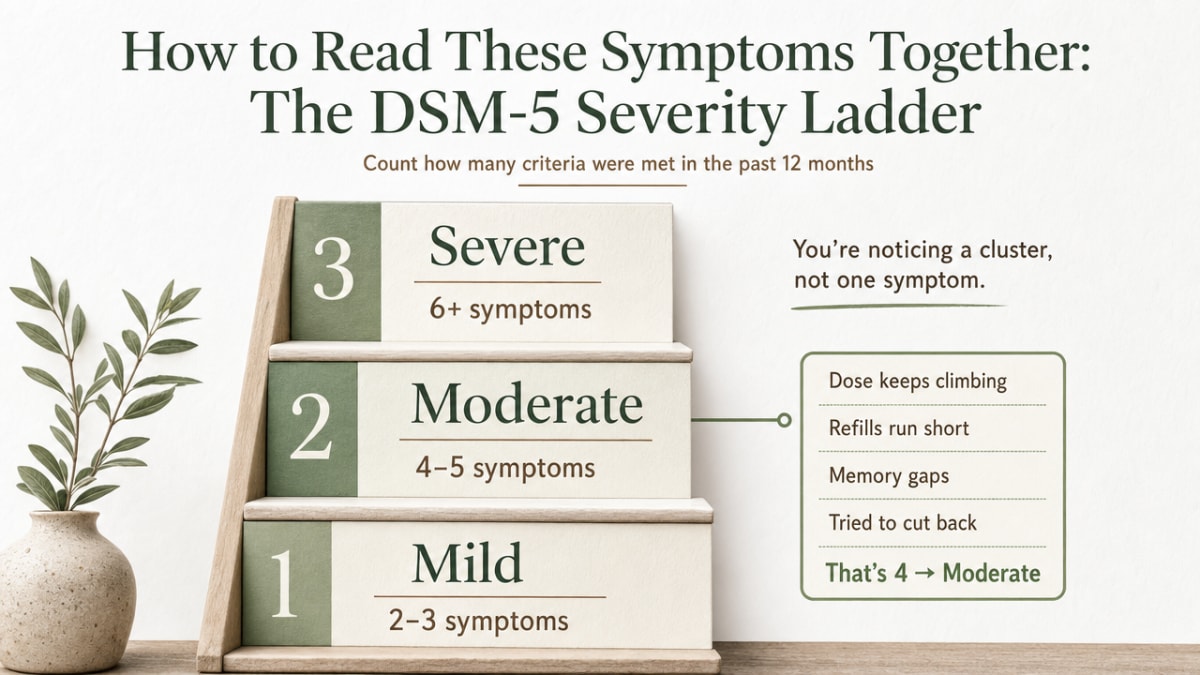
How to Read These Symptoms Together: The DSM-5 Severity Ladder
Looking at nine symptoms in a row can feel overwhelming. Here’s how clinicians actually read them.
The DSM-5 lists eleven possible criteria for a sedative, hypnotic, or anxiolytic use disorder — the diagnostic category that includes Xanax. A clinician looks at how many of those criteria a person has met within the past twelve months, and that count places the disorder on a severity ladder: two or three symptoms is mild, four or five is moderate, and six or more is severe.4, 10
That framework changes what you do with what you’ve been noticing. You’re not trying to prove a single damning symptom. You’re noticing a cluster. If your loved one’s dose keeps climbing, refills run short, conversations vanish from their memory, and they’ve tried unsuccessfully to cut back — that’s already four. Moderate territory. The kind of pattern a prescriber needs to know about this week, not next quarter.
A couple of things matter here. The twelve-month window means you’re looking at trends, not a single rough weekend. And the symptoms don’t have to be dramatic to count. A quiet, persistent pattern of four mild signs carries the same diagnostic weight as four obvious ones.
If you sat down right now and counted what you’ve seen this year, you’d likely have a number. Hold onto it. That number is the most useful thing you can bring to a clinical conversation.
Dependence Is Not Addiction — And Why the Difference Matters
This distinction is the one families get wrong most often, and the one that matters most.
If your loved one has taken alprazolam daily for months, their body has almost certainly adapted to it. Stop the drug abruptly and they will feel awful — anxious, shaky, sleepless, sometimes seizing.2That’s physical dependence. It can happen to anyone taking Xanax as prescribed, exactly as directed, and it isn’t a character flaw or proof of addiction. It’s how the medication works on the nervous system over time.1
Addiction is something else. The DSM-5 calls it a sedative, hypnotic, or anxiolytic use disorder, and it shows up in behavior, not just biology — running out early, sourcing pills from outside the prescription, losing track of responsibilities, trying to cut back and failing, building a life around the next dose.4
Why does the difference matter? Because the response is different. Dependence calls for a careful, medically supervised taper with the prescriber who wrote the script. Addiction calls for that taper plus treatment for the behavioral pattern underneath it. Confusing the two leads families to either panic when they shouldn’t, or wait when they shouldn’t.
When Anxiety, Depression, or PTSD Are Riding Along
Almost no one ends up on Xanax for no reason. There’s usually a real diagnosis underneath — generalized anxiety, panic disorder, PTSD from something they may not have told you about, depression that arrived after a job loss or a diagnosis or a death. That underlying condition doesn’t pause while a sedative use disorder develops on top of it. It runs alongside.
This is what clinicians call co-occurring disorders, and it’s the rule more than the exception. SAMHSA defines a co-occurring disorder as the coexistence of a mental health condition and a substance use disorder, and its current guidance is that integrated treatment — addressing both at once — is what actually works.6Treating only the Xanax misuse while leaving the panic disorder untouched is a setup for relapse. Treating only the anxiety while ignoring the escalating use is a setup for the next overdose statistic.
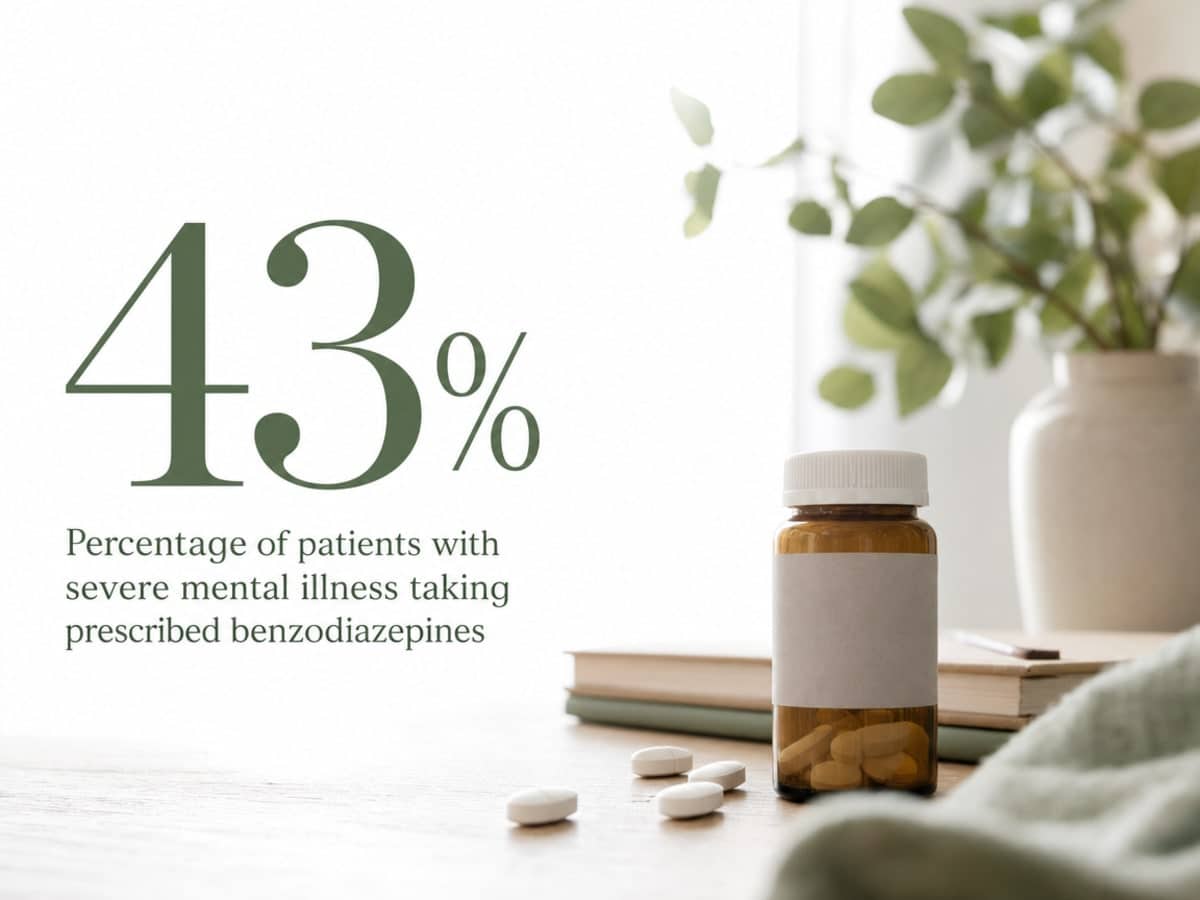
The risk isn’t theoretical. In one study of patients with severe mental illness and co-occurring substance use disorders, about 43% reported taking prescribed benzodiazepines — and within that prescribed group, 15% developed benzodiazepine abuse, compared with 6% among those not prescribed.8That’s a specific, high-risk population, not the general public, so don’t read it as a verdict on every Xanax prescription. Read it as a flag: when a serious mental health condition is already in the picture, the medication that’s meant to help can quietly become a second problem.
What this means for you, practically: don’t try to untangle the two strands yourself. If the person you love has an anxiety, depression, or trauma diagnosis alongside what you’ve been noticing on this list, they need a team that treats both — not a detox that hands them back to the same untreated panic that started the cycle.7
What Not to Do When You Notice These Signs
Before you do anything else, please don’t do these things.
- Don’t flush the pills. It feels decisive, but abrupt discontinuation of alprazolam can trigger seizures, delirium, and other life-threatening reactions — the FDA warns about exactly this on the Xanax label.2You could send the person you love into a medical emergency by trying to protect them.
- Don’t stage a confrontation when they’re between doses. Inter-dose withdrawal makes people irritable, anxious, and reactive.1Anything important you say will land on a nervous system that’s already braced for threat. Wait for a calmer window.
- Don’t try to taper them yourself, even slowly. Safe alprazolam tapers are clinician-supervised for a reason — the timing, the cross-tapers, the dose reductions are not intuitive, and a well-meaning home plan can produce worse withdrawal than no plan at all.2
- And don’t keep this entirely to yourself. Counting pills alone in the bathroom at midnight is not a strategy, and it’s wearing you down. The next section gives you a framework for what to actually do — but the first move is simply to stop carrying this in silence.
A Family Decision Framework: Watchful Waiting, Prescriber, or Integrated Care
Three doors, depending on what you’ve actually seen.
Watchful waiting is reasonable when you’ve spotted one or two mild signs, the prescription is being used as written, and your loved one is still functioning at work and at home. Keep notes. Date them. Watch for a second or third symptom to surface over the next few weeks. This isn’t doing nothing — it’s gathering the timeline a clinician will ask for.
Call the prescriber when the pattern has thickened. Doses creeping up. Refills running short. Memory gaps tied to dosing hours. Rebound anxiety between pills. You don’t need permission from your loved one to share what you’ve observed with the doctor who wrote the script — though looping them in first is almost always the kinder move. The prescriber can adjust the plan, build a supervised taper, and rule out other causes. Do not attempt this yourselves; abrupt discontinuation can trigger seizures and other life-threatening reactions.2
Reach for integrated care when you’re counting four or more signs, when there’s an anxiety, depression, or trauma diagnosis sitting underneath the use, or when previous attempts to cut back have failed. Dual-diagnosis programs are built for exactly this — treating the sedative use disorder and the underlying mental health condition in the same plan, by the same team, rather than handing the person back and forth.7
Speak With a Specialist About Xanax Concerns
Get answers and support for your loved one’s possible Xanax addiction, day or night.
Ready to Talk About Xanax Concerns?
Connect confidentially for guidance on next steps when Xanax symptoms become too hard to ignore.
Frequently Asked Questions
What’s the difference between Xanax dependence and Xanax addiction?
Dependence is the body adapting to the drug, which can happen even with careful prescribed use — stop suddenly and withdrawal hits.1Addiction is a behavioral pattern: running out early, sourcing pills outside the prescription, neglecting responsibilities, failed attempts to cut back.4Dependence calls for a supervised taper. Addiction calls for that plus treatment for what’s driving the use.
Can someone be addicted to Xanax if they’re only taking what their doctor prescribed?
Yes, though it’s less common. The DSM-5 criteria for a sedative use disorder include tolerance, failed attempts to cut back, and craving — none of which require buying pills illegally.4If your loved one is taking exactly as prescribed but the dose keeps climbing through their doctor, or they panic when a refill is delayed, that pattern still deserves a clinical conversation.
Why is it dangerous to stop Xanax suddenly, even if I think they’re misusing it?
Abrupt discontinuation can trigger seizures, delirium, catatonia, and other life-threatening reactions — the FDA puts this in a boxed warning on the Xanax label.2Harvard Health describes withdrawal that includes tremors, nightmares, insomnia, and dangerously high fever.3Flushing pills or forcing a cold-turkey stop can hurt the person you’re trying to protect. A medically supervised taper is the safe path.
How do I bring this up without pushing my loved one away?
Pick a calm window, not the hours when inter-dose withdrawal makes them irritable.1Lead with what you’ve observed, not labels — “I noticed you didn’t remember our conversation Sunday” lands differently than “you have a problem.” Bring your dated notes. Offer to go with them to their prescriber. You’re not accusing. You’re showing up with facts and company.
What if their anxiety or depression is the real problem and Xanax is the only thing helping?
Both can be true at once. SAMHSA defines this as a co-occurring disorder — a mental health condition and a substance use disorder living in the same person — and recommends integrated treatment that addresses both simultaneously.6Treating only the anxiety leaves the escalating use untouched. Treating only the use sends them back to untreated panic. They need a team that handles both.
When should I call a prescriber versus a treatment helpline?
Call the prescriber when the pattern is tied to the prescription itself — climbing doses, early refills, rebound anxiety between pills. Call SAMHSA’s National Helpline (free, confidential, 24/7 in English and Spanish) when you’re seeing four or more symptoms, when a co-occurring mental health condition is in the picture, or when you simply don’t know which door to open first.12
References
- A Review of Alprazolam Use, Misuse, and Withdrawal. https://pmc.ncbi.nlm.nih.gov/articles/PMC5846112/
- XANAX (alprazolam) prescribing information (2023 label). https://www.accessdata.fda.gov/drugsatfda_docs/label/2023/018276s059lbl.pdf
- Sedative, Hypnotic or Anxiolytic Drug Use Disorder. https://www.health.harvard.edu/mind-and-mood/sedative-hypnotic-or-anxiolytic-drug-use-disorder-a-to-z
- A. Substance Use Disorders Criteria. https://webcampus.med.drexel.edu/nida/module_2/content/5_0_AbuseOrDependence.htm
- Co-Occurring Disorders and Health Conditions. https://nida.nih.gov/research-topics/co-occurring-disorders-health-conditions
- Co-Occurring Disorders and Other Health Conditions. https://www.samhsa.gov/substance-use/treatment/co-occurring-disorders
- Managing Life with Co-Occurring Disorders. https://www.samhsa.gov/mental-health/serious-mental-illness/co-occurring-disorders
- Benzodiazepine use and abuse among patients with severe mental illness and substance use disorders. https://pubmed.ncbi.nlm.nih.gov/14557527/
- Drug Overdose Deaths: Facts and Figures. https://nida.nih.gov/research-topics/trends-statistics/overdose-death-rates
- Substance Use Disorders – Impact of the DSM-IV to DSM-5 Changes on the National Survey on Drug Use and Health. https://www.ncbi.nlm.nih.gov/books/NBK519702/
- Results from the 2024 National Survey on Drug Use and Health. https://www.samhsa.gov/data/sites/default/files/reports/rpt56287/2024-nsduh-annual-national-report.pdf
- National Helpline for Mental Health, Drug, Alcohol Issues – SAMHSA. https://www.samhsa.gov/find-help/helplines/national-helpline