
What Happens When You Mix Vicodin and Alcohol?
Key Takeaways
- Vicodin combines hydrocodone, an opioid that slows breathing, with acetaminophen, which strains the liver, so alcohol collides with both ingredients through separate pathways at the same time.
- Combining the two stacks central nervous system depressants, producing respiratory depression you can’t feel, while alcohol depletes glutathione and shifts more acetaminophen toward toxic NAPQI that damages liver cells 12.
- The urge to drink while taking Vicodin usually signals unaddressed pain, anxiety, sleep problems, or co-occurring conditions that need their own integrated treatment plan 5, 15.
- Quitting both substances cold turkey carries real medical risk, including alcohol withdrawal seizures and post-detox overdose from reduced opioid tolerance, so a supervised taper with clinical support is safer 15, 4.
The Collision Inside Your Body
You probably didn’t sit down and decide to mix a powerful opioid with alcohol. It happened the way most of these things do: the prescription was for pain, the drink was for the long day, and the timing overlapped before you really thought about it. That’s worth saying out loud, because shame makes this conversation harder than it needs to be.
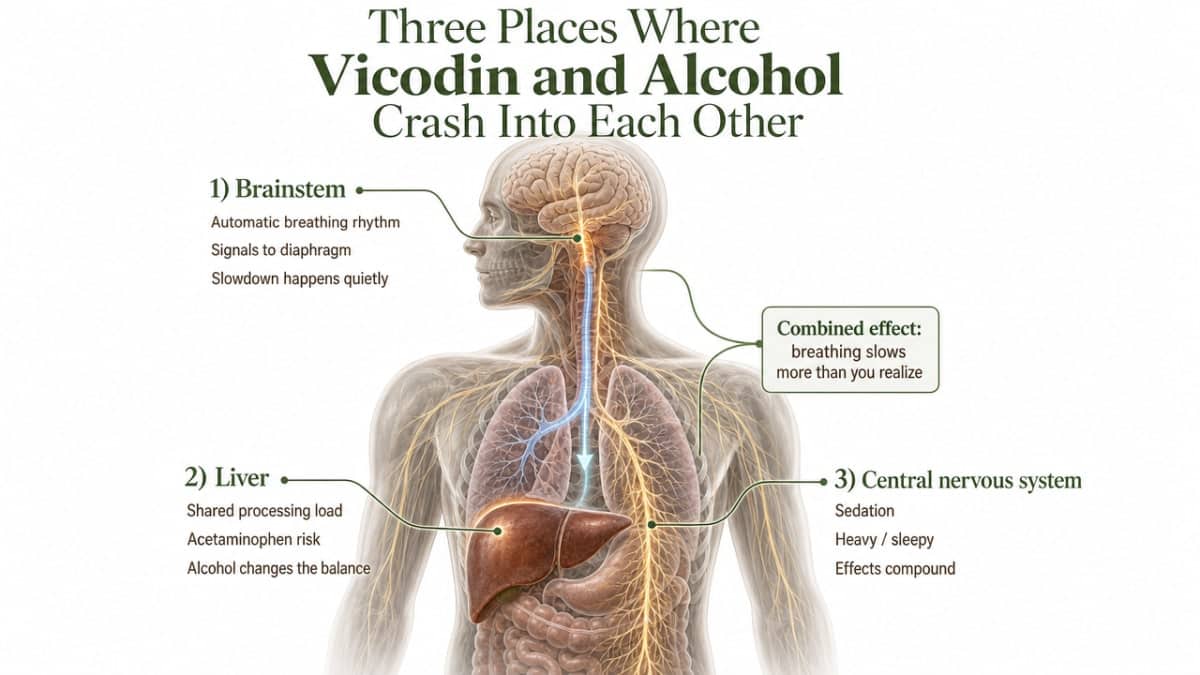
Here’s what’s actually happening when those two substances meet inside you. Vicodin contains hydrocodone, a Schedule II opioid that slows your breathing and dulls pain by acting on your central nervous system, and acetaminophen, which your liver has to break down 1. Alcohol is also a central nervous system depressant, and it competes for the same liver pathways. So you’re not adding one risk to another. You’re stacking two depressants on top of your brainstem while asking a single organ to process both 13.
Three things collide at once: your breathing slows more than you can feel, your liver works under doubled strain, and your sedation runs deeper than the dose alone would predict 2. The rest of this article walks through each of those, plainly, so you know what your body is doing and what you can do next.
What Vicodin Actually Is (And Why the Acetaminophen Matters)
Vicodin is a two-ingredient tablet, and that detail changes everything about how it interacts with alcohol. The first ingredient is hydrocodone, a Schedule II opioid that binds to receptors in your brain and spinal cord to blunt pain signals. The second is acetaminophen, the same active compound in Tylenol, added to boost pain relief at lower opioid doses 1. You’re not taking one drug. You’re taking two, and they exit your body through different doors.
Hydrocodone is the part that gets most of the attention, and for good reason. It can cause profound sedation, slowed breathing, and physical dependence, which is why the FDA label carries a boxed warning about combining it with any other central nervous system depressant, alcohol included 1. Your body handles hydrocodone largely through enzymes in the liver, then clears it through the kidneys.
Acetaminophen is the quieter half of the tablet, and that’s exactly why it deserves more of your attention than it usually gets. At normal doses it’s broken down safely, but a small fraction is converted into a toxic byproduct that your liver has to neutralize using glutathione, a built-in cleanup molecule. Alcohol depletes glutathione and shifts more acetaminophen down that toxic pathway 12. The FDA label specifically notes that the risk of acute liver failure is higher in people who drink alcohol while taking acetaminophen 1.
So when you hear “Vicodin and alcohol,” you’re really hearing about two separate collisions happening at once: an opioid stacking with a depressant in your brain, and a liver metabolite stacking with alcohol in your liver. Both matter. Neither cancels the other out.
Three Places Where Vicodin and Alcohol Crash Into Each Other
Your Brainstem: Breathing Gets Slower Than You Realize
You won’t feel your breathing change. That’s the part most people don’t understand about this combination, and it’s the part that matters most. Your brainstem runs the automatic rhythm of inhale and exhale without checking in with your conscious mind, which means the slowdown happens quietly, in the background, while you feel sleepy or relaxed or maybe just heavy.
Hydrocodone, the opioid half of Vicodin, dampens the brainstem signals that tell your diaphragm to keep working 1. On its own, at a prescribed dose, your body usually tolerates that small dip. Add alcohol and the math changes. Alcohol pushes on the same brainstem circuits from a slightly different angle, and the two effects don’t just add up. They compound.
Here’s what “respiratory depression” actually looks like from the outside:
- shallow breaths
- long pauses between them
- lips or fingertips that start to look bluish
- snoring that sounds wrong
From the inside, you’d feel nothing alarming. You’d feel like you were drifting off 11.
This is why “I only had one drink” still matters. Your breathing rate is already a little lower from the Vicodin. One drink lowers it further. You may never notice. Someone watching you might.
Your Liver: Two Toxins, One Overlapping Pathway
Your liver is the quiet workhorse in this story. It doesn’t send pain signals when it’s struggling. By the time it tells you something is wrong, the damage has usually been building for a while.
Here’s the part that’s worth slowing down for. Your liver processes both acetaminophen and alcohol through overlapping metabolic pathways. When acetaminophen breaks down, a small percentage gets converted into a compound called NAPQI, which is genuinely toxic to liver cells. Your liver neutralizes NAPQI using glutathione, a kind of internal cleanup crew. Alcohol does two unhelpful things at once: it depletes your glutathione stores, and it shifts more acetaminophen down the pathway that produces NAPQI in the first place 12. So less cleanup crew, more mess to clean.
The Vicodin label flags this directly, noting that the risk of acute liver failure rises in people who drink alcohol while taking acetaminophen 1. MedlinePlus describes what severe injury looks like when it shows up: yellowing of the skin and eyes, and in the worst cases, a need for liver transplant 11.
To be fair to the evidence, a short randomized trial of newly abstinent chronic drinkers given therapeutic-dose acetaminophen for three days didn’t find significant changes in liver enzymes 7. That’s a real finding, and it’s worth knowing. But three controlled days in a research setting is not the same as months of taking Vicodin while drinking on weekends, or doubling up on doses during a bad flare-up, or having a glass of wine with dinner most nights. The real-world pattern is what stresses the liver. The pathway doesn’t care about your intentions. It just metabolizes what arrives.
Your Central Nervous System: Sedation That Stacks
The third collision is the one you can actually feel, and that’s part of why it gets underestimated. You notice that you’re more relaxed, more tired, slower to respond. It feels manageable because you’re aware of it.
What you can’t feel is how much the sedation has stacked. Hydrocodone and alcohol both slow the central nervous system, and together they produce deeper sedation than either dose alone would predict 2. Co-ingestion can also raise hydrocodone plasma levels, which means more drug reaching receptors than your prescription was calculated for 2. Your reflexes blunt. Your judgment narrows. Your ability to notice that something is going wrong, including your own breathing, dulls.
This is the layer where a lot of accidental harm happens. Falls. Driving choices you wouldn’t make sober. A second drink because the first one didn’t feel like much. A second Vicodin because the pain crept back in and you forgot when you took the last one. The combination quietly removes the very awareness you’d need to course-correct 13.
Noticing any of this in yourself is not a small thing. It means a part of you is still tracking, still asking the question. Hold onto that.
Vicodin Alone vs. Vicodin With Alcohol: A Side-by-Side Look
Sometimes it helps to see the difference laid out plainly, without the softening of paragraph after paragraph. Here is what changes when alcohol enters the picture.
| What’s happening in your body | Vicodin alone (as prescribed) | Vicodin + alcohol |
|---|---|---|
| Breathing rate | Mildly slowed; usually tolerated at therapeutic doses 1 | Profound respiratory depression possible, including pauses, shallow breaths, coma, and death 3 |
| Sedation depth | Drowsiness predictable from the dose 2 | Sedation stacks; hydrocodone plasma levels can rise above what the prescription was calculated for 2 |
| Overdose risk | Present but bounded at prescribed doses | Markedly higher; NIAAA states all opioids, including hydrocodone, raise overdose and death risk when combined with alcohol 13 |
| Liver strain | Acetaminophen processed through normal pathways 1 | Glutathione depleted, more toxic NAPQI produced, acute liver failure risk rises 1, 12 |
Read across any row and the pattern is the same. The left column describes a calculated risk your prescriber accepted on your behalf. The right column describes a risk no one calculated, because no safe dose of alcohol exists alongside an opioid like Vicodin 13. Noticing that gap is useful. It’s not a verdict on you. It’s information you can act on.
Why the Urge to Combine Them Often Points Somewhere Else
If you reach for a drink while the Vicodin is in your system, you’re not weak and you’re not reckless. You’re trying to solve a problem the prescription didn’t finish solving. That’s worth naming, because the urge itself is data.
Most people who mix the two aren’t chasing a high. They’re chasing relief from something specific: pain that’s still loud at 9 p.m., anxiety that won’t let the day end, sleep that won’t come, or a memory that keeps surfacing when the house gets quiet. A critical review of alcohol and opioid co-use in chronic pain populations found that co-use is common, understudied, and tied to more severe substance use, worse psychiatric symptoms, and poorer treatment outcomes 5. Translation: when the two show up together, there’s almost always a third thing underneath that hasn’t been addressed.
That third thing matters because it changes what “getting better” actually requires. If your pain isn’t controlled, a stricter rule about alcohol won’t hold for long; the underlying signal will keep firing. If anxiety or depression is driving the evening drink, treating only the opioid side leaves half the problem in place. SAMHSA describes this overlap as co-occurring disorders, and notes that comprehensive, coordinated care is the standard when a mental health condition and a substance use pattern travel together 15. A treatment review echoes the point: outcomes are worse when these conditions aren’t treated in an integrated way 16.
So if you’ve been wondering why the urge keeps coming back, it’s probably not a willpower question. It’s a signal pointing at something that deserves its own care plan. Noticing that is the start of a different conversation, not a verdict on the one you’ve been having with yourself.
How Co-Use Patterns Start Earlier Than Most People Realize
One of the harder truths about Vicodin and alcohol is that the pairing rarely starts in adulthood. The first time you put a depressant on top of another depressant probably wasn’t the night you took a Vicodin with a glass of wine. It was years before that, and you almost certainly weren’t thinking about it as a pattern.
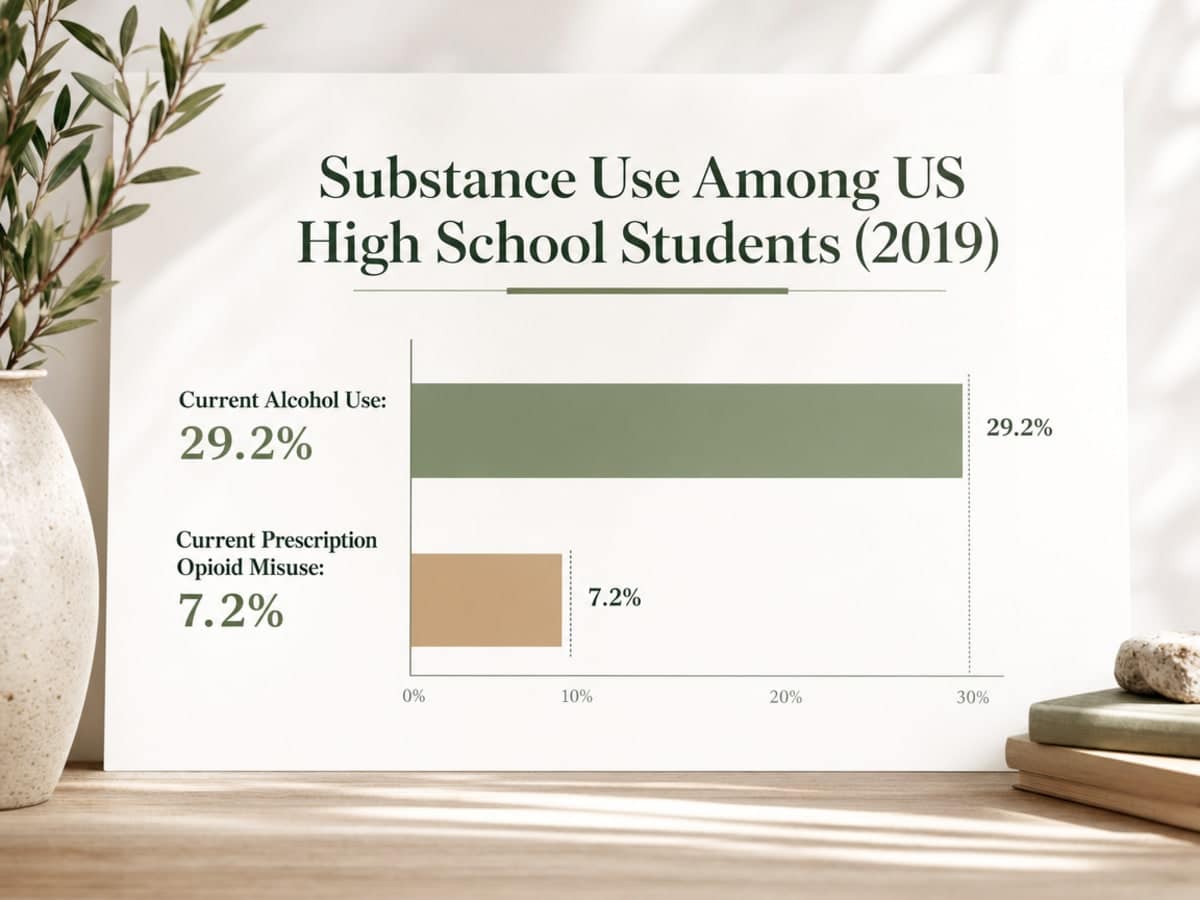
Look at what’s already happening in high school. The 2019 Youth Risk Behavior Survey found that 29.2% of U.S. high school students reported current alcohol use, while 7.2% reported current prescription opioid misuse 6. Those two groups overlap more than they don’t. Drinking is the wider behavior, prescription opioid misuse the narrower one tucked inside it, and the kids doing both are learning, without anyone teaching them, that two depressants feel like more relief than one.
That mental shortcut doesn’t disappear at graduation. It travels. By the time a prescription for Vicodin lands in your hand at 35 or 55, the muscle memory of “a drink takes the edge off” is already there, quietly suggesting that the pill and the glass belong on the same nightstand.
Knowing that doesn’t make the pattern your fault. It just makes it older than you thought, and easier to interrupt once you can see it.
What to Do Right Now
If You Already Mixed Them Today
First, stay where someone can see you. Not because you’ve done something unforgivable, but because the riskiest window is the next few hours, when sedation can deepen without you noticing. Sit up rather than lie flat. Eat something if you can. Skip any additional Vicodin until you’ve talked to a clinician, even if the pain comes back.
Tell one person in the house what you took and roughly when. Ask them to check on you, including during sleep. Watch for shallow or pausing breaths, bluish lips or fingertips, snoring that sounds strained, or someone who can’t be roused 11. Any of those is a 911 call, not a wait-and-see. If naloxone is in the house, the person with you should know where it is and how to use it 4.
Tomorrow, call your prescriber. You don’t need a confession script. “I had alcohol with my dose yesterday and I want to talk about how to handle this going forward” is enough to start a real conversation 8.
If It’s a Weekly Pattern
A weekly pattern is information, not a failing. It usually means the prescription isn’t covering what it was supposed to cover, or that something else, often sleep, anxiety, or a stretch of the day that feels unbearable, is being managed by the drink 5. Naming the pattern to yourself is the part most people skip, and it’s the part that changes everything else.
Book a longer appointment with your prescriber, not a refill visit. Bring three specifics:
- when in the week you tend to drink,
- what the pain or mood looks like in that window, and
- how much alcohol is actually involved.
Ask directly about a structured taper for the Vicodin, a non-opioid plan for the underlying pain, and a screening for depression or anxiety 8. Ask whether naloxone makes sense to keep at home in the meantime.
Between now and that appointment, don’t try to white-knuckle abstinence from both at once. That’s a different kind of risk, covered in the next section.
If You Suspect Dependence
If you’ve tried to cut back and couldn’t, if the dose has been creeping up, if mornings feel rough until the next pill or drink, you’re describing dependence. That’s a clinical pattern with a clinical answer, not a character problem. Reading this far is a real step. Hold onto that.
The next call isn’t to a willpower coach. It’s to a clinician who can assess both substances at once, because opioid dependence and alcohol dependence each carry their own withdrawal risks, and people with one often have the other 15. Ask specifically about medically supervised detox, a tapering plan rather than abrupt stoppage, and an integrated assessment for any co-occurring depression, anxiety, PTSD, or chronic pain driving the pattern 16. If your prescriber doesn’t offer dual-diagnosis care, ask for a referral to a program that does.
You don’t have to have it figured out before you call. You just have to make the call. The plan is what the assessment is for.
Why Quitting Cold Turkey Is Its Own Medical Risk
Once you’ve named the pattern, the next instinct is usually to stop everything tonight. Throw out the bottle, flush the pills, ride it out. That instinct is honest, and the impulse behind it matters. The execution can hurt you.
Opioid withdrawal from a medication like Vicodin is rarely fatal on its own, but it is genuinely awful: muscle pain, vomiting, diarrhea, anxiety that feels like a vise, sleep that won’t come for days. Alcohol withdrawal is the more dangerous half. In people who’ve been drinking heavily and regularly, stopping abruptly can trigger tremors, seizures, and in severe cases delirium tremens, which can be life-threatening without medical support. When both substances have been in your system, the two withdrawal timelines overlap and amplify each other 15.
There’s also a quieter risk on the other side. After even a short break from opioids, your tolerance drops fast. If withdrawal pushes you back to your old Vicodin dose, that dose can now cause the respiratory depression it didn’t cause last month, especially if alcohol is anywhere in the picture 4. Relapse after a self-managed quit is one of the highest-risk windows for overdose.
None of this is a reason to keep going. It’s a reason to not do it alone. A clinician can taper the opioid safely, manage alcohol withdrawal with monitoring and, when needed, medication, and keep naloxone within reach 8. Wanting to stop is the work. Letting someone help you stop is the plan.
What Medically Supervised Care Actually Looks Like
If the last section made you nervous about quitting on your own, good. That nervousness is appropriate, and it’s also the doorway into something better. Medically supervised care isn’t a punishment or a loss of control. It’s a clinical team taking the dangerous parts of stopping off your shoulders so you can do the harder, more human work underneath.
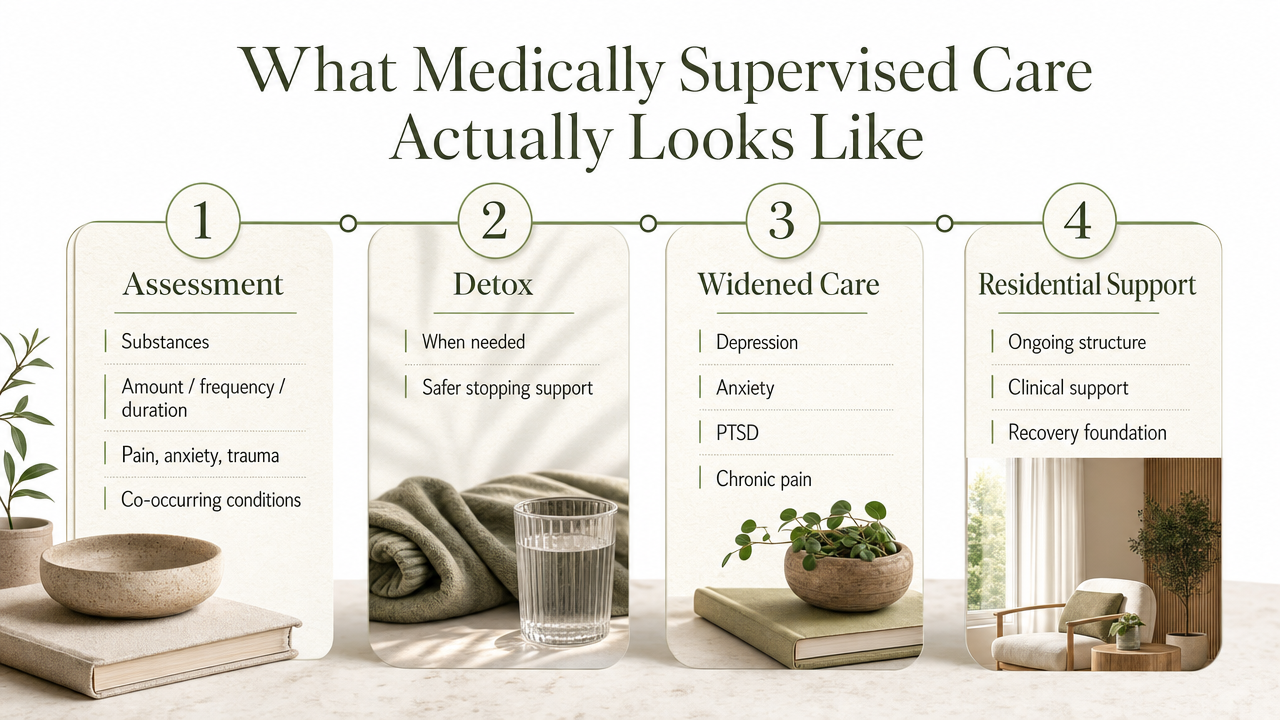
The first piece is assessment. A clinician sits down with you and asks about both substances: how much Vicodin, how often, how long, what the alcohol pattern actually looks like, what pain or anxiety or trauma is sitting behind the use. Screening for co-occurring depression, anxiety, PTSD, or untreated chronic pain happens here too, because treating one half of the picture and ignoring the other is the most common reason people relapse 15, 16.
Detox comes next when it’s needed. For Vicodin, that usually means a structured taper rather than a hard stop, so withdrawal stays bearable. For alcohol, it can mean monitored medication to prevent seizures and to keep the first 72 hours safe. Naloxone stays within reach the entire time 4, 8.
From there, care widens. Individual therapy works on what was driving the urge. Group sessions remind you that you’re not the only person who ended up here. A non-opioid pain plan, if pain is part of your story, replaces what the Vicodin was doing 5. For people whose home environment makes any of this nearly impossible, 24/7 residential settings, like the program offered through Arrow Passage Recovery, give the first few weeks the structure they need before outpatient care takes over.
You don’t have to walk in healed. You just have to walk in.
Talk Confidentially About Mixing Vicodin and Alcohol
Get expert support to safely address concerns about Vicodin and alcohol use, without judgment.
Start your conversation about safer recovery today
Discuss your Vicodin and alcohol concerns with someone who truly understands the challenges you face.
Frequently Asked Questions
Is it safe to have just one drink while taking Vicodin?
No safe amount of alcohol exists alongside Vicodin. Even one drink adds to hydrocodone’s effect on your breathing and sedation, and the NIAAA states plainly that all opioids, hydrocodone included, raise overdose and death risk when combined with alcohol 13. One drink may feel like nothing. Your brainstem still registers it.
How long after taking Vicodin should I wait before drinking alcohol?
There isn’t a clean number, and that’s the honest answer. Hydrocodone effects can linger well beyond when you feel them, and acetaminophen is still being processed by your liver hours later 1. While you’re on a prescribed course of Vicodin, the safest plan is no alcohol at all. Ask your prescriber for a specific timeline once you’ve stopped.
What are the warning signs of a Vicodin and alcohol overdose?
Watch for shallow or pausing breaths, bluish lips or fingertips, deep snoring that sounds strained, pinpoint pupils, and someone who can’t be woken 11. Later signs of acetaminophen-related liver injury include yellowing of the skin or eyes 11. Any of these warrant a 911 call and naloxone if available, not a wait-and-see 4.
Can mixing Vicodin and alcohol damage my liver even if I don’t overdose?
Yes. Acetaminophen and alcohol use overlapping liver pathways, and the FDA Vicodin label specifically warns that the risk of acute liver failure is higher in people who drink while taking acetaminophen 1. MedlinePlus identifies acetaminophen-containing pain medicines as a common cause of drug-induced liver injury 12. Damage can build quietly long before any overdose event.
Why do I crave a drink when I’m already taking Vicodin for pain?
Because the prescription likely isn’t covering everything you’re carrying. Co-use research on chronic pain populations shows that alcohol and opioid co-use is common and tied to underlying pain that isn’t fully managed, plus psychiatric symptoms like anxiety and depression 5. The craving isn’t weakness. It’s a signal pointing at something that needs its own treatment plan.
Can I stop drinking and taking Vicodin on my own at home?
Please don’t try this alone. Alcohol withdrawal can cause seizures and, in severe cases, delirium tremens, while opioid withdrawal is rarely fatal but genuinely brutal 15. Tolerance also drops fast, so returning to your old Vicodin dose afterward becomes a high-risk overdose window 4. Ask your prescriber about a medically supervised taper and a dual-diagnosis assessment 8.
References
- Vicodin (hydrocodone bitartrate and acetaminophen tablets) prescribing information. https://www.accessdata.fda.gov/drugsatfda_docs/label/2006/088058s027lbl.pdf
- Hydrocodone and Acetaminophen – StatPearls. https://www.ncbi.nlm.nih.gov/books/NBK538530/
- NORCO (hydrocodone bitartrate and acetaminophen tablets) prescribing information. https://www.accessdata.fda.gov/drugsatfda_docs/label/2019/040148s073lbl.pdf
- Opioid Toxicity – StatPearls. https://www.ncbi.nlm.nih.gov/books/NBK470415/
- Alcohol and Opioid Use, Co-Use, and Chronic Pain in the Context of the Opioid Epidemic: A Critical Review. https://pmc.ncbi.nlm.nih.gov/articles/PMC5832605/
- Prescription Opioid Misuse and Use of Alcohol and Other Substances Among High School Students — Youth Risk Behavior Survey, United States, 2019. https://www.cdc.gov/mmwr/volumes/69/su/su6901a5.htm
- The effect of acetaminophen (four grams a day for three consecutive days) on hepatic tests in alcoholic patients – a randomized clinical trial. https://pmc.ncbi.nlm.nih.gov/articles/PMC1894983/
- CDC Clinical Practice Guideline for Prescribing Opioids for Pain — United States, 2022. https://www.cdc.gov/mmwr/volumes/71/rr/rr7103a1.htm
- Assessment of Alcohol-Induced Dose Dumping with a Hydrocodone Bitartrate Extended-Release Tablet Formulation. https://pmc.ncbi.nlm.nih.gov/articles/PMC4579248/
- Hydrocodone: MedlinePlus Drug Information. https://medlineplus.gov/druginfo/meds/a614045.html
- Hydrocodone and acetaminophen overdose – MedlinePlus Medical Encyclopedia. https://medlineplus.gov/ency/article/002670.htm
- Drug-induced liver injury: MedlinePlus Medical Encyclopedia. https://medlineplus.gov/ency/article/000226.htm
- Alcohol-Medication Interactions: Potentially Dangerous Mixes. https://www.niaaa.nih.gov/health-professionals-communities/core-resource-on-alcohol/alcohol-medication-interactions-potentially-dangerous-mixes
- Drug Overdose Deaths: Facts and Figures. https://www.nida.nih.gov/research-topics/trends-statistics/overdose-death-rates
- Co-Occurring Disorders and Other Health Conditions. https://www.samhsa.gov/substance-use/treatment/co-occurring-disorders
- Treatment for Substance Use Disorder With Co-Occurring Mental Illness. https://pmc.ncbi.nlm.nih.gov/articles/PMC6526999/