
Understanding the Addiction Phases in a Loved One
Key Takeaways
- Addiction progresses through recognizable phases — experimentation, regular use, risky use, dependence, crisis, treatment, and recovery — and naming the phase lets you respond to a process instead of reacting to each incident 1.
- Families move through their own parallel track of concern, denial, control attempts, and crisis, and the patterns that look like help can quietly maintain the very use you’re trying to stop 9.
- CRAFT outperforms waiting for rock bottom or staging a confrontation, engaging 55–86% of treatment-refusing loved ones into care and roughly doubling the results of traditional approaches 6, 8.
- Use SAMHSA’s two-week threshold for sustained changes in mood, behavior, or functioning as your cue to call a professional, and ask providers about integrated dual-diagnosis care and structured family involvement 2, 9.
What you’re actually watching happen
You’ve been collecting evidence without meaning to. The missing twenty dollars from your wallet. The slurred phone call at 4 p.m. on a Tuesday. The way your son’s pupils looked at dinner last weekend, or how your wife’s explanations have started to contradict each other in small, deniable ways.
And you’ve probably been doing two things at once: telling yourself it’s not that bad, and lying awake at 2 a.m. convinced it’s catastrophic.
Both reactions make sense. What you’re watching is real, and it follows a pattern. Addiction is a chronic condition that develops in recognizable stages, starting with experimentation and progressing through repeated use as the brain adapts to the substance 1. The behaviors that confuse you, the personality shifts, the denial that feels almost theatrical, the broken promises that seem sincere in the moment — these aren’t random. They map onto phases that clinicians, researchers, and families have documented for decades.
Here’s what changes when you can name the phase: you stop reacting to each incident as if it were the first one, and you start responding to a process you can actually influence. Noticing what you’re noticing is already a step. The rest of this guide gives you a map for both tracks — what’s happening to your loved one, and what’s happening to you — along with what to do at each stage, including what the research says actually works.
Two tracks running at the same time
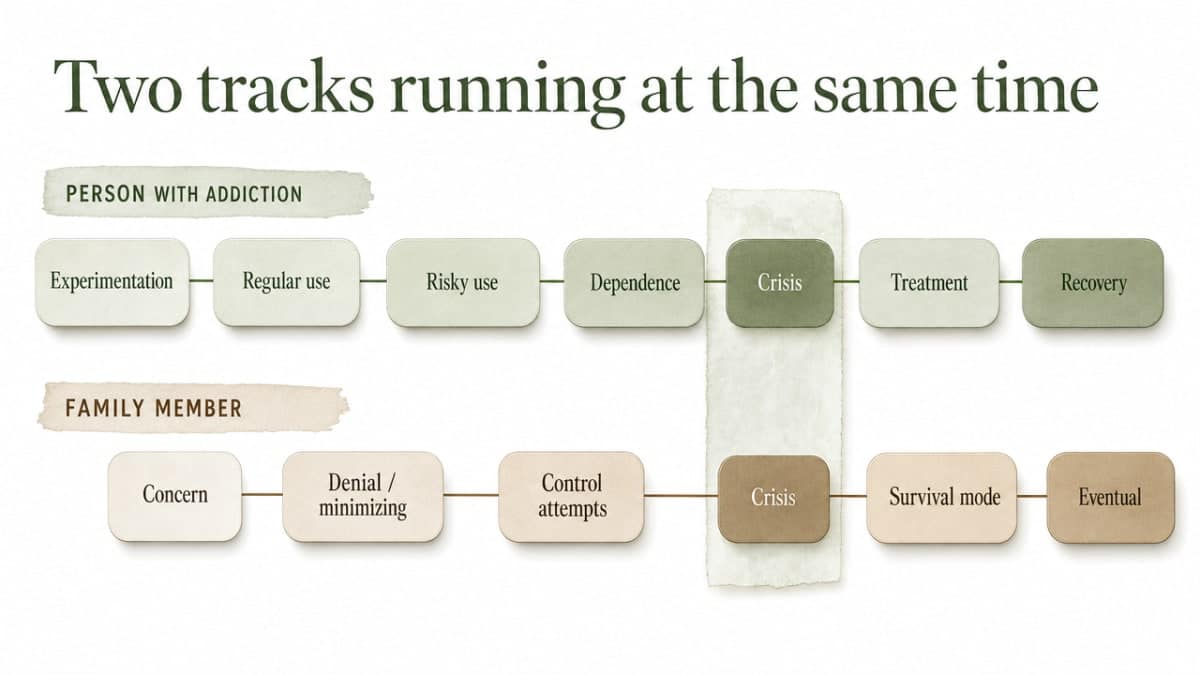
Here’s the part most family guides skip: while your loved one is moving through their phases, you are moving through yours. Two timelines, one household, often out of sync.
On their side, the progression tends to run from experimentation, to regular use, to risky use, to dependence, to crisis, and — when things break open the right way — into treatment and recovery. The brain adapts at each step, which is part of why willpower alone rarely reverses the slide once it has built momentum 1. The behaviors you see are downstream of changes happening underneath.
On your side, the track usually looks like this: concern, then denial or minimizing (“college kids drink, she’s just stressed, he’ll grow out of it”), then control attempts (hiding car keys, calling in sick for them, checking phones, rationing money), then crisis and survival mode, and eventually — if you let it — your own recovery. That last phase is real, and it isn’t optional. The family doesn’t just witness addiction. It absorbs it.
Seeing both tracks at once changes what you do. When you can name where your loved one is and where you are, you stop fighting the wrong battle. You stop trying to reason someone out of dependence with a calm Sunday conversation. You stop blaming yourself for a phase shift you couldn’t have prevented.
Research on family systems is clear on one point: when family members are educated and supported, they meaningfully improve the odds that a loved one recognizes the problem and accepts treatment 5. You are not a bystander in this. You are a variable.
The next sections walk both tracks, phase by phase, starting where almost everyone wishes they had started paying attention sooner.
Phase one: experimentation and the quiet early signals
This is the phase where you second-guess yourself the most. The signs are small enough to explain away, and explaining them away is what almost everyone does at first.
Experimentation can look ordinary. A beer at a friend’s house. A vape pen in a backpack pocket. A prescription refilled a little too quickly after a back injury. For some people, it stops there. For others, the brain starts learning that the substance reliably changes how they feel — and that learning is the seed of every later phase 1. Not everyone who experiments progresses. But progression doesn’t announce itself, which is why early signals matter even when they feel too thin to act on.
What to actually watch for:
- A shift in who they spend time with and a reluctance to talk about it.
- New secrecy around their phone, their room, their car.
- Sleep schedules that drift.
- Money that doesn’t quite add up — a twenty here, a debit charge they can’t explain.
- Mood swings that feel sharper than usual, especially in the hours before or after they’ve been out.
None of these alone proves anything. Two or three together, repeating over weeks, is a pattern.
You don’t need certainty to respond. NIDA’s guidance for families is direct: catch the problem early, and follow up consistently when something doesn’t add up 4. That doesn’t mean interrogation. It means a calm, specific conversation — “I noticed you came home at 2 a.m. on Tuesday and you weren’t yourself. I want to understand what’s going on” — followed by an actual follow-up, not a one-time speech that gets shelved.
Keep talking. Keep noticing. Stay curious instead of accusatory, because in this phase, your relationship is still the strongest lever you have. Defensiveness is normal at any age, and the goal isn’t a confession — it’s keeping the door open while you gather information. Writing down what you’re seeing, with dates, helps you separate the pattern from the panic.
If you’re the parent of an older teen or young adult, your instinct to step back because they’re “almost an adult” is worth questioning here. Early follow-through from a parent or partner is still one of the most protective factors during this phase 4. You are not overreacting by paying close attention. You are doing the work this phase actually requires.
Phase two: regular use slides into risky use
By the time you reach this phase, the explanations have started to feel thinner. The hangovers last longer. The “one beer after work” has become a routine, then a requirement. The Adderall prescribed for finals is still being refilled in August. What was occasional is now patterned, and what was patterned is starting to cost something.
Regular use, on its own, isn’t the same as addiction. Plenty of adults drink most weekends or use a substance recreationally without crossing into harm. The shift you’re watching for is when use stops fitting neatly into someone’s life and starts reshaping it. That’s risky use — the phase where consequences begin to show up but the person hasn’t lost control yet, and where most families either intervene effectively or lose the next eighteen months to wishful thinking.
What that looks like in real life: missed shifts or a written warning at work. Grades sliding. A partner pulling back from the bedroom or the dinner table. Bills paid late for the first time in years. New friends you’ve never met and old friends who’ve quietly disappeared. Weight changes, sleep changes, a face that looks tired in a way coffee doesn’t fix. Money questions that don’t resolve — small cash withdrawals, a credit card you didn’t authorize, items missing from the house.
The emotional signature changes too. Irritability when use is questioned, even gently. A flatness when sober and an animation that only shows up after using. Defensiveness that’s disproportionate to the question you asked. You’re not imagining the personality shift. The substance is becoming a load-bearing part of how your loved one regulates daily life.
This is the phase to stop watching and start acting — not with ultimatums, but with directness. Name what you see in specific terms, not labels. “You’ve called in sick three Mondays in a row and I found an empty bottle in the car” lands differently than “I think you have a problem.” Ask one question and let silence do work. If the two-week threshold is clearly behind you, that’s your cue to call a professional — a primary care doctor, a licensed counselor, or a treatment helpline — before the next phase removes the choice from your hands.
Phase three: dependence, denial, and the family’s control years
This is the phase where you stop recognizing your own life.
Dependence is what happens when the brain’s adaptations to repeated use cross a line: your loved one isn’t choosing the substance the way they used to. They’re organizing the day around it. Withdrawal — physical, emotional, or both — shows up when they try to stop or cut back, and the relief that comes from using again teaches the brain, one more time, that the substance is non-negotiable 1. This isn’t weakness. It’s a chronic condition doing what chronic conditions do.
What you’ll see at home: tolerance climbing, so the amount that used to be enough no longer is. Mornings get harder. Sick days stack up. Sleep is either too much or almost none. Money problems become structural — overdrafts, missed rent, items you owned last month that you can’t find this month. Promises start to sound rehearsed. The denial gets sharper, not because your loved one is lying to hurt you, but because admitting the truth would mean facing something they don’t yet have the tools to face.
And then there’s you.
This is the phase families often call the control years, even if they never use that phrase out loud. You start managing the fallout to keep the household functioning. You call their boss with an excuse. You pay the credit card so the lights stay on. You drive across town at midnight. You hide bottles, count pills, search the car, read the texts. You become very good at predicting moods and very bad at sleeping.
None of that makes you weak or foolish. It makes you a person trying to keep someone you love alive while everything tilts. But the research on family systems is unambiguous: the patterns family members fall into during this phase can quietly maintain the very use they’re trying to stop, even when every individual action looks like help 9. The 2 a.m. rescue prevents the consequence. The covered shift protects the job that funds the use. The smoothed-over fight keeps the peace and keeps the pattern.
Naming this isn’t blame. It’s leverage. Once you can see what your control is actually doing, you can start choosing differently — not by withdrawing love, but by withdrawing the cushion that’s been absorbing every impact.
A few markers that you’ve been in this phase too long:
- You can’t remember the last conversation you had with your loved one that wasn’t about their use.
- You’ve stopped telling close friends what’s really going on.
- Your own sleep, eating, or work has slipped for more than two weeks 2.
- You’re rehearsing arguments in the shower.
If two or three of those are true, the next phase isn’t waiting on your loved one — it’s waiting on you to ask for help of your own. A call to a counselor who works with families, or to a confidential helpline, isn’t giving up on your loved one. It’s the first step that doesn’t depend on them changing first.
When a loved one refuses help: the CRAFT alternative
If you’ve heard “I don’t have a problem” or “I’m not going anywhere” enough times to memorize the inflection, this section is for you. Refusal is not the end of your options. It’s the start of a different strategy.
For decades, the dominant advice given to families has been some version of two things: stage a confrontational intervention, or wait for rock bottom. Both have stayed popular despite the evidence, not because of it. Rock bottom is a gamble with your loved one’s life, and confrontational interventions ask you to risk the relationship on a single high-stakes meeting. There is a third option, and it is the one with the strongest research behind it.
It’s called Community Reinforcement and Family Training — CRAFT. It’s a structured, skills-based approach that teaches you, the family member, how to change the patterns at home in ways that make treatment more appealing and continued use less rewarding. You learn how to reinforce sober behavior, how to step back from rescues that absorb consequences, how to time conversations for moments when your loved one is most receptive, and how to take care of yourself in the process 7. You are the one in the training. Your loved one doesn’t have to agree to anything for you to start.
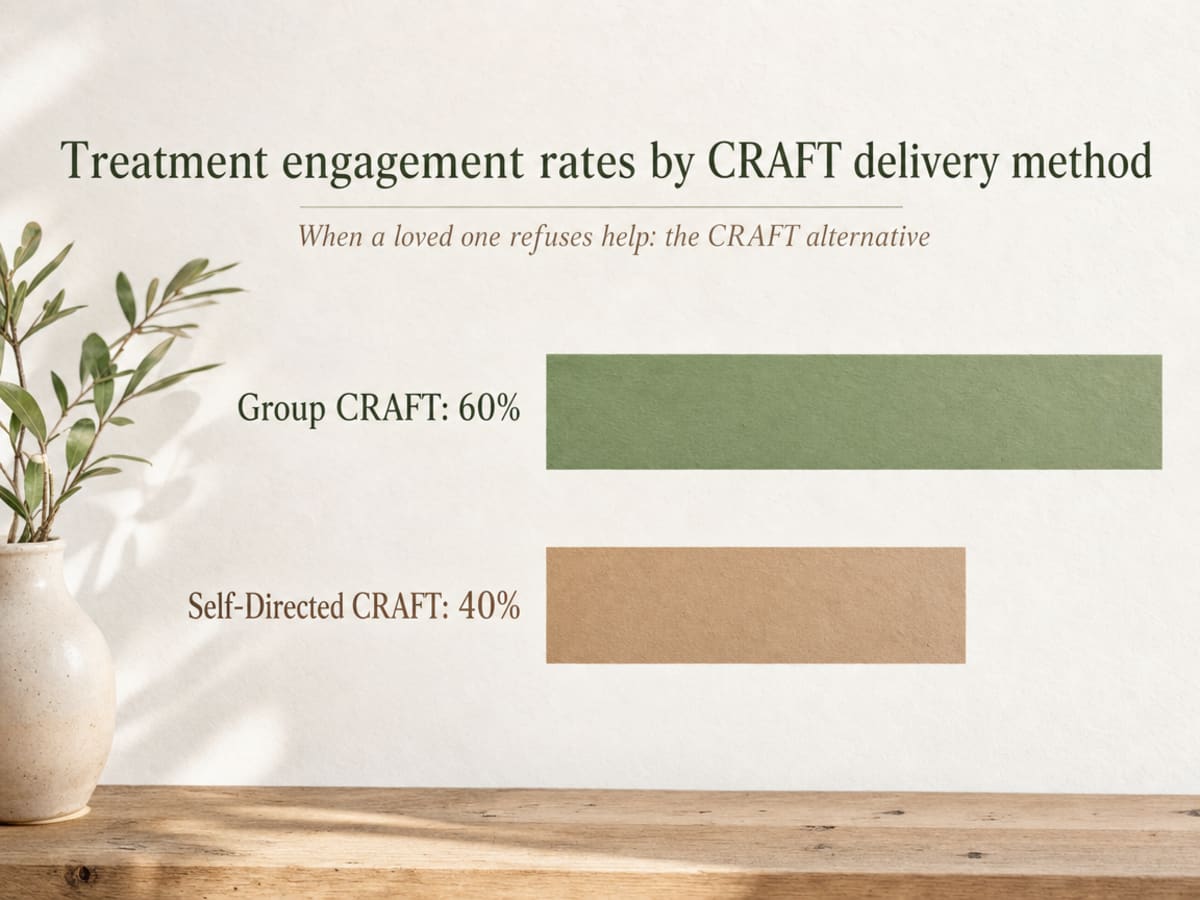
The numbers are what change the conversation. A pilot trial of concerned significant others — partners, parents, and family members of substance users who were refusing treatment — found that 60% of those who learned CRAFT in a group format successfully engaged their loved one into treatment, compared with 40% of those who learned it through a self-directed workbook on their own 8. Across the broader body of CRAFT studies, family members engage somewhere between 55% and 86% of treatment-refusing loved ones 8. Compare that with the alternatives: CRAFT is 2 to 3 times more effective at getting a treatment-resistant person into care than the traditional Al-Anon model or the Johnson Intervention 6.
Two things matter about those numbers. First, group delivery outperformed going it alone — being in a room with other family members learning the same skills nearly doubled the absolute engagement rate in the pilot. Second, even the lower end of the range is dramatically better than waiting. You are not stuck choosing between a confrontation and a vigil.
What CRAFT looks like in practice is less dramatic than the movies suggest. You stop arguing during use and engage during sober windows. You let natural consequences land — the missed shift, the unpaid bill, the awkward conversation with a friend — instead of cushioning them. You notice and respond warmly to small sober moments, even ones that feel too small to count. You prepare a short, specific invitation to treatment for the moment your loved one shows any opening, and you keep a vetted provider’s number in your phone so you can act inside that window, not after it closes.
You don’t have to learn this alone, and the data suggests you’ll do better if you don’t. Ask any therapist, counselor, or treatment center whether they offer CRAFT-informed family sessions or can refer you to a CRAFT-trained clinician. If the first call says no, make a second call.
Phase four: crisis, and how to act without making it worse
Crisis is the phase no one wants to imagine and most families eventually face in some form. An overdose. A car accident. A suicide attempt. An arrest. A hospital call at 3 a.m. that you’ll remember for the rest of your life.
If you’re reading this before a crisis has happened, take a breath. You can use the next few minutes to prepare in ways that will matter later.
If a crisis is unfolding right now, call 911 or the helpline. Stay. Don’t try to drive someone who is unresponsive or sedated to a hospital yourself.
What makes crisis harder for families is the pull to protect your loved one from consequences in the moment — to talk the officer out of the arrest, to convince the ER not to admit, to pay the bail before sunrise so no one has to know. Resist that pull when you safely can. A consequence that lands is often the opening for treatment entry that no Sunday conversation has been able to create. Crisis is not the goal, and it is not proof of failure. It’s a hinge, and your job is to keep your loved one alive long enough to walk through it.
Phase five: treatment entry and what to ask a provider
The window between “yes, I’ll go” and actually walking through a door is often shorter than you’d like. Be ready to move inside it.
Before that moment arrives, do the boring work. Pull your insurance card and call the number on the back to ask which addiction treatment providers are in network and what levels of care are covered — detox, residential, partial hospitalization, intensive outpatient, standard outpatient. Ask about prior authorization requirements and any session limits. If you don’t have insurance, the SAMHSA National Helpline at 1-800-662-4357 can refer you to state-funded options and sliding-scale programs in your area 10.
When you reach a provider, your questions matter more than their brochure. Ask whether they’re licensed by the state and nationally accredited. Ask if a physician evaluates every incoming patient and how they handle withdrawal, especially for alcohol, benzodiazepines, or opioids, where medical detox can be a safety issue. Ask whether they offer medication-assisted treatment for opioid or alcohol use disorder, and what the criteria are for using it. Ask how they screen for and treat co-occurring conditions like depression, anxiety, PTSD, or bipolar disorder — integrated dual-diagnosis care matters because untreated mental health conditions are one of the most common drivers of early relapse.
Ask one more thing: how they involve family. Brief family therapy and structured family sessions can change the patterns at home that quietly maintained use, and they belong in the treatment plan, not as an afterthought 9. There is one important caveat — family therapy isn’t appropriate when there’s been severe violence in the household, and a good provider will screen for that before recommending it 9.
Two more practical notes. First, the day-of logistics matter. Pack a bag in advance if residential care is likely. Know who will drive. Have the admissions number saved, not searched for. Second, expect ambivalence right up to the doorway. Your loved one may agree at 8 p.m. and waver at 8 a.m. That’s the phase, not a verdict on their commitment. Stay calm, keep the appointment, and let the clinical team take it from there.

Phase six: recovery, relapse risk, and the family’s own healing
Recovery doesn’t arrive in a single moment. It’s built across thousands of small ones — a craving that passes, a meeting attended on a hard night, a Tuesday that goes by without incident and barely registers as remarkable.
Hold two truths at once here. Your loved one is doing real work, and the risk of relapse is real too. Addiction is a chronic condition, which means recovery is managed the way other chronic conditions are managed: with ongoing care, attention to triggers, and a plan for setbacks 1. A return to use during this phase isn’t proof that treatment failed or that your loved one didn’t mean it. It’s information — about what wasn’t covered, what stressor wasn’t anticipated, what support wasn’t yet in place. Many people who reach lasting recovery have one or more relapses on the way there.
What helps during this phase: keep the treatment team involved, including for medication management and any co-occurring mental health care. Notice and respond to small sober moments without making them into a referendum. Ask, in calm windows, what would actually help — and believe the answer when you get one.
Then there is your own track, the one that doesn’t end when your loved one comes home. Family therapy, support groups, and a counselor of your own aren’t extras here. Family patterns that grew up around the addiction don’t unmake themselves, and brief family therapy can help reshape the interactions that once maintained use into ones that support recovery 9. The exception worth naming again: family therapy isn’t the right tool when there’s been severe violence, and a good clinician will screen for that first 9.
You are allowed to heal too. That isn’t a reward for finishing. It’s part of the work.
When mental health conditions change the timeline
If your loved one is also living with depression, anxiety, PTSD, bipolar disorder, or another mental health condition, the phases you’ve just read about don’t unfold on a clean schedule. They compress, overlap, and double back.
Substances often start as self-medication. A partner with untreated panic disorder finds that alcohol quiets the chest tightness. A son with PTSD discovers that cannabis is the only thing that lets him sleep. A daughter with bipolar disorder uses stimulants during depressive lows and cycles harder for it. The substance solves something real in the short term, which is why “just stop” lands the way it does — like asking them to give up the one thing that’s working.
What this means for you: experimentation can collapse into dependence faster, risky use can flip into crisis with less warning, and recovery without addressing the underlying condition tends to be fragile. SAMHSA’s two-week threshold for functional impairment still applies, but in co-occurring cases you may see that threshold crossed in days, not weeks 2.
When you call providers, ask specifically about integrated dual-diagnosis care — one team treating both conditions, not two teams sending records back and forth. Untreated mental health symptoms are one of the most reliable predictors of early return to use, and they belong in the treatment plan from day one.
Speak With Someone Who Understands Addiction Phases
Get personal guidance for navigating your loved one’s unique recovery journey, starting with a confidential conversation.
Take the First Step Toward Healing Together
Connect with a caring expert to explore next steps for your loved one’s recovery journey.
Frequently Asked Questions
How do I know if my loved one is in an early phase or already dependent?
Look at duration and function, not single incidents. SAMHSA’s working threshold is changes in thoughts, moods, or behavior that last two or more weeks and make it hard to manage work, school, home, or relationships 2. If withdrawal symptoms show up when they try to cut back, or use is organizing their day, you’re past early-phase territory.
Should I wait for my loved one to hit rock bottom before stepping in?
No. Waiting is a gamble with their life, and the evidence doesn’t support it. Family members trained in CRAFT engage 55–86% of treatment-refusing loved ones into care, far better than waiting for collapse 8. Earlier action, done with skill rather than confrontation, gives you and your loved one more time and more options.
What should I say when my loved one denies there’s a problem?
Skip labels and stick to specifics. Try: “On Tuesday you missed work, and I found the empty bottle in the car. I’m worried, and I want to talk about it.” One observation, one feeling, one ask. Then stop talking and let silence do work. Time the conversation for a sober window, not mid-argument, and expect to repeat it.
Am I enabling my loved one by helping with rent, bills, or rides?
Sometimes. The test isn’t generosity — it’s whether your help absorbs a consequence that would otherwise prompt change. Patterns that quietly maintain use, even when each action looks like care, are documented in family-systems research 9. Covering a missed shift or paying off a charge they hid usually qualifies. Keeping the lights on for grandchildren usually doesn’t.
What can I do if my loved one refuses treatment?
Start your own training. Ask a counselor or treatment center about CRAFT-informed family sessions, where you learn to reinforce sober behavior, step back from rescues, and prepare a short, specific treatment invitation for receptive moments 7. You don’t need their permission to start. If you’re not sure where to begin, call SAMHSA’s helpline at 1-800-662-4357 10.
Does a relapse mean treatment failed?
No. Addiction is a chronic condition, and chronic conditions involve setbacks managed with ongoing care, not one-shot cures 1. A return to use tells you something was missing — an untreated mental health symptom, an unanticipated trigger, a support that wasn’t yet in place. Call the treatment team, adjust the plan, and keep going. Many people relapse on the way to lasting recovery.
References
- Parents & Educators. https://nida.nih.gov/research-topics/parents-educators
- Mental Health, Drug and Alcohol: Signs You Need To Seek Help. https://www.samhsa.gov/find-support/how-to-cope/signs-of-needing-help
- Prevention of Substance Use. https://www.samhsa.gov/substance-use/prevention/substance-use-disorders
- FAMILY CHECKUP – Positive Parenting Prevents Drug Abuse. https://nida.nih.gov/sites/default/files/familycheckup_8_15.pdf
- The Impact of Substance Use Disorders on Families and Children. https://pmc.ncbi.nlm.nih.gov/articles/PMC3725219/
- The Community Reinforcement Approach: An Update of the Evidence. https://pmc.ncbi.nlm.nih.gov/articles/PMC3860533/
- Analyzing Components of Community Reinforcement and Family Training (CRAFT). https://pmc.ncbi.nlm.nih.gov/articles/PMC5690811/
- Community Reinforcement and Family Training: A Pilot Comparison of Group and Self-Directed Delivery. https://pmc.ncbi.nlm.nih.gov/articles/PMC3331969/
- Chapter 8—Brief Family Therapy. https://www.ncbi.nlm.nih.gov/books/NBK64953/
- National Helpline for Mental Health, Drug, Alcohol Issues. https://www.samhsa.gov/find-help/helplines/national-helpline