
Intensive Outpatient Program in Massillon, OH
Key Takeaways
- Intensive outpatient programs in Massillon provide nine to nineteen hours of weekly structured treatment, filling the gap between standard counseling and residential care while you keep working and living at home 4, 11.
- Ohio Medicaid and most commercial plans cover IOP when an ICD-10 diagnosis and medical necessity are documented, so confirm in-network status, prior authorization, and per-session costs before enrolling 10, 12.
- Research shows well-implemented IOPs can match residential outcomes for appropriately matched adults, and consistent engagement through roughly 16 days significantly reduces psychiatric hospitalization risk 1, 2.
- Compare programs on schedule flexibility (morning, afternoon, evening tracks), integrated treatment for co-occurring mental health and substance use conditions, and a clear path to step up or down in care 3, 6.
When weekly counseling isn’t enough but residential is too much
You know the feeling when weekly therapy isn’t enough to address your challenges, but residential treatment feels like an impossible step. Perhaps cravings persist, or anxiety continues to disrupt your mornings. Yet, taking extended time away from work, family, or other responsibilities for 24/7 care isn’t feasible or necessary.
This is where an intensive outpatient program (IOP) comes in. It offers a middle ground, providing nine to nineteen hours of structured treatment per week while allowing you to maintain your daily life and responsibilities 4. In Ohio, this distinction is clear: standard outpatient care for adults is less than nine hours weekly, while anything more intensive falls under its own category with specific guidelines and support systems 11.
Whether you’re exploring this for yourself or a loved one, understanding IOP can provide clarity. The following sections will detail what an IOP in the Massillon area entails, how it integrates with a working week, its effectiveness based on research, and what to expect during a first consultation.
Is IOP the right level of care for you?
How Ohio defines the line between outpatient and IOP
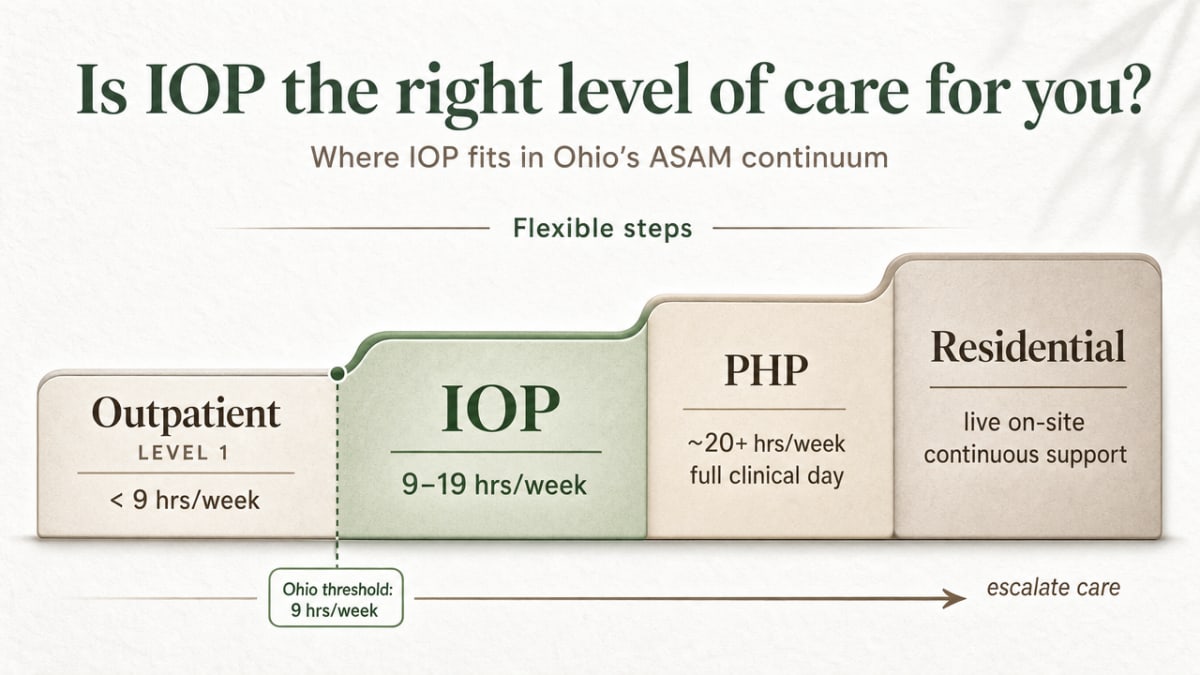
Ohio explicitly defines the difference between standard outpatient and IOP. According to Rule 5160-27-09, Medicaid designates Level 1 outpatient substance use treatment as less than nine hours per week for adults 11. Exceeding this threshold places you in intensive outpatient territory, which involves distinct structural, documentation, and clinical requirements.
Practically, IOP typically involves nine to nineteen hours of treatment weekly. Beyond this, around twenty hours or more, you would be looking at partial hospitalization (PHP), which is a full clinical day. Above PHP is residential care, where you live on-site and receive continuous support 4. The American Society of Addiction Medicine (ASAM) continuum, which Ohio utilizes, views these as flexible steps. You can escalate care if symptoms worsen or de-escalate as you stabilize 4.
The number of hours is crucial because it determines a program’s capacity to address your needs effectively. Fewer than nine hours might suffice for maintenance after significant progress, but if you’re experiencing frequent setbacks, the additional hours in an IOP provide essential clinical intervention.
Signs IOP fits your situation
While there’s no rigid checklist, certain patterns indicate that IOP might be a suitable option. It’s often appropriate when standard weekly counseling is no longer sufficient, but you are medically stable, not in acute withdrawal, and have a safe living environment. You might be managing work and responsibilities, but underlying issues are becoming more apparent.
IOP is also beneficial when multiple issues are present. If anxiety, depression, PTSD, or bipolar symptoms are intertwined with substance use, integrated treatment that addresses both simultaneously yields better outcomes than treating them separately 6. IOP is structured to manage this complexity within a single program.
When a higher or lower level of care makes more sense
Sometimes, IOP may not be the initial appropriate step. A thorough assessment will help determine this.
A higher level of care might be necessary if you are experiencing active withdrawal, if your home environment is not conducive to early recovery, if you’ve had recent overdoses or psychiatric hospitalizations, or if previous outpatient treatments haven’t provided enough support to prevent relapse. In such cases, detox or residential care, potentially followed by PHP, can establish a stable foundation before transitioning to IOP 4.
Conversely, a lower level of care, such as standard outpatient treatment (under nine hours), may be adequate if you have completed a more intensive program, your symptoms are well-managed, and you seek counseling for ongoing maintenance and accountability 11.
What a week of IOP in Massillon actually looks like
Morning, afternoon, and evening tracks built around work
A primary concern for many considering IOP is how it will fit into their existing schedule. Effective IOPs address this by offering flexible scheduling options.
Programs in the Massillon area typically provide three tracks:
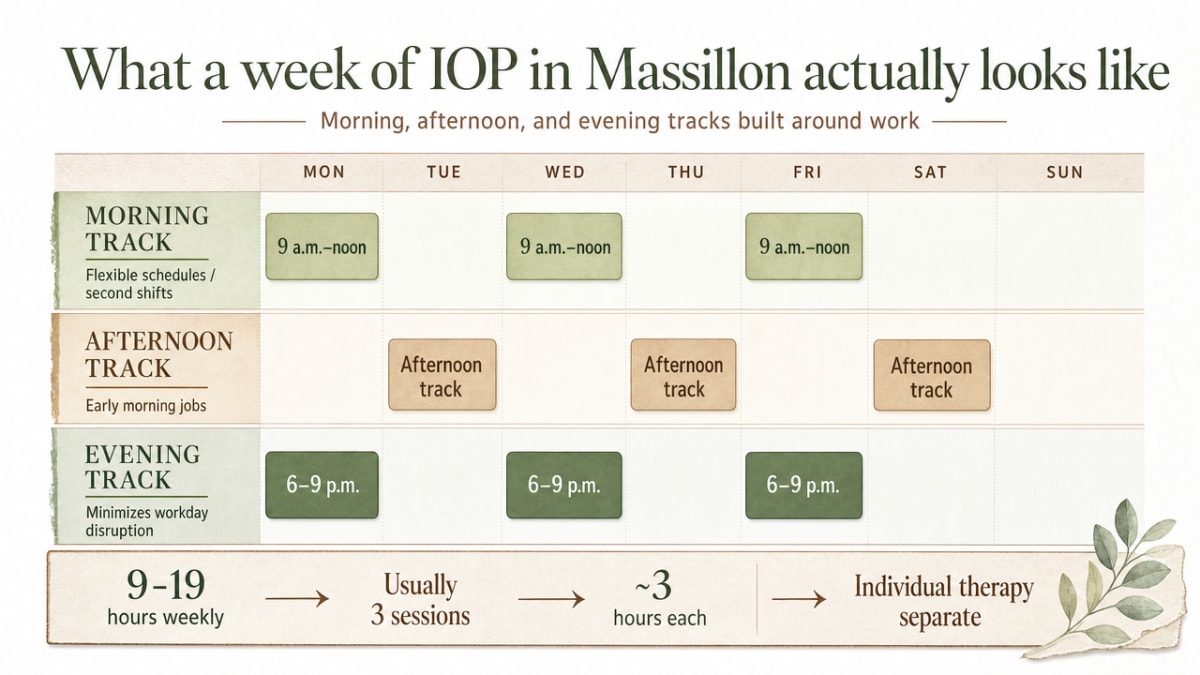
- A morning track (e.g., 9 a.m. to noon, three days a week) for those with flexible work schedules or second shifts;
- An afternoon track for individuals with early morning jobs;
- An evening track (often 6 to 9 p.m.) which is popular among working adults as it minimizes disruption to the workday.
Regardless of the track, you can expect nine to nineteen hours of structured care weekly, usually spread across three sessions of approximately three hours each, with individual therapy scheduled separately 5. SAMHSA’s clinical guidelines emphasize that IOP schedules should align with the patient’s readiness, work, and recovery environment, rather than solely clinic convenience 3. A program that offers limited scheduling flexibility might be a red flag.
Group, individual, and family sessions: what each one does
The various components of an IOP schedule serve distinct clinical purposes. Understanding these roles can help you engage more effectively.
Group therapy forms the core of IOP. You’ll spend a significant portion of your weekly hours in a group with six to twelve other adults facing similar challenges. These sessions are structured around skill-building, relapse prevention, and psychoeducation, facilitated by a clinician 3. Many find that the initial discomfort of group participation quickly gives way to the relief of shared experiences.
Individual therapy provides a one-on-one setting for addressing personal trauma, medication concerns, and sensitive aspects of your story that you may not be ready to share in a group. Evidence-based modalities such as cognitive behavioral therapy (CBT) and motivational interviewing (MI) are commonly used here 8.
Family sessions, when offered, involve your support system. They provide an opportunity for family members to understand the recovery process, ask questions, and learn how to best support you 5. You have control over who participates in these sessions.
Treating substance use and mental health in the same room
If you are dealing with both a substance use disorder and a mental health condition, you may have experienced the challenges of fragmented care. This often involves seeing different clinicians for each issue, leading to disjointed treatment plans and conflicting advice.
Integrated treatment addresses this by treating mental health and substance use disorders concurrently. SAMHSA’s guidance highlights that this approach leads to better outcomes, including reduced substance use and improved psychiatric symptoms and functioning, compared to treating them separately 6. This applies to a wide range of co-occurring DSM-5-TR mental and substance use diagnoses, meaning you don’t need a specific combination of diagnoses to benefit from dual-diagnosis IOP 7.
In practice, this means your treatment plan is developed by clinicians who consider both aspects of your health. A group session might focus on PTSD-informed coping skills that also address relapse triggers, while an individual session could discuss medication interactions with a clinician who understands both your mental health and substance use history. Therapies like EMDR for trauma, CBT for depression and anxiety, medication-assisted treatment for opioid or alcohol use disorder, and 12-step support can all be integrated into a comprehensive plan within a program designed for it 8.
The benefit of integrated care is that it centralizes your treatment, relieving you of the burden of coordinating multiple providers and conflicting advice.
What the research says about IOP outcomes
IOP can match residential care for many adults
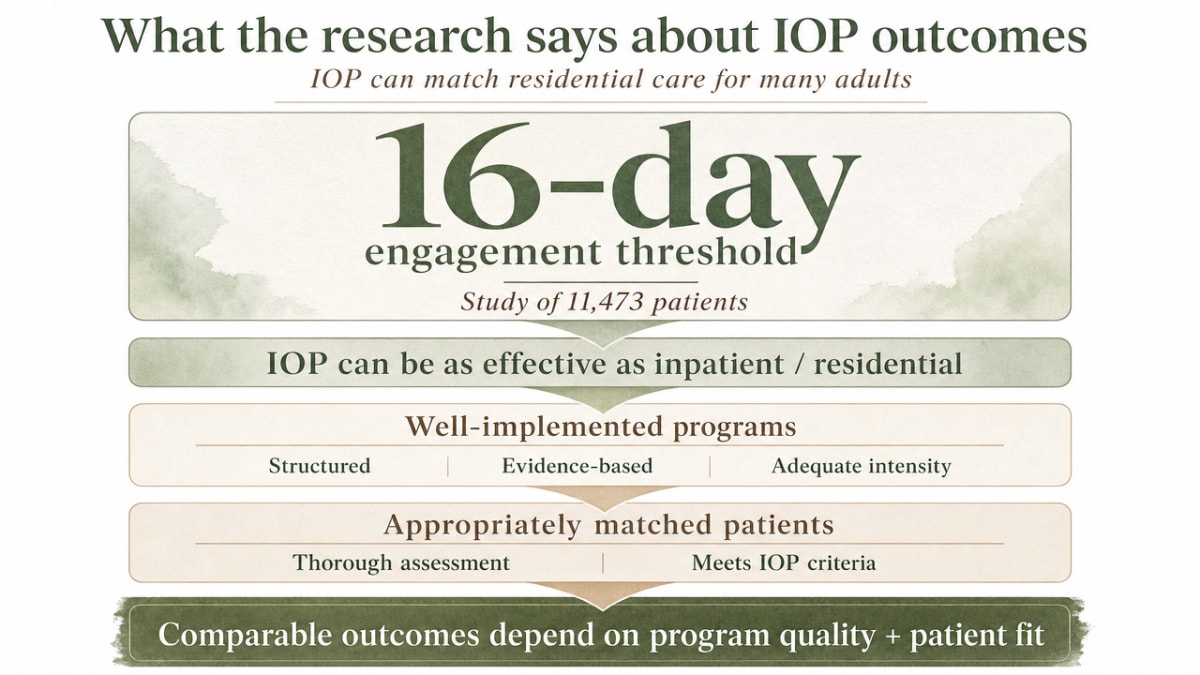
A significant finding in addiction research is that for many adults, intensive outpatient programs can yield results comparable to inpatient and residential treatment. A systematic review of substance abuse IOPs concluded that they can be as effective as inpatient treatment for most individuals, provided programs are well-implemented and patients are appropriately matched to this level of care 2.
It’s crucial to understand the nuances of this finding. “Well implemented” refers to structured, evidence-based therapies delivered with adequate intensity, not a diluted version of treatment. “Appropriately matched” means that the patient genuinely meets the criteria for IOP, underscoring the importance of a thorough assessment before enrollment.
The clinical guidance for these programs often follows a chronic-care model. SAMHSA’s Treatment Improvement Protocol on IOP describes it as part of a continuum, where relapse prevention, psychoeducation, family involvement, and the ability to step up or down in care are integral to the design 3. This means that maintaining your job and living at home while receiving effective treatment are not mutually exclusive when the program is structured correctly.
The 16-day finding: how long engagement actually matters
For those concerned about the duration of treatment, a specific research finding offers valuable insight. An analysis of 11,473 individuals receiving intensive outpatient behavioral health services examined the correlation between treatment days and the risk of subsequent psychiatric hospitalization. The study revealed that more days of IOP care reduced the risk of hospitalization, with a plateau observed after approximately 16 days of treatment 1.
It’s important to interpret this finding carefully. The study focused on psychiatric hospitalization risk within a large behavioral health population, not relapse rates, long-term sobriety, or quality of life. It highlights the dose of IOP that significantly reduces a specific negative outcome, but it does not imply that 16 days is sufficient treatment for everyone or that discontinuing treatment after this period is advisable.
This research can help reframe discussions about treatment duration. If you’ve viewed IOP as an open-ended commitment, this provides a concrete reference point. You can ask your clinician about the optimal duration of engagement for your specific situation. Most IOPs typically last six to twelve weeks, with sessions gradually tapering as you stabilize 3. The 16-day threshold is not a finish line but rather a critical early period where consistent engagement performs the most significant clinical work.
Paying for IOP: Medicaid and commercial insurance in Ohio
What Ohio Medicaid covers and what it asks for
For individuals with Ohio Medicaid, intensive outpatient treatment is a covered behavioral health service. The payment regulations are clearly outlined in state code and the Medicaid behavioral health manual, rather than being left to individual clinics 11, 12.
Two primary conditions must be met for a claim to be processed. First, every behavioral health claim submitted to the Ohio Department of Medicaid must include an ICD-10 diagnosis of a mental illness or substance use disorder 10. This diagnostic record, established during the intake assessment, is essential for reimbursement. Second, the service must be medically necessary, meaning a clinician must document your symptoms, history, and why this level of care is appropriate for your situation 10.
The hour thresholds specified in Rule 5160-27-09 also dictate Medicaid’s coverage. Treatment involving less than nine hours per week for adults is billed as Level 1 outpatient. Exceeding this amount places you in IOP or a higher level of care, each with its own service definitions and documentation requirements 11. The program you choose should be proficient in handling the provider qualifications, billing codes, and prior authorization rules detailed in the state’s behavioral health manual 12.
Commercial insurance, self-pay, and the questions to ask
If you have commercial insurance through your employer, IOP is typically a covered benefit, though specifics vary by plan. It’s advisable to ask a few key questions upfront:
- Is the program in-network with your plan?
- Is prior authorization required before sessions begin, and who is responsible for submitting it?
- What are your deductible, co-pay, or co-insurance amounts per session, and how many sessions are typically authorized at a time?
- What is the process if you need to transition to PHP or standard outpatient care during treatment?
If you lack insurance or if your plan doesn’t cover IOP, inquire about self-pay rates, sliding-scale options, and payment plans. You can also contact SAMHSA’s free, confidential helpline at 1-800-662-HELP for referrals to treatment options in your area, including IOPs that accommodate various financial situations 9. Making this call provides valuable information without any obligation.
Massillon context: who’s seeking help and why it matters
Massillon, a city of approximately 32,400 residents with a median household income of about $56,000 13, reflects a demographic where most adults rely on a steady paycheck. For many, taking a month off for residential treatment is not a realistic option. IOP is specifically designed to meet the needs of individuals in such circumstances.
The local health landscape further underscores this need. Massillon’s community health assessment revealed high self-reported rates of chronic diseases among residents, including arthritis (52.4%), heart disease (47.6%), and asthma (32.1%) 14. When managing chronic physical conditions, substance use and untreated mental health issues can complicate sleep, medication adherence, pain management, and overall energy levels.
If you are considering IOP in Massillon, you are not an anomaly. You are seeking treatment that accommodates your current life, income, and existing health conditions. A program that offers flexible weekday tracks and integrated care is responsive to these realities, rather than demanding you suspend them.
Taking the first step: what a first conversation sounds like
The assessment call, hour by hour
The initial phone call is often shorter than anticipated, typically lasting twenty to thirty minutes with an intake coordinator. You’ll be asked for your name, insurance information, a brief overview of your situation, and whether you are currently safe. This initial conversation is sufficient to schedule your next appointment. You don’t need to have a perfectly articulated story; a few honest sentences will suffice.
The comprehensive assessment usually follows, conducted either in person or via video, and lasts about an hour to ninety minutes. A licensed clinician will review your substance use history, mental health history, current medications, living situation, and typical weekly routine. This conversation is crucial for establishing the ICD-10 diagnosis and documenting medical necessity, which Ohio Medicaid requires for coverage 10. It also helps determine if IOP is the appropriate starting point or if a higher or lower level of care is more suitable 4. By the end of the assessment, you should have a recommended treatment track, a start date, and clear information regarding your insurance coverage.
What comes after IOP
IOP is a phase in the recovery journey, not the final destination. The most effective programs acknowledge this. Most individuals transition to standard outpatient counseling, which involves less than nine hours per week, focusing on maintenance, accountability, and addressing minor challenges before they escalate 11. This often includes participation in group support, such as 12-step programs or peer recovery communities. If you are on medication-assisted treatment for opioid or alcohol use disorder, this will continue according to its own clinical timeline.
SAMHSA’s chronic-care model accurately frames recovery as a process managed in phases, rather than a condition cured by a single treatment 3. If life becomes more challenging, you can step back up to a higher level of care. If things stabilize, you can step down further. When you’re ready to take the first step, Arrow Passage Recovery offers IOP and a full continuum of care in the Massillon area. Additionally, SAMHSA’s 24/7 helpline at 1-800-662-HELP is available as a neutral starting point for information and referrals 9.
Start Your Flexible Recovery Journey Today
Connect with a specialist now to discuss personalized outpatient support that fits your professional commitments.
Start Your Recovery Conversation in Massillon Today
Connect with a clinical expert about flexible outpatient options that fit your work and life commitments.
Frequently Asked Questions
How many hours per week does an IOP in Massillon typically require?
Most IOPs require nine to nineteen hours per week, usually structured as three sessions of approximately three hours each, plus a separate individual therapy hour 5. Ohio Medicaid defines anything less than nine hours per week for adults as Level 1 standard outpatient 11. Programs offer morning, afternoon, or evening tracks to accommodate work schedules.
Can I keep working while attending an intensive outpatient program?
Yes, IOPs are specifically designed to allow participants to maintain employment. SAMHSA’s clinical guidance emphasizes aligning IOP structure with the patient’s work, family, and recovery environment 3. Evening tracks, often scheduled from 6 to 9 p.m. three days a week, are a common option for working adults. You may also explore FMLA protections with your employer for flexibility during the assessment and initial weeks of treatment.
How is IOP different from standard outpatient counseling or residential treatment?
The primary distinctions lie in intensity and living arrangements. Standard outpatient care in Ohio involves less than nine hours of treatment per week for adults, typically consisting of weekly therapy 11. IOP provides nine to nineteen hours weekly, incorporating group, individual, and family therapy. Partial hospitalization (PHP) is more intensive, around twenty hours, while residential treatment involves living on-site with 24/7 care 4. These levels of care are part of a continuum, allowing for transitions as your needs evolve.
Does Ohio Medicaid cover intensive outpatient treatment?
Yes, IOP is a covered behavioral health service under Ohio Medicaid, with specific rules detailed in the state’s behavioral health manual 12. Coverage requires an ICD-10 diagnosis of a mental illness or substance use disorder and documentation of medical necessity 10. The intake assessment process establishes these records, and a reputable program will manage the billing paperwork on your behalf.
Can IOP treat both substance use and a mental health condition like anxiety or PTSD?
Yes, integrated treatment for co-occurring disorders is the recommended approach. SAMHSA’s guidance indicates that addressing mental health and substance use concurrently leads to better outcomes, including reduced substance use and improved psychiatric symptoms, compared to treating them separately 6. Any combination of co-occurring DSM-5-TR mental health and substance use diagnoses qualifies for dual-diagnosis IOP 7. Treatment plans can incorporate various therapies like CBT, EMDR, and medication support.
How long do most people stay in IOP?
Most IOPs typically last six to twelve weeks, with the duration adjusted based on your progress and stabilization 3. A study of 11,473 IOP patients found that consistent engagement for approximately 16 days significantly reduced the risk of psychiatric hospitalization, highlighting the importance of early, consistent participation 1. This 16-day period is a critical benchmark for foundational clinical work, though overall treatment length varies by individual need.
References
- Intensive Outpatient Treatment (IOP) of Behavioral Health (BH) Services Protects Against Psychiatric Hospitalization. https://pubmed.ncbi.nlm.nih.gov/32043237/
- Substance Abuse Intensive Outpatient Programs: Assessing the Evidence. https://pmc.ncbi.nlm.nih.gov/articles/PMC4152944/
- Substance Abuse: Clinical Issues in Intensive Outpatient Treatment (Treatment Improvement Protocol). https://www.ncbi.nlm.nih.gov/books/NBK64093/
- Chapter 3. Intensive Outpatient Treatment and the Continuum of Care. https://www.ncbi.nlm.nih.gov/books/NBK64088/
- TIP 47: Substance Abuse: Clinical Issues in Intensive Outpatient Treatment. https://www.samhsa.gov/resource/ebp/tip-47-substance-abuse-clinical-issues-intensive-outpatient-treatment
- Managing Life with Co-Occurring Disorders. https://www.samhsa.gov/mental-health/serious-mental-illness/co-occurring-disorders
- Co-Occurring Disorders and Other Health Conditions. https://www.samhsa.gov/substance-use/treatment/co-occurring-disorders
- Evidence-Based Practices Resource Center. https://www.samhsa.gov/libraries/evidence-based-practices-resource-center
- National Helpline for Mental Health, Drug, Alcohol Issues. https://www.samhsa.gov/find-help/helplines/national-helpline
- Rule 5160-27-02 | Covered Community Behavioral Health Services. https://codes.ohio.gov/ohio-administrative-code/rule-5160-27-02
- Rule 5160-27-09 | Substance Use Disorder Treatment Services. https://codes.ohio.gov/ohio-administrative-code/rule-5160-27-09
- MEDICAID BEHAVIORAL HEALTH STATE PLAN SERVICES PROVIDER REQUIREMENTS AND REIMBURSEMENT MANUAL (v1.25). https://medicaid.ohio.gov/static/BH/provider/Manuals/BH+Manual+v+1_25.pdf
- Massillon city, Ohio – U.S. Census Bureau QuickFacts. https://www.census.gov/quickfacts/fact/table/massilloncityohio/PST045224
- Massillon City Community Health Assessment Results. https://massillonohio.gov/health-department/massillon-city-community-health-assessment-results/
- MEDICAID BEHAVIORAL HEALTH STATE PLAN SERVICES PROVIDER REQUIREMENTS AND REIMBURSEMENT MANUAL. https://medicaid.ohio.gov/static/BH/provider/Manuals/Posted+Manuals/BH-Manual-12192022.pdf