
Key Takeaways
- Alcohol shaking signals that a nervous system adapted to heavy drinking is rebounding once alcohol drops, and tremor is often the first marker of withdrawal 11.
- The 6 to 72 hour window carries the highest risk for seizures and delirium tremens, so the timing of your last drink matters as much as how the shaking feels right now 7.
- A prior withdrawal seizure, past DT, daily heavy use, or coexisting medical conditions takes home detox off the table and points toward medically supervised care 2.
- Self-scoring tools like CIWA-Ar rely heavily on subjective symptoms and are unreliable alone, so calling a clinician or 911 beats trying to grade severity yourself 5.
What Your Shaking Hands Are Telling You
If your hands shook this morning when you reached for the coffee mug, or you watched someone you love tremble at the kitchen table, you already know something is off. Reading this is the right move. You’re not weak, and you’re not overreacting by checking.
Alcohol shaking is your nervous system reacting to a sudden drop in alcohol. After months or years of heavy drinking, your brain adapts. When the alcohol level falls, that adaptation rebounds and shows up as trembling, anxiety, sweating, and a racing pulse 6. The medical word is withdrawal, and tremor is usually the first sign 11.
Here’s the part most articles bury: shaking can be mild and pass on its own, or it can be the opening signal before something far more serious, including a seizure or delirium tremens 9. The difference often comes down to your drinking history, your other symptoms right now, and how the next two to three days unfold.
This guide will help you figure out where you fall, what to watch for, and when waiting becomes the wrong call.
The Withdrawal Timeline: Where You Are Right Now Matters
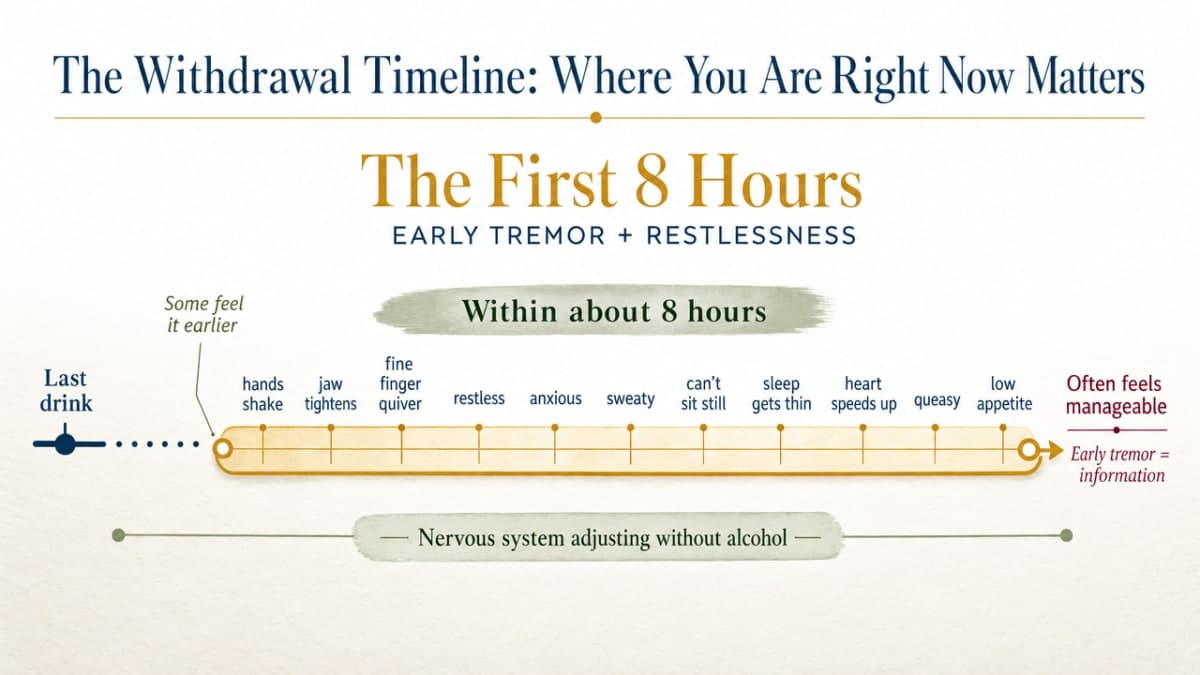
The First 8 Hours: Early Tremor and Restlessness
The first thing your body usually does is tremble. Within about 8 hours of your last drink, you might notice your hands shake when you hold a glass, your jaw tighten, or a fine quiver run through your fingers when you stretch them out 3. Some people feel it earlier, especially if they drank heavily for years.
Along with the shaking, you may feel restless, anxious without a clear reason, a little sweaty, or unable to sit still. Sleep gets thin. Your heart can speed up. Some people feel queasy or lose their appetite 6.
At this stage, things often still feel manageable. You might tell yourself it’s just nerves or a rough morning. But what you’re feeling is your nervous system, which got used to alcohol, suddenly running without it. That early tremor is information. It tells you a withdrawal process has started, and the next 24 to 72 hours will decide how rough it gets.
6 to 48 Hours: The Seizure Window
Somewhere between 6 and 48 hours after your last drink, the risk of a withdrawal seizure climbs 7. This is the window most people don’t know about, and it’s the one that catches families off guard.
A withdrawal seizure usually looks like a sudden loss of consciousness with full-body convulsions. It can happen with no warning. It can happen in someone who has never had a seizure before. And it can happen even when the shaking earlier in the day felt mild 10.
If you’ve had a seizure during a past quit attempt, your risk this time around is higher, not lower. The nervous system seems to remember, and each episode can prime the next one to come on faster and harder 2.
24 to 72 Hours: Peak Symptoms
Day two and day three are usually the hardest. Withdrawal symptoms tend to peak between 24 and 72 hours after your last drink 3. The shaking can get worse instead of better. Sweating drenches your sheets. Your heart races even when you’re lying still. Anxiety can tip into panic. Some people start seeing or hearing things that aren’t there 1.
This is also when blood pressure and pulse can climb in ways that put real strain on your heart, especially if you have any underlying health issues 10. What looked like a hangover on day one can look like a medical crisis by day two.
If you’re reading this on the morning of day two and your symptoms are getting stronger rather than fading, that’s the pattern clinicians watch for. It’s a signal that your body is not stabilizing on its own. Medication, fluids, and monitoring during this window can keep symptoms from climbing into territory that becomes much harder to walk back from.
48 to 72 Hours: When Delirium Tremens Can Begin
Delirium tremens, or DT, usually starts 48 to 72 hours after the last drink 7. It sits at the most severe end of the withdrawal spectrum, and without prompt treatment, it can be fatal 9.
DT is not just bad shaking. It’s a sudden, dangerous shift. The person becomes deeply confused and doesn’t know where they are or who is in the room. They may see things that aren’t there, often vividly. Their heart races, their blood pressure spikes, their body temperature can climb, and the trembling becomes hard to control. Among people hospitalized for alcohol withdrawal, roughly 3 to 5 percent develop DT 2.
Three to five out of every hundred sounds small until you realize who those people are: usually the ones with a long, heavy drinking history, prior withdrawal episodes, or other medical problems on top of the alcohol use. If that describes you or the person you’re watching, the odds are not background noise.
If you’re on day three and the shaking is getting worse, if confusion is creeping in, if the person you love is suddenly not making sense, this is the window where waiting stops being an option. Call 911 or get to an emergency department.
Green, Yellow, Red: A Triage Framework for Shaking
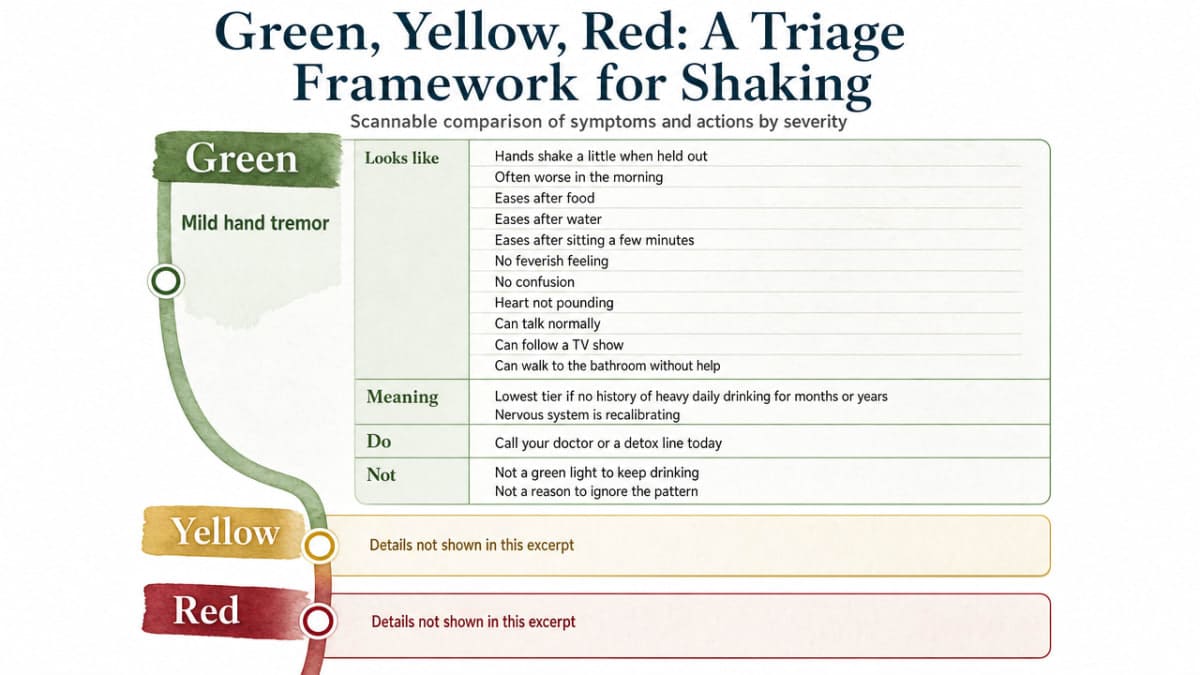
Green: Mild Hand Tremor With No Other Symptoms
Green looks like this: your hands shake a little when you hold them out, especially in the morning. The tremor eases when you eat something, drink water, or sit down for a few minutes. You don’t feel feverish. You’re not confused. Your heart isn’t pounding. You can hold a conversation, follow a TV show, walk to the bathroom without help.
If that’s where you are, and you don’t have a history of heavy daily drinking for months or years, mild hand tremor on its own is usually the lowest tier of withdrawal 6. It doesn’t mean nothing is happening. It means your nervous system is recalibrating, and right now it’s doing so without the louder warning signs.
Green is not a green light to keep drinking or to ignore the pattern. It’s a signal to call your doctor or a detox line today and tell them what’s happening, before symptoms have a chance to climb.
Yellow: Whole-Body Shaking, Sweats, Racing Pulse, Vomiting
Yellow is when the shaking stops being just your hands. Your shoulders shudder. Your legs feel weak and jittery. You’re sweating through your shirt even though the room is cool. Your pulse is fast and you can feel it in your neck. You can’t keep water down, or you’ve vomited more than once. Anxiety has tipped into something closer to dread.
This is moderate withdrawal, and it’s not something to ride out alone 1. The combination of whole-body tremor, drenching sweats, a racing heart, and vomiting tells you the nervous system is in a louder state of alarm. Dehydration alone can push your symptoms harder. A pulse that won’t slow can strain your heart, especially if you have any history of blood pressure or cardiac problems 10.
Yellow is the call-now tier. Phone your doctor, an urgent care, or a 24/7 detox line. Describe what you’re feeling and how long it’s been since your last drink. If you can’t reach anyone within an hour, or symptoms are getting worse while you wait, treat it as red and go to the emergency department. Yellow has a way of turning red overnight.
Red: Shaking Plus Confusion, Hallucinations, Fever, or Seizure
Red is the line. If shaking is happening alongside any of these signs, call 911 or get to an emergency room now: a seizure, fever, severe confusion, hallucinations, or an irregular heartbeat 3. MedlinePlus is explicit on this point, and it’s the single most actionable piece of guidance in this article.
What does red actually look like at home? The person you’re with suddenly can’t tell you what day it is or where they are. They’re swatting at something on the wall that isn’t there, or talking to a person who isn’t in the room. Their skin is hot to the touch. Their chest feels tight or their heartbeat skips and stumbles. They had a convulsion, even a brief one, and woke up confused. Any of these, with shaking, is an emergency.
This is also where the fear of overreacting tends to keep people at home one hour too long. Don’t. Emergency medicine teams treat alcohol withdrawal every day, and they would rather see you when you’re scared than when you’re seizing 11. You will not be the first person they’ve helped through this, and you will not be the worst case they’ve seen this week.
If you’re the family member reading this and the person in front of you fits the red description, stop scrolling. Make the call. The triage decision you’re trying to figure out has already been made by what their body is showing you.
Why You Can’t Score Yourself Out of This
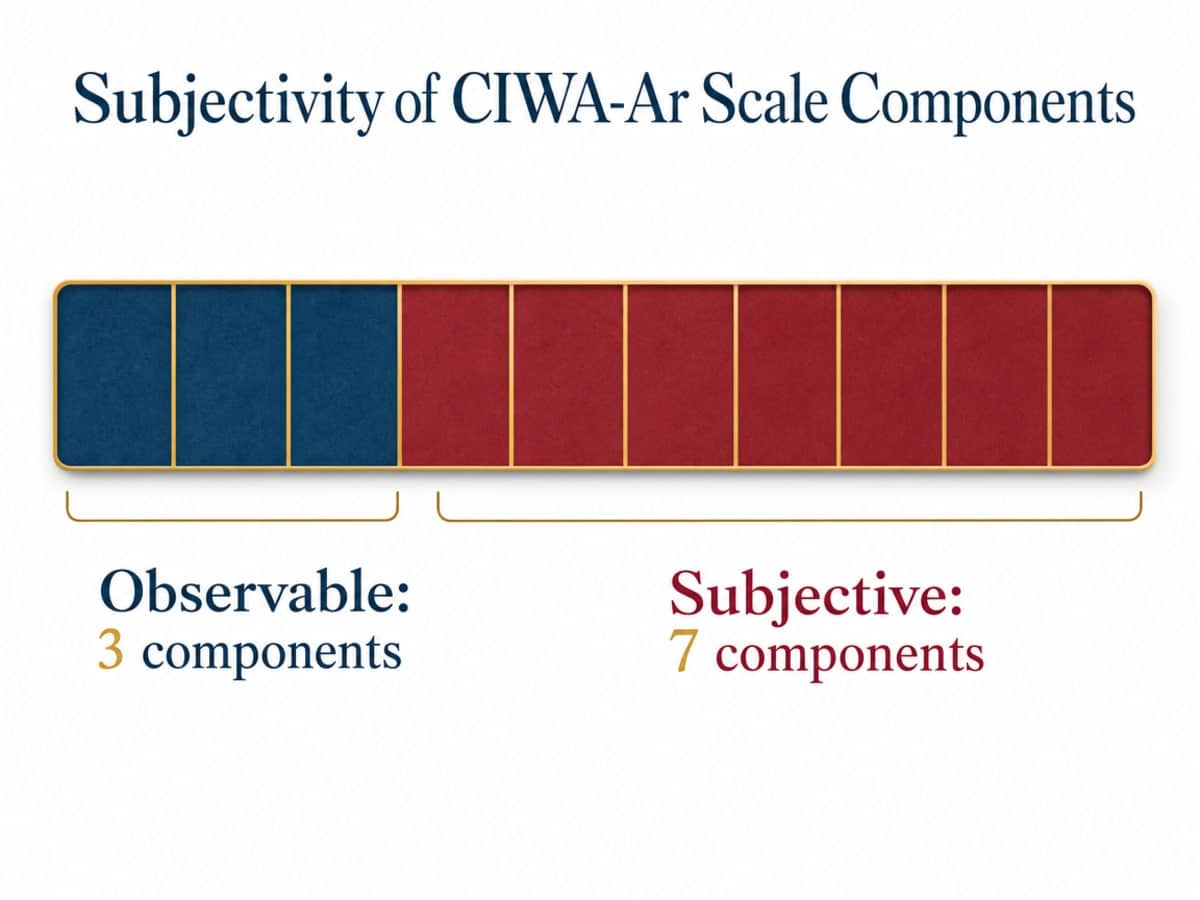
When people start searching online during withdrawal, they often land on the CIWA-Ar scale. It’s a ten-item assessment clinicians use to grade severity, and it has clear cutoffs: a score under 8 to 10 is mild, 8 to 15 is moderate, and 15 or higher signals severe withdrawal with a real risk of impending delirium tremens 4. It looks like a tidy answer to the question you’re asking right now: how bad is this?
Here’s the catch. Out of those ten items, only three can be judged by simple observation: tremor, sweats, and agitation. The other seven depend on how the patient describes what’s happening inside their head and body — nausea, anxiety, headache, tactile sensations like crawling skin, auditory and visual disturbances, and orientation 5. That’s 3 observable components against 7 subjective ones, and the subjective side is exactly the part that’s hardest to rate accurately when you’re frightened, exhausted, or already a little confused.
Researchers who studied this tool in real clinical settings concluded it can be unreliable even in trained hands, partly because patients underreport symptoms when they want to go home, and overreport when they’re panicked 5. Now picture yourself trying to score it at 3 a.m. on your kitchen floor.
This isn’t a reason to feel worse about not knowing where you stand. It’s a reason to stop trying to grade yourself and pick up the phone instead. A clinician can ask the questions, watch you while you answer, take your vitals, and weigh the numbers against your drinking history and what came before — context you can’t see on your own. Your job right now isn’t to land on the right score. It’s to get the right set of eyes on you.
The Prior-Withdrawal Trap: Why Past Episodes Change the Math
If you’ve been through withdrawal before, this one is not starting from zero. That’s the part most people get wrong when they try to gauge today’s shaking against today’s symptoms alone. Your nervous system carries a memory of the last episode, and that memory makes the next one more likely to turn dangerous, not less.
The clearest predictors of severe withdrawal in adults are prior complicated withdrawal, very heavy and sustained drinking, and signs that your body is already running hot — fast pulse, high blood pressure, sweating at rest 2. Of those, a past withdrawal seizure or a past episode of delirium tremens carries the most weight. It changes the math because it tells clinicians your brain has already crossed the line into the most dangerous form of this once. The threshold to cross it again is lower.
This is the trap: today’s shaking might feel milder than the last time. You might tell yourself you’ve handled worse, so you can handle this. But mild Monday symptoms in someone with a prior seizure history can become a Tuesday-night emergency without an obvious step in between 1. The progression doesn’t always announce itself.
If you’ve ever had a withdrawal seizure, ever been hospitalized for DT, or ever been told by a doctor that your withdrawal was severe, home detox is off the table this time. Call a detox program or your physician today and tell them your history. That single piece of information changes what they recommend, and it should change what you do next.
Who Should Not Try to Detox at Home
Home detox is a real option for some people. It is not the right option if any of the following describes you or the person you’re trying to help.
- If you’ve ever had a withdrawal seizure, even one, the ground rules change. The same is true if you’ve ever been diagnosed with delirium tremens or hospitalized for severe withdrawal in the past. Both are among the strongest predictors that this episode could turn severe again 2.
- If you’ve been drinking heavily every day for months or years, not just on hard weekends, your nervous system has built deeper adaptations and the rebound is louder when alcohol drops out 6. If your resting pulse is fast, your blood pressure runs high, or you’re sweating without exertion before you even start trying to quit, your body is already showing signs of autonomic strain that can climb quickly 1.
- If you have other medical conditions in the mix — heart disease, uncontrolled diabetes, liver problems, a recent infection, a head injury — withdrawal stacks on top of them in ways that are hard to predict at home 10.
- And if you don’t have a sober, attentive adult who can stay with you for the full 72 hours and call for help the moment something shifts, you don’t have a safe setup.
If any one of these is true, the right move is a phone call to a detox program or your physician today. Not tomorrow. The cost of being wrong about home detox is too high to absorb on your own.
What Happens in a Supervised Detox
If you’ve never been to a supervised detox before, the word can sound clinical and cold. What actually happens is closer to being watched over carefully by people who have done this hundreds of times and aren’t surprised by anything your body is doing.
When you arrive, someone takes your vitals — pulse, blood pressure, temperature, oxygen — and asks about your drinking history, your last drink, your past quit attempts, and any other health conditions. They look for the same risk factors you’ve been reading about: prior withdrawal seizures, a history of DT, heavy daily use, autonomic strain 2. That history shapes how closely you’re monitored and what medications they offer.
From there, you’re checked frequently, often every few hours during the first 24 to 48, sometimes more. Nurses watch tremor, sweats, and agitation directly, and they ask you the subjective questions that a self-score can’t capture honestly when you’re alone at 3 a.m. 5. If symptoms climb, medication is adjusted in real time to keep your nervous system from running off the rails. Fluids, thiamine, and other supportive care are standard for people at higher risk 8.
The point isn’t to make withdrawal pleasant — it isn’t, fully. The point is that the dangerous parts get caught early, and you sleep in a place where someone is looking at the monitor while you do.
Calling 911 Is Not Overreacting
The fear of looking dramatic keeps people sitting on the couch for hours longer than they should. You picture the ambulance pulling up, the neighbors looking out, the paramedics shrugging because the shaking didn’t seem that bad once they got there. So you wait. You drink some water. You tell yourself you’ll give it another hour.
That hour is where withdrawal does its worst work. The seizure that comes without warning, the confusion that wasn’t there at 9 p.m. and is there at 11 — those shifts don’t ask permission 1. By the time the picture is obviously bad enough to call, the window for the safest care has narrowed.
Emergency departments treat alcohol withdrawal as a recognized medical condition, not a moral failure 11. The nurse triaging you has seen tremor, sweats, and racing pulses many times this month. You are not wasting their time. You are doing exactly what the system is built for.
A Next Step That Doesn’t Require Certainty
You don’t have to know exactly how bad this is to make the next call. That’s the trap a lot of people get stuck in — waiting until they’re sure before they pick up the phone. Certainty isn’t the price of getting help.
If you’re somewhere in the green or yellow zone, call a detox program or your doctor today and describe what’s happening. If you’re in red, or you can’t tell, call 911. A clinician can sort moderate from severe withdrawal in minutes 1. You don’t have to sort it alone at 3 a.m.
Reading this far counts. It means you’re already taking your symptoms seriously. The next step is one phone call away — to your physician, a local detox line, or a program like Arrow Passage Recovery that handles medically supervised detox around the clock.
Get Expert Help Now for Alcohol Shakes
Speak with a specialist right away to ensure safe support for alcohol withdrawal symptoms.
Talk to Someone About Alcohol Withdrawal Now
Get answers and guidance for managing alcohol-related shaking or withdrawal safely and confidently.
Frequently Asked Questions
Why did my hands start shaking before I even stopped drinking?
Withdrawal isn’t triggered by hitting zero alcohol. It’s triggered by a relative drop in your blood alcohol level, even when some is still in your system 11. If you usually drink steadily through the day and you went longer than usual between drinks, your nervous system felt the dip and started reacting. Shaking before you’ve officially stopped is a real signal that your body is dependent, not a fluke.
Can I detox at home if I only drink heavily on weekends?
Maybe, but the pattern matters less than the symptoms and history. If you’ve never had a withdrawal seizure, no DT history, no significant medical conditions, and your shaking stays mild with no other red flags, a doctor may green-light supervised home detox 1. The honest answer is you can’t know that without a clinician’s input. Call your physician, describe your drinking pattern and symptoms, and let them decide.
How long will the shaking last once it starts?
For most people with mild to moderate withdrawal, tremor eases over three to five days as symptoms peak and then taper 3. Some people feel low-grade shakiness, sleep trouble, and anxiety for a week or two longer. If your shaking is getting stronger past day three instead of fading, that’s not a normal taper. It’s a reason to be seen by a clinician rather than wait it out.
Will I be judged or reported if I go to the ER for alcohol withdrawal?
No. Alcohol withdrawal is treated as a medical condition in the emergency department, and your care isn’t a police matter 11. Staff aren’t there to lecture you or call anyone on you. They’re there to keep your heart, brain, and body stable through a dangerous window. Whatever you’re worried they’ll think, they’ve seen it many times this month. Walking in is the part that matters.
Can drinking again make the shaking stop, and is that a bad idea?
Yes, another drink will usually quiet the tremor for a while. That’s the trap. It confirms dependence, restarts the clock, and sets up a harder withdrawal the next time alcohol drops 6. It also delays the medical help that could make this attempt the last one. If shaking has already started and you’re afraid to push through, that’s not a reason to drink. It’s a reason to call a detox program today.
What should a family member do while waiting for help to arrive?
Stay with them. Keep the room calm and dimly lit. Offer small sips of water if they’re alert and not vomiting. Don’t try to feed them if they’re confused. Note the time of their last drink, any past withdrawal seizures, and what medications they take — paramedics will ask. If they have a seizure, protect their head, turn them on their side, and call 911 immediately 3.
References
- Alcohol Withdrawal Syndrome – StatPearls – NCBI Bookshelf. https://www.ncbi.nlm.nih.gov/books/NBK441882/
- Will this adult patient develop severe alcohol withdrawal syndrome?. https://pmc.ncbi.nlm.nih.gov/articles/PMC6905615/
- Alcohol withdrawal: MedlinePlus Medical Encyclopedia. https://medlineplus.gov/ency/article/000764.htm
- Clinical Institute Withdrawal Assessment for Alcohol (CIWA-Ar) Instruction Sheet. https://www.ci2i.research.va.gov/paws/pdfs/ciwa-ar.pdf
- Clinical Institute Withdrawal Assessment for Alcohol–Revised might be an unreliable tool in the management of alcohol withdrawal. https://pmc.ncbi.nlm.nih.gov/articles/PMC5597013/
- Alcohol Withdrawal. https://www.health.harvard.edu/diseases-and-conditions/alcohol-withdrawal-a-to-z
- Alcohol withdrawal syndrome: mechanisms, manifestations, and management. https://pmc.ncbi.nlm.nih.gov/articles/PMC6084325/
- Alcohol Withdrawal in Hospitalized Patients. https://www.ncbi.nlm.nih.gov/books/NBK604324/
- Delirium Tremens: Assessment and Management. https://pmc.ncbi.nlm.nih.gov/articles/PMC6286444/
- Complications of Alcohol Withdrawal: Pathophysiological Insights. https://pmc.ncbi.nlm.nih.gov/articles/PMC6761825/
- Management of Alcohol Withdrawal in the Emergency Department. https://pmc.ncbi.nlm.nih.gov/articles/PMC7093658/
- Alcohol Withdrawal Prevention & Treatment. https://med.uth.edu/surgery/alcoholwithdrawl/