
Addiction and the Brain: Why Willpower Isn’t Enough
Key Takeaways
- Repeated substance use physically alters the brain’s reward, stress, memory, and self-control circuits, which is why willpower alone consistently loses to biology under pressure 1.
- Trauma sensitizes the same circuits addiction targets, so a trauma history changes the starting line — nearly half of people with lifetime PTSD also develop a substance use disorder 2.
- Integrated care that treats trauma and substance use simultaneously outperforms sequential or single-disorder approaches, with EMDR, TF-CBT, PE, CPT, MAT, and mindfulness matched to what each person carries 2, 23.
- Trauma therapy alone reduces PTSD symptoms but does not automatically change substance use, which is why both arms of the work — trauma processing and direct substance-use treatment — are needed 25.
If you’ve tried to stop and couldn’t, your brain isn’t broken on purpose
You probably already know the script. You promise yourself this time will be different. You mean it. For a while, you hold the line — a day, a week, maybe longer. Then something cracks. A bad night. A familiar smell. A look on someone’s face that sends you somewhere you didn’t want to go. And you’re back where you started, wondering what is wrong with you.
Here is what the research keeps showing: nothing is wrong with you in the way you think. Repeated substance use physically changes the brain circuits that handle reward, stress, and self-control, and those changes erode the very ability to “say no” that everyone keeps telling you to use 1. The Surgeon General’s report on addiction puts it plainly — substance use disorders are medical conditions with measurable neurobiological roots, and outcomes with real treatment look a lot like outcomes for other chronic illnesses 15.
If you carry a trauma history on top of that, your starting line was already different. The same circuits addiction targets were already sensitized by what happened to you. That is not weakness. That is biology doing exactly what biology does under that much load. The rest of this article walks through what is happening inside, and what actually helps.
What addiction actually does inside the brain
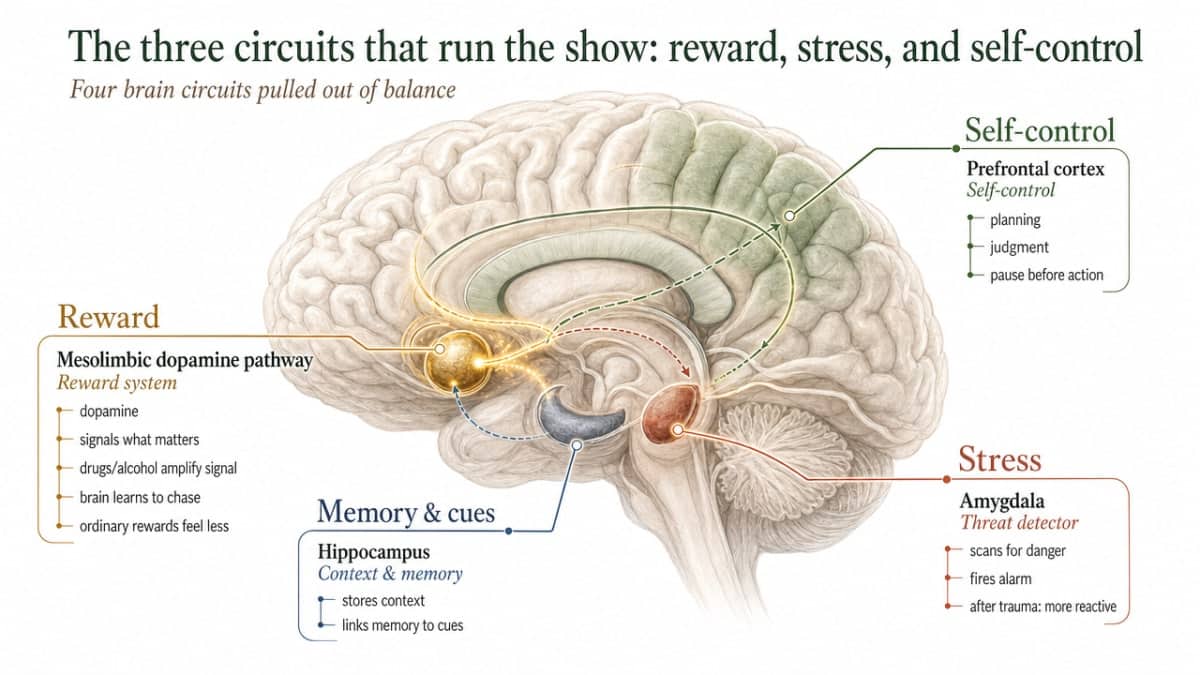
The three circuits that run the show: reward, stress, and self-control
Your brain runs most of its big decisions through a small handful of circuits. When substance use takes hold, four of them get pulled out of balance. Knowing their names changes how the whole thing feels, because once you can see what is happening, it stops feeling like a personal defect.
- The mesolimbic dopamine pathway
- is your reward system. It releases dopamine when something matters — food, connection, a goal met. Drugs and alcohol flood this pathway with a signal much stronger than anything in ordinary life, and the brain learns, fast, that this is the thing worth chasing 1. Over time, regular rewards stop feeling like much. That is not your imagination; it is the system recalibrating around a louder signal.
- The amygdala
- is your threat detector. It scans for danger and fires the alarm. After trauma, it tends to fire more often and more loudly, reading ordinary moments as unsafe 3. Substances quiet that alarm for a while, which is part of why they feel like relief.
- The hippocampus
- handles memory and context. It tags places, people, and smells. With repeated use, it links cues to craving — a street, a song, an anniversary — so the urge can show up before you have a thought 1.
- The prefrontal cortex
- is your self-control center. It weighs consequences, pauses impulses, and says “not now.” Brain imaging shows physical changes in the regions handling judgment and behavior control in people with addiction 1. When this circuit is worn down, the part of you that knows better is still there — it just has a quieter microphone than the part that wants relief.
How repeated use rewires decision-making
The first time you used, the choice was mostly yours. That is honest, and it is also not the whole story. With repeated use, the brain stops treating the substance like an option and starts treating it like a necessity, on the same shelf as breathing and eating. NIDA describes this shift plainly: the initial decision is typically voluntary, but continued use seriously impairs the ability to exert self-control, and that impairment is the hallmark of addiction 1.
Three changes drive the rewiring:
- First, the reward system dulls. Dopamine receptors downshift, so the high you used to get takes more to reach, and everything else — a meal, a laugh, a quiet morning — feels flatter.
- Second, the stress system winds tighter. The same circuits that handle withdrawal also handle daily stress, so ordinary pressure now lands harder and points straight at the substance 5.
- Third, the prefrontal cortex loses ground. Decision-making, judgment, and impulse control all live there, and chronic exposure measurably erodes its function 16.
What this looks like from the inside: you can know, with total clarity, that using will make tomorrow worse, and still find yourself reaching for it. That is not a moral failure showing up in real time. It is a wired-in pattern where the loudest circuit overrides the slowest one. The fix is not louder willpower. It is care that helps those circuits settle, repair, and learn something new.
Why trauma changes the starting line
Trauma sensitizes the same circuits addiction targets
Here is the part that often gets missed in the standard addiction explainer: trauma and addiction share real estate in your brain. They go after the same circuits, in overlapping ways, which is why a trauma history changes what “trying to quit” actually involves.
Brain imaging in people with PTSD shows measurable alterations in a circuit linking the medial prefrontal cortex, hippocampus, and amygdala — the same regions tied to dysregulated fear, hyperarousal, and trouble regulating emotion 3. Translation: after trauma, your threat detector tends to fire faster, your memory system tags more cues as dangerous, and the part of your brain that should slow everything down has a harder time doing it. That is the baseline you walk into the day with.
Now add substances. Reviews of brain reward circuitry find that trauma- and stressor-related disorders and substance use disorders share overlapping disruptions in the mesolimbic dopamine system and connected regions 21. The reward pathway that drugs and alcohol hijack is the same pathway trauma has already pulled out of balance. Chronic stress compounds it: stress and drug exposure cross-sensitize common neurobiological pathways, including the HPA axis and dopamine circuits, which raises vulnerability to addiction and relapse 5.
So when you tried to white-knuckle it and couldn’t, you were not failing at something easy. You were asking a pre-sensitized brain to outmuscle a system specifically wired to override that kind of effort. That is a different problem than “not wanting it enough,” and it needs a different kind of help.
Self-medication: a logical move with a high biological cost
If substances helped at some point, that part wasn’t an illusion. SAMHSA’s clinical guidance is direct about it: self-medication through substance use is one of the methods traumatized people use to try to regain emotional control, even though it ultimately causes further emotional dysregulation 6. A drink that quiets the alarm. A pill that softens the edge. A line that finally lets you sleep. For a window of time, it worked.
The cost shows up later, and it shows up in the same systems trauma already strained. NIDA notes that traumatic experiences are associated with substance use and with developing substance use disorders, because severe or chronic stress can alter brain circuits tied to reward, motivation, and impulse control 20. Each round of relief teaches the brain that this is the way to handle overwhelm. Other coping strategies fall out of practice. The threshold for using drops. The threshold for tolerating distress drops with it.
This is not a character flaw on a timeline. It is a survival strategy that worked, then stopped working, and then became its own problem. Naming it that way matters, because shame keeps people stuck and accurate framing does not. You were trying to regulate something real with the tool you had. The work now is replacing that tool with ones that don’t cost you the same way.
How often trauma and substance use travel together
If you have wondered whether your situation is rare, it isn’t. The overlap between trauma-related conditions and substance use is one of the most consistent findings in the field.
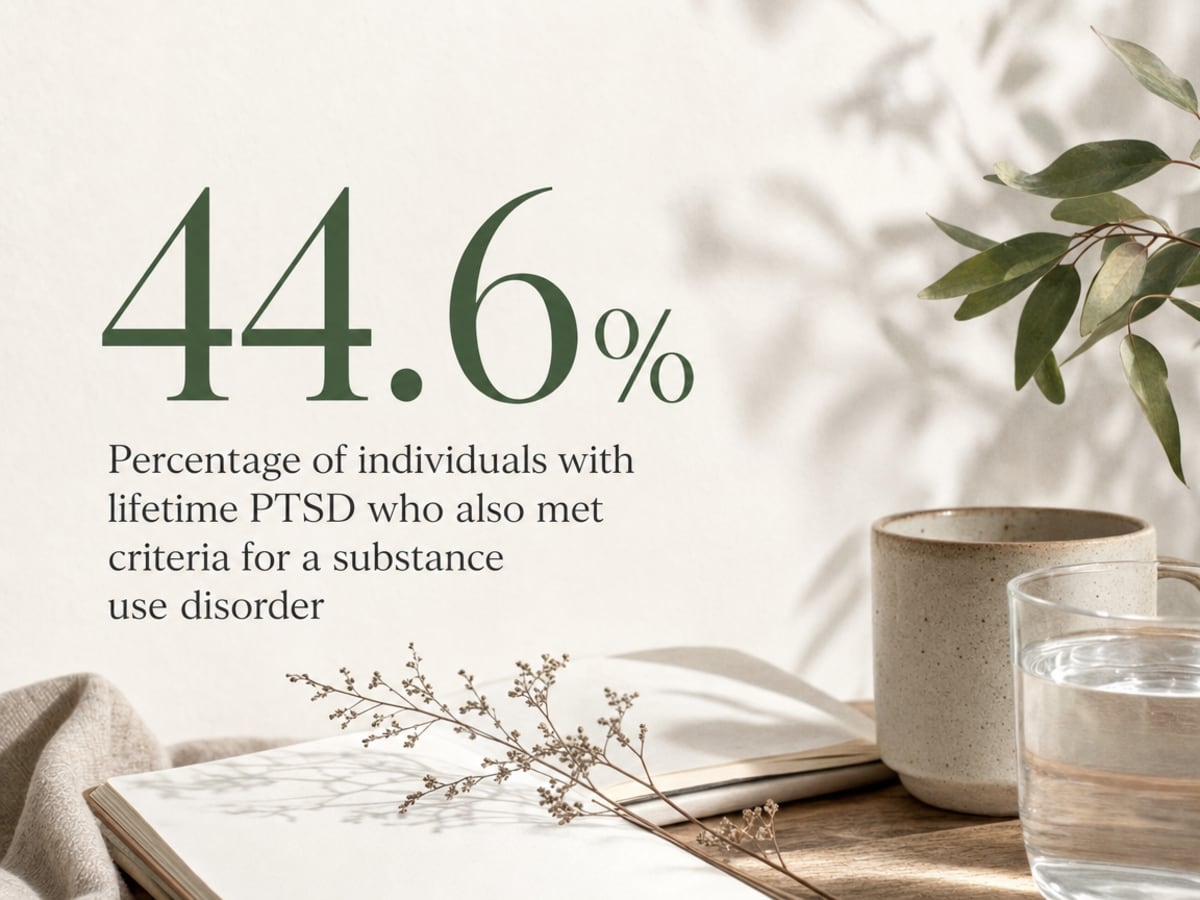
In a national epidemiologic study, 44.6% of individuals with lifetime PTSD also met criteria for an alcohol use disorder or another substance use disorder — meaning that across a person’s lifetime, nearly half of those who develop PTSD also develop a substance use problem at some point 2. That figure comes from population-level data and reflects lifetime co-occurrence, not point-in-time prevalence, so it captures the full arc of how often these two patterns travel together.
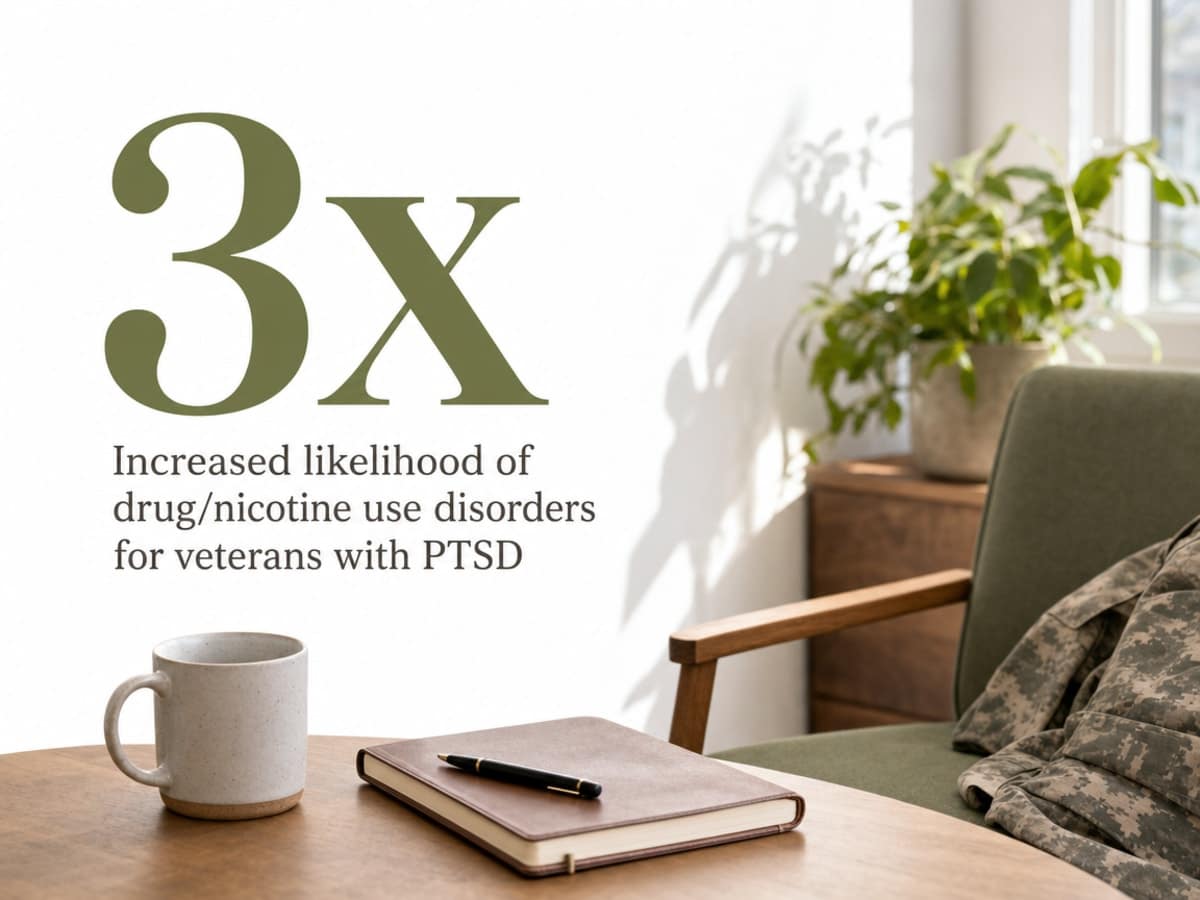
The broader dual-diagnosis picture is large too. SAMHSA’s 2024 National Survey on Drug Use and Health estimates that roughly 21.2 million U.S. adults have a co-occurring mental illness and substance use disorder 24. PTSD is one slice of that population; depression and anxiety make up much of the rest. In specific high-trauma groups, the rates climb further — veterans with PTSD are about three times more likely than peers without PTSD to have a co-occurring drug or nicotine use disorder 2.
None of these numbers are about you personally. They are about pattern. If trauma and substance use have shown up together in your life, you are sitting inside a well-documented clinical reality, and there is a body of treatment research built specifically around it. That is the more useful frame than “why can’t I just stop.”
Why willpower fails under stress, even when you mean it
Willpower is real, and it does real work. The problem is where it lives. Self-control runs through the prefrontal cortex, which is the slowest, most energy-hungry part of the brain and the first to go offline when stress spikes 18. That is not a flaw in you. That is how the system is built. Under load, the brain shifts resources toward immediate survival circuits and away from the deliberate, weigh-the-consequences circuit you are counting on to keep you from using.
Now layer in what chronic stress does over time. Reviews of prefrontal cortex function show that prolonged stress measurably impairs decision-making, cognitive flexibility, and impulse control — the exact tools you need to override a craving 18. If you have lived with a trauma history, you have been running that system hot for years. The hardware that says “not tonight” has been working a double shift since before the substance ever entered the picture.
So when you white-knuckled a hard week and lost it on Friday night, here is what was actually happening: your stress system was firing, your reward system was answering, and your self-control system was the smallest voice in the room. Willpower didn’t disappear. It got outvoted by biology. The work going forward isn’t squeezing harder on the weakest circuit. It is lowering the volume on the loud ones — through trauma processing, stress regulation, medication when appropriate, and skills practiced when your brain is calm enough to learn them.
The choice debate, briefly
You may have run into the argument that gets stuck on a loop online: is addiction a brain disease or a choice? Some researchers argue the disease framing reduces stigma and opens the door to medical care 12. Others push back, saying addiction looks more like maladaptive learning shaped by life context than a discrete disease 13. Both sides agree the brain changes are real.
You don’t need to resolve that debate to get help. What matters for you is this: the circuits are altered, the choices are harder than they look from the outside, and effective treatment exists either way. The path forward doesn’t wait on the philosophy.
What integrated treatment actually looks like
Treating trauma and substance use at the same time, not in sequence
For a long time, the standard advice was: get clean first, then deal with the trauma. The logic sounded reasonable on paper. In practice, it set people up to fail. If your substance use is partly how your nervous system survives the trauma, taking it away without addressing the underlying load leaves you exposed — and the relapse rate reflects that.
The current evidence points the other direction. NIDA’s guidance on co-occurring disorders is direct: when someone has both a mental health condition and a substance use disorder, it is usually better to treat them at the same time rather than separately, because doing so makes all the treatments more effective 23. The VA’s clinical review of co-occurring PTSD and SUD reaches the same conclusion from a different angle. Pooled analyses from the 2023 Project Harmony meta-analyses found that integrated, trauma-focused interventions — combinations like prolonged exposure or cognitive processing therapy plus substance-use treatment — have the greatest benefit relative to treatment as usual and to non-trauma-focused or single-disorder approaches 2.
What “integrated” actually means is less mysterious than it sounds. The same clinical team, or closely coordinated teams, screens for both trauma and substance use, builds one treatment plan that holds them together, and adjusts pacing so trauma work happens when you have enough stability to do it 7. You are not bounced between a therapist who won’t touch the substance use and a counselor who won’t touch the trauma. The two threads get worked at the same time, by people who talk to each other.
What each therapy actually does: EMDR, TF-CBT, PE, CPT, MAT, mindfulness
Treatment language gets thrown around in ways that can feel like alphabet soup. Here is what each of the main tools actually does, and which brain system it is built to help.
- EMDR (Eye Movement Desensitization and Reprocessing)
- targets distressing memories and the physical arousal that goes with them. You hold a piece of the memory in mind while doing a bilateral task — eye movements, taps, or tones — and the memory gradually loses its grip. EMDR is a guideline-supported PTSD treatment, and emerging research suggests it may also help substance use disorders by reducing the distress tied to craving cues 9.
- Trauma-focused CBT (TF-CBT)
- is a structured course that combines psychoeducation, emotion regulation skills, and gradual exposure to the trauma narrative. Multiple randomized trials show it produces robust reductions in PTSD symptoms and related emotional and behavioral problems 10. Prolonged exposure (PE) and cognitive processing therapy (CPT) are the two trauma-focused therapies most often paired with substance-use treatment in integrated programs; both are recommended in current VA/DoD guidance 2.
- Medication-assisted treatment (MAT)
- addresses the neurobiology directly. Opioid dependence produces lasting adaptations in the brain’s reward and stress circuits, which is why withdrawal alone rarely holds — the circuits keep pulling 4. Medications like buprenorphine, methadone, or naltrexone stabilize those circuits so the rest of the work becomes possible. This is not swapping one addiction for another. It is giving a rewired brain something to stand on.
- Mindfulness-based interventions
- train you to notice cravings, emotions, and stress responses without immediately acting on them. A review of 209 trials found moderate-to-large reductions in anxiety and depression and performance comparable to CBT, with effects holding at follow-up 8. In trauma-informed addiction care, mindfulness is often the skill that bridges the gap between a craving showing up and a choice about what to do with it.
The honest limit: trauma therapy alone may not change use
Here is something most treatment marketing won’t tell you. Trauma therapy is powerful for trauma symptoms — and that does not automatically translate into changed substance use.
The NIDA Clinical Trials Network’s CTN-0015 study compared trauma-focused therapies for women with co-occurring PTSD and SUD in community settings. The results showed large, clinically significant reductions in PTSD symptoms, but substance use outcomes did not differ significantly between groups, and there was no significant overall change in substance use from baseline at follow-up 25. PTSD got better. The using did not necessarily follow.
That finding is not a reason to skip trauma work. It is the reason integrated care exists. Treating the trauma reduces the fuel; treating the substance use directly — with medication, behavioral therapy, and structured support — is what changes the behavior. You need both arms of the work, which is the case for dual-diagnosis programs rather than against them.
What good care should feel like from the inside
If you have been through treatment before and it felt like a fight, that memory is doing real work right now — it is probably one of the reasons you have not gone back. So it is worth saying clearly what trauma-informed care is supposed to feel like, because the experience itself is part of the treatment.
The framework is built on a few principles: safety, trustworthiness, choice, collaboration, and empowerment, applied with cultural humility 11. In practice, that means you are asked what you need, not told. You are given options for pacing, including when and how to approach trauma material. The clinician explains what each step is for, why it might bring up what it brings up, and what to do if it does. You are treated as a partner in the plan, not a case to be managed.
Screening should ask about both trauma and substance use from the start, and the answers should shape the actual treatment plan rather than sit in a chart 7. If a setting makes you feel small, rushed, or judged for either side of what you are carrying, that is information. Good care should feel demanding but not unsafe — hard work you are doing with someone, not something being done to you.
Where this leaves you
If you take one thing from all of this, let it be the reframe. Your past attempts to stop on willpower alone weren’t a referendum on your character. They were a fair test that ran into unfair odds — a self-control circuit worn thin by trauma, going up against reward and stress systems that had been pulled in the same direction for years 1. Knowing that doesn’t erase the work ahead. It changes what the work is.
The path that fits what your brain is actually doing has a shape: integrated care that addresses trauma and substance use together, with the specific tools — EMDR, TF-CBT, PE or CPT, medication when it helps, mindfulness to bridge the gaps — matched to what you carry 2. That is what dual-diagnosis programs like Arrow Passage Recovery are built around. You don’t have to arrive already strong. You have to arrive.
Ready to Start Healing Beyond Willpower?
Connect with a caring specialist who understands addiction’s impact on your mind and life.
Take the First Step Beyond Willpower Today
Connect with compassionate professionals who understand the neuroscience behind addiction and real recovery strategies.
Frequently Asked Questions
If I can’t stop using on my own, does that mean I’m weak or lack willpower?
No. Continued substance use physically changes the brain regions that handle judgment, decision-making, and behavior control, so the very tool you are trying to use to stop has been worn down by the thing you are trying to stop 1. The Surgeon General’s report frames this clearly: addiction is a medical condition, not a character verdict 15.
Why does trauma make addiction harder to overcome?
Trauma already sensitizes the same circuits — prefrontal cortex, amygdala, hippocampus, and the dopamine reward pathway — that substances then hijack 3, 21. Chronic stress and drug use also cross-sensitize the HPA stress axis, so stressful moments and cravings start firing as one signal 5. You are not failing harder; you are working against more.
Should I treat my trauma first, then my substance use — or both at the same time?
Both at the same time. NIDA’s guidance is that co-occurring conditions usually do better when treated together rather than in sequence, because each treatment makes the other more effective 23. VA clinical reviews of PTSD–SUD find integrated, trauma-focused care outperforms treatment-as-usual and single-disorder approaches 2. Sequential treatment leaves the underlying load untouched.
Is medication-assisted treatment (MAT) just trading one addiction for another?
No. Opioid dependence produces lasting changes in reward and stress circuits that persist long after acute withdrawal and keep pulling you back toward use 4. MAT medications stabilize those circuits so therapy and daily life become workable. You are not getting high; you are giving a rewired brain something steady to stand on while it heals.
What’s the difference between EMDR, TF-CBT, PE, and CPT — and how do I know which one fits?
EMDR uses bilateral stimulation to reduce the distress tied to specific memories 9. TF-CBT combines skills training with gradual exposure to the trauma narrative 10. Prolonged exposure (PE) works directly with avoided memories and situations; cognitive processing therapy (CPT) targets stuck beliefs about the trauma — both are recommended in current VA guidance 2. A clinician matches the approach to your history and pacing.
Can the brain actually heal after years of trauma and substance use?
Yes. The same neuroplasticity that allowed these circuits to change under trauma and substances allows them to change again under different conditions. Outcomes for evidence-based addiction treatment are comparable to outcomes for other chronic illnesses when care is continuous 15, and trauma-focused therapies produce robust, durable reductions in PTSD symptoms 10. Healing is slow and real.
References
- Drug Misuse and Addiction | National Institute on Drug Abuse (NIDA). https://nida.nih.gov/publications/drugs-brains-behavior-science-addiction/drug-misuse-addiction
- Treatment of Co-Occurring PTSD and Substance Use Disorder in VA. https://www.ptsd.va.gov/professional/treat/cooccurring/tx_sud_va.asp
- Traumatic stress: effects on the brain. https://pmc.ncbi.nlm.nih.gov/articles/PMC3181836/
- The Neurobiology of Opioid Dependence: Implications for Treatment. https://pmc.ncbi.nlm.nih.gov/articles/PMC2851054/
- Chronic Stress, Drug Use, and Vulnerability to Addiction. https://pmc.ncbi.nlm.nih.gov/articles/PMC2732004/
- Understanding the Impact of Trauma. https://www.ncbi.nlm.nih.gov/books/NBK207191/
- Screening and Assessment – Trauma-Informed Care in Behavioral Health Services. https://www.ncbi.nlm.nih.gov/books/NBK207188/
- Mindfulness-Based Interventions for Anxiety and Depression. https://pmc.ncbi.nlm.nih.gov/articles/PMC5679245/
- Eye Movement Desensitization and Reprocessing (EMDR) Therapy. https://pmc.ncbi.nlm.nih.gov/articles/PMC7839656/
- Trauma-Focused Cognitive Behavioral Therapy. https://pmc.ncbi.nlm.nih.gov/articles/PMC4396183/
- Trauma-Informed Care and Cultural Humility in the Mental Health and Addiction Treatment System. https://pmc.ncbi.nlm.nih.gov/articles/PMC7011220/
- Free Will and the Brain Disease Model of Addiction. https://pmc.ncbi.nlm.nih.gov/articles/PMC5672554/
- Addiction and the Brain: Development, Not Disease. https://pmc.ncbi.nlm.nih.gov/articles/PMC5486526/
- Adolescent Substance Use Disorders. https://pmc.ncbi.nlm.nih.gov/articles/PMC11003516/
- Facing Addiction in America: The Surgeon General’s Report on Alcohol, Drugs, and Health. https://www.hhs.gov/sites/default/files/facing-addiction-in-america-surgeon-generals-report.pdf
- Drug Abuse and Addiction (LA County Public Health / NIDA reprint). http://ph.lacounty.gov/sapc/resources/nidasciofaddiction.0207.pdf
- Principles of Adolescent Substance Use Disorder Treatment: A Research-Based Guide. https://integratedcare.dc.gov/wp-content/uploads/2021/07/principles-adolescent-substance-use-disorder-treatment-research-based-guide.pdf
- Effects of chronic stress on cognitive function – From neurobiology to behavior. https://pmc.ncbi.nlm.nih.gov/articles/PMC11407068/
- Psychological therapies for women who experience intimate partner violence. https://pmc.ncbi.nlm.nih.gov/articles/PMC7390063/
- Trauma and Stress | National Institute on Drug Abuse (NIDA). https://nida.nih.gov/research-topics/trauma-and-stress
- Brain reward circuitry: The overlapping neurobiology of trauma and substance use disorders. https://pmc.ncbi.nlm.nih.gov/articles/PMC8209534/
- Co-occurring trauma- and stressor-related and substance-related and addictive disorders in youth. https://pmc.ncbi.nlm.nih.gov/articles/PMC11600332/
- Co-Occurring Disorders and Health Conditions | NIDA. https://nida.nih.gov/research-topics/co-occurring-disorders-health-conditions
- Co-Occurring Disorders and Other Health Conditions | SAMHSA. https://www.samhsa.gov/substance-use/treatment/co-occurring-disorders
- Women’s Treatment for Trauma and Substance Use Disorders (NIDA CTN-0015). https://adai.uw.edu/research_project/nida-ctn-0015-womens-treatment-for-trauma-and-substance-use-disorders/