
Alcohol Induced Seizures: Causes and Risks
Key Takeaways
- Alcohol-induced seizures are sudden misfires that happen when a brain adapted to daily heavy drinking loses the depressant it learned to balance against, usually 6 to 48 hours after the last drink 3.
- The mechanism is a GABA-glutamate seesaw: alcohol suppressed the calming side for so long that removing it leaves the brain overexcited, with no brakes and a stuck accelerator 7.
- Risk concentrates in daily heavy drinkers and anyone with a prior withdrawal seizure or delirium tremens, where more than half go on to seize again during the same episode without treatment 6.
- Supervised detox uses early benzodiazepines, symptom-triggered dosing, and monitoring to hold the seesaw steady through the 48-hour window — interventions a home setup cannot replicate 8, 12.
The 6 a.m. after the last drink
You wake up before the alarm. Your hands won’t stay still on the sheet. Your heart is going faster than it should for someone lying down. The room feels too bright, and your stomach is empty, and there’s a low hum of dread that has nothing to do with anything that happened yesterday. It’s been maybe ten hours since your last drink. Maybe fourteen.
If you’ve been here before, you know this hour. If you’re reading this for someone you love, this is the hour you’re afraid of.
This is the window where alcohol-induced seizures actually happen. Not while someone is drunk. Not days later. Right here, in the gap between the last drink and whatever comes next, when a brain that has spent months or years adapting to alcohol suddenly has to run without it. Acute withdrawal seizures most often emerge between 6 and 48 hours after the last drink 3.
You’re not weak for being scared of this hour. You’re paying attention. The shakes, the racing pulse, the nausea that won’t quit — those are signals from a nervous system that needs help, not a character test you’re failing.
The next pages explain what’s happening inside your head, who is most at risk, and what supervised care actually does in these specific hours. Plain language. No lectures. Just what you came here to find out.
Three different seizures people call “alcohol seizures”
A seizure while still drinking
This one is less common than people assume. A seizure that happens while a person is actively intoxicated usually isn’t caused by the alcohol in their blood at that moment. It’s caused by something underneath: a preexisting seizure disorder, a head injury, low blood sugar, an electrolyte crash, a missed anticonvulsant, or another drug in the mix. Alcohol can lower the threshold and make a seizure more likely in someone already vulnerable, but the drink itself isn’t usually the spark 4.
If you’ve had a seizure while drinking, that matters. It doesn’t mean you’re not also at risk for a withdrawal seizure later — you almost certainly are if you drink heavily. It means a clinician needs to look at the whole picture, not just the bottle.
A withdrawal seizure (the one this article is about)
This is the one that shows up in the 6 a.m. hour. You’ve been drinking heavily, daily, for a while. You stop, or you cut back sharply, and somewhere between six and forty-eight hours later your brain misfires. Most withdrawal seizures are generalized tonic-clonic: the body stiffens, then jerks, then goes still. They usually last a minute or two. They often come in ones or twos, sometimes more, and they can show up before any of the other dramatic withdrawal signs people associate with movies 1, 3.
Here’s the part that matters most: a withdrawal seizure isn’t just a scary moment that passes. It’s a signal that the rest of withdrawal is going to be harder, and that the next few hours need someone watching. People who have one withdrawal seizure are at real risk for another — and for delirium tremens after that 1.
Long-term heavy drinking that becomes epilepsy
The third pattern is slower and quieter, and people miss it. Years of heavy drinking can change the brain in ways that outlast any single withdrawal episode. Some people who start with alcohol-related seizures go on to develop a seizure disorder that keeps happening even after they stop drinking. Researchers have found that heavier alcohol use, along with certain clinical and imaging features, predicts both seizure recurrence and the later development of epilepsy 5.
This doesn’t mean one withdrawal seizure dooms you to a lifelong condition. It means the longer and heavier the drinking goes on, the more the brain’s wiring shifts in directions that are harder to reverse. It’s another reason the response to a first seizure isn’t “wait and see.” It’s an evaluation, a supervised detox, and a follow-up plan that takes the next year seriously, not just the next 48 hours.
Why the brain seizes when you stop: the seesaw explanation
Picture a seesaw inside your head. On one side sits the calming chemistry — a system called GABA that slows things down, quiets noise, and lets you sleep. On the other side sits the activating chemistry — a system called glutamate that wakes you up, fires neurons, keeps signals moving. In a brain that isn’t drinking, those two sides balance.
Alcohol is a depressant. Every drink pushes down on the GABA side of the seesaw, dampening the brain. If you do that once at a party, your brain shrugs it off. If you do it every day for months or years, the brain doesn’t shrug. It adapts. It quietly turns down its own GABA response and turns up glutamate to compensate, trying to keep the seesaw level even with all that alcohol pressing on one side 7, 10.
So now imagine the alcohol leaves. The thing that was pressing down on the GABA side is suddenly gone. But the brain hasn’t reset yet — GABA is still turned down, glutamate is still cranked up. The seesaw doesn’t return to neutral. It snaps the other way. The brain is now wildly overexcited, with no brakes and a stuck accelerator 7.
That’s a seizure. Not a mystery. Not a punishment. A predictable physical event from a nervous system that learned to live with a depressant and now has to relearn how to run without one.
If you’ve ever wondered why your hands shake in the morning until the first drink, or why your heart races, or why your skin feels electric — that’s the same seesaw, just at lower volume. The shakes and the seizure live on the same spectrum. One is the brain whispering. The other is the brain shouting.
Knowing this isn’t just biology trivia. It tells you something practical: a medication that gently presses on the GABA side again, in a controlled way, can hold the seesaw steady while the brain resets. That’s exactly what supervised detox does, and we’ll get to it.
The window: when withdrawal seizures actually happen
Here’s the part that helps you locate yourself: withdrawal symptoms move on a clock. Not a perfect clock, but a clock predictable enough that clinicians plan around it.
The first signs usually start within six to twelve hours of your last drink. Shaky hands. Sweating. A racing pulse. Nausea you can’t talk yourself out of. Maybe a headache that feels different from any hangover you’ve had before. Sleep is light and weird, or it doesn’t come at all. If you’ve been a heavy daily drinker, this is often the morning you used to take the first drink just to feel normal.
The seizure window opens next. Acute withdrawal seizures typically emerge between 6 and 48 hours after the last drink, and the cluster sits right in the middle of that range — roughly 12 to 24 hours in for most people, though it can come earlier or later 3, 2. This is the highest-risk stretch for the kind of generalized seizure described earlier: sudden, brief, sometimes the first dramatic sign anything is wrong.
After the 48-hour mark, the seizure risk doesn’t vanish, but it drops. What can rise instead, in the 48-to-72-hour range and sometimes a little later, is delirium tremens — severe confusion, hallucinations, dangerous swings in heart rate and blood pressure. People who have had a withdrawal seizure are at meaningful risk of going on to develop delirium tremens, which is part of why a single seizure changes what the next two days should look like 1.
So if you’re inside the first 48 hours from your last drink and the symptoms are real, you are in the window. Not might be. Are. That’s not a reason to panic — it’s a reason to stop trying to handle this alone. Help right now does more than help tomorrow. For people with moderate to severe withdrawal symptoms at the time they’re assessed, the standard guidance is inpatient-level care with frequent reassessment, exactly because of how this clock behaves 9.
If you’re past 72 hours and still standing, the worst of the seizure window is usually behind you. That doesn’t mean you’re done — sleep, mood, and cravings can stay rough for weeks — but the most acute danger has eased. Getting through it once doesn’t make the next attempt safer, though. That’s the next thing worth understanding.

How common is this, really
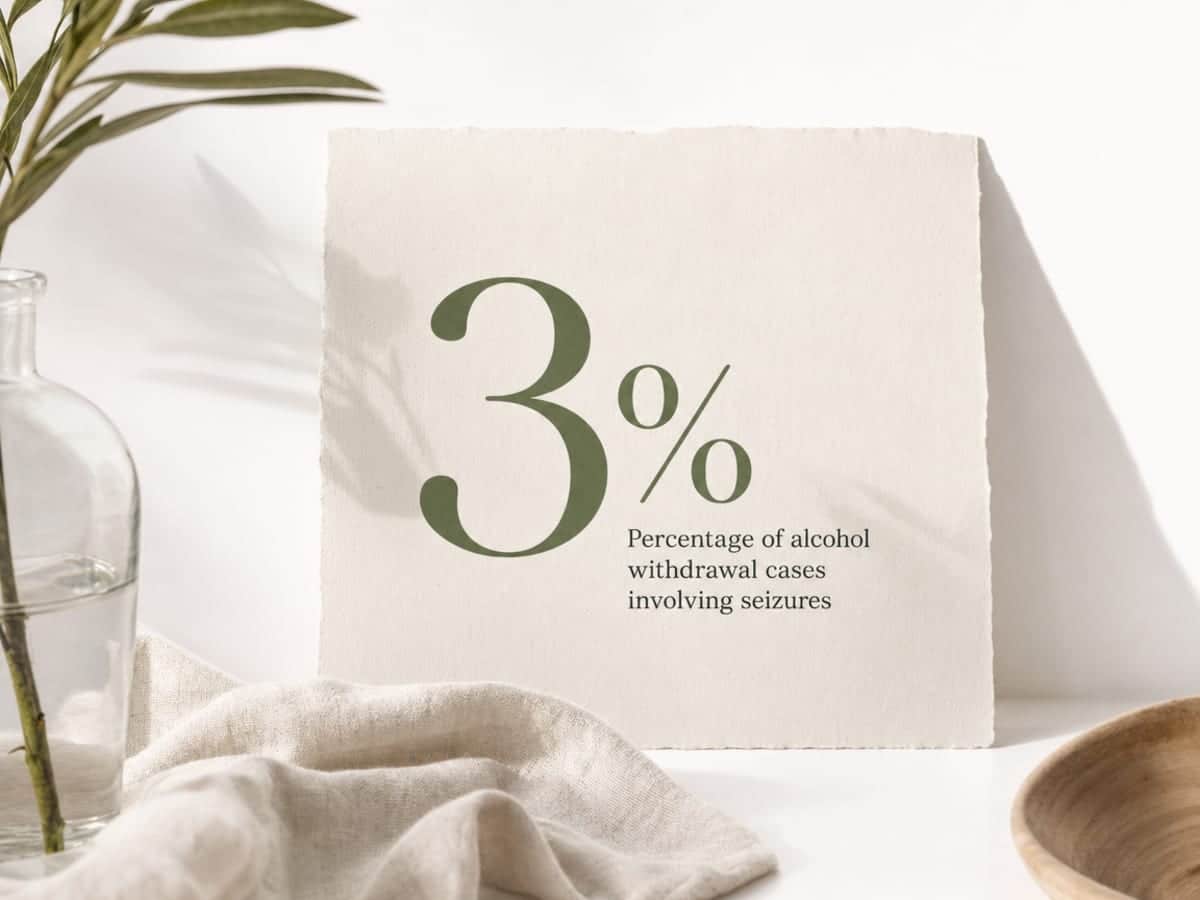
You probably want a number. Here’s the honest one: across all cases of alcohol withdrawal, seizures show up in about 3% 2. That sounds small, and on a page it looks small. It isn’t, and here’s why.
That 3% is an average pulled across everyone in withdrawal — the person who drank too much on vacation and feels rough for a day, the person who drinks a six-pack on weekends, the person who has been drinking a fifth a day for ten years. All of them are in the denominator. The seizures concentrate at one end of that range, hard. If you’re a daily heavy drinker who has been at it for months or years, your personal risk is not 3%. It’s meaningfully higher, and it climbs further if you’ve had a withdrawal seizure before or have had delirium tremens before 6.
So the average is real, but it isn’t yours. Think of it the way you’d think about any risk that depends on who you are. The 3% tells you withdrawal seizures aren’t rare oddities — they’re a known, documented complication that hospitals see often enough to plan for. What it doesn’t tell you is whether you’re standing in the safer part of the room or the riskier part. The next section helps you figure that out.
Your risk profile: a checklist you can actually use
Read these as honestly as you can. You don’t have to say any of it out loud. You don’t have to tell anyone yet. Just count.
- You’ve had a withdrawal seizure before. Even one. Even years ago. Even one you weren’t sure was a seizure but other people described as a seizure. This is the single strongest predictor that another one could come 6.
- You’ve had delirium tremens before — the severe confusion, hallucinations, fevers, racing heart that show up in the days after stopping. A past episode of DTs raises the odds your next withdrawal goes the same way 6.
- You drink heavily every day, or close to it. Not a weekend pattern. A daily one. The morning drink to steady your hands counts. So does the maintenance drinking that keeps the shakes from starting at work.
- You’ve been drinking heavily for months or years, not weeks. The longer the brain has been adapting, the bigger the rebound when alcohol leaves 5.
- You’ve tried to quit on your own before and it went badly — bad shakes, hallucinations, a trip to the ER, a seizure, or a relapse that felt safer than continuing to detox.
- You have other medical conditions in the mix: liver disease, poor nutrition, an infection you’ve been ignoring, a head injury, low electrolytes, or a seizure disorder. These somatic comorbidities make withdrawal harder and seizures more likely 6.
If you checked one of these, your risk isn’t average — it’s elevated. If you checked two or more, you are squarely in the population that current hospital guidance says belongs in supervised detox, not at home with a thermos of water and good intentions 9. That’s not a verdict on you. It’s a clinical category with a known response.
What happens after the first seizure
Here’s the part most articles soften, and you deserve the straight version: a first withdrawal seizure changes your odds for the next one.
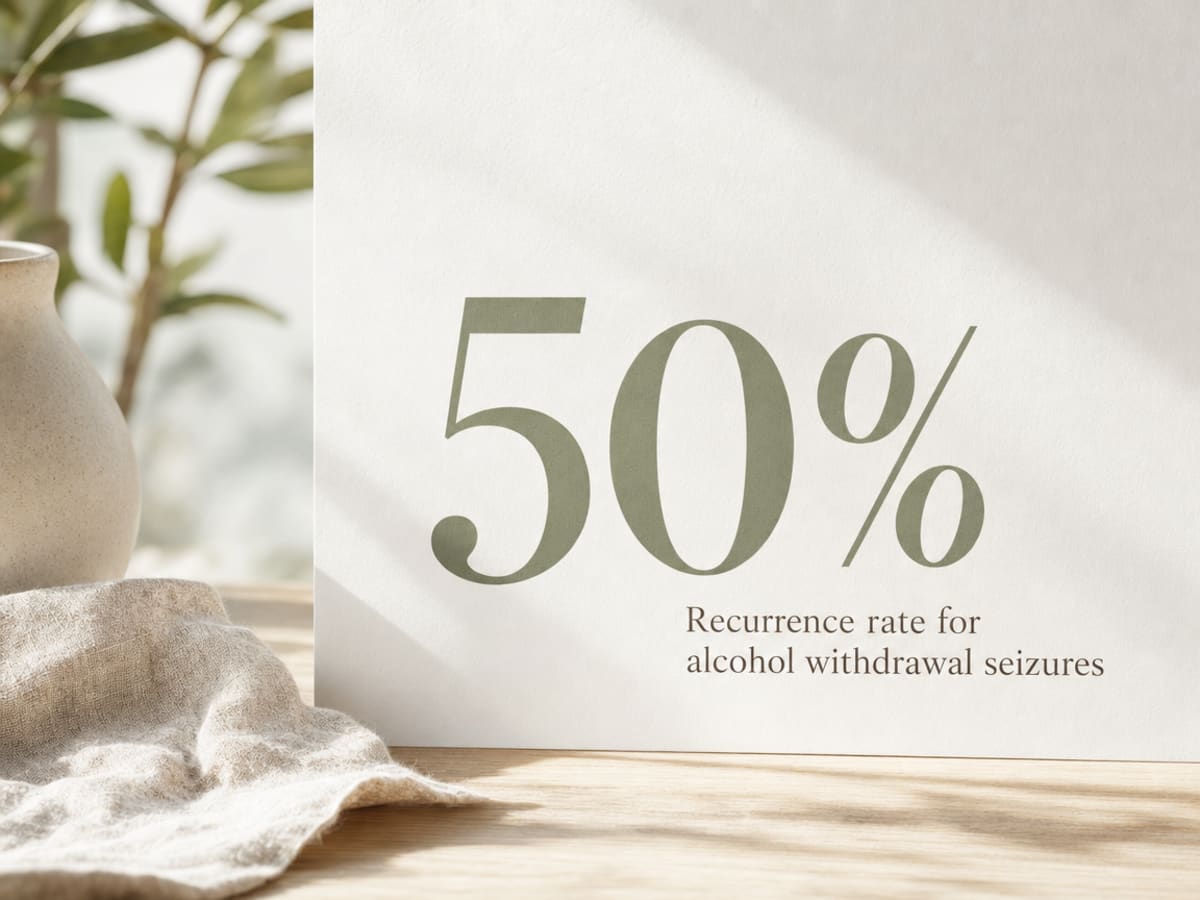
More than half of people who have one alcohol withdrawal seizure go on to have another during the same withdrawal episode if it isn’t actively treated 6. That isn’t a statistic about your future as a person. It’s a statistic about the next several hours. The brain that just seized is still in the same overexcited state it was in five minutes before the seizure, sometimes more so. Nothing about the event resets the chemistry. Without medication and monitoring, the seesaw stays tipped.
The other thing that often follows a first seizure is delirium tremens — the severe confusion, hallucinations, fever, and dangerous heart-rate swings that can show up 48 to 72 hours after the last drink. People who have had a withdrawal seizure are at meaningfully higher risk of going on to develop DTs, which is the most dangerous part of withdrawal 1. This is the medical reason a seizure isn’t something to ride out at home and reassess in the morning.
There is also a longer arc. For some people, alcohol-related seizures don’t stay confined to the withdrawal window. Heavier, longer drinking and certain clinical features predict both recurrence and the later development of epilepsy, which is why follow-up after the acute days matters as much as the acute days themselves 5.
If you’ve already had one, you are not back at the starting line. You are in a known clinical category with a known response. The next attempt to stop drinking is not the time to try harder alone — it’s the time to do it somewhere a clinician can dose, watch, and adjust.
Why home detox keeps failing for higher-risk drinkers
You’ve probably tried this already. A long weekend, a full pantry, someone you trust on the couch, and a quiet promise that this time you’d ride it out. By hour fourteen your hands wouldn’t hold a cup. By hour twenty you were either back at the liquor store or somewhere worse. If that’s you, hear this clearly: you didn’t fail. The setup did.
Home detox keeps breaking down for a few specific reasons, and none of them are about how badly you want to stop.
The person watching you can’t dose medicine. The single intervention that flattens the seesaw — a benzodiazepine, given early, adjusted as symptoms move — has to come from a clinician who can prescribe it and titrate it 8, 13. A worried partner with a notebook can’t do that. They can hold your hand. They can’t hold the chemistry.
The person watching you also can’t catch what comes after a seizure. A first withdrawal seizure doesn’t end the danger; it raises the odds of another one and of delirium tremens in the next 48 to 72 hours, both of which need IV access, vital-sign monitoring, and medication on hand right now, not after a drive to the ER 1.
And the third thing: when the shakes get loud enough, the brain reaches for the one thing it knows will quiet the noise — another drink. That isn’t weakness. That’s the seesaw demanding the weight back. For moderate to severe withdrawal, the standard of care is inpatient-level monitoring precisely because the home setup can’t interrupt that loop 9, 12. If white-knuckling it hasn’t worked twice, the third try doesn’t need more grit. It needs a different room.
What supervised detox actually does in the next 48 hours
Strip away the brochure language and a supervised detox is a small, focused operation built around one job: keep your seesaw steady while your brain relearns how to balance itself. Here’s what that actually looks like, hour by hour, in the window that matters most.
The first thing that happens is an assessment. A clinician asks how much you’ve been drinking, when your last drink was, what your previous withdrawals have looked like, and whether you’ve had a seizure or delirium tremens before. They check your pulse, blood pressure, temperature, and tremor. They score your symptoms with a standardized scale so the team can track whether you’re getting better or worse in real time 11. That score becomes the dashboard for the next two days.
Then comes the medication. For anyone with a history of withdrawal seizures or DTs, current detox guidance is to start a benzodiazepine early — at the first clinical setting, before the seesaw tips further 13. Benzodiazepines work because they gently press on the same GABA side of the seesaw that alcohol was pressing on, holding the brain steady while it resets. They are the first-line treatment for alcohol withdrawal because no other medication has matched their record for preventing seizures and reducing the slide into delirium tremens 8.
The dose isn’t set and forgotten. Nurses recheck your symptoms every couple of hours, sometimes more often, and adjust based on what your body is doing — a model called symptom-triggered dosing. If your tremor is climbing and your heart rate won’t settle, you get more. If you’re calm and stable, you get less. That live adjustment is the thing a home setup cannot replicate 12.
Underneath the medication, the basics get handled. IV fluids if you’re dehydrated. Thiamine and other vitamins, because long-term heavy drinking depletes them and the depletion itself can cause neurological damage. Electrolytes corrected. Blood sugar watched. A quiet room, dimmed lights, someone checking on you through the night 9.
And if a seizure happens anyway — sometimes it does, even with treatment — the team is already in the room. IV access is in. Airway support is steps away. The next dose is ready. That’s the difference between a seizure that becomes a story you tell later and one that becomes an emergency call.
By hour 48, for most people, the worst of the storm has passed. You’re not finished. But you’ve crossed the part of the road where the brain was most likely to seize, and you crossed it with brakes.
The shame part, named directly
You probably haven’t told many people how much you actually drink. You might not have told anyone. The morning you couldn’t lift the coffee cup, the seizure your partner described that you don’t fully remember, the times you promised yourself and broke the promise by noon — those live in a quiet place that feels like proof of who you are.
They aren’t. They’re proof of how a dependent brain behaves, which is a description of biology, not character. The seesaw doesn’t care how hard you’ve been trying. It tips on its own timeline.
If you’ve already tried to quit on your own and it scared you, that fear is information, not failure. If you’ve been hiding the real number of drinks from a doctor, you’re not unusual — you’re the rule. Walking into a supervised detox doesn’t require a confession speech. It requires showing up with the body you have and letting someone help you through the next 48 hours.
Choosing supervision isn’t an overreaction. It’s the smallest, most accurate response to what your nervous system is actually doing.
Talk to a Specialist About Alcohol-Related Seizures
Get immediate answers and support for alcohol withdrawal and seizure concerns from caring professionals.
Talk with Someone About Managing Alcohol Withdrawal Risks
Connect with a professional for confidential guidance on safe stabilization and the next steps in recovery.
Frequently Asked Questions
Can you die from an alcohol withdrawal seizure?
Yes, though death from the seizure itself is uncommon. The bigger danger is what often follows: another seizure, or the slide into delirium tremens with its dangerous heart-rate and blood-pressure swings. People who have a withdrawal seizure are at real risk for recurrent seizures and delirium 1. That’s why a single seizure is treated as a reason to get monitored care now, not a reason to wait and see how the next hours go.
How long after my last drink am I out of the seizure window?
The highest-risk stretch sits between 6 and 48 hours after the last drink, with most seizures clustering in the first 24 3. After 48 hours the seizure risk drops, but delirium tremens can still emerge in the 48-to-72-hour range 1. By around 72 hours, most people are past the most acute danger. If you’re still inside that first window, you’re in the part where supervision matters most.
If I had one withdrawal seizure, will I get epilepsy?
One seizure doesn’t mean you’ll develop epilepsy. The risk goes up with heavier, longer-term drinking and certain clinical and imaging features that a neurologist can evaluate 5. That’s why follow-up after the acute window matters — not to scare you, but to catch any pattern early. Stopping drinking, getting proper detox, and staying in care give your brain the best chance to settle without the wiring shifting in directions that are harder to undo.
Can I detox safely at home if someone watches me?
If you’re a heavy daily drinker, have had a withdrawal seizure or delirium tremens before, or have other medical problems, the honest answer is no. Current hospital guidance puts moderate-to-severe withdrawal at inpatient level, with frequent reassessment, because a person watching can’t dose benzodiazepines or respond to a seizure in real time 9, 12. A friend on the couch is comfort. It isn’t the medical setup the next 48 hours actually need.
What should someone do if they witness an alcohol withdrawal seizure?
Call 911. While you wait: ease the person to the floor, turn them on their side so anything in their mouth can drain, clear hard objects away, and put something soft under the head. Don’t hold them down. Don’t put anything in their mouth. Time the seizure if you can. After it ends, stay with them — confusion is normal. Tell paramedics how much they’ve been drinking and when they stopped, because that information shapes everything that happens next 1.
Why do doctors use benzodiazepines instead of just letting it pass?
Because letting it pass is exactly when people seize, slide into delirium tremens, or end up back at the bottle. Benzodiazepines press on the same calming side of the brain that alcohol was pressing on, holding things steady while the chemistry resets. They are the first-line treatment because no other medication matches their record for preventing seizures and reducing delirium 8. For anyone with a prior seizure or DTs, guidelines say start them early 13.
References
- Alcohol Withdrawal Syndrome – StatPearls – NCBI Bookshelf – NIH. https://www.ncbi.nlm.nih.gov/books/NBK441882/
- Seizures and alcohol withdrawal: A literature review. https://pmc.ncbi.nlm.nih.gov/articles/PMC9567585/
- Alcohol withdrawal syndrome: mechanisms, manifestations, and management. https://pmc.ncbi.nlm.nih.gov/articles/PMC6084325/
- The seizure precipitating effect of alcohol: A prospective study. https://pubmed.ncbi.nlm.nih.gov/29705654/
- Clinical characteristics of seizure recurrence and epilepsy development in patients with alcohol-related seizures. https://pubmed.ncbi.nlm.nih.gov/39333025/
- Characterization of alcohol-related seizures in withdrawal syndrome. https://pmc.ncbi.nlm.nih.gov/articles/PMC10984295/
- Alcohol Withdrawal Seizures: Neurobiological Mechanisms, Clinical Implications, and Future Directions. https://pubmed.ncbi.nlm.nih.gov/42095715/
- Alcohol Withdrawal Syndrome: Benzodiazepines and Beyond. https://pmc.ncbi.nlm.nih.gov/articles/PMC4606320/
- Alcohol Withdrawal in Hospitalized Patients – NCBI Bookshelf – NIH. https://www.ncbi.nlm.nih.gov/books/NBK604324/
- Update on the Neurobiology of Alcohol Withdrawal Seizures. https://pmc.ncbi.nlm.nih.gov/articles/PMC1312739/
- Clinical management of alcohol withdrawal: A systematic review. https://pmc.ncbi.nlm.nih.gov/articles/PMC4085800/
- Assessment and management of alcohol dependence and withdrawal in the acute hospital: concise guidance. https://pmc.ncbi.nlm.nih.gov/articles/PMC4953492/
- Quick Guide For Clinicians Based on TIP 45—Detoxification and Substance Abuse Treatment. https://nida.nih.gov/sites/default/files/samhsa_detoxification_and_substance_abuse_treatment.pdf