
Key Takeaways
- Alcohol use disorder is roughly 50% heritable, meaning family history is a meaningful risk signal but not a verdict, with environment and choices shaping the rest 2.
- Unadjusted risk for children of alcoholics sits near 4x the general population, but after accounting for co-occurring factors the genetic piece is closer to 2x 6, 5.
- What gets inherited is often a broader vulnerability in reward and impulse-control systems, not a pull toward alcohol specifically, which is why cross-addiction risk matters 9.
- Delayed drinking onset, treatment of co-occurring mental health conditions, and stable nurturing relationships are the protective factors that keep most children of alcoholics from developing AUD 6.
What your family history actually tells you about your own risk
If you are reading this, you probably already know the answer in your gut. Maybe your dad cracked his first beer before he took off his work boots. Maybe your mom’s drinking was the thing nobody named at Thanksgiving. Maybe a brother is six months sober and a grandfather drank himself into an early grave. You are not here for a definition of alcohol use disorder. You are here because you are watching the same pattern show up in your own life, and you want to know what that means.
Here is what your family history actually tells you: it is a risk signal, not a verdict. Genetics shape roughly half of the picture for alcohol use disorder, and the other half is shaped by environment, mental health, trauma, and the choices in front of you right now 2. That second half is where your agency lives. It is also where treatment does its work.
This article will not pretend the risk is small. It is real. But inherited vulnerability is not destiny, and understanding how alcoholism moves through a family, through genes, through environment, and through emerging biological pathways researchers are still mapping, gives you something more useful than fear. It gives you a place to start.
The short answer: yes, but not the way most people think
Yes, alcoholism runs in families. The science on that is settled. But the version of “runs in families” that lives in your head, the one where you watched your uncle drink himself into a stranger and assumed you were next in line, is probably more absolute than what the research actually says.
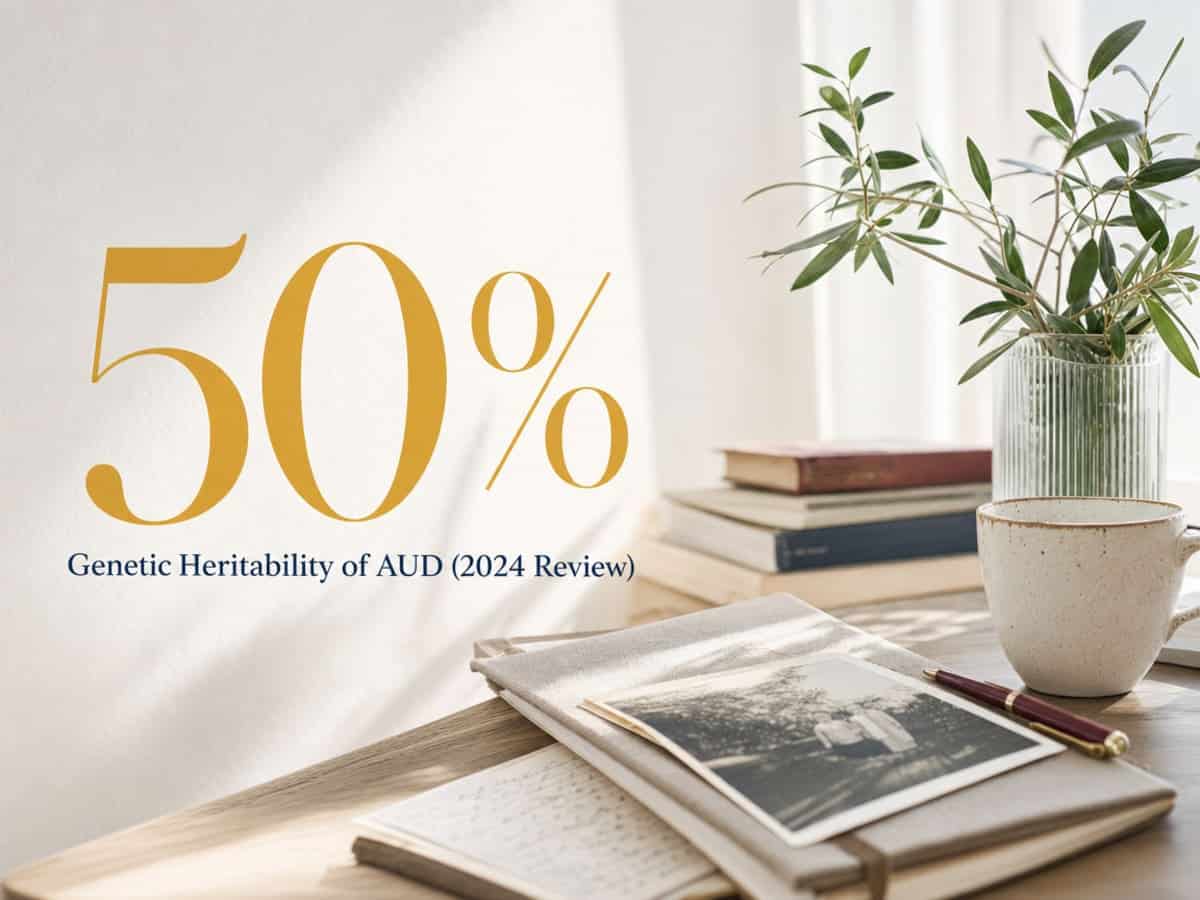
Here is the number that matters. A 2024 review of family and twin studies puts the genetic heritability of alcohol use disorder at about 50%, with a 95% confidence interval between 43% and 53% 2. Think about what that means. Roughly half of the variation in who develops AUD across a population traces back to inherited biology. The other half traces back to environment, mental health, trauma, stress, what you were taught about drinking, when you started, and what was happening in your life when you started.
That second half is not background noise. It is half of the equation. And much of it is something you, or a good treatment team, can work with.
This is also why “alcoholism runs in my family” cannot be turned into “so I will definitely become an alcoholic.” Heritability is a population statistic, not a personal prophecy. It describes patterns across thousands of people. It does not tell you, individually, which side of the line you will land on.
What your family history does tell you is that you are starting from a different baseline than someone with no alcohol problems in their bloodline. You need to take your drinking more seriously, sooner. That is not fatalism. That is useful information.
How alcoholism actually moves through a family
Inherited vulnerability: what twin and adoption studies show
The cleanest evidence that genes matter comes from a study design researchers have been refining for decades: adoption studies. When children are adopted at birth and raised by parents who do not drink heavily, you would expect their alcohol risk to track their adoptive home. It does not. Risk tends to follow the biological parents, even when the child never lived with them, never watched them drink, and never absorbed their patterns at the dinner table 1. That separation is what tells researchers genes are doing real work, not just shared dysfunction at home.
Twin studies tighten the picture further. Identical twins share 100% of their DNA. Fraternal twins share about 50%, the same as any pair of siblings. If alcoholism were purely about how you were raised, both kinds of twin pairs would track each other at roughly the same rate. They do not. Identical twins are far more concordant for AUD than fraternal twins, and that difference is what heritability estimates are built from.
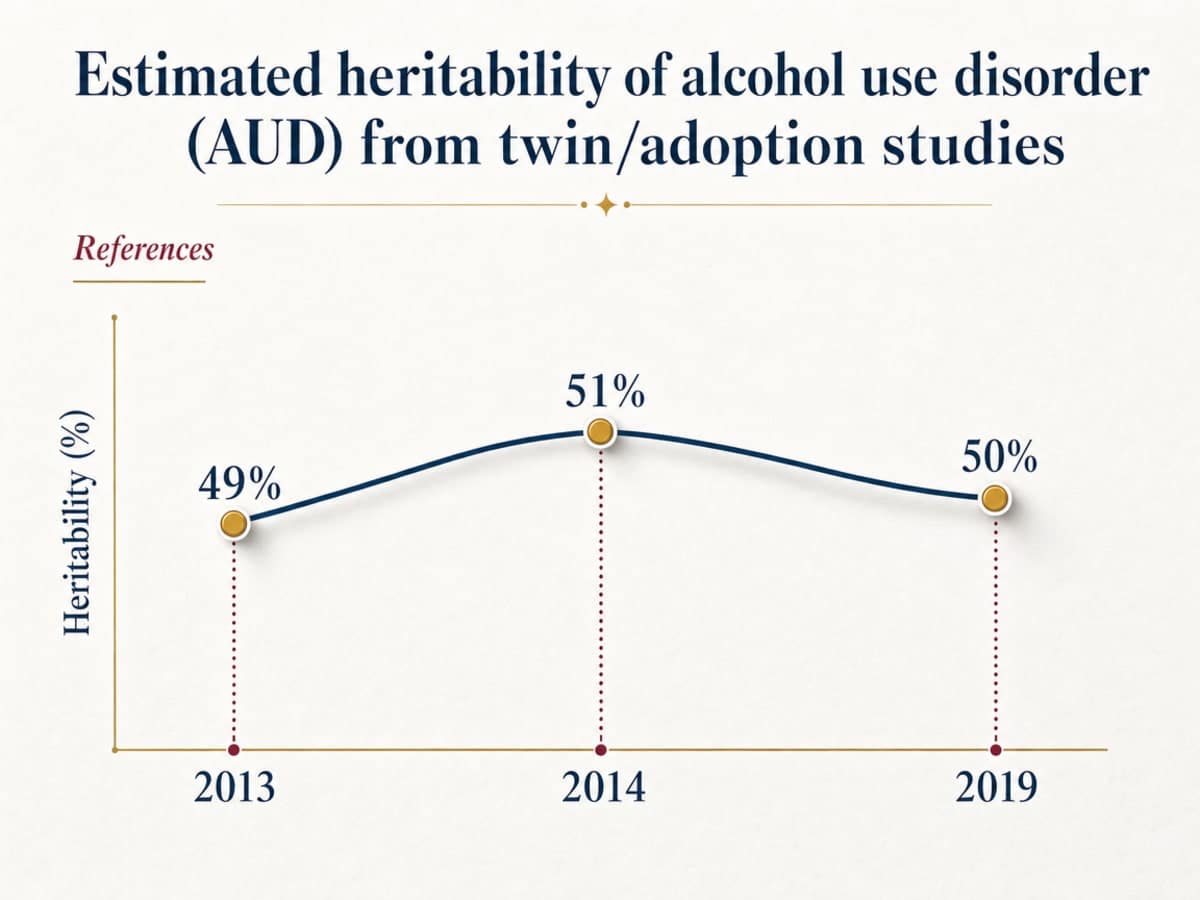
A meta-analysis pooling 13 twin and 5 adoption studies landed on a heritability estimate of 0.49, with a 95% confidence interval of 0.47 to 0.54 7. A Swedish twin study found that genetic influence is already substantial by age 18, meaning your inherited vulnerability is not waiting until midlife to show up 3.
What this means for you: if you have a biological parent with AUD, you are working with a different starting hand than someone who does not. That is not a moral failing. It is biology you did not choose. And it is information you can use.
Shared environment: what you grew up watching and absorbing
Genes load the gun. Environment, in many cases, pulls the trigger. And the environment you grew up in does more than just teach you what drinking looks like. It shapes when you started, how you learned to handle stress, whether anyone modeled sober coping, and what counted as a normal Tuesday night in your house.
Children of alcoholics are two to ten times more likely to develop alcoholism than children who grew up in non-drinking homes, and that range reflects real differences in family environments, not just genetics 10. A house where a parent drank heavily but stayed employed and emotionally present is a different inheritance than a house where drinking came with rage, neglect, or chaos. Both raise risk. They do not raise it the same way.
What you absorbed probably includes some combination of these:
- drinking as the default response to a hard day,
- alcohol present at every celebration and every crisis,
- adults who could not be reached after a certain hour,
- and a quiet rule against naming what was happening.
You learned, without anyone teaching you on purpose, that this is what adults do when things hurt.
A large multi-ancestry study found that psychiatric and environmental factors explain much of the AUD risk that shows up in clinical settings, even though genetics account for an estimated 50 to 60% of total risk 8. The environmental half is not abstract. It is the specific house you grew up in, and it is the specific coping skills you did or did not learn there.
Epigenetics: an emerging third pathway
There is a third pathway researchers are still mapping, and it is worth knowing about even though the evidence is younger than the other two. It is called epigenetics, and the short version is this: your genes can be turned up or down by chemical tags that respond to what your parents lived through, including their drinking, before you were ever conceived.
A 2023 NIH-hosted review summarized growing evidence that parental substance use, including alcohol, can leave epigenetic marks on sperm and eggs that influence offspring behavior and brain development 11. A separate review focused on paternal alcohol exposure found that fathers’ drinking before conception can alter germ cell chemistry in ways that affect children’s growth, neurodevelopment, and later behavior 4.
This is important context, not a verdict. Most of the strongest evidence so far comes from animal studies, and translating those findings to specific human risk is still in progress. Researchers are careful to say that effect sizes in people are not yet clear, and that epigenetic inheritance does not work like a simple on-off switch.
What you should take from this: when your dad drank heavily for years before you were born, that may have done more than model a behavior. It may have left biological traces that shaped how your stress system and reward circuits developed. That is not a reason to despair. It is a reason to take your own treatment seriously, including how stress, sleep, and mental health are managed alongside drinking itself.
If your parent drank, here is what the numbers really say
You have probably heard a number thrown around. Maybe a doctor said it. Maybe a sponsor did. Maybe you read it on a pamphlet in a waiting room. Children of alcoholics are about four times more likely to develop alcohol problems than the general population 6. That figure is real, and it is the one most often cited when people talk about family risk.
But four times what, exactly? That is where it gets less scary and more useful.
That 4x figure is unadjusted. It compares children of alcoholics to everyone else without accounting for the other things that often travel alongside parental drinking: untreated depression in the family, financial stress, divorce, exposure to violence, or a co-occurring mental illness in a parent. When researchers strip those factors out and look at what genetics and direct parental influence are doing on their own, the number shrinks. A 2025 population study found that even after full adjustment for sociodemographic and psychiatric factors, the risk of any substance use disorder in adult children of parents with severe AUD stayed roughly doubled compared to peers 5.
So the honest range is something like this. Compared to a baseline of 1 for the general population, your unadjusted risk if a parent had AUD sits near 4x 6. Strip out the things that often come bundled with parental drinking, and the genetic and direct-influence piece is closer to 2x 5. Both numbers are above baseline. Neither is a sentence.
The difference between those two numbers is important, and it is hopeful. The gap between 2x and 4x is mostly made up of things that are not fixed: mental health that can be treated, environments that can change, coping skills that can be learned, relationships that can be repaired. That gap is where treatment lives. It is also where your choices, starting now, actually move the needle.

It is not just about alcohol: the cross-addiction finding
Here is something that often catches people off guard. If your dad’s problem was pills, or your mom’s was something stronger, you may have told yourself a quiet story: “I only drink. That is different. I am not like them.” The research does not back that story up.
NIH-funded work that scanned the genomes of more than a million people identified shared genetic markers that run across multiple substance use disorders, regardless of the substance involved 9. What you may have inherited is not specifically a pull toward alcohol. It is a broader vulnerability in the brain’s reward and impulse-control systems, and alcohol is just the substance that happened to find you first, or be available, or feel socially acceptable.
The 2025 population study mentioned earlier sharpens this point. Adult children of parents with severe AUD showed elevated risk for all substance use disorders, not just alcohol, and that doubled risk held across substance categories after adjustment 5. The transmission is not narrow.
What this means for treatment: a recovery plan that only targets alcohol, without addressing the underlying vulnerability, may leave you exposed to cross-addiction later. This is part of why integrated care looks at the whole picture, not just the bottle in front of you.
Why some children of alcoholics never develop the disease
Here is the part of the research that does not get printed on pamphlets, but should. More than half of children of alcoholics never develop alcohol use disorder themselves 6. That is the majority. That is most of the people who grew up where you grew up. Whatever you have been telling yourself about being doomed, the data does not actually support it.
So what protects the people who make it through? Researchers have spent decades looking at this, and the answers are less mysterious than you might expect.
The age you start drinking matters, a lot. People who delay their first heavy drinking into their twenties have substantially lower odds of developing AUD than people who start in their early teens, and that protective effect holds even for kids with strong family histories 6. If you have teenagers in your house right now, this is one of the most concrete things you can act on.
Treatment for co-occurring mental health conditions matters too. A lot of the family risk that shows up in clinics is not raw genetic risk. It is depression, anxiety, ADHD, PTSD, and untreated trauma riding alongside the inherited vulnerability and amplifying it. When those conditions get diagnosed and treated, the alcohol risk often drops with them 8.
The other protective factors are quieter but real:
- At least one stable, nurturing adult in childhood.
- A peer group that does not center drinking.
- Work or school that gave you something to be good at.
- A reason to stay sober that felt bigger than the reason to drink 10.
If you did not get most of those growing up, you are not out of options. Adults build protective factors too. A therapist who actually knows you. A sponsor who picks up the phone. A spouse who notices when you are quiet for the wrong reasons. The protective list is not fixed in childhood. It is being written right now, in what you do this month.
What integrated treatment does with all of this
Dual diagnosis: treating the conditions that activate inherited risk
If you only treat the drinking, you are working on half the problem. That is the practical lesson buried inside the family-risk research, and it is the reason integrated dual diagnosis care exists.
Think about what activates inherited vulnerability. It is rarely the gene by itself. It is the depression that has been there since you were fourteen and never got a name. It is the anxiety you learned to quiet with a drink because nobody taught you another way. It is the PTSD from a childhood that included a parent who drank, with everything that came with that. The large multi-ancestry analysis on AUD made this point bluntly: psychiatric and environmental factors account for the majority of alcohol use disorder risk that shows up in clinical settings, even though genetics explain an estimated 50 to 60% of the underlying risk 8.
Integrated treatment looks at both at the same time. The same clinical team treats the depression and the drinking. The same team treats the anxiety and the drinking. The trauma work and the relapse-prevention work happen in the same building, often in the same week, often with overlapping providers who actually talk to each other. That coordination is not a luxury. For someone with a strong family history, it is the part of treatment that addresses why the drinking started doing a job in your life in the first place. Pull out the job, and the drinking has less to hold onto.
Trauma therapy and family work: addressing the environmental half
The environmental half of your risk is not vague. It is specific events, specific people, specific patterns you absorbed before you had words for them. Trauma therapy is how that half gets addressed in a treatment setting.
Approaches like EMDR and trauma-focused cognitive behavioral therapy do not ask you to relive the worst moments for no reason. They help your nervous system finish processing what it never got to finish at the time, so that a Tuesday afternoon stops feeling like a threat your body needs to drink away. For adult children of alcoholics, the trauma being treated is often the home itself, the long quiet weight of growing up around someone whose drinking shaped every room.
Family therapy does something different and equally important. It interrupts the patterns that get passed down in how people talk, fight, hide, and avoid. If you have kids, this is where the chain you are worried about actually breaks. Researchers have repeatedly identified delayed drinking onset, treatment of co-occurring conditions, and stable nurturing relationships as the factors that protect children of alcoholics from following their parents’ path 6. Family work is how those protective factors get built on purpose, instead of left to chance. That is the environmental half, addressed directly.
What to do with this information starting this week
Reading about heritability does not change anything by itself. What changes things is the next seven days.
- Start with an honest count. Write down how many drinks you actually had last week, not the version you would tell a doctor. If the number surprised you, that is data, not a verdict. Family history means your margin for casual drinking is smaller than other people’s, and seeing the real number is how you stop negotiating with yourself.
- Name the other things riding alongside the drinking. The anxiety that shows up at 4 p.m. The grief you never put down. The sleep that has not been right in years. These are not separate problems from the alcohol. They are the conditions that activate inherited risk, and they respond to treatment when they get named 8.
- Tell one person this week. A partner, a sibling who gets it, a doctor at a check-up you book on Tuesday. Family risk thrives in silence, and the first sentence out loud is usually the hardest one you will ever say.
If you are ready to look at integrated care that treats both the drinking and what sits underneath it, Arrow Passage Recovery offers dual-diagnosis programs built for exactly this. You are not starting from zero. You are starting from informed.
Talk to Someone Who Understands Family Patterns
Connect right now for guidance on addressing family-related alcohol challenges with real solutions.
Discuss Family Patterns and Personalized Recovery Options
Get clarity on your family’s alcohol history and explore tailored next steps for lasting change.
Frequently Asked Questions
If both of my parents struggled with alcohol, am I destined to become an alcoholic too?
No. Your risk is higher, and it makes sense that this scares you, but it is not a sentence. Even with strong family history, more than half of children of alcoholics do not develop AUD themselves 6. Two parents likely raises your risk above the typical fourfold figure, but the other half of the equation, environment, mental health, and what you do next, still belongs to you.
Will my kids inherit this from me if I have alcohol use disorder?
They are at higher risk, but inheritance is not the whole story. The protective factors matter as much as the genetic piece. Delayed drinking onset, a stable nurturing parent, and early treatment for any anxiety or depression they show meaningfully shift their odds 6. The most powerful thing you can do for your children is treat your own AUD. Recovery in the home rewrites what they absorb daily.
My dad used drugs, not alcohol. Why am I the one with a drinking problem?
Because what gets inherited is rarely substance-specific. NIH research identified genetic markers commonly inherited across addiction disorders, regardless of which substance someone ends up using 9. You likely inherited a broader vulnerability in reward and impulse-control systems. Alcohol just happened to be the substance that found you, whether through availability, social acceptance, or timing. The underlying biology is the same family pattern, wearing a different label.
Is there a genetic test that can tell me if I’m at risk?
Not in a clinically useful way, not yet. Researchers have identified dozens of risk variants linked to problematic alcohol use, but no single test currently predicts who will develop AUD with the accuracy you would want before changing your life around it 2. Your family history remains the most actionable risk signal available. A parent or sibling with AUD tells you more than any consumer DNA test on the market today.
I was adopted and never met my biological parents. Does family history still matter for me?
Yes, and this is one of the clearest findings in the field. Adoption studies show that AUD risk follows biological parents even when children are raised in non-drinking homes by adoptive families 1. If you can access any medical history through your adoption agency, do it. If you cannot, treat your own drinking patterns as the data point. How alcohol feels in your body and what it does to your life tells you what you need to know.
At what age should I start talking to my children about our family’s history with alcohol?
Earlier than feels comfortable. Genetic influence on AUD is already substantial by age 18, and delaying first heavy drinking is one of the strongest protective factors documented 3. Honest, age-appropriate conversations can start around ages 9 to 11, with more direct discussion in early adolescence. You are not warning them about a stranger. You are telling them something true about their own biology so they can make informed choices when alcohol shows up.
References
- Genetic Influences on Alcoholism Risk: A Review of Adoption and Twin Studies. https://pmc.ncbi.nlm.nih.gov/articles/PMC6875767/
- Human Genetics and Epigenetics of Alcohol Use Disorder. https://pmc.ncbi.nlm.nih.gov/articles/PMC11324314/
- Prevalence and heritability of alcohol use disorders in 18-year old Swedish twins. https://pmc.ncbi.nlm.nih.gov/articles/PMC10472931/
- Intergenerational effects of alcohol: a review of paternal alcohol exposure. https://pmc.ncbi.nlm.nih.gov/articles/PMC6551262/
- Risk of substance use disorders in the adult children of parents with alcohol use disorder. https://pmc.ncbi.nlm.nih.gov/articles/PMC12723945/
- Family History of Alcoholism: Are You at Risk?. https://dmh.lacounty.gov/our-services/employment-education/education/alcohol-abuse-faq/family-history/
- The heritability of alcohol use disorders: a meta-analysis of twin and adoption studies. https://pmc.ncbi.nlm.nih.gov/articles/PMC4345133/
- New Study Reveals Genetic, Psychiatric, and Environmental Factors Contributing to Alcohol Use Disorder. https://medicine.yale.edu/news-article/new-study-reveals-genetic-psychiatric-and-environmental-factors-contributing-to-alcohol-use-disorder/
- New NIH study reveals shared genetic markers underlying substance use disorders. https://nida.nih.gov/news-events/news-releases/2023/03/new-nih-study-reveals-shared-genetic-markers-underlying-substance-use-disorders
- Children of alcoholics: an update.. https://hsrc.himmelfarb.gwu.edu/cgi/viewcontent.cgi?article=1554&context=smhs_psych_facpubs
- An epigenetic synopsis of parental substance use. https://pmc.ncbi.nlm.nih.gov/articles/PMC10308258/