
How to Find Dual Diagnosis Rehab Centers You Can Trust
Key Takeaways
- “Integrated” can mean three very different things—coordinated, co-located, or fully integrated—and only the third runs one clinical team with one shared plan, which is what the evidence supports 1.
- Most adults with co-occurring conditions never get both treated together, and that split drives higher relapse rates and worse psychiatric outcomes 7, 4.
- State licensure and Joint Commission or CARF accreditation are a minimum screening floor, not proof a program actually delivers strong dual diagnosis care 2.
- Ask whether every client is screened at intake for both substance use and mental health conditions; “it comes up in therapy” means the program waits for a crisis instead of catching it.
- A real dual diagnosis program has a psychiatrist or psychiatric NP on staff with a set schedule, and the full team meets together about each client’s care.
- Medication for addiction (buprenorphine, naltrexone, methadone) and psychiatric medication should be managed under one plan, because changes on either side affect the other 1.
- Trauma-informed care should mean named interventions like EMDR, CPT, or Seeking Safety and ongoing staff training—not a line in the brochure 6.
- Strong programs use measurement-based care with validated scales reviewed regularly, so a quietly worsening condition gets caught instead of missed 9.
What “integrated” actually means when a program says it treats both
Almost every rehab website now says it treats co-occurring disorders. The word “integrated” shows up in headers, brochures, and intake scripts. That doesn’t mean every program delivers it.
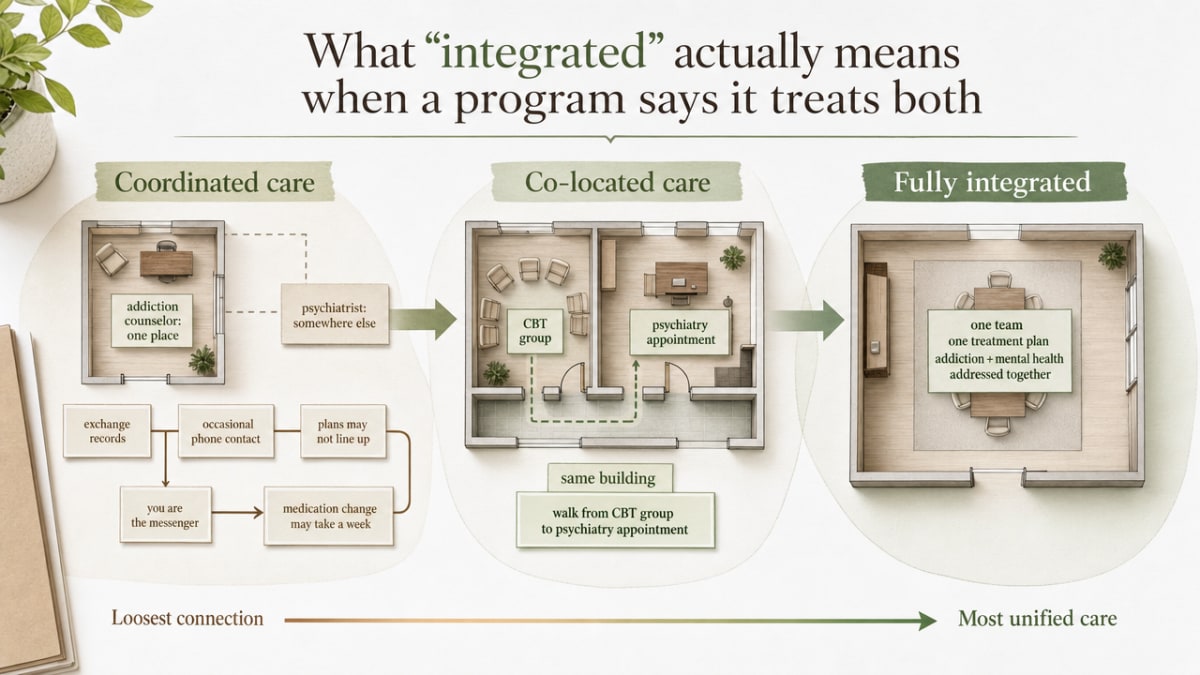
SAMHSA describes three different models that all get called dual diagnosis care, and the differences matter a lot from your seat as the patient 3.
Coordinated care is the loosest version. Your addiction counselor works at one place. Your psychiatrist works somewhere else. They might exchange records, occasionally talk on the phone, and hope the plans line up. You are the messenger between two systems. If your psychiatric medication needs a change because your cravings spiked, that conversation may take a week.
Co-located care puts both teams in the same building. You can walk from a CBT group to a psychiatry appointment without driving across town. That’s a real improvement. But the teams often still work from separate charts, separate treatment plans, and separate goals. The substance use side may not know what your psychiatrist just adjusted, and vice versa.
Fully integrated care is the model the evidence supports for dual diagnosis 1. One clinical team. One shared treatment plan that names both your substance use disorder and your mental health condition by diagnosis. Medication decisions for addiction and for psychiatric symptoms are made by clinicians who talk to each other in the same room, often the same day. Your therapist knows what your prescriber changed. Your prescriber knows what came up in trauma work yesterday.
When a program says “we treat both,” you have a right to ask which of those three it actually runs. The honest answer tells you a lot. A program that says “we have a psychiatrist who comes in on Tuesdays and our counselors refer to her” is describing coordination, not integration. That can still help some people. It is not the same thing.
The treatment gap that explains why this question is hard
If asking these questions feels exhausting, there’s a reason. The system you’re trying to evaluate has been failing people with co-occurring conditions for a long time, and you’ve probably already met some of that failure in person.
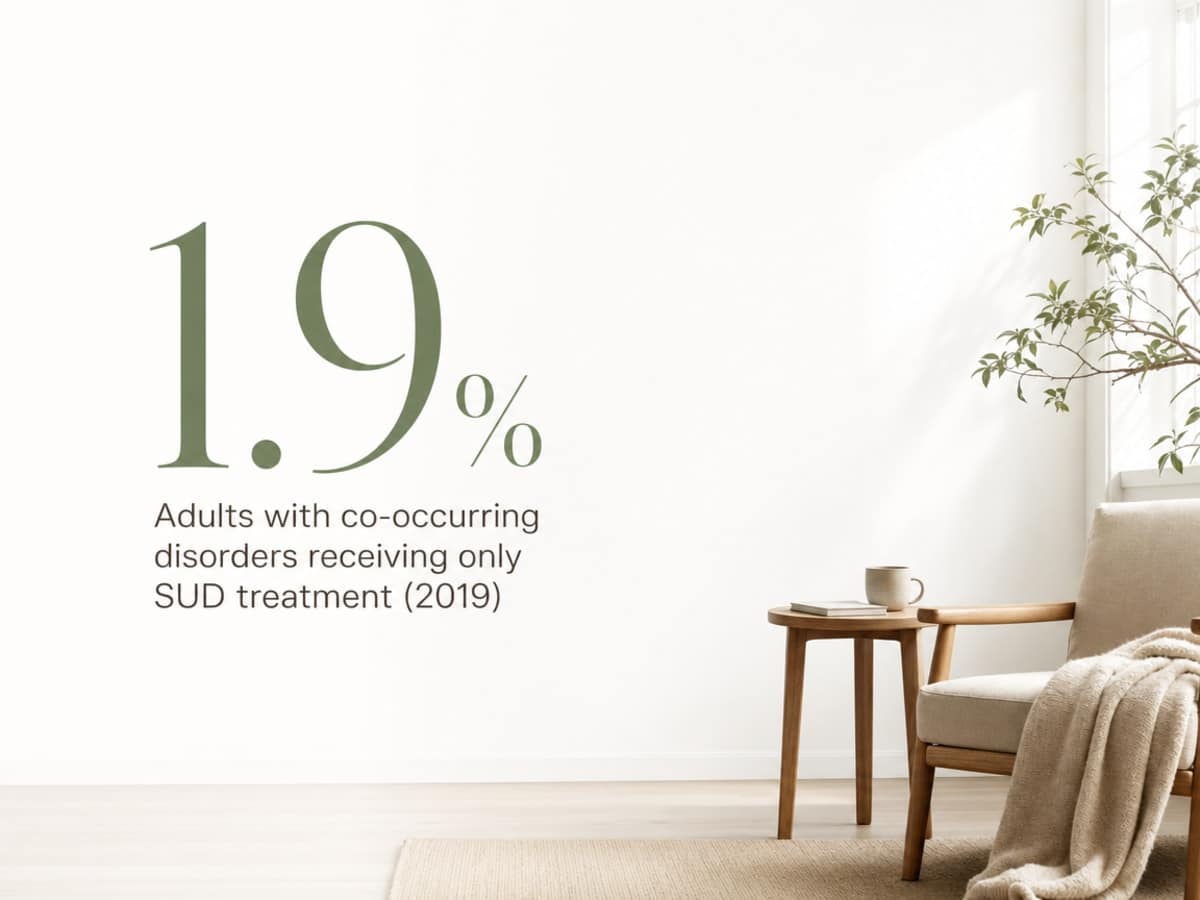
Look at one data point. In 2019, among adults with co-occurring substance use disorder and any mental illness, just 1.9% received substance use treatment alone — meaning they got help for the addiction but nothing for the depression, PTSD, or anxiety sitting underneath it 7. That number isn’t a headline about market size. It’s a snapshot of a gap. Most people with both conditions never reach a setting where both get treated together. Many cycle through detox, an ER visit, a 30-day program, then a psychiatrist months later, never in the same conversation.
The clinical cost of that split is well documented. When only one condition gets attention, relapse rates climb, psychiatric symptoms get worse, and people end up using more emergency and inpatient psychiatric services than they would under integrated care 4.
So when you ask a program pointed questions about how they handle both diagnoses, you are not being difficult. You are correcting for a system that, by default, treats one thing and hopes the other resolves on its own. The skepticism you’re carrying into the call is appropriate. Bring it with you.
Licensure and accreditation: the floor, not the ceiling
Before you ask anything clinical, confirm the basics. A trustworthy dual diagnosis program holds a current state behavioral health license and a national accreditation from a recognized body like The Joint Commission or CARF. Ohio programs are licensed through OhioMHAS for mental health and addiction services. Ask for the license number. Ask when it was last renewed. A real program will read it off without flinching.
Accreditation matters because it signals an outside reviewer has looked at the program’s policies, charts, and outcomes within the last few years. It does not, on its own, prove the program treats dual diagnosis well. Plenty of accredited centers run strong addiction programs with thin mental health support bolted on.
So treat licensure and accreditation as a screening filter, not a verdict. If a program can’t clear that floor, stop there. If it does, you still have most of the real questions ahead of you — about staffing, screening, medication, and how both conditions actually get treated in the same plan 2.
One more practical point: any program that resists giving you its license number, accreditation status, or the name of its medical director is telling you something. Write that down and move on. You are allowed to be picky. This is the rest of your life.
The screening question that separates real dual diagnosis from marketing language
Here is the single sharpest question you can ask: “At intake, do you screen every person for both a substance use disorder and a mental health condition, even if they only came in for one?”
That question matters because SAMHSA’s standard for integrated care is a “no wrong door” approach. Whichever problem brings you through the door first, the program should screen for the other one as a matter of routine, then build a single plan that names and treats both 3. A program built around real dual diagnosis work will not hesitate. They will tell you which screening tools they use, who administers them, and how the results feed into the treatment plan within the first few days.
A weaker program will tell you that mental health “comes up in therapy” or that the counselor will “refer out” if something looks serious. That is not screening. That is waiting for a crisis.
Follow up with a second question: “If the screen is positive for something like PTSD, bipolar disorder, or major depression, does the same team treat it here, or do you send me somewhere else?” Integrated programs assess for both conditions and treat both inside the same plan, because untreated components of a co-occurring disorder tend to make each other worse 13.
You are not testing them to be difficult. You are listening for whether mental health is built into the program’s structure or sprinkled on top of an addiction track. The phrasing of the answer will tell you which one you are dealing with within about ninety seconds.
Who is actually on staff, and who prescribes
Integrated care is a staffing question before it is a philosophy question. Ask who works there, what their credentials are, and how often you’ll actually see them.
A program built for dual diagnosis has a psychiatrist or a psychiatric nurse practitioner on staff, not just on call. Someone with prescribing authority for psychiatric medications needs to be involved in your care from the first week, not after a four-week wait for an outside referral. Ask how many days a week the prescriber is on site and how quickly you can be seen if your symptoms shift.
Then ask about the rest of the team. Trustworthy programs have licensed mental health clinicians — psychologists, LISWs, LPCCs, or LMFTs in Ohio — carrying caseloads alongside addiction counselors with credentials like LCDC III or LICDC. The mix matters. A program staffed mostly by recovery coaches and peer supports can offer real value, but it cannot, on its own, treat bipolar disorder or PTSD. The clinical guidelines for co-occurring conditions assume both diagnoses are assessed and treated by qualified clinicians, not addressed in passing 13.
Ask one more question: “Does the same treatment team meet together about my care?” In a fully integrated program, your prescriber, therapist, and counselor sit in the same case conference. If the answer involves words like “we send notes” or “we coordinate,” you are back at the coordinated model from earlier in this guide. That can still help. It is not the same thing as one team, one plan.
Medication for addiction and psychiatric medication, under one plan
Medication is where the integrated-versus-bolted-on distinction gets concrete. Ask two specific questions on the call.
First: “Do you offer medication for addiction here, including buprenorphine, naltrexone, and methadone, and will I be allowed to start or continue it during treatment?” A program that says yes to all three options, or that explains clearly which it offers on site and which it coordinates with a partner, is treating addiction as a medical condition. A program that calls itself dual diagnosis but excludes clients on buprenorphine or methadone is not a fit for most people with opioid use disorder, no matter how warm the intake call sounds.
Second: “If I’m already on psychiatric medication for depression, bipolar disorder, or PTSD, who manages it during my stay, and how fast can it be adjusted?” The answer should name a prescriber on staff, not a referral somewhere else. Stopping or pausing psychiatric medication at admission is a warning sign, not a clinical norm.
The reason both questions matter together: in genuinely integrated programs, the same team makes addiction-medication and psychiatric-medication decisions inside one plan, because the two interact. A change in your antidepressant can affect cravings. A new buprenorphine dose can shift sleep, anxiety, and mood. When the prescriber managing one piece doesn’t know what the other piece just did, things drift. Treating co-occurring conditions together, under shared medication oversight, is what the evidence actually supports 1.
Trauma-informed care, beyond the brochure
Most dual diagnosis websites use the phrase “trauma-informed.” Far fewer programs can tell you what they actually do differently because of it. That gap matters, because a large share of people with co-occurring conditions are carrying PTSD, complex trauma, or histories that shape how they respond to confrontation, group settings, and authority.
SAMHSA’s TIP 57 sets a clear bar: a trauma-informed program assumes trauma is common, builds policies and practices around that assumption, and works actively to avoid re-traumatizing people in care 6. That shows up in small, specific ways you can ask about.
Ask how staff are trained. A real answer names ongoing training, not a one-time slide deck at orientation. Every person you interact with, from the intake coordinator to the night tech, should understand why someone might freeze during a search, refuse a group, or shut down in a one-on-one.
Ask what trauma-specific treatment is available, by name. EMDR, Cognitive Processing Therapy, and Seeking Safety are concrete interventions delivered by trained clinicians. “We talk about trauma in group” is not a trauma treatment.
Ask about the rules. Programs that confront people hard in early sobriety, use shame as a tool, or restrict basic autonomy without a clinical reason are working from an older model. Trauma-informed programs build choice and predictability into the day, because unpredictability is what trauma teaches the nervous system to fear.
If a program can’t answer these questions with specifics, the brochure language is doing work the practice isn’t.
Measurement-based care: how a good program proves it’s working
Here’s a question most people never think to ask, and one that quietly separates programs that are serious from programs that are coasting: “How do you know if I’m getting better?”
In a strong dual diagnosis program, the answer is specific. They use short, validated questionnaires at regular intervals, and the results actually change what happens in your care. That practice has a name: measurement-based care. The evidence behind it is solid. Routine use of patient-reported outcome measures with real-time feedback to the clinical team improves outcomes across behavioral health settings, and it’s increasingly treated as a marker of high-quality care 9.
What that looks like in practice: every week or two, you fill out brief check-ins on depression symptoms (often the PHP-9), anxiety (GAD-7), cravings, sleep, and how you’re functioning day to day. Your clinician reviews the scores with you. If your depression score is creeping up while your sobriety is holding, the plan changes — maybe a medication adjustment, maybe a shift in therapy focus. The data is a conversation, not a file.
This matters more for dual diagnosis than for single-condition care. When two conditions are moving at once, one can quietly worsen while the other improves, and a feel-based check-in misses it. Numbers catch it.
The broader field has built infrastructure to support this. AHRQ maintains a database of more than 300 quality measures for mental health and substance use care, covering screening, engagement, and outcomes 10. You don’t need to know them by name. You just need to hear that the program tracks something, reviews it, and adjusts.
If the answer to your question sounds like “we check in during sessions” or “the counselors get a feel for it,” that’s not measurement. Ask what they’d show you at week four to prove the plan is working.
Red flags that should end the call
Some answers tell you a program isn’t built for dual diagnosis, no matter how warm the voice on the phone sounds. If you hear any of these, you can thank them and hang up.
“We don’t accept clients on Suboxone or methadone.” A program that excludes medication for opioid use disorder is not practicing current medicine. Walk away.
“Our psychiatrist is available by referral.” That’s not on staff. That’s a phone number. Psychiatric prescribing needs to live inside the program for co-occurring care to work 1.
“We focus on the addiction first, then address mental health later.” Sequential treatment is exactly what the evidence says doesn’t work. Untreated mental health symptoms drive relapse, and untreated substance use makes psychiatric symptoms worse 4.
“We screen if something comes up.” Real programs screen everyone for both conditions at intake, not when a crisis forces the issue 13.
They won’t share the medical director’s name, license number, or accreditation status. That information is public. Reluctance is the answer.
The intake call feels like a sales call. Pressure to commit today, vague answers about clinical questions, heavy talk about amenities before anyone has asked about your diagnosis — that’s a marketing operation with beds attached.
You are allowed to end any call that isn’t earning your trust. Doing that is not rude. It’s the work.
A verification script for the admissions call
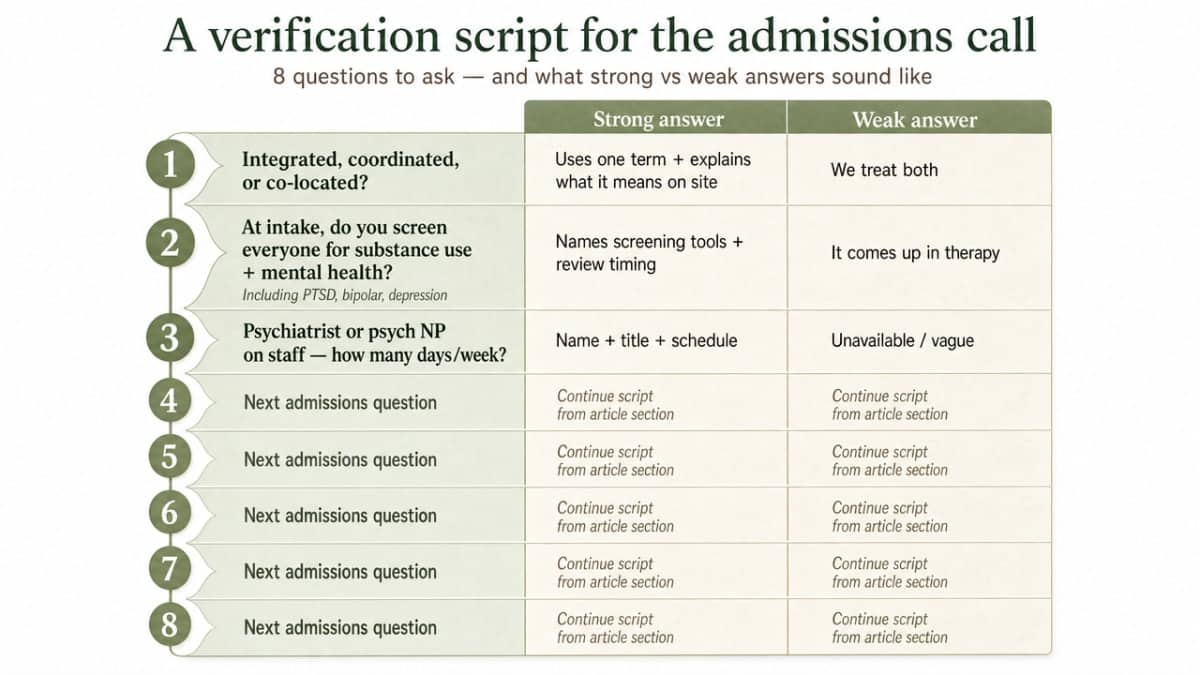
You don’t need to remember all of this from memory. Print this list, keep it next to the phone, and read straight from it. Admissions staff at real dual diagnosis programs answer these questions every week. They won’t be thrown.
- “Are you a fully integrated dual diagnosis program, or coordinated, or co-located?”Strong answer: They use one of those three words and describe what it means in their building. Weak answer: “We treat both.”
- “At intake, do you screen everyone for both substance use and mental health conditions, including PTSD, bipolar, and depression?”Strong answer: They name the screening tools and tell you when results are reviewed. Weak answer: “It comes up in therapy.”
- “Is there a psychiatrist or psychiatric nurse practitioner on staff, and how many days a week?”Strong answer: A name, a title, and a schedule. Weak answer: “On call” or “by referral.”
- “Do you accept clients on buprenorphine, naltrexone, or methadone, and can I start or continue it here?”Strong answer: Yes, with specifics on which they offer on site. Weak answer: Any version of no.
- “Who manages my psychiatric medication during treatment, and how fast can it be adjusted?”Strong answer: The on-staff prescriber, within days. Weak answer: Pausing it, or waiting weeks.
- “What trauma-specific therapies do you offer, by name?”Strong answer: EMDR, CPT, Seeking Safety, delivered by trained clinicians 6. Weak answer: “We’re trauma-informed.”
- “How do you measure whether I’m getting better, and what would you show me at week four?”Strong answer: Specific scales, reviewed with you, used to adjust the plan. Weak answer: “The team gets a feel for it.”
- “Can I have your license number, accreditation status, and the medical director’s name?”Strong answer: Read off without hesitation 2. Weak answer: Anything else.
Make notes in the margins as they talk. You don’t have to decide on the call. Tell them you’ll follow up, then sit with what you heard.
If a family member is making the call
A quick note for the person in the family who ended up holding the phone. You didn’t choose this job. You probably feel underqualified for it. That’s a normal response to an abnormal situation, not a sign you’re doing it wrong.
The questions in this guide work the same whether you or your loved one asks them. What changes is one thing: ask the program how families are involved in treatment, and listen carefully to the answer. Structured family services aren’t a nice extra. Research on families of people with co-occurring substance use and severe mental illness shows that family involvement can improve engagement and outcomes, particularly when relatives feel the relationship with the client is worth protecting 14.
A strong program will name specific family services: psychoeducation sessions, family therapy, scheduled check-ins with the treatment team, and clear guidance on what to do during a crisis. A weaker program will say “families are welcome to visit on Sundays.”
One more thing. You are allowed to be tired. Making this call while scared for someone you love is hard work. Asking one good question today counts.
Next steps when you’re ready to decide
You’ve read enough. Here’s what to do with it.
Pick two or three programs that cleared your first pass. Call each one with the verification script in hand. Ask the same questions in the same order. That way the answers are comparable, and you’ll feel the difference between a program that’s used to these questions and one that isn’t.
If you want a second opinion on options in your area, SAMHSA runs a free, confidential helpline at 1-800-662-HELP, available 24/7, that provides treatment referrals and information for mental and substance use disorders 12. It’s a useful cross-check, not a sales line.
When you’ve made the calls, sit with what you heard for a day if you can. Notice which program treated your questions as routine and which got defensive. That signal is real data.
If you’re in Ohio and want to talk through what integrated dual diagnosis care looks like in practice, Arrow Passage Recovery is one option to consider.
Making it this far in the decision is hard work. You did it anyway. That counts.
Connect With Specialists Ready To Listen Now
Speak directly with caring experts who understand dual diagnosis challenges and guide you through your next steps.
Start a Confidential Conversation About Dual Diagnosis
Connect with experts who understand the challenges of co-occurring disorders and integrated recovery.
Frequently Asked Questions
What’s the difference between a dual diagnosis program and a regular rehab that offers therapy?
A regular rehab treats addiction and offers therapy as support. A real dual diagnosis program assesses both a substance use disorder and a mental health condition at intake, then treats both inside one plan with one clinical team. Untreated psychiatric symptoms drive relapse, so addressing them in parallel, not later, is what the evidence actually supports 1.
How do I know if a program is truly integrated, not just co-located?
Ask directly: one clinical team, one shared treatment plan, joint medication decisions? In a co-located program, addiction and psychiatric staff share a building but work from separate charts and goals. In a fully integrated program, your prescriber, therapist, and counselor meet about your care together, and both diagnoses are named in the same plan 3.
Will a dual diagnosis program let me stay on my psychiatric medication or MAT?
A trustworthy program will. Ask up front whether buprenorphine, naltrexone, and methadone are accepted, and who manages your psychiatric medication on site. Programs that exclude clients on medication for opioid use disorder, or that pause antidepressants and mood stabilizers at admission, are not practicing current co-occurring care. Continuity matters because the two medication tracks interact 1.
What accreditations or licenses should a trustworthy dual diagnosis center have?
Look for a current state behavioral health license (OhioMHAS in Ohio) and national accreditation from The Joint Commission or CARF. These confirm an outside reviewer has examined the program’s policies and charts. Treat them as a minimum floor, not proof of strong dual diagnosis work. A program should share its license number and medical director’s name without hesitation 2.
What questions should I ask during the admissions call?
Ask whether the program is fully integrated, coordinated, or co-located. Ask if everyone is screened for both conditions at intake 13. Ask if a psychiatrist is on staff and how many days a week. Ask about MAT, trauma-specific therapies by name, and how outcomes get measured. Strong answers are specific. Vague ones tell you to keep calling.
Can family members be involved in treatment, and should they be?
Yes, and structured involvement helps. Research on families of people with co-occurring substance use and severe mental illness shows family participation can improve engagement and outcomes, especially when the relationship is one both sides want to protect 14. Ask programs to name their family services: psychoeducation, family therapy, treatment-team check-ins. “Visiting hours on Sunday” is not a family program.
References
- Co-Occurring Disorders and Health Conditions. https://nida.nih.gov/research-topics/co-occurring-disorders-health-conditions
- Co-Occurring Disorders and Other Health Conditions | SAMHSA. https://www.samhsa.gov/substance-use/treatment/co-occurring-disorders
- Managing Life with Co-Occurring Disorders. https://www.samhsa.gov/mental-health/serious-mental-illness/co-occurring-disorders
- Integrating Treatment for Co-Occurring Mental Health Conditions. https://pmc.ncbi.nlm.nih.gov/articles/PMC6799972/
- Treatment Guidelines for Substance Use Disorders and Serious Mental Illness. https://pmc.ncbi.nlm.nih.gov/articles/PMC3285548/
- Trauma-Informed Care in Behavioral Health Services (TIP 57). https://www.ncbi.nlm.nih.gov/books/NBK207201/
- Key Substance Use and Mental Health Indicators in the United States: 2019 NSDUH. https://www.samhsa.gov/data/sites/default/files/reports/rpt29393/2019NSDUHFFRPDFWHTML/2019NSDUHFFR090120.htm
- 2022 National Survey on Drug Use and Health (NSDUH) Releases. https://www.samhsa.gov/data/data-we-collect/nsduh-national-survey-drug-use-and-health/national-releases/2022
- Measurement-Based Care: A Practical Strategy Toward Improving Behavioral Health Outcomes. https://pmc.ncbi.nlm.nih.gov/articles/PMC11861827/
- Mental Health Quality Measures (AHRQ). https://www.ahrq.gov/patient-safety/quality-resources/tools/chtoolbx/measures/measure-9.html
- Development and Testing of Behavioral Health Quality Measures for Health Plans: Final Report. https://aspe.hhs.gov/reports/development-testing-behavioral-health-quality-measures-health-plans-final-report-0
- National Helpline for Mental Health, Drug, Alcohol Issues. https://www.samhsa.gov/find-help/helplines/national-helpline
- Simplified Clinician Guidelines for Treatment of Co-occurring Disorders. https://library.immaculata.edu/Dissertation/Psych/Psyd449TaylorTroutA2021.pdf
- Family Intervention for Co-occurring Substance Use and Severe Mental Illness. https://pmc.ncbi.nlm.nih.gov/articles/PMC3262454/