
What Is Ether Abuse?
Key Takeaways
- Ether abuse involves inhaling diethyl ether for alcohol-like intoxication and anxiety relief, producing the same central nervous system depression that once powered surgical anesthesia 1, 12.
- Clinicians call it a ‘forgotten addiction’ because ether sits outside typical inhalant awareness, leaving lab, pharmacy, and veterinary workers with quiet access and unrecognized risk 1, 6.
- The dose that intoxicates and the dose that stops breathing share the same dial, with sudden cardiac arrest, suffocation, and lasting neurological damage all documented 12, 3, 15.
- Recovery typically starts with medically supervised detox, then matches care level to severity while treating co-occurring anxiety or depression through CBT, motivational interviewing, and integrated psychiatric support 11, 13.
The Forgotten Inhalant Hiding in Plain Sight
If you found your way here because something feels off — your own use, or a pattern you’ve noticed in someone you love — take a breath. You’re in the right place, and you’re asking the right question.
Ether abuse rarely makes the news. It doesn’t show up on most addiction checklists. The medical literature even calls it a “forgotten addiction,” a phrase that comes from a case report on diethyl ether dependence and the surprisingly thin clinical attention it has received 1. That silence is part of why this can feel so isolating. You may have searched and come up with chemistry pages, surgical history, or vague warnings about “huffing” — not a clear picture of what’s actually happening.
What’s happening is real. Ether is a fast-acting volatile substance that produces alcohol-like intoxication, and people do become dependent on it 1, 12. The rest of this guide walks through what ether abuse is, why it’s easy to miss, the risks worth taking seriously, and the treatment path that genuinely works.
Defining Ether Abuse in Clinical Terms
What Ether Is and How It Acts on the Brain
Ether — most often diethyl ether — is a volatile, fast-evaporating liquid that was used as one of the first surgical anesthetics. Its vapors cross from your lungs into your bloodstream within seconds, then into the brain, where they depress central nervous system activity in a pattern that feels a lot like being drunk 4, 12.
That’s the part worth slowing down on. When you inhale ether, you’re not just “getting high” in some abstract way. You’re putting your brain into a chemically induced light anesthesia. Early on, that often shows up as a rush of euphoria, loose disinhibition, slurred speech, and a floating, dreamlike calm. Some people describe it as anxiolytic — the edges come off 1. Pull in more, and the same mechanism that quiets anxiety starts quieting your breathing, your heart rhythm, and your ability to stay conscious 12.
The brain doesn’t distinguish between an operating room and a back office. The dose-response curve is the same. What changes is whether someone is watching your vitals, controlling the concentration, and standing by with oxygen. Outside those guardrails, the same chemical that produced surgery-grade unconsciousness on a hospital table can do it on a bathroom floor.
Why Ether Gets Overlooked Among Inhalants
If ether abuse feels invisible, that’s not your imagination. The clinical literature itself calls it a “forgotten addiction,” and one widely cited review opens by noting that, among abused inhalants, ether has recently received little attention 1. Researchers question whether its apparent rarity reflects truly low prevalence or simply under-recognition and under-reporting by clinicians 1.
A few things drive that blind spot. Ether stopped being a common surgical anesthetic decades ago in wealthy countries, so doctors trained recently may never have seen a case 6. Public health campaigns about “huffing” tend to focus on aerosols, glue, and nitrites — the products teenagers reach for in convenience stores — while ether sits in a different world: laboratories, pharmacies, veterinary supplies, and certain low-resource medical settings 6, 13. A broader 2023 review describes inhalant abuse overall as “one of the most neglected and overlooked forms of substance abuse,” despite real and serious health consequences 13.
The takeaway for you: if your concern doesn’t fit the stereotype, that doesn’t mean it isn’t real. It means you may be looking at a pattern most of the world isn’t trained to see yet.
How People Encounter and Use Ether
Access Points: Labs, Clinics, Pharmacies, and Online
Most ether abuse stories don’t start in a parking lot. They start somewhere mundane — a workplace, a stockroom, a veterinary supply cabinet, a chemistry bench.
Diethyl ether is still a working chemical. It’s used as a laboratory solvent, in some pharmaceutical manufacturing, in certain veterinary procedures, and as starting material for organic synthesis. Institutional safety guidelines treat it as hazardous enough to require dedicated training, ventilated storage, and peroxide checks before each use 17. That means the people who handle it most are often the people who could be exposed to it most: lab techs, graduate students, pharmacists, chemists, veterinary staff, and clinicians in settings where ether is still part of the toolkit.
In some lower-resource medical environments, ether also remains a working anesthetic. Reviewers have argued it’s reasonable to keep using it where supplemental oxygen, intubation, and cardiac monitoring aren’t reliably available 6. That same accessibility — cheap, shelf-stable, easy to obtain through medical and chemical channels — is what makes diversion possible 6.
If you’re worried about your own access, you don’t need to justify the worry. The fact that ether is around you is part of the situation, not a character flaw. Naming it is the first useful thing you can do.
Who Develops a Problem With Ether
There isn’t a single profile. But the patterns in the literature are clearer than you might expect.
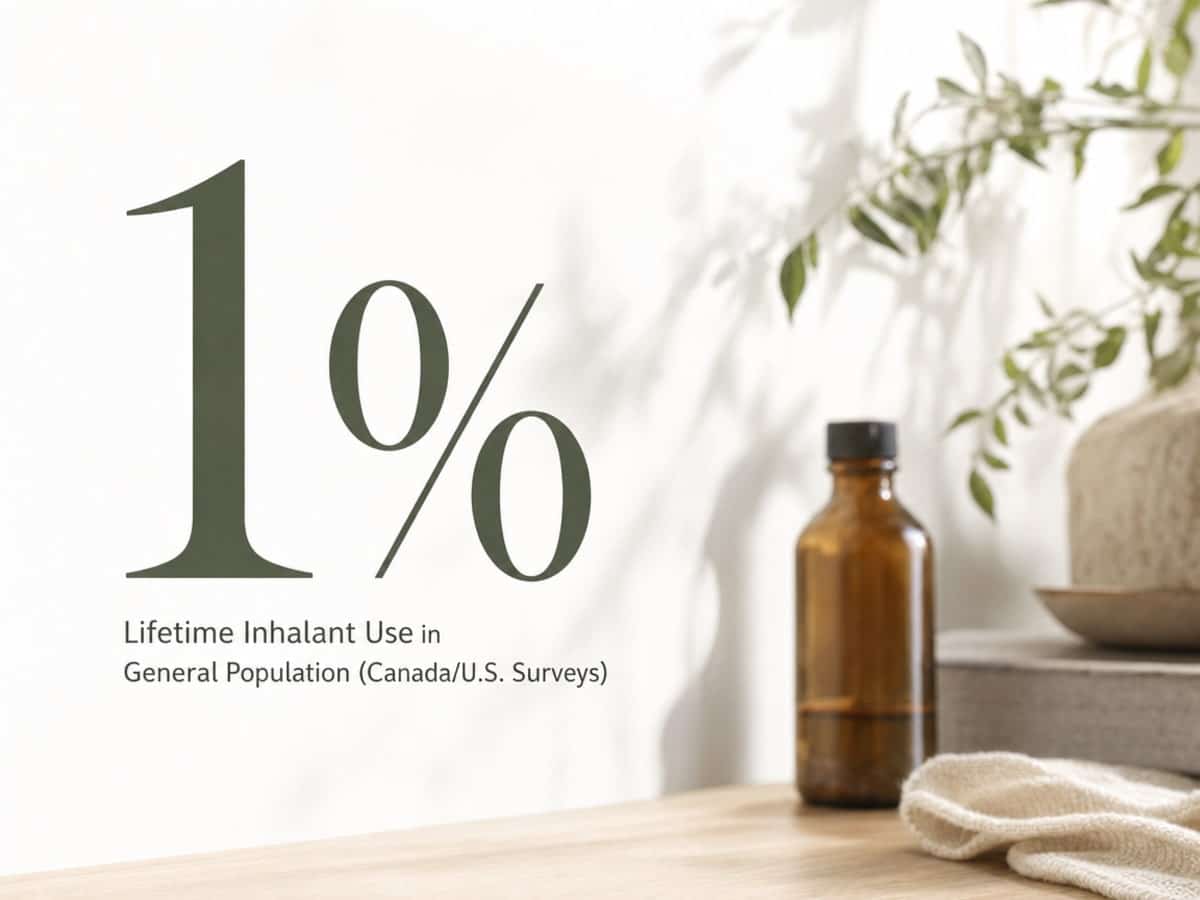
Surveys cited in the inhalant epidemiology literature put lifetime inhalant use at around 1% of the general population in U.S. and Canadian samples, with notably higher rates among adolescents and first use often occurring before age 15 8. Early onset is itself a risk multiplier — people who start inhaling volatile substances young are more likely to develop alcohol and other substance use disorders later in life 8. That 1% figure covers all inhalants, not ether specifically, and ether sits in a smaller, harder-to-count slice of that group. The shape of the risk, though, applies.
For ether specifically, the case-report literature points to a different cluster of risk factors. The well-known “forgotten addiction” case described a patient who used ether for its rapid intoxicating and anxiolytic effects — meaning ether was doing a job for him, taking the edge off anxiety, before tolerance and dependence built 1. That motivation matters. People who self-medicate anxiety, insomnia, or trauma with a fast-acting depressant are at higher risk of slipping into compulsive use, especially when the substance is easy to reach.
If any of this is recognizable to you — the early onset, the anxiety underneath, the proximity at work — you’re not an outlier. You’re describing the pattern clinicians actually see.
Recognizing the Pattern: Acute vs. Chronic Signs
What Acute Ether Intoxication Looks Like
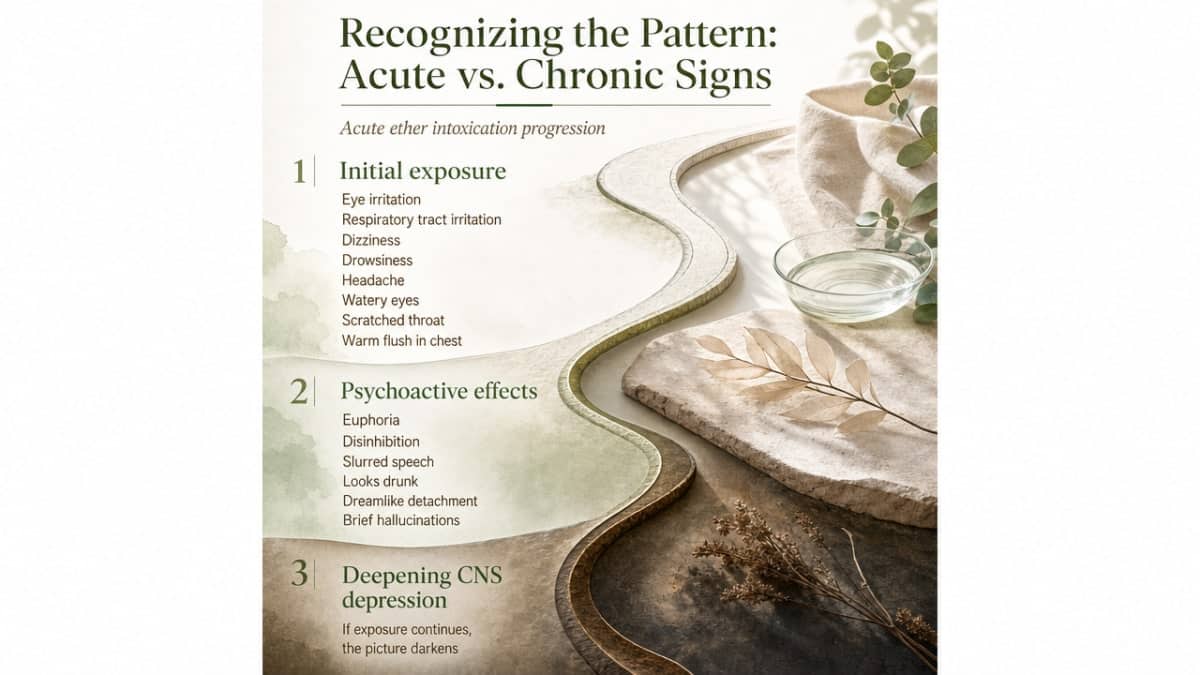
Acute ether intoxication tends to follow a recognizable arc, and it helps to know what each phase actually looks like — not so you can self-diagnose in the middle of it, but so you can name what you’ve seen.
In the first few minutes after exposure, NIOSH documents the predictable physical signs: irritation of the eyes and respiratory tract, dizziness, drowsiness, and headache 14. Eyes water. The throat feels scratched. A flush of warmth moves through the chest. Then the psychoactive layer settles in — euphoria, loose-limbed disinhibition, slurred speech, and what bystanders often describe as someone simply looking drunk 7. Some people experience brief hallucinations or a dreamlike detachment as central nervous system depression deepens 7.
If exposure continues, the picture darkens. Coordination falls apart. Reaction time slows. Breathing becomes shallow. Consciousness slips. NIDA notes that even brief inhalant use can cause life-threatening complications including cardiac arrest and suffocation 12.
The thing to remember: these symptoms aren’t a moral signal. They’re a chemical one. If you’ve watched someone move through this sequence — or moved through it yourself — you’ve witnessed something medically serious, not something embarrassing.
Signs of Dependence You Can Watch For
Dependence is a different animal than intoxication. Intoxication is what happens in the minutes after a dose. Dependence is what’s happening across weeks and months, often quietly, often in ways the person using doesn’t fully see.
The clearest clinical portrait comes from the “forgotten addiction” case report, which describes a patient who developed tolerance to ether’s intoxicating and anxiolytic effects, kept using it despite mounting harms, and organized parts of his life around continued access 1. Those are the textbook markers of a substance use disorder, and they show up in ether use the same way they show up with alcohol or benzodiazepines.
What that looks like in real life:
- Needing more of the substance to feel the same release.
- Using when you didn’t plan to.
- Anxiety, restlessness, or a creeping irritability when you can’t.
- Hiding bottles, rags, or supplies.
- Lying about how much, how often, or where.
- Choosing ether over things that used to matter — sleep, meals, work, the people who notice when you’re gone.
You may also notice physical wear: lingering headaches, a sore throat that won’t quit, irritated eyes, fatigue, weight changes 14. Memory gaps. Difficulty concentrating after sessions that used to clear within an hour.
If you’re checking off more than a couple of these, that isn’t a verdict. It’s information. And it’s the kind of information that, named honestly, points toward a real next step.
For Families, Partners, and Coworkers
This part is for you if you’re the one watching someone else and trying to figure out whether what you’re seeing is what you think it is.
Pay attention to a faint, sweet, solvent-like smell on clothes, hair, or in small rooms — diethyl ether has a distinct odor that doesn’t fully leave the air 17. Notice repeated short absences followed by a period of slurred speech, unsteady walking, or unusual flatness. Look for rags, cotton balls, small bottles, or sealed containers tucked into bags, drawers, or vehicles.
In a lab, clinic, or pharmacy, watch for missing inventory, ether bottles in places they shouldn’t be, or a colleague who lingers near storage 17.
You don’t have to confront anyone with a full case file. You just have to be willing to name, gently and clearly, what you’re seeing. That single conversation has started more recoveries than any intervention script.
How Dangerous Is Ether Exposure, Really
Concentration Thresholds That Turn a Session Lethal
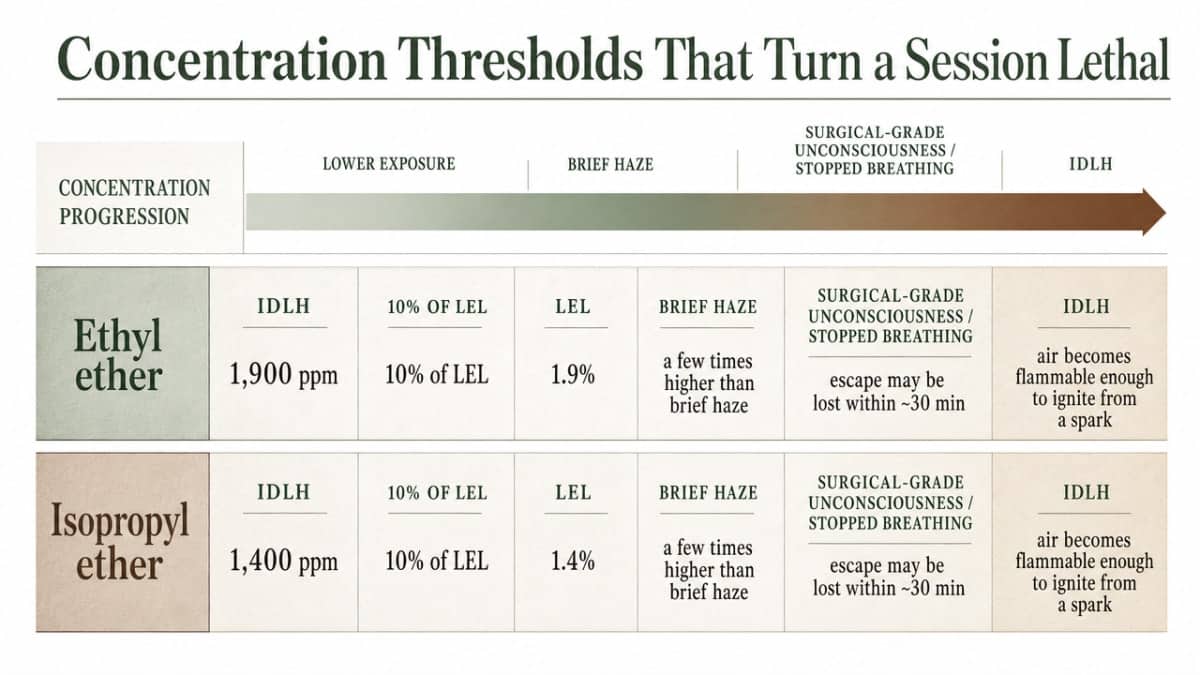
One of the hardest things about ether is how fast “a little” becomes “too much.” The same vapor that produces a brief, drunken haze at one concentration can produce surgical-grade unconsciousness — and stopped breathing — at a concentration only a few times higher.
NIOSH publishes a specific threshold for this called the IDLH, short for “immediately dangerous to life or health.” For ethyl ether, that level is 1,900 ppm, set at 10% of the substance’s lower explosive limit of 1.9% 15. For its chemical cousin isopropyl ether, the IDLH is 1,400 ppm, again pegged to 10% of a 1.4% explosive limit 16. Those numbers aren’t just lab trivia. They mark the concentration at which a healthy adult can lose the ability to escape on their own within about 30 minutes — and at which the air itself becomes flammable enough to ignite from a spark, a static charge, or a pilot light 15, 16.
Cardiac, Respiratory, and Sudden-Death Risk
The phrase clinicians use is “sudden sniffing death,” and it is exactly as blunt as it sounds. A person inhales, the heart goes into a fatal arrhythmia, and there is no second chance to call for help 9. It can happen on a first use. It can happen to someone who has done this dozens of times without incident.
NIDA is direct about this: even brief inhalant use can cause cardiac arrest and suffocation 12. With ether specifically, the central nervous system depression that creates euphoria also slows breathing. If you pass out with a rag near your face, in a closed car, or with a bag over your head, the dose keeps coming while your body loses the ability to push it away 12. Forensic case reports confirm that fatal diethyl ether intoxications still occur, though the substance’s volatility makes them hard to detect after death 5.
Long-Term Damage to the Brain and Body
The damage that builds slowly is, in some ways, harder to talk about than the acute risk — because it doesn’t announce itself. You don’t wake up one morning with a diagnosis. You wake up a little foggier, a little slower, a little more tired, and you tell yourself it’s stress.
Chronic inhalant use is linked to a long list of physical injuries: neurological damage, kidney and liver toxicity, pulmonary problems, and persistent deficits that don’t fully clear when use stops 2. Imaging and neuropsychological studies of long-term inhalant users show widespread white matter injury, cerebellar dysfunction, cortical atrophy, and — in heavier cases — cognitive impairment that resembles early dementia 3. Peripheral neuropathy is common: tingling, numbness, or weakness in hands and feet that lingers long after the last session 3.
Here is the part worth holding onto. The brain has more capacity to heal than people often realize, and earlier intervention makes a real difference in what’s recoverable. Noticing the damage now — even if it scares you — is the move that protects what’s still intact.
Why Ether Dependence Often Travels With Anxiety and Depression
Here’s something worth sitting with: a lot of people who develop a problem with ether didn’t go looking for a high. They went looking for relief.
The well-documented case in the “forgotten addiction” literature describes a patient who used diethyl ether specifically for its rapid intoxicating and anxiolytic effects — meaning he wasn’t just chasing euphoria, he was chasing quiet 1. That pattern is common with fast-acting central nervous system depressants. If your nervous system has been running hot for years — anxiety, panic, untreated trauma, the kind of insomnia that makes 3 a.m. feel like a country — a substance that flips the dial down in under a minute starts to feel less like a drug and more like a tool.
The clinical literature on adult inhalant use disorders backs this up. Adults who develop these patterns frequently present with co-occurring psychiatric illness, and reviewers explicitly recommend integrated treatment that addresses both at once rather than treating the substance use in isolation 11. Treating only the ether use, while the anxiety or depression underneath stays untouched, tends to send people right back to the thing that worked fastest.
If that’s your story, it doesn’t make you weak. It makes you someone whose pain found a chemical answer before a better one showed up. A better one exists.
What Treatment Actually Looks Like
Starting With Medically Supervised Detox
The first stretch — the first 24 to 72 hours after your last use — is the part most people fear, and it’s the part you don’t have to do alone.
There isn’t a specific FDA-approved medication for inhalant withdrawal the way there is for opioids or alcohol, and the evidence base for pharmacologic management of inhalant use disorders is built largely on case reports and small series 13. What medically supervised detox does provide is the thing that actually keeps you safe: continuous monitoring of your heart rhythm, breathing, and neurological status while the chemical clears, plus symptomatic treatment for the anxiety, agitation, sleep disruption, and cravings that follow 11, 13.
That matters because ether’s cardiac and respiratory effects don’t always disappear the moment you stop 12. A clinical setting catches what you can’t catch yourself. You walk in, you let someone else watch the dials for a few days, and you give your nervous system the first quiet it’s had in a while.
Choosing the Right Level of Care
After detox, the question becomes where you do the actual work. There’s a continuum, and the right answer depends on how severe the use has been, what’s happening at home, and whether anxiety, depression, or trauma are riding alongside.
Clinical reviewers recommend residential treatment when use has been heavy, when housing is unstable, or when significant co-occurring psychiatric illness is in the picture 11. Residential care gives you 24-hour structure, separation from the workplace or environment where ether was accessible, individual and group therapy, and integrated psychiatric care if you need it. For people whose ether use was tied to lab, clinical, or pharmacy access, that physical distance from the supply isn’t a luxury — it’s often the thing that makes early sobriety possible.
Partial hospitalization and intensive outpatient programs step the intensity down while keeping the clinical contact dense — usually multiple days a week of therapy and medical check-ins. Standard outpatient counseling fits people with shorter use histories, stable home environments, and no acute psychiatric concerns. Reviewers consistently emphasize that motivational interviewing, cognitive behavioral therapy, and integrated treatment of co-occurring mental health conditions form the backbone of effective care across every level 11, 13.
If you’re not sure which fits, a clinical assessment will tell you. You don’t have to decide that alone either.
Aftercare and Relapse Prevention
The work that holds is the work that comes after the structured program ends. Aftercare is where recovery stops being a treatment plan and starts being a life.
For ether specifically, relapse prevention has a practical edge: you may need to change your relationship with the place where ether lives. That can mean a job change, a department transfer, a different lab, or a conversation with an occupational health provider. Ongoing individual therapy, peer support, and continued treatment of any underlying anxiety or depression are what the literature points to as the difference-makers in long-term recovery from inhalant use disorders 11, 13.
Small things count here. A weekly check-in. A sponsor’s phone number. A therapist who knows your story. You’re building scaffolding, one piece at a time.
A Direct Word If You’re Scared Right Now
If your hands are shaking a little as you read this, that fear is doing its job. It’s telling you something matters.
You don’t have to have it figured out before you call someone. You don’t need a perfect story, a clean timeline, or the right words. You just need to pick up the phone and say, “I think I have a problem with ether, and I don’t know what to do next.” A clinician on the other end will take it from there.
If you’ve used in the last few hours and you’re feeling chest pain, a racing or skipping heartbeat, trouble breathing, or you can’t quite stay awake — that’s an emergency room visit, not a phone call. Go now. Bring someone with you if you can.
Noticing what you’ve noticed is already the hard part. The next step is smaller than it feels.
Start Your Safe Recovery From Ether Abuse Today
Connect immediately for expert guidance and support through every step of ether withdrawal and recovery.
Talk with a Professional About Ether Abuse Recovery
Connect one-on-one to discuss safe, medically supported steps for addressing ether abuse and withdrawal.
Frequently Asked Questions
Is ether abuse the same as huffing other inhalants?
It belongs to the same broad category — inhalant use disorder — but ether is its own chemical with its own risk profile 12. Unlike glue, aerosols, or nitrites, diethyl ether is a true anesthetic that can produce surgical-level unconsciousness, not just a brief buzz 4. The dependence pattern, though, follows the same playbook as other volatile substances 1.
Can you become physically dependent on ether?
Yes. The clinical literature documents tolerance building, continued use despite harm, and a dependence pattern that fits standard substance use disorder criteria 1. People often describe needing more ether to get the same anxiolytic relief, and feeling restless or anxious when they can’t reach it 1. It’s a real disorder, not a habit you should be able to outwill.
What should I do if someone has just inhaled ether and seems unresponsive?
Call 911. Move them to fresh air if you can do it safely, loosen anything tight around their neck, and place them on their side so vomit can’t block their airway. Don’t try to wake them with cold water or stimulants. Inhalant use can trigger cardiac arrest and suffocation even in someone who has used before without incident 12.
Does ether use cause permanent brain damage?
Chronic inhalant use is linked to white matter injury, cerebellar dysfunction, cortical atrophy, and lasting cognitive deficits, with some heavier cases resembling early dementia 3. Peripheral neuropathy — numbness or tingling in hands and feet — can also persist 3. The encouraging part: stopping use earlier generally protects more of what’s still working, and some deficits improve with sustained recovery.
How is ether dependence treated differently from alcohol or opioid use disorder?
There isn’t a specific FDA-approved medication for inhalant withdrawal the way there is for opioids or alcohol, so detox focuses on monitoring vitals and treating symptoms like anxiety and sleep disruption 13. After that, the core treatment — motivational interviewing, CBT, integrated psychiatric care, and the right level of structured care — mirrors what works for other substance use disorders 11.
How do I talk to a loved one I think is using ether?
Pick a calm moment, not the middle of a crisis. Name what you’ve actually seen — the smell, the absences, the changes — without accusation. Say you’re worried, not angry. Ask if they’ll talk to a clinician with you. Adults with inhalant use disorders often carry untreated anxiety or depression underneath, so leading with concern about how they’re feeling lands better than confrontation 11.
References
- Ether: a forgotten addiction. https://pubmed.ncbi.nlm.nih.gov/12873252/
- Inhalant abuse. https://pmc.ncbi.nlm.nih.gov/articles/PMC2948777/
- Inhalant abuse among adolescents: neurobiological considerations. https://pmc.ncbi.nlm.nih.gov/articles/PMC2442441/
- Inhalational Anesthetic. https://www.ncbi.nlm.nih.gov/books/NBK554540/
- Another case of diethyl ether intoxication?: a case report focusing on toxicological analysis. https://pubmed.ncbi.nlm.nih.gov/21807546/
- Ether in the developing world: rethinking an abandoned agent. https://pmc.ncbi.nlm.nih.gov/articles/PMC4608178/
- Inhaling muscle spray: A rising trend of abuse. https://pmc.ncbi.nlm.nih.gov/articles/PMC8131932/
- Inhalant abuse – epidemiology and clinical implications. https://pubmed.ncbi.nlm.nih.gov/2948777/?from=PMC2948777
- Inhalant Abuse (StatPearls). https://www.ncbi.nlm.nih.gov/books/NBK430924/
- Substance use disorders in adolescents: Inhalant use disorders. https://pubmed.ncbi.nlm.nih.gov/29468557/
- Substance use disorders: Inhalants (adult focus). https://pubmed.ncbi.nlm.nih.gov/29467701/
- Inhalants | National Institute on Drug Abuse (NIDA). https://nida.nih.gov/research-topics/inhalants
- The Clinical Assessment and Treatment of Inhalant Abuse. https://pmc.ncbi.nlm.nih.gov/articles/PMC10266853/
- Ethyl ether – NIOSH Pocket Guide to Chemical Hazards. https://www.cdc.gov/niosh/npg/npgd0277.html
- Ethyl ether – IDLH | NIOSH. https://www.cdc.gov/niosh/idlh/60297.html
- Isopropyl ether – IDLH | NIOSH. https://www.cdc.gov/niosh/idlh/108203.html
- Lab Safety Guideline: Diethyl Ether. https://www.ehs.harvard.edu/resource/lab-safety-guideline-diethyl-ether