
How to Recover From Addiction Alone (And When to Get Help)
Key Takeaways
- Natural recovery without formal treatment is real, but it’s most likely for people with milder dependence and few co-occurring conditions, not a universal path 14.
- Anchor solo recovery to five relapse-prevention rules — change your life, stay honest, ask for help, practice self-care, and don’t bend your own rules 12.
- Run the FRAMES brief intervention on yourself: feedback, responsibility, advice, menu, empathy, and self-efficacy turn vague intentions into a specific weekly plan 2, 15.
- Treat sleep, movement, stress management, and boundaries as load-bearing structure, not extras — they’re the part of recovery you fully control 13.
- Pair a structured digital CBT program with one weekly mutual-help meeting to borrow clinical structure while keeping privacy and agency intact 6, 7.
- Stop solo detox immediately for heavy alcohol, benzodiazepine, or opioid use, prior withdrawal seizures, suicidal thoughts, or psychosis — these need medical care 1, 3.
- When depression, anxiety, or PTSD ride along with substance use, integrated treatment that addresses both together outperforms tackling them separately or sequentially 4, 8, 9.
- Bringing someone in can start small — one honest conversation with a primary care doctor opens screening, safe withdrawal care, and the right referral 1.
Why You’re Reading This at 2 a.m. Instead of Calling Someone
The house is quiet. Your phone is face-down on the table. You’ve typed something into the search bar that you’d never say out loud, and now you’re here, reading, because asking a real person feels worse than whatever got you to this page.
That makes sense. Maybe you have a job that can’t know. A spouse who has already heard the promises. Parents you’ve disappointed once too many times. Maybe you don’t trust treatment programs, or you can’t afford one, or the idea of sitting in a circle and saying your name out loud makes your skin crawl. Maybe you’ve tried before and it didn’t take, and you’re not ready to admit out loud that it’s back.
None of that makes you weak. It makes you a private person dealing with something painful in the way private people tend to handle things — by yourself, at an hour when no one’s watching.
Here’s what this article is going to do, and what it isn’t. It isn’t going to tell you that you have to walk into a rehab tomorrow to be taken seriously. Research shows that meaningful change without formal treatment is real, especially for people whose problems are on the milder end of the spectrum 14. It also isn’t going to pretend that white-knuckling your way through severe withdrawal or untreated depression is the same thing as recovery.
You’re going to get a plan you can start tonight, the tools clinicians actually use, and an honest list of the moments when going it alone stops being brave and starts being dangerous. You get to decide what to do with it.
What ‘Alone’ Actually Means in Recovery Research
Before you decide what to do tonight, it helps to know what the research actually says about people who change their use without ever walking into a treatment center. The honest answer is that this group exists, and it’s larger than most rehab marketing wants to admit.
The National Epidemiologic Survey on Alcohol and Related Conditions — a large U.S. study that has tracked tens of thousands of adults — has been used repeatedly to examine how often people move out of alcohol and drug problems with or without formal treatment 14. A meaningful share of people do remit on their own. The catch, and it’s a real one, is who they tend to be: people whose dependence is on the milder end, who don’t have a stack of co-occurring conditions, and who are reporting on themselves in a survey rather than being clinically assessed 14. Translation: natural recovery is real, but it’s not evenly distributed.
So “alone” isn’t a single thing. It’s a spectrum. On one end is the person who decides to stop drinking after work, swaps the routine for a run, and quietly stays stopped. On the other end is someone with daily opioid use, prior withdrawal seizures, and untreated depression — for whom solo means dangerous, not brave.
Most readers land somewhere in the middle. The point of the next sections isn’t to talk you into a level of care. It’s to help you figure out which slice of that spectrum you’re actually on, and which tools fit your slice — without flattening your situation into someone else’s story.
The Five Rules That Form the Spine of a Solo Plan
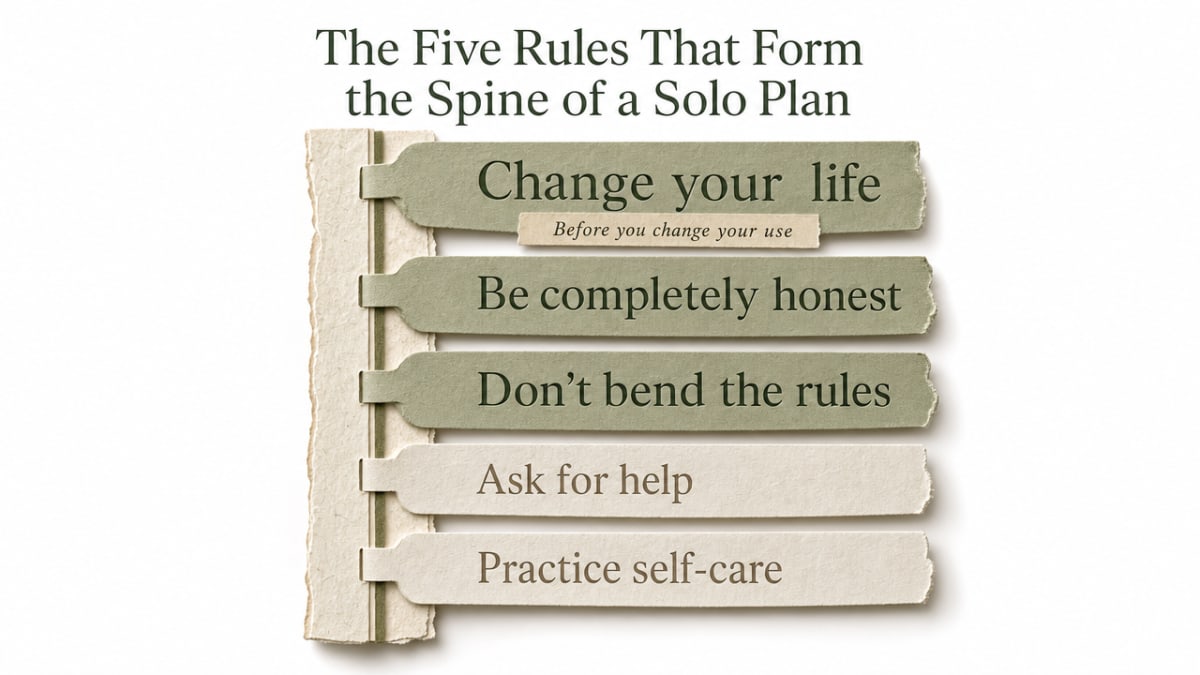
If you’re going to run your own recovery, you don’t need a hundred tips. You need a small set of rules that hold up when the wanting gets loud. Researchers studying relapse prevention have boiled the work down to five 12:
- Change your life
- Be completely honest
- Ask for help
- Practice self-care
- Don’t bend the rules
That’s the entire spine.
Three of them deserve their own treatment here. The other two — asking for help and practicing self-care — get their own sections later, because they’re where solo recovery either gets reinforced or quietly falls apart. For now, focus on the three rules that are most yours to enforce when no one is watching.
Change Your Life Before You Change Your Use
People try to white-knuckle the same life that produced the using and wonder why it doesn’t take. The first rule in the relapse-prevention model is to change your life — the schedule, the routines, the relationships, the empty hours — not just the substance 12.
That means looking honestly at the Tuesday night that always ends the same way. The drive home that passes the same liquor store. The friend whose calls only come when something is about to go sideways. You don’t have to torch everything. You do have to interrupt the loops your using is currently riding on. Add a 7 p.m. walk. Move the bottle out of the kitchen. Pick one person you stop replying to after 9 p.m. Small structural changes give your decisions somewhere new to land.
Practice Brutal, Boring Honesty
The second rule sounds simple and isn’t: be completely honest, especially with yourself 12. Addiction runs on small, well-rehearsed lies — about how much, how often, why this time was different, what you’ll do tomorrow.
Honesty in solo recovery looks unglamorous. Write down what you actually used today, not what you meant to use. Track the trigger, not just the slip — the argument, the boredom, the 4 p.m. dip in energy that always points you toward the same place. If you keep a notebook or a notes app, the rule is one line, true: “Drank four, not two. Wife had asked twice.” You don’t have to share it. You just can’t lie in it. The honesty is the intervention; the page is the witness.
Don’t Bend the Rules You Just Wrote
The last rule is the one that catches people: don’t bend the rules 12. Your brain, mid-craving, is a very persuasive lawyer. It will argue that tonight is an exception. That the wedding doesn’t count. That one is fine because you’ve been so good.
Write your rules when you’re calm and decide ahead of time what’s non-negotiable. Maybe it’s: no drinking at home, no using alone, no pills you didn’t get from a pharmacy, no “just one.” Then treat those lines the way you’d treat a peanut allergy — not a preference, a fact. NIDA frames addiction as a chronic condition that responds to ongoing structure rather than one-shot willpower 10. Structure means the rules stay the same on hard nights. That’s the whole point of writing them down on easy ones.
Run Your Own Brief Intervention: The FRAMES Self-Coaching Script
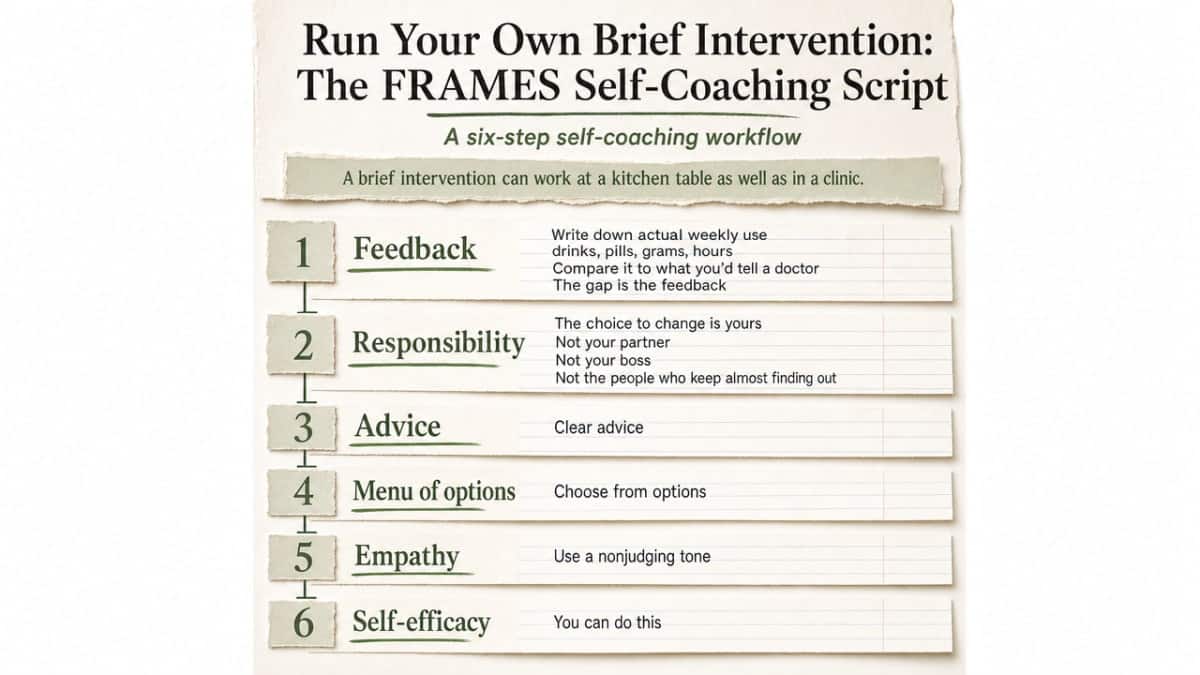
Clinicians who work in primary care and emergency rooms have a tool they use when they only get one short conversation with someone about their drinking or drug use. It’s called a brief intervention, and it follows a six-part script called FRAMES: Feedback, Responsibility, Advice, Menu of options, Empathy, and Self-efficacy 2, 15. You can run the same script on yourself. It works on a kitchen table as well as it works in a clinic.
- Feedback.
- Write down what you actually use in a week. Drinks, pills, grams, hours. No editing. Compare it to what you’d tell a doctor. The gap between those two numbers is the feedback 15.
- Responsibility.
- Nobody else is going to decide this for you. Not your partner, not your boss, not the people who keep almost finding out. The choice to change is yours, and naming that out loud — “this is mine to do” — is part of the work 2.
- Advice.
- Give yourself the advice a steady friend would give: cut down to a specific number, stop for thirty days, or quit one substance entirely. Be specific. “Drink less” isn’t advice. “No alcohol Sunday through Thursday” is.
- Menu of options.
- List the ways you might get there: removing alcohol from the house, deleting a dealer’s number, switching your after-work routine, trying a digital CBT program, going to one mutual-help meeting. Pick two to start. Save the others for when the first two stop working 15.
- Empathy.
- Talk to yourself the way you’d talk to a friend in the same spot. Not soft, not harsh. Most people who try to change their use need more than one attempt. That’s information, not a verdict on your character 2.
- Self-efficacy.
- End with evidence that you can do hard things. Times you’ve quit something else. A week you already strung together. A morning you chose differently. Brief interventions work partly because they leave people believing change is possible 15— and you’re allowed to give yourself that ending too.
Run this script on a Sunday night with a notebook open. It takes about twenty minutes. The point isn’t to feel inspired. It’s to leave the table with a number, a date, and two specific moves you’re going to make this week.
Self-Care Isn’t Soft. It’s Structural.
Self-care got hijacked by candles and bubble baths, which is a shame, because in recovery research it means something much more practical. A 2025 scoping review of self-care in addiction recovery pulled together the evidence and landed on a short list of behaviors that actually move the needle 13:
- Healthy sleep
- Regular physical activity
- Stress management
- Boundary-setting
These aren’t add-ons. They’re load-bearing.
Sleep first, because nothing else works without it. When you’re underslept, the part of your brain that makes the rules goes quiet and the part that wants relief gets loud. Pick a bedtime and protect it the way you’d protect a paycheck. If withdrawal or anxiety is wrecking your sleep, that’s a signal worth taking seriously — not a personality flaw.
Movement next. Not a transformation, not a six-day split. A walk after dinner. Twenty minutes that puts you somewhere your usual cues aren’t. The point isn’t fitness; it’s giving your nervous system another way to discharge the day.
Stress management is where most solo plans quietly collapse. Cravings rarely show up out of nowhere — they ride in on a hard conversation, an unpaid bill, a moment of loneliness around 9 p.m. Pick two or three responses you trust before you need them: a five-minute breathing exercise, a phone call to one specific person, a cold shower, a walk around the block. Then use them in that order when the wanting starts.
Boundaries close the loop. That means deciding which people you don’t see on Friday nights yet. Which group chats you mute. Which family events you skip this year without apologizing for six paragraphs. Boundaries aren’t punishment; they’re how you stop pouring your recovery into the same hole that drained it before.
The scoping review is careful — self-care is one part of a broader recovery plan, not a replacement for treatment when treatment is needed 13. But it’s also the part you control completely. Every night you sleep, every walk you take, every boundary you hold is a small vote you cast for the version of yourself you’re building. They count.
Digital CBT and Mutual-Help Groups: The Honest Middle Ground
Between pure solo work and walking into a clinic, there’s a middle tier most people don’t know exists. It’s where you keep your privacy, keep your schedule, and still borrow the structure of evidence-based treatment. Two tools live here: digital CBT programs and mutual-help groups.
Digital CBT is exactly what it sounds like — a computer-based program that walks you through the same cognitive-behavioral skills a therapist would teach in person: spotting triggers, challenging the thoughts that lead to use, practicing refusal, building coping plans. The most-studied version is called CBT4CBT, and a Harvard-summarized trial compared it head-to-head with treatment-as-usual and with therapist-delivered CBT. At six-month follow-up, the percentage of days abstinent from any drug use was 75% in the CBT4CBT group, 67% in the treatment-as-usual group, and 61% in the live-therapist CBT group 6. People in the computer-guided arm also reported higher satisfaction and were less likely to drop out 6.
That’s a striking result, and it’s worth holding it carefully. It was a small trial in a specific population, not proof that a laptop beats a clinician across the board 6. What it does suggest is that a structured, self-paced CBT program is a real tool — not a placebo, not a gimmick — and one you can use at your kitchen table without anyone knowing.
Mutual-help groups are the other half of this tier. AA, NA, SMART Recovery, Refuge Recovery, LifeRing — the model differs, but the function is similar: regular contact with other people doing the same work. A review of mutual-help groups for illicit drug use disorders found the evidence “encouraging but incomplete,” with participation associated with better outcomes while acknowledging that people who show up are also people who chose to show up 7. The honest read is that meetings aren’t a magic input, but they break the isolation that quietly powers using, and online and anonymous formats now let you try one without committing your name to anything.
If you want a middle path that isn’t really alone but isn’t yet a treatment program, pair one structured digital tool with one weekly meeting — in person or online, whichever you’ll actually do. You keep the agency. You just stop running the whole thing inside your own head.
The Red-Line Checklist: Signals That Mean Stop Going Alone Today
Every plan in this article assumes you get to decide your own pace. This section is the exception. There are a handful of situations where solo recovery isn’t a choice between brave and cautious — it’s a choice between getting medical help and risking something you can’t take back. The point isn’t to scare you. It’s to give you a short, specific list you can check yourself against tonight, so you know exactly when to stop running this by yourself and pick up the phone.
Withdrawal That Belongs in a Medical Setting
Some substances are safe enough to stop on your own. Three are not: alcohol, benzodiazepines (Xanax, Klonopin, Ativan, Valium), and opioids. Heavy daily alcohol use can produce withdrawal that includes shaking, racing heart, hallucinations, and in serious cases seizures or delirium tremens, which can be fatal without medical care. Benzodiazepines work on the same brain system and carry the same seizure risk when stopped abruptly. Opioid withdrawal is rarely deadly on its own, but the relapse risk after unsupervised detox is high, and the danger of overdose climbs once tolerance drops 3.
Psychiatric Red Lines: Suicidality, Psychosis, Spiraling Mood
The other red lines are above the neck. If you’re having thoughts of ending your life, planning how you’d do it, or finding that those thoughts get louder when you drink or use, that’s the moment to stop managing this privately. Call 988 (the Suicide and Crisis Lifeline) or go to an emergency room. You don’t need to have a plan or a script. You can say, “I’m using, and I’m not safe right now,” and that is enough.
Psychosis is the other clear line. Hearing voices that aren’t there, seeing things others don’t see, becoming convinced people are watching you or coming for you — especially during heavy stimulant use, alcohol withdrawal, or after stopping benzodiazepines — is a medical situation, not a willpower one. So is a mood that’s spiraling: days without sleep, can’t-stop crying, can’t-feel-anything flatness, or a rage you don’t recognize.
NIMH is direct about this: when substance use and serious mental health symptoms are tangled together, trying to treat one without the other usually fails, and the risk of self-harm climbs 9. Primary care guidance says the same — these are referral situations, not office-visit situations 1. If you’ve quietly noticed any of this in yourself over the last few weeks, you’re not overreacting by reaching out. You’re reading the chart correctly.
When Depression, Anxiety, or PTSD Are Riding Along
If your using is tangled up with something heavier — a depression you’ve had since your twenties, anxiety that climbs every Sunday night, PTSD from something you still don’t talk about — you’re not failing at solo recovery because you’re weak. You’re trying to solve two problems with tools designed for one.
Co-occurring disorders are the rule, not the exception. NIMH is direct that people with mental health conditions are more likely than others to develop a substance use disorder, and that the two feed each other in ways that make treating one without the other unusually hard 9. The drinking dulls the panic, the panic comes back louder, the drinking has to do more work. That’s the loop. White-knuckling either half rarely unhooks it.
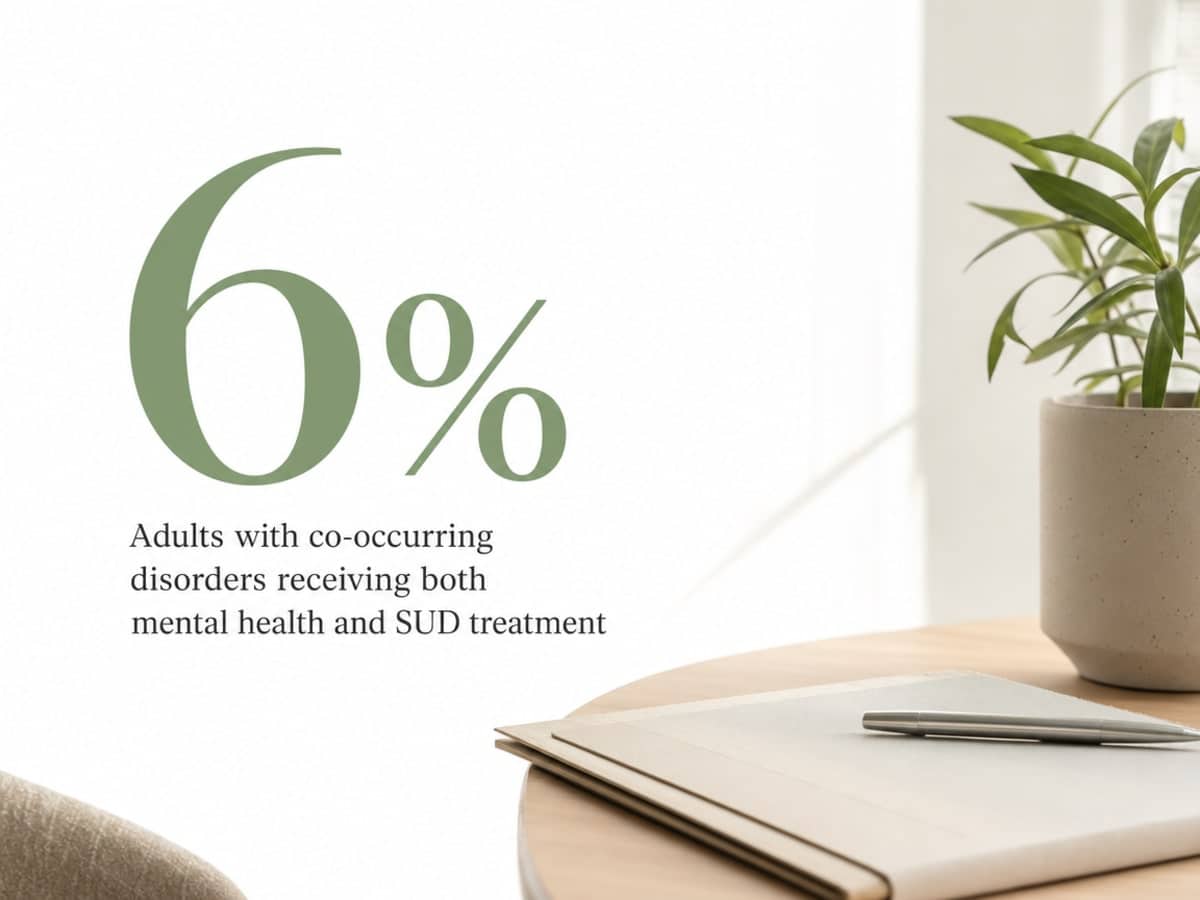
And yet most people with both end up trying. An HHS analysis of national data found that only 6% of adults with co-occurring mental health and substance use disorders receive treatment for both conditions 5. The other 94% are getting one, or neither, or are doing what you’re doing right now — running it themselves at the kitchen table. That gap isn’t a comment on your character. It’s a system problem you’re up against.
The evidence on what actually works for this group is consistent. Integrated treatment — where the same team addresses the substance use and the mental health condition together, rather than sending you to two clinics that don’t talk to each other — produces better engagement and outcomes than treating them separately or sequentially 4, 8. For outpatients with anxiety or depression on top of substance use, integrated care has been shown to increase motivation for treatment itself, which matters because motivation is what carries you through the weeks when neither problem is improving fast 8.
The practical read for you tonight: if a mental health condition is part of why you’re using, solo work on the using alone will keep hitting the same wall. You don’t have to commit to a program this week. You do have to stop treating the mood, the trauma, or the anxiety as background noise. Tell your primary care doctor about both. Ask specifically for someone who treats them together. That one conversation is the move that changes the math.
If You Decide to Bring Someone In
At some point, you may decide the privacy isn’t worth what it’s costing you. That’s not a failure of solo recovery — it’s solo recovery doing its job, which is helping you see your situation clearly enough to choose the next move.
Bringing someone in doesn’t have to mean a residential program tomorrow. The most useful first step is usually the smallest one: a single honest conversation with a primary care doctor about what you actually use and how often. They can screen, treat withdrawal safely if that’s on the table, and refer you to the right level of care instead of the loudest one 1. If a mental health condition is part of the picture, ask specifically for a clinician or program that treats both together — integrated care consistently outperforms two disconnected providers 4.
Outpatient counseling is where most people land when they’re ready for structure without uprooting their life. You keep your job, your home, your routines, and you add weekly individual and group therapy, relapse-prevention skills, and a clinician who knows your name 11. If you’re in Ohio and want a starting point, Arrow Passage Recovery offers outpatient and dual-diagnosis programs designed for exactly this handoff — where the private work you’ve been doing meets a team that can carry some of it with you.
You don’t have to be at the bottom to deserve help. You just have to be ready for the next honest step.
Ready for a real change? Let’s talk now
Connect with someone who understands and can guide your next step toward recovery, day or night.
Ready for extra support on your path?
Talk through your next steps and get guidance tailored to your recovery goals.
Frequently Asked Questions
Can you really recover from addiction without going to rehab?
Yes, for some people. Large U.S. survey data shows a meaningful share of adults with substance problems improve over time without formal treatment, particularly those with milder dependence and fewer co-occurring conditions 14. That doesn’t mean rehab is optional for everyone — severe dependence, withdrawal risk, and untreated mental illness change the math. Solo recovery is real; it’s just not the right fit for every situation.
Is it safe to detox from alcohol or opioids by myself at home?
Not for heavy daily use. Alcohol and benzodiazepine withdrawal can cause seizures and delirium tremens, which are medical emergencies. Opioid withdrawal is rarely fatal on its own, but relapse risk is high and overdose danger climbs once tolerance drops 3. If you drink to morning shakes, use benzos or opioids daily, or have had a prior withdrawal seizure, call your doctor or a detox program before you stop 1.
What self-directed strategies actually have evidence behind them?
Four hold up consistently. Cognitive-behavioral skills like spotting triggers and challenging use-related thoughts work whether delivered in person or through structured digital programs 6. The relapse-prevention “five rules” — change your life, be honest, ask for help, practice self-care, don’t bend the rules — give you a tested spine 12. Self-care routines (sleep, movement, stress management, boundaries) support recovery 13. Mutual-help groups add accountability and break isolation 7.
How do I know when solo recovery isn’t working anymore?
Watch for specific signals: repeated failed quit attempts, use that’s climbing despite your plan, withdrawal symptoms that frighten you, suicidal thoughts, psychosis, or a mental health condition that keeps pulling you back to use 1, 9. If you’re hiding more, sleeping less, or your red-line rules keep bending, that’s data — not failure. The move isn’t to try harder alone; it’s a single honest conversation with a doctor about what’s actually happening.
What if I also have depression, anxiety, or PTSD alongside my substance use?
Treat both, together. People with mental health conditions are more likely to develop substance use disorders, and trying to fix one while ignoring the other usually fails 9. Integrated care — where the same team handles both — produces better engagement and outcomes than two disconnected providers, and it specifically increases motivation to keep going 4, 8. Ask your doctor for a clinician or program that treats both conditions in one place.
Do online CBT programs and mutual-help groups count as ‘alone’?
Technically no, and that’s the point. They’re the middle tier — you keep your privacy and your schedule while borrowing real structure. A structured digital CBT program teaches the same skills a therapist would, and the research is genuinely promising even with small-trial limits 6. Mutual-help groups break isolation, which quietly powers using 7. If pure solo isn’t holding, pairing one digital tool with one weekly meeting is the next honest step.
References
- A Guide to Substance Abuse Services for Primary Care Clinicians. https://www.ncbi.nlm.nih.gov/books/NBK64827/
- Brief intervention in substance use disorders. https://pmc.ncbi.nlm.nih.gov/articles/PMC5844156/
- Psychosocial interventions and opioid detoxification for drug misuse. https://pmc.ncbi.nlm.nih.gov/articles/PMC1934496/
- Integrating Treatment for Co-Occurring Mental Health Conditions. https://pmc.ncbi.nlm.nih.gov/articles/PMC6799972/
- Adoption of Integrated Care for People with Co-Occurring Mental and Substance Use Disorders. https://aspe.hhs.gov/sites/default/files/documents/e2ccdd7991f1de5060983598cb66624f/adoption-integrated-care.pdf
- Small study suggests benefits of computer-guided CBT for substance abuse. https://www.health.harvard.edu/blog/small-study-suggests-benefits-of-computer-based-cbt-for-substance-abuse-2018082014434
- Effectiveness of Mutual Help Groups for Illicit Drug Use Disorders. https://pmc.ncbi.nlm.nih.gov/articles/PMC12360454/
- The effectiveness of integrated treatment in patients with substance use disorders co‑occurring with anxiety and/or depression. https://pmc.ncbi.nlm.nih.gov/articles/PMC3974008/
- Finding Help for Co-Occurring Substance Use and Mental Disorders. https://www.nimh.nih.gov/health/topics/substance-use-and-mental-health
- Treatment and Recovery | National Institute on Drug Abuse (NIDA). https://nida.nih.gov/publications/drugs-brains-behavior-science-addiction/treatment-recovery
- Principles of Drug Addiction Treatment: A Research-Based Guide (Third Edition). https://nida.nih.gov/sites/default/files/podat-3rdEd-508.pdf
- Relapse Prevention and the Five Rules of Recovery. https://pmc.ncbi.nlm.nih.gov/articles/PMC4553654/
- Self‐Care in Addiction Recovery: A Scoping Review. https://pmc.ncbi.nlm.nih.gov/articles/PMC12409770/
- The National Epidemiologic Survey on Alcohol and Related Conditions: Overview and Applications. https://pmc.ncbi.nlm.nih.gov/articles/PMC4618096/
- Chapter 2—Brief Interventions in Substance Abuse Treatment. https://www.ncbi.nlm.nih.gov/books/NBK64942/