
Creating a Plan for How to Wean Yourself Off Alcohol
Key Takeaways
- Before tapering, assess whether your body has become physically dependent on alcohol, because abrupt or rushed reduction can trigger seizures or delirium tremens in high-risk drinkers 3.
- A history of withdrawal seizures, delirium tremens, or significant medical comorbidities rules out home tapering and points toward supervised detox as the only safe path 9.
- Knowing the withdrawal timeline matters because seizure risk peaks between 24 and 48 hours and delirium tremens risk peaks between 48 and 72 hours after the last drink 9.
- A workable taper starts with honestly counting standard drinks, setting a clinician-guided reduction window, and covering basics like thiamine, hydration, and sleep planning 16.
- Unsupported attempts often fail not from weak willpower but from missing structure — no one watching during peak hours, no medication available, and no one to call when cravings hit 17.
- Stop tapering and seek emergency care for seizures, confusion, hallucinations, racing heart, fever with agitation, or persistent vomiting, since these signal severe withdrawal 11.
- Detox alone rarely holds; combining FDA-approved medications like naltrexone or acamprosate with therapy and mutual-help support produces the most durable outcomes 12.
Before You Pour Out the Bottle: The Question That Comes First
You searched for a way to wean yourself off alcohol, which means you already know something has to change. That clarity is real, and it matters. But before you map out a taper or set a quit date, there’s a question that has to come first, and it isn’t about willpower.
It’s this: has your body adapted to alcohol in a way that makes stopping medically dangerous?
That’s not a dramatic question. Alcohol is one of the few substances where withdrawal itself can be life-threatening, and the people most at risk are often the ones who feel the most ready to quit on their own. If you drink daily, wake up shaky, or pour a morning drink to take the edge off, your nervous system has changed. Stopping suddenly, or even tapering too fast without support, can trigger seizures or delirium tremens in people who have a history of severe withdrawal 3.
So the plan you build isn’t a one-size template. It depends on how much you drink, how long you’ve been drinking that way, what your past withdrawals have looked like, and who is around you. The rest of this guide walks you through how to figure out where you actually stand, what a safe taper looks like for your situation, when home tapering crosses into territory that needs medical help, and how to connect the last drink to the recovery work that keeps people sober 15. You don’t have to know all of that yet. You just have to start with the honest question.
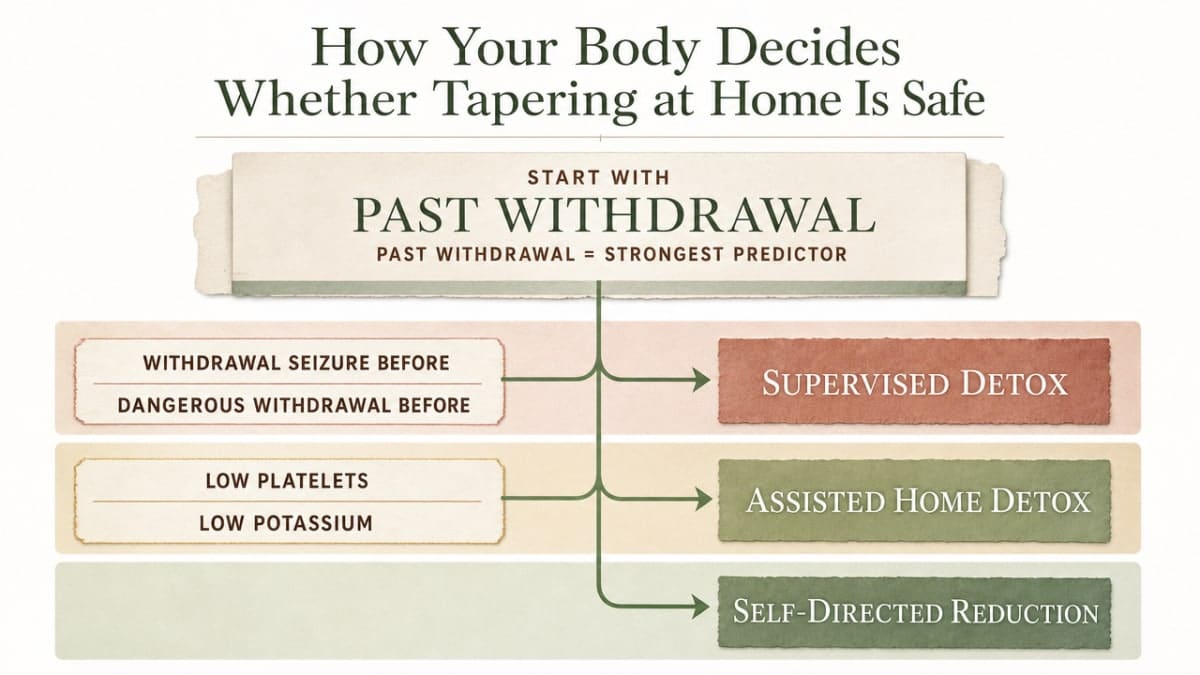
How Your Body Decides Whether Tapering at Home Is Safe
Red Flags That Mean Home Tapering Is Off the Table
Some bodies cannot safely come off alcohol without medical supervision. That isn’t a character flaw or a sign you’ve failed at something — it’s a fact about what alcohol has done to your nervous system over time. The question is whether you fall into that group.
The single most reliable predictor of a dangerous withdrawal is what your past withdrawals looked like. A systematic review of severe alcohol withdrawal found that the course of prior episodes is the strongest signal for what the next one will do, and that thrombocytopenia (low platelets) and hypokalemia (low potassium) on bloodwork also track with severe withdrawal 3. In plain terms, if any of the following describes you, home tapering is not your option:
- You’ve had a withdrawal seizure before, even once.
- You’ve had delirium tremens — confusion, hallucinations, severe agitation, or a hospitalization for withdrawal.
- Your last attempt to stop or cut back produced symptoms that scared you or someone around you.
- You have significant liver disease, a seizure disorder, or unstable heart or psychiatric conditions on top of daily heavy drinking.
If you’re nodding at any of those, the safest next step is supervised detox — inpatient or a closely monitored residential program — not a slower pour schedule at home 9. This isn’t about willpower. Your brain has been chemically braced against a sedative for a long time, and removing that sedative without medical cover is what causes the worst outcomes. The good news is that supervised withdrawal is short, the medications used are well-established, and once you’re through it, the rest of the plan opens up.
The Middle Ground: Daily Drinkers Without Severe Withdrawal History
Most people searching for how to wean themselves off alcohol live in this middle band. You drink every day, or close to it. Maybe a bottle of wine a night, six or eight beers, or several drinks of liquor. You feel rough in the morning. You might shake a little until the first drink, or feel anxious until you know one is coming. But you haven’t had a seizure or a hospitalization for withdrawal, and your last attempts to stop produced sweats, bad sleep, and irritability rather than something medically alarming.
You may be a candidate for assisted home detox — and that word assisted is doing real work. A 2024 study comparing assisted to unassisted home detox found that monitoring and professional involvement changed how the withdrawal unfolded and how often people completed it 2. Home detox protocols built around general practitioner supervision report high patient satisfaction when patient selection is careful and follow-up is built in 1.
What that looks like in practice: a clinician screens you, checks bloodwork, decides whether a short course of medication is appropriate, and someone — a doctor, a nurse line, a telehealth team — is reachable during the hardest 72 hours. You also need a sober adult at home with you. If you can’t assemble that team, the middle ground collapses and you’re back to needing a more structured setting.
Lighter Patterns Where Self-Directed Reduction Can Work
Not everyone reading this is physically dependent. If you drink heavily on weekends but not daily, or you’ve drifted into four or five drinks a night and want to pull back before it becomes something harder to escape, your nervous system probably hasn’t adapted in the way that makes withdrawal dangerous.
For this pattern, the evidence behind brief intervention in primary care is reassuring. Structured conversations with a clinician — combined with self-monitoring and concrete reduction goals — reduce drinking and slow the drift toward more severe problems 5. You can do a lot of this work yourself, especially if you loop in a primary care provider for a single visit to check bloodwork and talk through goals.
The honest test is this: if you skip drinking for a day or two and feel only the psychological pull — boredom, restlessness, a craving — without the physical symptoms (tremor, sweats, nausea, racing heart), self-directed reduction is reasonable. If skipping a day produces physical symptoms, you’re not in this group anymore, and the plan needs to change accordingly.
What Withdrawal Actually Does, Hour by Hour
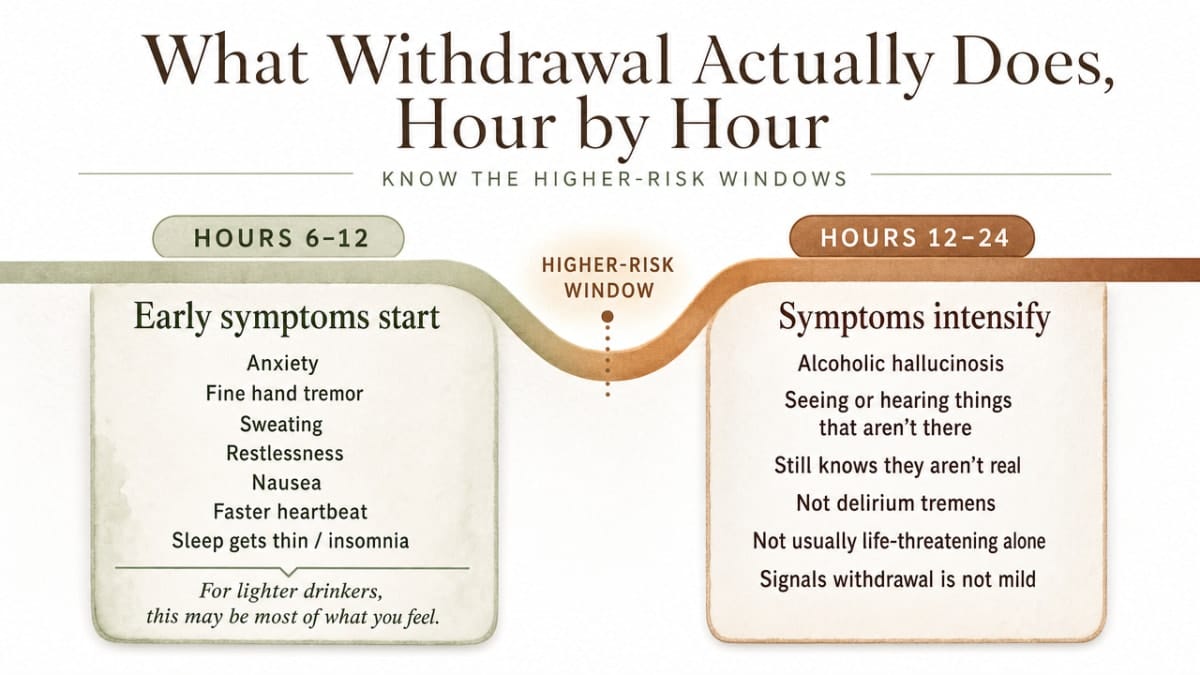
If you’ve never let yourself go more than a few hours without a drink, the timeline below is probably abstract. It shouldn’t be. Knowing which hours carry the most danger is how you decide whether you can ride this out at home with support or whether someone needs to be watching you in a clinical setting 9.
Hours 6 to 12 after your last drink. Early symptoms start. Anxiety. A fine tremor in your hands. Sweating, restlessness, nausea, a faster heartbeat. Sleep gets thin or doesn’t come at all. For lighter drinkers, this may be most of what you feel.
Hours 12 to 24. Symptoms intensify. Some people develop alcoholic hallucinosis — seeing or hearing things that aren’t there while still knowing they aren’t real. This is distinct from delirium tremens and on its own isn’t usually life-threatening, but it tells you the withdrawal is not mild.
Hours 24 to 48. This is the peak risk window for withdrawal seizures. They can happen without warning, in people who have no prior seizure history, and they are the single biggest reason home tapering goes wrong 9.
Hours 48 to 72. The peak window for delirium tremens — severe confusion, disorientation, fever, racing heart, profound agitation. DTs carry real mortality risk and are a medical emergency 11.
Days 4 to 7. For most people without complications, symptoms taper off. Sleep returns in pieces. Anxiety lingers longer than the physical symptoms.
Building a Taper Plan That Respects Your Biology
Count What You Actually Drink
You can’t taper what you haven’t measured. Most people who drink heavily underestimate their intake — not because they’re lying to themselves on purpose, but because a pour at home isn’t a measured drink, and a beer that’s 7% alcohol isn’t the same as one that’s 4%.
Spend two or three days writing down every drink before you change anything. Not to feel bad about the number. To see it. One standard drink in the U.S. is 12 ounces of regular beer, 5 ounces of wine, or 1.5 ounces of 80-proof liquor. A generous pour of wine at the end of a long day is often two standard drinks, not one. A pint of craft beer can be closer to two. The bottle of whiskey you finish over four nights is roughly seventeen standard drinks.
Once you have an honest baseline, you have something to taper from. Without it, you’re guessing at a reduction schedule using a starting number you made up. Screening conversations in primary care use this same step for a reason — measurement comes before the plan 5.
Set a Reduction Window, Not a Finish Line
A taper is not a sprint to zero. If you go too fast, your nervous system reacts the same way it would to going cold turkey, and you lose the whole point of tapering. If you go too slow, you give yourself endless room to stall, renegotiate, and start over. The middle path is a reduction window — a set number of days during which you bring your intake down on a schedule you wrote before you started.
There is no single percentage cut per day that fits every drinker, and any source promising one is making it up. What the evidence does support is that a taper works better when a clinician helps you set the pace and checks in along the way 1. A primary care provider, a telehealth addiction clinician, or an outpatient program can look at your baseline count and your withdrawal history and design a schedule that’s slow enough to be safe and fast enough to actually end.
Pick the dates. Write down the daily target. Put the bottle that’s beyond that day’s target somewhere inconvenient or out of the house entirely. The schedule does the deciding so you don’t have to decide again at 8 p.m. when you’re tired.
Thiamine, Hydration, Sleep, and the Boring Things That Matter
Heavy drinking depletes thiamine (vitamin B1), and low thiamine during withdrawal can cause serious neurological problems that have nothing to do with how strong your willpower is. Hospital withdrawal protocols routinely include thiamine supplementation for exactly this reason — one academic medical center protocol recommends 200 mg orally daily during withdrawal 16. If you’re tapering at home with clinician support, ask about thiamine and a B-complex vitamin. It’s a small thing that prevents big problems.
Hydration matters because alcohol is dehydrating and withdrawal sweats compound that. Water and electrolyte drinks help. Sugary mixers don’t.
Sleep is going to be terrible for a while. Accept that going in. Your brain has used alcohol as a sedative, and when you remove it, sleep architecture falls apart before it rebuilds. Don’t reach for over-the-counter sleep aids without checking with a clinician, and absolutely don’t reach for someone else’s anti-anxiety medication. Plan for a few rough nights. Plan to be home, off work, and not driving during the worst of it. The boring logistics — food in the fridge, a quiet space, a few easy meals — are doing more work than they get credit for.
Who You Tell, and Why That Matters More Than the Schedule
The single change that most reliably improves a home taper is not a smarter schedule. It’s a person. A 2024 study comparing assisted and unassisted home-based alcohol detoxification found that monitoring and professional involvement materially changed how withdrawal unfolded and how often people finished what they started 2. The variable that moved outcomes was support, not grit.
So tell someone. At minimum, one sober adult who will be physically present during the hardest stretch — someone who knows what you’re doing, knows when you took your last drink, and knows the signs that mean call 911. A clinician, even one phone call deep, is the second layer. A primary care doctor, a telehealth addiction service, or a treatment program can give you a contact number for when something feels wrong at 2 a.m.
Saying it out loud is the part that feels hardest and turns out to matter most. The schedule on paper is only as strong as the people who know you’re following it.
Why Going It Alone Tends to Fail
If you’ve tried to quit before by white-knuckling it through a weekend and ended up drinking again by Sunday night, the problem probably wasn’t you. It was the setup.
A systematic review of home-based detox found that completion was feasible when structured support was in place, but participants often had substantial psychiatric comorbidity that made unstructured attempts especially fragile 17.
What that means in practice: the thing that changes outcomes is not how badly you want it. You can want it badly and still have a seizure at hour 36 because no one was watching. You can want it badly and still pour a drink at hour 14 because the anxiety is unbearable and there’s no one to call.
Going it alone fails for ordinary reasons:
- There’s no one to notice when symptoms cross from uncomfortable to dangerous.
- There’s no medication available if withdrawal escalates.
- The cravings hit at predictable hours and the bottle is closer than any source of help.
- Shame keeps you from telling the people who would actually show up.
- Sleep collapses, judgment follows, and the easiest path back to feeling normal is the one you were trying to leave.
None of that is a verdict on your character. It’s a description of what alcohol withdrawal does to a brain without backup. Build the support before you start, not after the first hard night.
When to Stop the Plan and Call for Help
A taper plan is something you commit to, not something you have to finish. If your body starts telling you the plan is too much, the right move is to stop tapering and get medical help — not to push through.
Those signs point toward severe withdrawal, including delirium tremens, which is a medical emergency 11. Don’t drive yourself. Don’t wait to see if it passes. Tell whoever takes you that you’ve been drinking heavily and when your last drink was — that information changes the care you get.
Stopping the plan to get help is not starting over. It’s the plan working.
What Happens After the Last Drink
Medications That Help You Stay Stopped
Detox ends. The hard part doesn’t. The first few weeks after your last drink are when your brain rewires around a substance it’s been leaning on, and that’s also when cravings are loudest. Medications can quiet that signal, and they’re underused for no good reason.
Three FDA-approved medications have the strongest evidence behind them.
- Naltrexone
- Blocks the reward signal alcohol normally produces — for many people, it makes drinking feel less worth it.
- Acamprosate
- Helps stabilize the brain chemistry that’s still recalibrating after months or years of heavy drinking, which can take the edge off the restless, anxious feeling that drives early relapse.
- Disulfiram
- Causes a sharp physical reaction if you drink while taking it, which works for people who want a built-in deterrent and have someone to help them stay consistent with the daily dose.
NICE guidance recommends acamprosate or oral naltrexone after withdrawal for people with moderate to severe alcohol dependence, with disulfiram as an option when the others don’t fit 13. The APA practice guideline echoes this and recommends pharmacologic treatment alongside psychosocial care for moderate to severe AUD 4.
Some clinicians also use topiramate off-label, which has shown promise for reducing craving and the anxiety and depression that ride along with early sobriety 14. None of these are willpower replacements. They lower the volume on the part of your brain that’s still pulling you toward a drink, so the work you’re doing in therapy and at home has a fighting chance.
Therapy, Mutual Help, and Why Detox Alone Rarely Holds
SAMHSA’s detoxification guide is blunt about this: detox by itself rarely produces lasting recovery 15. Getting through withdrawal clears your body. It doesn’t change the patterns that got you drinking heavily in the first place — the stress responses, the social cues, the way evenings are shaped around a bottle, the underlying anxiety or depression or trauma that alcohol was muting.
That’s what the next phase of treatment is for. Cognitive behavioral therapy helps you spot the thoughts and situations that lead to drinking before they end at a drink. Motivational enhancement work strengthens the reasons you started this. If there’s something else going on — depression, PTSD, anxiety, a bipolar diagnosis — dual diagnosis treatment addresses both at once, because treating one without the other usually means losing ground on both.
Mutual-help groups matter for a reason that doesn’t show up in symptom checklists: they put you in a room with people who know exactly what hour 36 felt like. NIAAA’s review of evidence-based treatment finds that combining medication with behavioral therapy and mutual-help support tends to produce the best outcomes 12. The combination isn’t redundant. Each piece reaches something the others can’t.
If you’ve relapsed before, this is the part that was probably missing. Detox without follow-up is a door that closes behind you and opens again two weeks later.
Finding a Provider and Paying for Care
If you don’t have a provider yet, the simplest starting point is SAMHSA’s National Helpline at 1-800-662-HELP. It’s free, confidential, available 24 hours a day, and connects you with treatment options in your area 6. You can also start with your primary care doctor, who can write referrals, run baseline bloodwork, and prescribe AUD medications.
Cost is real, and it shouldn’t be the reason you stall. Most accredited treatment programs accept major insurance — Aetna, Blue Cross Blue Shield, UnitedHealthcare, Cigna, and Tricare among them — and verifying coverage is usually a single phone call. Ohio regulates residential substance use treatment through the Department of Mental Health and Addiction Services, so any reputable program will be state-licensed and able to document accreditation 8.
What to ask when you call a program: do they handle medical detox, do they offer the level of care you need (residential, partial hospitalization, intensive outpatient), do they treat co-occurring mental health conditions, and what does aftercare look like once you finish. Programs like Arrow Passage Recovery are built around that full continuum, which is what the evidence keeps pointing toward — detox, treatment, and aftercare connected, not handed off and forgotten.
Connect Now for Immediate Support and Guidance
Speak directly with a caring specialist who can help you start your alcohol recovery plan today.
Start Building Your Personalized Alcohol Tapering Plan
Get expert support for creating a safe, effective strategy to reduce your alcohol use and regain stability.
Frequently Asked Questions
Is it safe to wean myself off alcohol at home?
It depends on your drinking history. If you’ve had a withdrawal seizure, delirium tremens, or daily heavy drinking with morning shakes, home tapering is not safe for you — supervised detox is 3. For moderate daily drinkers without that history, assisted home detox with clinician check-ins and a sober support person present can work, and it outperforms going it alone 2.
How long does alcohol withdrawal last?
Early symptoms — anxiety, tremor, sweating — start 6 to 12 hours after your last drink. The peak danger window for seizures falls between hours 24 and 48, and delirium tremens risk peaks between 48 and 72 hours 9. For most people without complications, physical symptoms ease by days 4 to 7 11. Anxiety and poor sleep often linger longer.
How much should I cut back each day when tapering?
There’s no single percentage that fits every drinker, and any source promising one is making it up. A clinician — primary care, telehealth addiction service, or outpatient program — should set the pace based on your baseline count, drinking history, and prior withdrawals 1. Tapers that include professional monitoring complete at higher rates than self-designed schedules 2.
What are the warning signs that I need to go to an emergency room?
Call 911 or go to an ER if you have a seizure of any length, confusion about where you are or what day it is, hallucinations you can’t tell are real, a racing heart with chest pain, a fever with severe shaking, or vomiting you can’t keep fluids down through. These point toward severe withdrawal, including delirium tremens — a medical emergency 11.
Do I still need treatment after I get through withdrawal?
Yes. SAMHSA is direct: detox alone rarely produces lasting recovery 15. Withdrawal clears your body, but it doesn’t change the patterns that built heavy drinking. Combining FDA-approved medications like naltrexone or acamprosate with behavioral therapy and mutual-help support produces the best outcomes 12. If depression, anxiety, or PTSD rides alongside the drinking, dual diagnosis treatment addresses both at once.
What if I’ve tried to quit before and relapsed?
Relapse is common, and it’s almost never about character. Most prior attempts fail because the structure wasn’t there — no monitoring during peak withdrawal hours, no medication to quiet cravings, no therapy addressing what drinking was managing 2. The APA guideline recommends pharmacologic treatment alongside psychosocial care for moderate to severe AUD 4. SAMHSA’s helpline at 1-800-662-HELP can connect you with options 6.
References
- Home detox – supporting patients to overcome alcohol addiction. https://pmc.ncbi.nlm.nih.gov/articles/PMC6299173/
- Assisted Versus Unassisted Domiciliary Alcohol Detoxification. https://pmc.ncbi.nlm.nih.gov/articles/PMC11572512/
- Predictors of severe alcohol withdrawal syndrome: a systematic review and meta-analysis. https://pubmed.ncbi.nlm.nih.gov/25346507/
- The American Psychiatric Association Practice Guideline for the Pharmacological Treatment of Patients With Alcohol Use Disorder. https://pubmed.ncbi.nlm.nih.gov/29301420/
- Screening and Brief Intervention in Primary Care Settings. https://pmc.ncbi.nlm.nih.gov/articles/PMC6601648/
- National Helpline for Mental Health, Drug, Alcohol Issues – SAMHSA. https://www.samhsa.gov/find-help/helplines/national-helpline
- Core Resource on Alcohol. https://www.niaaa.nih.gov/health-professionals-communities/core-resource-on-alcohol
- State Residential Treatment for Behavioral Health Conditions: Regulation and Policy – Ohio. https://aspe.hhs.gov/sites/default/files/2021-08/StateBHCond-Ohio.pdf
- The ASAM Clinical Practice Guideline on Alcohol Withdrawal Management. https://pubmed.ncbi.nlm.nih.gov/32511109/
- Alcohol Withdrawal Syndrome: Benzodiazepines and Beyond. https://pmc.ncbi.nlm.nih.gov/articles/PMC4606320/
- Alcohol Withdrawal in Hospitalized Patients. https://www.ncbi.nlm.nih.gov/books/NBK604324/
- Recommend Evidence-Based Treatment: Know the Options. https://www.niaaa.nih.gov/health-professionals-communities/core-resource-on-alcohol/recommend-evidence-based-treatment-know-options
- Harmful drinking and alcohol dependence: advice from recent NICE guidance. https://pmc.ncbi.nlm.nih.gov/articles/PMC3223772/
- Treatment of alcohol dependence with low-dose topiramate. https://pmc.ncbi.nlm.nih.gov/articles/PMC3062593/
- Detoxification and Substance Abuse Treatment (TIP 45 Quick Guide). https://nida.nih.gov/sites/default/files/samhsa_detoxification_and_substance_abuse_treatment.pdf
- Alcohol Withdrawal Prevention & Treatment. https://med.uth.edu/surgery/alcoholwithdrawl/
- Home‐based detoxification for individuals with alcohol or drug dependence: A systematic review. https://pmc.ncbi.nlm.nih.gov/articles/PMC11814356/