
IOP Alcohol Treatment Explained
Key Takeaways
- An Intensive Outpatient Program for alcohol use disorder is an ASAM Level 2.1 service delivering at least nine structured clinical hours per week without requiring an overnight stay 18, 19.
- For working adults at moderate severity, a well-structured IOP produces outcomes comparable to residential care when continuing care is built into the plan 2.
- Credible programs run under physician direction, combine group and individual psychotherapy, integrate care for co-occurring depression, anxiety, or PTSD, and can prescribe naltrexone, acamprosate, or disulfiram alongside counseling 4, 10, 20.
- What happens after the intensive phase matters as much as the phase itself — structured continuing care nearly doubles the odds of avoiding heavy drinking compared with IOP alone 9.
What the evidence says about treating alcohol use disorder without leaving your life
You probably already know the drinking has crossed a line. What you don’t know is whether real treatment is possible without disappearing for a month, telling your boss, or rearranging your kids’ lives around your recovery. That question deserves a straight answer.
Here it is: for many adults with alcohol use disorder, a well-structured Intensive Outpatient Program produces outcomes comparable to inpatient or residential care, particularly when continuing care is built into the plan 2. That conclusion comes from a peer-reviewed review of substance abuse IOP outcome studies covering mixed adult populations, and the authors are careful to note that program quality and post-treatment support are what move the numbers. IOP is not a watered-down version of the real thing. For the right person, at the right level of severity, it is the right thing.
That matters because the standard mental picture of “alcohol treatment” — packed suitcase, 28-day stay, vague excuse to coworkers — is one reason so many people who need help never start. IOP exists at a defined level of clinical intensity (ASAM Level 2.1), with specific structure, hours, and services 18, 19. It sits on a continuum that lets you step up if you need more, or step down as you stabilize 3.
The rest of this guide walks through what that actually looks like — the hours, the groups, the medications, the continuing care that holds the gains — so you can decide what fits your life with your eyes open.
What an Intensive Outpatient Program actually is (ASAM Level 2.1)
The nine-hour minimum and what those hours contain
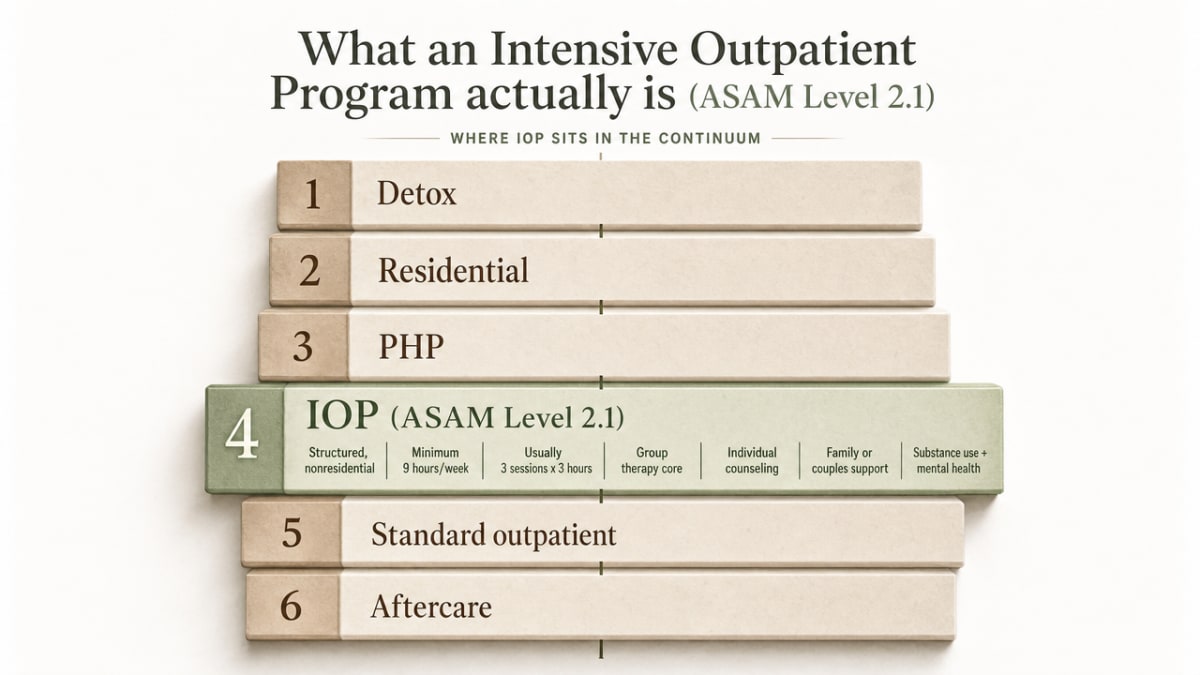
IOP has a definition, not a vibe. Under the American Society of Addiction Medicine’s placement criteria, an adult IOP is classified as Level 2.1: a structured, nonresidential service that delivers a minimum of nine hours of clinical contact per week, organized around groups but built to address both substance use and co-occurring mental health concerns 19. SAMHSA’s TIP 47 describes the same floor — “multifaceted treatment services… for a minimum of 9 hours per week” in a structured outpatient setting 18. Most programs run three sessions a week, three hours each. Some stretch to four or five days, especially early on.
What fills those hours is not random. Expect:
- Group therapy as the spine of the week
- Individual sessions with a primary counselor
- Family or couples sessions when relevant
- Structured education on relapse triggers, craving, and the neurobiology of alcohol use 18, 19
You will also get medical oversight — a physician or advanced practice clinician directs the program and signs off on your treatment plan, which is why insurers, including Medicare, treat IOP as a covered medical service rather than a self-help group 4.
The nine-hour floor matters because it is enough contact to interrupt the pattern that brought you here. You leave a Tuesday evening group, sleep on what came up, and walk back into Thursday’s session before the insight has time to evaporate. That cadence is the point.
Where IOP sits on the continuum of care
Think of alcohol treatment as a ladder, not a single door:
- At the top sit medically supervised detox and 24-hour residential care, used when withdrawal is dangerous or daily life is too unstable to support recovery 3.
- A step down from there is partial hospitalization (PHP), which typically runs 20 or more clinical hours per week without an overnight stay.
- Below PHP is IOP at nine-plus hours per week 18, 19.
- Below IOP is standard outpatient counseling — usually one session a week.
- Aftercare and mutual-support groups wrap around the whole structure.
The ladder is built for movement in both directions. SAMHSA’s continuum chapter calls this the step-up/step-down model: a patient who stabilizes in residential care steps down to IOP to practice new skills in real life, while a patient struggling at standard outpatient steps up to IOP for more support before a relapse forces a higher level of care 3. NIAAA frames it the same way, listing intensive outpatient among the recognized intensity options for people with more complex needs 1.
For a working adult, IOP often lands in the middle of the ladder for a clinical reason, not a logistical one. You are well enough to sleep at home, hold a job, and stay safe between sessions — but you need more than an hour a week to actually change how you drink. That gap is exactly what Level 2.1 was designed to fill.
Why this level of care fits a working schedule by design
Morning tracks, evening tracks, and the clinical reason both exist
The 6 a.m. group exists because alcohol treatment that doesn’t touch your real life doesn’t generalize to it.
That sounds like a marketing line. It isn’t. ASAM Level 2.1 is defined as a nonresidential, group-based service precisely so you keep waking up in your own house, riding the same elevator, eating dinner with the same people, and bringing those exposures back into the room 19. The Nebraska behavioral health definition puts it plainly: IOP “allow[s] the individual to apply skills in natural environments” and supports “integration into the community” 19. A morning track lets you process Sunday’s wedding before Monday’s quarterly review. An evening track lets you sit in group after a brutal Tuesday and walk into Wednesday with a plan instead of a hangover.
SAMHSA’s TIP 47 treats this scheduling flexibility as part of the clinical design, not a customer-service concession — IOP is meant to be delivered in a structured outpatient setting that fits around work, family, and other responsibilities so treatment and life inform each other 18. Most programs run a 9 a.m. or a 6 p.m. block, three days a week.
Pick the one you can sustain for two to three months without lying to anyone about where you are.
Privacy, employer disclosure, and what stays confidential
You do not have to tell your employer you are in treatment. Federal health privacy law treats your IOP records like any other medical record, and substance use treatment carries an additional layer of confidentiality protection on top of that. Your insurance claim shows a billing code, not a confession.
What you may have to plan around is the schedule itself. Three evenings a week is easier to absorb without explanation than three mid-mornings, which is one reason evening tracks fill faster. If your role requires daytime sessions and someone asks, “medical appointment” is true, sufficient, and protected. You are not obligated to elaborate.
There are narrower situations where disclosure becomes a real question — safety-sensitive roles, professional licensure programs, FMLA paperwork, or a job where you are already on a performance plan tied to alcohol use. Those are conversations to have with the program’s intake clinician and, if needed, an employment attorney, before you make a decision either way.
For most working adults, IOP runs quietly in the background of a normal week. The people who need to know are the ones you choose to tell.
Inside a typical week: groups, individual sessions, and homework
Picture a Monday. You finish work at 5:30, eat something on the way, and walk into a process group at 6 p.m. with seven or eight other adults who also drink too much and also have jobs. The first hour is check-ins — what happened since Friday, what almost happened, what worked. The second hour is a structured skills module: identifying high-risk situations, mapping the chain of events that led to a slip, rehearsing a refusal script for the office happy hour you have on Thursday. The third hour is more group work, often a topic like shame, family roles, or how to talk to a partner who is angry and exhausted.
Wednesday looks similar in shape but different in content. A relapse-prevention worksheet you started Monday gets reviewed in pairs. Someone shares a craving they rode out without drinking. The clinician introduces a cognitive behavioral exercise — pulling apart the automatic thought “I deserve this” into the evidence for it, the evidence against it, and a more accurate replacement 17.
Once a week, usually wedged into the schedule or scheduled separately, you meet one-on-one with your primary counselor for 45 to 60 minutes. That session is where the personal stuff lands — the trauma history, the marriage, the medication questions, the goals you would not put on the table in front of seven strangers. Medicare’s coverage rules name both group and individual psychotherapy as required components for a reason: each does work the other can’t 4.
Family or couples sessions get folded in when relevant, often every two or three weeks 18. Between sessions you have homework — a craving log, a daily mood rating, a sobriety sampling assignment, a worksheet on values. None of it is busywork. It is what keeps Tuesday connected to Thursday.
The treatment gap that makes accessible outpatient care matter
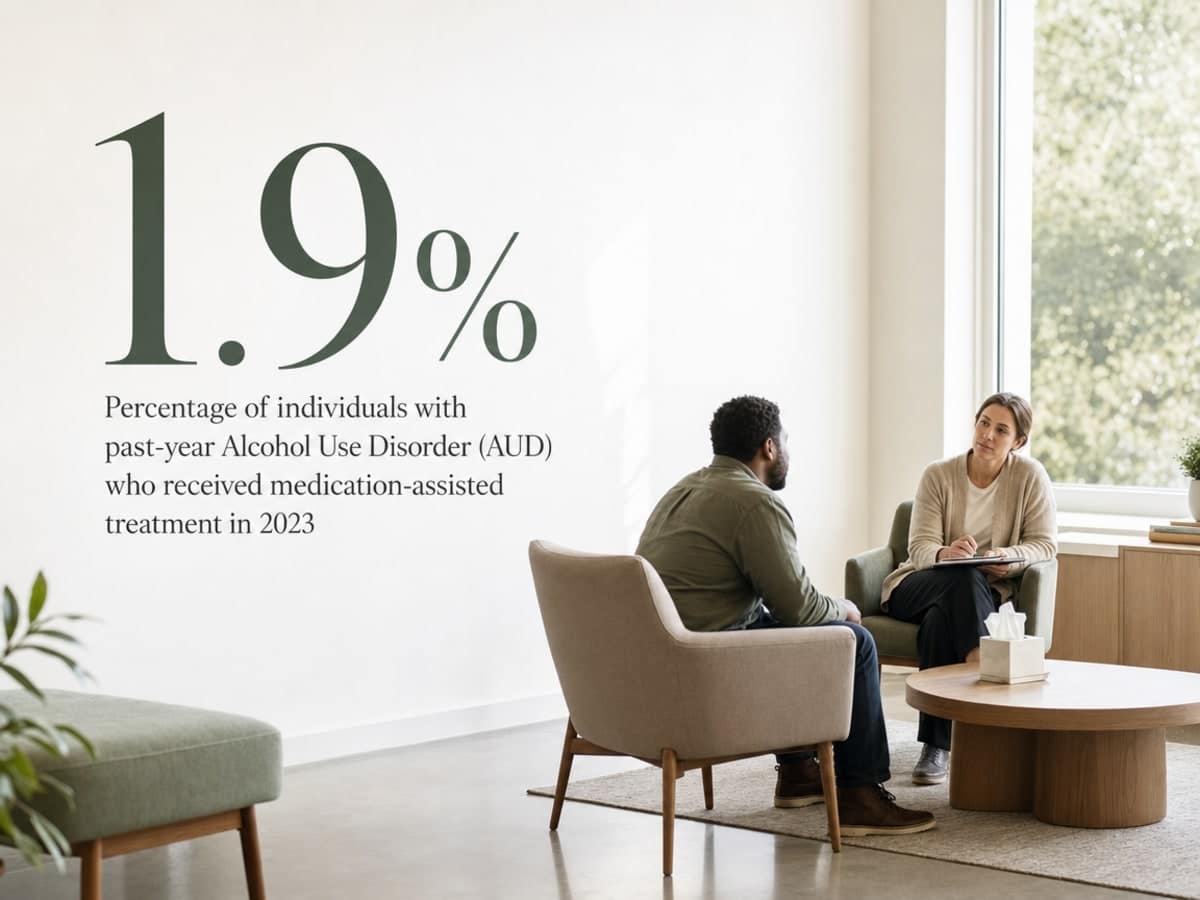
Here is the part that should make you feel less alone, not more ashamed: in 2023, an estimated 28.9 million people ages 12 and older in the United States met criteria for past-year alcohol use disorder, and only 1.9% of them received any medication-assisted treatment for it 6. That figure comes from NIAAA’s national surveillance data, and it covers MAT specifically — counseling-only treatment numbers are higher, but still a small slice of the people who could benefit.
Sit with the ratio for a second. The problem you are trying to address is not rare. The decision to actually do something about it is.
Most of the gap is not about willingness. It is about access — programs that fit a workweek, providers who treat AUD as a medical condition rather than a character flaw, and a structure that doesn’t require quitting your job to start. IOP exists in that gap on purpose. Walking into one puts you in the small fraction of people with AUD who get real, structured clinical care for it, and that is already a meaningful step before you have done any of the harder ones.
Dual diagnosis is the standard, not an add-on
If you drink the way you drink, there is a real chance something else is running underneath it. Depression that predates the bottle. Anxiety that the first two drinks quiet down. A trauma history that the third and fourth drinks bury. The clinical literature is direct about this: alcohol use disorder co-occurs with depression, anxiety, and PTSD at rates high enough that treating one without the other is associated with worse outcomes 10.
That is why integrated care — the same team, in the same program, addressing both the drinking and the underlying mental health condition — is treated as the standard of care for co-occurring AUD, not a premium upgrade 10, 11. “Integrated” has a specific meaning. It means the counselor running your relapse-prevention group also knows you are being treated for PTSD, the prescriber managing your sertraline also knows you are working on alcohol cravings, and your treatment plan addresses both conditions as one problem with two faces. Sequential care — get sober first, then deal with the depression — used to be the default. The evidence stopped supporting it 10.
For a working adult walking into IOP, this matters in a practical way. The anxiety that drove the after-work drinking does not vanish when the drinking stops. The depression that made Sunday nights unbearable will still be there on the first sober Sunday. A program built for AUD alone will hand you coping skills for the alcohol and leave you alone with everything else. Ask, during intake, who on the team handles the mental health side and how the two tracks coordinate. If the answer is vague, the integration is probably vague too.
Medications that pair with IOP counseling
Counseling does a lot of work in IOP. Medication does work counseling cannot.
Three FDA-approved medications are used for alcohol use disorder, and all three are nonaddictive: naltrexone, acamprosate, and disulfiram 20.
- Naltrexone
- Blunts the reward you get from a drink, which makes the second and third drinks less compelling — useful if your pattern is “one turns into six.”
- Acamprosate
- Steadies the brain chemistry that goes haywire in early abstinence, which helps with the restless, sleepless, joyless weeks after you stop.
- Disulfiram
- Makes you physically sick if you drink, which works for people who want a hard external guardrail.
NIAAA is explicit that these medications are designed to be combined with counseling, not used instead of it, and they fit cleanly inside an IOP because a physician is already directing your care and your prescriber can adjust based on what shows up in group 20, 4. If you have worried that taking a medication for drinking means trading one dependency for another, NIAAA addresses that directly — these are not addictive substances 20.
Ask, at intake, who can prescribe and how quickly you can start.
Continuing care: the backbone that separates programs that hold
The weeks after IOP ends are where most of the work either sticks or quietly comes apart. You stop showing up to a Tuesday group. The skills you practiced for two months start to feel theoretical. A bad Thursday lands, and there is no Wednesday session waiting on the other side of it.
Read that as a design instruction, not a marketing claim. The thing that separated the people who held their gains from the people who didn’t was a thin but consistent thread of contact after the heavy lifting was done.
When you are evaluating a program, ask what happens in month four. A credible answer names something specific: a step-down to weekly outpatient, scheduled check-in calls, an alumni group that meets on a real night, a relapse-response plan you can activate without starting over from intake. A vague answer — “we encourage ongoing support” — means the backbone isn’t there.
The good news is small: you don’t need another nine hours a week forever. You need something, and something can be enough.
What IOP can and can’t do
Honesty helps here more than reassurance does.
IOP can interrupt a pattern. Nine to twelve hours a week of structured group work, a weekly individual session, medication management when it fits, and homework that follows you home — that is enough clinical contact to change what you do on a Tuesday night and a Saturday afternoon 18, 19. It can give you a relapse-prevention plan that names your specific triggers, a small group of people who know the actual shape of your week, and a prescriber who can start naltrexone or acamprosate alongside the counseling 20. For working adults at the right level of severity, that combination does the job.
IOP cannot manage dangerous withdrawal. If your drinking is at a level where stopping causes shakes, seizures, or hallucinations, you need medically supervised detox first, then a step down into outpatient care 3. It also cannot substitute for stable housing or a safe place to sleep — the clinical literature is clear that IOP outcomes depend on the recovery environment you go home to each night 16. And it cannot do the work for you. The hour between sessions is yours.
Knowing what this level of care is for makes it easier to use well.
Coverage and what a credible program must include
Most commercial insurance plans cover IOP for alcohol use disorder, and the federal coverage rules give you a useful floor for what “covered” should actually mean. Medicare, for example, will only pay for an IOP that includes individual and group psychotherapy, occupational therapy, and other services delivered under physician direction in a certified setting like a hospital outpatient department or community mental health center 4, 5. Read that as a checklist, not just a billing rule.
If a program calls itself an IOP but skips individual sessions, has no prescriber on the team, or runs without medical oversight, it does not meet the standard Medicare uses to define the service 4. Your commercial insurer’s medical-necessity criteria will look broadly similar. Call the number on your card, ask whether IOP for substance use is a covered benefit, and ask what your per-session or per-episode cost share looks like before you commit to a start date.
What “credible” means in one sentence: physician-directed, both group and individual psychotherapy, multidisciplinary team, and a defined plan for what happens after the intensive phase ends.
How to evaluate a program before you commit
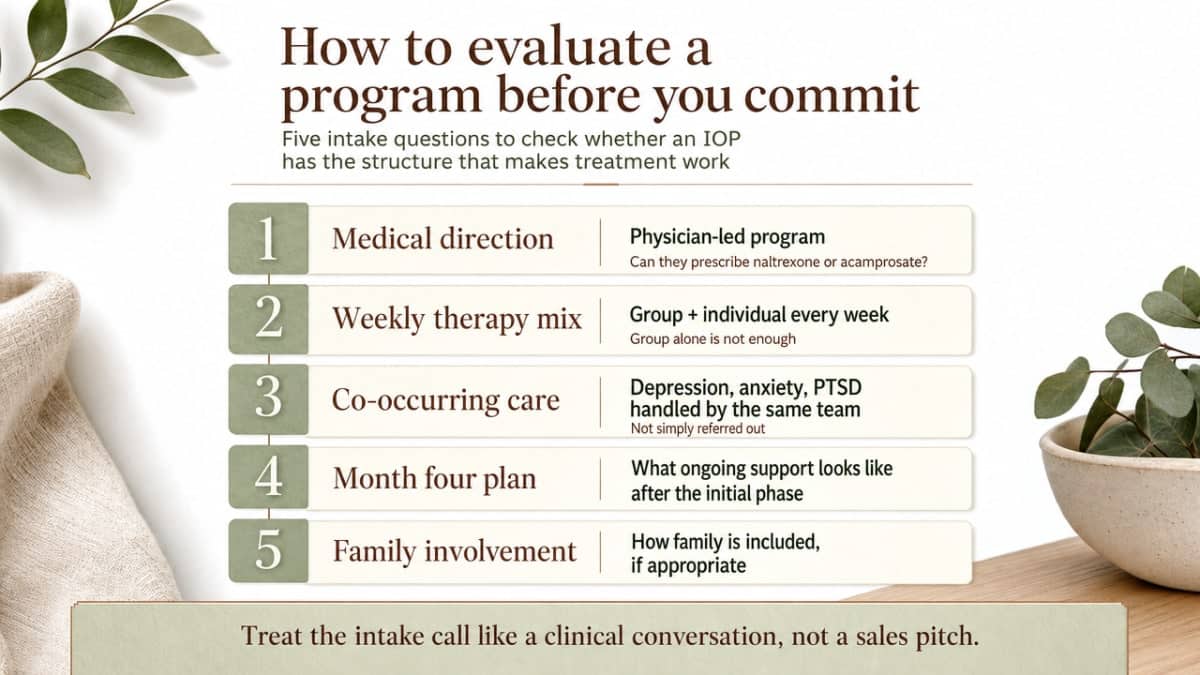
Treat the intake call like a clinical conversation, not a sales pitch. You are not shopping for a vibe. You are checking whether a program meets the structure that makes IOP actually work.
Five questions, asked plainly, will tell you most of what you need to know.
- Who directs the medical side of the program, and can they prescribe naltrexone or acamprosate if I want it? A real IOP runs under physician direction, and your prescriber should be part of the team, not an outside referral 4, 20.
- Do you offer both group and individual psychotherapy every week? Group alone is not enough; the federal coverage standard names both for a reason 4.
- How do you handle co-occurring depression, anxiety, or PTSD — same team or referred out? Same team is the standard of care for AUD with a co-occurring condition 10.
- What does month four look like after I finish the intensive phase? A specific answer — step-down outpatient, scheduled check-ins, a named alumni group — is what the continuing care evidence rewards 9.
- What happens if I drink during the program? A clinical answer adjusts the plan. A punitive answer discharges you.
If the intake clinician can answer all five without hedging, you are looking at a program built to hold.
Talk to a Specialist About Starting IOP Care
Connect directly to discuss flexible treatment options that fit your professional and personal schedule.
Start Your Path Toward Sustainable Alcohol Recovery
Connect with a specialist to map out a flexible recovery plan that fits your demanding schedule.
Frequently Asked Questions
How long does an IOP for alcohol typically last?
Most IOPs run eight to twelve weeks of intensive programming, though the exact length depends on your progress and the program’s design. ASAM Level 2.1 is defined as time-limited but comprehensive, with a minimum of nine clinical hours per week 18, 19. Plan for two to three months of structured group and individual work, followed by a step-down into less intensive outpatient care and continuing support.
Will my employer find out I’m in treatment?
Not from the program. Your treatment records are protected health information, with an extra layer of confidentiality specific to substance use care. Your insurance claim shows a billing code, not a diagnosis story. What may need planning is the schedule — three evenings or three mid-mornings a week. “Medical appointment” is true and sufficient. Disclosure becomes a real conversation only in safety-sensitive roles or FMLA situations, which intake can help you think through.
What happens if I drink during IOP?
A credible program treats a slip as clinical information, not a failure. Your counselor adjusts the plan — more individual sessions, a medication conversation, a closer look at the trigger, sometimes a temporary step up to PHP or detox if drinking has become unsafe 3. If a program’s answer to that question is automatic discharge, that is a punitive policy, not a clinical one. Relapse during treatment is common and is what the structure is built to address.
Can I drive myself to and from sessions?
Yes. IOP is nonresidential and explicitly designed for adults who are sober enough between sessions to handle normal daily life, including driving 19. The exception is if you arrive at a session impaired — the program will arrange a safe ride home and a same-day clinical conversation. If you cannot get through the day without drinking, that is information your intake clinician needs, because it may indicate a higher level of care first.
Is IOP really as effective as going to a residential program?
For many adults with alcohol use disorder, yes. A peer-reviewed review of substance abuse IOP outcome studies found that well-structured IOPs produce outcomes comparable to inpatient or residential care, especially when continuing care follows the intensive phase 2. The qualifier matters — program quality and post-treatment support drive the result. Residential is the right call for unstable withdrawal, unsafe living conditions, or severe co-occurring crises. For working adults at moderate severity, IOP holds.
How do I tell my spouse or family I’m starting IOP?
Keep it short and specific. “I’ve been drinking more than I want to, and I’m starting an outpatient program three evenings a week for the next few months.” You do not owe a full history on day one. Most IOPs include family or couples sessions every few weeks, which gives your partner a structured place to ask questions and a clinician to help translate 18. That conversation often goes better with a counselor in the room.
References
- What Types of Alcohol Treatment Are Available?. https://alcoholtreatment.niaaa.nih.gov/what-to-know/types-of-alcohol-treatment
- Substance Abuse Intensive Outpatient Programs: Assessing the Evidence. https://pmc.ncbi.nlm.nih.gov/articles/PMC4152944/
- Chapter 3. Intensive Outpatient Treatment and the Continuum of Care. https://www.ncbi.nlm.nih.gov/books/NBK64088/
- Mental health care (intensive outpatient program services). https://www.medicare.gov/coverage/mental-health-care-intensive-outpatient-program-services
- Outpatient Services in Hospitals Coverage. https://www.medicare.gov/coverage/outpatient-hospital-services
- Alcohol Treatment in the United States. https://www.niaaa.nih.gov/alcohols-effects-health/alcohol-topics-z/alcohol-facts-and-statistics/alcohol-treatment-united-states
- Treatment Programs for Substance Use Disorder. https://www.ncbi.nlm.nih.gov/books/NBK584391/
- Summary of Evidence – Inpatient and Outpatient Treatment for Substance Use Disorder. https://www.ncbi.nlm.nih.gov/books/NBK507689/
- A Randomized Trial of Extended Telephone-Based Continuing Care for Alcohol Dependence. https://pmc.ncbi.nlm.nih.gov/articles/PMC3082847/
- Integrating Treatment for Co‑Occurring Mental Health Conditions. https://pmc.ncbi.nlm.nih.gov/articles/PMC6799972/
- Integrated Treatment of Substance Use and Psychiatric Disorders. https://pmc.ncbi.nlm.nih.gov/articles/PMC3753025/
- Co-Occurring Disorders in Substance Abuse Treatment. https://pmc.ncbi.nlm.nih.gov/articles/PMC2200799/
- Treatment Access Barriers and Disparities Among Individuals with Co-Occurring Disorders. https://pmc.ncbi.nlm.nih.gov/articles/PMC4695242/
- Contingency Management for Patients with Dual Disorders in Partial Hospitalization. https://pmc.ncbi.nlm.nih.gov/articles/PMC4292935/
- Evidence-Based Treatment for Young Adults with Substance Use Disorders. https://pmc.ncbi.nlm.nih.gov/articles/PMC7879425/
- Chapter 7. Clinical Issues, Challenges, and Strategies in Intensive Outpatient Treatment. https://www.ncbi.nlm.nih.gov/books/NBK64101/
- Chapter 8. Intensive Outpatient Treatment Approaches. https://www.ncbi.nlm.nih.gov/books/NBK64102/
- TIP 47 – Substance Abuse: Clinical Issues in Intensive Outpatient Treatment. https://www.samhsa.gov/resource/ebp/tip-47-substance-abuse-clinical-issues-intensive-outpatient-treatment
- Adult Substance Use Disorder Intensive Outpatient Level 2.1. https://dhhs.ne.gov/Behavioral%20Health%20Service%20Definitions/Adult%20Substance%20Use%20Disorder%20Intensive%20Outpatient%20Level%202.1.pdf
- Treatment for Alcohol Problems: Finding and Getting Help. https://www.niaaa.nih.gov/publications/brochures-and-fact-sheets/treatment-alcohol-problems-finding-and-getting-help