
Is Ether Addictive? What You Need to Know
Key Takeaways
- Ether is a fast-acting inhaled solvent that can produce true addiction—compulsive use, craving, and loss of control—even when dramatic physical withdrawal symptoms are absent 5, 6.
- The drug reaches the brain in seconds and acts on GABA, glutamate, and dopamine systems, giving volatile solvents high abuse liability by training reward circuits directly 1.
- Ether carries serious medical risks people underestimate, including sudden cardiac arrhythmia, respiratory depression, fire hazards, and lasting damage to the brain, liver, and kidneys 7, 10.
- Recovery relies on assessment-matched care, supportive medical stabilization, behavioral therapies like CBT and DBT, dual diagnosis support, and ongoing aftercare rather than brief detox alone 4, 8.
If you’re not in withdrawal, is it still addiction?
Here’s the question that probably brought you here: if you stop using ether and you don’t shake, sweat, or get sick the way people on alcohol or opioids do, are you actually addicted? That confusion is fair, and it’s worth taking seriously.
The short answer is yes—you can be addicted to ether even without a textbook withdrawal scene. Clinical literature has documented exactly this pattern. A case report titled, quite literally, Ether: a forgotten addiction described a patient with clear dependence on diethyl ether—repeated use, craving, loss of control—despite minimal withdrawal symptoms 6. Ether is not the only drug that works this way. With inhalants generally, the formal diagnostic criteria don’t require withdrawal at all, though some users do show a characteristic withdrawal pattern 5.
That matters because most of us were taught a narrow picture of addiction: a body in physical distress, demanding the next dose. Real addiction is broader than that. It’s the compulsion. It’s the secrecy. It’s reaching for the bottle or the cloth even after promising yourself you wouldn’t. It’s the time you lose, the people you avoid, the things you stop doing.
If any of that sounds familiar, you’re not exaggerating your situation. You’re describing one. The rest of this guide walks you through what ether does in the brain, what the warning signs look like, what the real medical risks are, and what treatment can actually do—so you can decide what to do next with clearer information.
What ether actually is and why people use it
Diethyl ether is a clear, fast-evaporating liquid with a sharp, sweet smell you don’t forget. It was one of the first surgical anesthetics, used in operating rooms starting in the 1840s, and it still shows up today in chemistry labs, certain industrial processes, and some starting fluids. It is not a street drug in the traditional sense. It is a solvent that happens to be powerfully psychoactive when its vapors are inhaled.
People reach for it for a few reasons, and none of them are mysterious. The high comes on within seconds. It feels warm, floaty, dreamlike—closer to alcohol intoxication than to a stimulant rush, but faster and stranger. It wears off quickly, which means you can use it and, on the surface, seem fine an hour later. For someone trying to manage anxiety, escape a bad day, or quiet a mind that won’t slow down, that combination of speed and short duration can feel like a private off-switch.
It is also, for some people, easy to get. That matters more than it sounds like it should. Ether is not tightly controlled the way opioids or benzodiazepines are. It belongs to the broader family of inhalants—volatile substances that depress the central nervous system and produce euphoria, dizziness, and impaired coordination 10. That same family includes solvents in glue and paint thinner, gases in aerosol cans, and medical anesthetics. They share a basic profile: legal or semi-legal access, rapid onset, and a high that hides in plain sight.
Knowing what ether is doesn’t make using it your fault. It just helps explain why something so old-fashioned still pulls people in—and why the pull is real, not imagined.
How ether hooks the brain
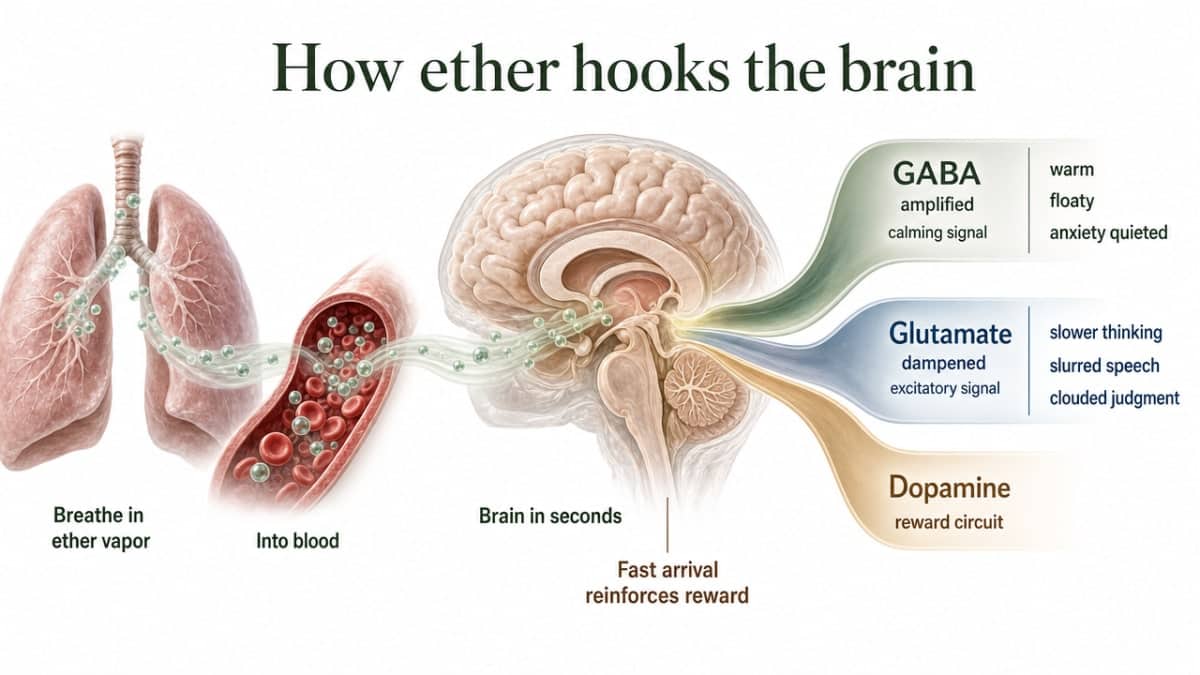
When you breathe in ether vapor, the molecules cross from your lungs into your blood and reach your brain in seconds. There is no slow build the way alcohol works in the stomach. The high arrives almost on contact, and that speed is part of what makes it so reinforcing.
Once it gets there, ether doesn’t just sedate you. It pulls on the same circuits your brain uses to register pleasure, motivation, and reward. Researchers studying volatile solvents as a class have found that these inhaled substances act on three big chemical systems at once: GABA, glutamate, and dopamine. GABA is your brain’s main calming signal, and ether amplifies it—that’s where the warm, floaty, anxiety-quieting feeling comes from. Glutamate is your brain’s main excitatory signal, and ether dampens it, which slows your thinking, slurs your speech, and clouds your judgment. Dopamine is the chemical your brain releases when something feels worth doing again. Ether nudges dopamine release in the reward pathway, which is the part of the brain that learns, very quickly, what to want more of.
One major neuroscience review of volatile solvents put it bluntly: these substances“have high abuse liability because of their selective” effects on critical nodes of the addiction neurocircuitry 1.In plain terms, the chemicals don’t just touch the reward system in passing. They land on the exact spots that decide what your brain treats as important.
That’s why ether can hook you even if your body never throws a dramatic fit when you stop. The hook isn’t really in your muscles or your gut. It’s in a learning system that’s now been trained, dose by dose, to associate one specific smell and one specific feeling with relief. After enough repetitions, your brain starts pulling toward it on its own—before you’ve consciously decided anything.
That doesn’t mean you’re broken, and it doesn’t mean you can’t change course. It means the pull you’re feeling is real, it has a biological address, and it responds to the kind of structured support that retrains those same circuits. Understanding the mechanism isn’t about adding shame. It’s about taking the mystery out of why stopping on willpower alone keeps feeling harder than it should.
What ether addiction looks like in real life
Forget the movie version of addiction for a minute. Ether dependence rarely looks like someone curled up shaking on a bathroom floor. It looks quieter than that, and that quietness is part of what makes it so easy to miss—or to talk yourself out of taking seriously.
Here’s what it actually looks like. You bought it once for a reason that made sense at the time. Then you bought it again. The amount you use has crept up because the old amount doesn’t quite get you there anymore. You’ve started using alone, or hiding it from people you live with. You’ve told yourself this is the last time more than once. You think about it when you’re not using it—when you’ll get to next, where you’ll do it, how you’ll explain the smell. You’ve skipped things you used to care about. You’ve kept using even after a scary moment: a fall, a blackout, a near-miss driving, a partner crying.
That pattern has a clinical name. The DSM-5 criteria for an inhalant use disorder cover exactly these features—loss of control, craving, continued use despite harm, tolerance, and use that interferes with work, school, or relationships. Notably, the diagnostic criteria for inhalant use disorder don’t formally require withdrawal symptoms at all, though research suggests some users do develop a characteristic withdrawal syndrome 5. That’s the piece that confuses so many people. With alcohol or opioids, withdrawal is front and center: shakes, sweats, nausea, the works. With ether and other inhalants, the diagnosis hinges on the behavior pattern, not on whether your body throws a visible fit when you stop.
So if you’ve been measuring yourself against the alcohol-withdrawal yardstick and coming up “not bad enough,” that yardstick was never the right one. The 2003 case report that named ether dependence in plain terms described a patient with clear craving and compulsive use even though withdrawal was minimal 6. The absence of dramatic physical symptoms didn’t make the addiction less real for that person. It just made it easier to ignore for longer.
Some signs that tend to sneak up on people:
- You notice you’re rationing your week around when you can use.
- You’ve started lying about small things to protect your supply.
- The relief you get is shorter than it used to be.
- Stopping for a few days makes you irritable, restless, or unable to sleep even if nothing else is obviously wrong.
None of that is proof of anything by itself. Together, in a pattern, it’s information worth listening to.
The medical risks people underestimate
Here’s the part that’s hard to say gently: ether can kill you on a use that wasn’t supposed to be different from any other. The drug that feels like a private off-switch is also a powerful central nervous system depressant, and the line between intoxication and overdose is narrower than most people realize.
Start with the heart. Inhalants, ether included, can sensitize the heart to its own adrenaline. That means a sudden burst of fear or exertion—startling, running, even a hard cough—can throw the rhythm into a dangerous arrhythmia. Clinicians call the worst version of this sudden sniffing death: a person inhales, gets startled or moves abruptly, and the heart simply stops. It can happen on a first use. It can happen on a hundredth. There is no warning shot 7.
Then there’s the breathing piece. Ether sedates the brainstem circuits that keep you breathing. Use enough, or pass out with the cloth still close to your face, and respiration slows or stops while you’re unconscious. People have died this way alone in rooms where someone walking in five minutes earlier would have changed everything. The drug’s high vapor pressure and flammability add another layer: a spark, a stove, a cigarette near a soaked rag, and the room ignites 7.
The slower harms matter too. Repeated inhalant exposure is linked to brain damage, liver and kidney injury, and cognitive changes that don’t fully reverse 10. The euphoria you feel in the moment is being paid for in tissue you can’t see.
None of this is meant to frighten you out of reading the rest of this guide. It’s meant to take seriously what you may already half-know. The reason ether addiction needs structured medical attention isn’t because the withdrawal is dramatic. It’s because the using itself is dangerous in ways that don’t give second chances.
If you work in healthcare or a chemistry-adjacent field
This part is for a narrower group: anesthesia providers, OR nurses, lab chemists, vet techs, pharmacists, and anyone whose workday puts volatile anesthetics or solvents within arm’s reach. If that’s you, the path into trouble looks different from someone who buys a can off a shelf, and you probably already know that.
The pattern is documented. A case report and literature review of a sevoflurane addiction in an anesthesia provider with chronic workplace exposure describes exactly what you might recognize: compulsive use, craving, and symptoms that look a lot like withdrawal from any other substance—built on top of a job that requires you to be around the vapor every shift 2. A broader review of non-opioid anesthetic addiction reaches the same conclusion. Inhaled anesthetics with GABA and NMDA activity have real potential for dependence, and the medical literature is increasingly clear that healthcare workers with daily access are a population that needs attention, not a footnote 3. Ether sits in the same chemical neighborhood. The mechanism that hooks a sevoflurane user is the mechanism that hooks an ether user.
What makes your situation different is not the drug. It’s the context. The exposure started as legitimate. The smell is familiar in a way it isn’t for anyone else. You may have told yourself that a small amount, in a controlled setting, by someone who understands the pharmacology, is not the same thing as misuse. At some point, that story stopped being true, and you probably know roughly when.
You also have more to lose on paper—a license, a role, a reputation—which is exactly why people in your position wait longer than they should to ask for help. Most state professional health programs and confidential physician or nurse assistance programs exist precisely for this. So do treatment programs that have worked with clinicians before and understand the licensure piece. Reaching out early, before something goes wrong on a shift, is the move that protects both you and the people in your care.
Polysubstance use and mental health in the same body
Almost no one uses ether in isolation. If you’re honest with yourself, there’s probably alcohol in the picture, or benzos, or weed, or something to come down, or something to come back up. That’s not a character flaw. It’s how the brain solves a problem it can’t solve—stacking one depressant on another to chase a feeling that keeps moving.
There’s also a good chance something underneath the using is doing its own work. Anxiety that won’t quit. Depression that flattens everything. Trauma that shows up in the body before it shows up in words. PTSD, bipolar disorder, untreated ADHD—any of these can make a fast, quiet, anxiety-muting drug feel less like a choice and more like medicine. Treating the addiction without treating what’s underneath tends not to hold, which is why dual diagnosis care—addressing the substance use and the mental health condition together, in the same plan, with the same team—matters here more than almost anywhere else 8.
You don’t have to sort any of this out before you ask for help. A good assessment does that with you. What you do need to do is tell whoever evaluates you the whole picture—every substance, every prescription, every symptom you’ve been managing on your own. The plan only works if it’s built on what’s actually happening.
What treatment actually involves
If you’ve been picturing treatment as a dramatic detox scene followed by a lecture, set that aside. For ether and other inhalant use disorders, the work looks different—and in some ways more honest—than the cultural image suggests.
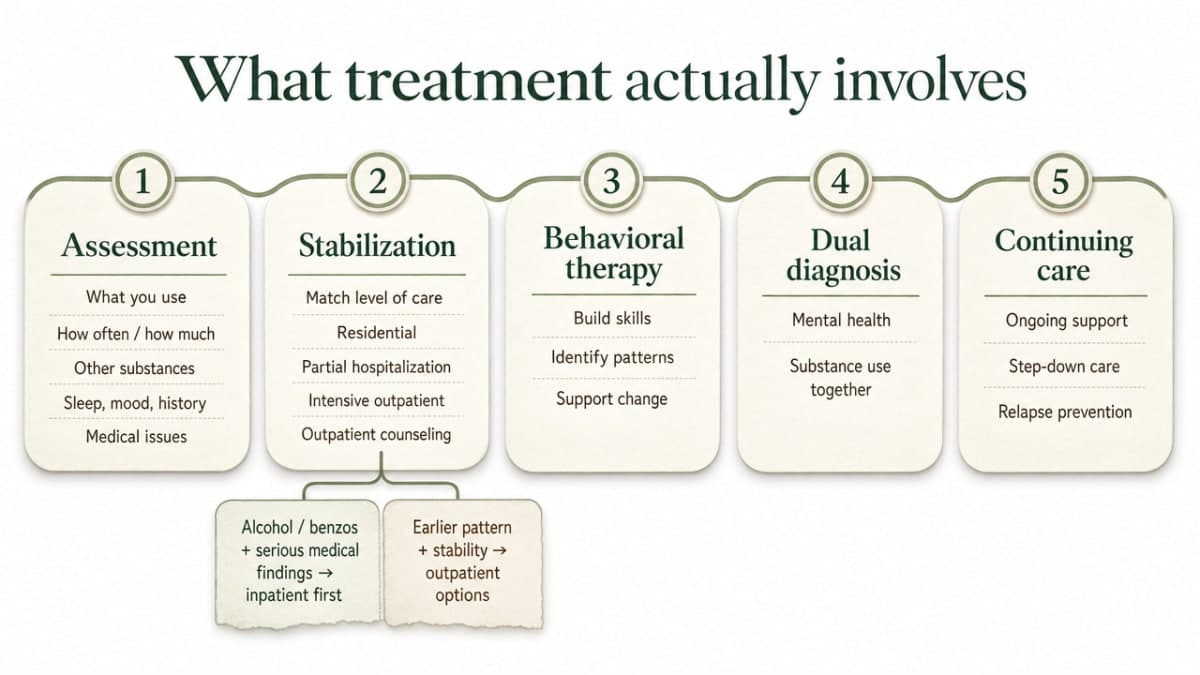
It usually starts with an assessment. A clinician sits with you and asks about everything: what you use, how often, how much, what else is in the mix, what your sleep and mood and history look like, what’s happened medically. This isn’t a quiz you can fail. It’s how the team figures out the level of care that actually fits—residential, partial hospitalization, intensive outpatient, or standard outpatient counseling. Someone using ether alongside alcohol or benzos, or with serious medical findings, generally needs the structure and round-the-clock monitoring of an inpatient setting first. Someone earlier in the pattern, with stable medical status and a safe place to sleep, may do well stepping into IOP.
Medical stabilization comes next, and here’s where the inhalant story diverges from what you may expect. There is no FDA-approved medication that specifically treats inhalant or ether addiction. Care during the early days focuses on supportive measures—hydration, sleep, nutrition, treating any cardiac, liver, or neurologic findings, and managing symptoms like anxiety, irritability, or insomnia as they come up 4. If other substances are on board, those may have their own withdrawal protocols that need attention at the same time.
The behavioral work is where most of the change happens. The 2023 clinical review of inhalant abuse names the same evidence-based therapies used across substance use disorders: cognitive behavioral therapy, dialectical behavior therapy, motivational enhancement, and individual, group, and family sessions 4. CBT helps you spot the moments before you reach for the bottle—the feeling, the trigger, the half-thought—and rehearse a different move. DBT builds tolerance for the emotions that used to feel unsurvivable without something to take the edge off. Family therapy brings the people closest to you into the work, because they’ve been affected too, and recovery tends to hold better when relationships are part of the repair.
If anxiety, depression, PTSD, bipolar disorder, or another condition has been running underneath the using, a dual diagnosis approach treats both at once with the same team. That’s not optional add-on care. It’s how the plan stays standing.
The last piece is continuing care. Substance use disorders are chronic medical conditions, and NIDA is clear that comprehensive, ongoing treatment—not brief detox alone—is what produces better outcomes 8. That means aftercare, relapse prevention planning, sober support, and a way to get back in touch quickly if things start to slip. You are not signing up for a sprint. You are building a structure that can hold.
What recovery can look like from here
Recovery from ether addiction doesn’t usually announce itself with a single dramatic moment. It looks more like a series of small returns. You sleep through the night again. The smell that used to pull you stops pulling quite as hard. You answer a text from someone you’d been dodging. You catch yourself laughing at something and realize it’s been a while.
The research backs up what those small returns add up to. Substance use disorders are chronic medical conditions, and people genuinely recover from them with appropriate, ongoing care—not willpower alone, and not a single round of detox 8. That framing matters because it takes the weight of “fixing yourself” off your shoulders and puts it where it belongs: on a structured plan, a clinical team, and time.
You won’t be the same person on the other side of this, and that’s the point. The brain that learned to want ether can also learn to want other things—rest, connection, a morning that doesn’t start with a calculation. If you’re ready to talk to someone about what care could look like for your situation, Arrow Passage Recovery’s admissions team can walk you through it without pressure. Reaching out is not a commitment. It’s a conversation.
Speak with someone who understands ether addiction now
Get immediate support and guidance for managing ether addiction safely and confidentially.
Frequently Asked Questions
If I don’t have shakes or sweats when I stop, am I really addicted to ether?
Yes, you can be. With inhalants like ether, the diagnostic criteria for a use disorder don’t formally require withdrawal symptoms at all, though some users do show a characteristic withdrawal pattern 5. A documented case report described a patient with clear ether dependence and craving despite minimal withdrawal 6. The hook is psychological and behavioral. That makes it no less real.
How quickly can ether use turn into a problem?
Faster than most people expect. Ether reaches the brain in seconds and acts on the same reward circuits that drive learning and motivation, which gives volatile solvents what one neuroscience review called high abuse liability 1. Some people slide into compulsive use within weeks. There’s no safe number of times that guarantees you’re fine. Pattern matters more than count.
Is there a medication that treats ether or inhalant addiction?
Not specifically. There is no FDA-approved medication for inhalant or ether use disorder. Care during early recovery focuses on supportive measures and treating symptoms like anxiety, irritability, or sleep problems as they come up, alongside evidence-based behavioral therapies such as CBT, DBT, motivational enhancement, and individual, group, and family work 4. If other substances are in the mix, those may have their own medication protocols.
I’m a healthcare worker with access to anesthetics. Is what I’m doing the same thing?
Mechanically, yes. Inhaled anesthetics with GABA and NMDA activity carry real dependence potential, and a documented case of sevoflurane addiction in an anesthesia provider with chronic workplace exposure shows the same compulsive use and craving pattern 2. The broader literature on non-opioid anesthetic addiction reaches the same conclusion 3. Confidential physician and nurse health programs exist for exactly this. Reaching out early protects your license and your patients.
What should I do if I’m also drinking or using other substances?
Tell whoever assesses you the full picture. Combining ether with alcohol or benzodiazepines amplifies the same respiratory and cardiac risks that already make ether unforgiving 7. Polysubstance patterns usually need a higher level of care up front—often residential or partial hospitalization—so withdrawal from other substances can be managed safely while the inhalant use is addressed. The plan only works if it’s built on what’s actually happening.
Can someone actually recover from ether addiction?
People do recover. NIDA describes substance use disorders as chronic but treatable medical conditions, with comprehensive, continuing care—not brief detox alone—producing better outcomes 8. Recovery rarely arrives as one dramatic moment. It looks like sleep returning, the smell losing its pull, harder days getting less frequent. Structured treatment, dual diagnosis support when needed, and aftercare are what hold the change in place over time.
References
- Volatile Solvents as Drugs of Abuse: Focus on the Cortico–Basal Ganglia–Thalamic Circuitry. https://pmc.ncbi.nlm.nih.gov/articles/PMC3828545/
- Sevoflurane addiction due to workplace exposure. https://pmc.ncbi.nlm.nih.gov/articles/PMC6160252/
- Non-Opioid Anesthetics Addiction: A Review of Current Situation and Potential Molecular Mechanisms. https://pmc.ncbi.nlm.nih.gov/articles/PMC10526861/
- The Clinical Assessment and Treatment of Inhalant Abuse. https://pmc.ncbi.nlm.nih.gov/articles/PMC10266853/
- Inhalant Use and Inhalant Use Disorders in the United States. https://pmc.ncbi.nlm.nih.gov/articles/PMC3188822/
- Ether: a forgotten addiction. https://pubmed.ncbi.nlm.nih.gov/12873252/
- Inhalants Toxicity – StatPearls. https://www.ncbi.nlm.nih.gov/books/NBK430735/
- Treatment of Substance Use Disorders. https://nida.nih.gov/research-topics/treatment
- Drugs of Abuse: 2024 Edition (DEA Resource Guide). https://www.campusdrugprevention.gov/sites/default/files/2025-03/Drugs-Abuse-2024.pdf
- What are inhalants? (NIDA Research Report). https://www.drugabuse.gov/publications/research-reports/inhalants/what-are-inhalants