
Identifying Nicotine Addiction Symptoms in Yourself
Key Takeaways
- Clinicians use eleven DSM-5 criteria for tobacco use disorder, and meeting just two within a twelve-month window — like cravings, failed quit attempts, or withdrawal — crosses the clinical line 8.
- Withdrawal follows a predictable curve: cravings start within an hour or two, peak across the first three days, ease over two to four weeks, then occasionally recur for months 2, 6.
- Anxiety, low mood, irritability, sleep disruption, and attention dips during a quit attempt are documented withdrawal effects, not personality changes — especially relevant if you already live with anxiety, ADHD, or depression 6, 7, 10.
- The strongest next step is stacking support: an honest history with a clinician plus a screening tool, then counseling combined with medication, which gives adults the best chance of quitting 3, 4.
When a Habit Starts Acting Like Something Else
You probably didn’t open this page on a whim. Maybe you noticed you reached for the vape before your feet hit the floor this morning. Maybe a pouch has been tucked in your lip through most of a workday and you can’t quite remember sliding it in. Maybe the last quit attempt lasted four days, and you’re trying to figure out why.
That noticing matters. It’s not nothing.
Nicotine is one of the most addictive substances people regularly use, and federal health agencies treat cigarettes, e-cigarettes, vapes, dip, and pouches as part of the same picture 1. The delivery method changes. The hook does not.
What you’re about to read isn’t a quiz designed to scare you, and it isn’t a pep talk. It’s the same pattern clinicians actually look for when they decide whether use has crossed into a disorder: craving, loss of control, withdrawal, and continued use despite real costs 4. You’ll see what those signals look like in everyday life, what stopping tends to feel like in the body and the head, and what to do if a lot of this sounds like you.
Read at your own pace. This is part of the work.
The Pattern Clinicians Actually Look For
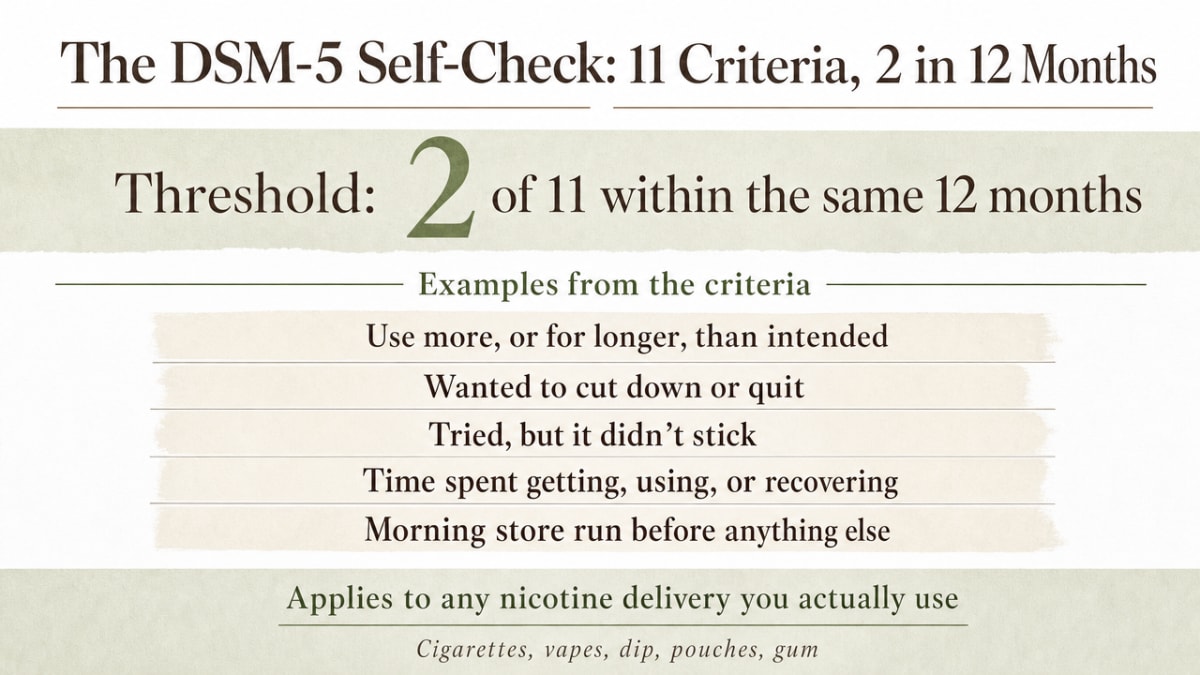
The DSM-5 Self-Check: 11 Criteria, 2 in 12 Months
Here’s the framework clinicians use when they have to put a name on what’s happening. The DSM-5 lists 11 criteria for tobacco use disorder, and you only need two of them showing up in the same 12-month stretch to meet the threshold 8. Two. Not eight, not all of them. That’s a smaller bar than most people guess.
Read these slowly. They’re written for cigarettes, vapes, dip, pouches, gum — any nicotine delivery you actually use. Count quietly to yourself.
- You use more nicotine, or use it for longer, than you meant to. The pack that was supposed to last three days lasted one. The vape you bought “just for nights out” lives in your pocket now.
- You’ve wanted to cut down or quit, or tried, and it didn’t stick.
- You spend a real amount of time getting it, using it, or recovering from being without it — including the morning store run before work.
- You crave it. The 2013 DSM-5 update specifically added craving as a criterion, which the older diagnosis didn’t include 9.
- Your use is getting in the way of work, school, parenting, or things you said you’d do.
- You keep using it even though it’s causing problems with people you care about — partner, kids, a roommate who’s asked you to stop vaping indoors.
- You’ve given up or cut back on activities you used to enjoy because of it, or to keep using it.
- You use it in situations where it’s risky — driving while lighting up, vaping somewhere you could lose a job over it.
- You keep using it even though you know it’s hurting your health or your mood.
- You’ve built tolerance — you need more to get the same hit, or the same amount does less than it used to.
- You get withdrawal symptoms when you stop or cut back, or you use nicotine to keep withdrawal from showing up.
What ‘Loss of Control’ Looks Like With a Vape or Pouch
“Loss of control” sounds dramatic. With nicotine, it usually isn’t. It’s small, quiet, repeatable, and easy to talk yourself out of seeing.
It looks like buying a disposable vape on the way home because you finished the last one faster than you expected, again. It looks like sliding a pouch in during a meeting and realizing on the drive home that you had four more than you planned. It looks like the can of dip you said was your last can two cans ago.
It also looks like the rules you keep negotiating with yourself. Only after meals. Only outside. Not in the car with the kids. Not before noon. Then the rule moves. Then it moves again. The rule isn’t the problem; the fact that it keeps moving without your permission is the signal.
Another version: you’ve tried to quit, even quietly, even just for a weekend. You set the device on a high shelf or threw out the tin. Within hours or days, you were back, sometimes without a clear memory of deciding. That counts. The DSM criterion isn’t “you failed.” The criterion is that you wanted to cut down or stop and it didn’t hold 8.
A useful question to sit with: when was the last time you went a full waking day without nicotine and didn’t think about it? Not white-knuckled through it — actually didn’t think about it. If you have to scroll back weeks or months to find that day, your brain is telling you something honest about where you are. None of this is a character verdict. It’s information. Clinicians use the same kind of history-taking and behavior patterns to make the call, alongside formal screening tools 4.
What Stopping Actually Feels Like in the First 72 Hours
The Withdrawal Timeline From Hour One to Month Six
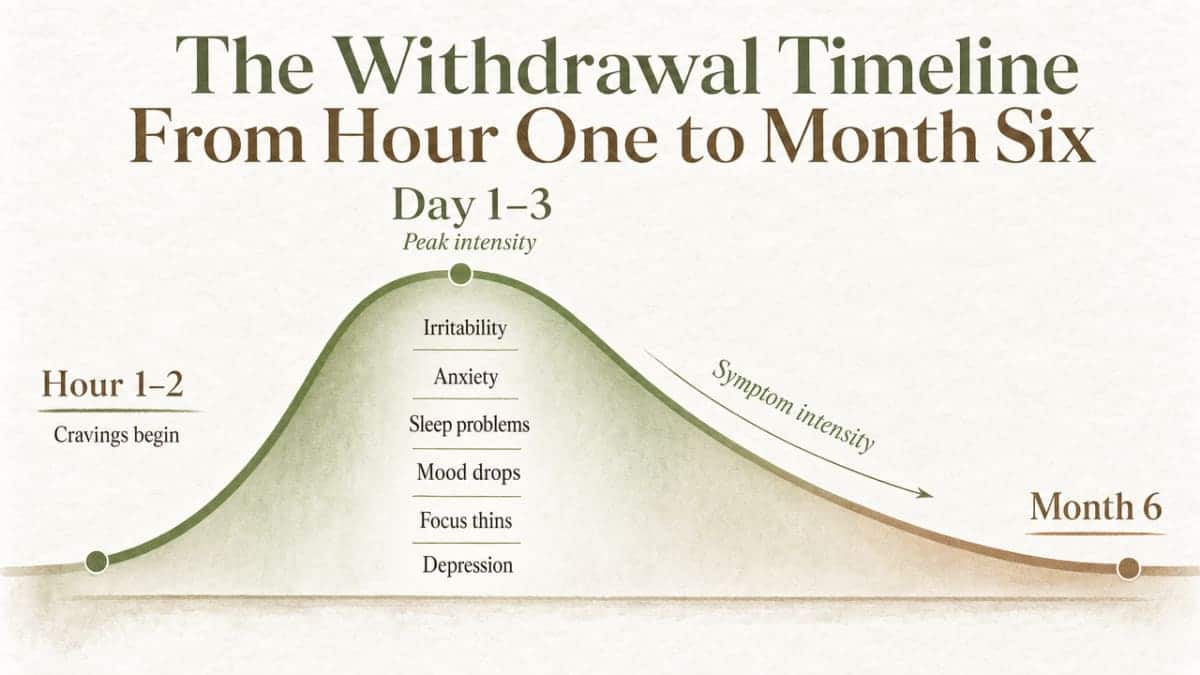
If you’ve ever tried to put nicotine down and felt like you were losing your grip by lunchtime, there’s a reason. Your body keeps a timeline, and it’s faster than most people expect.
Hour one to two. Cravings can show up within an hour or two of your last hit 2. That’s not weakness. That’s pharmacology. The receptors that got used to a steady drip are sending a request, and the request is loud.
Day one through day three. This is the steep part of the curve. Irritability sharpens. Anxiety creeps up the back of your neck. Sleep gets weird — either you can’t fall asleep or you wake at 3 a.m. fully alert and angry about it. Mood drops. Focus thins out. Peer-reviewed reviews of withdrawal group these together as the core cluster: anxiety, depression, irritability, and sleep problems, often peaking in the first few days 6. If you’ve made it to day three and felt like a different, worse version of yourself, that’s the window you were in.
Week one to week four. The acute edge starts to soften. The symptoms don’t vanish on a schedule, but most people notice the volume turning down over two to four weeks. You’re sleeping more like yourself. The fuse is a little longer. Food tastes louder.
Month two through month six and beyond. Here’s the part almost nobody warns you about: cravings can recur for months or even years after your last use 2. They’re usually shorter and less intense than week one, but they show up. A song. A parking lot. The first sip of coffee. A bad meeting.
That long tail isn’t relapse. It isn’t failure. It’s the normal shape of recovery from a substance your brain learned very well. Knowing the curve in advance is part of what keeps an intermittent craving in month four from feeling like proof you can’t do this. You can. The curve is just longer than the first 72 hours.
Physical Signals: Headaches, Hunger, Restlessness, Sleep
The mental side of withdrawal gets most of the attention. The body has its own list, and it’s worth naming so you don’t get blindsided.
Headaches. A dull band across the forehead or a sharper pulse behind the eyes is common in the first few days. It’s not a sign something is wrong. It’s a sign your system is recalibrating.
Hunger that doesn’t quite make sense. Suddenly you want to eat. Then eat again. Nicotine had been quietly suppressing appetite and shifting how food tasted; without it, both come back online. Many people reach for snacks during the exact hours they used to vape or step out for a cigarette.
Restlessness. A buzzing under the skin. The urge to stand up, walk, check your phone, do anything with your hands. The hands miss the ritual as much as the lungs miss the hit.
Sleep that won’t cooperate. Trouble falling asleep, vivid dreams, or waking too early all sit inside the documented withdrawal cluster alongside the mood symptoms 6. The first week is usually the worst.
None of these are dangerous on their own. They are uncomfortable, they cluster together, and they pass. Naming them as withdrawal instead of “I’m falling apart” changes what you do next. A headache becomes water, food, and ten minutes outside. Restlessness becomes a walk around the block. Hunger becomes a real meal instead of a guess. That reframing is small. It matters.
Is This Me, or Is This Nicotine?
When Withdrawal Looks Like Anxiety, Low Mood, or Brain Fog
Here’s one of the most disorienting parts of nicotine dependence: when you stop, the symptoms don’t show up wearing a name tag. They feel like you. Like your personality got worse overnight. Like the stress you’ve been managing for years suddenly broke through. Like your brain stopped working the way it’s supposed to.
It’s worth knowing, before you decide what to make of any of that, what withdrawal actually does.
On the mood side, peer-reviewed reviews consistently group anxiety, depression, irritability, and sleep disruption as a core withdrawal cluster 6. Not one of those. All of them, often at once, often hitting within the first day or two. The chest tightness that feels like an anxiety attack at 11 a.m. The flatness that descends after dinner. The fuse so short it scares the people you live with.
On the cognitive side, the research is just as specific. Nicotine withdrawal is associated with measurable deficits in sustained attention, working memory, and response inhibition 7. Translation: you can’t stay focused on the email, you walk into the kitchen and forget what you came for, and you snap at things you’d normally let slide. That’s not your IQ falling. That’s a documented neurological window.
Here’s the side-by-side that helps:
- Restless, jumpy, dreading nothing in particular → often withdrawal anxiety, not a personality flaw 6.
- Flat, unmotivated, can’t enjoy the things that usually work → often withdrawal-driven low mood, especially in the first two weeks 6.
- Can’t hold a thought, rereading the same paragraph, missing what someone just said → withdrawal-related attention and working memory dip 7.
- Snapping at small things, hair-trigger frustration → irritability sits squarely in the cluster 6.
- Lying awake at 2 a.m. or waking too early → withdrawal-pattern sleep disruption 6.
Naming what you’re feeling as withdrawal doesn’t make it hurt less in the moment. It does change what you do with it. “I’m an anxious person who can’t quit” is a story that closes doors. “My brain is in a documented adjustment window that eases over weeks” is a story that keeps you in the fight.
If You Already Live With Anxiety, ADHD, or Depression
If you’re reading this and already carry a diagnosis — anxiety, ADHD, depression, PTSD, bipolar — the picture gets more tangled, not less real. You deserve a straight answer about that, because the standard “just quit” framing wasn’t written with you in mind.
Nicotine dependence shows high comorbidity with many mental illnesses, including anxiety and ADHD 10. That isn’t a coincidence and it isn’t a weakness. People with these conditions often discover early on that nicotine briefly takes the edge off — focuses the ADHD brain, smooths the anxious one, lifts a depressive afternoon by a few notches. That’s not in your head. The relief is real, short, and expensive.
The trap is that when you try to stop, withdrawal lands on top of a system that’s already running hot. The irritability you’d notice as withdrawal looks identical to your baseline anxiety amped up. The focus problems look like your ADHD getting worse. The low mood feels like depression returning. So you go back to nicotine, and the loop closes — not because you lack discipline, but because two things are happening in the same body at the same time.
A few honest pieces of guidance:
- If you’ve quit before and your mental health symptoms got dramatically worse within days, that’s information worth telling a clinician. It doesn’t disqualify you from quitting. It changes what support looks like.
- Don’t change psychiatric medications on your own when you’re trying to stop nicotine. Some medications interact with smoking, and stopping can shift dosing needs. That’s a conversation, not a guess.
- You’re not choosing between treating your mental health and treating nicotine dependence. Coordinated care, where both are addressed at once, is the version that actually holds 10.
What you’re feeling makes sense. Both things are real. Both can be treated. You’re not asking too much by wanting help with both at the same time.
The Quieter Behavioral Signs People Miss
The loud signs of nicotine dependence get the headlines: chain-vaping, the cough, the failed quit. The quieter signs are often what tells the real story, because they show up before you ever decided this was a problem.
Check yourself against these. None of them are dramatic on their own. Stacked together, they’re a pattern.
- The first hit happens before the first decision. Vape on the nightstand, reached for before you’re fully awake. Pouch in before coffee. That early-morning use is one of the most reliable markers clinicians look at when sizing up dependence 4.
- You map your day around access. You know which meetings you can step out of, which bathrooms are private, which gas station is on the route home. The planning is so automatic you’ve stopped noticing it.
- You get anxious when supply runs low. Not out — low. Half a pod left at 9 p.m. sends you to the store. That’s the brain protecting against withdrawal before withdrawal arrives 2.
- You use it as a tool. To start the day, to break a hard conversation, to get through the email backlog, to fall asleep. When a substance becomes infrastructure for ordinary tasks, that’s the loss-of-control criterion wearing different clothes 8.
- You hide the amount. Not the use — the amount. The second can of dip you didn’t mention. The disposable in the glove box your partner doesn’t know about. Concealment usually means part of you already knows.
- Other people have stopped asking. The kid stopped complaining about the smell. Your partner went quiet on it. That isn’t acceptance. That’s often the point where the people around you decided the conversation wasn’t worth having again.
If three or four of those landed, you’re not imagining things. You’re seeing the shape of it. That clarity is exactly what makes the next step possible.
What to Do Once the Signs Ring True
Talking to a Clinician and Using a Screening Tool
If you’ve recognized yourself in any of the patterns above, the next move isn’t a dramatic announcement. It’s a conversation. A primary care doctor, a nurse practitioner, a therapist you already see — any of them is a fine starting point. You don’t need a referral letter or a perfect script. “I think I’m dependent on nicotine and I’d like help with that” is the whole sentence.
A clinician will usually do two things. First, they’ll take a history: what you use, how much, when you started, when in the day you first reach for it, what’s happened on past quit attempts. That history is the bulk of the diagnosis 4. Second, they may walk you through a short screening tool that translates your patterns into something measurable, which gives both of you a shared starting point and a way to track change over time 4.
Bring honesty. Not the version of your use you’d tell a stranger at a party — the real number, the morning timing, the failed attempts, the pouches you don’t mention at home. The visit only helps if the picture is accurate.
Quitlines, Counseling, and Combined Treatment
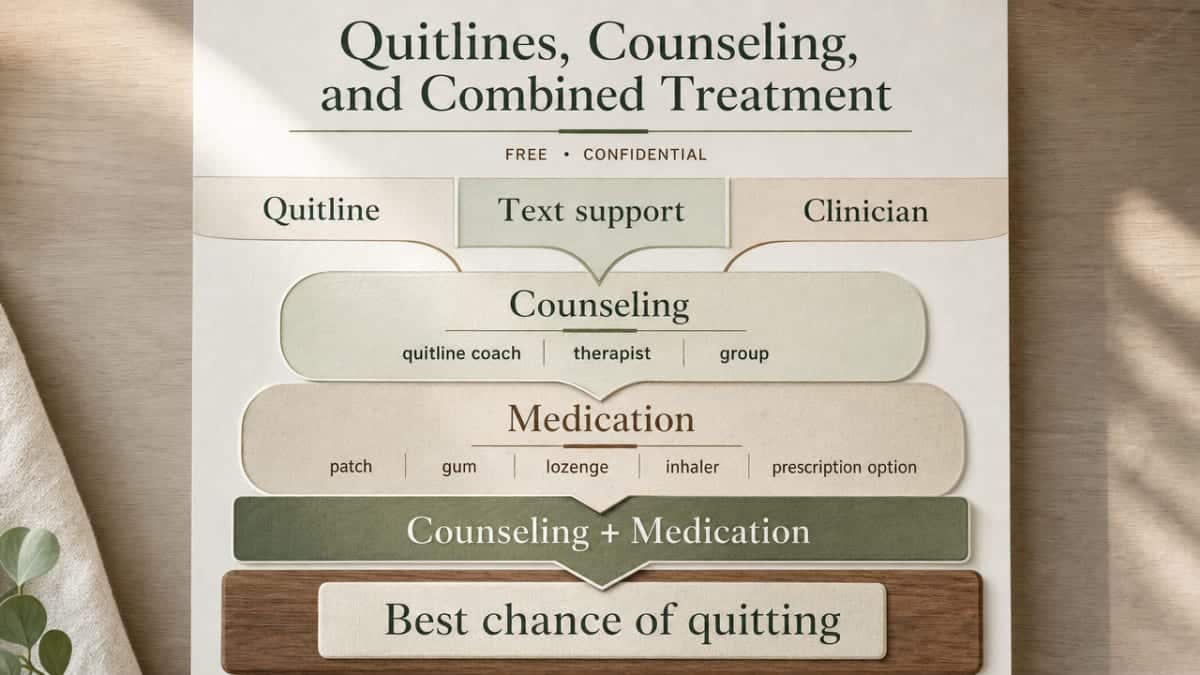
You don’t have to start with a clinic visit. Some of the most effective help is a phone call away. SAMHSA points adults toward national quitlines, text-based support, and counseling specifically built for tobacco, e-cigarettes, and vaping 1. These are free, confidential, and staffed by people whose entire job is helping someone in your exact spot make a plan.
The thing worth knowing before you pick a path: the strongest results don’t come from one tool. They come from stacking two. CDC guidance is direct about this — counseling and medicine together give adults the best chance of quitting 3. Counseling can be a quitline coach, a few sessions with a therapist, or a group; medicine usually means nicotine replacement therapy (patches, gum, lozenges, inhalers) or a prescription option a clinician can talk through with you. Nicotine replacement therapy alone is reported to increase quit chances by about 50% to 70% compared to going it cold 5. Pair it with counseling and you’re not relying on willpower to carry the whole load.
If you’re also managing anxiety, depression, ADHD, PTSD, or another substance use issue, look for care that treats those alongside the nicotine work, not after it 10. Coordinated treatment — the kind Arrow Passage Recovery is built around — exists because the two threads are tangled, and pulling them apart one at a time rarely holds.
Start with the call you’ll actually make today. A quitline number. A message to your doctor’s portal. A text to a friend who’s been through it. The signs ringing true is the hard part. You’ve already done that.
Talk With Someone Who Understands Nicotine Struggles
Get immediate support and guidance for nicotine addiction, right when you need it most.
Take the First Step Toward Nicotine Freedom
Talk confidentially with a specialist about your nicotine use and start building your personalized recovery plan.
Frequently Asked Questions
How do I know if I’m actually addicted to nicotine or just in the habit of vaping or smoking?
The clinical line is smaller than most people expect. If two or more of the eleven DSM-5 tobacco use disorder criteria have shown up in the last twelve months — craving, failed quit attempts, using more than you meant to, withdrawal when you stop, using despite real costs — that’s tobacco use disorder, not a habit 8. Habits don’t usually produce irritability, anxiety, or sleep trouble when interrupted. Addiction does 6.
Can you get addicted to nicotine pouches or vapes the same way as cigarettes?
Yes. The delivery device changes; the drug doesn’t. Federal guidance groups cigarettes, e-cigarettes, vapes, and smokeless products together because nicotine is the addictive substance in all of them 1. Pouches and disposable vapes can actually deliver nicotine faster or more steadily than older cigarettes, which is part of why people who switched expecting a softer landing often end up using more, not less.
How long do nicotine withdrawal symptoms last?
The acute window is shorter than the long tail. Cravings can start within an hour or two of your last hit, peak through the first three days, and ease meaningfully over two to four weeks 2. Anxiety, irritability, low mood, and sleep disruption usually fade in that same window 6. The piece almost nobody warns you about: occasional cravings can recur for months or even years, triggered by a song, a smell, or a stressful afternoon 2.
Why do I feel more anxious, irritable, or unfocused when I try to quit?
Because your brain is in a documented adjustment window, not because something is wrong with you. Peer-reviewed reviews group anxiety, depression, irritability, and sleep problems as the core withdrawal cluster 6. On top of that, withdrawal produces measurable dips in sustained attention, working memory, and response inhibition — the exact skills that let you focus, remember what you walked into the kitchen for, and not snap at people 7. It’s withdrawal, not your personality.
I’ve tried to quit before and failed. Does that mean I’m addicted?
It usually means yes, and it also means you’re in extremely normal company. Wanting to cut down or quit and not being able to make it stick is one of the eleven DSM-5 criteria for tobacco use disorder 8. Past attempts that didn’t hold aren’t proof you can’t do it. They’re data — about what triggers showed up, when cravings peaked, and what kind of support was missing. The next attempt starts from that information, not from zero.
What should I do next if these symptoms sound like me?
Pick one move you’ll actually make today. Call a free quitline, text a tobacco support line, or message your primary care provider — SAMHSA points adults toward all three 1. When you’re ready to plan, stack two tools instead of one: counseling plus medication gives adults the best chance of quitting, according to CDC guidance 3. If you’re also managing anxiety, depression, ADHD, or another substance use issue, ask for care that addresses both threads together 10.
References
- Find Help Quitting Tobacco, E-cigarettes, and Vaping | SAMHSA. https://www.samhsa.gov/substance-use/learn/tobacco-vaping
- Tips for Coping with Nicotine Withdrawal and Triggers – NCI. https://www.cancer.gov/about-cancer/causes-prevention/risk/tobacco/withdrawal-fact-sheet
- Celebrate a Fresh Start: Make Your New Year Smokefree! – CDC. https://www.cdc.gov/tobacco/tobacco-features/new-year.html
- Nicotine Addiction and Smoking: Health Effects and Interventions. https://www.ncbi.nlm.nih.gov/books/NBK537066/
- Nicotine Replacement Therapy – StatPearls – NCBI Bookshelf. https://www.ncbi.nlm.nih.gov/books/NBK493148/
- Nicotine Withdrawal – PMC – NIH. https://pmc.ncbi.nlm.nih.gov/articles/PMC4542051/
- Cognitive Function During Nicotine Withdrawal – PMC – NIH. https://pmc.ncbi.nlm.nih.gov/articles/PMC3779499/
- DSM Criteria for Tobacco Use Disorder and Tobacco Withdrawal. https://pmc.ncbi.nlm.nih.gov/articles/PMC3246568/
- Validity of the DSM-5 tobacco use disorder diagnostics in adults with …. https://pmc.ncbi.nlm.nih.gov/articles/PMC9035622/
- Nicotine Addiction and Psychiatric Disorders – PMC – NIH. https://pmc.ncbi.nlm.nih.gov/articles/PMC5755398/