
Key Takeaways
- OCD and substance use feed each other through a compulsion-craving loop, where substances become the fastest ritual and siloed treatment cannot interrupt the cycle.
- Each substance class undermines ERP differently: alcohol and benzodiazepines blunt habituation, stimulants amplify intrusive thoughts, and opioids erase the distress exposure work depends on.
- True integration means one team, one chart, and one plan with stage-based sequencing—acute stabilization first, then concurrent ERP and relapse prevention, then maintenance with SSRIs and MAT where indicated.
- Vet programs by asking whether OCD clinicians are ERP-trained specifically, how often the team meets about you, and how slips are handled—co-location is not integration 8.
The Compulsion-Craving Loop That Siloed Care Cannot Break
If you’ve cycled through OCD treatment that ignored your drinking, or sat in a 28-day program that treated your fentanyl use but never asked about the hours you lose to checking, counting, or contamination fears, you already know the problem. The two conditions don’t sit politely in separate rooms. They feed each other.
Here’s the loop most patients describe, once someone asks the right questions. An intrusive thought lands. Distress climbs. A compulsion would normally bring relief — washing, checking, mental reviewing — but the relief is shorter and smaller every time. So the substance steps in. A drink, a benzo, a line, a pill. Distress drops within minutes. The brain logs that lesson hard. Next time the intrusion hits, the craving arrives faster than the ritual does. The substance has become the compulsion.
That loop is exactly what siloed care fails to interrupt. An OCD specialist who doesn’t track your use can’t see why exposure and response prevention (ERP) — the gold-standard behavioral treatment that asks you to sit with distress until it falls on its own 14 — keeps stalling. A substance use program that doesn’t screen for OCD can’t see why you relapse three weeks after discharge, every time, around the same trigger. Treating one disorder while the other runs untreated raises the risk of relapse and poorer outcomes across the board 7.
Integrated treatment means one team, one chart, one plan that holds both conditions at once 11. The rest of this article is about what that actually looks like, where the evidence is strong, and where it’s more complicated than the brochures suggest.
How Often OCD and Substance Use Disorder Travel Together
If you’ve felt like you were the only one running both tracks at once, the clinical data says otherwise. In OCD treatment-seeking samples, more than a quarter of people also meet criteria for a substance use disorder 2. That’s not a fringe overlap. It’s a defining feature of who actually walks into OCD clinics.
One important caveat: this is a clinical-sample finding, not a population estimate. The figure comes from patients already in care for OCD, which means it tells you what providers are seeing in front of them — not the rate across everyone who has OCD but never sought help. The direction holds, though. Early-onset OCD and certain personality traits raise SUD risk, and substance use often emerges after OCD symptoms are already entrenched 2.
What that pattern tells you about your own history matters. If your drinking, benzo use, or stimulant use started after the obsessions did — to quiet them, to push through a workday, to sleep — you’re describing the most common sequence in the literature, not an unusual one. The substance came in as a tool. It stopped being one a long time ago.
This is also why screening matters in both directions. SAMHSA guidance treats any combination of SUD with a DSM-5 disorder, OCD included, as co-occurring disorders that warrant integrated assessment from the start 7. When an OCD program doesn’t ask about substances, or an addiction program doesn’t ask about rituals, the prevalence above predicts exactly what gets missed.
How Each Substance Class Interferes With OCD Treatment
Alcohol and Benzodiazepines: Blunting the Habituation ERP Depends On
ERP works because your nervous system, given enough uninterrupted time with a feared stimulus, learns the alarm was wrong. Anxiety rises, peaks, and falls on its own. That falling part is habituation, and it’s the engine of the whole treatment 14.
Alcohol and benzodiazepines short-circuit that engine. Both are GABAergic — they dampen the same anxiety signal ERP is trying to teach your brain to tolerate. If you sit through an exposure with two drinks in your system, or with a clonazepam taken an hour earlier, your distress may look manageable on the SUDS scale. It isn’t really. Your brain didn’t learn that the contamination thought is safe. It learned that the chemical made it safe. The next exposure, without the substance, will feel like the first one all over again.
That’s why a clinician who knows what they’re doing will ask, in plain language, what you took and when, before any exposure session. It’s also why detox-only programs that don’t address OCD see relapse so consistently — once the benzo cushion is gone, the obsessions return at full volume, and the substance that worked once is right there in memory as the fastest fix 3.
Stimulants: Amplifying Intrusive Thoughts and Ritual Urgency
Cocaine, methamphetamine, prescription stimulants used outside their prescribed dose — these run in the opposite direction from the depressants, and they create a different kind of mess for OCD.
Stimulants sharpen attention and crank up vigilance. For someone without intrusive thoughts, that can feel like focus. For someone with OCD, it often feels like every obsession suddenly has a microphone. Contamination worries get louder. Checking urges feel non-negotiable. Mental rituals — counting, reviewing, praying — accelerate to the point where you lose hours you can’t account for. The ritual urgency that ERP is trying to slow down is exactly what the stimulant is speeding up.
There’s a second problem. Stimulant use disrupts sleep, and sleep loss alone worsens OCD symptoms. By the time you’re three days into a stimulant binge, the obsessions aren’t just amplified — they’re running on a brain that hasn’t rested. ERP in that state isn’t a fair fight.
Opioids: Reinforcing Avoidance and Numbing Exposure Distress
Opioids are particularly hard to untangle from OCD because they target the exact thing ERP asks you to feel. Distress. Discomfort. The unpleasant rise in anxiety that you’re supposed to sit through until it falls.
Heroin, fentanyl, oxycodone, and similar drugs flatten that distress before it can climb. If your obsessions trigger shame, disgust, or dread — and most do — an opioid removes the emotional signal entirely. The exposure becomes a non-event. You went through the motions. Nothing was learned, because nothing was felt.
Opioid use also reinforces avoidance in a broader way. The whole point of an opioid, for many people who become dependent on one, is to make the day tolerable without having to engage with it. That’s the same pattern OCD already runs: avoid the trigger, perform the compulsion, get through. The drug becomes a compulsion that covers all the other compulsions. ERP cannot get traction underneath that. Medication-assisted treatment, when indicated, is often what makes exposure work possible at all 3.
What Integrated Treatment Actually Delivers, and What It Doesn’t
Here’s where the conversation about integrated care needs to get more honest than most program brochures allow. Treating OCD and addiction under one team is the right model. It also doesn’t do everything its marketing claims, and you deserve to know where the evidence is strong and where it’s more complicated than the brochures suggest.
The strong part first. Across the broader dual-diagnosis literature, integrated treatment — one team, concurrent care, shared treatment plan — has been found to be consistently superior to treating each disorder in separate silos with separate plans 10. SAMHSA’s own outcomes data for integrated care lists reduced or discontinued substance use, improved psychiatric symptoms, fewer hospitalizations, and better quality of life among the gains 8. For OCD specifically, integration also protects something fragile: the ability to keep doing ERP while addiction work is happening, instead of having ERP indefinitely deferred until you’re “stable enough” 4. That deferral, in practice, often means never.
Now the part that gets glossed over. A 2023 multi-center study of dual-diagnosis patients across several European sites compared integrated versus non-integrated care directly. Integrated treatment improved psychiatric symptom outcomes. It did not show clear superiority for substance use measures or treatment retention compared with non-integrated care 1. The authors concluded that no significant benefits were found between the two groups on substance misuse and retention, even though psychiatric symptoms moved in the integrated group’s favor 1.
What this means for you, concretely: integration buys you protected OCD treatment and better psychiatric trajectory. Substance-use gains depend on execution — on whether the team uses MAT when indicated, on whether relapse prevention is structured and stage-matched, on whether the clinicians treating your OCD actually talk to the ones treating your use. The next section is about that sequencing, because it’s where execution either happens or doesn’t.
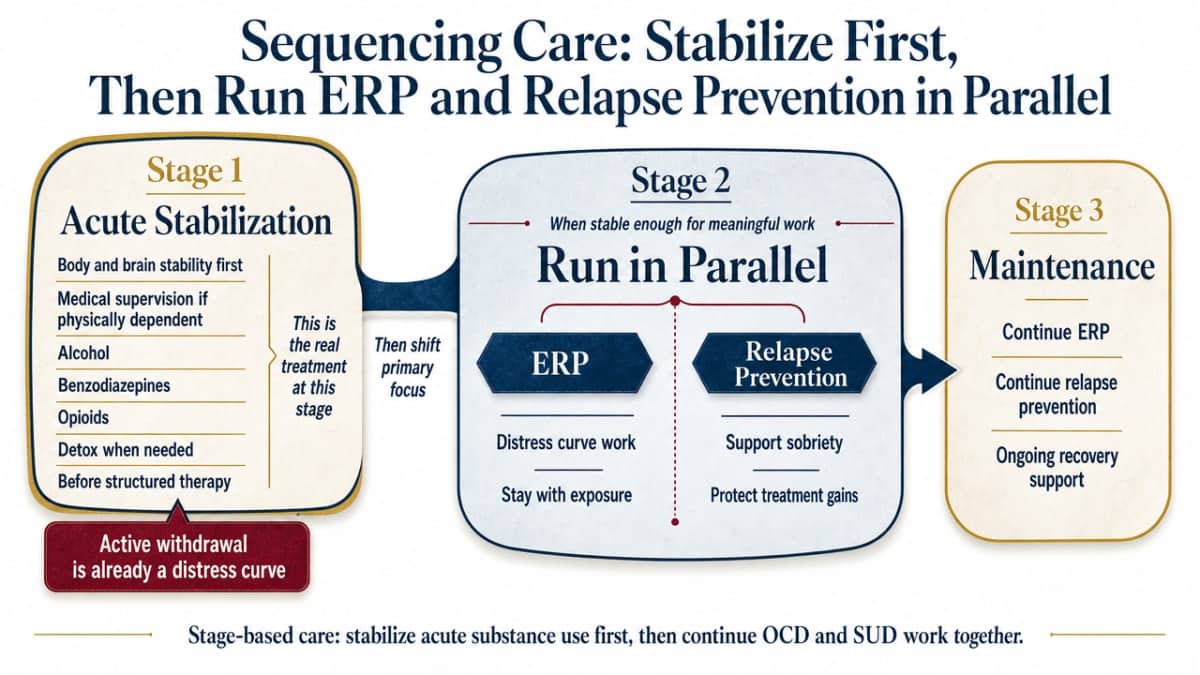
Sequencing Care: Stabilize First, Then Run ERP and Relapse Prevention in Parallel
Acute Stabilization and Medically Supervised Withdrawal
The first question isn’t whether to treat OCD or addiction first. It’s whether your body and brain are stable enough to do meaningful work on either. If you’re physically dependent on alcohol, benzodiazepines, or opioids, withdrawal needs medical supervision before any structured therapy begins. That isn’t a delay in your real treatment. It is the real treatment, for this stage.
Stage-based care, as outlined in clinician training for OCD and SUD, starts with stabilizing acute substance use — including detox when needed — before shifting the primary therapeutic focus to OCD work 3. There’s a reason. ERP asks your nervous system to climb a distress curve and stay there. A brain in active withdrawal is already on that curve, for entirely chemical reasons, and cannot learn anything useful from an exposure during it.
What this looks like in practice: a few days to a couple of weeks of medically managed detox, with OCD symptoms tracked but not directly targeted yet. Your team should still be asking about obsessions, watching for ritual flare-ups that often surge once the substance is gone, and planning the next phase. If your symptoms are screened only on the addiction side during this window, that’s a sign integration isn’t really happening.
Concurrent ERP and Relapse Prevention Under One Team
Once acute withdrawal is behind you, the parallel work begins — and this is the phase where integrated care either earns its name or doesn’t. ERP for OCD and structured relapse prevention for addiction run at the same time, under the same team, with information moving freely between the clinicians doing each piece 11.
Concretely, that might mean ERP sessions twice a week building an exposure hierarchy around your specific obsessions, while relapse-prevention groups and individual addiction counseling map your high-risk situations, cravings, and the triggers that historically ended in use 3. The two tracks aren’t separate curricula taped together. They share a working hypothesis about you: which obsessions tend to trigger which cravings, which exposures are likely to spike use risk, and how to plan ahead for the sessions that will be hardest.
CBT-based methods carry weight on both sides of this, which is part of why concurrent delivery works. The same cognitive and behavioral skills that help you sit with an intrusive thought also help you sit with a craving without acting on it 5. A clinician trained in both can teach the response-prevention skill once and apply it in two directions.
Maintenance: SSRIs, MAT Where Indicated, and Step-Down Planning
As acute symptoms settle and your exposure hierarchy starts to move, treatment shifts into a longer maintenance phase. The medications often stabilize here. SSRIs for OCD typically take eight to twelve weeks to show full effect, and they’re usually run alongside continued ERP rather than in place of it 12. If opioid use disorder is part of the picture, medication-assisted treatment — buprenorphine, methadone, or naltrexone where indicated — often continues for months or years, and that’s not a failure of recovery. It’s the floor that lets the rest of the work hold.
This is also when step-down planning starts in earnest. Residential to partial hospitalization, partial to intensive outpatient, intensive outpatient to weekly therapy. Each step down should include an explicit plan for both tracks: who handles OCD medication management, who handles MAT, how relapse-prevention groups continue, and what early warning signs trigger a step back up. If those handoffs are vague, the gains made in residential care erode quickly.
One honest note. Maintenance is where uneven progress is most visible. ERP hierarchy steps will move faster than craving work some weeks, and slower others. Completing an exposure step while staying sober is real progress, even when other things are still hard.
The Access Problem: Why Fully Integrated Programs Are Hard to Find
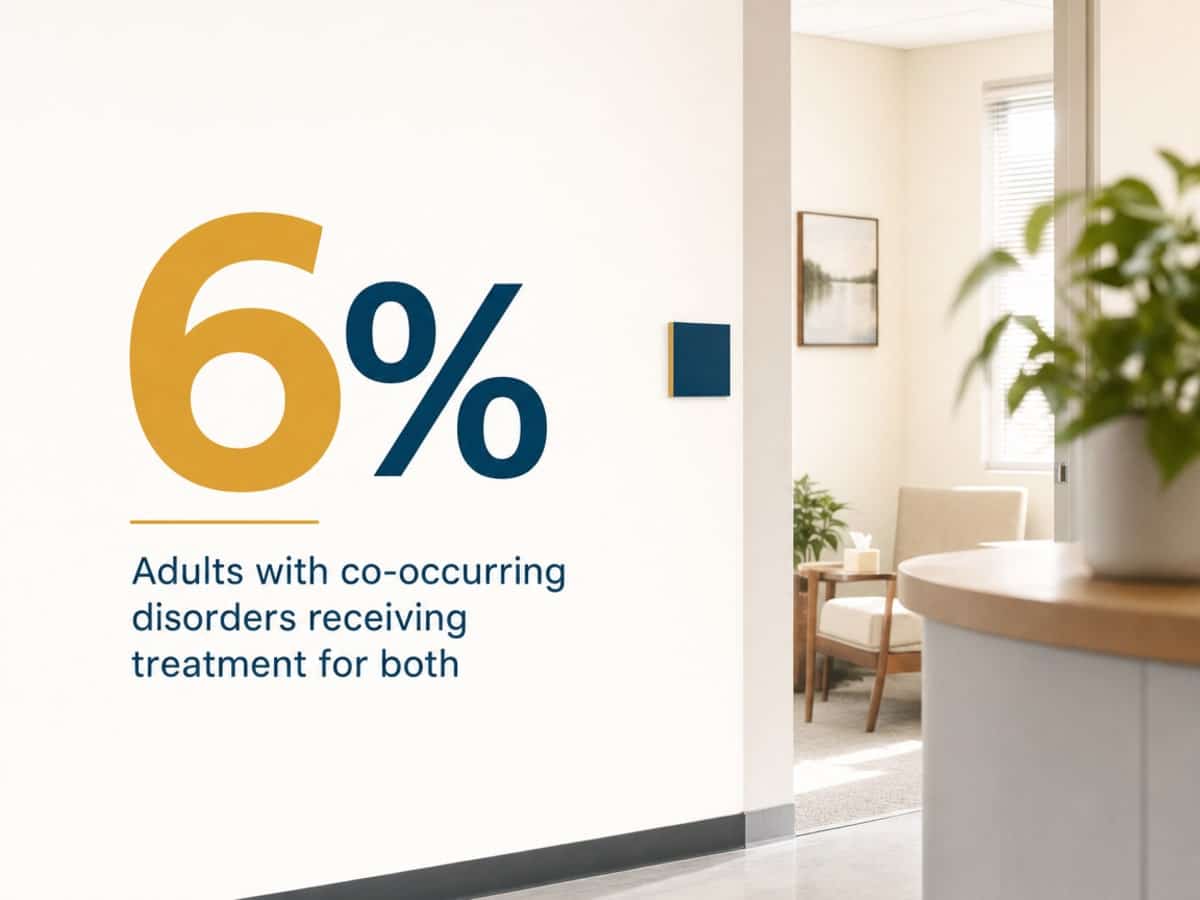
If finding a program that actually treats both your OCD and your substance use under one roof has felt unreasonably hard, that’s not a perception problem on your end. It’s a system-level note worth saying out loud: only about 6% of U.S. adults with co-occurring mental illness and substance use disorders receive treatment for both conditions, according to the 2024 ASPE report on integrated care adoption 6. The other 94% get treatment for one side, the other side, or nothing.
That gap exists for reasons that have very little to do with whether integrated care works. Workforce shortages are part of it — clinicians trained to deliver ERP for OCD are scarce, clinicians trained in addiction medicine are scarce, and clinicians trained in both are scarcer still 6. Financing is the other piece. Mental health and substance use treatment have historically been billed, regulated, and reimbursed through separate channels, which makes it administratively easier for programs to specialize in one and refer out the other 6. The result is a lot of facilities that can credibly treat addiction, a smaller number that can credibly treat OCD, and a narrow slice that can do both at the depth the conditions actually require.
What this means for your search is practical. You may need to look beyond the program down the street. You may need to ask specific questions — covered in the next section — that get past the marketing copy. And if the first place you call can’t answer those questions cleanly, that’s information, not a verdict on whether help exists. The scarcity is real. So is the smaller set of programs doing this work well.
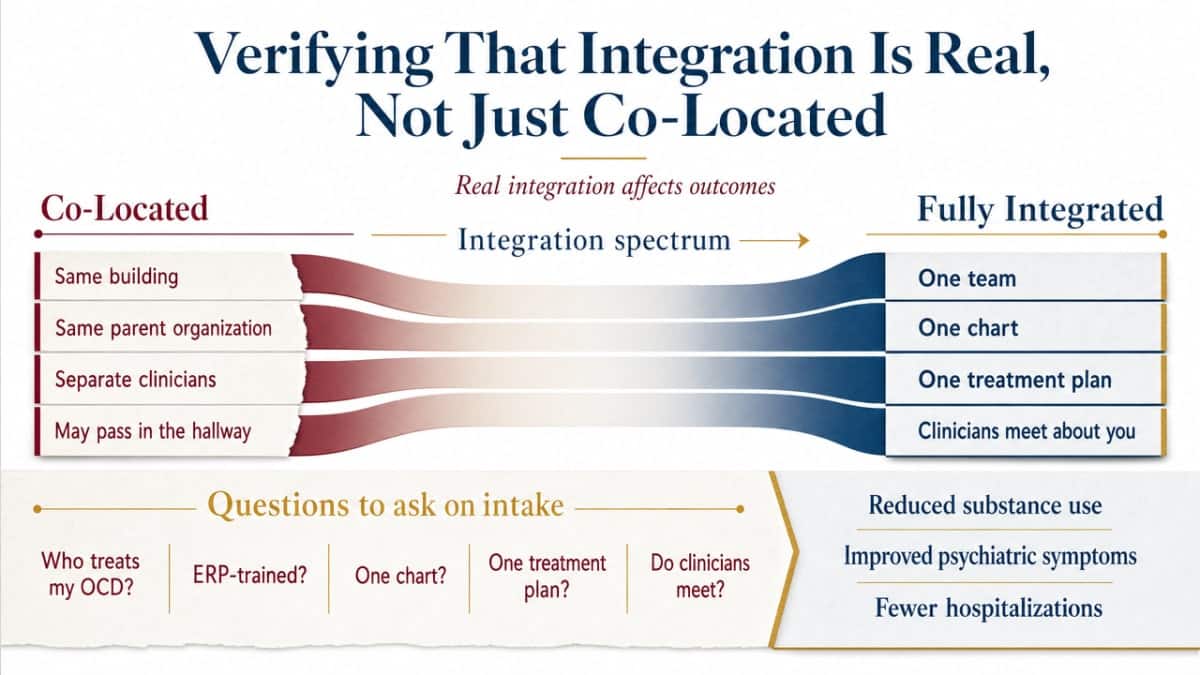
Verifying That Integration Is Real, Not Just Co-Located
Most programs that market themselves as integrated are actually co-located. That’s not the same thing, and the difference shows up in your outcomes. Co-located means OCD services and addiction services live in the same building, billed by the same parent organization, with clinicians who may pass each other in the hallway. Fully integrated means one team, one chart, one treatment plan, with clinicians who actually meet about you 8. SAMHSA distinguishes these models explicitly, and the outcomes evidence — reduced substance use, improved psychiatric symptoms, fewer hospitalizations — is tied to the integrated end of that spectrum, not the co-located one 8.
Here are the questions worth asking on an intake call, and what good answers sound like.
Who actually treats my OCD, and are they ERP-trained? Not CBT-trained generally. ERP specifically. If the answer is vague, or if the person on the phone has to check, that’s information 4. ERP is underutilized even in OCD-only settings, and a program treating addiction as its primary line of business may not staff for it at depth.
Will the clinician doing my ERP and the one handling my addiction work talk to each other, and how often? Weekly case conferences with a shared treatment plan is what integration looks like in practice 9. Separate progress notes that nobody reads across is what co-location looks like.
Is there one chart, or two? One chart, accessible to both sides of your care, is a structural marker that the program has built integration into how it operates rather than into how it markets 11.
How do you sequence ERP with relapse-prevention work? A program that can describe stage-based care — acute stabilization, then concurrent ERP and relapse prevention, then maintenance — is doing this on purpose 3. A program that can’t articulate sequencing is improvising.
What happens if I have a slip mid-treatment? Good answer: we adjust the plan and continue. Bad answer: we discharge to detox and restart. The second answer means ERP will keep getting deferred every time use returns, which is the opposite of integration 13.
If three or four of these answers come back thin, keep calling. The scarcity is real. So is the smaller set of programs that can answer cleanly.
What Progress Looks Like on Both Tracks
Progress in dual-diagnosis recovery rarely looks like the clean arc people picture before they’re in it. It looks like one track moving while the other holds still for a while, then switching. That’s not failure. That’s how this works.
On the OCD side, real progress is measurable. Time spent on rituals shrinks. You complete an exposure step you couldn’t have approached two months ago. The intrusive thought still lands, but the gap between thought and compulsion widens, and sometimes the compulsion doesn’t come at all. SSRIs continue doing quiet work in the background while ERP does the loud work 12.
On the addiction side, progress includes days sober, but also things that don’t show up on a calendar. Recognizing a craving as a craving instead of a verdict. Calling someone before using instead of after. Sitting through a high-risk situation that used to be automatic 5.
Some weeks one track moves and the other doesn’t. Completing an ERP hierarchy step while staying sober is real progress, even if your sleep is still wrecked and your mood is uneven. Both conditions are chronic. Both respond to treatment that holds them together 8. Keep going.
Talk Now About OCD and Addiction Solutions
Connect with a specialist who understands dual diagnosis challenges and next steps for integrated treatment.
Take the Next Step Toward Integrated Healing
Discuss your unique OCD and addiction challenges with someone who truly understands dual diagnosis care.
Frequently Asked Questions
Can I start ERP while I’m still using substances?
Active, heavy use of alcohol, benzodiazepines, or opioids will blunt the distress curve ERP depends on, so most clinicians stabilize acute use first 3. That said, comorbid SUD does not permanently disqualify you from ERP — it requires planning, not postponement 4. A program that says you have to be sober for months before any OCD work begins is deferring care, not sequencing it.
Which condition should be treated first, OCD or addiction?
Neither, in the way that question usually means. Stage-based care addresses acute substance use first — detox if needed — then runs ERP and relapse prevention concurrently under one team 3. The VA frames the underlying principle clearly for any psychiatric–SUD pair: having one disorder should not block evidence-based treatment for the other 13. Sequential treatment, where one waits indefinitely for the other, is what fails.
How do I tell if a treatment program is truly integrated or just co-located?
Ask whether there is one chart and one team, or two of each 11. Co-located programs share a building; integrated programs share a treatment plan, with clinicians who meet weekly about you 8. Also ask whether the OCD clinician is ERP-trained specifically, not just CBT-trained 4. If those answers are vague, the integration is likely marketing, not structure.
Can SSRIs for OCD be combined with medication-assisted treatment for addiction?
Yes, and for many people this combination is what makes recovery hold. SSRIs are a standard pharmacologic option for OCD, often paired with ERP 12. MAT — buprenorphine, methadone, or naltrexone — addresses opioid use disorder on its own track. A prescriber experienced in dual diagnosis manages interactions and dosing. Staying on MAT for months or years is not a failure of recovery; it is the floor underneath it.
Why did my OCD get worse after I got sober?
Because the substance was doing OCD work for you, badly but quickly. Once it’s gone, the obsessions return at full volume — and that surge is one reason relapse risk climbs when OCD is untreated alongside addiction 3. This is not a sign sobriety was the wrong call. It is a sign the OCD needs direct treatment now, ideally ERP with SSRI support, instead of being managed chemically 14.
Does integrated treatment guarantee better outcomes for substance use?
No, and any program that promises that is overselling. A 2023 multi-center study found integrated care improved psychiatric symptoms but showed no clear advantage over non-integrated care for substance use measures or retention 1. Integration reliably protects your OCD treatment and psychiatric trajectory. Substance-use gains depend on execution — MAT when indicated, stage-matched relapse prevention, and clinicians who actually coordinate 6. The label alone does not do the work.
References
- Integrated vs non-integrated treatment outcomes in dual diagnosis disorders: a multi-center study. https://pmc.ncbi.nlm.nih.gov/articles/PMC10157410/
- Substance Use Disorders in an Obsessive Compulsive Disorder Clinical Sample. https://pmc.ncbi.nlm.nih.gov/articles/PMC2705178/
- Treating OCD and SUD: Tools for Effective Treatment. https://www.kennesaw.edu/georgia-network/docs/mcgrath-presentation.pdf
- Exposure and Response Prevention in the Treatment of Obsessive-Compulsive Disorder: Current State and Future Directions. https://pmc.ncbi.nlm.nih.gov/articles/PMC6935308/
- Treatment for Substance Use Disorder With Co-Occurring Mental Illness. https://pmc.ncbi.nlm.nih.gov/articles/PMC6526999/
- Adoption of Integrated Care for People with Co-Occurring Mental Illness and Substance Use Disorder. https://aspe.hhs.gov/sites/default/files/documents/e2ccdd7991f1de5060983598cb66624f/adoption-integrated-care.pdf
- Co-Occurring Disorders and Other Health Conditions. https://www.samhsa.gov/substance-use/treatment/co-occurring-disorders
- Managing Life with Co-Occurring Disorders. https://www.samhsa.gov/mental-health/serious-mental-illness/co-occurring-disorders
- Integrated Treatment for Co-Occurring Disorders: Resource Materials. https://radarcart.boisestate.edu/library/files/2017/07/CoOccurringDisordersResourceMaterials1.pdf
- Integrated Treatment of Substance Use and Psychiatric Disorders. https://pmc.ncbi.nlm.nih.gov/articles/PMC3753025/
- Integrating Treatment for Co-Occurring Mental Health Conditions. https://pmc.ncbi.nlm.nih.gov/articles/PMC6799972/
- Obsessive-Compulsive Disorder (OCD). https://www.nimh.nih.gov/health/topics/obsessive-compulsive-disorder-ocd
- Treatment of Co-Occurring PTSD and Substance Use Disorder in VA. https://www.ptsd.va.gov/professional/treat/cooccurring/tx_sud_va.asp
- Exposure and response prevention for obsessive-compulsive disorder. https://pmc.ncbi.nlm.nih.gov/articles/PMC6343408/